
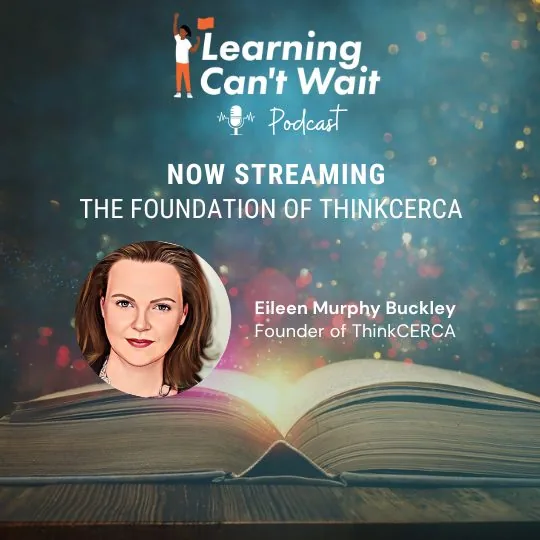
Learning Can’t Wait · Season 1, Episode 13
The Foundation of ThinkCERCA
 Hosted by Hayley Spira-Bauer, Chief Academic Officer at Fullmind
Listen now
The Foundation of ThinkCERCA
Episode summary
Eileen Murphy, founder and CEO of ThinkCERCA, describes learning to teach at Chicago's Whitney Young High School, helping found Walter Payton College Prep, and directing curriculum for 115 CPS schools as RTI, Common Core, and MAP assessments landed at once. Asking monolingual teachers to differentiate to ten levels was impossible, so she built a literacy platform around Socratic debate, close reading, and writing that frees teachers to give feedback. She discusses teacher shortages, reorganizing people, places, products, and time, guest-teacher playlists during COVID staffing gaps, widening literacy inequities, and argues education should be a constitutional right. Her advice: go to the kids; they'll help you.
Key takeaways
- Replacing teachers with technology has failed for 60 years; build tools that amplify teachers instead
- Debate and Socratic dialogue engage every kind of learner; literacy means reading, thinking, and writing
- Rethink people, places, products, and time so scarce teacher expertise goes to small groups
- Ready-made curriculum turns five minutes of prep into 20 minutes of student-driven learning
- Everyday survival now demands near-college literacy; education should be a constitutional right
About this episode
Eileen Murphy is the Founder of The Foundation of ThinkCERCA and a lifelong career educator. Eileen believes classrooms should be full of “happy noise,” and through that theory she's helped students improve their reading and writing skills with an impressive growth rate. Hayley Spira-Bauer interviews Eileen about the origin story of ThinkCERCA and how she’s gotten to where she is today, and where she’s going next.
Learning Can't Wait is brought to you by iTutor.com.
Full transcript
Transcript generated from the recording; minor errors may remain.
Welcome to the Learning Can't Wait podcast an iTutor production at iTutor. Our vision is to ensure every child has access to education regardless of circumstance each. We will be joined by Pathfinders within and around the education space who are bringing about transformational change. On behalf of deserving students, I am your host, Hayley Spau.
Welcome back to all of our listeners to today's podcast. I am so excited that we have a special guest today. Her name is Eileen Murphy. Hi Eileen. How are you? I'm good. Thanks for having me. We are so excited to have you today. You are both the founder and CEO of a learning tool that I know educators across the United States and maybe even the world embrace, called ThinkCERCA.
So are you international or just national? Did I, did I overemphasize your usage? , we, we, we definitely have some international partners. Yep. Yeah. International usage. ThinkCERCA. We're gonna dive into how ThinkCERCA was created in just a few moments, but I don't wanna get ahead of myself. As I told you, I call you an educator's educator, a true teacher from the very start, who has expanded their capacity to impact students all over the world.
Why don't you tell our audience, our listeners, why do you think I call you an educators educator? How did you get to be the founder and CEO of an organization like ThinkCERCA. Let's see. Well, first I started out as a Chicago public school teacher, and I went to an A University that was, Literally a few blocks away from Whitney Young High School, which is the, magnet high school that Michelle Obama went to.
That's kind of one of the reasons why it's pretty famous, but it's also a place where, you know, royalty from another country might come and visit a school. And at that time when I was teaching there, that was like the stop in Chicago, an amazing school, and many leaders have come out. And I sort of got really lucky because I asked if I could student teach there cuz it was very close to where I lived.
And they said, sure. Well the next thing you know I found myself actually getting a job there. And I was like, oh my God, whoever gave me this job should be fired . So unprepared as a teacher. I think everybody does. In your first year, you're just like, oh my God. If anybody find, I was say, I think that's a very common feeling.
I'm in, I'm in right now, a, a te, a first year teachers group on Facebook, and especially during this time of covid, these, the first year teachers feel just so under prepared for what stands before them. Yeah, so empathy on that front. I also felt under prepared, but, amazing. Totally amazing first entry into schools.
Yeah. Yeah. No, I was really, really lucky. I had no idea at the time. That, that was like an incredible career move because I was definitely given a lot of credit that wasn't necessarily deserved about being a great teacher, cuz I was at a great school and I had amazing students, but I did because I felt so under prepared, really spend a lot of time, you know, finding resources that could help me be a better teacher.
And so everything from the wonderful older teachers that I worked. To actually the textbooks and, and materials that were available in the building. And the kids, you know, I felt like they always, in many ways they were only like four years younger than me in, in a lot of cases, so they had no problem telling me what was working and what wasn't.
And so I really just kind of, you know, learned how to be a teacher at Whitney Young. Had an amazing experience there, and then left to work at Facing History and Ourselves, which was a professional organization, a professional learning organization focused on helping kids think about the moral choices they make every day, but really in the context of rigorous academic learning.
So we taught about history and literature and just sort of how in the moment you make a choice, and then it might have. For a lot of people over time, and so exploring different case studies in history where people made positive differences, negative differences, and that also really improved my ability to think about the practice of teaching and, and the best practices.
I took that. Then I had a really amazing opportunity to start a school with a small group of ama amazing educators called Walter Payton College Prep. And so just to give you a sense of how lucky I was and, and how unusual this situation was, but so my, the most of my career was spent at two of the very best high schools in the country.
So Walter Payton College Prep and, and Whitney Young are both in the top. Of Illinois. I always have been, and certainly in the top 10 of the US and in the case I believe of, of Payton right now. So, an amazing experience as an educator and had the time to really design a school and design best practices across a team and hire a team and work directly with the founding principal on making the school what it was.
And so those experiences led me then to becoming a district leader where, In Chicago Public Schools, I was able to be the director of curriculum and instruction for about 115 schools right around the time we were implementing RTI, which is sometimes called MTSS Today or AIS in certain places, but it's that that multi-tiered system of support.
We also implemented new standards, the Common Core, which definitely upped the rigor and the focus on close reading and academic writing. And then we also implemented a growth assessment, the NWEA MAP assessment. , we were throwing a whole lot at teachers at the same time. And in my , I'm not getting overwhelmed, just listening.
Right. Like you've named quite a few, like historically fundamental to how educators teach. There were changes mm-hmm. Based on some of the kind of overarching initiatives that came through. But how did it look? And, you know, I don't wanna stray us too far from getting us to how we, where you are today, but I think it's, it's relevant in talking.
You know, implementation of such broad principles for such a large school system. Yeah. How, how is that experience of, of adoption? . Well, let, let's just say that. I was like, this is not gonna work. We need technology. And I founded ThinkCERCA to, to solve the problems I was seeing. So number one, it's very hard to teach things that you yourself as a student even didn't learn.
And. . You know, like most school systems you might have, if you're lucky, three or four days in a year to do professional development. But the depth of expertise that was required to design the types of lessons that would help students meet those standards was there just wasn't enough time to retool a workforce that, you know, was 3 million.
Teachers. I had 10,000 teachers that I worked with in the, the group of schools within CPS, and that was just a group within CPS, there were 681 schools. We had 111 of them. So, When I thought about the challenges of scale and then personalized that to that one student who was sitting in a school in Englewood or you know, Chinatown, who was really struggling to attain grade level standards to go to college, et cetera, and, and that the intergenerational or intergenerational.
Poverty that was gonna continue if we didn't figure out a good solution to the problem. And so asking teachers who are mostly monolingual to differentiate to 10 levels, with maybe three new arrivals by February from three different countries and, you know, 10 or more IEPs in a classroom of 32 students.
It was impossible. It wasn't humanly doable. And so at the time, my sister was also in Chicago Public Schools and she was implementing a grant with iPads and showing me these amazing things teachers were doing with technology. And I was like, okay, that's it. If we're gonna really implement new standards and make sure there's equitable access to it, then it needs to come through technology, but not the kind of technology we were using at the time.
And I was gonna say the time. Yeah, exactly. You're, you're talking. Time when technology wasn't pervasive. Schools weren't one-to-one at the time. Right. And they also typically were using technology as teacher proofing. So it was, you know, the, the understanding that what needed to be done was hard, was there, butthey were trying to solve the problem of teachers versus trying to help solve teachers problem.
And really kids don't come to school to sit there and answer multiple choice questions. They come to school to see a teacher, they come to school to see their friends. And we were taking both of those two key motivators away from kids with the technology that we were using and like, you know, pre 2010.
So I was like, okay, we have to actually just enable teachers to be a force amplifier for teachers, not. Place them. And so that's what we built. We built a technology that would work to enable teachers, but also to enable students. And of course, the other key thing that we knew in implementing any school-wide strategy that was gonna have impact on a larger scale, it had to be a tool that worked also for instructional leaders.
We couldn't have something. You know, there were like 35,000 different programs the kids were answering questions on and have no clue what was happening at an aggregate level for that group. So ThinkCERCA provides a literacy platform. It gives everybody a common language for talking about those skills.
And then because we have all the ready made resources at 10 levels and a shared platform with analytics, it gives everybody on the team insight. Is what you're doing, which you like. We know you're working so hard to do, is it working or not? And if it's not, can we adjust it to make it work better? I mean, that's really the thinking human job, and that's who we enable.
Yeah. And a, as I'm listening to you speak, and, and I appreciate you sharing, like what led you to edu, what led you through education to ThinkCERCA? It really becomes obvious for me. And I think right hindsight is 2020, that there was a theme throughout your career that really strong content helped enable yourself and other teachers mm-hmm.
To enact and move students forward. And with the addition of technology, it catapulted forward much of what you were trying to. Yeah, exactly. Because at the end of the day, you can't practice mean idea all year. , number one, it's, it's boring and it takes about five minutes for most kids to understand what you're talking about.
But applying that skill requires that the student is actually mentally engaged in whatever they're trying to apply it to. And so the content is king at the end of the day. I'm having flashbacks right now, by the way. I was having flashbacks to being a brand new teacher and being told like, you have to teach main idea and taking like 40 texts and one worksheet that looked the same every time and telling kids, okay, now find the main idea for this.
Now find the main idea. Like, yeah, it, it did nothing to move my kids forward. So, so for those folks that are non-educators, right? That are not an educators educator like yourself, Eileen, talk us through a little. What pedagogy looks like ThinkCERCA, and now with ThinkCERCA and why your team felt it's so important to actually build a more engaging, interactive option for students and teachers.
Yeah. So I would say that that pedagogy, if you think of it like, you know, the evolution thing where it's like, you know, when we see that image of, of evolution, you know, of any process. I think we went from, you know, teachers as experts who had textbooks and then. , then we tried like the, again, replace the teachers with technology and the real evolution that we were trying to get to.
But that is, you know, the, the real human evolution of education is that it's social. And so our pedagogy is all about making the academic work social, and so, , we kind of went back to, I mean, Aristotle, like old school. What was he doing? It was Socratic dialogue. It was debate, it was, you know, people really thinking about ideas worth thinking about, and usually those don't have answers.
So for. For example, like should, what, what, what should the rule be around creating AI in today's world? Should we, and, you know, regulate that so that we don't create situations that are gonna have negative impact on some people. , et cetera. That's like a really important question that we have to struggle with.
And the only way we can do that is by engaging as many perspectives as possible and making sure that everybody who's having that debate is well qualified to argue. And you can ask anybody, and I'm sure you know as a teacher, there is nothing. More engaging to a group of, of people, not just kids, but any age group.
If you give somebody a debate, there are gonna be the people who are quieter, who just wanna listen and absorb and construct knowledge. There are gonna be the people who are just wanting to win, and then there are gonna be people who go. And then there are gonna be people who go, okay, I don't agree with you, but I am much smarter now about the other points of view and even my own point of view because I've engaged in this process with you and I.
Ideally, we wanna make sure that kids play all of those roles at some point, point. Absolutely. In their experiences. So that's our pedagogy. It's just a six we process. It's patented and that's, yeah. So sorry, say it's, it's patented. Sorry, I didn't mean to cut. Yeah, no, it's, it's just a six step process that we bring students through where we've done all of the cognitive chunking with the topics that we've created and, and the design instructionally of what they do with the product brings them through that process of, of engaging in close reading, and then ultimately a piece of writing.
That's sort of the core experience, but, as as an implementation model. We don't have kids sitting in cubicles by themselves doing it. We actually have it in a classroom or even on Zoom, where kids are interacting with each other and the teacher is actually spending their time doing things that they never have time to do if they're standing in front of the class lecturing, which is giving kids feedback.
And so there's nothing more powerful than that real time feedback from a teacher who, in the words of, of any teacher I've ever known, I knew what he meant to say. . A teacher knows what a kid meant to say. Mm-hmm. . But unless they have that shoulder to shoulder time with a teacher to help them say it in writing, they are never gonna get there.
And when we think about the world today and what you need to be successful in, in this time, , try being successful in life without being able to search Google and consume complex information. Think about it critically and express yourself effectively in writing on an email. If you can't do that, the chances of you doing anything in your career or you know in school, or even in your personal life or civic life are pretty limited.
It's very disempowering not to have that. Yeah. And I think you're speaking to the way a lot of movement in education is going, which is to prepare kids, not just for college, not just for the next grade. Mm-hmm. , but for life. Yeah. It's funny you're talking about debate and, and I am a bonafide Lincoln Douglas High School debater.
Like I love. Debate in high school. I am, I am the daughter of an attorney and probably pretty combative myself some days, but I think that you're right. There's, there's a lot about the progress, the process that speaks to skills I use today that I don't think I've ever applied or realized that I was using, which I garnered from the.
Experience of LD, it wasn't very common. LD being an abbreviation for Lincoln Douglas, debate for the Nerds. The people that are listening that are not totally nerdy and know what LD is, . But you know, I'm, I'm wondering just like at a broader level, right, like how do you think schools have advanced or regressed in regards to their approach to education during covid?
Just like put yourself in a, that's a great question. Airplane level. Looking down, what do you think has happened lately? I think, I think that maybe what we don't talk about enough is the triumph of what's happened that. Number one, teachers have, have come to teach and, and principals have come to make sure that it was possible to learn and, and that includes everything from serving fish sticks themselves or subbing superintendents, subbing in a kindergarten or whatever it is.
So I think, you know, the fact that educators. Who already had really tough jobs, have arrived at work, and have kept schools opened and reopened them. Time and again is amazing. So I hope that speaks to, number one, the importance of education for everybody and how critical it is for our, our society to function.
I think the, the other flip side is that there's also a tremendous shortage of teachers that existed before, but as older teachers continue to retire and that. Quite a huge percentage of our teaching force. I think that it's also changed the availability of skilled qualified teachers. I, I know that there are many communities across the country who today do not have substitute teachers to keep schools open because teachers are sick and out and, they can't get some of the retired teaching force that used to be the substitute teachers to come back in knowing that there are health risks.
So I think one of the things that changed during Covid was, The whole country should appreciate educators more than ever, but number two, they should also be very worried about making sure we have more of them in our pipeline for the future. And third, I think, because we can't guarantee that right now it is.
Really challenging, but I do think that we have to think about different instructional models where the delivery of instruction is supported more effectively and not entirely skilled teacher dependent without removing. Teachers from this picture, and that's the puzzle to solve because again, we've tried many times over the past 60 years to replace teachers with, you know, TVs, with computers, with all these other things.
It doesn't work. We've proved that throughout evolution, it does not work. So how do we make the job doable? How do we make sure there's equity of access to opportunity and excellence for every kid? And how do we use technology to the extent. It can be useful without replacing the human experience we come together for, because that's critical for the level of literacy we're talking about.
You just can't do it with multiple choice. You can't do it with just computers. Even if there's advanced ai, which we are developing to give feedback on writing, there is a human component to learning how to think and communicate that can't go. And I think that the temptation will be there for people to go, let's just, you know, do remote learning and let's just com, you know, make everything tech-based, et cetera, and, and we can't go there, but we also can't go to the place where we don't have skilled teachers and jobs that are actually doable.
So how do we make that work? You're hitting on how do, how do we make it work in a schedule? Yeah. You're hitting on a theme that I have heard time and time again in my conversations with folks in and around education. , which is of course the teacher shortage and mm-hmm. Deciding as a society what we want education to look like moving forward.
Mm-hmm. And how that vision for education supports uplifting the field of education and, and being a teacher, one of the biggest problems is that, While you, you named earlier that during the pandemic educators have arrived at work every day and kept schools open. As a society, we've essentially relied on our teaching force to provide childcare during a pandemic.
Mm-hmm. And teachers are so much more than childcare. Teachers are social workers and custodial staff, and instructional providers and mentors and friends and allies, and the list goes on and on. . So how do we give teachers what they need so they can remain in the profession, do what they do best, while also still moving the needle for kids?
It is a daunting, yeah. Tall order. Yes, it is a tall order and daunting. But the other thing that's, thank God it happened now and not a hundred years ago. And that's, or well, maybe we didn't even have that level of access to public education a hundred years ago, but I. . What's really exciting is that the innovation that exists today and what's possible today with technology does open up opportunities that are unprecedented, just as un unprecedented, probably as the problem that we have at hand.
And in many ways it's tactical things like, you know, some of the organized schedules within a school, the way buildings are laid out in the capacity for students to. You know, opportunities for learning that are self, you know, that are driven by them and not necessarily all teacher directed. I think if we really think about the people.
We also have to think about the places and the products and the time. Those are like kind of the four components or levers that we have no matter what. Everybody has people, everybody has, you know, some access to products. Everybody's got some space to work with and some time to work with. How do we make all of those work and put the right processes?
Maybe there's four P's entity, but put the right processes in place so that you know people can do their thing and be engaged and have some autonomy, but also make sure that there's really good ways for people to have visibility into is this working or not? And optimize it. I. As a tech company, we, we do that all the time.
We put a dashboard behind anything that we say we're gonna try to do to see if we're making progress toward that goal. I think that some of the technology now exists for us to do that with Continuum of Learning and you know, also just like kind of time on task. You know, how much effort are people putting into things that really aren't a great use of their.
And how can we shift that to some other place? Those are some of the questions that I think really bringing some, some innovative ideas to some of those time and place, questions is probably the place I would recommend we begin. Absolutely. There's some of it that have constraints, right? I I, there's only a certain number of hours in the day.
There's only a certain amount of money in the budget. Mm-hmm. There's only a certain number of teachers available. Everything has constraints, so it's, I I really like what you're naming as like a four pronged approach to improving the student experience and the educator experience. , there's, there's, our society is at a pretty pivotal moment and, and looking more creatively at how we tackle problems in order to.
Benefit every stakeholder is of the, of the utmost importance and just something that a lot of smart people are thinking about in separate spaces and probably need to come together to talk about more. Yeah, definitely. Because I, you know, at least in my 30 years in education,have never seen a problem that if you give it to the teachers and the kids, that can't be solved
I think it's a design process where, you know, if we, if we know what the problem. , we're gonna be able to find a solution. And I think maybe breaking it down into more actionable problems is actually one of those steps. I, I just talked to the principal, the other day, who is the leader of a school that's in the Middle Schools to Watch national, you know, list of schools that have done amazing things.
She has. , 95% of her students qualify for free and reduced lunch. She has the whole team aligned in collaborating around literacy. She has amazing growth in literacy and math as a result. And when I asked her, how are you doing this now during the pandemic, it was very simple things like she was, when there's low coverage in terms of subs and you know, sick teachers who are out, how is she still enabling?
teachers to have collaborative planning time and how is she still enabling teachers to go in and watch each other teach and then have a planning day the next day so they can go do the same lesson with their students later. And the way she's doing it is scheduling, just making those, those opportunities available and grouping students in different ways so that where, where there's.
Teacher expertise required. There's larger groups and where there's more expertise required, there's smaller groups in those time slots. And you know, it's, it's actually very tactical what we can do. And we can do it tomorrow if we decided, but I think we have to actually think about it in steps and not be so overwhelmed by how daunting the problem is.
I like that in the midst of talking about these really. Important themes of how we can enact change or giving a concrete example for our listeners to kind of clinging to mm-hmm. . And what I'm taking away from it is the moments where we really need that subject matter expertise is where the teacher has to be the present for the focus force with small groups to support the students.
Mm-hmm. Empowered, but let's reimagine those other moments where it is less. Necessary to have a subject matter expert at the table targeting every individual student. Mm-hmm. . And I think that that's really powerful. . Yeah. I mean, I think that, you know, in every other industry, you know, we're, we're always thinking in, in the tech world for example, you know, it's, it's all about innovation, which is doing more with fewer resources.
And when we think about that precious human time, that is like kind of what you have to build around is what are those things that we have to have skilled teachers and students together collaborating for and for everything else. Can we reorganize our schedule and our spaces to do it differently? So we are, for example, providing curriculum that is ready to go.
So five minutes of prep can give you 20 minutes of learning time. In some cases, we've got stuff that 30 minutes of prep will give you 250 minutes of learning time that students can drive independently and collaboratively, not isolated in cubicles, but in a collaborative classroom. And so we're saying, look, , let us break down the standards, find the text, create the lessons, create the learning design, and you then can spend your time building relationships with students and giving feedback and making sure collaboration is happening.
So that's an example of where instead of a teacher doing everything from top to bottom, we're providing it. And right now, frankly, because of the way schools are operating with guest teacher, , whether they're actually experienced substitute teachers or, truly community members who are just there to keep the school open.
we're creating guest teacher accounts so that we can provide playlists for students with highly engaging in current readings and other activities that students can do so that even, you know, making sure that the relevant to students today topics are in front of them, and that the critical literacy skills are being developed regardless of whether or.
You know this, this awesome teacher that they would normally have is available to lead that work. These are some of the things that we can do to at least mitigate. So your team's been busy? Yeah. Yeah. We're, we really try to just put ourselves in the shoes of a principal who's going to bed at night with a bunch of techs saying, my staff isn't there.
And, waking up to figuring out the jigsaw puzzle to make the building work the next day. And of course, the teacher who is dealing with just the really extreme amount of insecurity and just distrust and, and just general anxiety that kids are feeling right now because they've had three years of very difficult, you know, situations.
It's been a big chunk of their life. Percentage. You. Oh, I, believe me, I know I have a, a student who said to a child, I should say he's not a student, he's my child who said to me yesterday, mom, I am not gonna go to school on my birthday. And I said, well, what makes you think that? And he said, well, I didn't go to school last year.
My birthday, I go, Right, because you, you weren't in school. We, we took you out for safety reasons, and we took you out of school . And he goes, oh, I just thought there was no school on my birthday. I thought it was a national holiday. . I told him he could write to the president and, and, and, he could ask for it to a national holiday.
So that's our, that's our weekend project is to write to the president. That's our ask. His birthday becomes a national holiday. But in all seriousness, you know, he's a child's. Right, exactly. He's a child who, his whole experience with school has like formal school Yeah. Is limited to this. Very fragmented, not near his peer separated experience because of Covid and Yeah.
He is not alone. He is not alone. . It is a shared, it's a national, an international shared experience. Over the past, almost two years of interrupted, kind of confusing learning experie. . Yeah. Yeah. And in and in school year times, that's, it's three years of school years, you know, so two calendar years, but you know, 24 months really crossed over three school years.
So there hasn't been, you know, there certainly are. I don't think mass, you know, as a, as a country, most have not, most countries have not held back students. We've continued to promote to grade level where students are, and that's creating, you know, obviously a lot of, a lack of confidence that students have because oftentimes they're working with grade level materials for which they really haven't developed.
Maybe the background knowledge or, or have enough practice rehearsing before they get there. So it's creating an enormous amount of insecurity around their own ability to learn things. And obviously insecurity for teachers who might be asked to teach skills that they've never had to teach before, so they're not as experienced and familiar.
You know, a third grade teacher who is teaching phonics to an absolute non-reader who is now in third grade, but kind of missed, you know, first and second grade. And then of course students who were already behind in a given grade level being promoted to two. Had without having had those hours of practice and those hours of that, that exposure, it's really challenging for teachers who are like, oh, wow, I have to teach this amendment.
I, I would've assumed that you had already, and it just isn't necessarily the case. Not for lack of trying. Yeah. It's, it's recalibration of experience and what's expected. I was talking a few months ago to someone about, about how. Because it is a shared experience and, and it is impacting different communities differently.
Right. Let, let's name that for a second. Yep. High, higher income, more resource accessible communities have had the type of support they need to continue progressing forward. So yeah, they, they may not be seeing the same gaps. I think McKinsey just published another study that said there's a four month gap in, higher resource white communities versus under.
name mostly black communities, having a six month gap mm-hmm. Right now. Mm-hmm. . And so yeah, that is important to note as well, that yet again, we're seeing the disparities widen and become even more challenging for com for communities that are under-resourced and those teachers having to again, shoulder the burden and, and really.
Think critically about how they meet the needs of all the various types of learners in their classroom environments. Yeah, exactly. I think that is again, where technology can help. You know, we, we provide things like visual vocabulary for third grade materials so that students who, you know, again, even the every.
Kind of vocabulary that you might take for granted. And the kids know maybe verbally, they certainly have like an awareness of the experience in their real life and have concrete reference in the world to understand that word. But they may not have seen it in print before. And so, you know, when you think about some of the challenges that students have just in terms of lack of, of text time, in the print to, to sound correspondence and things like that.
These are really hard. And then when you get into English learners or what I call ALLs, sometimes we're all academic language learners, you get into a whole other level of, of difficulty with acquiring those, those literacy skills. And so you. Again, our literacy demands on, on the everyday person's life.
Just to buy food, go to the doctor, get to a school, you know, navigate, self-checkout, those kinds of things. The literacy demands that people have in their everyday survival are much higher. So to say it's too hard of a problem to solve is, is. An answer, we have to solve the problem because this is not a nice to have.
Or like, oh, college isn't for everyone. Kind of a, a mentality that we would've had 20 years ago. This is like everyday survival actually is for everyone. , and the level of literacy that they need is much higher. It's probably more like what college? Literacy skills were like in, you know, in 1960. So we can't take it for granted and we have to make it work.
And so that's where thankfully we have technology. We have, you know, in many ways I think have opened the out of necessity we have. The mother of invention, I think, opened the opportunity to have a discussion. How we organize time and space in a school, how we use products to do jobs that other people might have done in the past, you know, so that the human time can be redeployed to the things that only humans can do and that a machine really can never do, and that's sitting shoulder to shoulder with you to help you, right?
It's, it's, you know, telling you, I understand what you meant. Let's see if we can make this clear. It is saying, Hey, it doesn't matter if you gotta be, plus where you came from is amazing and you should be proud of that. It's the the kind of emotional support that great teachers are able to give. That's, that's the stuff we can never take away.
So, technology can't do that no matter how good it is with badging, it's, it's really the human touch that we need to protect and, and, and again, just make it a doable job that people wanna do. . Yeah, absolutely. And, and you know, I wanna go back to one point you said, which is that it's not a nice to have, it's a must have.
This is a question I asked a lot of the podcast guests. So if you had the ability to have the, the nice to have thing, the dream mm-hmm. , to transform education, what would you, what would you do? How would you transform education with the, with the kind of like wave of a magic wand? I guess I would, I would try to treat,
You know, I mean, to be honest, I, I would try to treat it like a destiny as opposed to a goal. And you know, I think that that. For most people, high educational attainment is, is is almost treated like a privilege rather than a right. And I think today, if we could, and this is like super radical, but right now we don't have an amendment in the constitution that guarantees your right to education.
And I think a lot of things would change if we as a country decided that that was an inalienable. That you had. I think a lot of the policy and funding that would make a big impact on equity and education would change if we actually made it a right . And, and again, it's a little bit, you know, as we're, we're in the middle of debate around voter protection, et cetera, at the core of that is, is sort of the state and federal.
But when we look at other countries that have done exceedingly well in terms of improving educational outcomes and the esteem allocated to teachers and the funding allocated to teachers, there is a national ownership of education and we've struggled with that as a country and often depended on philanthropy to fill in and their, there simply aren't enough people or enough of their philanthropy to solve a problem that is really.
National critical problem, and honestly, I don't think most people outside of education really understand the gravity of what we're about to be faced with. With 30% of teachers retiring and a pipeline that is at 4% versus 20% annually in terms of. Students signing up to be teachers and, you know, sort of funding crises that will occur over the next couple of years as, as their funding goes away, we really have to decide are we gonna educate our country or are we going to let each state fend for itself?
Are we gonna let each family fend for itself or are we gonna say, no, this is like clean water, , you know, food security. These are things that we have to work on. As a country and make sure that we guarantee or our country will, will fall behind other countries that are doing that. Eileen, that is really profound and somewhat mind blowing when you think about the fact that this is your magic wish is to make education an inalienable, right?
That is a little bit of a mind bender, I'm sure for a lot of the listeners here today. . I'm glad, I'm glad we're talking about this though, because it's, it's when policy meets practice that we really start to see mm-hmm. The dis or when policy doesn't meet practice, maybe . Mm-hmm. That we start to see like where the major gaps are and where we are as, as a nation misalign with the values we ex, we, purport to uphold.
Yeah. I mean, and, and again, I think it, it's sort of like part of the, part of the problem is, is that this story is relatively untold. Everyone experienced this tremendous pain over the past two years. Anyone with kids and anyone in a community where the kids being out of school brought the community to a, a grinding halt realizes the importance of education in a very firsthand way.
But I think that they're waiting for the pandemic to end. And in waiting for the pandemic ending to be the solution. I think there's, there's, that would be nice. That it would be nice if it all just happened. The problem. Yeah. That, that, that made the problem visible. It wasn't the cause of the problem.
No. And so many of the problems existed previously. To your point of it being visible, they're just magnified today. By, yeah. First of all, a public attention to what's happening in education and mm-hmm. A, a widening or expanding, I should say, of some of the, the issues you've named, right? Like the pipeline being one of them.
Yeah. So I'm, I'm really, I'm grateful that you're naming it, and I think for those listening that are not as close to education as Eileen, Eileen and myself are. These are real problems that aren't, like if you've seen the movie, don't look up, right? Like, the people are warning, they're raising the flag.
Like, this is a problem. Yes. Let's not ignore it. Like, please look up. Please look up at this. Mm-hmm. . Yeah. No, I, I did watch that movie over the winter break and I was, I was grateful for the commentary because yeah, it is one of those don't look up situations and you know, it, it really, I, my husband always calls me Our Lady of Sorrows because I, I have a tendency to like be able to rattle off like major problems, but I, I will just say that despite like the grim outlook I just painted, I think again, as.
Continue to evolve as a democracy and, and continue to worry about ensuring its future that, you know, education rights are right up there with, with other things that we need to be paying attention to and focused on. Because at the end of the day, an educated and humane citizenry and technology really are the solution to, to not just, you know, this problem of education.
But to really, I mean, education is the lever that really opens up the opportunity to release the innovation that exists in our society that's untapped. Because people don't have that access to education that that gives us the next, you know, the, the person who cures cancer gives us the person who brings us to Mars or whatever it might be.
They're out there right now and we just need to make sure that their pathway is cleared. I love. . So Eileen, as a closing thought, I've really appreciated what you're sharing, but as a closing thought, I would love to hear what advice would you start or would you give an educator at the start of their career?
My advice is go to the kids, they'll help you.the, the kids are so much less hampered by what's not possible, and so when educators are having trouble figuring out how to do their jobs, well, I would say trust that if you ask the kids, they'll help you. Help them enable. And I owe whatever scrap of talent or skill that I developed as a teacher early on in my career to the kids at Whitney Young High School, who really just taught me how to be a teacher along with the wonderful, women who were very near retirement.
When I started there, but I really feel like if we, if we trust this next generation of kids to help us figure out these problems and give them the tools to, you know, I, our tagline as a company is to spark courageous thinking. Just trust them and follow their lead. They will help us figure this out. And they're, they're much better at it in so many ways because they're not hampered by what's not possible.
They're yes people in the best. Oh my goodness. I think students, I think your message to teachers about students is such a true one, and it's actually a perspective I haven't heard thus far in our podcast recordings. And I really am grateful for your kind of veterans and respect of children and how much you really believe, and I think you're, you're speaking to this point, how much you believe students can.
Help us all find the path forward. This is, this should be a process that involves them rather than divorces them from it. Yeah, exactly. Exactly. All right. Well, I am so grateful for all of our listeners for tuning in today to hear about Eileen Murphy and how she became the founder and CEO of ThinkCERCA.
But more than that, how she earned the title of, of Being a True Educator's Educator. Eileen, thank you so much for coming today and sharing your wisdom with everybody listening and with. Well, thank you so much for having me. I really appreciate the opportunity and hope. Hope there's some good ideas that get sparked from our conversation today.
I am certain that there are. Thank you again to everyone for joining us and we'll talk to you again soon.
Thanks for listening to the Learning Can't Wait podcast. If you liked what you heard, please rate, review, and share this episode. Be the first to know when we have a new episode by subscribing wherever you listen to podcasts. If you'd like to be a guest on the show or. Suggestion for an episode. Email us at podcast@itutor.com.