
Learning Can’t Wait · Episode 186
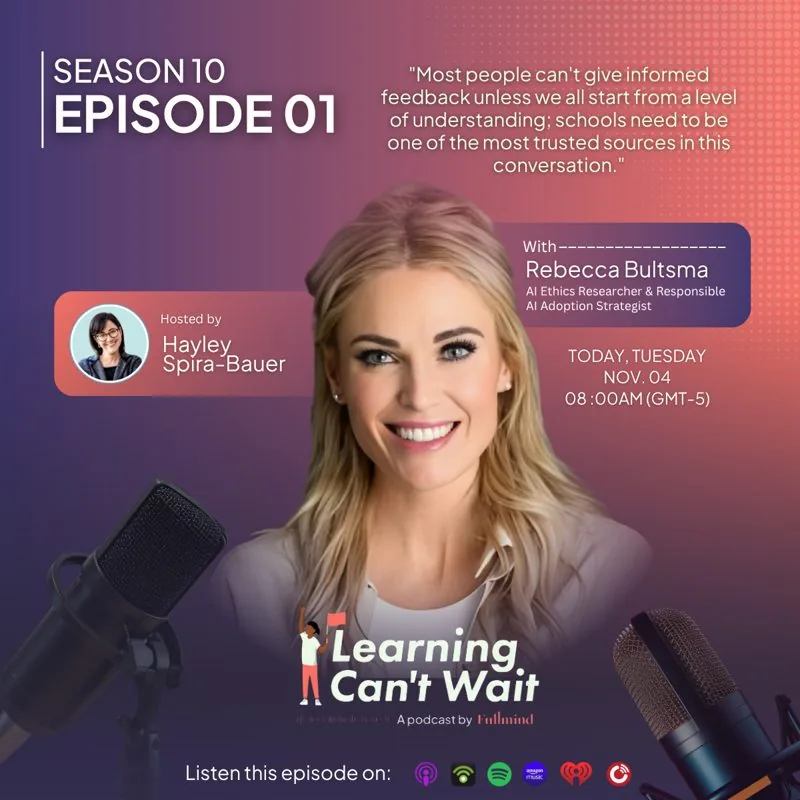
Rebecca Bultsma: AI ethics, AI in education & Deepfakes
- Rebecca Bultsma
 Hosted by Hayley Spira-Bauer, Chief Academic Officer at Fullmind
Listen now
Rebecca Bultsma: AI ethics, AI in education & Deepfakes
Episode summary
Rebecca Bultsma, an AI ethics researcher and K-12 adoption strategist, opens Season 10 by describing how a communications career led her to a master's program in AI ethics after ChatGPT's release. She explains her swing between excitement and concern, shares research on deepfakes and nudify apps marketed to teens, and warns that digital data will follow students for life. She advises policymakers to co-create through appreciative inquiry and build trust by being transparent about AI use, argues AI literacy rests on ethics and digital literacy taught early, and tells teachers to start in their personal lives, keep accounts separate, and involve students in setting the rules.
Key takeaways
- Effective communication, not computer science, is the core skill for working with AI
- Deepfake and nudify tools are easy for teens to find; a fake nude of a student must be treated as real harm
- Co-create AI policy through appreciative inquiry and explain why and how you use AI to keep trust
- Teach ethics, truth, and digital literacy early; AI literacy grows from those foundations
- Sort concerns into what you can't fix, can influence, and can control; it's okay to be a beginner
About this episode
Rebecca Boltsma, an AI ethics researcher and K-12 strategist, shares her journey from a communications background to becoming deeply immersed in AI ethics driven by her fascination with ChatGPT. She discusses the cognitive dissonance she experiences between excitement for AI's potential and concern over its ethical challenges, particularly in education and society. Rebecca highlights the importance of curiosity, inquiry, and co-creating policies around AI, focusing on transparency and trust-building in schools. She emphasizes teaching ethical values through modeling and conversation rather than direct AI literacy at an early age. Rebecca advises educators to personally explore AI tools first and engage students in open dialogue about responsible AI use while acknowledging the need for parent advocacy and learning.
Full transcript
Transcript generated from the recording; minor errors may remain.
Hayley Spira-Bauer: Welcome back, everybody, and welcome to Season 10 of the Learning Can't Wait podcast. Today's guest has become a dear friend, but is someone whom I admire very deeply, and whose writing and sharing, as of late, has me on my toes, and I know you're going to see why in just a second. I want you all to welcome with me Rebecca Bultsma, an AI ethics researcher and an adoption strategist in K-12. Rebecca, welcome! Rebeccabultsma: I'm so happy to see you! If I can never see you in person, because I can't be in New York all the time, it's nice to see you here. You know, I always appreciate the roving band of passionate educators I get to connect with on the road, but if I can't, like you said, it's… at least I have video. Rebeccabultsma: Or a massive group chat, right? What are those? I don't know what you're talking about. As our friends listen in, they're probably like, Hayley, Rebecca. Rebeccabultsma: I absolutely do not have notifications turned off on the group chat. Well, the good news is that because you are kicking off Season 10, and Season 9 just ended, your episode is being recorded mere days before release. And, you know, with AI, I feel like I have to do that. Rebeccabultsma: because… the world is changing so rapidly, so thank you for getting this in under the wire so that it could be fresh content for Season 10 Kickoff. Rebeccabultsma: Oh, my pleasure. I love fresh content, especially when it comes to AI. You never know what's gonna happen between now and release, right? Now watch, I'll have to put a disclaimer on this episode, because we said this, I'll have to be like, since Rebecca and I last spoke, the following has happened. Rebeccabultsma: Yeah, GPT-6! Just kidding. Rebeccabultsma: Don't worry. Well, Rebecca, you know, I… I said, you keep me on my toes, you have me thinking constantly. Let's start us off by having you tell everyone, how did you get here? How did you come to be the personal and professional version of yourself? Rebeccabultsma: Honestly, it's the weirdest thing that has ever happened to me. I… I still think about it all the time when people ask me this, because my background is communications and marketing and public relations, specifically in K-12. Rebeccabultsma: And nothing technology-related, nothing curriculum, necessarily. Rebeccabultsma: related, I just, as the day ChatGPT came out, I was immediately transfixed. It was like one of those slow-motion moments happening before your eyes where I knew this was gonna change everything. I knew it in my bones down to my core. Rebeccabultsma: And I started using it, and I just naturally was really, really good at it. I think because you completely control it with effective communication, and that has always been my passion. Rebeccabultsma: It's figuring out how to be effective in how you ask questions, or how you communicate requests, and how you give people information. And it ended up really translating well over to… rebeccabultsma: working with AI. So, the more I worked with it and experimented with it, which was easier back then, because there was only ChatGPT and it did only a few things, I started to realize there were a lot of rebeccabultsma: questions I had, and concerns, and… rebeccabultsma: problems that I was seeing, and nobody could really answer any of those questions I had, especially because most of the people who really understood the technology were computer science people, and we didn't speak the same language. I didn't necessarily understand transformer architecture. I needed someone to explain it in regular language. Rebeccabultsma: So, in the absence of answers to my questions, I found rebeccabultsma: one school that I could find that actually offered a master's program in artificial intelligence ethics. Rebeccabultsma: And I registered for it immediately a couple of years ago, and it's in Scotland, which means my classes are usually at 1 in the morning, sometimes 8-hour classes in the middle of the night, but it's been fascinating to still experiment with the technology, which I do every day. Every new tool that comes out, I learn how to maximize it, so I'm in this… rebeccabultsma: this is cool, camp, and then I also live in this research-based, here's all the ways this can go horribly wrong, and we need to be talking about these things, and I just swing wildly between the two on a regular basis, so… I… That feels tiring, hearing that, like, the swinging wildly between the two, but I understand exactly what you mean, you know? Like, I understand the plight of having this information, being thrilled about it, and uncovering or even anticipating the long-term implications on our K-12 learners, but also our society. Rebeccabultsma: Yeah, it's this space of, like, cognitive dissonance, for sure, where there's all these really cool, helpful things it can do, but then questions about what it's all gonna mean for students, teachers, the system, the world. I… the rate at which my computer is… Upgrading software lately feels like twice a week. Rebeccabultsma: Okay. That's super inconvenient. Okay, so you were talking. Rebeccabultsma: Just start again. No, all good. We'll just say that again. You were talking about the pendulum swing, and how you go from deep excitement to a sudden shift to concern as you anticipate what this technology, what the implications are on our K-12 space, but also on society as a whole. Rebeccabultsma: Yeah, it's just cognitive dissonance all the time, but I think it's important. I'm just a curious person, so people ask me all the time, isn't it depressing to do all this? And… rebeccabultsma: I wouldn't say that. I think it's useful, and I like knowing, and I like being curious, and I like helping other people be curious and ask important questions, because I think that's how we can collectively solve these problems, if we kind of are all curious about solutions together. Curiosity is definitely my most valued attribute that I want my children to have. Like, I want them to wonder about the world, I think that's how you develop empathy for other people. You know, talk to me a little bit about what does a degree in AI ethics mean? Like, what are you studying? How does it apply? I think it feels somewhat foreign if you're not deeply embedded, I'm sure. Rebeccabultsma: Yeah, it's actually been really, really interesting. It's very interdisciplinary, and so some of the courses we've done have been related to… like, I had to learn stuff about coding, which I hated, but also it helped me understand how bias gets into models and why that happens. Mmm. Rebeccabultsma: a lot about governance and laws, and democracy and the impact that AI's gonna have on those things, which has been useful as I help schools write policies around AI. And then I get a lot of electives, so I take a lot of things related to education. I just finished one about learning and resilience. Rebeccabultsma: And another about relationality in education, and that human-centeredness in education, why it matters, how AI might change those things, and has us thinking about how to keep things student-centered. Rebeccabultsma: And then looking a lot at, like, the history of technology changes and the impacts they've had on society, and how we don't repeat the same things over and over and over, and then how we work with other disciplines from, like, wildly different disciplines to be able to solve problems. That is so deep, but also, I'm glad people are doing this, right? Like, I need there to be more programs that are offered in this discipline. You know, when I was in college, I went to the University of Pennsylvania, and there was a bioethics program at the university, and it's one of the few U.S.-based schools that has this bioethics program. It's very renowned, and it was by far the most fascinating work that I did. Because, you know, we talk about medical advancement and all the components that go with helping keep people alive longer and living high quality of lives, but those come with implications. And so, to think about that field existing within emerging technologies feels also so relevant, and I have a feeling that the more you tell me about this, the more I'm going to want to start studying it, too. But you do give a really good insight and glimpse into what's going on in your brain, and probably what you're learning in these courses. On your LinkedIn Talk a little bit about what's happening there and why you think you've reached such virality as it relates to your musings and your curiosity on various parts of this ecosphere. Rebeccabultsma:I think I just, from day one, decided I was just gonna try and learn in public.rebeccabultsma: And I did. I make sense of things through writing, because my background is very humanities-based. Rebeccabultsma: And so I just write about what I think and what I'm learning, and sometimes it resonates with people, sometimes it doesn't. It is more lately because I'm raising concerns that other people also have, or things that people might not have been aware of that are actually kind of scary. So, kind of fringe stuff sometimes, but… rebeccabultsma: Again, that idea of sharing curiosity and bringing awareness. Rebeccabultsma: Without trying to always be… not be the doom and gloom girl is hard, but I think… rebeccabultsma: awareness is the goal, right? To just ask questions and get other people curious as well. Okay, so what has you fearful right now? Rebeccabultsma: Oh, man. Lots of things. Lately, I've been preparing to, like, give a session at a, leaders, education leaders. Rebeccabultsma: conference in Tennessee, and one of the sessions I'm giving is about deepfakes. Rebeccabultsma: In education, and I kind of went down a rabbit hole last week, where I… rebeccabultsma: pretended to be, like, as if I was, like, a 16-year-old kid trying to find apps, and… rebeccabultsma: tools to help me make new deepfakes. And I found more than I ever wanted to know about. I found out it was super easy to be able to, access these things. Kids are being rebeccabultsma: advertised directly to on LinkedIn, not on LinkedIn, on Instagram, targeted with some of these things, and Discord is where a lot of this is happening. And I also have kind of learned that there's rebeccabultsma: a difference, if you will, this was pointed out to me very kindly by an organization that I mentioned, between these rebeccabultsma: AI, like, nudify apps where kids still can. Rebeccabultsma: Go in and create the… rebeccabultsma: sexy AI companion of their dreams that's hyper-realistic, and the age verification is really just a checkbox for them to do this. Rebeccabultsma: And the difference between that and organizations that let you actually upload a picture of somebody and put their face on another body, or integrate them into a video, those kind of deepfakes, but… rebeccabultsma: None of them are great. I was just gonna say, okay, like, as a mom of two boys, I'm listening to this, and I'm like, I actually don't care. Rebeccabultsma: Yeah. The implications are very similar here. Rebeccabultsma: Right, so I just think that's not great, and I have empathy for school leaders who are trying to deal with this, because. There's the two sides, right? There's been cases where school leaders and teachers have been deepfaked. Rebeccabultsma: and things go out, or go viral, that has their face and their voice, that's not them, but also they're trying to police this in their schools. And I was talking to someone right before this, and we both kind of agreed. Rebeccabultsma: if something comes across your desk that is a student deepfake, like, it doesn't really matter if it's real or a deepfake? It's still, like, a nude image of a student, an underage student, and it needs to be addressed, and it's hugely problematic, however it came to be, but it is something that rebeccabultsma: Is a wicked problem that we're dealing with as a byproduct of this quickly developing and widely accessible technology right now. I, like, have to take a pause here because, you know. We have… we had forewarning about where this was going and how this was evolving as… as the imagery technology started to improve. But hearing it in the real concrete sense of being a teacher and receiving an image of your student, an underage child, or, you know, being a parent and dealing with the ramifications of a deepfake being sent around of your own child is terrifying. Rebeccabultsma: You know, there's something… actually, one of the most interesting things I've read recently is a report that's put out by a group called Policy Horizons, and where I am in Canada, they actually advise the government of Canada, and they are foresight and forecasting groups, so their job is to think of all the ways things can possibly go wrong. Rebeccabultsma: and write about it so that the government could potentially be prepared. And they released, rebeccabultsma: a report specifically about AI futures, and one of the things they mentioned in there as a big, huge risk that's likely rebeccabultsma: To happen, that is happening, is that rebeccabultsma: digital data, digital images, digital stuff we collect about students, even through EdTech, will follow them for the rest of their lives, and I think that includes rebeccabultsma: things like deepfakes, right? Those are gonna be around forever. All of this data that we're collecting on kids that's being tracked about them, how does that impact their lives down the road? And I think just those are important things, depressing, but important things to be thinking about, and when we talk about responsible AI, responsible adoption, and we make decisions about rebeccabultsma: What we're doing next. You know, Rebecca, you are talking about policy, and you're also talking about… regulations at the school level. Let's go from big to small and start with policy. If you are crafting policy right now for a national government or a state government. Government body, what… what would you advise? How would you… tell them, and I know you do help do this, so what do you advise? Rebeccabultsma: Hmm. Rebeccabultsma: sometimes, like, my advice isn't necessarily, like, the most efficient, but I really feel strongly, because my background is, like, public relations and communication. Rebeccabultsma: that it really needs to be, number one, like a co-creation process that you have to bring everybody along with. A process I really like is called appreciative inquiry, which means everyone gets together and thinks, what do we love about our world, our school, how things are working? What's going well? Like, let's be positive. If everything goes right, what does that look like? Rebeccabultsma: What are the best things we want to keep? Really positive focus and building a positive vision of the future, and then mapping towards how we get there, instead of, let's just make all the do-nots. Rebeccabultsma: And so I think that's important, but I also feel strongly people can't give informed feedback unless we're all on, like, some sort of level of understanding. So you can't ask parents what they think an AI policy should be if they don't understand anything about AI. And so I think it's important that we kind of learn together. Rebeccabultsma: to and include people, but also make sure people have the opportunity to give, like, informed ideas. So, as a really long way to answer your question, I would say rebeccabultsma: Make it a conversation. Help people understand the implications. Build towards, like, a positive future instead of… rebeccabultsma: necessarily, like, not the, how do we stop this? How do we stop this? How do we stop this? And keep it, like, an ongoing conversation that's, like, front and center all the time, because I think, especially with schools, this was something else in the foresight report from Policy Horizons, is that rebeccabultsma: people are not gonna trust anything. Ever. Ever again, right? They're gonna have a handful of very, very trusted online sites that will be their go-to's. Rebeccabultsma: And I think schools need to be one of those sites, and one of those very, very trusted institutions. And I think that happens when we are constantly talking to parents and saying, hey, this is a problem we just realized with AI, this is something that's happening, reminding you that these are our goals. Rebeccabultsma: Collectively, how do we, work towards this future? What do we need to do? Let's keep talking about this, or here's why we made this decision. There's actually some really fascinating… I'm a huge nerd. I should have led with that, but… I mean, me too, so you're in good company! Rebeccabultsma: There's a really fascinating, some research that came out about a month ago, and it talked about how people don't trust AI, and if they find out you use AI, they don't trust you. Unless you pair it with what they call legitimacy, which is saying, yes, we used AI, but for these reasons, and we use it in these ways. And being clear about the why and the how, and then maybe why it's useful for you. Rebeccabultsma: So for schools to be like, yes, we're using AI, but it's because of these things, and these are ways we think it might be helpful, let's talk about it, then those things build trust in an ecosystem where people aren't going to trust a lot of things. That is really helpful. I talk about the ways I use AI openly at work, but I'm realizing that maybe I don't use it as, like, for my public persona, I don't always talk about the way I'm using it as clearly, so that's helpful for me to think about. So, bringing it back to the school level, I'm actually going to tweak what I was planning to ask you here, but, I just went to the Begin Early Learning Summit, and the last panel that I observed was about AI. And there were some really brilliant folks from Common Sense Media and a couple other different outlets that were talking about how we integrate AI literacy into early childhood. I don't know how much thought you've given to this particular age frame. I'm gonna tell you my favorite anecdote, and then I'd love to know what you would add to it. And I think that this is true of so many things we say about early childhood. Very much about modeling. You're modeling so much of what you do. And I think that one… one piece that really stuck out to me was, you know, a lot of homes have Alexas, and have these devices that you can speak to, and really, like, noting, like, oh, is that a real person, or is that a computer? And, like, for little kids, just modeling, oh, it's a computer! Which means she's, like, using all this information and giving it to us, but… does that mean it's always right? Like, how do we know? And, like, just modeling that cognitive process that we talk about in later years. Like, you know, chat gives out… there's hallucinations, we have to verify, we have to look at the source information. Okay, so that was what stuck with me, was modeling it when you're using these everyday tools that already are doing aggregate of information and using LLMs to compile the data that they share. I'm curious what you would say for the early childhood space. Rebeccabultsma: It's tricky, right? But… rebeccabultsma: A friend of mine, Pat Yongpradit, works with Code.org, and we were speaking together at an event a couple weeks ago, and he showed a diagram that has really stuck with me, and I'll actually share it with you, so you can link it in the show notes. Rebeccabultsma: And he was talking about AI literacy and how it's kind of this invisible thing in the middle. It's really made up of a lot of different elements, and I think if we teach those elements, they naturally lend itself. As you mentioned, modeling. Talking about things like ethics and truth. Rebeccabultsma: General digital literacy, like. Rebeccabultsma: general digital literacy will apply, and if you… kids understand those principles, I don't know that… rebeccabultsma: we need to be specifically teaching AI literacy. There's almost just these elements all around the peripheries that if we do those things well about, like, be a good person, give credit where credit's due, don't… rebeccabultsma: use things in this way, right? Like, don't take things that don't belong to you. Those core philosophy, computer science, democracy, like, all of those things that we already teach. Rebeccabultsma: and taking opportunities, like you said, to model and take those back to a place where you can show, here is how this might apply to AI. But I think really instilling those deep values and understandings in kids at a young age, instead of actually rebeccabultsma: giving them, you know, straight access to AI, or calling it AI. I don't even think we'll be calling it AI, necessarily, in 15 years. It reminds me of when we used to call it, like. Rebeccabultsma: the net, or, you know, cyber, you know, all of these things, but I think it's almost like a peripheral. It's in the center, but it's made up of lots of different elements, and so I don't know if it's its own thing, necessarily. I think exactly what you said, modeling lots of rebeccabultsma: Good behavior around technology and life and being a good human is probably our best defense for our kids. That's such a valid point. I follow Pat as well on various channels, and I've listened to him speak numerous times, and I really appreciate that mindset. We need to center ethics! Like, it's such a valid point about just teaching our kids to be good people, and then you can apply those principles to AI. I, you know, I, as a parent, don't think I've heard one mention of my kid's own school AI policies, or how they're approaching it with my children. And the other day, my brother, which was really unlike him, sent me this, like, AI-generated video that turned him into a superhero for my sons. And they were like, what is this? Rebeccabultsma: Sora 2. Yeah, they had… my boys had no idea, and I talked to them about tools, I've shown them how I use ChatGPT, I've shown them how they can use it ethically to use it. Use your favorite word. But I'm just, like, realizing as we're chatting right here that they haven't. Now I kind of want to ask them, what are you doing? How are you integrating the conversation? I mean, this is… it… I mean, many of his friends already have phones. My oldest one, he doesn't, but a lot of them probably have access to some of the elements we're talking about. Like, are you advising any parent organizations right now? Like, how… now… or what advice would you tell me? How should I approach this with the school? Rebeccabultsma: I think this is a huge missing piece of this conversation. I think there's a lot of conversation around, oh, we have to help teachers with AI, we have to help students with AI. No one's… someone needs to mobilize, and I was just talking to a friend about this, whatever the equivalent is of, like. Rebeccabultsma: MADD, or mothers, you know, parents' advocacy groups around AI, and helping parents understand this, because a lot of us, and I'm probably older than you, Hayley, but, like. Rebeccabultsma: there was no social media, I didn't even have an email account until college, so I didn't have a curriculum that ever taught me about digital literacy, and that's true for a lot of parents and people older than us, and so they have no idea what's going on. And so, we need to bring everybody along for that conversation, but… rebeccabultsma: it's tricky, and especially in schools, right? Like, I don't know if we should be giving kids access to AI tools until way later. It's embedded into a lot of what they do, sure. Correct, correct. Rebeccabultsma: But they still need to understand about it, and that it exists, and how to use it responsibly, because as you mentioned, if you have a phone, you have access to it. Things like Sora 2, that video that I'm assuming. Yes. Rebeccabultsma: your brother made was probably made with this latest and greatest AI video generator that OpenAI came out with a few weeks ago. Rebeccabultsma: And they're gonna see things like that, so they need to be prepared for those what is real, what is not real conversations. But with that said, I do know, as, like, a mom of, like, 4 big kids. Rebeccabultsma: kids are pretty smart about technology, like, they know better than we do what's AI, what's not. They're friends, and they talk about it, but they're not immune, but they're not also not stupid, right? Like, they know, but it's just a matter of us then teaching them rebeccabultsma: what's appropriate and not, and that probably needs to be happening at school, at least conversations around it, and maybe it is. It just all takes a long time for curriculum and policy and things like that to catch up. So maybe, yeah, parents just saying. Rebeccabultsma: Hey, like, have any of your friends talked about this? Are you using this? How are you using it? Show me! Teach me! And taking those opportunities to figure out what they do know, and how they use it, and what they think about it. Rebeccabultsma: is good, but then I think we also need to… rebeccabultsma: come up with some way, and maybe the schools start doing this, like, offering opportunities for parents to learn some of the great things I've seen done. There was a school in El Segundo, California. Rebeccabultsma: And they had student AI club that actually ran an open house rebeccabultsma: And they taught all the parents about all the different things about AI. Wow. Rebeccabultsma: went, and it was kind of community building and helping the parents understand and giving the students leadership opportunities. And I thought that was really great. That is awesome. I love student-led learning, especially for families. Like, when you have a student-run report card session where a kid is reporting out on their progress over the year, that… nothing gets to my heart better than that. That is amazing. Okay, I've been a little dark, and I know you said you don't want to be seen as a pessimist, so I'm gonna ask you now, like, what has you most excited? What has you, like, on the edge of your seat? Like, this is such a cool advancement, what applications Could we use it for? Rebeccabultsma: There's… I just think everything is so cool. Every day, I just think, what a time to be alive. Rebeccabultsma: the worst technology we're ever gonna use, and it's amazing. There's just so many cool things out there. Rebeccabultsma: right now, I use all the different tools, like ChatGPT, Google Gemini. The Google Gemini image generator is phenomenal right now. It's the best out there. It's called Nano Banana, it's right in Google Gemini. I love Claude, and rebeccabultsma: if people who are listening to this are sort of new, there's basically, like, 4 big AI tools that are most common. Large language models, there's ChatGPT, there's Claude, there's Google Gemini, and then there's one called, Grok that's kind of built into the X. Rebeccabultsma: formerly Twitter platform. And they're all really good for different reasons, but they're all very powerful. They all have free versions and paid versions, and a lot of capabilities. And I like… rebeccabultsma: building different personalities within those to challenge my thinking. My favorite way to use AI in general, and I tell people this all the time,I think using it to write stuff for you is the least interesting way to use it.I use it to challenge my thinking, and spot gaps in what I'm saying, and what I'm believing, and help me draw connections across things that might not have obvious connections. Rebeccabultsma: So, I like using it strategically in ways that are, like, what am I missing here? Or, in what ways… rebeccabultsma: do I have blind spots about this? That… rebeccabultsma: are making it so that I'm not seeing a full picture, or how can I develop empathy in this situation and see this from another point of view? Or ask me really hard questions to help me understand myself better in this situation. So. Rebeccabultsma: that's kind of what's interesting for me. I'm a verbal processor, but I'm also an introvert, which means I love talking things out, but I also… rebeccabultsma: or I'm not around other people a ton. Mmm. Rebeccabultsma: So, being able to talk things out verbally with these AI tools, I think, is amazing. NotebookLM continues to be what I think is one of the most amazing tools, if people haven't used it yet. Rebeccabultsma: Basically, I show lots of different ways to do it, but one of my favorites is I have a son who, you know, plays basketball in college. Rebeccabultsma: And he was struggling with, like, a financial accounting course. Well, we gave it his slide deck and the content, had it generate a podcast for him, using all basketball analogies to explain the concepts, and it made sense for him. I had another teacher I was working with who taught Old Testament at a Catholic school, and the kids were not into it. Rebeccabultsma: So she combined it with an Outer Banks movie trailer, and turned it into, like, a video podcast that made it so it's super engaging and explained things in a way that was super relevant for kids. And now you can do. It seemed like you made your own Hamilton, right? Like, people suddenly cared a lot about history of America once Hamilton came out, but now you're using tech to do it. Rebeccabultsma: Yeah. So in those ways, I think it's amazing, because in no universe could have I ever gotten my kid to care about financial accounting. Right. Rebeccabultsma: Right? So in those ways, the ways I learn about myself, or how I see the world, I just think it's a phenomenal tool, and the fact that it's readily available to everyone. Rebeccabultsma: in that sense, is amazing. It's cool, scary, cool, scary, like, for lots of reasons, but, it's just phenomenal technology. It really is. It's… it's sci-fi come to life, you know? I mean, you have me hype right now. I'm sure you have our listeners extremely hype right now, and I don't mean hype cycle hype, I mean… rebeccabultsma: Oh, I can hype it up. It's amazing. No, but I think you have to be healthily skeptical. I ju- I feel that way about everything in this world. Like, if anything doesn't… if you don't approach new, shiny objects with a healthy dose of skepticism, you're literally asking for, like, brainwashing and cult by, like, all the things that are bad. So, I appreciate that you and some of the other really brilliant folks I've gotten to interview on this podcast, approach it with such a unbiased, very balanced perspective. I have yet to interview someone that is, like, all in without bringing up some of the things they have on their mind or that they're concerned about. So, maybe I'm just very lucky, maybe, maybe we're doing a good job of approaching these exciting challenges, but I am always grateful that Brilliant folks like you, who are leading a lot of these conversations, are bringing… Both the joys and the problems to light. Rebeccabultsma: And I think that's most people. I think especially the people who are hesitant about even using AI, it's because they have valid concerns, and it's important for me to be like, yeah. No, totally. That is a problem. And I've had to, rather than just think about or list all these major problems. Rebeccabultsma: break it down in a way that makes sense for me, and that's kind of just organizing it into three buckets. Like, bucket one is, like, these big systemic problems that we can't fix, right? Like, we need to be aware of the fact that this is hard on the environment, that was trained on biased data. Like, these big problems, we can't fix them. Like, we just need to know they exist. Rebeccabultsma: But we also have, like, things that we can influence. Where can we influence? Well, maybe it's within our professional association, maybe it's on our staff, maybe it's in our classroom, we can influence how kids think about it, and then what we can directly control. And that's whether or not we fact-check, how we use it, how we use it responsibly, how we speak about it. Rebeccabultsma: The strategies we take for adoption, so just… that makes it a little more manageable. What can I control about this versus what can I maybe influence, and what do I just need to be aware of? And it becomes a little less overwhelming that way, because the deepfakes thing is huge. Rebeccabultsma: we can't fix that problem. We might be able to influence in our little parent circles by bringing awareness, and then we might, on an individual basis, be able to have those important conversations with our kids, but we can't fix the big problem, but there are still things we can do. So, let's get to that final question, then. What advice would you give a teacher who wants to start using AI in a productive manner? And we're gonna say that they're, like, in high school, right? So, grades 9 through 12. What advice would you give them to get started? Rebeccabultsma: The advice I would give would be to actually just start using it in your personal life first. Sign up for accounts at Claude, ChatGPT, Gemini, with your personal email. I think that's really important that people need to know. There's actually been cases of Freedom of Information requests. Rebeccabultsma: that actually are being granted on people's ChatGPT histories, right? If they're set up with their work account. So I would just say keep everything totally separate. Rebeccabultsma: And just start experimenting and figuring out where it's great and where it's not great, and start with things that you like and care about, because then you'll know where the limitations are. If I start talking to it about brain surgery, I won't know if it's right or not. But if I start using it, and that's how I learned. I just started being like, I wonder if AI can help me with this. Rebeccabultsma: And I talk to it. Once you get familiar and comfortable using it in your rebeccabultsma: personal life. Start dabbling in ways that you can use it professionally, and… rebeccabultsma: then also talk to your students openly about it. Are you guys using this? What should I know? Show me this. How could we use this in a way that would be useful in this classroom? And kind of that student-led conversation and learning, I'm finding that's going really, really well in a lot of classrooms, because rebeccabultsma: we're so used to going in and being like, nope, yes, nope, yes, this are the rules, I'm the teacher, and if this is… rebeccabultsma: more of, like, what should our rules be for this? If this is the assignment, how could we use AI to cheat on this? How could we improve this assignment? Maybe your assignment is to come up with a way to rewrite this assignment in a way that AI can't be used to complete it, right? And involve students in that process. Rebeccabultsma:But I think most people just need to know it's okay to be a beginner.rebeccabultsma: there's this… moment, in learning. It's called aporia. It's… rebeccabultsma: this moment of disorientation where you realize everything you thought was true up until that point, you're stuck in a spot where you're like, I actually don't know the answer to this. I don't know what happens next. I'm stuck. Rebeccabultsma: And it happens in learning all the time, it happens to our learners, and it's our job as educators to guide learners through that aporia and out the other side. And I think we as educators, forget what it feels like to be in that place of uncertainty, and that's where most of us are right now, and so just living in the uncertainty and… rebeccabultsma: Really having our students help us navigate through it, and being comfortable in a space of discomfort, and remembering that our students live there every day. Rebeccabultsma: And… rebeccabultsma: Just kind of soaking that in and taking the opportunity to grow and learn through something unfamiliar and uncomfortable. I love it. Rebecca, you are such a force. Thank you so much for coming on the Learning Can't Wait podcast and sharing your fear and joy, simultaneously with us today. Rebeccabultsma: Thank you for having me, I always love talking to you. And thank you to everybody for tuning in!