
Learning Can’t Wait · Episode 200
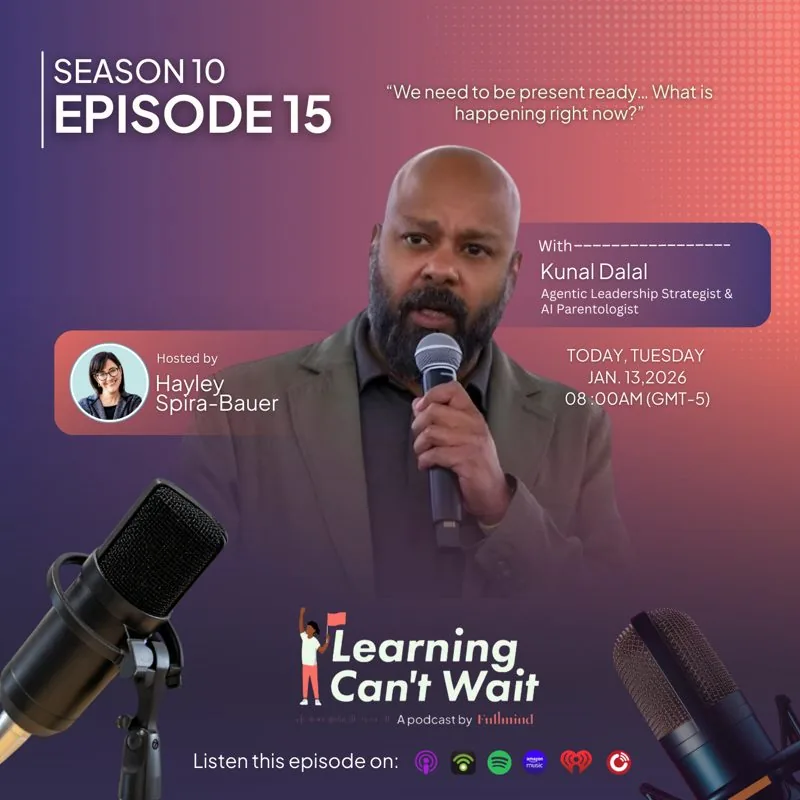
Kunal Dalal: AI parenting, Agentic AI & Present ready
- Kunal Dalal
 Hosted by Hayley Spira-Bauer, Chief Academic Officer at Fullmind
Listen now
Kunal Dalal: AI parenting, Agentic AI & Present ready
Episode summary
Kunal Dalal, Chief Parentologist at AI Parentology and a former teacher, principal, and startup founder, explains why parents must shape the AI era rather than defer to companies with monetary stakes. He reassures parents that fear and confusion are normal, shares how AI helps parents be present with homework and creative projects, and defines agentic AI as infrastructure where humans create and watch the loop. He describes the Agentic Education Framework and Super Leaders cohort, argues for being present ready instead of future ready, and offers two home practices: AI images of a child's dreams and shared daily storytelling.
Key takeaways
- It's okay for parents to feel scared or behind; there is no behind because there is no ahead
- Agentic AI means humans create, observe, and optimize the loop; AI becomes infrastructure, not a tool
- Schools can learn from agentic systems, like a shared memory every team member draws on
- Being future ready abdicates the future to someone else; be present ready instead
- Connect with kids through AI: dream images, shared daily stories, and links to ancient wisdom
About this episode
This episode of the Learning Can't Wait podcast features Kunal Dalal, Chief Parentologist at AI Parentology, exploring how generative AI can support parents emotionally and practically while reshaping education and leadership. He traces his path from teacher and principal to startup founder and AI parenting advocate, explaining how tools like ChatGPT can reduce parental stress, deepen connection with children, and inspire creative rituals like AI-generated dream journals. The conversation also unpacks agentic AI as “AI as infrastructure,” examines how schools and leaders might adopt agentic mindsets, and urges parents to slow down, focus on being “present ready” rather than “future ready,” and intentionally model joyful, human-centered uses of AI for their kids.
Full transcript
Transcript generated from the recording; minor errors may remain.
Hayley Spira-Bauer: Welcome back, everybody, to the Learning Can't Wait podcast. We have a big energy, big-brained, as my kids say, guest joining us here today, who is doing incredible work and doing incredible thought leadership in the space of AI. I'm thrilled to introduce you all to Kunal Dalal, the Chief Parentologist at AI Parentology. Kunal, welcome!
Kunal Dalal: What's up, Hayley? How you doing?
Hayley Spira-Bauer: I'm doing great! I am so thrilled to have you on the podcast today. I have a lot of questions that are just gonna help me better understand this space better, but also, I think, that are gonna help further the conversation that you're already having in many places and spaces.
Kunal Dalal: Yeah, yeah, yeah, I'm excited to have this conversation. You're one of my favorite people in the space, so let's.
Hayley Spira-Bauer: I… listen, that is a tall, tall honor to be considered in your… in your sphere and your orbit, and I honestly have to say that I'm finding the content and information you're putting out to be more meaningfully descriptive and more meaningfully… advancing the conversation than so many other voices right now, so I'm really excited to dive in, but first, I think that it's really important people understand how you got here. So why don't you tell us all, how did you come to be the personal and professional version of yourself, Kunal?
Kunal Dalal: Thank you, great question. I think, it's been a long journey for me. I started… when I was in high school, I used to tell myself, I'm going to become a teacher when I can afford it. What a terrible thing to say, right? But that's sort of the… that was kind.
Hayley Spira-Bauer: Wow!
Kunal Dalal: I know, that's kind of a crazy thing to say, but I remember, like, sitting in the hallway, going to chemistry class, being like, I'm gonna be a teacher when I can afford to be a teacher. But, it ended up that callings don't wait, and so, I, by the time I was 21, I was already working with, youth coming out of lockup, doing, getting high school curriculum, and… Then I became a classroom teacher, and then I was like, wait, this is… this isn't just a job, this is my calling, and in a way, this is sort of therapy for me. And so that's when I… I was a teacher, high school teacher, high school principal, assistant principal, all the things. I didn't actually get to the district office, before I left to start a headphone company. So I was a… founded a headphone company, did some edtech work as well, and that… that sort of took… that was sort of 20 years of my career, was teaching… Wow. School administration, and then starting my own startup, and then being in some startups. And then COVID happened, had my kids, and things sort of changed, obviously, as happens when you have kids. And having a kid right when COVID started. And… pretty soon after ChatGPT becoming public, things merged all at once. And I started to see pretty quickly the power that something like generative AI could have on parents who otherwise feel isolated, lonely, feel like they're the only ones going through what they're going through. And so then I wrote my first book, The AI Parent, back in March of 2023, and that was… like, it was basically a pamphlet, but it was just like, hey, look, this can help parenting. And I thought everyone would be so excited, and definitely it made the New York Times bestseller list… wait, hold on, hold on, sorry, I misread that. The New York Times worst seller list. Worst seller list. It made the New York Times worst seller list. But… How much has happened in the last few years? Now I'm actually running parent sessions at schools. I've done multiple parenting sessions and multiple conferences. I've had my stuff published, I've been in multiple publications like Forbes and Guardian and all that stuff. Because people are really understanding that this is, that AI isn't just about jobs, isn't just about work, isn't just about specific things, it's actually about life. Because it's about ourselves, right?
Hayley Spira-Bauer: Yeah.
Kunal Dalal: And so that's how I got into it, and that's… and I continue to live in that space of AI is about ourselves, about who we are, and every bit of what AI becomes is going to be a reflection of what we want it to become. And we as parents have to be front and center in that conversation, otherwise, it's going to be about those who have monetary stakes, not who have human stakes, and we have to have the people who have human stakes make these decisions.
Hayley Spira-Bauer: Wild to think that just two years ago, they weren't ready for the book, but now the environment's so ripe for this conversation. So, if you could encapsulate the message you're trying to share with parents, and, like, what they're ready to hear today, what would that be?
Kunal Dalal: I think first thing is, it is okay to be scared. There are a lot of parents who are so frightened, and nervous and, uncertain, and that's all… Correct. Like, we all… like, if you're not feeling that, then I don't know that you're paying attention. Because we don't know what's good for our kids in the future. How are our kids' future gonna look? Like, this is real visceral stuff. We're not talking about, like, what is Q4 gonna look like from a business? We're talking about the lives of our children, right? And so, this is very, very visceral stuff, and so the first thing is, it's okay to be confused. It's okay to feel behind. There is no really…there is no behind, because there is no ahead.And… and it's okay to ask questions, right? But I would also offer to parents that We are not gonna have another opportunity to shape what this AI world is gonna look like. We are in a transition period right now, and like all big transformations, it happens. And then it becomes really hard to undo. And so we are in a space where we are changing as a society, as a world. AI is going to be an integral part of what that means, not because of AI, but rather because we have spent 30, 40 years building an incredibly robust digital infrastructure that does a lot of work, and AI now happens to be able to port into that and do a lot of that work for us. Well, that's actually really cool for us. We did a lot of work to get AI to help us out here. So let's use that, and let's let AI do that. Because… If we don't, and instead we let AI kind of bleed over into our personal lives, then I'm worried we're gonna have social media 2.0, and this is gonna be way worse.
[05:00] **Hayley Spira-Bauer:** Yeah.
Kunal Dalal: Social media.
Hayley Spira-Bauer: The parallel with social media is the one that really gets me, because… it ran away from us. It got away from us faster than we could even think about trying to stop it or get ahead of it. And, you know, luckily my kids are too young for social media, although some of their peers have it. That's a whole other thing for a whole other time. But I know that this kind of, like, getting away from us situation is very possible. If we aren't attentive right now. You know, you're on the ground, you're saying you speak at conferences with parents, you're in schools with parents. They're fearful, they feel behind. What has parents excited on the flip side?
Kunal Dalal: Yeah, oh, great question. I think there are a lot of parents who are seeing themselves? A little bit freed. From some of the tedium that they have to do every day. And so, in that sense, they have been… like, parents are like, you know, one thing I've noticed is that I can now help my kids with their homework. Like, I can sit.
Hayley Spira-Bauer: Oh, yes!
Kunal Dalal: Right? Like, I can sit with them while they're doing their homework.
Hayley Spira-Bauer: Yes.
Kunal Dalal: And I can ask ChatGPT some questions, and then I can even… some parents are like, I can even ask ChatGPT, hey, this is what I do for work, how can I help with… how can I connect this to my work? And all of a sudden, parents are like, wait a moment, like, I… I… there's a… there's a way in which this can help me actually be more present with my kid, right?
Hayley Spira-Bauer: Yeah.
Kunal Dalal: In the conferences that I've done, I share the things that I do with my kid. I have 2 years now of dream journals from my kid. He's 6 now, so we've been doing this since he was 3. And almost every night, he tells me what his dream was when he has a dream, and we do an AI image of it, and now I have 2 years of images of his dreams. And I shared that with another parent, and the next day, that parent sent me images of him and his daughter on the piano doing other things that they had created, kind of of that same… through that same lens. And so, I think the connection that you can have with your kids.
Hayley Spira-Bauer: Hmm.
Kunal Dalal: Really exciting some parents, and so that's what I would offer, is, like, lean into that. Lean into the joy, lean into the creativity, lean into the wonder. None of us know what this is, and so let's all just figure this out together.
Hayley Spira-Bauer: I have a really funny anecdote about this. So, I, like, obviously lit up when you were starting to say, like, ask AI about homework, because I have a friend, hi Dr. Joe, she is a, like, preeminent… women's health psychiatrist at Brown University. She's super, super brilliant, and she has 3 boys, one of whom I think is… yeah, he's 13. The oldest is 13. And she doesn't know how to do his math homework, and so she used ChatGPT one day, and she immediately came to me, and she's like.
Kunal Dalal: Is that cheating? And I was like, well, hold on.
Hayley Spira-Bauer: No, it's actually not cheating, because she didn't… first of all, she didn't use the numbers that were provided in the question that he was given. She used other numbers to try and understand the process, and then re-explain it to him, and, like, look at it with him. And I was like, that is exactly how you should be using it, but, like. How funny that this, like, world-famous, brilliant doctor is second-guessing her use of AI with her own child at home. And how empowering, like, for.
Kunal Dalal: Yeah.
Hayley Spira-Bauer: For them as a family, you know?
Kunal Dalal: Right, right. And how empowering for me, right now, to hear that someone like that is struggling. Like, how good, right? Like, that should make every parent feel like, okay, it's okay to be lost in this, and it's okay to sort of just dabble and wonder. Great story, thank you for sharing that.
[10:00] **Hayley Spira-Bauer:** Yeah, of course. Okay, so there's a term that you use. That obviously I googled, and chatted, and clotted, and all the things, but I'm not sure I fully understand it at its, like, generalized use case the way it's… I see it in the media. What do we mean when we say agentic AI? What are we talking about? How is that different from, like, using an LLM the way we're describing right now? Talk us through it.
Kunal Dalal: Yeah, absolutely. Great. That's awesome. I love this conversation. So, agentic AI, I mean, the term itself has existed probably for a couple of years at this point. It probably existed before, but in this specific case around AI, probably a year or two old. But… the way in which agentic AI is different from, for example, agents and AI, because we can think agentic means… oh, agents. Yes, but that's not the whole story. So, when you think of an LLM, you think ChatGPT, okay, I need something done, right? Okay, I need an email done, or I need a brainstorm, whatever, right? So, I have an input, I go to the LLM, the LLM gives me an output, and then that's the conversation. Or I do it with other people, whatever it is. But the LLM sort of is the engine, right? But that engine is me input, me output. In an agentic system, and I'll give you the most basic, basic version of one, is like an email. Agentic system, right? Which is, With an email agentic system, you have a trigger, which is, say, it could be you, or it could be a clock, right? Where it's, like, every 2 hours, check my email, right? Boom, that trigger hits. Now, that… begins a process where A bot goes in, and goes into your… inbox, and LLM is actually gonna read all your emails. And then make a decision about whether or not that… which emails are pertinent, which emails are not pertinent, which emails are good, which emails are bad. You can even have your, agent, write an email, draft emails, whatever, and then it's gonna send you, say, a notification, say, hey, in the last hour you got two emails, one was, useful, and one was spam, and I've drafted a response for you. And you can just click, good response, send it. Done, right? So, you have an agent in there, which is your thing that's reading your emails. But the entire system is what we would call agentic, and what the difference between an agentic system is, is that we're no longer talking about human in the loop.We're actually talking about human creating the loop.and then observing the loop, and then optimizing the loop. And so AI is actually end-to-end doing everything, but you have to craft it in a way that you know it's gonna work, you know it's not gonna cause a bunch of problems, and you gotta watch it, at least for a good long while. And ideally, in the agentic system, you actually have another agent in there that watches and collects data and sends you information about when it's working and when it's not. And so, when we talk about agentic AI, we're really talking about infrastructure. AI as infrastructure, rather than AI as tool. And that, to me, is the easiest way to distinguish, is when you think of AI as ambient infrastructure. And we are the tools, versus we are the infrastructure and AI is the tool. When we switch that, then we start thinking agentically. I don't know if that makes sense or not.
Hayley Spira-Bauer: It does, and I, like, immediately know that example you gave was really clarifying for me specifically, and I can think about the multiple other Kind of systems and structures that are already existing. What about for schools? Are schools in a place where they're ready to talk about this type of agentic system, or are they… where are we? I mean, this is not a conversation I'm having on the regular, but you definitely are, so…
Kunal Dalal: Yeah, yeah, for sure, for sure. I'm actually having another conversation about this tomorrow, which is great, but, I think… It's complicated, because agentic AI is really systems like, humans building systems, and when you get to the more sophisticated part of Agentic AI, it's systems building systems. It's AI systems that you have designed to be able to help you build systems, and those systems don't necessarily need to be permanent. They can be quick, they can be ephemeral, they can last for just one interaction, because that's what you needed for that moment, and your agentic team kind of figured that out and figured… and did that. And so, in my mind. One of the… like, what I work on is what I call this Agentic Education Framework, which I've… which I've developed now, and it's part of the Super Leaders course that I started with superintendents. But what it is, is it's actually… what I'm doing is I'm actually taking the frame of agentic AI, the technical frame of it. And mapping it to actual human organizational functions. And so, rather than sort of boxing an agentic AI as a technical software tool. I'm wondering what agentic human organization looks like. So, what's happening, it's kind of weird and really cool, is I'm finding myself learning human stuff from… observing AI, which is really interesting, right? Because… AI and, like, for example, swarm intelligence, right? That's part of agentic AI.
[15:00] **Hayley Spira-Bauer:** Like, you couldn't.
Kunal Dalal: A swarm of agents, and each agent does different things, they all come together, but what makes a swarm work is that in the swarm of, say, eight agents, one of them is researching blah, one of them is building out a website, one of them is finding out, I don't know, colors for your web… I don't know, whatever. You would have, say, eight agents. But what makes them all work together is that everything they're doing, they're dumping into a common memory, so every agent knows what every other agent is doing. And they're constantly checking that memory to see what other agents are doing, so that they can… so that each agent can be doing their work better. And I'm like, why don't we do that as humans? Like, why is it that we as humans in an organizational setting, especially in a school setting. Where, why is it that we don't have a common repository of all of our stuff? That now, because we have AI, it's no longer difficult for us to locate information that we need, or be able to analyze information. We can have all of it there, and AI can help us figure that out. And so that's where I'm really leaning into, is less about agentic AI as sort of a thing to learn, but rather Agentic AI as a model for how we can just be better, at school administration, really, that's it.
Hayley Spira-Bauer: More effective, more efficient, better outcomes, all the things.
Kunal Dalal: Yeah, all the things…
Hayley Spira-Bauer: I can't even imagine if these tools existed when I was still in leadership in schools. I, like, truly. Well, I age myself, but it's been a decade since I've been in a school setting, directly.
Kunal Dalal: And it would be a very different ballgame to have access. It would be so weird, right?
Hayley Spira-Bauer: Okay, so you touched on the Super Leaders cohort, and I know some of the folks in your Super Leaders cohort, and let me say, they are super… what do you.
Kunal Dalal: Yes.
Hayley Spira-Bauer: There? Like, what do you… what is the goal of this Super Leaders cohort? Are they… and also, like, for the people that aren't familiar with the folks in it, are you talking to one side of the ecosystem or another, or are you, like, really spreading the range of all the types of people getting involved?
Kunal Dalal: Yeah, so… we had our first actual call meeting yesterday, last night, and it was brilliant. I think… what I'm trying to do in the Super Leaders Cohort, and for those of you listening or watching, like, superleaders.io, if you want to learn more there, but, what I'm really trying to do is this idea of agentic leadership, which is not, again, not about AI, necessarily. It's about learning from agentic systems how we can make human systems a little bit better. And so, what I'm doing is I have these 6 incredible lenders, like, I have… former superintendents, I have education leaders, I have healthcare CEOs, I have, I have healthcare HR VPs, I have… you know, Brian, who I don't know what you, like, an everything guy, right?
Hayley Spira-Bauer: We see you, Brian, we see you.
Kunal Dalal: Yeah, like the Swiss Army knife, right? But, like, but these… these are folks who are really, like, kind of top-of-their-game type folks, right? But in this new space. They are also in this place of, wait, hold on, like, I can do something different, right? There are a lot of leaders who don't want to hear that they have to do something. They figured it out, right? They are experts, and they don't need to hear anything else. But the folks I have in this cohort, I've chosen explicitly because they are, like, obsessed with growth. They're obsessed with, like, kind of reflecting on themselves, and obsessed with learning new things. And so, we're trying to figure out how some of them who work with superintendents, how can you bring this to A superintendent's office, and think, okay, how can we think agentically, as a district, or as a county, or even as a state? Yeah, and that's… it's a mix, and my hope is that it continues to be a mix, that we mix… I think there's a special, magic that happens when you bring in educational leaders and corporate leaders, and when you put those two things together, you get this… you get… And you get, like, the best of both worlds, and you get each of them, sort of. Questioning one another, and both of them leaving with, like, okay, am I caring about the right things? Am I pushing on the right things? And that kind of humility, that kind of learning, that kind of… that kind of stance, I hope that that's what we get in the Super Leaders cohort.
Hayley Spira-Bauer: I'm excited to see how that…
Kunal Dalal: How that shapes, because I imagine, too, that you'll discover use cases and ideas that you weren't even anticipating right now, which is the beauty of bringing really brilliant people together in the same room. That's the hope. My hope is, like, I'm not leading all the conversations. I want… I know that I'm going to be learning more from them than from me, so that's… that's what we're going for.
Hayley Spira-Bauer: Best spaces to be in.
Kunal Dalal: Yep. The best. Yes.
Hayley Spira-Bauer: You know, despite the fact that this is all moving really quickly, in some of your keynotes, you've spoken about slowing the moment down, rather than rushing for answers.
[20:00] **Kunal Dalal:** Yep.
Hayley Spira-Bauer: What does that mean to you?
Kunal Dalal: I mean, yeah, what does that mean? Especially when you look out the window, or you look at your phone, and it feels like… every day is, like, a year, you know? But I think slowing… Yeah, I think slowing down for me is… I mean, there's an incredible thinker, Bayo Akomolafe, who talks about, he has a book called Times Are Urgent, Let's All Slow Down. And it is… it's an… and I think that's the title of it, my apologies to Bayo if I said it wrong. But it is, it is an… it's… I think this moment requires us Like, speed is easy now. Deliberation is difficult. Quiet is difficult. We are in… we've been, sort of submerged in this hyper-competitive global capitalist ecosystem for so long, we don't know anything else other than rushing for the quickest way to get advantage. And that has caused our… so many people here to… are, like, losing their minds, trying to keep up with this and trying to figure out, what's next, what's next? How do I prepare for the future? Slow down, folks. Slow down. Like, we do not know what the future is. And this is what I call being present ready, and I talk about this in my keynotes, I talk about this in my sessions, but we talk so much about being future ready, and we don't know what the future is. And so, I thinksaying that we need to be future ready is actually abdicating responsibility to somebody else about the future.It's like I'm being.
Hayley Spira-Bauer: Whoa!
Kunal Dalal: I always…
Hayley Spira-Bauer: I love that!
Kunal Dalal: Yeah.
Hayley Spira-Bauer: Again.
Kunal Dalal: Like… I think that when you say, I need to be future ready. We need to be future ready, you're abdicating responsibility for the future to somebody else, right? Like, you are saying, it is someone else's future, I need to prep for it. No, no, no, no, this is our future. Like, we need to be present ready. What is today? What is happening right now? It doesn't mean you need to understand AI inside out. That… absolutely not. But you do need to understand yourself, and you do need to understand your community, you need to understand your family, you need to understand the people around you, and if you can understand that, then you can understand what is happening for you, and for the people you love, and the people that love you. And if that… if we can… if we can live there. Then I think we have a whole lot to look forward to in the future. But if we sit here and just talk about this kind of defensive posture of being future-ready. Then the people who have created the world that… the current digital world that we live in right now, they're going to continue to build out with AI the next version of this kind of techno-feudalist world that we live in right now. And if we want that, and if we love that, fine. I don't think… I don't know a lot of people that love it, outside of the people who… the shareholders of the big companies. I don't know who else loves it. And so I think we have a chance, and that's what I would ask. That's what I mean. Is slow down, let's be present, ready, and let's be really deliberate about what it means, for us and our families, in this crazy transition.
Hayley Spira-Bauer: Do you think that we have… we, the collective, have agency to address the current bias in our systems? Right? Like, I have a big concern about the speed at which things are moving, in part because the foundation of our LLMs that we're all basically building off of right now are foundations that are, like, very biased toward white, upper-middle class. You know, text-created content being fed in. So, how much control do you see us having on changing that for the future?
Kunal Dalal: I don't know how much control we have on the LLM side. I think we have 100% agency and control on what we do with it. And it's sort of the difference between, stopping the bully versus, being so resilient that police don't bother you, right? And I think… the LLMs. We're talking about ingesting Only written and digitized work, right? 99% of who we are as humans, I don't know if 99%, actually, I did a Google Deep Research thing, and I can't remember what the numbers were, but the vast majority of who we are is not recorded, is not written down, is not in digital form, and therefore is not in LLMs, right? The smile that we share when we see each other, when the call starts, that's not caught on an LLM.
Hayley Spira-Bauer: Hmm.
Kunal Dalal: Most of who we are as people, as organic, emotional, face, body, embodied humans. None of that is in LLMs. And so, what we are going to have with LLMs is always going to be some Some kind of fractional version of who we are, right?
[25:00] **Hayley Spira-Bauer:** Hmm.
Kunal Dalal: And it's always going to kind of bend toward the stories that are already documented, right? The stories that are already written down, but also those that are also then digitized. Because there are plenty of things written down that haven't been digitized, and those aren't going to make it into the LMs, right? And so, in that sense, I think Rather… for me, rather than try to fix it on the LLM side, I'm more… Stoked about how much we feel about ourselves, how much we learn about what we have digitized, what we have valued, what we have, you know, kind of determined to be worth writing down, versus… well, what don't we have here in the LLMs, right? I did a provocation in one of my sessions, a couple months ago, because it was a big conversation around, LLMs and… and… sorry, I don't know if you can hear the, Road paving outside happening, but…
Hayley Spira-Bauer: Not any louder than the alarm that went off a few minutes ago.
Kunal Dalal: Okay, okay, second time. We're good, we're good, we're good, we're good. But I think right now, it's like, if… if we can… if we can figure out a way to, sort of… I'll tell you this provocation. I'll finish that thought. This provocation I did where we were talking deeply about how, LLMs can write, and therefore we can't think anymore because they can write for us. And so I did a little provocation where I said, Moana 2 had just come out, and I was like, you know. Ancient Indigenous Polynesian cultures didn't have a written language. They never wrote a single word down. So there was no paragraph, there was no essays, there were no written… there was no written thought. So does that mean that these people were not critical thinkers, were not imaginative, were not creative? And, of course, the answer is no, we know that. Trick question, but I think what that reveals is that these LLMs are never going to be able to capture the ancient wisdom of Polynesian seafarers, right? That's just… it's never going to be there, because they didn't write anything down.
Hayley Spira-Bauer: Hmm.
Kunal Dalal: We know of it, and how we memorialize that, that's on us now, before AI runs away from us, how we memorialize that, and how we maintain that, and how, hopefully, this is my hope, how we remember The centrality of oral storytelling. It doesn't need to be accurate oral storytelling, it just needs to be oral storytelling. The importance of oral storytelling, not written storytelling, it needs to be oral storytelling. Yeah. When we remember that. I think we can put LLMs back in the place that they, I think, maybe should be, which is just a fractional version of who we are, not some reflection of anything bigger.
Hayley Spira-Bauer: That's heartening.
Kunal Dalal: Excuse me.
Hayley Spira-Bauer: Shit.
Kunal Dalal: Thank you, thank you. It's hard to do that these days sometimes.
Hayley Spira-Bauer: Right? Like, you know, I know you know Rebecca Bultsma, and we talked, recently on the podcast, and she was like, it's just so up and down! Like, I'm so positive, and then I'm no negative, and then I'm positive.
Kunal Dalal: Kind of, and like…
Hayley Spira-Bauer: I feel that way about everything right now, but, you know, this is no different. This is no different.
Kunal Dalal: Yep, this is no different, yep.
Hayley Spira-Bauer: Kunal, you know, we could go on for days, and I would love to go on for days, and I look forward, because we're gonna see each other in person very soon.
Kunal Dalal: Yep.
Hayley Spira-Bauer: AI aside, and I'm wondering, though, what you would close off with as… What advice you would give parents who are eager to be… more involved in creating a better future with AI, what advice you'd give them?
Kunal Dalal: Yeah, so first, I will give you… I'll give you two concrete things to do at home. One, Make images of either dreams, or favorite moments of the day, or something. Something that connects you to… I… one of the… one of the biggest connectors that, sort of started my journey with this connection with my son was when I was trying to find images of Calcutta in the 90s, because that's where I grew up when I was a kid, and I could not find any online.
Hayley Spira-Bauer: Wow.
Kunal Dalal: And so then I asked… this was the first DALL-E, I asked DALL-E, -oh, do this, and the image that came out shook me. I felt like I was transported back to being 11 years old on a train in Calcutta. And then that turned into a whole story that my son and I made about being in Calcutta, and going there together, and all of that. And so we… that little image of connection of my past to him, and him being able to visually see it in a medium that he understands, not some complicated text or whatever like that, but he can actually understand what I'm saying, that is one piece of connection. So I'd say figure out what that is. It can be imagery… oh my god, it's a lot out there, I'm so sorry. It could be imagery, it can be whatever. But I… the second piece of advice I would say is storytelling. My son and I do this thing where… you know how hard it is to, be like, well, how was your day? Fine. What did you do? Nothing. How was nothing? Fine. And so instead of me, you know, running into that wall constantly, we do this thing where I just say what I did during the day, so I just do a narrative, like, I was on a call with Hayley, and I did this, and I did that, and these are the things I did today. And then he goes in, and he records, what did he do today? I played with this person, I did this, I did that. And then I ask the LLM, Read the two stories, and figure out how we both made a positive impact in the world today. Even though we lived separate lives, how did we both make positive impacts in the world today? And so there, my son and I, we can read that now, and we can be connected. We can be like, okay, even though you were at school and I was at work, we both did this in common together. We were connected in this way. And then I have added another layer where I say, okay, now, whatever it is that we did good today. Locate that in some form of ancient Indigenous wisdom. It doesn't matter locality, I just want some ancient wisdom, because I want to show him that we're not just connected with one another, we're actually connected with our ancient humanity, too. Every single day, everything we do, we're connected with our ancient humanity. And if… and that's an example that's because this is what I'm interested in, that's an example of how we can connect with our kids with AI. And the more that our kids see us doing that. This is my conviction. The more that our kids see us doing that, the more they're not gonna even understand why people would use AI for anything unsavory, anything manipulative, anything bad. That's my hope. I don't know. That's my hope. And so that's what I would lean on for parents. I'm like, find joyful ways Connective ways, uplifting ways. To connect with your kid around AI, with AI, around AI, however you want to do it, because our kids are really going to be the determiners of what this thing looks like long-term. And so let's get them seeing this in a beautiful, positive, uplifting, humanized way. So that's… that would be my advice.
[30:00] **Hayley Spira-Bauer:** That is beautiful, positive, uplifting, and humanized. I, Kunal, you're such a light. I am so glad that we were connected just over a year ago, but also that I get to follow this work you're doing, and the trajectory that has been… really… Opening a lot of people's eyes into how to view this, and how to frame this, and how to absorb this. Differently than just thinking about asking ChatGPT a question. Thank you so much for coming on the podcast and sharing some of your wisdom.
Kunal Dalal: It is… Always a pleasure, always a pleasure. I love talking with you, Hayley.
Hayley Spira-Bauer: And thank you to everybody for tuning in today.