
Learning Can’t Wait · Episode 194
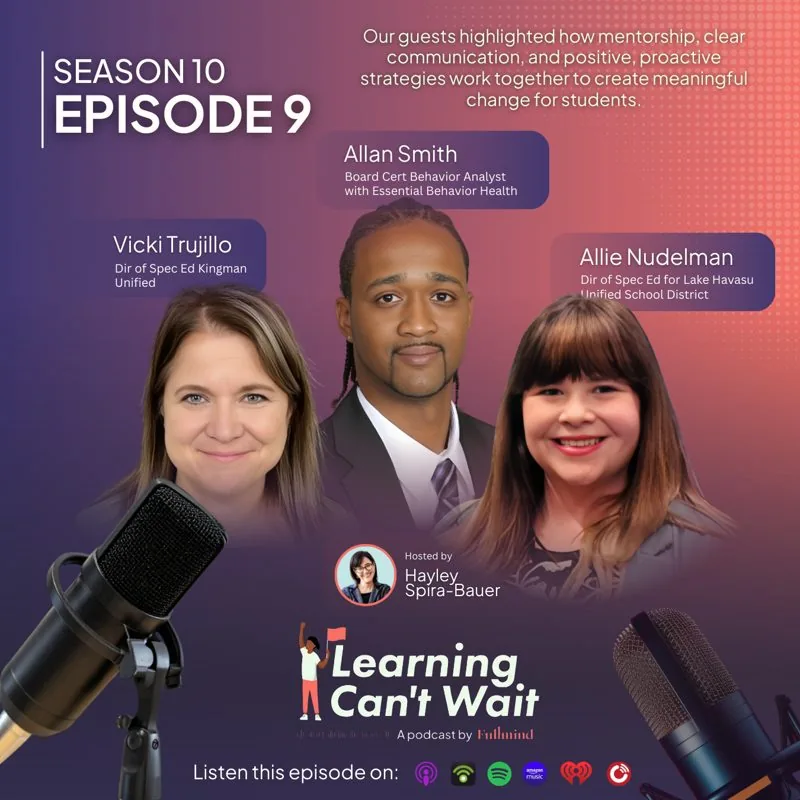
Allie Nudelman, Vicki Trujillo & Allan Smith: Behavior support capacity-building, Relationships and positive reinforcement & Data-driven, trauma-aware practice
- Allie Nudelman, Special education leaders
- Vicki Trujillo, Along with BCBA
- Allan Smith, Sharing how their unlikely paths (from aspiring doctor, lawyer
 Hosted by Hayley Spira-Bauer, Chief Academic Officer at Fullmind
Listen now
Allie Nudelman, Vicki Trujillo & Allan Smith: Behavior support capacity-building, Relationships and positive reinforcement & Data-driven, trauma-aware practice
Episode summary
Allie Nudelman and Vicki Trujillo, special education directors in Lake Havasu and Kingman, Arizona, join BCBA Allan Smith to explain how two rural districts share a behavior analyst two days a week each. All three came to education on nontraditional paths. Allan describes coaching certified and classified staff to build capacity, debunks myths that all behavior is manipulative or that consequences alone change it, and explains extinction bursts and why interventions need two weeks of fidelity. The directors describe funding the work through IDEA and other grants, operationally defining behavior, using data before removing a student, and proactive PD on routines and rotations.
Key takeaways
- Rural districts can share a BCBA; the goal is coaching staff so outside experts aren't needed
- Consequences alone don't change behavior; positive reinforcement and antecedent strategies do
- Expect an extinction burst; give an intervention two weeks of fidelity before judging it
- Operationally define behavior and bring data before concluding a student can't stay in class
- Fund behavior support creatively through IDEA and competitive grants with superintendent and board backing
About this episode
This episode of the Learning Can’t Wait podcast features special education leaders Allie Nudelman and Vicki Trujillo, along with BCBA Allan Smith, sharing how their unlikely paths (from aspiring doctor, lawyer, and basketball player) led them into education and intensive behavior support in rural Arizona districts. They describe how partnering across Kingman Unified and Lake Havasu Unified with Allan has transformed how staff understand behavior, shifting from emotion and exclusion to data, operational definitions, relationships, and capacity-building so teachers and classified staff can support even the most complex learners in their own classrooms. Throughout the conversation, they emphasize Maslow’s hierarchy of needs, the power of positive reinforcement, the science behind functions of behavior and extinction bursts, and the necessity of fidelity and proactive structures such as rotations and clear routines. The episode closes with concrete advice for new teachers: stay open and adaptable, seek mentors and supportive colleagues, avoid negativity, and relentlessly invest in relationships with students and adults.
Full transcript
Transcript generated from the recording; minor errors may remain.
Hayley Spira-Bauer: Welcome back, everybody, to the Learning Can't Wait podcast. I'm so excited that I was able to bring three incredible people from the mountains of Utah to their very warm, but not currently warm, homes in Arizona, all the way here to the Learning Can't Wait podcast. I am thrilled to introduce you to Allie Nudelman, the Director of Special Education for Lake Havasu School District. Welcome, Allie!
Vicki Trujillo or Allie Nudelman (shared microphone): Hi, Hayley, so happy to be here. Thanks for having me.
Hayley Spira-Bauer: I'm so glad you're here, and you're sitting right next to Vicki Trujillo, the Director of Special Education for Kingman Unified. Welcome, Vicki!
Vicki Trujillo or Allie Nudelman (shared microphone): Hi, Hayley!
Hayley Spira-Bauer: I know the both of you are even more thrilled for me to introduce this third guest. This third guest, not to hype you up too much, is Allan Smith, a board-certified behavior analyst with Essential Behavior Health. Welcome, Allan.
Allan Smith: Happy to be here. Thanks, guys.
Hayley Spira-Bauer: You know, the three of you, I met you because I attended your session at the NREA conference, I mean, the Rural Education Alliance Conference, in Salt Lake City, Utah, and I was blown away for a ton of reasons. One, it really brought me back to my days in schools working with behavioral support services. Which was transformative for me, but two, Vicki and Allie, as I listen to you share, and I'm so excited for you to be able to share these stories on the podcast today, I was reminded of what happens when leaders really understand Maslow's hierarchy of needs and prioritize Students and their social-emotional well-being. Along with their academic needs. So, thrilled to have you talk about this today. I'm gonna jump right in and have us start off. Allie, can you tell us how you came to be the personal and professional version of yourself?
Vicki Trujillo or Allie Nudelman (shared microphone): Oh my gosh. So, I feel like my story is very different from most educators. At least traditional educators, but I feel like I'm relating a lot more to people who come, through non-traditional routes into education. I, from the time I was very, very little, wanted to be a doctor. So I pursued that academically all the way through my undergraduate degree, prior to making some changes in life, but while I was in high school and even junior high, I was involved in a peer tutoring mentoring program for students with disabilities, and really just found I connected with them. I think that was probably my sign that I was supposed to be a special education teacher, and I didn't listen. Instead, I was set on being a doctor. Went all the way through my undergrad. That's why I had my degree in chemistry. Took an MCAT, applied to medical school, and then changed course completely. Got back into education a couple years after getting my bachelor's degree. Started by teaching chemistry, and when I was able to move to Arizona with my family. I became a special education teacher where I met Vicki, who was my mentor and guide through my whole process of being a SPED teacher, a special education administrator, and now just my friend and colleague as we get to collaborate across districts in what we're doing. And just being able to have those experiences with multiple students across multiple settings has really led me to believe and support the work that is going on in education today.
Hayley Spira-Bauer: Okay, so first of all, the Love Fest has already begun. I know listeners are going to take that away from this conversation. There's a ton of mutual respect, and I appreciate how that made its way into your story, Allie. That's very beautiful. Vicki, I have the same question for you. We know a little bit about how you met Allie, but how did you come to be the personal and professional version of yourself?
Vicki Trujillo or Allie Nudelman (shared microphone): Well, Hayley, I was sort of chuckling, because Allie and I have never talked about how we became who we are today, and I, on the other end, started my career to be a lawyer. So she's talking about going and doing all that medical. I'm like, I went to school and I got my history government degree, I took my, test to be… go to law school, applied to law school, and then I decided I wanted to do something else. We moved to Kingman, where I became the law librarian, and I was the adult education coordinator. And I fell in love with what I was doing. But I wanted to help younger kids. I had nieces and nephews at the time. My son was quickly entering, elementary school, and I said, I'm gonna go back and be a teacher. And so, for the past 26 years, I've worked for Kingman Unified School District in a variety of roles. I started as a substitute, then moved into teaching, to an administrator, and then into the position I am today. With each turn in my career, the goal and my desire was to help others, and as I transformed into the leader here at Kingman Unified, I knew I could help support others to build those relationships, to make those changes, and to help those struggling students. And through it all, I've got to work with Allie and many other great people, and then we got to meet Allan, and we can really focus on the needs that we're seeing in today's educational arena.
[05:00] **Hayley Spira-Bauer:** Wow, so we have a lawyer, a doctor, Allan, I can't wait for you to come on and tell us what you were gonna be when you grew up before you came into this.
Allan Smith: I wanted to be a basketball player.
Hayley Spira-Bauer: You're a very diverse group here!
Allan Smith: But honestly, what happened with me is, again, I entered education through a non-traditional route. I started out with a staffing agency and was just a classified paraprofessional. But they saw how well I worked with the students, and like, hey, would you like to become a substitute? And because, based on my background, I liked working with that population of students, which is the alt-ed population, which is where I started at. And the reason this population was so good for me, where I felt I was needed in that area, is I was adopted as a kid growing up. So, again, bouncing from different families, having a different support, I felt like I could relate to those students in those classes, and it was 6th to 8th grade, and so that just kind of made me want to be a teacher. So, again, I taught in that setting for 3 to 4 years. And then, I kind of wanted to make an impact on a larger scale, so that's when I decided to get my admin cert. So I became an assistant principal, over at Southwest Academy, which was another alt-ed school. And just, again, based on that, they were utilizing, applied behavior analysis, and really, I got into being a BCBA by accident, because I thought I was taking courses to become a special education teacher, and when I went to go get my certification, they were like, this coursework doesn't align. So, I found out what the coursework aligned to, and it kind of piqued my interest with behavior. And kind of just became a board-certified behavior analyst. So, pretty much, I was a principal for a couple years at Arizona Autism Charter School. And then I became a BCBA, and just figured I could make a larger impact on more behaviors, so that's why I kind of started my own organization. And I was happy to meet Allie and Vicki, and they've been, Very incredible with helping me spread my knowledge of behavior and just jumping in different behavior situations.
Hayley Spira-Bauer: I appreciate all three of you being so vulnerable and sharing your stories here on the podcast as an introduction. You know, this work that you do is very important, and it's very challenging. Who wants to tell the story of how you all started working together, and why Allan is grateful that Vicki and Allie have really brought his expertise into their school districts?
Vicki Trujillo or Allie Nudelman (shared microphone): Hayley, I'll go ahead and start. We also worked together when Allie worked at Kingman Unified. We were struggling a lot with some very intensive behaviors and lots of damage. And we actually, were connected with Allan through one of our contract agencies at the time, and we decided to venture down that avenue to see what he could do to help. It was the best thing we've ever done, because his ability to build relationships, not only with staff, but with other students, was instrumental. And so he worked really closely with all of us, and then Allie moved over to Lake Havasu and brought Allan with her two days a week. We always joke that we have to, share custody of them. She gets them two days a week, I get them two days a week. If we had our way, we'd have them every day, but we let them go to Phoenix one day a week.
Hayley Spira-Bauer: So what is it, Allan, that you're doing in Lake Havasu and in Kingman Unified?
Allan Smith: Well, initially, it was for me to help build that support with, working with challenging behaviors, but honestly, what it's really morphed into is coaching the staff and building capacity for those guys to put those interventions or skills in their tool belt so they can manage behaviors within the classroom, so outside individuals like myself don't need to come in. So it's like… like building up the capacity for those Within the district, so they can support themselves.
Vicki Trujillo or Allie Nudelman (shared microphone): And, Hayley, I just want to add to that, because I've been super lucky to work with Allan on a couple different levels. So, like Vicki shared, my first interaction with Allan was as an assistant principal at a high school that I was working in Kingman Unified School District at a high school here. And I would see this guy come in, and he'd walk down and go into my classrooms and support people, and Vicki would be like, oh, hey, you've got Allan there to go look at this behavior. I'd be like, oh, okay. And so, I got to know him briefly, and when I transitioned, districts. Lake Havasu Unified School District was in a really tough place with behavior and really needing support. And the superintendent and I started to work very closely together, and she's like, what are they doing in Kingman for support? And I said, well, they contract with this BCBA that comes to town, because Us being so rural, finding a BCBA that would come and support our area was such a challenge. So his relationship with Lake Havasu Unified School District actually started when I was still just contracting part-time. The one day a week. The one day… I was one day a week in Lake Havasu, and I happened to be able to connect the superintendent and Allan together, and so I've been lucky now, since I've transitioned fully. To be able to see how Allan was able to support, you know, the administrator at the school personally, but also on this side, where I, kind of get to oversee how he supports multiple schools and students across multiple situations, and really just value his support and guidance through things. Because sometimes, as administrators, we can say something. And it goes… In one ear. In one ear and out another, and Allan will come and say the same thing, or the same thing differently. And it… it just rings so much truer. And so, I… I'm so thankful and grateful for Allan and his support. And Hayley, I was going to add, the other thing I've really noticed over this school year, Allan provides great support to our certified staff, but the relationship now that he's building with our classified staff It's really empowering them to help address those behaviors and help build those relationships with those students, so we're seeing less of the outbursts.
[10:00] **Hayley Spira-Bauer:** Yeah, first line of defense are those other classified workers in buildings. They're the first people that see kids every day. They're the first ones that can pick up on challenges happening at home or on the way to school. I love that. I love that you've called that out as an important component of this, because it's not just the teachers, it's really the whole team. Allan. Oh, yeah?
Vicki Trujillo or Allie Nudelman (shared microphone): Share a little bit more on how Allan supports classified staff, because I have seen it, like, through a whole process where he mentored one of my paraeducators, who then pursued getting their registered behavior technician license, and he provided that supervision and support as they did that. And is now, like, this paraprofessional has transitioned into a teaching role because of that support and guidance through that process.
Hayley Spira-Bauer: You know, Allan. You're gonna have some problems after this podcast, because people are gonna want you driving all over the place.
Vicki Trujillo or Allie Nudelman (shared microphone): They're not gonna let it…
Hayley Spira-Bauer: They're not gonna let it happen. You know, Allan, I know, again, like, I've had the experience of working with an extremely, extremely brilliant team of BCBAs and psychologists and therapists. It changed how I think about education. So let's share some of the love right now. Allan, talk us through What… what is different about the way you're approaching supporting some of our most… our top 5% of kids that don't respond to typical behavior interventions, and why does it work for you when it doesn't always work with the standard interventions we're trying?
Allan Smith: Well, I would say the first thing is, as a person coming in with any challenging behavior,you can't take yourself too seriously.Like, I'm gonna come in here, and you're gonna listen to whatever I say. No, it's really meeting them where they are, and the way I work is, I've been there. I've been a paraprofessional, I've been a teacher, I've been a principal, and now a BCBA. And so I kind of speak the same language as the teachers, so I come in with this sympathetic and empathetic approach, and then… so I'm kind of figuring out, alright, so what are the things you're doing well that we can build upon, and then what are the areas that we're struggling with? And that's on the teacher side. With the kid side, it's coming, again, coming up with that sympathetic, empathetic background. Hey, I've been where you are, do you think this is a choice that's going to help you or hurt you right now? And then kind of having that conversation with our more vulnerable kiddos. With our nonverbal kiddos, it's really just being supportive, and again, just following through with anything, and then being empathetic so they understand that it's coming from a good place, and not just, please just do what I say.
Hayley Spira-Bauer: Alright, you ready for some rapid fire, Allan?
Allan Smith: I'm ready.
Hayley Spira-Bauer: I need you to debunk some things for me. You ready?
Allan Smith: Let's do it.
Hayley Spira-Bauer: You kind of just debunked for me that one plan doesn't work across all kids, right?
Allan Smith: No.
Hayley Spira-Bauer: Next one I need you to debunk for me is. All behavior… all problem behavior is intentional or manipulative. Or false?
Allan Smith: Okay, so now we're getting into more of the science area. ABA right now has four functions of behavior, sensory, escape, attention, and tangible. In 2026, they're looking at adding a fifth, function of behavior, which is control. So, some individuals engage in behavior because they want to manipulate the situation, so it's more beneficial for them. But some of our individuals just engage in behavior because that's their form of communication, and that's the way they've identified that they need to get their needs met in this environment. So that's why it takes a couple of times to observe the antecedent, and then the consequence to identify that temporal effect, to see what is exactly happening. Is it one of those control issues, or is it, hey, I don't have the words, or I don't have the verbal skills in my repertoire to get my needs met, so I'm going to engage in this behavior, because this typically gets my needs met.
[15:00] **Hayley Spira-Bauer:** Alright, Vicki, Allie, I have one for you.
Vicki Trujillo or Allie Nudelman (shared microphone): Okay.
Hayley Spira-Bauer: Consequences alone change behavior. Oh, I wish that were true.
Vicki Trujillo or Allie Nudelman (shared microphone): That would make life easy. If that were true, my child would be potty trained, all of my kids would behave day in, day out, my teachers would come to school ready and energized. Ready to work on a daily basis.
Hayley Spira-Bauer: Yeah. I wish that were true. Allan, this is a common misconception, right? Like, kids get in trouble in a classroom, the teacher is frustrated, and frankly, they're tired. They think if there's a proper consequence, the behavior will just stop.
Allan Smith: Why doesn't it work? Consequence doesn't… well… If the consequence is positive, that's going to maintain the behavior a lot longer than if the consequence is negative, because negative consequences are only valid as long as the punishing factor is there. So if that punishing person or factor isn't there, they're more likely to engage in that behavior because it's not corrected. And what you said earlier, when teachers are upset, again, I reference back to that Maslow's hierarchy of needs. If my needs aren't being met, then I can't help meet the needs of the other students. So again, if I'm upset, then it's more likely going to be displayed in my interactions with students. So again, if I can remain calm, I can get more beneficial outcomes for the students in our interactions.
Hayley Spira-Bauer: Mmm.
Vicki Trujillo or Allie Nudelman (shared microphone): Hayley, I see that a lot in everything Allan does when he's here. It's that relationship building to keep those needs of the teacher and the paraeducators, Even our principals, he really acknowledges what they need and really provides them with that support wherever they're at, to help them identify that consequences are not going to just fix everything.
Hayley Spira-Bauer: Hmm…
Allan Smith: Yeah. If you can develop good antecedent interventions, you won't even get to the consequence strategies, except if you're having out positive praise or things like that. And we want to live in that world, the positive reinforcement, as opposed to the punishment factor. Because, again, that tarnishes our relationship with the students, and again, we want to build these positive associations with school, because all it takes is one negative interaction to change a learner's academic career, or their trajectory.
Hayley Spira-Bauer: Everybody remembers that teacher who shut them down. How often do you hear professional, like, celebrities talk about, oh, that this is for my teacher who told me I'd never be an actor, and they're like, look at me now, or I'd never be a writer, and now I'm a published author. You know, like, everybody remembers.
Vicki Trujillo or Allie Nudelman (shared microphone): My favorite thing with that, Hayley, was in my early education days. I had a teacher in my 10th grade year, a math teacher. Sent an email to my mom that I read that said I was never gonna amount to anything. And then I went and worked with her as a teacher in my first two years of teaching.
Hayley Spira-Bauer: Did you remind her?
Vicki Trujillo or Allie Nudelman (shared microphone): No, I just kind of stewed in it.
Hayley Spira-Bauer: Do you want to call her out right now?
Vicki Trujillo or Allie Nudelman (shared microphone): I'm just kidding.
Hayley Spira-Bauer: I'm making space for you here, you know, it's 6 o'clock my time, this is… feels like coffee chat.
Vicki Trujillo or Allie Nudelman (shared microphone): But yes, like, and how, as educators, it's so important for us to realize how much one comment can impact a child.
Hayley Spira-Bauer: Yes.
Vicki Trujillo or Allie Nudelman (shared microphone): Because I don't think that teacher ever thought, and I guarantee she doesn't remember it.
Hayley Spira-Bauer: Right, right. You know, you've talked a little bit, Allie and Vicki, about the relationship that Allan has built with different stakeholders in your community. Can you talk about the impact Like, can you see it, feel it from your staff, now that Allan is, like, with Allan's support? How have their mindsets changed? What have you observed on, like, a holistic level, now that they have this support?
Vicki Trujillo or Allie Nudelman (shared microphone): I had the best day, and I know it's probably it's gonna sound kind of crazy, I had to go to a manifestation meeting this week, but I had a building administrator for the first time, describe behavior and operationally define it, so that we can really, truly knew what the child had done. Instead of he threw chairs across the room, he tipped chairs. He moved them. Instead of hitting, he… slap someone with an open hand. And while we might not think that's anything major, it really is, because if we can really operationally define that behavior, we can put strategies in place to help it. The, the administrator didn't over… like, hype it up, she's like, this is what happened, B, and C, and it was, like, finally, after all this time, we finally got someone to do this, so…
Hayley Spira-Bauer: Wait, so just kind of… let me repeat this back to you and see if I'm understanding, Vicki. You're saying that instead of, like, using emotion and feeling and frustration and over-exaggerating the student's behavior, that the administrator that you spoke to was using proper terminology, really descriptive language. So that… and what does that mean? Like, why is that important?
[20:00] **Vicki Trujillo or Allie Nudelman (shared microphone):** It's important because that allows us to really target that behavior and really make those changes. When we take the emotional part out, we can really look and get those antecedents and really identify strategies to, make things better.
Hayley Spira-Bauer: You're talking a little bit about data keeping here. I know data plays a huge part in this behavior work. A lot of people, when they think about data, they think, well, how did the kid do on the test? But… Allan, Vicki, and Allie, you have your own set of data that you're thinking about when we talk about behavior. Can someone walk us through what is the data that we're looking at, both collection and obsessing over when it comes to looking at reforming student behavior?
Vicki Trujillo or Allie Nudelman (shared microphone): So my favorite thing is when I get a principal or a teacher or somebody that comes to me and says, I just need this student out of my room, they are out of control. I'm like, okay. What do you mean they're out of control? Define what that is, and then I'm… then I want… and then I'm like, okay, show me the data. They're like, well, what data? I'm like, well, how often is it really happening? When is it happening? What's the time frame? What's the length of time that this incident is happening? Because without all that information, it could be like, oh, this is happening at We can find that data that says. This is happening at 10.30, right before we have snack, at 10.45, and this kid's just getting hungry. Early, so if we think that…
Hayley Spira-Bauer: My child's right now. I don't feed one of my kids, like, as soon as he gets home, every single thing after that is not going to happen. But I had to, like, literally stop and think, like, why can't I get him to do his activities, etc. So yeah, yeah, go on, sorry.
Vicki Trujillo or Allie Nudelman (shared microphone): Yeah, no, just that data piece is huge. Or, like, okay, we have tried this behavior intervention, and show me the data that we've actually tried it, and how you're doing it, and what's working, what's not working. And then we can have those conversations of, is this the appropriate setting for the child? And having Allan there has really opened my school's staff to being more open to taking the time to do that, versus just automatically jumping to We can't handle this kid, they just can't be in school.
Allan Smith: Because a lot of times when they think, I'm coming in, I'm coming in to… I'm going to provide you data to get this kid out of the classroom. No, on the other hand,I'm going to give you skills to keep them in the classroom, because again, if you start providing them opportunities to get out of the classroom, you're just going to reinforce that escape-maintain behavior. And when talking with teachers, I like to go with facts over feelings. Is this how you're feeling, or is this what's actually happening in the classroom? And if it's not what's actually happening in the classroom, then we can work to identify some other things. And another thing that's unique to my role, within both of those districts, I get to be the bad guy. When I come in and say, when they're doing FBAs and BIPs and things like that, I get to say, hey, what interventions have you guys tried before? And with fidelity, that is the biggest thing. It can't be, I tried this for 2 or 3 days, because… and it didn't work. It has to be for at least 2 weeks, because those first 3… 3 to 5 days are going to be an extinction burst. And you're not gonna get any real behavior change until.
Hayley Spira-Bauer: Okay, Allan, hold on, hold on, I need a literacy moment here. I know what an extinction person Well, you need to tell our audience, what's an extinction burst, because it's wild. It's wild.
Allan Smith: An extinction burst is when you apply a behavior change procedure, and the behavior spikes, because they're trying to access reinforcement in the old ways that they did before. So, what you need to do is continue to provide your intervention, again, respond under control and calm, and then whatever interventions to meet that specific, function of behavior's needs, and then just address it that way. But a lot of times. Teachers don't get past that first 3 to 5 days of the extinction burst, and now we're trying different behavior plans. And really, it's like medication. You won't know what's working until after 2 weeks, so we keep trying to spitball all these different interventions. And you need to at least try 3 of those, interventions within Tier 1, so teachers don't understand what resources are available to them. Or what interventions are available to them during the MTSS, or their multi-tier student support system, and they don't understand how change of placement actually works to get those kiddos the best needs. And frankly, again, through my research, they don't understand how that change of placement works in a rural setting as opposed to an urban setting.
Vicki Trujillo or Allie Nudelman (shared microphone): Well, thanks for just calling me out as a parent, Allan. I was like, oh yeah, that was why potty training took so long.
Hayley Spira-Bauer: Right? Because you're like, I'm gonna try the M&M method. No, I'm gonna try the method with this. No, I'm gonna try the… Listen, parenting…
Vicki Trujillo or Allie Nudelman (shared microphone): Went through her extinction burst, and it took her 5 days instead of 3 days.
Hayley Spira-Bauer: Yay!
Allan Smith: Really the fidelity.
[25:00] **Vicki Trujillo or Allie Nudelman (shared microphone):** Fidelity is what we have to really focus on. Because Allan's right, people are like, it didn't work today, I'll try this tomorrow, and this the next day, but those who do the fidelity and do those two weeks, like he talks about, really get to see the difference, and then you get the whole other side, like, they fall in love with the student, they build that relationship back, and it's amazing. When we do it with fidelity. When you build that relationship with the kid, like, building a relationship is so key to a student's success. I had a student that was one of my We're not supposed to have favorites, but one of my favorites. That I worked with in an alternate setting, and then, just recently graduated this last year, but… We had such a relationship that the student, when they were frustrated, instead of turning around and hitting another student, would come storm in my office and sit and scream and kick my desk. And I was so… they didn't understand why that would make me happy. But, like, being able to stick through that and build that relationship so that they have the safe space is huge.
Hayley Spira-Bauer: Yeah, that is so valid. I think all of… all of my advice when it comes to becoming a teacher has to do with relationships, but that's a story for another podcast.
Allan Smith: No, but that's your number one intervention.
Hayley Spira-Bauer: Yes, it is. That's why it's my number one piece. When I coached new teachers, when I was leading schools, it was always invest in relationships with parents, with families, with the people in your building, the students, like, that is the number one key to life, in my opinion.
Allan Smith: For me, again, that speaks to how… again, I walk on campuses where I've never met these kiddos before, and then I have to find ways to build those relationships. Right now, I could just go 6, 7, and then they'll all be… they'll all be right there with me. But really, it's finding things that I know kids like, like talking about anime, talking about sports, talking about shoes, just finding quick ends with them. I'll say, oh, Ronaldo's way better than Messi. They'll be like, no, Messi's better.
Hayley Spira-Bauer: Alright, yeah.
Allan Smith: And then I'm like, alright, yeah, now why are you misbehaving class? And then I found an in with him, and now we're having an actual conversation.
Hayley Spira-Bauer: I love that. I used to tell people, I hate Roblox, but I know a lot about Roblox. Like, I know a lot about it!
Allan Smith: And…
Hayley Spira-Bauer: Okay, so Vicki and Allie, I need to step into a different direction now for a second, because… Not everyone thinks of this as a priority. I want them to. Allan wants them to, you want them to. But they don't, and they make excuses about why ensuring our teachers, specifically, and our staff. Have the skills to support even our most challenging learners is a priority, is expensive. How have you made this work? Where have you found the resources to ensure that Allan gets to be in your district twice a week?
Vicki Trujillo or Allie Nudelman (shared microphone): For us, we were very fortunate to be able to add it to our IDEA grant. That's that special education grant. We were fortunate to be able to add it in there, and I would have to say it's through that support of our superintendent that she makes sure it's a doable thing, because she'll help us make sure that Allan can help all students, and not just our special education students. We've been very blessed in that area. For me, like I shared, when I went into Lake Havasu, so my transition from Kingman Unified to Lake Havasu was… They were at a place where they didn't have a director, their director was out on leave, their special education coordinator had left. And so they really just needed somebody, and I was kind of just consulting on a once-a-week basis, and one of the big concerns I heard was, we have so many behaviors that we don't know how to support. And as a teacher, and I remember being in the classroom when you just are dealing with a behavior that will not stop, and it's interfering your teaching every day, or all day. And it's so emotionally draining, and you're like, I planned these great lessons, and all of my other kids are suffering because I can't support them, because I have to support this one kid with these extreme behaviors. So, coming in on that administrative side and saying, okay, what tools can we give our teachers? So that they feel more successful. And then having that support of our superintendent to be like, yes, this is important. And then I'm very lucky right now to also have a very supportive school board that, like, understands behavior is a… it's a whole new challenge and a new beast, especially after the pandemic, and kids being out of school, and… Not learning those important social interactions. So really, just as a district. Recognizing and prioritizing that, yes, we have to spend the funds on this, and getting creative, so using part of the IDEA grant, or, what… what can we move from our M&O budget to a different grant that's competitive to cover the cost that we need to pay for behaviors? So it's just being really creative and finding that funding so that you can support it, but I know not everybody's as lucky, and it's not as easy for them, and we're just very lucky to have the support of our administration that I do right now. And I think we're, I think what really helps us maintain it is the progress that they see, this teacher's ability to be able to handle some of these behaviors, address them. Allan just participated in a behavior summit we did to really identify the key needs our teachers are having, so that we can sit down, and now we can really target and have him target those needs that they identified. We had all the elementary schools get together with the administrator and one or two representatives, and they had some really rich discussions. So we're kind of excited to go through that data so we can really target their needs.
[30:00] **Hayley Spira-Bauer:** Yeah, I was going to ask about.
Vicki Trujillo or Allie Nudelman (shared microphone): Some of the topic we're talking about here is more…
Hayley Spira-Bauer: Reactive. Like, we know we have these behaviors, we have to equip people immediately with skills so they can handle them, but there's a proactive component here, too. So, what does PD look like when it's proactive? Like, what is your fir… what would you focus on first, Allan?
Allan Smith: Honestly, I would focus on catching the students when they're engaging in behaviors that are appropriate, because a lot of times, we just take for granted that students are coming to school, and they're doing things that are appropriate for students, and what's appropriate for that environment, but if we can catch them being good, we're more likely to, to shape those positive behaviors. Like, if they come in the classroom appropriately, let's praise them for that, that appropriate transition when they are working appropriately. At their desk. Let's praise them, hey, nice job staying on task, or having nice interactions with their peers. That, it goes a lot… a long way to mitigate a lot of the other behaviors, because in the classroom, the only time some of these students are getting responded to by the adults is if it's corrective feedback, and if we're providing that reinforcing feedback, we're going to get a lot more positive behaviors in the classroom. And we're gonna shape those behaviors, because to kids.Bad attention or good attention, it's all attention, and we want them to get the good attention.
Vicki Trujillo or Allie Nudelman (shared microphone): And then… oh, sorry, go ahead, Vicki. I was gonna say, Hayley, Allan really has been focused, for some of our programs on his center rotations. And it's something that simple that he's really helped the teachers to identify if you break the kids up in these little groups, you're gonna be more productive, the learning's going to increase, and the behaviors will decrease. And we've seen a huge, turnaround at our autism support campus this year. He put a lot of effort, and they put a lot of time in that behavior… well, not even behavior, but in the PD training, where they talked about those rotations, and the teachers are thriving.
Allan Smith: It's really just identifying how long they can sit, and then basing it around that. Like, meeting the students where they are. If we're designing these 30-minute lessons, and the student can only sit for 10, well, you're gonna have 20 minutes of behavior. So, it's just meeting them where they are, and then mixing up those rotations. And that, I felt, is more appropriate for those kiddos.
Vicki Trujillo or Allie Nudelman (shared microphone): And I think one thing we did this year that had really positive staff impact was Allan came in during our staff professional development and tailored professional development to get all our teachers ready for the year. We separated them out by grade levels and He was able to kind of talk about what behaviors are and how to support that, and then As a district, just reminding teachers that you have to set your routines and teach your kids how to behave. The kids don't know. And I think even as… especially as we get into the upper grades, we forget that kids don't always know how to do something or how to behave appropriately. We have to teach them that. And so, they might be acting out, and if we act… react negatively, then we're giving that negative Feedback? And we're just gonna keep seeing it, because… well, you didn't teach… then they get that defiance, right? Well, I didn't know how to do it, and instead of you guys trying to help correct me, you just… reprimanded me, so why do I want to work for you anymore? And it's also being aware of their individual needs.
Hayley Spira-Bauer: Mmm.
Vicki Trujillo or Allie Nudelman (shared microphone): As you're learning, Allan's helping us provide strategies to work with all the different students. We have to know the difference between how you work with your oppositional defiant, to your autistic student with autism, to your student with ADHD, so that all the strategies can blend.
Hayley Spira-Bauer: So much here, I could spend… An entire season just talking about behavior. Because it is really, to me, the number one step. It's where you start, and it's where you end in education, and I think it often gets missed, especially in a politically charged climate, where we talk about social-emotional learning and students' needs. It can be a real challenge to get people to focus on How we all can work towards the same goal, especially if you start here. Vicki, Allan, and Allie. I have my final question for you. I'm gonna start this time with Allie.
[35:00] **Vicki Trujillo or Allie Nudelman (shared microphone):** No. Okay.
Hayley Spira-Bauer: Can you tell us what advice would you give a teacher starting their career today?
Vicki Trujillo or Allie Nudelman (shared microphone): I think first go in just open-minded and know that you're going to learn so much in your first few years. That your first few years of teaching are just such a learning curve. Know that that- know that that's gonna happen? And it's okay. Seek out mentorship and guidance, you're not in this alone. My first couple years, I really segued myself into, like, seclusion, and ate lunch in my room by myself, and didn't have that teacher support, that by the time I moved, and I'd found a teacher support group, and just friends that I could sit with and have 30 minutes to… decompress and understood what I was going through, it made a world of difference in who I was as an educator. So, find your support people and hold on.
Hayley Spira-Bauer: I love that. I know who one of your support people was. We're gonna kick it over to Vicki. Vicki, can you tell us what advice you would give a teacher starting your career today?
Vicki Trujillo or Allie Nudelman (shared microphone): Number one, be open to change. Be moldable. Take what people tell you and teach you, and pick out what's gonna work for you. You have to get that resiliency and build relationships. The only other thing I would really recommend is be weary of naysayers and the negativity. It is so easy to get caught up in the moment of. This is awful, no one cares, the kids are this, the kids are that. If you really surround yourself with people who help build your resiliency and are there for you to support you and everything, it's gonna make teaching Your favorite thing to do?
Hayley Spira-Bauer: Hmm. Well said. And finally, Allan, What would you tell a teacher starting their career today?
Allan Smith: Honestly, I kind of want to piggyback over what they said. Find a mentor, somebody who's done it before. Also, don't be afraid to try different things, be flexible and adaptable in your learning and your classroom lessons and things like that. But really, again, just… Be willing to try things, because again, not every day is going to go the way you want. Adapt from what worked well, and then carry those things over to the future.
Hayley Spira-Bauer: You three are such a light. You've really brought attention to a topic that is so incredibly important. Vicki and Allie, your leadership has made it possible for the students and families of your community to benefit from Allan's incredible wisdom and guidance, and Allan, the work you've done to become the professional you are and the person you are is such a gift to so many, and now we've shared it here on the Learning Can't Wait podcast. Thank you, to the three of you, for joining me here today on the podcast.
Vicki Trujillo or Allie Nudelman (shared microphone): Thank you, Hayley. Thank you for having us, Hayley.
Allan Smith: Yeah, thank you for having me on.
Hayley Spira-Bauer: And thank you to NREA for hosting a conference and putting these three on the docket so I could see them and be wowed by them, because now there are many more people, I'm sure, that will be wowed by the leadership of Vicki and Allie and the incredible guidance that Allan has shared here today. Thank you, everybody, for tuning in.