
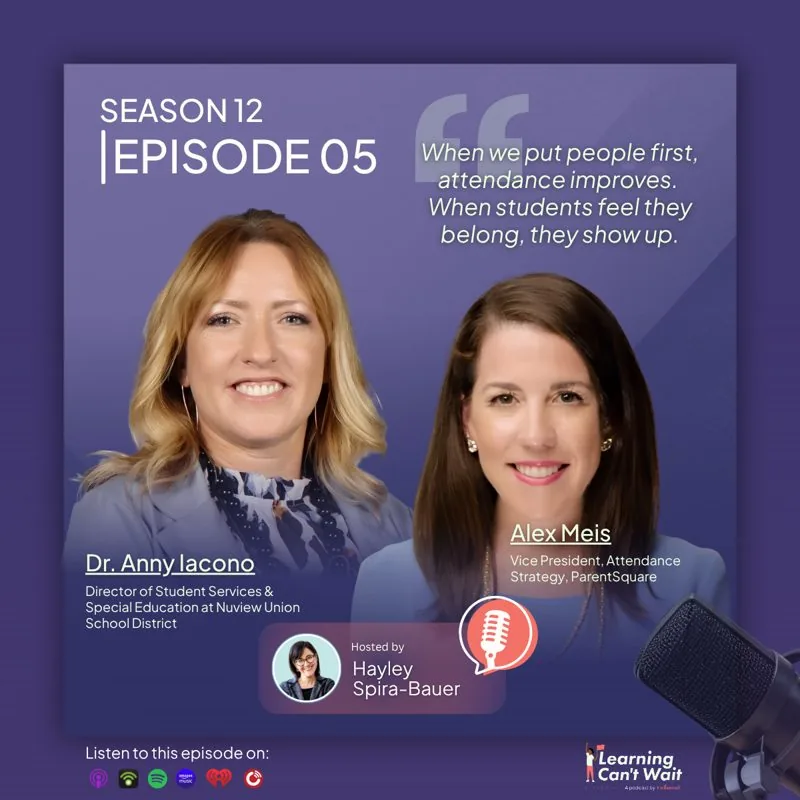
Learning Can’t Wait · Season 12, Episode 5
Alex Meis & Dr. Anny Iacono: Chronic Absenteeism, Family Engagement & Relationships
- Alex Meis, Vice President of Attendance Strategy at ParentSquare
- Dr. Anny Iacono, Director of Student Services and Special Education at Nuview
 Hosted by Hayley Spira-Bauer, Chief Academic Officer at Fullmind
Listen now
Alex Meis & Dr. Anny Iacono: Chronic Absenteeism, Family Engagement & Relationships
Episode summary
Alex Meis of ParentSquare and Dr. Anny Iacono of rural Nuview Union School District in California discuss chronic absenteeism as a relationship problem, not a compliance problem. Dr. Iacono describes a community with no healthcare providers, unreliable mail, and roughly 10% of students unhoused, where mailed truancy letters drew almost no response. Empathetic phone-based messages through ParentSquare's Attendance Plus brought hundreds of replies a week and raised attendance from 92.7% to 94.9%. They connect the approach to new California legislation and offer advice for schools short on time.
Key takeaways
- Punitive letters and robocalls rarely change behavior; relationship-first messages do
- Switching from mailed letters to phone-based messages took replies from near zero to hundreds a week
- District attendance rose from 92.7% to 94.9%, roughly 200 more students attending regularly
- Attendance teams, not one clerk, should own the work; California law now requires them
- Start small: one student a day or five families a week with a positive first contact
About this episode
In this episode of Learning Can't Wait, Hayley Spira-Bauer is joined by Alex Meis, Vice President of Attendance Strategy at ParentSquare, and Dr. Anny Iacono, Director of Student Services and Special Education at Nuview. Together, they explore the growing challenge of chronic absenteeism and explain why improving attendance is fundamentally about building relationships rather than enforcing compliance. The discussion highlights how Nuview transformed attendance outcomes through empathetic communication, customized family support, community partnerships, and a person-first approach, resulting in district-wide attendance improvements and stronger engagement with families.
Full transcript
Transcript generated from the recording; minor errors may remain.
Hayley Spira-Bauer: Welcome back, everybody, to the Learning Can't Wait podcast. We are talking today about one of my favorite topics, as I believe it is one of the most important topics in education. We'll be talking about attendance with Alex Meis, the Vice President of Attendance Strategy at ParentSquare. Welcome, Alex!
Alex Meis: Hi, Hayley, thank you for having me.
Hayley Spira-Bauer: Thank you for being here, and thank you for bringing your incredible partner, Dr. Anny Iacono, Director of Student Services and Special Education at Nuview. Welcome, Annie!
Dr. Anny Iacono: Thank you so much for having me, this is exciting.
Hayley Spira-Bauer: You know, it is exciting, because all the things we talk about in education cannot happen if students don't show up to school. So I am really excited to talk about this topic broadly, but then also talk about what your partnership has looked like and how it has improved attendance outcomes in Nuview, and so to do that, we'll just get… go ahead and get started, and I'll start with you, Annie. Can you tell everybody, how did you come to be the personal and professional version of yourself?
Dr. Anny Iacono: Well, I think, like many people, it's a long journey, of evolving and changing, and I… it really started… I was a single mom of three, and I jumped into teaching and fell into the career of special education, and I just fell in love. I remember my first day, I'll never forget, going home after meeting my students, just knowing this would be my lifelong passion. And ever since then, I've served in a lot of different roles, and worked with a lot of different age groups, and different needs, and on the general education side of the house as well. Even students who were incarcerated, and had a real struggle, and I just fell in love with trying to make a difference and really help people. And that's led me to this, my favorite position I've ever held, which is this one here at Nuview, working with this rural community and really focusing on our students and our families and… Helping to connect them to what they need. So, I just absolutely love it.
Hayley Spira-Bauer: I appreciate how much you really are exuding joy about the work you're doing, and maybe perhaps it's a culmination of a lot of the experiences you've had, and some of the barriers you've noticed, and we'll dive into those more deeply in a few moments, but Alex, I'm going to ask you the same question. How did you come to be the personal and professional version of yourself?
Alex Meis: That is a great question. It's also been a… twisty, turny journey in my career. My heart has always been invested in supporting, equitable family engagement. I started my career Back in… a long time ago, working in the South Bronx, in New York City. Working, in a pediatric clinic by way of a program called AmeriCorps. I was young at the time, 22 or so, right out of college, not exactly sure where that role would take me, but knowing I wanted to give back to the community, In that capacity, I spent a year in that role, again, working in the South Bronx. And I worked for a pediatric neurologist. I only mention this as, he was so informative for me and illustrative in pushing me in my career, in policy. I, went back to NYU for my master's in public administration, since he said to me, Alex, if you… Really want to make a change, and respectfully, he's like. Don't be a doctor like me, you need to be a lawyer or a politician. And I said, oh my gosh, I never thought… saw myself as a lawyer or a politician, but… I see how these roles, you know, influence the structures and systems by way our students receive services and families are included in education, right? So, I went back, to NYU for my degree in policy, and that's where I started my career as an entrepreneur. Again, twisty-turvy, circuitous, building out a solution to a problem that I saw deeply, which… is, I think what we're going to talk a lot about today, of how to be, in service of families when it comes to solving chronic absenteeism, so… like Dr. Iacono, I find so much joy in my work, and working with people like Annie is my why now, of helping build better systems and processes in place to, again, make a more inclusive environment for families when it comes to attendance improvement.
Hayley Spira-Bauer: Yeah, you do have a twisty-turvy story, and I'm super excited to hear how all the different experiences have impacted your work. Now at ParentSquare, but specifically around improving chronic absenteeism, I'd be remiss if I didn't share, my first job out of college was also in the South Bronx. However, in a school, through another AmeriCorps program known as Teach For America. And I do believe that these types of programs, although they're short engagements, they tend to have a really big impact on people. When they see the opportunity that exists to do good things and help great people, and I really, really am grateful that I had that experience, and it sounds like you are too. But, Alex, I'd love to know more about how the past 15 years you've spent on attendance, both policy, research, and product, how you came to the conclusion that this is fundamentally a relationship problem, not a compliance problem.
[05:00] **Alex Meis:** Yeah, and I want to hear more about your experience in the South Bronx as a teacher. I'm sure maybe I worked with one of the schools you were at, in my time there. But yeah, so… I, you know, I don't see the line as so divided of its… compliance or engagement, right? I see it really as a Venn diagram, in that there's a world that exists in the middle, between compliance and family engagement, right? There is a world that both can exist in a dual capacity. However, what I've seen over the past 15 years when I started working in this space was that we were so focused on, alerts and auto calls and truancy letters, and… That is how we solved the problem, right? It was very, by what I observed, more punitive in nature than what my gut was telling me, or from reading and working with school leaders and those that I saw as the most valuable asset in a child's career, like folk… people like Dr. Iacono and leaders in the South Bronx or in New York City, right, working in public education, the New York City DOE were those that put the relationship first, the human first, the person first, right, and understanding why that child wasn't in the school building, not necessarily defaulting to the letter home, the robocall home, right? The punitive nature of, more so. The finger-pointing, right, of, you know, this student was in school today, and this is why, and this is what we're gonna have to do, or in different states, there are different, you know, rules and policies in place, and Again, the most successful leaders in the space put that human first, and understood the why behind the absenteeism first, and put the child first, and I see that all boiling down to relationships, and say, why do anything? Like, I show up to work every day because of the relationships I have with my peers, right? I show up to today, because of my relationship with Dr. Iacono and, you know, yourself, right, of a leader in the… in the K-12 space, and that's because of our relationships, and I see the same in… in K-12.
Hayley Spira-Bauer: You know, Dr. Iacono, I kind of jumped ahead here in not naming the problem first, which is that, you know, absenteeism rates are higher than they've ever been before. We saw a major, major issue post-COVID of student locations being unknown, student attendance being very low. Talk to me a little bit about your experience during and after COVID, and then we'll jump back over to Alex's really strong point about some of the point solutions that were developed to attack that problem.
Dr. Anny Iacono: Sure, yeah, so, I was working actually with the county at the time of COVID, so I actually had a really broad view. I worked and served all of the school districts within our county, including Nuview, so I was able to see the impact live, with our families. And it was devastating in so many ways. I mean, there were some positives, of course, as there always are, you know, as far as, some of the experiences that families were able to have, and more time together. But by and large, that, support with our schools and those relationships with our school folks and the parents, it was really impacted. We didn't have that face-to-face engagement. We didn't have that ability to support our families and nurture our kids in a real in-person way. So I think coming on the heels of that, what we've seen is, you know, a huge chronic absenteeism while we were still first getting back into the classroom and back into in-person instruction. And then that lack of relationship, I feel like, is what we were still coming out of, even when we were full fully starting the school year in person, so… Because those relationships weren't there, that support wasn't there, we hadn't followed and been able to nurture those relationships during that time the way we typically would, then we were out of touch with what their needs were. So then, when I came to Nuview in 2023, I realized some of those gaps were significant. We're an island as far as healthcare, there are no healthcare providers in our local area, there's a dentist that's open one time a week. And that's very limited. We don't have a full grocery store. Just all of the human aspects. And then being detached on the heels of COVID, really put our districts in the whole county, and Nuview included, just in arrears, really. We were behind the game, and we needed to find a way to catch up, and what was work… what was happening with the auto responses and the auto letters, and that more punitive That wasn't the approach that our families needed after going through the traumatic and the hardships that came from COVID.
[10:00] **Hayley Spira-Bauer:** You know, because I have a really special interest in rural America, I know that the problems you're naming here are, unique to rural America and widespread across our country. Most of America is rural. What you're naming are particularly, big barriers, having no access to medical care, having limited grocery supply. Those all become factors in why students don't show up to school. They are inextricably linked. However, I would imagine, and Alex, please, please correct me here as the expert here on attendance. That simply sending automated reminders, as you named, isn't going to necessarily get families to school. So talk a little bit about what has been impactful, how the relationship aspect, knowing relationships matter so much. How that translates? In some of the solutions that ParentSquare provides to getting students to school.
Alex Meis: Yeah, I would… say that we…I would be so daring to say we can't improve attendance without relationships. They're one and the same.If our expectation is that kids are coming to school and want to be in school, right? And parents, similarly. Want their kids to be in school. That relationship must be intact. And as Dr. Iacono was saying, right, in the pandemic days, like, how… decoupled those items might have been, right? Even though we did our best effort of staying connected on Zoom and communication, right? Like, there's just no replacement for that in-person connection point, particularly in our rural and even urban regions, right? And I would say that it's not really what we say, it's how we say it. And within ParentSquare, right, we are one of the nation's largest communication providers across the country, and what we're doing within attendance now is providing different tools and coaching mechanisms to support districts across the country, and how to communicate with parents just a bit more empathetically and positively to draw that connection point, right, around that relationship. Not just… information sharing. And what Nuview has done so well, and many of our district partners, is has just changed sentence structures, or ask questions of parents, or say, I missed you in school today, versus just, you were not in school today, right? Like, that's the start of a relationship, and again, like. How can we expect students or families to want to be in our school communities without that foundational matter intact?
Hayley Spira-Bauer: You know, Annie, you went from families never responding to these outbound messages… That were being sent to communicate their students' absences. To fielding hundreds of messages at a time. What was the shift like on the ground, and what did your team, in addition to tailoring some of the language, have to do differently to get there?
Dr. Anny Iacono: It was a massive shift for us. So prior to partnering with Attendance Plus, we were already a ParentSquare district, but our, previous method was to mail home actual letters, as the primary form of communication. Well, in a rural area, we unfortunately do have a very unreliable, mail system. There's unfortunately break-ins into the mailbox. There are some areas that we serve that are only accessible through a four-wheel drive vehicle in the dirt, and our mail carriers don't have that. So, we just really… it was so inefficient, and we got… had zero response, as you mentioned, almost. It was very infrequent that we've received any response whatsoever. And so now what's shifted is because ParentSquare is already a tool that our team and our parents and our community is used to, they are getting those messages right on their cell phone. We don't have great internet service in the hills, that we serve, so, but they have good phone service, so that was a big shift as well. It felt more personal, because it's coming right on their device that they're already looking at. And again, we took advantage of some of those suggested messages that are coming across as that supportive message, and offering resources, offering connections to different things we offer. And it did increase. We are getting hundreds of messages every week, and our team had to really shift. So what we ended up creating, that we never thought we'd need before, we actually have a dedicated attendance line at each school site, where the parents can just leave a voicemail and just say the reason for their student's absence. We can also… they have a Q… we have a QR code set up for each school site, where the parents can, just scan the QR code. Type in the reason their student was absent. It's very user-friendly for the parents if they're walking in, say, a younger child into the school. They don't have to wait until the student's all checked in. They can just do the QR code. Send their kiddo off, the kiddo can walk right to class much faster, and then we also created, online They have a message system through ParentSquare where they can just message the attendance clerks directly, through their phone. So, it's all of these methods to help make the access easier for our parents. But then also for our attendance clerks to be able to capture the data they need to clear those absences, and to put the explanation why the student missed school, or was tardy, or whatever the case is. So that really helped.But it was such a great problem to have, to go from almost zero response to hundreds in a week.It was… it was really awesome to see.
[15:00] **Hayley Spira-Bauer:** I mean, the punchline here is that when you implemented this feature, Attendance Plus, through ParentSquare, you had district-wide attendance improve from 92.7% to 94.9%. And for those thinking, okay, well, that's a 2% jump. 2%? How many students does it approximately represent in your district?
Dr. Anny Iacono: So we have, in total, 2,253 students, about. So 2% of that, you know, we're talking a couple hundred kids, so that's a big.
Hayley Spira-Bauer: It's incredible, right? Like, sometimes we can remove the human from behind the number, but a couple hundred kids coming to school with regularity Dramatically improves the trajectory of their life. It improves their longitudinal outcomes for health, well-being, academic, and social and emotional progress. So it is incredibly significant. Even at that number of 2%. I think sometimes it's easy to overlook the incredible impact it has on very real people in your community.
Dr. Anny Iacono: That's so true, and I think the great part about ParentSquare, because we're a rural district, and we don't mirror our local districts that are surrounding us, you know, I can send customized messages offering mental health supports. We have therapists at every school site and counselors at every school site. I can send them messages saying, hey, does your child need to be connected to their managed care plan for specialty care? Do they need dental and vision care? Because we have dental and vision mobile units now coming to our sites. But that message, getting it out there, our tool is ParentSquare and Attendance Plus, but that wouldn't be possible without the great supports they offer that I can then customize for our unique needs, and I think that's been just a game changer completely.
Hayley Spira-Bauer: What I love about the work and your passions is that it is extending beyond just the communities that you serve. Alex, as that doctor first told you when you were working in the South Bronx, if you really want to make a change, you have to look at policy. California has passed various legislation, SB 691, AB 461, and additional state guidance to exercise by this fall that essentially writes this relationship-first approach into law. How does what's happening in California connect to what Nuview is already doing? And how… what should other states know about this approach when they look at the legislation that I just referenced?
Alex Meis: Yeah, it's been an interesting shift in, you know, not just in California, but across the country over the past several years, and past decade, or even 15 15 years, if I go back in my memory bank to that long, when I started in this arena, you know, chronic absenteeism, that word wasn't really a thing. It wasn't as circulated or mainstream as it is today, really even recognizing the totality, I mean, not just in California, but across the country. I know AttendanceWorks and Hedy Chang, and many people have been the… spearhead thought leaders in this space, and we, like, I owe so much credit to them, right, of just socializing Chronic absenteeism, the totality of absences, right? Excused, unexcused, it doesn't matter the reason, right? These students are missing learning time, and we need to get them back in school. But when we then double-click into what's happening in California and other, average daily attendance states, right, supporting that, compliance-oriented manner, in California, there's the SART and SARB, processes of sending attendance letters home, but then what I find interesting about new legislation is requiring, schools and districts to have what I call for general purpose naming convention attendance teams in place, right? That there must be a team, that must be communicated, which is really amazing, right? We need to have attendance teams in place to support the whole child, and this can't just fall on an attendance clerk, it can't fall on one person, and I see that emulating now the It Takes a Village mantra, that it's All of our, equal responsibilities to support, that student achievement and growth. And, you know, that's awesome that we're… we're pushing towards a relationship-oriented, approach, and that, for the first time in California, right, Letters not related to these specific, legislations, but a general trend we've seen is that, the truancy communications, right, are the most cost-effective way to communicate home to parents this information. That does not mean that sort of letter in the mail. Snail mail, but digital means of communication to… to also close that equity gap, right, of parents who might not receive mail. And we don't always think of that, right? We just think of mail, like everyone has mail, right? But as Dr. Iacono illustrated. That is, in fact, a gap, an equity gap, or when working in urban, communities, or, you know, and I'll… stop in a moment, but just thinking about the concept of a home. Not all students have homes. They might not have mailing addresses, right? But, even the word homework can be triggering to a student, right? It's work that you need to complete for school. So anyway, I go back to… we're modernizing how we communicate about attendance, you know, we're modernizing how we wrap our support around students, and that's really awesome that, that's being recognized at a state level for policy and practice, so…
[22:00] **Hayley Spira-Bauer:** I'm really glad you called out Hedy Chang. She's actually been on the podcast twice. This was part of my attendance deep dive. I am so… interested in learning not just the philosophical, but also the practical, and I think you both have done a really good job of illustrating that. Let's take it to the local level, Dr. Iacono. On the ground, how have you seen shifts in your local government or district to offer additional support and guidance in tackling this problem?
Dr. Anny Iacono: That's a great question. So, I am fortunate, you know, I really appreciate my partners in the other school districts. We meet regularly, the county office hosts, you know, regular meetings, so we can kind of brainstorm what's working for our district, what's working for another district. And we really partner closely with not only the attendance-focused side of the house, but also that student support side of the house. And so we're really trying to wrap around you know, what services can we offer students? What are those barriers that are preventing them from coming to school regularly? Getting to know the family on such a close level, where they're willing to share some of these really difficult pieces of their life that are really hard. We have almost about a 10% homeless or unhoused population, and when we're saying unhoused, we don't have a motel nearby, so they're more than likely living out of their car, or have some sort of other inadequate housing, or sleeping on the couch or on the floor of their family member or friend's home, and it really is, staggering what some of our families are experiencing. So even things like hygiene essentials, clothing, shoes.I've had kiddos missing school because they don't have shoes to wear to school.So we've created resources for those families, we have resource rooms that have all sizes for the entire family, but that partnership with the county, with other agencies, nonprofits around us who are really just, alongside us, the managed care plans, I cannot tell you what a huge transformation that has been. Being able to connect our families to their managed care plan for specialty support. They'll even offer transportation sometimes. And, that helps our kids stay in school, because the parents can go to their appointment. They don't have to take the kiddo out of school to go to the appointment with them, because they have that support. But a lot of our families are embarrassed, so if we can't be that direct connection, if we can't be that comforting spot for them to land and feel comfortable opening up to us. Then they're not going to get the help they need. So we really work hard on filling in all of those gaps and barriers to the best of our ability. And if we can't, I am the first to jump on emails and say, hey, who can help this family? We really have a situation. And I think that partnership between like-minded individuals in other districts, as well as all of the, supports that we have from our partnerships with, different programs, like ParentSquare and Attendance Plus, and our managed care plans and all of that, really make a difference. And you have to really look at it from that person-first, approach, and that's made, to me, all the difference in the world. And I've been really fortunate to see how those relationships have improved, and, the communication. It's been a great thing to see.
[25:00] **Hayley Spira-Bauer:** I feel so heartened when I hear the level of… just… complete wraparound support that occurs to ensure students can be in school, they can happily be in school, healthily be in school, but also that the families are being supported. It's so often… I'm so often reminded of something a mentor once told me, which is. You know, I am very privileged in that I had an experience that was very positive with school growing up, and my associations and my own trajectory has been… Relatively smooth to go to my local public school. That is not the case for everyone. And so when you hear of organizations and people and communities really doing everything they can to change the narrative for all kinds of families from all different walks of life and all different backgrounds and all different communities. It gives you that accessibility and that access and that equity that Alex started our conversation off with today. And it really allows for Every unique situation to be accounted for whenever possible, and it sounds like even when it's not accounted for, there's a lot happening to make sure students and families feel included and present, and… Like we said from the start, it starts with the relationships that you're building, it starts with the way that you see people and acknowledge people and bring people to the table. As a final question, I'd love to know… What advice you might give a school, and I'm gonna start first with Alex, what advice you might give a school who's trying to improve their attendance outcomes?
Alex Meis: Hmm, that's a good question. Huh, a school, to improve attendance outcomes, right? And, I can see how, while this conversation is incredibly uplifting, and it's amazing, I can hear a school then in the other ear, my other ear say, well. I don't have time. Like, that seems like a lot of work, right? Like, we are really busy, and that is something that's a reality, and with budget cuts, right, and changes within school district structures, that's… real. The time scarcity, right? Affect. I would suggest, as we start the school year, right, to start small and specific and manageable, right? If you don't have that time, to think about, even on a daily basis, who's that one student? We can have a more positive connection with, or on a weekly basis, right? Who are those 5 students whose families we just have not heard from, and being really specific and intentional. Again, if I'm hearing from a school that says, I don't have time, right? Like, just starting really specific and small. And having that, you know, I hear all the time also, well, I don't think that parent will write back, and then they hear right away back from that parent, right? And it's because we're saying something positive, maybe for the first time in that parent's educational experience. Right? The parent of the chronically absent student, they're used to and conditioned to get the truancy letters, the auto-call notifications, the this and that, and the other thing about, you know, absenteeism, but flipping that script is where I'd suggest, right? How can we start with a positive intention and tone? In our communication, and putting ourselves in that parent's shoes, in that position of what we might like to hear if we were on the receiving end of that message. And that is something I see Nuview and many of our other district partners do an amazing job at of putting that parent perspective first.
[30:00] **Hayley Spira-Bauer:** I appreciate the realism there. It's an important call-out, and it's a really good way for us to wrap up your portion of the conversation, along with some very practical advice about how to overcome that barrier. Annie, same question for you. What advice would you personally give to a leader who is really looking to improve attendance?
Dr. Anny Iacono: I think it starts from the top down. You know, I think it is really important that in the school site, that the leaders are modeling the importance of relationships, and first with their staff. That's where it starts, right? So, you know, at those welcome back, events, you know, really modeling that you care about your staff. You care that they're there. You care how their summer went. You care about their families. You know them as human beings first. I think building that… family feel, along… amongst the school staff is so important. I think every staff member on a school site is absolutely critical and important for students to feel safe, heard, respected, like they belong. And so, I've often had, you know, where I've had students who are chronically absent, and their favorite person on campus is the custodian. So when they come to school, and they get to have an extra few minutes with the custodian, and they're able to high-five them, and maybe, like, chit-chat with them for a few extra minutes, that might be the difference between them wanting to come to school and not wanting to come to school. So I think for every role in the school site, that relationship piece should be first and foremost. And it needs to be modeled from the top. I think also just the staff feeling empowered that what you're doing with kids makes a difference. You're the person they're talking about at the dinner table, right? And, or with their family when they're wrapping up the end of their day. That's what's on their mind, so make that be the best part of their day, if you can, because we don't know what our kids are really experiencing outside of that, and what the families are going through. So we really want to make that impression, and that's what will make kids want to come to school and feel like they belong. And feel like they're loved and supported, and that goes a long way. But again, I think it's that top-down.
Hayley Spira-Bauer: You all have given our audience a lot to think about, as well as a lot they can practically implement tomorrow. I'm so grateful for both of you coming on and sharing the story of the work that's happened in Nuview, but also really across the country, and ways that folks can Immediately connect with families and put them first to help encourage students more regularly to attend school and create a really beautiful community to be a part of. Thank you so much, Annie and Alex, for joining me on the podcast today.
Dr. Anny Iacono: Thank you, it was fun.
Hayley Spira-Bauer: And thank you to everybody for tuning in.