
Learning Can’t Wait · Episode 189
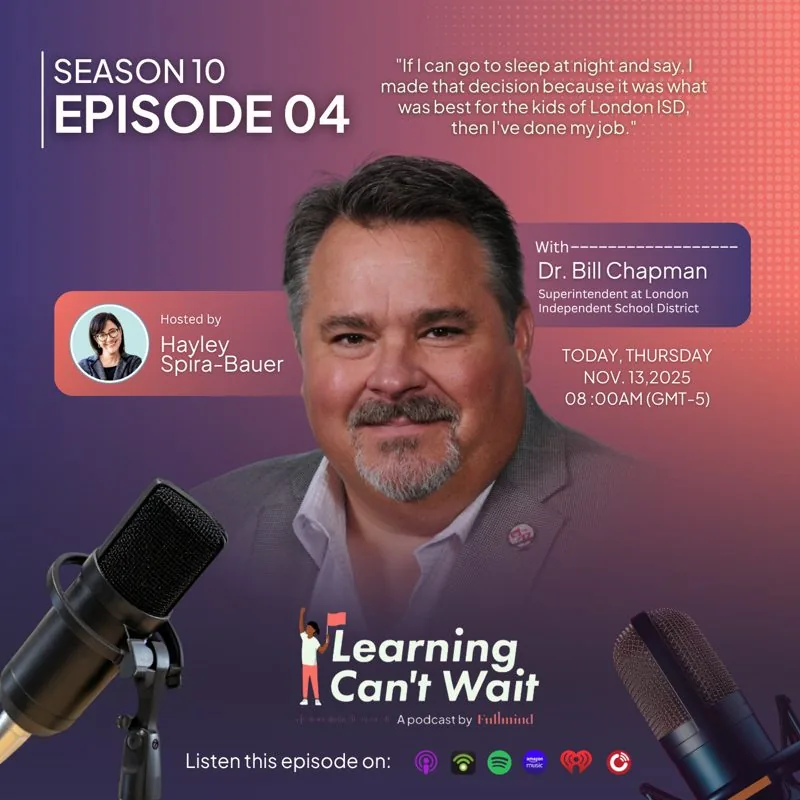
Dr. Bill Chapman: Rural education, Student engagement & Leadership visibility
- Dr. Bill Chapman, Superintendent of London ISD in Texas and president-elect of NREA
 Hosted by Hayley Spira-Bauer, Chief Academic Officer at Fullmind
Listen now
Dr. Bill Chapman: Rural education, Student engagement & Leadership visibility
Episode summary
Dr. Bill Chapman, superintendent of London ISD in Texas and president-elect of the National Rural Education Association, describes a roundabout path from accounting and athletic training to teaching, coaching, and 14 years as a superintendent across six districts. He explains why rural schools where students do everything see less absenteeism, how state laws written for Dallas and Houston create fallout for small districts, and NREA's new vision of strong rural schools and communities. He shares coaching his district's girls' soccer team to a record season, his practice of starting every meeting with good things, and why a superintendent cannot lead from an ivory tower.
Key takeaways
- Hire kid magnets: teachers students want to be around keep kids engaged and in school
- Small rural schools where students join everything have had less of an absenteeism problem
- Laws written to fix big-city problems hit rural districts with costs for problems they didn't have
- Begin every meeting with good things and model collegial meetings for principals
- Being visible on every campus is the most important part of the superintendent's job
About this episode
In this episode of Learning Can't Wait, Dr. Bill Chapman, Superintendent of London ISD in Texas and president-elect of NREA, shares his journey from initially resisting a career in education to embracing leadership in rural schools. He discusses the unique qualities of rural education, including close-knit communities and student engagement through multiple activities, and addresses challenges such as absenteeism and teacher shortages. Bill emphasizes the importance of empathy, visibility, and collaborative leadership in creating strong school communities and offers advice for new superintendents to always prioritize what is best for students.
Full transcript
Transcript generated from the recording; minor errors may remain.
Hayley Spira-Bauer: Welcome back, everybody, to the Learning Can't Wait podcast. It is always a good day when I get to have a school leader, and better yet, a rural school leader. On the podcast. And today, I get to welcome Dr. Bill Chapman, the Superintendent of London ISD in Texas, and the president-elect of NREA. Welcome, Bill!
Bill Chapman: Thank you so much, Hayley.
Hayley Spira-Bauer: You know I have a huge bias toward rural America, primarily because I have no experience teaching or living in rural America. And I think you have a really interesting story that we'll get to in a few moments. About all the types of experiences of leading districts in rural America. So, thank you for coming to the podcast.
Bill Chapman: You're so welcome, I'm glad to be here.
Hayley Spira-Bauer: You know, Bill, I always start off with the same question, so I'll start it here. What… how did you come to be the personal and professional version of yourself?
Bill Chapman: I think kicking and screaming could be a good way of saying it in many ways. I will tell you that I am the product of two educators. My mom was an elementary educator, my dad was a high school educator in career and technology and became an administrator. My brother and I were both Told to not go to education. That education was not a career that you wanted to go into because of finances. I could do so much better, and I should go into accounting, or business, or engineering, or something like that. And as you can see, I listened so well to my As did my brother, he's also… he's a teacher coach and just got moved into administration. So, as many boys did, we've got a list of our parents. But I… I literally… I went to school to be an accountant. And then swing out and realized I did not want to be an accountant, because I did not want to wear a suit and tie and a chain desk in a room by myself. And so, honestly, my dad, I was a freshman, sophomore in college, and he took me to a psychologist friend of his to do an aptitude test. And literally, the old school aptitude test, and said, you're really good towards this, this, and this. And what it came up with is working in medicine, working in athletics, working with people. Those are what they came into. So, I changed my major to become an athletic trainer.
Hayley Spira-Bauer: Mmm.
Bill Chapman: I went to college, was an athletic trainer at UTSA, graduated. I realized I wanted to have something to work in a high school, so I got a degree in history, so I could then have a history, I could teach history, be a trainer, because at that time, you couldn't just be a… you couldn't be a full-time trainer then, you still had to teach a class. So if I want to teach. I like history. I always was a history buff, so I got a degree in history at UTSA, a minor in physical education because of the athletic training classes I was taking, and I took all my hours and my exams. To this day, the hardest exam of my life was to become a licensed athletic trainer. And because it was a… it was a written test and a practical test, and it was the hardest exam I took it in Houston, Texas. And I never worked a day as a trainer. I… I went to… my parents worked for Corpus Christi ISD at that point in time, a very large district with 5 schools, and I went and visited with their assistant athletic director about… and she took me to all the 5 schools and the trainers. They all had trainers. At that time, it was only you had one trainer. Now, schools have two and three trainers for large schools. Sure. That was not the norm back in the 90s. And… but they said, oh, well, we also see that you coach soccer, you've refresh soccer, you've played football, all this kind of stuff. She goes, you know, we have… we have some coaching needs. And so I talked to… I shifted and became a history teacher and football and soccer coach at Moody High School. And just through there, began my progression. My wife pushed me to get my master's degree. I was thinking of becoming a head football coach, athletic director. But somehow, as I say, I drifted to the dark side, and went to the administration route, and became an assistant principal, and a principal, and an assistant superintendent. And superintendent. So, I, I, I… I can tell you this, I landed where I'm supposed to land. I truly believe that. I landed… I may have gotten here in the most roundabout way, but I am where I am supposed to be.
Hayley Spira-Bauer: You know, you started off by saying that you didn't listen to your parents, and neither did your brother. I hope my boys aren't listening to this episode, but sometimes it works when you don't listen to your parents, you know? They don't always know. But, you know, it's funny, as you were starting to tell this story, I was listening to you, and you are such a people person. You and I met at an event at the NREA conference in Utah this year. You're such a gregarious, big personality, so kind, welcoming, and inclusive. Which is what makes a great teacher. So then you said you took this aptitude test, and it talked about you being a people person. And I just wonder if we sold the profession more as being a people person, if we would get more teachers to come into the field, since we're facing somewhat of a crisis these days. I just, you know, it makes me wonder, because I too consider myself a people person, and I think it really lends itself well to being an educator.
[05:00] **Bill Chapman:** No, no, it does, 100%, because you have to have that empathy for other people, and truly, people who are really great teachers, I'm not gonna say all teachers, people who are really great teachers have that high level of empathy. To where they're able to really see that kid for who they are and what they can be. There's some that don't, so that's a different world. Those are the ones we try to not get out of the profession. But we really… we have that ability, and it's just… We want people to do well.
Hayley Spira-Bauer: Yeah.
Bill Chapman: You're becoming a teacher because you want to see people grow and change and adapt, and give them the skills and the lessons that they can take far outside my classroom. And, you know, it's 100% true. I think there's a piece that your best teachers are those gregarious people, people. And you know… the term we use, and I use, you know those kid magnets. You know those kid magnets in your school, on your coaching staffs, on your… wherever it may be. That's who I want. When I was… when we were hiring for our AD this last year. In the… in the… when I was meeting with the committee who was doing the hiring, I go.I need someone who is a kid magnet.People who… someone who has those… wants those kids to be around. They want those kids around, they drive those kids to them, because you get those, any program can grow. And so, you can see that on campuses and with your great teachers. You are 100% correct.
Hayley Spira-Bauer: No, I… I love that, that that was part of how you hire, is thinking about who are the kids gonna gravitate towards? I mean, today there are two crises that I've touched on one already, which is shortages of teachers across the U.S, and it's not pervasive in every district, but we have lower enrollment in programs right now than we ever have before. The second crisis that's hitting America right now are… is absenteeism. You know, student… students are enrolled in school, but they're not always going. Now, I know you've worked in many different districts across Texas. And I'm curious, you know, but as I hear you talk about people, or kid magnets, kid magnets get kids to school. Right? Like, those are the teachers that, when you have their class, you don't want to miss it, because you want to be near them, you want to be with them. So, I think that that's a cool, like, another application or solution to the absenteeism issue. Curious if the districts that you've worked in, London included, but your previous as well, have faced the absentee… Absenteeism crisis, and how you've handled it to get kids to school.
Bill Chapman: The short answer is yes. The long answer is some have and some haven't. And I will tell you that I've been blessed, so this is my 32nd, 33rd year in education. I taught for… I taught and coached for 8 years, was an AP for 3, associate for 1, 2, principal for two, and so all of the… I think this is my sixth district. I will tell you that the absentee problem was more of an issue in the larger urban and suburban schools I was in. I'm gonna be honest with you, the rural schools, we did not have as much of an attendance issue. Until a few years ago. The COVID change and return from education, did change that a little bit. We did not get hit as heavy as the urban and suburban schools did in where I was in Palacios and here in London, but it is there. I will tell you it's there.
Hayley Spira-Bauer: Hmm.
Bill Chapman: But I think… I will tell you what I really believe. So, my first high school was a 2,000-kid high school. In the middle of Corpus Christi. It was the school that had one of the highest low socioeconomic statuses. We had… were predominantly Hispanic, and we were the afterthought school in many ways. My next school, I moved to one about 1,800 kids in Huntsville, Texas. I don't know if you know where Huntsville is. Huntsville is about an hour north of Houston. It is home to the Texas Department of Corrections. There were about 7 prisons inside our area. There were 7 prisons, Sam Houston State University, and Forest. There was no taxable entity, so we were a very poor school. With most of the land owned by the government. Who had a large part of the population that lived there, who was there because they were there to visit their parents, and be close to their parents. That happened. Then I moved to Coldspring, a little east of there, which was my first true rural… I went to Willis for 4 years, which is more of a larger suburban school. More affluent, and then as principal at Coldspring, that's where I really hit my rural, my rural roots. It starts in Coldspring, I believe. The… The difference between those urban, suburban, and those rurals is, when you get to a rural school, one, yes, it's smaller. First and foremost, that size of a school matters. As someone who spent my entire life in high schools, once you break above that. 12, 13, 1400 number kids, that school starts to be hard to manage to keep everybody Moving forward the same direction, everyone involved. That… but if you get down to those 400 and 500, 600 to 1,000 kid schools.
[10:00] **Hayley Spira-Bauer:** Hmm.
Bill Chapman: Your kids are doing everything. I mean, your kids are, you know, still marching in the band while they're playing football. They're cheering and playing volleyball. They're involved in multiple sports. You're always gonna have those kids that will specialize in one or two sports, but, you know, really, you have that. They're involved in FFA and athletics. You have to do… they're so involved. Which keeps them engaged in that school setting. There is a… that's what I refer to as the quality of life of a rural school. Where… You know who the kids are, because they're involved in everything.
Hayley Spira-Bauer: Right.
Bill Chapman: So, you can throw a rock and find that kid's in 15 organizations.
Hayley Spira-Bauer: Right. But by them being engaged in school.
Bill Chapman: It's harder to miss school.
Hayley Spira-Bauer: Mmm, yeah, no.
Bill Chapman: And also, they get so many absences for their activities that they can't miss school because they're already missing too much school because of their activities.
Hayley Spira-Bauer: Well, that's a fair point. And truly, the disengagement crisis, which is attributed a large part to attendance issues in schools. You're naming the antidote for it, which is, everyone just moved to rural America! Well, you have a soft spot in your heart, though, for rural America, Bill. You name when your roots started, and some of the benefits of being in rural America, and how you've seen it play out as it relates to one particular issue. Talk to me a little bit about NREA and what the organization does to help foster relationships amongst these isolated schools, and why you're taking on the presidency in the future.
Bill Chapman: Well, I'm taking it on because I stumbled onto being a… I was first in the Texas Rural Education Association, which is the Texas affiliate of NREA, and that's how, really, how I got into NREA, I just… I just… I got involved, and it was… great, because I didn't know what I was doing and not doing, and where I was going, and I mean. It gave a point to where I was, like, going, this is… this is a niche where, you know, people always talk about putting money into schools and fixing schools, but when the… when the state and federal governments are looking into Fixing schools to some extent. What they end up looking for Is they try to solve problems at your large urban and suburban schools, just because that's what they're targeted to do. There's… there tends to be more issues there. I'm not saying it's right or wrong, it's just… it's just what it is. But what happens is when… even Texas… Texas passes a law to solve a problem in Dallas, Houston, Austin, San Antonio.We get the shrapnel of that, and the fallout of rural schools is felt because we're having to solve a problem that we didn't have.But that takes money, and time and manpower, and things like that. So what NREA, what I found so much, and we actually redid our vision and mission while we were at… in Salt Lake City. You know, we've turned into… NREA envisions strong rural schools and communities where education is the catalyst for resilience, opportunity, and success. And so, why that means so much to me is, yes, we are focused on those schools, but we're also focused on… our rural schools are only as strong as our rural communities. And so, NREA is an organization that brings together K-12 practitioners. Community colleges, higher ed, researchers, all looking at things to help you know. Grow, the benefits of rural schools and communities, because it takes both. We're… they're both having… facing issues, and if the community starts dying, the school dies as well. And so, it's that tooth balance there that gets you there, to help go. So that's… that's where I kind of fell in love with, this makes sense to me. He's like, I live in Texas, and growing up, as my dad as an educator, we moved around a lot as he was chasing and growing into the administration of CTE. Then it was called vocational education, of course. But, so I spent time in some small, smaller schools, suburban schools. I mean, I moved… I mean, I moved… I moved after… 2nd grade, 5th grade, 6th grade, 8th grade, and 9th grade. And kind of hit the gamut of. Pretty… some fairly rural schools in Northeast Texas, rural schools in Southeast Texas, near the Louisiana border, and then suburban schools, in Corpus and Austin, area, and… And I will tell you that school is a school when you're a kid, but you can tell a difference in how you and where you belong in some of those different areas, and I really… I didn't realize it until I started working in Coldspring-Oakhurst High School as a rural school principal, where I got some of my sensibilities from. In my time in Carthage, and in Orange, and things like that, and the kind of fun you had in some of those areas in a rural school, as opposed to my high school piece being a little more suburban school. And I look back fondly on both of them. My high school was a rural suburban. It was still… now it's a totally suburban area, but it was kind of a little bit… we were… the west half of my district was all… all my friends and farms and ranches and FFA kids, so we had this piece, that semi-rural piece, but it wasn't quite what I experienced at other schools. But I go back to, there's a quality of life that some of these schools give you that you don't get in your urban, suburban schools.
[15:00] **Hayley Spira-Bauer:** That's really interesting. Are you talking about from the perspective of an educator, or from a student, or both?
Bill Chapman: Both.
Hayley Spira-Bauer: Yeah. Both.
Bill Chapman: My freshman year, I was at Round Rock High School, there were 4,500 kids There were almost 2,000 freshmen when I was a freshman at that school.
Hayley Spira-Bauer: Hmm.
Bill Chapman: I don't even know… I didn't even walk… and I never walked the entire campus. You know, there are buildings in my high school I never went to as a freshman. Was so large. And I moved to my time at TM, there were 750 kids in my school.
Hayley Spira-Bauer: My class was the largest class in each of the school. There was 200 kids.
Bill Chapman: You almost know every single person in your graduating class. And then I move into Coldspring. We were a 500-kid school. You know, there's 150 kids max in the class. And then same thing, about where we are here in London. Palacios is a little bit smaller, Jarrell was a little bit smaller when I got there. The ability to truly know your teachers, and know your classmates, and know your administrators, and you see them all… because there's no place else to go in Palacios but.
Hayley Spira-Bauer: Sure.
Bill Chapman: Grocery store, it's a…
Hayley Spira-Bauer: And that's where you see your whole… the whole team, the whole staff, etc.
Bill Chapman: I mean, if you go to Subway, one of my kids is making your sandwich.
Hayley Spira-Bauer: Sure.
Bill Chapman: Go to Dairy Queen, someone's making your Blizzard. Right. You know, that's because there's nobody else that's gonna do the labor but your kids. So you see them over and over. And it's just the fact that you see those kids everywhere. You get to experience that life in that small town, together. And it truly is… there's truly nothing like it.
Hayley Spira-Bauer: Well, this is why I'm obsessed with rural America, because I do a lot of work with rural schools through my role at Fullmind, but when I started the.
Bill Chapman: Podcast series, mini-series on rural schools, and started interviewing leaders, the community collegiality, resourcefulness, and collaboration.
Hayley Spira-Bauer: Blew me away. I am so used to the competition that exists in New York State, I worked in urban settings, and I've gone to school in suburban settings, versus the opposite is true. It's, you know, everybody's out to help their neighbor. You know, we're benefiting here together, we're growing together, and that really struck me as… something that more of America needed to know about, which is why I keep asking rural leaders like you to come on the podcast and share, because it really feels underrepresented in the stories we tell about education.
Bill Chapman: Well, you hit… you hit it. I mean, as someone… I've lived both. I've lived both, I've loved both, you know, I'll give you a story that kind of shows you that. Yeah, please. I'm in my… this is my 14th year as superintendent. I spent 8 years in Jarrell. Jarrell grew from 972 kids to 2200 kids. We were growing. We were growing out of being… being rural. Went to Palacios, in 2020. My wife wanted to go to the coast. We lived on the water. Palacios is a… was a… a… a… It's rural, but it's, like, really rural, where we're driving 40 miles to get to our Walmart. Or 40 miles to our HEB, 40 miles to a Whataburger, those kind of things. So, so you had this piece, but the kids were so great, and we had these great kids, and so my second or third year in Palacios, my AD, my athletic director comes to me and says, look, he goes. I have this… my girls' soccer team, I'm hurting, I cannot find a girl's soccer coach. I go, okay, well, how can I help you? And he goes, well, you coach girls soccer. And I go, well, what do you mean? He goes, you are by far the most qualified person in our school to coach this team. You spent 10 years coaching varsity soccer. He goes, you know the sport like nobody in this town. And I go, well, so I asked my board, I go, I'm being asked this, I go, do you mind if I coach our girls' soccer team? And so, they had a strong senior class, they had made the playoffs the first time in history the year before. And so, the superintendent, starting in November was the girls' soccer coach, and so I'd never coached girls before. I'd always coached boys. When I became the girls' soccer coach, and I loved every minute of it, because I got to see those 35 girls a different way. They got to see me a different way. I mean, most of the first week is, what do they call me? They kept saying, I'm.
[20:00] **Hayley Spira-Bauer:** First chat.
Bill Chapman: I'm not Dr. Chapman, I'm Coach Chapman. And so once we got past that, and once I learned that,
Hayley Spira-Bauer: Traveling with girls on the buses and traveling with boys on the bus, it was a totally different experience for me. I didn't realize how much time was devoted to doing hair on the way to a game. Sure.
Bill Chapman: But luckily, my assistant helped… she taught me that very quickly. But we had a great year. We made the playoffs. We won the most games in school history. We scored the most goals in school history.
Hayley Spira-Bauer: Wow.
Bill Chapman: Parents were… were just thrilled to death because they saw that our girls progressed. We were in the hunt for… we had a great season, and… but I got to spend so much more time with those girls, and learn… I got to see… The district for a different level. Also was the most… we also were the most successful program that year, athletically.
Hayley Spira-Bauer: Look at that!
Bill Chapman: I hang that over our coaches the following year.
Hayley Spira-Bauer: Right? I mean, you rolled up your sleeves. You should be able to brag about it.
Bill Chapman: So, you hear those pieces, that's what makes rural.
Hayley Spira-Bauer: Yes.
Bill Chapman: School's different. You hear stories of the superintendents driving the buses, you know, hitting the roads.
Hayley Spira-Bauer: I always tell the story of the superintendent who had to get his boiler license because he couldn't get someone within 4 hours to his school site.
Bill Chapman: We don't have boiler problems, we have air conditioning problems.
Hayley Spira-Bauer: Sure, okay, you keep reminding me Like, in beautiful Texas, where it's 83 degrees.
Bill Chapman: And when I went to Jarrell. This previous suit handed me, here, by the way, here's the tractor key. I'm going, I have the key to the tractors?
Hayley Spira-Bauer: So I…
Bill Chapman: So, it happens, but it is that piece of… you know, when you're in a big district, you have so many people who do A and B and C and D. Well, in a small school, you do all A, B, C, and D, and E.
Hayley Spira-Bauer: Sure. Sure, you learn a lot. You learn a lot. Yeah. You know, Bill, we could talk as, like, you know, the next topic, I can bring up so many different hot-button issues in education right now. AI, or phone bans, whatever it may be, we've touched on a few already today, but I think beyond the specific topic is the larger question about mindset. And often in education, it is about getting people on board, finding consensus within a district, and then moving teachers forward toward the vision that you as the leader is trying to set and create for the community. Talk to me a little bit about, across the different years you've been a superintendent, in the many different places you've been a superintendent, how you particularly Bring mindsets forward as changes need to happen.
Bill Chapman: I'm a firm believer in that It can't just be me. It has to come from a variety of people. I am a… I'm a coach by nature. You go even more… I'm an offensive line guy, which is… offensive linemen are the guys who do all the grunt work, that no one sees what really happens, but without them, nothing ever… you never make a play. You never get… never throw a pass, never get a handoff, all that kind of stuff. So I always had that mentality going… going forth. And really what it is, is I'm willing to… when I came… so, this is my third district I've taken over, so I've been as superintendent. And so, my first and foremost is, I try to model for my principals how they should work with their teams. And then you take it to where you have the district level, my cabinet level, my district leadership, then you have your campus leadership, your teams, and I try to model what I expect their meetings to be like, and how it's supposed to be working together. I want people To have the freedom to talk, and to answer questions, and to ask questions, and really make a collegial atmosphere. To where you're willing to collaborate. And so, what I want to see is every meeting forever, An old. Flippen Group's Capturing Kids' Hearts. I don't know if y'all have it up there in.
Hayley Spira-Bauer: No, no, tell me, I don't know about this.
[25:00] **Bill Chapman:** So, the Flippen Group thing called Capturing Kids' Hearts was a program I went through, honestly, as a teacher, and then as a principal, and later on, and it really is a way of making sure that you can't teach the kid unless they know you care. That's all it's based on, until you know they care about them. And so, there's things about, you know, shaking hands at the doorway when you walk in the classroom. You know, having… playing name games with kids, creating social contracts in the classroom. To where these are our rules that the kids made up, not the teacher, the kids made. This is the rules we follow in this classroom about not interrupting, not, you know, being mean, all that stuff. You do the same kind of stuff with adults, and one of their core things was, every meeting that you have. Begin with good things. Personal, professional, school ways. So, every meeting I have, whether it's a cabinet meeting, a leadership meeting, a principal meeting, number one on the agenda is good things, and we talk about things. It could be someone's daughter's doing well in volleyball. It could be, you know, the team did well, you know, win in the playoffs, whatever it may be. Or something cool on your campus. But you start off with the… talk about the good stuff that's happening. Some weeks it's hard to find a good thing, so you really have to encourage people to get involved with it, and maybe, hey, we don't have school next week, that's a good thing. So, that's fine.
Hayley Spira-Bauer: We'll all recharge, yeah, exactly.
Bill Chapman: You know, you said the deal of… it's also about the people you're dealing with. And then, so, when we… when I meet with my principals, the same thing, that same thing happens, but I ask them, what are you doing with your staff? How are you growing your staff? How are you… do you… what do you ask your department heads, your grade-level chairs to do? And mimic this piece to where you start creating this mentality of, we're all in this together, and we all kind of have these… we're important in our own ways, and we work things up and work things down. And so, it sometimes takes a while to get principals to realize that, look, when we have principal meeting, you take this back to your campuses and do this, bit by bit, bit, and so everyone's there. And then, literally, the thing I'm doing is… my second district here is I'm only right now scheduling a time to where I'm going to go and sit and be on each campus for an entire day. That teachers can roll through and visit with me during their conference. Don't have to come over here. I'm in some room somewhere on their campus, and they can come visit with me to make sure that, hey, they can talk whatever they want to. It's just, I won't say anything, it may be good, bad, or ugly, I don't care, just come visit. I'm a firm believer in them seeing me. Being approachable. I try to hit every campus every week if I can. Sometimes it gets difficult. But I want to be seen. You know, I spent probably an hour and a half at the elementary campus yesterday, having meetings with the principal. We met in the library, we just wander around the campus, go out to recess, just check things, talk about things. Just…you know, I can't, as a superintendent, I can't reside in some ivory tower.
Hayley Spira-Bauer: No.
Bill Chapman: And expect to know what's happening. And expect to know what's going on on the campuses. And so. If I make the effort and be out there, you know, it's being visible. I hate to say it, part of this job, the most important part of this job as a superintendent is being visible. Being visible to parents, to kids, to teachers. That's, you know, whatever you want to say, I think that's the biggest part of what I try to do.
Hayley Spira-Bauer: I think… when I hear you talk about it in that way, it reminds me about the earlier part of our conversation, being people… people people, right? You know, that it is a huge… component of being a good leader is being present, being visible, and listening, which is one you can learn, but often very innate. So, appreciate that call out to how you build consensus and how you shift mindsets, and… Your community, because often that is the hard work of being a leader, is doing things that are not popular, but are important, or necessary, or driving you towards your goals. And getting everybody on board. So, I guess as my final question for you, Bill, I want to ask you, what advice would you give a superintendent who's starting their career today in rural America?
Bill Chapman: You will wear many hats. You will make many decisions. You will, encounter things you don't want to do, and things that you wish you didn't have to do. Honestly. I try to make sure, and the best thing you can do, and at times, people make it harder than it is. Is, as you're working To make your district better. You gotta keep what's right for the kids in that forefront. A lot of decisions that I make. People can come out from one side or the other.
[30:00] **Hayley Spira-Bauer:** Right.
Bill Chapman: If I can go to sleep at night and say, I made that decision. Because it was what was best for the kids of London ISD. Then I've done my job.
Hayley Spira-Bauer: That's like a mic drop right there. Bill, thank you so much for coming on the podcast and sharing your… just your joy for this work, and also how you make it happen, and how you've made it happen in all kinds of schools. We really appreciate you being a guest on the Learning Can't Wait podcast.
Bill Chapman: Thank you, ma'am, I appreciate it, Hayley.
Hayley Spira-Bauer: And thank you to everybody who tuned in today.