
Learning Can’t Wait · Episode 230
Student Safety, Community Trust & Resilient Leadership
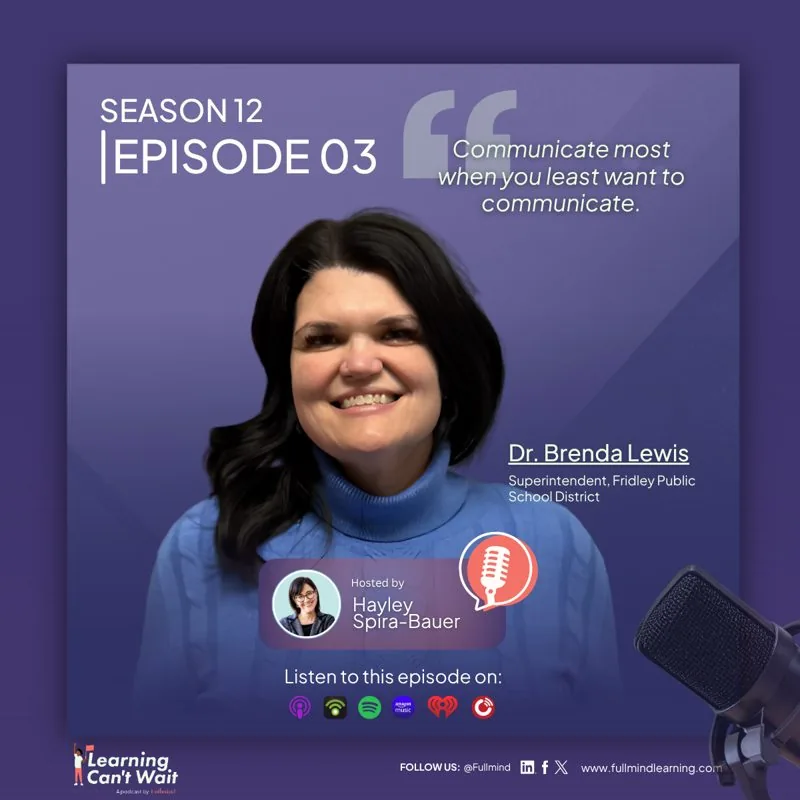
 Hosted by Hayley Spira-Bauer, Chief Academic Officer at Fullmind
Listen now
Student Safety, Community Trust & Resilient Leadership
Episode summary
Dr. Brenda Lewis, superintendent of Fridley Public Schools outside Minneapolis, recounts the school year when federal immigration agents staged in district parking lots, followed staff and board members, and disrupted student arrival. She describes door-to-door transportation, a virtual option that enrolled 473 students, and grocery and rental support, and explains the district never interfered with enforcement but insisted agents follow the law. She discusses lingering fear, enrollment losses, staff sustainability, and advice for superintendents: communicate most when you least want to, and stay political but never partisan.
Key takeaways
- A district can insist agents produce a warrant without interfering in immigration enforcement
- Fear drove attendance drops; door-to-door transport, virtual school, and food and rent support kept students learning
- The hardest lasting impact is no assurance it won't happen again; families have moved to other districts
- Staff safety now comes before belonging; name what happened and don't normalize it
- Communicate most when you least want to; jobs are political but cannot be partisan
About this episode
In this episode of Learning Can’t Wait, Dr. Brenda Lewis, Superintendent of Fridley Public Schools, shares her leadership journey from paraeducator to superintendent and discusses the challenges her district faced during ICE Metro Surge. She explains how immigration enforcement activities on and around school property disrupted student attendance, created fear among families, and threatened students' access to their constitutional right to education. Dr. Lewis reflects on leading through crisis, supporting staff and families, rebuilding trust within the community, and maintaining a steadfast commitment to student safety, belonging, and public education. She also offers valuable leadership lessons on communication, transparency, governance, and leading through core values.
Full transcript
Transcript generated from the recording; minor errors may remain.
Hayley Spira-Bauer: Welcome back, everybody, to the Learning Can't Wait podcast. Today's guest is a bucket list guest for me, and if you know me, you'll soon know why that is. I'm so honored and thrilled to introduce Dr. Brenda Lewis, the Superintendent of Fridley Public Schools to Learning Can't Wait. Welcome, Brenda!
Dr. Brenda Lewis: It's so good to be here, thanks for this honor.
Hayley Spira-Bauer: Thank you so much for joining us. I know there has been a lot going on in your community. You have been all over the news as an outspoken proponent of ensuring your children are in school every day, which Seems controversial in the news, but isn't so controversial.
Dr. Brenda Lewis: First of all.
Hayley Spira-Bauer: And we'll get to that, but I'd love for you to tell everybody how you came to be the personal and professional version of yourself, just to kick us off.
Dr. Brenda Lewis: Okay, great. Well, without showing my age, I'm 27 years now in education, that's the only profession I've held. So I started as a paraeducator when I was in college, and then I became a first grade teacher, and then that led to assistant principal, principalships. Serving at the cabinet level, assistant superintendent, and now superintendent. And, I have sat in a number of seats, and I've been in a number of school districts. And a number of… I've also been overseas, and, have worked in Charter, Catholic, so it's been really, a journey. I, most of my career, though, has been in public schools. Most of my career has been in Minnesota, and this is my fourth year now in Fridley Public Schools, fourth year as a superintendent. This is my first superintendency. They tell you that year 3 is, like, a great year as a superintendent. And year 3 for me was ICE Metro Surge. So, I'm not certain that I… and I certainly hope that's not my best year, in my career, but that was my third year, so there we go. I'm also a mom to three children, and I've got now a senior in high school, a junior, and a freshman, so I have, that aspect as well.
Hayley Spira-Bauer: Well, your third year may have been a very challenging year, but it was certainly a defining one. Before we jump into the details of that experience, you know, you mentioned yourself, this is your fourth year, you're heading into as superintendent. You're also a mom to three kids in district. Can you talk a little bit about.
Dr. Brenda Lewis: Yeah.
Hayley Spira-Bauer: What again?
Dr. Brenda Lewis: Kids are in district, and one goes to neighborhood district, yeah?
Hayley Spira-Bauer: Okay, so two kids in district, but all kids who are in school, K-12, kind of what you're leading. I've done a lot of reflecting recently, about how it is to be a parent and an educator. You have a unique position. Can you talk about how being a parent and a superintendent shapes the way you lead?
Dr. Brenda Lewis: As a superintendent. Including during ICE Metro Surge, I felt way more competent than I do as a mom of teens. Especially as a mom of two girls, my son is pretty easy, my girls are easy to run in a different way, so I would say being a mom is really, really humbling, and I would say one of the… if I had a do-over card, my children, have… only been with me when I've been a principal or up. I did not have children when I was a teacher. Or an assistant principal. And I think the biggest learning for me is I've always had my children in the system that I've been in. And the biggest learning for me has been that sometimes I under-advocate for my own children because I don't want to seem like I'm using my positional power on behalf of my children. And that's something that we talk about as a family, when things come up. It's not too often, but that's a piece that I guess, for me, is still an area of growth, is that I under-advocate. And the way that that actually got elevated to me was from one of my children's teachers. Is that I under-advocate for my children. So it's an interesting balance, when you have to do that role, as being a parent and being the superintendent of schools. And my children are, children of Nigerian immigrants. So that was also… that's also a really interesting perspective to have, especially during a time as we had this school year.
Hayley Spira-Bauer: Yeah, thank you for sharing that. You know, for those who don't know Fridley, it's a small district, about 2,800 students, right outside Minneapolis. What makes this community so special to you?
[05:00] **Dr. Brenda Lewis:** This community, I know that when my time is ready to be transitioning out of Fridley Public Schools, I know I will not have another superintendency that I bleed in my soul. And Fridley is just a place of Immense diversity and beautifulness. And I think the whole world saw that. This year, and so our school district is 80% kids of color. We are heavy children that are from East Africa, heavy children that are from West Africa. Very significant Somali population, which plays into what we're going to talk about a little bit later on. We have a very rapid growing population of Hispanic Latinos, specifically Ecuadorian, children. Just 10 years ago, Fridley was 67% white, and now we're 80% children of color. We used to be what I would call… a… pretty typical suburban school district. Fridley has always been more like a blue-collar, community, but it was more suburban.Now, Fridley is suburban by location and urban by every other measure.We're 72% children coming from homes of poverty. Three years ago when I came, we were 13% children that are multilingual, now we're 20 and growing. So that just kind of tells you about the footprint of Fridley Public Schools, and to your point, we're located right outside of Minneapolis.
Hayley Spira-Bauer: I want to make space, obviously. You feel so passionate about the community you're in, and you got a little choked up there. It… speaks volumes to your character. And, you know, character's not what you say, but it's what you do. And here it feels like your character's on display and how you feel. So, I just want to say thank you for your vulnerability. I am going to now dive in a little bit to this past year. So, this past year really became… you know, a national story because of Operation Metro Surge and the ICE activity near your schools. Can you walk us through what it actually looked like day to day for your staff and your families?
Dr. Brenda Lewis: And Hayley, I'm gonna do just a tiny bit of wordsmithing on you. Our, immigration activity actually occurred on school district property. So, while ICE agents were also near all the time. What I'm going to talk about and center on today is them actually physically being on school district property and preventing children of their constitutional right to attend school.
Hayley Spira-Bauer: Thank you for that correction. As I said it, I actually caught it, and I should have corrected myself, but appreciate you keeping me honest, as I should be, so…
Dr. Brenda Lewis: Yeah, and no problem. And the reason that I wanted to really make that distinction is… There have been times when individuals are concerned that the work that we did in Fridley Public Schools was about immigration policy, or immigration enforcement or interfering in immigration enforcement, and none of that occurred. This was only when ICE agents came onto property without a valid or any warrant that they had. So, I will, walk you through just some of the things of how this manifested, in, the school year. It really started In December, as I talked about earlier in the show here, we have, a very significant Somali population, and we're very proud and honored of all of our children to serve, and very proud of our Somali families that choose us and choose to come differently. And in early December, the federal government put out the order that they were removing, the status around temporary status for Somali individuals. That applied to roughly 700 individuals in the entire United States, a little north of 350 in Minnesota. I do not believe that any of those individuals attended Fridley Public Schools. Most of our, if not all, frankly, of our Somali students are either U.S.-born. Or they are citizens here. However, what that did is it upended our community because our Somali community understood from the federal government that you don't belong here, and we don't value you. So that's when we first started to see significant attendance issues, but our community really trusts us. And we've worked hard for that trust, and we should, because our Somali community has not always, in public education, been treated in a manner that they should be and deserve. So, we then started to stand up transportation. Door-to-door, because our families were really worried about bus stops, they were really worried about their children walking, right? And what became 18 in one day became 63 in another, the next day became 75, etc. So that's how it really started, was with that piece. And then I… thought December was really bad. I thought it was really bad. And, we messaged the community. Our community is really what carried all of the beautifulness of Fridley through what happened to us, and I kept telling people, and… I think maybe it was my brain subconsciously helping us to cope in the moment and not understanding the horror that was coming. I kept telling people, we have a two-week winter break, ICE Metro Surge is gonna die down into… after winter break, like, they're gonna leave, like, this is horrible, we just gotta get through, right? And I think that temporary order came out around December 9th, so we really And it seemed like a long period of time, but we made it. We made it to winter break, right? And then we came back from winter break, and it had escalated out of control. And the next kind of notable point in our journey was the day that Renee Goode was murdered. In the afternoon, ICE agents were on a Minneapolis public school property, during dismissal, and then at the same time, ironically, they, pulled over a white U.S. Citizen American-born teacher of ours, for reasons that we still don't know, and six, ICE agent cars, vehicles, so more than 6 agents, but 6 vehicles, pulled her car over right near our school district and held her at gunpoint, and then, she didn't… know what to do, and then she drove off, and they actually followed her for several miles until she got to a sanctuary city, where she pulled off, and then… was able to put her car in a place and have a significant other pick her up, and then the next day, we then provisioned for ICE agents to come and, like, retaliate against her, those pieces. Again, at that moment, I thought it was really bad, messaged out to the community. That same day, then, that day after this traffic stop, we had a teacher that went, during her lunch break to a very close restaurant here grabbed, to-go order, and ICE agents came and did a raid at that time, and then the teacher got confronted and yelled and screamed at, and it was a really, kind of a… not kind of, it was a dangerous situation. Again, none of this happened on school district property, but this is kind of how it began. Then, the… New York Times had reached out and wanted to follow us for two days, and when the Renee Goode murder happened the next day, we saw more than a third of our students absent. And so then we decided that afternoon to stand up virtual. Then, we had 473 kids enrolled in virtual. We had 75 kids that we didn't know where they were, in addition to the virtual. It was, we had families not able to leave their homes, so we started standing up grocery support, rental support, all the things, and then, when the New York Times reached out, they went with me to a press conference, which was kind of a turning place, where a… one of our local senators asked for me and others to speak and to talk about the impact, and during that time, when we were in the press conferences, when threats started to come to us about the work around ICE and, protecting our children. And then, if you fast forward, that day after the press conference is when we first had our first ICE involvement on school district property, and they were just there. We had stood up observers as well for arrival and dismissal. Then it heated up more. Where, the day after the New York Times article came out, the day of, excuse me, came out, like, 4 o'clock Minnesota time. Then we had ICE agents stage in our middle school parking lot, and we were doing a huge rental that day at our middle school and high school, over a thousand people coming, and we had, like, 30 to 40 ICE vehicles sitting staged in our school district parking lot. At the same time, they were all We're also staging in another school district parking lot at an elementary school. Then, that Monday, following that, they were also staged, again, during a school day. At our Fridley Middle School, before the school day started. No reason given, no warrants, no contacting the superintendent's office. Then that afternoon, we had a school board member see on her Ring camera footage that, several ICE vehicles were sitting outside of her house for a pretty lengthy time. She's a U.S.-born, American-born citizen, white, racially identifies white. Then, later in that week. I, suspected I was being followed to work, by ICE agents, and at that time, it was kind of scary, but it was a good little warning for me, because I learned how to navigate that. And then during the day. Oh, chaos broke out. We, were doing our morning patrols. And, board members were letting us know that there were vehicles sitting outside their home. We were seeing these ICE agents. So literally for 6 to 7 hours, ICE agents were sitting outside the homes of board members. And in one sense. That's horrible in another sense. At least then we knew they weren't, trying to… their resources were being used on school board members instead of targeting our children, right? So then, and this all happened in one day. I thought this was our birthday, but it wasn't. Then, that, school board member was followed for one and a half hours. We don't know why. She also had what I call kind of a double interaction. They were also sitting outside her home. Then that afternoon, 5 o'clock or so, I left here the same morning that I was following on all this chaos. And, I went to a school district bingo event at an elementary school, and I was followed, pretty aggressively by ICE agents that afternoon. But at this point. I had become so numb, it was the craziest thing. Like, looking back, I got to the bingo event, and one of our security team members was there, and he's like, hey, Dr. Lewis, and I'm like, hey, and he's like, how are you? And I know him very well. And I said, oh, I was just followed here by ICE agents. And he's like. Like, how many? And I said, only, like, 6 vehicles, but, like, nothing happened. They just pushed me over to the side of the road. I just kept going, like, it was just, like… and then, like, they kept following me and cutting me off, and all… and he's looking at me, and he's like, okay, and then to the point where I didn't even tell… like, I forgot to tell our assistant superintendent. Like, I just forgot. Right? And so it was like, none of that is normal, but that just kind of tells you the mindset. Then, we, again, are doing press conferences and things like that, because I knew that we needed helpers. And when I first started out, I said, we have no helpers. And then… I started to say, we're building our own helpers, and a huge helper in that was actually the media. And… elected officials, and what they would do is they would come, and they would come on our patrols, and they would always start naively, like, oh, I wonder if we'll see ICE today. And I'm like, you're gonna see ICE? What we want is, we want to have no interaction on school district property. That is all we care about. And then I would always say to whoever was with me after patrol, I would say it was a good day to what got murdered and no one got snatched. Like, and that was a good day for us. And just looking back on how crazy that is, then we had, kind of a… a really bad day. We were on patrol in the morning, and a principal reached out with a protocol, and… she had, ICE agents. She… her school is, like. One block away from a roundabout. And, the roundabout Six ICE vehicles got in the roundabout at arrival and prevented our crossing guards, which are adults, employees, from crossing our children. And the children couldn't come to school at that moment, because they wouldn't stop circling in the crosswalk. And then, I mean, the roundabout. And then what they would do is they would go… it's marked 35 there, but it's a school zone also, right? And so they would go up and down at rapid rates of pace, and we're a very urban footprint in our district, so the school is right next to the road, and everybody has to use the road. So that was happening, the roundabout is happening, they're racing up and down. Then, this vehicle of at least four ICE agents who are wearing armbands up here. Come in, and they start screaming and yelling. At our principal during arrival, and school staff, and families, and filming them, and videoing, and taking pictures of them, and then they said they were media, but they weren't. And we, at this point, knew exactly media has badges, they call ahead, they reserve all that. It was ICE agents then posing as media. At this point, I was over there managing this. It was also super cold. Super cold. We are literally, as families are now coming after arrival. I am out there, along with other team members, literally saying to families, again, most of our families are black and brown, literally saying, ICE is here, do not get out of your car, because when you come a little bit after arrival, you walk your child in, especially at an elementary. And I'm like, do not get out. I'm like, you're black, please do not go above 35, set your cruise, make sure you use your blinker, like, turn into the right, like. The superintendent of schools is grabbing children out of cars and warning families about ICE agents, who are creating absolute chaos. This is also the morning that it was announced that 700 ICE agents were exiting. Then, at the same time, as if that wasn't enough, a school board member reaches out and says, I'm being followed by ICE. And she had her 3-year-old in the back, she lives right by this school, she's her 3-year-old in the back, and her child attends our school district for childcare, and is getting followed on the way as a school board member. U.S.-born, white. American school board member. So that day happened. Then, the next day, we had ICE agents, just one vehicle this time, which is pathetic that I'm like, oh, just one. They were sitting at one of our elementary schools, a different… the other elementary school, That day, and then, Senator Smith came on patrol, she reached out, and then she reported everything back to Tom Homan, and that was the last day that ICE agents came on to Fridley Public Schools or any other public school district in the nation. So those are… I've missed a ton of examples, but that's… Kind of… and again, that story is one day.
[22:00] **Hayley Spira-Bauer:** For those that have knowledge of these events in Minnesota, I imagine that it's still surprising to hear it, and surprising to hear at what lengths you had to go through as a leader to ensure kids could come to school. You know, what I think you have made the point of really distinguishing here on the podcast already has been the fact that this activity prevented students from getting their constitutionally protected education. Let's fast forward some time. It's now July 2026. School starts on what date for you?
Dr. Brenda Lewis: September 2nd.
Hayley Spira-Bauer: September 2nd, and there's some new… there are news reports about Fridley having trouble locating many families for the return to school this year. That is one impact that you may be seeing already for the return to school. Can you talk through what other impacts you're seeing? On the far end of these events.
Dr. Brenda Lewis: The biggest impact that we're seeing is we don't have assurances because sensitive locations, which was in place for 3 decades, hasn't been brought back. So we have zero assurances that what happened will not happen again. So that's the biggest impact. There's been no… I struggle with the right word. Closure is not the right word, but it's the word that I'm coming… there's no closure, there's no assurances, right? So we have these ugly, horrific signs that I had installed that say, like, you can't come on property, you can't do surveillance. Etc. Is that really going to prevent ICE from coming onto our property? No, but it's one more line in the sand where we say we expect you to follow the law. I'm not saying you can't come on property, I'm saying you have to produce a warrant, just like every other law enforcement agency has to. That's all I'm saying. So we're sitting… our biggest impact is we don't know if it's going to happen again. We don't know with the intensity that it will happen. So, I would say there's still this level of fear and uncertainty. The second thing that I will say is. Fridley Public Schools has worked very hard. To rebuild trust with the community. That trust that had been eroded for several years. We had, schools that were understaffed, that was resulting in behaviors manifesting, etc. We have worked so hard to fully staff our schools. To rebuild that, and now we have through literally no fault of our own, families that literally were crying on voicemails telling us that they were choosing districts that were safer than Fridley from federal agents. So, if I, as a mom. Made that decision, which… I 100% would have if I wasn't the superintendent of schools. If I had moved my children to a district And open enrollment in Minnesota is very broad, so that's very easy to do that. And if… and many of our students are open enrolled to begin with, so going back to their neighborhood school is not a big deal. And if I had chosen to do that in January, I certainly wouldn't bring my child back for yet another transition. Right. It's this whole piece of… Our safety and security for our children and our staff and our community was taken away from us, and we don't have assurances that that will never happen again. That's the biggest impact.
[25:00] **Hayley Spira-Bauer:** Yeah, I… I'm envisioning what it must… feel like, on a personal level, to have this community that you're so proud of, that you started the call speaking so highly of, and seeing it fractured in so many ways. You've talked a lot in the media about your staff showing up in extraordinary ways all year, and I… and I'm wondering how… how that level of resiliency has become normal. How are you protecting your teachers and staff For next year, so that they can recharge and come back with the energy that they need to… both protect, but also educate their… the students of Fridley.
Dr. Brenda Lewis: Yep. The first way that I would say that we're doing that is acknowledging what happened. So many… people… people being… community members, not inside Fridley, but the general public? Some just want to sweep it under the ruck, right? Like, that didn't happen. Federal agents didn't do that. No one's coming after children. Like, it happened. And we're gonna talk about that that happened, and we're gonna call it wrong, right? And we're gonna acknowledge that this happened. So… As we come back to the school year, it's things like continuing to fully staff our schools, even in times of severe financial hardship. It's ensuring that our Black and Brown and immigrant staff feel? Safety first, and belonging. If you had talked to me last year, well, I wouldn't even have this concept right. But if you would have asked me last year, I would have said belonging, and I wouldn't have put safety. And now I put safety first. We have to ensure that staff feel safe, right? And not targeted. And then we have additional supports if people want to go beyond, the employee assistance program. Our health insurance partners have offered that additional support. And we use language, including in school board presentations, that say. With the impact of ICE Metro Surge. So it's… that's what I mean, is when we talk about it, and we validate that, right? That's what we talk about, and that's how we acknowledge and… We honor what happened to our community, but more importantly, we honor that the level? That our staff went to is not sustainable. And number two… I continue to say, please don't normalize this. And that's what I think is really the underpinnings. It happened, it was horrible. It was unacceptable. We will continue telling our story so that it never happens to us or anyone again. And by the way. You took extraordinary levels, and I'm worried about that because it's not sustainable. So those are kind of the steps we're taking.
Hayley Spira-Bauer: Yeah, those are pretty concrete, and while the situation is… new to the challenges that superintendents face on school grounds, I do think that the solutions you're implementing are applicable to other trauma-based events that occur in communities in a way to protect the staff and make the work sustainable, because We need our teachers to be healthy and well-functioning to support our learners so they can be healthy and learning in classrooms. I want to switch gears a little bit, not to gloss over these events, but I know there are so many things you're excited about and hopeful for this school year. Can you share a few things that have you lit up inside when you think about the 26-27 school year?
[30:00] **Dr. Brenda Lewis:** Yeah, so today… and staff know me well, right? It's my fourth year, it's a small district, and a staff member said to me today. Enrollment's looking good, Brenda. And I'm like, good! Like, they know, like, I'm gonna be watching that, right? We are launching a virtual program. We had that, but it was made in the middle of ICE Metro Surge, so we're doing that now to not only cater, to our families that chose virtual, but also for other families that are Fridley Public Schools residents, or through open enrollment. We're very excited about that. We also are, in Minnesota, like many states, we've been doing a lot of work around literacy, and the work that is being done in our district around literacy is unfathomable. Like, I see the results, and I literally have principals and, international baccalaureate coordinators that literally contact me, and they're like, oh my god, you need to see the data. Like, this is crazy, this is unprecedented. And, like, just hearing that. And seeing the energy around it. Really makes me excited, and the fact that our community still believes in, and I think even stronger, for the public schools. That's what I'm most excited about.
Hayley Spira-Bauer: Those are some great things to be excited about. You know, Brenda, even in the short conversation we've had, you've really dropped a lot of practical thought leadership, wisdom, advice. I am a lover of pedagogy, but I also believe that in education, the here and now is so vital. So, as a final question, I'm going to ask you, what advice would you give a superintendent who's starting their superintendency today?
Dr. Brenda Lewis: Have they been hired yet or not?
Hayley Spira-Bauer: Yes, they're hired.
Dr. Brenda Lewis: Okay.
Hayley Spira-Bauer: Give me both, why not? Let's see…
Dr. Brenda Lewis: Why do you ask that? So, oftentimes, myself included, when you are trying to land your first superintendent job. You apply for a lot, right? And it hurts when you don't get those jobs. And as much as you want to tell yourself a story, it doesn't, it does, right? Especially if you make it all the way. And then in the state of Minnesota. Usually, finalists, and especially semi-finalists, are announced publicly, so everyone knows you didn't get it. And people are supportive, but you feel kind of like a loser, right? So, where I'm going with this is… I would tell aspiring supes first of all, what people told me, your right fit is coming, your right fit is coming. It didn't feel like it in the moment, and the universe delivered. This is my right fit. Like, I couldn't be more thankful. The second thing I will say is… Make sure, unequivocally, your core values are a mirror of the school system in which you are interviewing in. And thirdly. Tell the truth during your interview. Talk about your core values. Otherwise, they're going to hire you, and you're gonna be expected to lead how you interviewed versus how you actually are. So be very certain that you come across in a way that mirrors your core values. What I would tell brand new superintendents is.Communicate most when you least want to communicate.Your community will really trust you if you tell them information quicker. Rather than later. And they will also pardon you. If you gave information at the time that was accurate, and then you followed up and said, I have better information now. People believe you when you tell them. They also believe you when you make a mistake, and you say, I missed the mark here. So, I think that communication is the number one piece that builds trust. And the second thing that I will say is. Do not keep your board in a place where they don't have the decisions to make the information to make good governance decisions, because oftentimes we talk about governance versus management. However, in order for our board to govern well, we need to give them the information. So… really work hard with your board to be a partner in that. Really work hard. And the final thing that I will say is, in the time of here and now, of public schools, not always being held in high esteem as they maybe were a decade or longer ago. To know in your soul what you stand for, and to ensure that you do that in a manner that's from a core value standpoint, and not a manner that's partisan.Our jobs are highly political, but they cannot be partisan.
[35:00] **Hayley Spira-Bauer:** Brenda, this has been such an honor to hear your story from you directly, and the story of Fridley Public Schools, but also just the level of humility and vulnerability you showed on the podcast speaks volumes to who you are at the core. Thank you so much for coming on the podcast today, and being so yourself.
Dr. Brenda Lewis: Well, right back at you. I appreciate it. It's such an honor, and always happy to… to follow up.
Hayley Spira-Bauer: Yeah, I think there's going to be a part two, so stay tuned for the part two, and thank you to everybody who tuned in today.
Dr. Brenda Lewis: Thanks again.