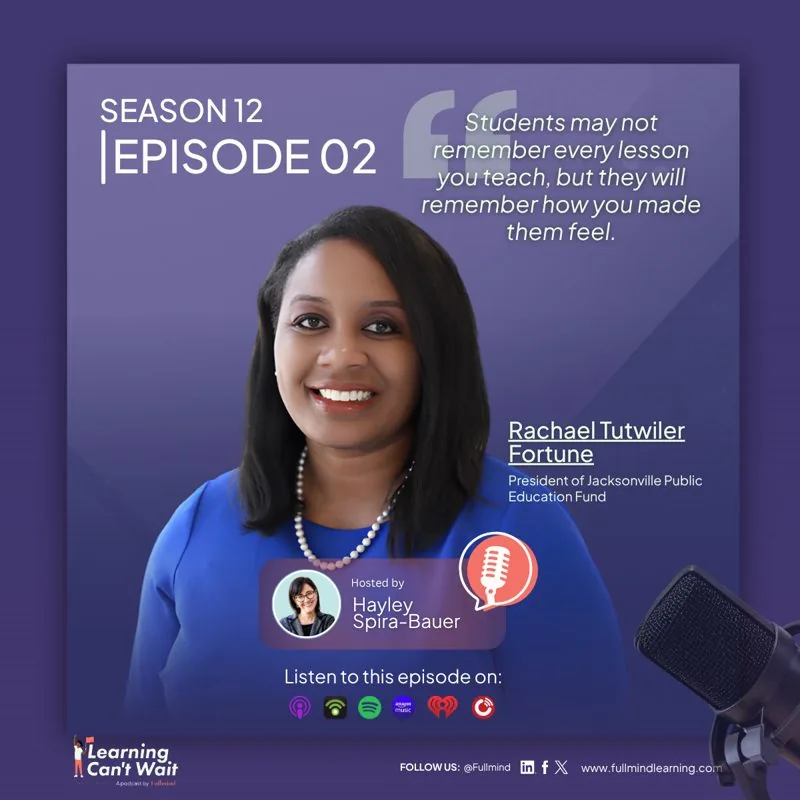
Learning Can’t Wait · Season 12, Episode 2
Rachael Tutwiler Fortune: Future Readiness, Community Engagement & Student Opportunity
- Rachael Tutwiler Fortune, President of the Jacksonville Public Education Fund, for an inspiring conversation
 Hosted by Hayley Spira-Bauer, Chief Academic Officer at Fullmind
Listen now
Rachael Tutwiler Fortune: Future Readiness, Community Engagement & Student Opportunity
Episode summary
Rachael Tutwiler Fortune, president of the Jacksonville Public Education Fund, describes becoming a mother at 16, teaching elementary school, and returning to lead JPEF. She traces Jacksonville's progress from one in three students not graduating on time to graduation rates above 90%, while literacy sits near 51%. She frames future readiness as strong learners, confident creators, and caring citizens, explains what makes partnerships last, and shares what she looks for in a school: belonging, respected teachers, high expectations, and families engaged as partners. She closes with advice for new teachers.
Key takeaways
- Jacksonville moved from one in three students not graduating on time to rates above 90%
- Future readiness is bigger than workforce readiness: strong learners, confident creators, caring citizens
- Lasting partnerships start by defining success for everyone, then backwards planning together
- No parent doesn't care; start family engagement from empathy, not blame
- Students may not remember every lesson, but they remember how you made them feel
About this episode
In Season 12 Episode 2, Hayley Spira-Bauer sits down with Rachael Tutwiler Fortune, President of the Jacksonville Public Education Fund, for an inspiring conversation about community-driven change, future readiness, and the power of believing in young people. Drawing from her personal journey as a young mother who benefited from mentors who invested in her potential, Rachael shares how Jacksonville has dramatically improved graduation rates through collective action while remaining focused on literacy, workforce preparation, and educational equity. She emphasizes that preparing students for the future requires more than workforce skills, it demands developing strong learners, confident creators, and caring citizens who can thrive in a rapidly changing world.
Full transcript
Transcript generated from the recording; minor errors may remain.
Hayley Spira-Bauer: Welcome back, everybody, to the Learning Can't Wait podcast. I am honored to have our next guest joining us today. We have Rachael Tutwiler Fortune from the… excuse me, the president of the Jacksonville Education… Public Education Fund. I'm gonna do that one more time.
Rachael Tutwiler Fortune: Okay.
Hayley Spira-Bauer: I got nervous, Rachael, I got nervous. We have Rachael Tutwiler Fortune, the president of Jacksonville Public Education Fund, joining us here today. Rachael, I'm so happy you're here.
Rachael Tutwiler Fortune: No, thank you so much for having me, I really appreciate it.
Hayley Spira-Bauer: The best part about education is that you can find so many threads of commonality, but also learn so much from one another, and when I looked at… your background, and we met for the first time, I was like, oh, same, same, but different. And the ways you've approached your career and the chart, the path that you've taken is so incredible, and I'm really honored that you're coming here today to share with the Learning Can't Wait. Podcast audience.
Rachael Tutwiler Fortune: No, it is… it is truly an honor, and I always like to say kindred spirits, are drawn to each other, so I'm so happy we met.
Hayley Spira-Bauer: Yeah, same here. So, start us off. How did you come to be the personal and professional version of yourself?
Rachael Tutwiler Fortune: Yeah, no, I love this, this opening question, and I often say that, you know,my life is a testament to the power of the people who choose to invest in others.What is not on my CV, but is very much a part of my narrative, is that, you know, I became a mother at 16, and you know, there were many people who saw possibilities in me that I couldn't always see in myself. And, that experience really shaped my commitment to education and to opportunity. I, have… I've had so many incredible opportunities in my life, and it has always been about ensuring that young people like myself when I was a kid, like my son when he was a kid, and like those who are in school today, have every opportunity they can to maximize, or that they need to maximize their potential. I started my career as a teacher here in Jacksonville. I taught elementary school, second and third grade. I later worked at the U.S. Department of Education and with national educational organizations, and eventually found my way back home here in Jacksonville at JPEF to help lead the work that we're so proud to do in our community. And what I will say is that across every role. I've seen that lasting change happens because communities really come together around shared purpose, and that's really what our mission is about at JPEF. It's really become a central theme in my leadership and in my work to help prepare young people for the future.
Hayley Spira-Bauer: You know, when you return back to serve the community that you started in, it means a lot. Can you talk about how you've seen Jacksonville change since the first time you really worked within the community, and how it looks today, and what kind of bright spots What have you excited, and what has you worried or thinking about in your work, but also as a person?
Rachael Tutwiler Fortune: Yeah, so, you know, when I think about… what I've seen in education over the years, you know, what I neglected to mention in the last response is I actually had an earlier stint with JPEF, too, and when I first came to the organization, at the time, 1 in 3 students wasn't graduating from high school in 4 years. That was a startling statistic, and, you know, the community came together, through… the incredible work of educators, but also, you know, some of the work that we were proud to lead and help organize at JPEF to say, we can do something about this. We want to see our young people, Persist and graduate and to kind of go on and have really exciting next steps and opportunities. And so today, you know, we see graduation rates who are… that are remarkably high. You know, 90-something percent of our students are graduating year over year, and that's just a testament to the fact that if we kind of set our minds to something, we can accomplish it. That's not the only indicator of progress that we've seen locally. We also see, according to Florida's accountability system, you know, school grades have improved over time. A lot of our both traditional and charter schools, you know, are performing at levels that suggest that there's a lot of good work happening in those buildings. And we also just see so much more engagement. Back when JPEF was founded, a significant portion of the community just really didn't have a vested interest in ensuring the success of its public schools and the public education system, because, you know, they just didn't really feel like it belonged to them, or that they had a role to play in ensuring that public education was a thriving part, you know, of our community. And over time, you know, we've really been able to move the needle on that, and we see so much evidence that, you know, parents and community partners and businesses Really see public education as a part of their business, and things that they have to be involved in in order to help our community keep moving forward. And so I'm really, really proud of those things. You know, we're also very sober-minded in our work at JPEF. There is so much, to be proud of in terms of the progress, but there's also so much work to do. We look at things like, you know, our literacy rates are just north of 50%, 51 or so percent today, and that is not where we need to be. We recognize that when students are graduating from schools. We want them to be really prepared for their next steps and successful long-term in their futures. And so that kind of paradox of graduation and literacy kind of paints the picture for the work of the present moment. We're also hearing from workforce, from the, sort of our industry partners and, you know, local businesses that, you know, students don't always come with the skills that they need in order to really be successful in their careers. And so, you know, our commitment in this moment is ensuring that students are really leaving school prepared to thrive, and also prepared to really sort of lead our community in new ways in the future.
[05:00] **Hayley Spira-Bauer:** You covered a lot of ground there, but I think if I'm gonna… repeating back to you what I've heard here, there's been significant progress made in graduation rates, in engagement from young people in their community, and there's still a lot of work to be done. And in the continuous improvement mindset, which is one that I hold really close. You're never done in any place or any space, especially when it comes to young people's education. So, I identify with what you're sharing here, and appreciate you calling out some of those sober details and sober facts that you shared. And it sounds like the work is ongoing, and the work is happening, and you have direction of where to head. One point you called out at the very end here was about future readiness and workforce development. This is a topic that I focused on a lot at the end of season 11, and have done a subsequent amount of research into, because it's an area that, as a curious person, I don't know a lot about, and it's one that even in my day job at Fullmind, we are supporting communities in fulfilling. Talk to me about how… Jacksonville Public Education Fund is thinking about this big question of preparing students for an uncertain future. How are you… what are the questions you're asking yourselves? How are you tackling some of those questions? I want to hear it all.
Rachael Tutwiler Fortune: Yeah, no, and I really appreciate the question because, you know, I think one thing that's very clear about the future that none of us can argue about is that it is still shaping every single day, and, you know, as the world evolves and as changes happen, right, we're constantly kind of learning new things about the future that's shaping for us. But what I'll say is that, you know,first and foremost, future readiness is bigger than workforce readiness.It's bigger even than exclusively talking about, some of the technologies that are evolving. We're hearing, you know, that employers are consistently, they tell us that we need people who can think critically, who can solve problems, who can adapt, who can, you know, communicate effectively, and also those who are able to collaborate across differences. As it relates to artificial intelligence and generative AI, you know, those tools can automate many technical tasks, but human skills of creativity and judgment and empathy and leadership and, just relationship building, those are becoming even more valuable, and, you know, I've heard folks lately use the language of durable skills. Like, these are the types of things that, you know, even as things continue to rapidly change around us, we know that those capabilities are going to continue to be important. And, you know, at JPEF, as we think about future readiness, we really believe, you know, we have to be thinking about three things simultaneously. The first is strong learners. So as we support young people and the adults who support them. This is thinking about things like, you know, how do we make sure that we're supporting learners who possess strong, literacy skills, great creative thinking, abilities, and, you know, digital fluency. So that ability to really, you know, navigate and understand what the tools are doing and what they aren't, really doing. And to ask the right questions as they go about that. So strong learners is the first component of that. The second is, you know, confident creators. Like, we really want to make sure that as we're supporting our young people, that they are being supported to be people who can innovate, who can really solve some of the pressing challenges and problems that are facing our communities. And the type of individuals who can really turn ideas into action. Those are the types of, you know, capabilities that will continue to move our community forward and help us to be, you know, the world-class city that we aspire to be. And the third bucket that I would name is caring citizens. So, you know, that is, you know, people who can work across differences and, you know, really listen in ways Allow us to more… effectively understand each other, and to really draw from, the collective strengths that we all bring to the table. And in so doing, you know, able to really com… contribute to their communities, and to really help build those strong relationships that allow us to be that much better together. You know, I really believe that those three dimensions, strong learners, confident creators, and caring citizens. Together, they really prepare students, not just for jobs, but for life.
[10:00] **Hayley Spira-Bauer:** I wish everybody had those 3 skills right now, because I feel like you, you know, there's always this joke, like, you can have this part of your life balanced, and if you have a job, or a family, or, you know, to find happiness, and yet… It's hard to have all at once, and I think it is a unique challenge that we're expecting, or that students are anticipating right now as they dive into an uncertain future, but you're right. If they bring those elements together, they can tackle whatever the situation or challenge may be. Yes. And so, I, I… when I hear you talk about the future readiness as the big… the big umbrella and under which it all falls, I… I totally agree. I think about it for my own kids, but I think about it for the, you know, tens of thousands of kids we're educating at Fullmind every day, and you have hundreds of thousands of kids in Jacksonville, that are… Learning and growing and trying to get into the world, so… It's tough. How do you ensure that when you're building this future-ready population, you are leaning on your community to collaborate and really drive that change in their youth?
Rachael Tutwiler Fortune: Oh my gosh, thank you for asking that question, because I was also remembering that you had asked me what questions are top of mind for us, and, I want to speak to that as I answer your question as well, because, you know, none of us has the entire answer within ourselves. Like, it is really going to be because we are, tapping into the collective genius that exists around us, that we're going to be able to move forward in the best manner for our community. And so, you know, my background, my first job at JPEF was as our community engagement manager, so I'm, like, the type of person that really deeply believes in, the power of really being able to really understand what we as a community, collectively aspire to create. And so, and then what we kind of collectively see is the opportunities or the things that we need to do to get there. I actually recently, attended a workshop that was led by our statewide consortium, the Consortium of Florida Education Foundations, and, I was coming home to myself in that conversation, because we were talking about how powerful it is. And how it breaks down those barriers and those, in a world that often is described as divisive in this present moment, you know, if we can have more conversations and bring people together in small or large groups that allow us to really sort of explore, you know, what do you aspire for our city? What do you aspire to see for our students and for our schools? You know, what do you believe the present-day reality is, and you know, what needs to happen for us to bridge from where we are today and where we aspire to be. Oftentimes, when you ask those questions to people, you find yourself hearing some common threads, regardless of, like, what background people come from. And then from there, you can kind of develop a roadmap that is actionable, because we can kind of, through that type of very, hopeful discourse, align around, you know, the fact that at the end of the day, most, if not all of us, really want to see some of the same things happen, in our communities long term, and we kind of got to get back into a space where we're able to, you know, actively listen and sort of, you know, connect in very real, deep, and authentic ways. But those are some of the questions that I think we, have to be asking, and that we're getting geared up at JPEF, in some of our upcoming work to ask again. We asked very similar questions back in the day when we brought the community together to, raise awareness and to catalyze action around the dropout epidemic. But today, I think we're in another one of those changing moments where we have to be, you know, reminding ourselves that, you know, we have more in common than we have different. We have some shared goals and aspirations, and we're capable of creating a plan to move forward in a very powerful way.
[15:00] **Hayley Spira-Bauer:** You know, you probably have seen a lot of partnerships come and go, both those within the nonprofit space to support schools, but also in the for-profit space, in edtech. As a vendor, quote-unquote, I like to call myself a partner, but as a vendor, I'm curious, what makes a lasting partnership for… that you're willing to support from Jacksonville Public Education Fund? That really changes lives. Like, what do you see are the most valuable characteristics in that relationship?
Rachael Tutwiler Fortune: You know, I think partnerships, strategic partnerships and effective partnerships start from clarity around, like, what success looks like for everyone. You know, I think sometimes, we skip that step. We kind of just go into, you know, this is what we're gonna do together, but if we can't really know what it is that we're trying to accomplish, then we really won't be able to drive toward the intended outcome as effectively. And so, as I meet with all kinds of partners in the education space, I'd really like to begin those conversations from a space of. You know, one, clearly communicating what success looks like to me, but then really seeking to understand from, that potential partner, what does success look like for them, and then together, we can backwards plan for success. I think that is probably the most, foundational component when it comes to really having effective, strategic partnerships.
Hayley Spira-Bauer: Yeah, I really know what you mean. Like, in my heart, I know what you mean when you say being open and honest about goals. One of the other kind of jokes I like to tell people is, like, when you're starting a relationship with a school, or a foundation, or a nonprofit, no matter what the relationship is, we're gonna go into this knowing there will be problems.
Rachael Tutwiler Fortune: Right.
Hayley Spira-Bauer: They're the right kind of partner. Tackling those problems together should feel smooth and supportive and communicative and collaborative, and I want to figure that out quickly. Are we going to have that kind of relationship where we can communicate if something is not going as we want it to? Or is it going to be finger-pointing and… Frustration and poor communication, and you can't always suss that out right away, but it's something I definitely like to talk about early and often.
Rachael Tutwiler Fortune: Oh, yes. No, and I couldn't agree more. I will tell you that, as you just named, communication is absolutely essential. Trust is absolutely essential, and you cannot build that if you don't have, kind of, a, a strong communication cadence, an open flow of information, kind of that sense of, you know, we're building a real relationship. Like, this is not transactional, but we're in this because we have, you know, shared objectives and shared values. So I think, you know, sometimes there's a bit of a mismatch, for lack of a better term, and on the surface, it might look like groups should pursue something together, but it really is important when you're, taking the time to Build out what will be a long, lasting, and impactful partnership relationship that you really are investing the time on the front end, to make sure there is that strong foundation for trust and true relationship. We can pick up the phone and call each other when problems emerge, as you just described, and… or even when the perception of problems arise, because sometimes we think something happened that didn't really happen the way that it did, and we're not able to unpack that because that relationship isn't really there in the way that it needs to be. And that's built by, you know, having those strong communication cadences, as you described.
Hayley Spira-Bauer: Rachael, when you walk into a school in Jacksonville. What are your look-fors? What are the… feelings, the things you'll see, what you'll hear. You know, you've held a lot of roles, so I really want… I'm curious what really strikes a chord for you.
Rachael Tutwiler Fortune: Yeah, oh, oh my gosh. So… you know, when I walk into a school building, what I… what I hope to see, and what, you know, really lets me know that some incredible learning is happening there is first and foremost, paying attention to the learners themselves, and how they, feel, whether, you know, even in how they carry themselves, or how they walk through the halls, or are engaged in their classrooms. Is this a place that they feel they truly belong, and that they are kind of, you know, able to thrive in. And you can almost sense that in the atmosphere when you're in the buildings. So when I walk into a building and I see students with, you know, smiles on their faces, and they are, you know, kind of in an environment that feels like it's warm, welcome, welcoming, and somewhere that, you know, is the type of environment where they truly feel like they are the core, the center of of what it's all about, then that lets me know something good is happening. I think, you know, a lot of times we also don't, appreciate how Much, you know, parents of our young people, you know, have their own long histories with schools, and sometimes because, you know, they might not have had the best experience, they don't feel that the school environment is a warm and welcoming place for them either. And so, you know, I want to see from the front office to the classrooms to the playground, you know, environments that feel like true places where parents are invited to truly partner and to sort of labor alongside and engage alongside the educators to ensure the success of the young people. I want to see an environment where teachers are treated, as respected professionals. And able to really kind of bring their expertise into the instruction they're delivering, and the support that they're providing their students every day. I want to see high expectations for every learner, so this is not just kind of a warm, welcoming environment, but we are truly believing that young people are capable of amazing things, and we're, not only demonstrating that through the instruction that we're providing, but in every practice in the building. Like, truly, like, holding young people capable of excellence, because what you believe is what you will produce. And so having those high expectations for every learner, I think, is absolutely essential. And we know how important, you know, great teachers are, equally, you know, or nearly as equally as great leaders, you know, who are, you know, accessible, engaged, supportive, connected, and helping to hold, you know, all the various individuals, the leaders. I call every teacher and every person working with students in that building a leader, but holding everyone capable To the excellence that they can and should be bringing to ensuring those young people are supported to thrive. So those are, you know, when I think about the factors that really drive, school quality and the type of outcomes that we want to see from students, it always kind of comes back to that strong leadership and management of the building. The ability to support, retain, and attract amazing and exceptionally talented teachers, to have the right school climate and culture, to ensure that the You know, instruction is rigorous and holding students to the high expectations they're capable of meeting, and, you know, the type of environment in which parents and families are engaged as partners in the learning process.
[22:00] **Hayley Spira-Bauer:** That last point that you just mentioned, which was the first point that you named about family engagement, is so critical. What have you seen in your time in Jacksonville recently as an example of this being done well. I think this is one of the hardest pieces for districts to nail. I sat with a district leader from New York City the other day, and he said that this is their number one challenge in this particular region of New York. Give us an example of something beautiful that you've seen that shows they really are tuned into their families, and they're meeting their families where they are.
Rachael Tutwiler Fortune: Yeah. You know, I think, I'm gonna… I guess I have a few things to say about this. The first thing that I will say is… I always… push back if ever I hear someone say the parents don't care, or they're not here, they're not, you know, engaged. Sometimes, you know, for harder-to-reach families, there are some reasons why they are not as engaged as would be, desired, both by them as the parents and also by the school community, butI have never met a parent who said, I don't care about my child's success.I just have never met that parent. And so I think we have to begin these conversations First, from a place of empathy and understanding that every single family, every single child, every single person, right, has their own unique lives and circumstances that they're navigating, and it's not about starting from a place of blame or, you know, assigning fault for anyone for what they may or may not be capable of delivering in the moment. And so, you know, I would go back to my own, you know, experience as a classroom teacher, as an example of, you know, what I think, you know, this looks like when done well. I was that young teacher that poured her host heart and soul into the classroom, but when I… I remember I had a student who was harder to reach, and when I first kind of began instructing this student in the classroom. You know, I was trying to reach out to his mom, and, initially she was very reluctant to return the call because she shared that he had spent so much, time kind of getting in trouble the previous year, but by the time she connected to me after listening to some of my voice messages, she called me back and was like, Ms. Tutwiler, I'm calling because I can tell you really care about my child, and we were able to develop a relationship. It is not about just reaching out to that parent when that child is in trouble. It's about developing, you know, that relationship that really demonstrates that investment. In that child's success, and I'm gonna call you for the good news, I'm gonna call you, you know, for the more challenging moments, but we are partners, and that parent is experiencing, you know, that educator or that school's outreach as one of partnership. And so I think that's what it really looks like when that work is done well. I'll hold up one more, just kind of example. Because there are some exceptional leaders, who happen to be parents, really supporting education in our community. We at the Public Education Fund are proud to partner with the local school district and our city's Agency for Children and Youth, the Kids Hope Alliance, around an initiative called Parents Who Lead. And these parents are the types of parents who, you know, not only want to support the success of their own child, but want To support the success of all children. And so we've seen parents who have graduated from this particular initiative go back to their school communities and to go back to our community at large, and lead transformational work based on, you know, whatever gaps they may have seen for their own child's learning experience, whether that be related to bullying, or related to, you know, safety and belonging. And so it's just been transformational, honestly. Watch how those parents have, you know, stepped up and stepped in. You know, again, every parent will not have the same availability or capacity to show up to everything, but how do we really make sure that we're able to leverage the people and the partnerships who can help, you know, address any gaps that may exist, so that we can make sure we're really Approaching this holistically, from the standpoint of there are many caring adults who want to help ensure the success of our young people.
[27:00] **Hayley Spira-Bauer:** Those are some beautiful examples, and you really illustrated for us just how… schools can handle this, but also on the individual level, how teachers can make sure that this becomes a priority. As a final question, I guess I would ask you what advice you'd give a teacher who's starting their career today.
Rachael Tutwiler Fortune: Ugh. I love this question, and first, I want to say to teachers who are just starting out. Thank you. This is the most important work that I think anyone in our country, or even our world, is doing. So for stepping up to the plate for our young people, thank you so much from the bottom of my heart. Teaching has never been easy, but it is one of the most important professions in our society. You know, every doctor, every entrepreneur, engineer. Nurse, teacher, and leader begins with a student sitting in someone's classroom. So I would encourage teachers to remember that while curriculum matters, relationships matter just as much. And, you know, students And over the course of their lives, they might not remember every lesson you teach, but they will absolutely remember how you made them feel. I love that quote whenever I hear it. So it is about recognizing that, you know, students will remember whether they felt seen. Valued, you know, challenged and believed in. And, you know, as a former teacher myself, I learned quickly that some of the most important work happens even before the lesson begins. It happens when students know you care about them and that you really believe in their potential. One other bit of advice, or maybe two bits of advice that I would give to teachers is to remember to give yourself grace. You know, no person masters teaching in their first year, and so the goal isn't perfection. It's about that commitment to continuous improvement and growth. And so you have to be willing to learn from your students and your colleagues and your experiences as a teacher. And the very last bit of advice I would offer is to just, Remember that the impact of your work as a teacher sometimes won't be visible right away. Sometimes teachers are planting seeds that take years to bloom, and, you know, you may never truly know how a particular conversation or word of encouragement or a moment of belief really changed the trajectory of a student's life, but it absolutely does. So, thank you. I love that.
Hayley Spira-Bauer: Rachael, those are some wise, wise words. Thank you so much for coming on the podcast and sharing so much of your passion and your heart, both personally and professionally with us. It's been an honor having you on the podcast.
[30:00] **Rachael Tutwiler Fortune:** Yes, thank you so much for the invitation, I truly do appreciate it.
Hayley Spira-Bauer: And thank you to everybody who tuned in to the Learning Can't Wait podcast today.