
Learning Can’t Wait · Episode 78
Asya Johnson: New York City Public Schools, Culturally Responsive Teaching, College and Career Readiness
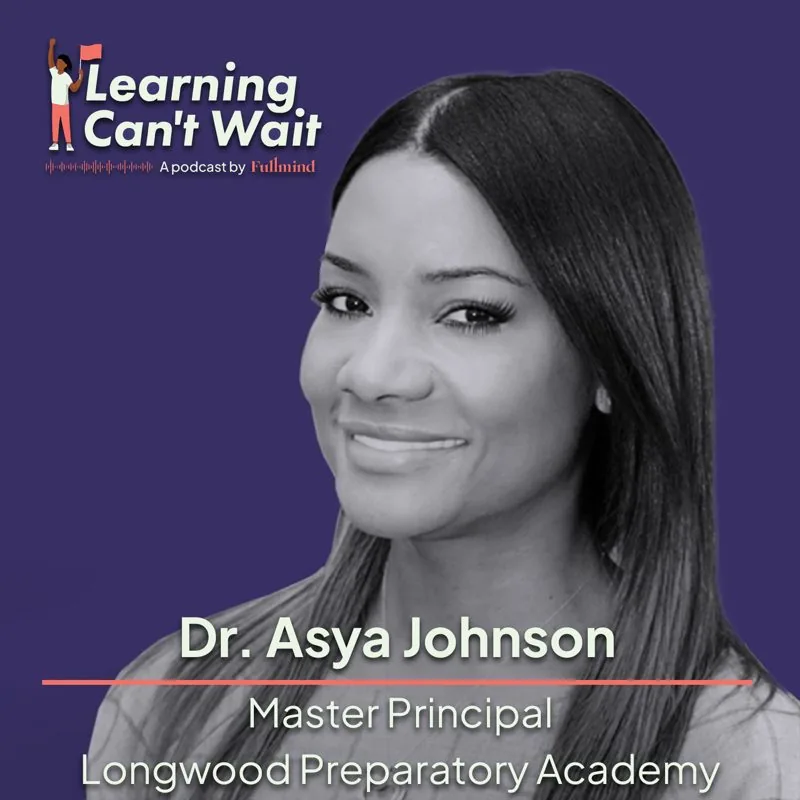
- Asya Johnson, Master Principal of Longwood Preparatory Academy
 Hosted by Hayley Spira-Bauer, Chief Academic Officer at Fullmind
Listen now
Asya Johnson: New York City Public Schools, Culturally Responsive Teaching, College and Career Readiness
Episode summary
Asya Johnson, master principal of Longwood Preparatory Academy, shares how a math teacher who refused to let her opt out set her on a path from Verizon to special education to leading a turnaround school. She took a school with a 40% graduation rate and 77% chronic absenteeism to 89% graduation and a 93% college and career readiness index by rehiring staff, operationalizing culturally responsive practices, winning grants, and requiring every student, including those with disabilities and English learners, to take AP and college courses with embedded supports.
Key takeaways
- Turnaround started with rehiring only 9 of 23 staff and a shared belief that students belong and can excel
- Culturally responsive practice must be operationalized, internalized, and institutionalized, not left to an equity team
- Calling a parent back after a hang-up and assuming good intent is what responsiveness looks like in practice
- Every student takes an AP course and a dual-enrollment college course, co-taught with special education and ELL teachers
- Hire for commitment to the South Bronx, not convenience, and build teacher self-efficacy with coaching and resources
About this episode
Welcome back to Season 5 of the Learning Can’t Wait podcast! Today, Hayley Spira-Bauer hosts an inspiring conversation with Dr. Asya Johnson, Master Principal of Longwood Preparatory Academy.
Listen as Asya describes the profound impact of education on her trajectory and how her past experiences continue to shape her work today. Asya explains her efforts to implement culturally responsive practices and integrate them seamlessly into the school's culture. She also discusses her strategies for boosting enrollment and transforming her school into a college preparatory institution where every student takes AP courses.
Join us every Tuesday at fullmindlearning.com/podcast. Next week we talk to Dr. Steven Weiner, Senior Research Analyst at the Center on Reinventing Public Education.
Full transcript
Transcript generated from the recording; minor errors may remain.
Hayley Spira-Bauer: Welcome back everybody to the Learning Can't Wait. Podcast today I have an incredible guest. We have Dr. Asya Johnson, the master principal of Longwood Preparatory Academy in the South Bronx. With us. Asya. Welcome to the Podcast thank you, Hayley, for having me, I appreciate it. It is so important to me that we have a diversity of experience and voices on the podcast and having school leaders in, on the podcast sharing their experiences, their efforts, their initiatives, and their daily life is so valuable to our listeners. Thank you for taking time out of your busy schedule to be here.
Dr. Asya Johnson: No, it's no problem at all I love talking about this stuff. So it's it's just it's amazing to me how often people want to hear it, you know.
Hayley Spira-Bauer: Amazing to you is. So it's so funny, because, as I talked to, I could see you light up prior to this call, when we were just prepping for our conversation light up when I asked, Is there anything of particular interest that you'd be excited to talk about today? And so I just have to say, like your inspiration. Your passion is infectious, and I'm really excited for the listeners today to get a little taste of what I we what I mean when I say that
Dr. Asya Johnson: They took so Asya, it'd be really great if you could just start us off by telling us how you became the personal and professional version of yourself so personal. How I became the personal version of myself. I grew up. I'm not a native New Yorker grew up in North Philadelphia. Had a lot of traumatic growing up issues and was in pot. Lived in poverty for a number of years, got bounced around from a number of schools and elementary schools. II recounted 7 different elementary schools by third grade. And luckily I was never held back from school at at that time, and I sort of thought about the challenges that I had with having a parent who was in in involved, not involved in in a lot of my education and just meeting some amazing people. When I got to high school, a teacher, a math teacher who like really believed in me, and you know, saw that I wasn't doing as well, and pulled me to the side and said, What do you do after school? Cause, you know you're not doing well in this class, and I'll and I had a part time job at Burger King, and I didn't shift in start till 4 school got out at 3. She says, stay with me after school, and I'm gonna help you and tutor you. And she sure she did. She became my favorite teacher. She was the only one who was invested in me, and didn't allow me to opt out of math something I had deemed to myself as having dyscalculia then, and I've never been formally diagnosed with it. But until those experiences I kept with me when I went to to college. I worked hard. I was never like a top of my class. I never got offered AP courses, but when II got to high school. Something in tenth grade tenth, and eleventh grade just really clicked for me. And I was like, you know, I think I can go to college, and I think I really wanna do it. And I just worked so hard. My tenth and eleventh grade year. I started to get some offers, found some interesting colleges to go to, visited it at HBCU. During my senior year, Delaware State University, and I love the schools an hour away from Philly. And I went there. Stayed there for all 4 years, graduated and thought I was going to become an attorney and because I had an English degree. And I was like, I'm not gonna be a teacher because people like, What are you gonna do in an English degree. Then I was like, oh, I'm not gonna be a teacher. I'm gonna be a lawyer and then graduate. It was like, I am not going to law school to figure this out. But then there wasn't really a lot of jobs for English majors, and I didn't want to do journalism, or you know of any of that. So I decided to go back to school, got my masters, went into a program called Corporate to Classroom. I was working at Verizon at the time, and II became got into this program. It's very similar to like teaching fellows. Teach For America, right? Career change right? And so, going into the program. Got my masters. I ended up teaching. They were very desperate for teachers. I was my class in my class, third teacher in November, so I didn't start teaching until like November, and I was their third teacher, and they were set on getting me out of the class they were like, Oh, you gotta leave us like the rest of them, I said, I'm here and and I told self-contained special education. I had very so many challenges there with like trying to teach the principal about demystifying her understanding of special Ed and just begging for support. I had a classroom that had nothing but garbage in it. It was just like all everything that no one wanted was in my classroom, where my students were, and so I cleaned it all out I had to do. I had to do a lot and 12 for 2 years special education realized that the advocacy for students with disabilities was the thing that I really needed to do. And then I moved to New York City and got a job at in a charter school in Harlem. Started that pathway, and it just became the most rewarding thing for me to do is to lead the special education work and so fast forward many years later to becoming a principal at a turnaround school. I was. I accepted the job of this school without even knowing the name of the school. I'm sure, probably illegal. But I just wanted to try my hand at being a principal in a New York City public school, which is very different from being in a charter and the school at the time when I got here had a 40% graduation rate and a 77% chronic absenteeism rate about a 12% college and career preparatory access for students. Only about 12% of the students actually passed college prep courses, AP courses, college now courses and as I think I could do this, I had worked with a different district, doing special education in the city with students who are living on. Who, being educated on Rikers Island, and a secured facility, secured detention facilities and drug and mental health rehabilitation. So I was like I can go do this little school in the Bronx right? And they did have a student. The school the school did have, and still does have 30%. Students with disabilities that attend the school about 20%. English language learners. And I just learned a lot in the turnaround process of one like having kids feel like they're welcoming in a part of a community having very high expectations for them, and that sort of blossom me blossomed me into wanting to research it, knowing that I was getting all these teachers who had to believe in my mission, and Hired a whole bunch of brand new teachers like brand new. Never, ever been in a classroom ever before. They took a chance on me. I took a chance on them, and I figured we would just learn and grow and develop together, which we did, and they were all a part of the turnaround process. For the school that has now led us to an 89% graduation rate as of last June and a 32% chronic absenteeism and and a 93% college and career preparatory and indexed. So 93% of our students pass college and career preparatory courses. Ap courses take college courses during the day they're dual enrolled. And that work was all a part of who I became from both personally, having not experienced that, but going and being in a school, a high school at the time where those options weren't available to students like me. But now, working in a school that's very similar, and not allowing kids to opt out likekids don't get to opt out of access here.So every student takes an AP courses, every Co student takes a college course, whether they're a student with a disability or their English language learners, I believe in embedding supports that's going to allow them to be successful. So there is no, you know Asya Johnson or Dr. Asya Johnson potentially sitting in their classes. And I'm not giving them access to, you know. Maybe I would have been a lawyer had I've been exposed to more curricular access in high school, and so you know, II just believe access is not optional for for children, and they shouldn't be especially students of color.
[08:00] **Hayley Spira-Bauer:** So hearing your story just really emphasizes the importance of education, I mean, you just painted a picture of your personal history, and how education and teachers made a tremendous impact on your trajectory. You're now painting a picture of a school that had potential, as all schools do, and with the right community surrounding your students and your families, was able to change the trajectory. So I feel like I need to pause for a second, because what you shared is so meaningful and really emphasizes what this work is about. It emphasizes the need for passionate people who don't believe in barriers. I love the the phrasing. A access is not optional. I think you just titled our app. So our episode here. But wow! Like congratulations to you like, and the community and the team that you built who unabashedly believe in the potential of students and the work that's required to get there. Incredible. Thank you very much. Of course. Let's talk a little bit about the work that's required to get there. Turnaround work is known to be in the education space, some of the most challenging work. Because. You're not starting from scratch, you're starting with a community that has experienced what the system calls failure, but off often is just a lack of attention, support, resource, allocation, and really love that's required to build greatness. So what does turnaround work look like in the beginning. And what does it look like now?
[10:00] **Dr. Asya Johnson:** In a beginning it is very, very challenging. I think it's almost like having a whole bunch of tools to build something. But you don't know where to start. You know, it's always it's being able to identify what is the most important priority that's going to yield the greatest results you need to identify and be patient with yourself around knowing that these things aren't going to change overnight. Right? I know. For me it was a lot of pressure, because the school, when I entered was considered out of time, it was persistently struggling and was out of time. And so one of the things that I had to do was had to everyone who all of the the teachers in the building and counselors had to reapply and re interview for their jobs. That's how it? How much the school had struggled in the past. And so with that it became what is the greatest priority. So out of the 23 staff members that were pre that were in the school at the time, I only retained 9 out of those 23. I only rehired 9 of those 23, so I had to start there. So now I have to hire a bunch of other teachers and counselors to uphold this vision of excellence. Once we had high expectations for students, one who knew that kids weren't just here because they needed to be here, but that we wanted them to be here, and that we believe that they were going to be successful from being here to support that work. We've really started with identifying an instructional framework that we knew was going to help us. We have used the culturally responsive teaching in the brain work from Zaretta Hammond. Since 2018, those practices have lived in our school. They required us to really think about how to get kids ready for rigor, students who came from all over the city, sometimes even in the Bronx, to let them see the level of excellence in themselves, that maybe others had not seen. And to take it even a step further, because our school is very diverse. We wanted to make sure that we were able to put in a set of culturally responsive practices that will allow us to see them, for who they are. Fill, affirmed, be warm demanders for them, as is mentioned in in the book right? Elevate their cultural experiences and give them more challenging work, that we knew that when we put those supports in place, they can step up to the playbook. And you you tell them my expectation is that you get an 80 right? And here's what I'm gonna do to get you there. My expectation is that you're gonna take this college class and you're gonna pass it. You're gonna take this AP courses. You're gonna pass it that you have the access to those resources that you create in your school. And so with the that in mind, I've created this framework to really think about? How do you embed culturally responsive practices by operationalizing. Internalizing and institutionalizing them across every single thing that you do in your school community? Right? Sometimes people think of culturally responsive practices. We're reading books by authors of color. Or we're talking about people of color or we celebrate a historical like, we celebrate Black History Month, or we celebrate Hispanic Heritage Month. We have to go beyond that. And what I've seen here is from teachers is that they understand the vision, and they they also want to be a part of it. And so to operationalize that first, we needed to start with understanding. What does it mean to be a culturally responsive schools. How do you operationalize it? So that when I'm speaking to a parent, it's a culturally responsive conversation. I'm not judging you based on what I think you. What I think I know about you. Right? You don't care you you're you've never come to any parent teacher. Conferences. You don't care right, I'm thinking. Perhaps you're busy, cause you have a job in the evening, or you have other children to think of that. You have to take care of. Perhaps you yourself might have a physical disability, and you can't get access to this built in right? Maybe the time doesn't work for you. Maybe just the way you. Maybe your experiences from other schools has led you to feel like you can't trust this school right? That's being culturally responsive. I've had parents who've hung up on me. I've had conversations with them where they've hung up on me, and I called them right back and said, Hey, I think we got disconnected right? I didn't say I'm never calling that parent again, you know. I say, I think we got disconnected. But I do wanna leave you with this. I think that your child can do X. And I believe that if you allow us to continue to support, here's what we want to do for your child. I literally had that same parent call me back and apologize to me, cause they send me a voicemail. When I called back the second time and say, I apologize, I'm actually going through something. I have a young child at home. I have this expectation, and my child is going to go to school. They're gonna do the right thing. They're gonna do what they're supposed to do. And I'm very exult. I am tired. I am exhausted. So me. So you calling me to tell me that my child hasn't been in school, is missing school. That's my frustration. I apologize. She's on her way to school. She's gonna be late, but if you can, please talk to her. If there's any resources you can give to help her stay encouraged and stay in school. I would appreciate that now. If I wasn't being culturally responsive, I would just make the assumption that that parent didn't care. I would see the child and say, Oh, well, she doesn't care. Her mother doesn't care who cares what happens to her, but because I'm operationalizing. Would I want to become a norm in the school. It happens consistently when we think about the classroom practices, we've used resources like the NYU scorecard to evaluate how culturally responsive our curriculum is, we're ensuring that it's anti racist, and it the lines with the cultures of the students that are in this school. And then we also ensure that to internalize it it becomes second nature. You might often hear about people saying that they have equity teams, and it's like, you know, we have a team to make sure we're doing equity like. But we don't have a team to make sure we're doing reading or team to make sure we're doing math or social studies. Right? We just have those teams that are talking about. How do we strengthen
[17:00] **Hayley Spira-Bauer:** This works? And so we're not doing equity teams. We're just gonna do the work. We're gonna make sure that everything that we do in this school is culturally responsive in our curriculum, in our conversations with students, in our conversations with their parents, in our communication to them, like just translation of a newsletter is not culturally responsive. It's just translating a newsletter. Right? It's about. How do you celebrate those differences? How do I make sure that I'm communicating to you some of the things that's also important to you and your community
Dr. Asya Johnson: And internalizing e. Institutionalizing is how you make it a part of second nature. I call it the the brushing your teeth. Moment. No one has to remind you, when the alarm clock goes off, that it's time for you to go brush your teeth, you just do it right, and when it's institutionalized it becomes a part of the fabric is permeated throughout your school community. It is what you do without second guessing, and so that is some of the work that has led us to be able to to effectively turn around the school from where it was to where it is now.
Hayley Spira-Bauer: But making it part of the fabric like the way you're you're saying it in a way more eloquent fashion than I am, which is to operationalize, internalize and institutionalize this. But I appreciate the notion that it has to be part of the fabric. It's not a lesson you occasionally return back to once a month when you have a staff meeting. It is part of everything you do. It is part of every person you hire. It is part of every conversation you have. It's not something you revisit on occasion when you feel like it's slipping. That is what makes, in my opinion, something institutionalized. Part of this is the system that you're building and creating and so powerful for students, right? So powerful for students to have a community around them committed to this type of work. I think that there's a direct connection between the systems that you're building the cultural responses you're embedding and your high expectations for students in their academics. Let's talk about what you named earlier, your 93% passing of I I'm sorry I forget the term you use, but the equivalent of Ap exams or college readiness exams. I think there's a direct connection there. Let's talk about the decision that you made to have every student receive the scaffolds necessary so they can access the content and be successful.
Dr. Asya Johnson: So interesting enough I always call it is like my fake it to you. Make it moment. So when I arrived at the school we had very low number of ninth graders who had applied to the school. Typically, you should have anywhere between a typical ninth grade class up to upwards to a hundred. Right? We had 26 who had applied for ninth grade, and what was challenging and problematic about that is that you wanna sustain the school. And you know, in New York City, if many of you know the smaller schools, they just get closed altogether. You can't have a school of like 100 students, right? And so one of the things that I did was, I know that parents are most interested in getting their kids into a preparatory school one that was also a college preparatory school. So just 2 things that I did one is, I changed the name of the school. I applied for a number of grants, so that I can not just have a school that existed for the for the sake of existing. But I wanted to be able to give kids a specialized program. And so I had applied for $500,000 career and technical education. Grant which I was awarded, I applied for a $65,000, grant which I was awarded that enabled students to get makeup credits that they had from the past and also get some counseling. As well have Saturday Academy to help them to recover and feel good. The other thing that I did was I applied for the then Chirlane McCray, Bill de Blasio's wife, had a mental health grant that I applied for $10,000, and I wrote a proposal to open up a recording studio to offer hip-hop therapy.and this is the Bronx, so I figured. Why not? Why, why can't we offer hip-hop therapy here? I had talented counselors. You know it would. Well, I was awarded this $10,000. Grant built a recording studio in the school that was connected to the media program that I also applied for and got the grant for. So now students come to the school. They learn how to do create films do podcasts do digital communications. And they learn Adobe Photoshop, all the things that we play, the all the celebrities pay for to look good, our students of learning that that is a college ready skill. They take exams that will then lead to replacing the Regents if they need to. We partnered with A number of colleges here have a articulation agreement with those colleges, so the courses that the students are taking here. If they apply to City Tech any of the CUNY universities that were partnered with, they will automatically articulate into that university, and their high school credits will dual count for college credits for them. Have they majored in. You know, web design, or any of the tech fields that's related to our coursework here? Additionally, I just kept telling parents that this is a college prep school. And in order to be a part of a college prep. School, you have to receive an 80 or higher on your English and math regents. Now it was hysteria for a very long time where kids were like, oh, we gotta do the 80. I can't. Oh, my God, it's gonna drive me crazy. I was like, I believe in you. You have support. We had students with disabilities who had intervention that we gave them during the day that did not disrupt their program. We didn't take all of the fun classes. You don't get art, you don't get theater. You don't get, you know all the fun classes, because you you know, you don't read on grade level. We found a way to be able to embed it in in the day so that they can get the both best of both worlds and the students achieve those goals. We partner with organizations, colleges that we knew would would want our students to come local colleges and say, Can you offer a college course right here on our campus? So we got a college to come in, send a professor here to offer a course, 1, 3 credit course, intro to psychology, which everybody loves. Everybody wants to diagnose somebody. The kids love that course. And they came and taught the course our kids from there. They wanted to take more courses, so we started to pay. We paid for Syracuse University paid up, paid to send a teacher to Syracuse to get trained so he can be an adjunct professor teaching here. I opened up more courses. Here we partnered with other organizations. So it just became that part. Then it came to the expectation of every eleventh and twelfth grade class. English class will be an advanced placement course. So they are co-taught by a special education teacher and or an English language learner teacher, right? Because we provided so many support so much support to them in ninth and tenth grade in terms of intervention, reading intervention. If they had it then I knew by the time they got to eleventh grade. They had access that rigorous coursework. And again, it was not optional right? Because when we did have it optional and the course work was challenging. You saw kids say, I don't want to be a net hard course I don't wanna be in that course at all. And I said, No, it's not optional access is an optional. You're going, and and I was very clear of parents. When you come to this school your child must take and get it, receive an 80 on their Regents exams. They will take an advanced placement course. They will take several interim assessment exams during the day, because I want to know how is my teacher's doing with learning? You're teaching your child where the gaps in their learning, and how can we use that opportunity to fill in those gaps, and if I only wait until the state assessments are happening, it's too late. The gap is already widened right, and then, when you're very. What I found is that when you're up front with parents around that time about what's happening, they're they're more likely to be on board right. And they and kids are, too, because you're making them aware. And you're you're making learning, not be the thing that they want to stand up again, you know, like backup again, especially exams. Kids are so afraid of exams. But we need to normalize that as a process of what we have to do, even professionally, we have to get a driver's license. If we want to drive a bus, we have to. It's an exam, right? If you want to be a teacher, you got to take a test. If you want to do construction you got to take. You have to take exams for everything that you want to do. So we had to demystify that concern that kids had. And so the 93% was as a result of us doing an entire culture shift with our students, our community, our families, and saying, You can do it. We're going to help you. And I believe in you. And here's the access to it. And not Cherry picking either, not saying you can't go in the Ap. Cause. You didn't get an 80 on the Regents like you might not have made the the score that you want you. You may not. I'm not a.We don't have a hundred percent of students getting an 80. But we have a hundred percent of students striving for an 80, which is a difference, not just passing, which is a 65 right? And so when you change that mindset of kids thinking that 65 isn't good enough. Then you start to think about what are some ways in which I can ensure myself internally that I can do better.
Hayley Spira-Bauer: Wow! I know when I heard you first speak about this concept at Longwood Preparatory Academy, it was at an event, and I heard you share that. And I said, Well, I have never come across a school that has that expectation that all kids will take college preparatory courses, and it shouldn't be. I would love for it. Not to be surprising, I would love for it not to be an outlier, but it very much is right now and so again, like absolute. Incredible kudos and hats off to the work that you put in to make that happen, and to build a community of of learners and families and teachers and staff who all are driven and passionate about achieving these these outcomes. It's absolutely incredible. It makes me so inspired. And I have to book. I'm coming. I'm coming up to the Bronx to visit some school soon. I really would like to make a stop over and see your students in action. I. You know.we we haven't spoken largely about the teachers just yet in this conversation, and and my last question for you is about them. So I'm gonna tailor the question I normally ask and and ask it about your community teachers. So what advice would you give Longwood Preparatory Academy teacher who's just starting their career at your school right now.
Dr. Asya Johnson: The advice that I would give them would be that it's it's very similar to my my interview. Question. And it's interesting me, my Ap. And I always will make our determination about whether or not we want to hire a teacher based on how they respond to the question. And the first question is, why do you want to teach in the South Bronx? And and then what makes you a great candidate to teach Longwood Preparatory Academy. But when we think about the response, we are looking for a school that is committed. We're not a school. We're looking for a teacher who is committed, not looking for a teacher who once convenience. What we know, which answers we get are. This is commute. This is close to my house. Or you know the train is right here, or right over the bridge, right? Or something like that. And we always clarify that. The difference is thatI'm looking for commitment, and you're looking for convenience.I'm looking for you to say that the South Bronx is one of the poor has some of the poorest congressional districts in the country. The South Bronx specifically has a need for a teacher like me. And let me explain to you why I'm passionate. I'm committed. I believe students of color deserve excellence, require high expectations, require a teacher who can think outside the box, and, more importantly, can. Are are in need of a teacher who wants to do more than just only teach English and only English. So help me God, because the thing about high school teachers is, they are subject based educators, right? They're not like elementary middle, because elementary teachers. They teach everything. High school people are about their content. They teach social studies cause they love history. They teach science because they love science, they love exploring and problem solving right. So when you love your content, you also have to get other children who don't love your content to love your content just as much as you do right, or even have the belief that they can do it just as well as you believe you can teach them. While also feeling good about it. Right? Some of the courses that you're going to be required to take here requires teachers to do that. And our teachers here are passionate. They're committed. They're relentless. That's how you you think you can get any teacher to teach an advanced placement course to students with disabilities, and that you have to have a level of commitment. You have to have a level of confidence right? And your leader, who says I'm gonna support you and your Co teacher who says you, you're gonna be able to help me differentiate and provide some. So some scaffolds for some students who need access to this course. Right? We're reading Just Mercy. That is not an easy text.
Hayley Spira-Bauer: You you know.
Dr. Asya Johnson: You know we are doing some. I mean, AP Language is challenging.It's challenging. So if you're an English language learner and you're reading it, and you're taking AP Language. Course. You're going to have a lot of belief in your skills as a teacher. And I tell teachers I believe you can do it. I'm not going to set a teacher up for failure. I'm not going to give you a course that I know you're going to fail at. Because. You know. Like, why, why would I do that? I want you to be successful at it. I know that you could be successful at it. I'm gonna get you coaching. I'm gonna get you textbooks. I'm gonna get you resources. I'm gonna get inter visitation so that you can see some other schools that have the same exact thing, because, although those students might look different in other schools, that doesn't mean that you cannot teach the same way, they teach well with the students here. And so when you have that belief, and the teachers believe they have that strong self efficacy which was a part of my dissertation. Research is, I wanted to know. Why. How do you get teachers to have self efficacy? How can they believe in themselves and their work? And when they do have that belief in their work. They just they they teach as if they could teach. They could teach anybody which they can. You know, you just gotta get them to to believe that they can. And they have. These teachers have.
Hayley Spira-Bauer: Well, Dr. Asya Johnson, it is an absolute honor to be able to amplify the work that you're doing at your in your school community and share the the triumphs of your students and your families and your teachers and your staff. Thank you so much for coming on the podcast today. It's been an absolute pleasure to have you
Dr. Asya Johnson: Thank you so much for having me. I really appreciate you, letting me share my story. Today. I feel like I could ask 8,000 more questions. But you're a school year. I can't keep you more time I got. I have to make sure you get back back to your community. But I know that the listeners that joined us today are probably as enamored with the highlights you've shared, and also some of the practical information about building a community that's culture responsive, embedding it in their community and their work, and also continuing to have high expectations for their students, and providing the proper support to make it possible. So thank you so much again for being on, and thank you to everybody who joined us today. Thank you.