
Learning Can’t Wait · Episode 137
Shannon Cox: Leadership, Innovation, & Inspiration
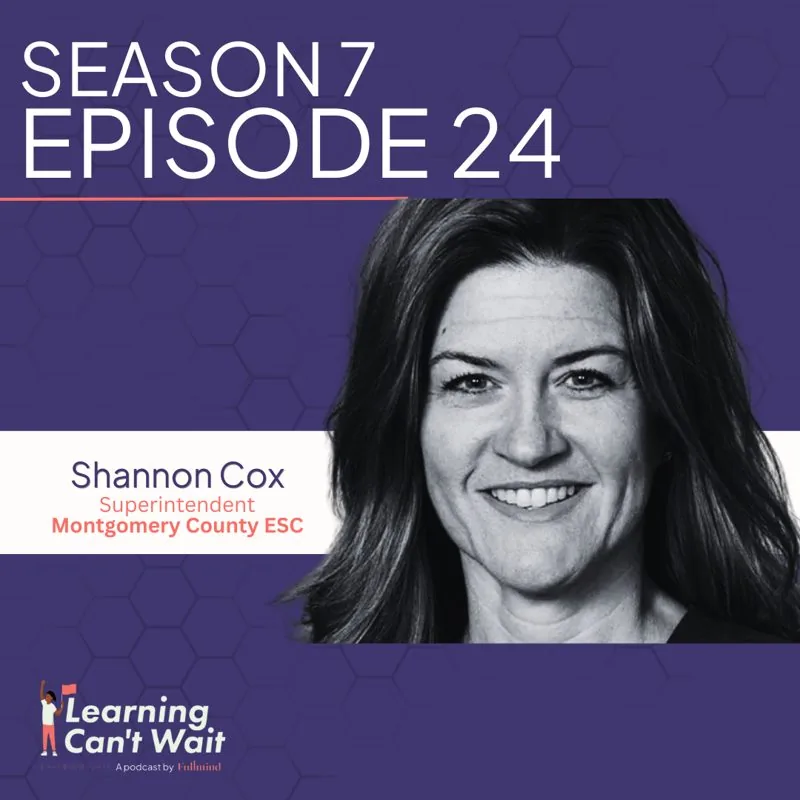
- Shannon Cox
 Hosted by Hayley Spira-Bauer, Chief Academic Officer at Fullmind
Listen now
Shannon Cox: Leadership, Innovation, & Inspiration
Episode summary
Shannon Cox, superintendent of Montgomery County ESC, shares how a senior-year stroke ended her Air Force Academy dream, how she found her people in junior high classrooms, and a full-circle ride in a Blue Angels F-18. She champions the future self vision after kindergartners could not imagine any future, and built a K-6 literacy-integrated SEL and careers curriculum with singer Jewel. Her Engage Montgomery County pilot with Graduation Alliance found pandemic-era missing students, scaled statewide to 98,000 families, cut extreme chronic absenteeism, and informed Ohio's science of reading law.
Key takeaways
- Every child should be able to close their eyes and picture a future quality of life, regardless of zip code
- Ask what quality of life kids want, not what they want to be; expose careers before junior high
- A literacy-integrated SEL curriculum answers principals' who, when, and money questions and improved attendance and achievement
- Engage Ohio outreach reached 98,000 families; needs were tech help, academic support, transportation, and teacher contact
- Make learning the constant and time and environment the variables; if kids can't get to school, get school to them
About this episode
This is one of those episodes you feel as much as you hear.
Shannon Cox’s dream of becoming a fighter pilot was derailed by a stroke in high school—but what followed is a remarkable story of purpose, resilience, and transformational leadership in education.
From flying a Blue Angel jet to redesigning how we think about absenteeism, future self-vision, and SEL, Shannon’s work is nothing short of inspiring.
Full transcript
Transcript generated from the recording; minor errors may remain.
Hayley Spira-Bauer: Welcome to the Learning Can't Wait podcast of Fullmind. At Fullmind, our vision is to ensure every child has access to an exceptional education. Each episode, we will be joined by Pathfinders within and around the education space who are bringing about transformational change. On behalf of deserving students, I'm your host, Hayley Auer. Welcome back everybody to the Learning Can't Wait podcast. We have a guest today who is beyond inspiring to me for many, many, many reasons, and I know you're going to feel that as well. We have Shannon Cox, the superintendent of Montgomery County Educational Service Center. Welcome, Shannon.
Shannon Cox: Hi. Thanks for having me,
Hayley Spira-Bauer: Shannon. You know this is a full disclosure moment. We recorded this episode, or at least I thought we recorded this episode once before, but no recording actually could be found. So thank you for your generosity of coming back to tell your story. I, as you know, am in awe of what's happening in Montgomery County ESC. I'm also in awe of your leadership, so I felt it really important to do this again, and I just want to thank you for sharing your time with our audience even. Sorry you did it once before.
Shannon Cox: Absolutely, it was my pleasure. Times too.
Hayley Spira-Bauer: Shannon, can you please tell the audience how you came to be the professional and personal version of yourself?
Shannon Cox: Yeah, absolutely. So being an educator was actually not something. I woke up in third grade and said, Hey, I want to be a teacher. It wasn't this lifelong ambition at all. My dad, however, was an educator and a building principal for several years. Spent his entire career in one particular school district, 40 years in education. I parked his car in the same spot for 37 of those 40 years. So it wasn't like education wasn't in the purview of what life could be or what the opportunities are, but I was just really always infatuated with aviation. The Wright brothers were something that when I first heard that story and knowing that I was in the epicenter of the birth of flight, it just was something that sparked that interest and joy in my heart. And so I actually woke up in sixth grade and wanted to be the first female fighter pilot for the United States Air Force. ([02:30](https://www.google.com/url?sa=E&q=https%3A%2F%2Fwww.rev.com%2Ftranscript-editor%2Fshared%2Fhwp_0XGtghWzi2oDb_w3BA-KhHgNDnTacifhnLNqDEHwT7Ehsnp80V4TMj5W2tfvqlQZwJ8TCREcF6sOKLmxU4bbpiQ%3FloadFrom%3DDocumentDeeplink%26ts%3D150.93)): And I decided to break the news to my parents that I was going to head off to the Air Force Academy and I was going to do my thing. And so my parents were completely supportive of that. We went to all of the right meetings, I took all of the right coursework. I followed all of the right senators at the time to hopefully get my nod of affirmation that they would support me and make the recommendation. And life just has a way of taking its turns. And so I was a senior in high school, had passed the interview, had gotten all the way to the point of waiting, literally waiting on the nomination from John Glenn and/or Mike DeWine at the time, which is ironic. Our current Ohio governor and I suffered a stroke my senior year in high school. I was quickly faced with reality that I was not going to be eligible. ([03:30](https://www.google.com/url?sa=E&q=https%3A%2F%2Fwww.rev.com%2Ftranscript-editor%2Fshared%2Fa2HSLAGmCSzHsoiVjJ2plaSdl0fdZ9e80a5avM5vtNLY7o9ZM5NtUXA4LtfxaZy-kwJcQyxWbQAjkAI7_oncvUgj-RY%3FloadFrom%3DDocumentDeeplink%26ts%3D210.37)): I don't hold it against the United States military in any way, shape or form that they would put somebody with a medical issue into a million dollar plane and say, Hey, have at it. But what it was was a real quick way to say, okay, but what am I going to do with my life? What are these other opportunities? And so what I didn't really realize at the time, but quickly became very keen to, was that I had developed some skills and aspirations and I had met people that allowed me to really navigate my current situation heading into college in a different capacity, hurrying up and having to do actual college applications. I honestly had not applied to any other college other than the academy. I was pretty convinced that that was going to be my path in life. And so we did that and we did that as a family unit, but I did that as a young woman. ([04:21](https://www.google.com/url?sa=E&q=https%3A%2F%2Fwww.rev.com%2Ftranscript-editor%2Fshared%2FpYS2VvzJc5R4uDL4wNzt1bwaTV-vJ4pU2ykgea708_8b4-WpCN5x8OA_gUt694jLtw3i67lHFShbpRU490pTX6Ce9NE%3FloadFrom%3DDocumentDeeplink%26ts%3D261.67)): And so I landed at Miami University and their education, college of education. And so once I became a teacher, it was a pretty typical trajectory within the educational setting. I taught for several years. I was in the junior high. It was where I just found the kids that I loved the most. And my dad looked at me and he said, what are you doing in junior high? They have heavy sighing and a lot of eye rolling, but was they were my people. And so again, pretty typical trajectory. I was an athletic coach at the time. I went back to school, got my master's, and it led to that sequential career progression that I became a building principal that is the best job on the face of the planet. Someday I will do it again. And then went into a central office curriculum director position and then landed myself in an associate superintendent position and then in superintendent position. So professionally, it was, again, once I got into the field, it was a pretty typical trajectory. Personally, have a husband of 32 years at this time and we dated before then. I have two adult children, a grandchild. And so professionally, again, pretty typical personally, also pretty stereotypical. But here I am today doing what I love to do.
[05:00] **Hayley Spira-Bauer:** So first of all, thank you for being so vulnerable and sharing that story with everyone as a person who had to also change their career path because of my health. I know that you grieve a lot both in that moment and then for a really long time. So I can empathize with the experience you had, but also I'm grateful that you've wound up here because your impact is so significant on so many children and so many teachers as well. I know though, that you did get to get in that plane, that plane. Can you quickly tell that anecdote because your face lights up whenever you talk about this, and so while the listeners might not be able to see your face, they will be able to hear your joy.
Shannon Cox: Absolutely. So yeah, just please know, I am smiling ear to ear because every time I think about it, so in the job that I have now, I get to do some really cool things. And so I interact with a board that puts on Air Camp, so thanks Space Camp, but airplanes again, we're here in the Dayton region. I've been on the board since forever. It seems like our institution, the ESC helped create the curriculum for this camp, but it was a camp for students at first, and then it became a camp for teachers. And we put through participants, we put them through a week long immersive experience that gets to experience all the different types of jobs because when we think aerospace and aviation, we are sitting right here on the heels of the Dayton International Airport and right outside of the gate of the United States Air Force base that sits here in Dayton, Ohio. ([07:28](https://www.google.com/url?sa=E&q=https%3A%2F%2Fwww.rev.com%2Ftranscript-editor%2Fshared%2FeUEw9o4yH1CsTHAZRsPLKGCQYFSs7ckFg1Ttcf2SIiXKqTxm2nQK0vIkQKTycZdOSDbToR4fuRyTtGPM_m9SxQZ2RC4%3FloadFrom%3DDocumentDeeplink%26ts%3D448.07)): And so because of that Air Camp just seemed like a really great thing and exposure and awareness for kids and adults. And so we take these participants through a week long immersion camp, and at the end of their camp, they get to fly a Cessna. They do get to co-pilot, I should say a Cessna airplane. And so been on that board for a while, helped create the curriculum. And so got to know a lot of the founders and they're folks that also sit on the board of our Dayton Air Show board. And so the air show fluctuates between every other year. They have either the Thunderbirds or the Blue Angels. And so the Blue Angels have this beautiful program called Community Key Influencer. And so I was nominated by one of my Air Camp board founders to be that community influencer for the work that I get to do and have the privilege of doing here in the Dayton region. And I was among probably a handful, I think, of key community influencers. And I got it. I got the gig and the gig is a ride in a Blue Angels jet. It's an F/A-18 Super Hornet. I was in the plane over an hour. I was in the air for 57 minutes. It was the best 57 minutes of my life. And I'm so sorry to my husband and my children, but it really was, you're like, it
Hayley Spira-Bauer: Didn't involve them. And it was the best moment of my life.
Shannon Cox: They were on the ground watching and I appreciate, but it was the best experience of my life. So we try really hard to make sure that kids know what opportunities they have in life. And I had an opportunity that was taken away from me because of a health issue. But what we don't do is we don't ever squelch dreams. We don't ever tell students that they can't dream and have aspirations to be anything they want to be. I was not able to be a pilot for those health reasons, but I still got the ride. I still got the ride. I got to surf the clouds. I got to do all of the, I shouldn't say all of, I got to do a lot of the maneuvers. I pulled 7.46 Gs. I did not throw up. You did not. I want to throw up just thinking about that, Shannon, that is woo. No, I did throw up and I didn't out your stomach did not pass out, made it through and it was just great. And we have video of everything. So every once in a while I'd go back and watch the video just to re-experience it, but it was a full circle moment in life, let me say it.
Hayley Spira-Bauer: Totally. Totally. Thank you for sharing that. You just spoke a little bit about not Squelching dreams, and one of the things that you're well-known for is being a champion of the concept of the future self vision for students in Montgomery County. Can you talk a little bit about what is that future self vision and what inspired you to champion it?
[10:00] **Shannon Cox:** Yeah, absolutely. So we really believe that every child, regardless of their circumstance, regardless of their zip code, should be able to close their eyes and think about themselves in the future and actually be able to envision themselves in an opportunity to be living the lifestyle they want to live, living, having the job that they want to have. And not just about what do you want to be when you grow up, but really about what quality of life do you want to have when you grow up? Who do you feel safe around? What kind of car will you drive? Where will the neighborhood be that you walk your dog? If you choose to have a dog, what does that look like? And then as adults who are caring for these children, both in the educational setting and just as a community member, how do we as adults then help you realize that aspiration and how do we help you get there? ([11:19](https://www.google.com/url?sa=E&q=https%3A%2F%2Fwww.rev.com%2Ftranscript-editor%2Fshared%2FiQEiV8SQMGMuUDjpYOgZc7CrlA1oowbGLkF5lVSmGdByR44AVNHYA21vxzR2ztya2Q_ZLaxL8S8KVUJTI7oyXNu3sS8%3FloadFrom%3DDocumentDeeplink%26ts%3D679.83)): And so we call it the future self vision. We completely believe in the five social emotional competencies that CASEL has put on the map, but we believe that that future self vision is the sixth competency, the ability to be able to see oneself in the future regardless of circumstances. And the reason we got to that, and I was able to do, I was very humbled to be able to do a TED Talk on that. But the reason we got there is because we had staff members that were working in school districts and they were asking that age old question of what do you want to be when you grow up? And again, we try not to ask that question anymore. We try to ask what quality of life do you want to have when you grow up? But they were asking the age old question, what do you want to be when you grow up? ([11:59](https://www.google.com/url?sa=E&q=https%3A%2F%2Fwww.rev.com%2Ftranscript-editor%2Fshared%2Fd7aZJOOMS2TtENadPaB3eyzs4i2Mn32AAoAPhBe8I_kawvkYkiMYw-Rv80OsFwvQGc57bIo2PHD9FRoMpGNdEF7kHcw%3FloadFrom%3DDocumentDeeplink%26ts%3D719.5)): And we literally had five-year-olds, six year olds, the students, the scholars that are still full of curiosity and intrigue and they could not answer the question because they literally did not have the hope inside of them that there was possibility of future for them because of their circumstances. And that's when I said, I didn't just call a timeout. I called the full court timeout. Like everybody on the bench we're going to talk about this and we're going to figure out what to do about it. Because as leaders in the education sector and leaders in the community on our watch, that's not going to happen. I will not apologize for taking that time out. I will not apologize for the work that we're about to do or that we have done since that moment. It's been politically polarized that we should not help children have those social and emotional skills and not on my watch. ([12:54](https://www.google.com/url?sa=E&q=https%3A%2F%2Fwww.rev.com%2Ftranscript-editor%2Fshared%2FIY--0CpKa0BeXgmZUXwR-OZ8vYStJ7dd4QEHprvgjJdvHwTaHZziRmqvxV0GOC1ritbvW-rl_3Sr1rFnDDV6Z4QzD60%3FloadFrom%3DDocumentDeeplink%26ts%3D774.94)): We're not going to do that. Yeah, it's so wild. Yeah. I don't care what side of the aisle you sit on, I don't care what semantics I have to change because those skills are employability skills. Those skills are human skills. Those skills are skills that every human needs to survive. I cannot stop the life challenges that happen, right? I could not stop that stroke that I had when I was a senior in high school. I could not stop the 15 tornadoes that rolled through this community in 2018. I could not stop the mass shooting that happened in 2019. I certainly couldn't help the pandemic that rolled through this entire world in 2020. I can't stop the things that happen in life, but what I can do and that the thing that I am committed to doing is making certain that our students have the skill sets and the competencies that they need to be able to navigate those life challenges. And so that's what future self vision is all about.
Hayley Spira-Bauer: It's so incredibly powerful to hear not only your passion, but how much you have prioritized this work on behalf of deserving students as someone who really seeks to just be surrounded by people who care deeply and who work hard in this world. You truly top my list and I am so grateful to know you and to learn from you. Can you share a little bit more about what this looks like in action? So of course, you're leading your community with this theory, but what does it look like in practicality if the superintendent is listening or a school listening and they're like, that sounds great. How do I do that? What are some actualities of this in your community?
Shannon Cox: Yeah, absolutely. One of the things that I think we tend to pigeonhole ourselves in education to thinking about future opportunities and those discussions with children, but we think about it in high school, we think about it maybe in the eighth grade when they take that trip to the career center and they start to explore their opportunities. What we need to do better as the adults in the community is making certain that we're having those conversations and showing children at very young ages what opportunities could be and can be. We focus a lot, especially post pandemic on learning recovery, but the learning will happen if we have regulated brains and we can see to the future. So it's sort of twofold. We need to do school differently, and that means a lot of different things. We need to talk to kids earlier about future opportunities. I often sayif it doesn't happen on their block, they don't know that it can happen.Most five-year-olds only relate to career opportunities in the future that they find has a vehicle attached to them or a uniform, a hat. My 5-year-old
[15:00] **Hayley Spira-Bauer:** Still wants to be a digger man. He called
Shannon Cox: Digger man. Yep, that's right. And my now 7-year-old grandson when he was four, he was infatuated with a trash collector, right? Because that truck was cool and that vehicle was something about that. And we need trash collectors. So if that's where you end up, then that's where you end up. It's not to judge careers, it's to make certain that every child understands what their opportunities are. And in order to do that, we just have to do school differently. We have to provide opportunities at a much younger age. A lot of people want to talk about personalized learning. It's a big buzzword. And education, I think learning just needs to be personal. I think that it needs to mean something to the student. And whether they're a kindergartner, the third grader, a seventh grader or a 12th grader, they need to be involved in education that is personal to them. ([16:55](https://www.google.com/url?sa=E&q=https%3A%2F%2Fwww.rev.com%2Ftranscript-editor%2Fshared%2Fz_RAKfZs5hVJaemxEIoljeR-TwBIzDK0K7nCh3P06h728_PVjeZqEauBbDZ9vEfEzUf8S17wYxHJKj9iovDXdtnzU4M%3FloadFrom%3DDocumentDeeplink%26ts%3D1015.46)): And that means we have to be engaging. And so we have to think about school differently. The one thing that I was really hoping the pandemic would do is shove us wholeheartedly into the 21st century. We've pulled that bandaid off and said, we're going to do school differently.We're going to make learning be the constant, and we're going to have time and environment be the variables in this whole equation.And unfortunately, it didn't quite happen the way that I wanted it to happen. And I think that's malpractice on our part that, and those are strong words, but I stand by them. I think we have got to do school differently. So that's one aspect of it. But I also think that we need brains that can learn because if we can't have brains open for business, we do a lot of work with Dr. Bruce Perry and he talks about those cortex, that top part of the brain being open for business. ([17:42](https://www.google.com/url?sa=E&q=https%3A%2F%2Fwww.rev.com%2Ftranscript-editor%2Fshared%2FfOtXKZX4u1X-4nC9OFjpItlTb9kwBS1V-nZKUTrEP0RPgphXP2c7dcEksAcKkBgTq3odi_joDLmvacE_Y5b_jYfTzjk%3FloadFrom%3DDocumentDeeplink%26ts%3D1062.98)): And we can't do that if they're not regulated. And so life is hard, and that's where those compensatory skills come into play. Those human skills come into play. So what we have found is that you can't do them in isolation. You have to do them together. So we couldn't find a curriculum out there that exposed young people to careers or future opportunities that weren't attached to vehicles, children's literature, or when we think healthcare, we think doctor, nurse, we don't necessarily think radiologists. We don't necessarily think nutritionists. We don't think about all the other careers within those sectors. And so we created a curriculum that allowed students to be involved and engaged in those types of opportunities. The other thing that we've created is a social emotional curriculum that was integrated with language arts for our K-6 learners. I was a building principal. I said it was the best job on the face of the planet. ([18:37](https://www.google.com/url?sa=E&q=https%3A%2F%2Fwww.rev.com%2Ftranscript-editor%2Fshared%2F_7aiont_QazH_xPF8V8Tlu1hpxXJVVEsDzWMW8gk6KZdHJlnDgzncIIZwLB4Hzsm8y6eGH6R1XKw2dzBMEozT8ojCTA%3FloadFrom%3DDocumentDeeplink%26ts%3D1117.56)): But the three questions we always ask as a building principal is, who's going to teach that? When am I going to put it in this schedule and where's the money going to come from? So we created this curriculum that allowed future self to really be developed through language arts and social emotional competencies that allowed the language arts teacher, the who in the language arts block, the when with the resources that every school has set aside for literacy and language arts. So we answered the three major principal questions and said, this is when you're going to do it. This is how you're going to do it. And what we've seen is we've seen kids come to school more regularly. We've seen kids have less office referrals. We've seen an academic achievement in language arts when using this curriculum that supersedes the peers that do not use the curriculum. ([19:24](https://www.google.com/url?sa=E&q=https%3A%2F%2Fwww.rev.com%2Ftranscript-editor%2Fshared%2FWrck8D9eW9lRB3YTVWCRIaszXuwTm472woNLQYW7yRZRMC7KOzPW_Xf_ikqEehb4hiqzftH8LjovefrOxYchG9aT5DA%3FloadFrom%3DDocumentDeeplink%26ts%3D1164.81)): And it's not the be all end all. It's not a magic wand, it's not a silver bullet, but it was our attempt to make certain that we did school differently and we expose kids at an earlier age of what those future opportunities and what those skill sets they need to navigate future opportunities so that they could have those at a young age. Again, waiting until junior high high school, it's just too late. So I get a lot of pushback. We partnered with the singer songwriter Jewel to do that curriculum, and honestly, her people wanted to go junior high and up and we pushed back and said, we need to go junior high and down so that we are preparing our youngest learners to have those skill sets. It doesn't mean that we stop doing all the great things that we're doing in junior highs and high schools to make sure that kids have opportunities to build on those skill sets, but we've got to be preventative, not reactive to the situation and to the world, quite frankly, that we're living in.
[20:00] **Hayley Spira-Bauer:** So speaking of doing things differently, one of the pieces of Montgomery County ESC that has me most gobsmacked is your work on absenteeism. And when I interviewed former Secretary of Education, Arne Duncan, I actually brought this up because absenteeism is a platform that he stands on as a huge piece of school improvement as well as gun violence reduction, which is what he's currently focused on. And I told this story, I said recently I met Shannon Cox, the superintendent of Montgomery County ESC in Ohio, and she described an astoundingly impactful partnership that they formed with Graduation Alliance to conduct outreach to more than 98,000 students and families to address chronic absenteeism. The work resulted in a 13.9% drop in extreme chronic absenteeism across schools with an impressive increase in K-5 participant attendance by 11.3 days year over year. Shannon, this work I have not read of, heard of, seen work like this. Can you tell a little bit about the partnership before and with Graduation Alliance, why you felt this was important to focus on and the lasting impact that it's had some three years later, two years later?
Shannon Cox: Yeah, a hundred percent. So we actually were introduced to Graduation Alliance as a dropout recovery program through our business community. One of the leading trade organizations, which is the Dayton Region Manufacturers Association here in the Dayton area, their president of DRMA came to me years ago and said, listen, we're struggling with workforce. And again, this was years ago. This was pre pandemic, this is pre everything, but they knew they were struggling with workforce Workforce in the manufacturing sector already. So she brought the company to me. We were introduced to them as a dropout recovery program, and we started in that lane. But what we really realized is they really were an at-risk student program. So whether the kids had already dropped out or we were actually going to try to stop them from dropping out, we engaged in a partnership with Graduation Alliance and it's just, they've been fantastic. ([22:36](https://www.google.com/url?sa=E&q=https%3A%2F%2Fwww.rev.com%2Ftranscript-editor%2Fshared%2F9I2lPuMmq_3cYFI_xczlrJuCC9Zro07eYJ-LTZJxrcYYCLMi1nSdxtodfmKz-FQ9eRpB_TO6AjJgH2-5wkdJXlqqHPA%3FloadFrom%3DDocumentDeeplink%26ts%3D1356.88)): And so as we over the years developed the different models of engagement with Graduation Alliance, I went to them and I said, Hey, what about the kids that just aren't at school? Can you go find them? If you can find kids that have dropped out, can you find the kids that are still enrolled K-12, because they were really just a high school company at the time, but K-12, can you go knock on the doors of these families and see if we can get these kids back to school? Because one of the measurements of success that we had established with Graduation Alliance was did we get kids back to their homeschool or did we just get them back in school? And either way, it was a success story. And so they politely said, Shannon, that's not really our gig, but as most people do when they know me long enough, I don't usually just stop there. ([23:31](https://www.google.com/url?sa=E&q=https%3A%2F%2Fwww.rev.com%2Ftranscript-editor%2Fshared%2FttQEqDPmXXFIil3ZCqMNysrFTxmxErYcHOirtQX4crq06fs7sF7xGu7YYI-PE5KNFJO2Alt6m9eN9NhVa5SA3EavGsA%3FloadFrom%3DDocumentDeeplink%26ts%3D1411.93)): So I just kept re-engaging that conversation and said, so let's try again. It's now in the middle of a pandemic and we have like 60,000 children that are no longer enrolled in the state of public schools. And I don't know about you guys, but my Amber Alert, which is what we use to notify for missing children, I didn't get 60,000 Amber Alerts. So where are these kids and why isn't it bothering anyone but me that they're gone? Where are they? And so they realized Graduation Alliance were like, you know what? We are having the same request in New Mexico. We kind of started down that path with them and I said, okay. So that's what we did. We started what we called Engage Montgomery County. We did a little pilot here in Montgomery County where we said, in Montgomery County, we have these missing children, and by missing, again, not coming to school. ([24:26](https://www.google.com/url?sa=E&q=https%3A%2F%2Fwww.rev.com%2Ftranscript-editor%2Fshared%2FvrNTV8NBWU5yZifiGEV7tQGYIHij9_qei5wf_YQJ5YLtn0yaNNFm4BmOZBwda1RJA-vkPff5pU7UtWHJLb0RjT9R7Nc%3FloadFrom%3DDocumentDeeplink%26ts%3D1466.57)): And so they started re-engaging those kids. And what we realized is that in the sixth through 12 grade, it was parents were saying, well, they're not coming to school because we're not home. And they are. And again, this was in the midst of the pandemic. 14% of them said, we've got commitments outside of school, meaning they had to go to work to help their families survive. The pandemic in the K-5 area. We had 71% of our families say to us in Montgomery County, we just don't know how to operate the tech. And 90, or I'm sorry, 89% of our family said, we need academic support. So I turned to the State Department and I said, if this is what we're seeing in Montgomery County, my guess is we're going to see this in the state as well. And this is not going to be a short recovery. ([25:16](https://www.google.com/url?sa=E&q=https%3A%2F%2Fwww.rev.com%2Ftranscript-editor%2Fshared%2Fvn_TGGr42MIYbc7HJJrvkrrCPkg2HKPeVLi5E4YXHOy8EEB9mqIeNtsnoz1FDA25ZCwCmVgvUhghiWh1_Kd4e_E_cUY%3FloadFrom%3DDocumentDeeplink%26ts%3D1516.58)): Like we're not going to get this call one day that says Pandemic is now closed, it's now over. Everybody go back to school and everything's going to go back to normal. And so the State Department of Education embraced the data that we had here in Montgomery County. They did Engage Ohio, took it statewide, and then that's where you see that over 98,000 families were referred to Graduation Alliance to be helped. And so we had amazing outcomes from them too, but very similar reasons why students were not re-engaging back in school. And so what we know is what we've learned, families need support, they need academic support. Transportation plays a huge role in getting kids to school. And so when you are now short on bus drivers and even just people with CDLs to become bus drivers, we know that 79% of our Ohio families were facing transportation challenges. ([26:21](https://www.google.com/url?sa=E&q=https%3A%2F%2Fwww.rev.com%2Ftranscript-editor%2Fshared%2FLN9Jhc8Ad35CSJ-7szgTfYlhxfYAPUw0LBeX_OHYcTV8Bsktd5fhDbx7TGqMF677W-61p2zXhFqdOA8udc1qNhb_5gE%3FloadFrom%3DDocumentDeeplink%26ts%3D1581.32)): 63% of our students at that time that they were doing the statewide rollout said, we just need help contacting our teachers and having more communication with teachers. And let's face it, teachers were doing the best that they could because it was just so crazy, right? We were trying to get back to school. Teachers were still trying to deal with their own family issues, they were dealing with their own mental health issues. And so it was just a lot. So having this third party that could kind of help intervene and put people into connection with community resources was just absolutely vital to the recovery, if you will, and the sustain sustainability. But the biggest piece that we know is that 93% of our families that were involved in Engage Ohio needed math and language arts support. And so that really led to one of the pieces of data that really bolstered our state department, our governor and our general assembly, passing some new legislation around the science of reading and really making certain that we taught language arts differently so that students didn't need as much academic assistance coming up. ([27:30](https://www.google.com/url?sa=E&q=https%3A%2F%2Fwww.rev.com%2Ftranscript-editor%2Fshared%2FHgU8Zf1tXazC_L8nhyrxFQ-L7HrgXlvheAQOuDkzXvJv_ynldQfOdgHMsH160E8t49xI_SdVQdvRUO3X78M2rmjhBJg%3FloadFrom%3DDocumentDeeplink%26ts%3D1650.57)): And again, we're now clearly out of the pandemic. So this is something that has now been sustained for the last couple of years. We've got resources, we've got new training for teachers. The ESCs are eyeball deep in providing that professional development. And we've got coaches going in and helping kids, families and teachers give the supports to families and students around literacy. And we also know that a little bit of the reason that we're still dealing with some absenteeism across the nation, transportation is still an issue across the nation and housing insecurity, I don't have much control over those things. Again, it goes back to that, but what I can do is make sure that we're providing as much professional development and family resources to our community as possible. But having that third party connection and Graduation Alliance just knocked it out of the park when it came to that.
[28:00] **Hayley Spira-Bauer:** Wow. I am astounded by the impact that this work had, and I get every chance I can to tell the story I do, because I do think that absenteeism is a huge issue still in the US like you named. It has gotten worse in many places, and it is so impactful in the long-term trajectory of kids' lives. So it is something that we all should be thinking about, and you've provided some amazing blueprints for how people can tackle it.
Shannon Cox: And Hayley, I think that if we come full circle with this really quickly, the attendance is an issue, but if time and environment are the variables and learning is the constant, again, we need to do school differently so that if we do have families that do have transportation issues, we're still providing education. If we do have families that have outside obligations that their young people have to work. We started a driver's ed program here in Montgomery County just this past school year because we realized that a lot of students, it's not just the big yellow bus, that's the transportation. People can't get to work. And also people didn't learn how to drive through a class. They waited until they were 18, took their test. And so they don't know the rules of engagement on the road,
Hayley Spira-Bauer: Which
Shannon Cox: Is a safety issue. So the more we can do to kind of plug in the fillers of some of those gaps, we constantly just have to keep thinking about how we do school differently though, so that we can have students who are engaged in learning regardless of where they are attending school. And I'm putting air quotes around that for those who are listening, because it's full circle. We have to think about doing school differently. It doesn't mean do away with brick and mortar schools. We know that humans belong with other humans, and we know that they learn the best when they're in those cohorts and have, again, families of students learning together. But when that can't happen, we still need to make sure that they're attending school and learning in a different environment. So I think full circle, it comes back to just making certain, if we can't get them to school, then how do we get school to them?
[30:00] **Hayley Spira-Bauer:** Oh, Shannon, wildly. We're at our final question, which I know that you have spent years in different phases of school systems as teacher, as an assistant principal, principal as district leader, and now as the superintendent of Montgomery County and Ohio. But I want you to think back to the early days of your career in schools when your dad was questioning your choices as a middle school teacher. And I'd love for you to share what advice you would give a teacher who's starting their career today.
Shannon Cox: My dad actually gave me some great advice. He said, the first two years you're just learning. And so give yourself some grace and permission to forgive yourself that you weren't a hundred percent those first couple of years. The third year is when you feel like, I got this, but in your five, you're like, I can do this with my eyes closed. But if we think about the research around masterclasses, and when you become an expert, it's usually around year 10 when you think about the hours that we spend in the classroom. So whatever that equates to it in education equates to year 10. So as lifelong learners, you should not stop learning, but we have to give ourselves the grace and the permission to do the best that we can. If I could go back and apologize to the kids that I had in that sixth grade classroom, those first couple of years, I would be like, oh, babies, I'm so sorry. ([32:11](https://www.google.com/url?sa=E&q=https%3A%2F%2Fwww.rev.com%2Ftranscript-editor%2Fshared%2FIgLjQoeI06cZxyqfXPsHcSmX8WYL37RIb_DbqrQnBsg47ubuPENH_5Biaok4_rkcazhKdNxIBzPpyfixKc1kQ-JjDcA%3FloadFrom%3DDocumentDeeplink%26ts%3D1931.47)): I know how to do it better now, but I don't spend time thinking in that space because I did the best that I could. But you were called to this profession for a reason. You landed in that classroom for a reason. Don't discount the lifelong impact that you are having on your, not just the students, but on the community and in the world. The ripple effect for educators is long-term, and it's sometimes really hard to see when you're grading 300 essays and getting ready for standardized tests and making certain that Billy has breakfast. It's really hard to see when you put on so many hats as an educator, because we expect so much out of our teachers. But long term, when you get to that end of career and you look back, I always tell peoplethere's work and there's legacy work, and I would tell all of my would tell my younger self, and I would tell all of my new educators, you are doing legacy work.
Hayley Spira-Bauer: Amazing. Shannon, thank you so much for doing this again, this time for an audience that's not just me and the dog that's sitting next to me. Thank you so much for sharing your insights, your wisdom, and I really am just so grateful to be able to follow you and the work that's happening in your community, and I am grateful to have you in my life.
Shannon Cox: It is a pleasure and honor to know you every day. I'm a better person because I know you, Hayley.
Hayley Spira-Bauer: Oh my goodness, that's so kind. This is just a love fest happening here at the end of the episode. Thank you to everyone who joined this, and thank you to everybody who just really is going to learn a lot from today's episode. I'm grateful that you all came to join. Thanks for listening to the Learning Can't Wait podcast. If you like what you heard, please rate, review and share this episode. Be the first to know when we have a new episode by subscribing wherever you listen to podcasts. If you'd like to be a guest on the show or have a suggestion for an episode, email us at podcast@fullmindlearning.com.