
Learning Can’t Wait · Season 12, Episode 6
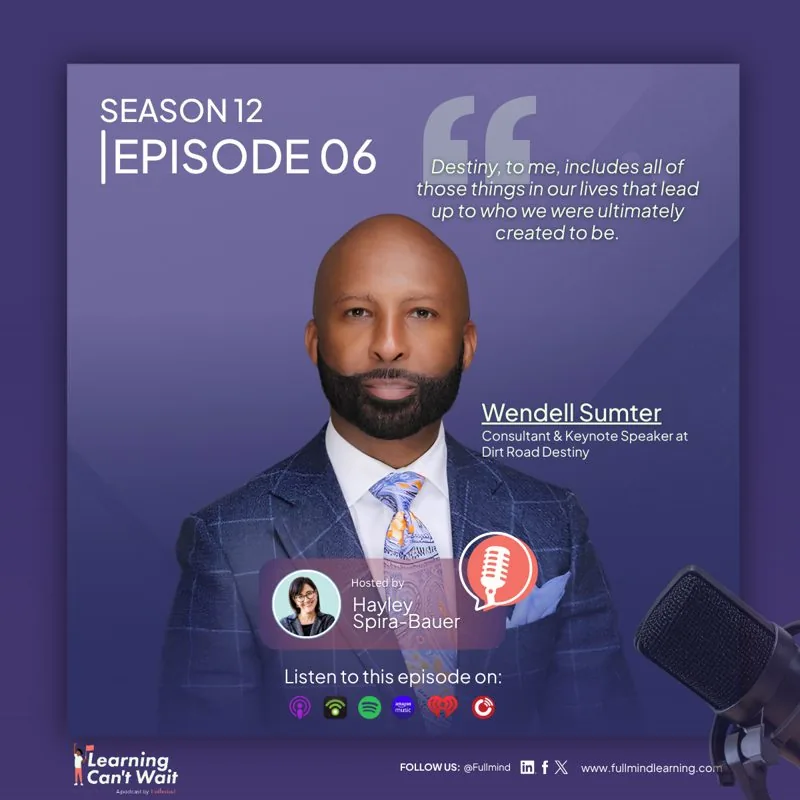
Wendell Sumter: Leadership, Resilience & Empathy
- Wendell Sumter, Retired education leader and author
 Hosted by Hayley Spira-Bauer, Chief Academic Officer at Fullmind
Listen now
Wendell Sumter: Leadership, Resilience & Empathy
Episode summary
Wendell Sumter, retired after 36 years in education and author of Dirt Road Destiny, describes growing up in rural Hopkins, South Carolina, an aunt whose example led him to teaching, and being told he wasn't college material. Unsupportive leaders during his mother's illness shaped his empathetic, high-expectations leadership. He explains his Win Them Over framework: listen without defensiveness, value perspectives, invite people in, empower them, and celebrate publicly. A critical parent became the school's biggest champion. His advice: believe in yourself and trust the process.
Key takeaways
- Leadership isn't about winning arguments, it's about winning hearts
- Take care of your people and they will take care of students; empathy and accountability coexist
- Win Them Over: listen without defensiveness, value perspectives, invite, empower, celebrate
- A once-critical parent became the school's loudest champion after one honest conversation
- Words from teachers last a lifetime, for better or worse; believe in your own destiny
About this episode
In this episode of Learning Can't Wait, Hayley Spira-Bauer sits down with retired education leader and author Wendell Sumter to discuss his new book, Dirt Road Destiny. Drawing from his upbringing in rural South Carolina and his 36-year career in education, Wendell shares how family, mentors, adversity, and resilience shaped his leadership journey. He reflects on pivotal experiences, including being told he was "not college material," overcoming educational misplacement, and learning the importance of empathy through difficult personal and professional moments. The conversation explores leadership, school culture, community engagement, and Wendell's "Win Them Over" framework, which emphasizes listening, collaboration, and winning hearts rather than arguments. Ultimately, the episode is a powerful reminder that challenges can become stepping stones toward purpose, impact, and lasting leadership.
Full transcript
Transcript generated from the recording; minor errors may remain.
Hayley Spira-Bauer: Welcome back, everybody, to the Learning Can't Wait podcast. I am so honored to introduce our next guest. We have Wendell Sumter, retired education executive and new author of the incredible book, Dirt Road Destiny. Welcome, Wendell!
Wendell Sumter: Thank you, thank you. I am so excited to be here, and I'm so excited to have this opportunity to, share and to speak with you and all of your viewers and subscribers, so I'm excited about this opportunity. More importantly, excited because I get to share My experience in hopes that others will… Be encouraged, enlightened, feel supported, and believe in their own destinies.
Hayley Spira-Bauer: I love that, and obviously, you could tell I'm excited about something. That little moniker that I used to introduce you, retired education!
Wendell Sumter: Yay! Retired!
Hayley Spira-Bauer: Congratulations! So, I know that you're gonna tell us your story, but we're talking 36 years in education, is that correct?
Wendell Sumter: 36 years in education, can you believe that?
Hayley Spira-Bauer: It's not over, your journey's not over.
Wendell Sumter: No.
Hayley Spira-Bauer: Wow, that is an incredible, incredible number, and an incredible, incredible legacy, and I'm so happy for you.
Wendell Sumter: Oh, thank you, thank you. I keep asking myself, like, how is it that I'm 36 years old, and I've been in education for 36 years? I can't make the…
Hayley Spira-Bauer: Totally.
Wendell Sumter: It doesn't add up.
Hayley Spira-Bauer: Yeah, the math, the math isn't mathing, but…
Wendell Sumter: Not mathing.
Hayley Spira-Bauer: Right, right, right, right. Amazing. Well, Wendell, I'd love you to kick us off by telling everybody how you came to be the personal and professional version of yourself.
Wendell Sumter: Well, here it is. I think, the book, Dirt Road Destiny, kind of highlights some of that in my own life. I started off in the rural parts of the state of South Carolina in a little small town called Hopkins, South Carolina. And, growing up in Hopkins, South Carolina, I went to Hopkins Elementary, Hopkins Middle School, and then Lower Richland High School, which were all in this, rural town, in Hopkins, where You know, our dirt roads were the places we played and made, mud pies and, all those wonderful things, and, and growing up around my grandmother's house and my family and all of those things, I think, for me, growing up, I kind of always looked up to, the adults that were around me. And some of those adults that were around me were so instrumental in providing me what I believe to be a solid foundation, and… and it was really, you know, we often talk about it takes a village, but it really was, that type of, support that I had with the entire village, so it wasn't… just my mom, or it wasn't just my grandmother, or it wasn't just, you know, my grandparents, or any… anything like that. I think more importantly, it was everybody. And, growing up, I had an aunt who, taught Elementary school, and so she, had gone to college, and, she taught elementary school. And every single summer that I can remember, from probably, when I was in first grade up until middle school, my aunt would take me with her To prepare her classroom for the students coming back in the fall. And that was every year. And so, when it came time for me to make decisions about, what I wanted to do in life, I felt like it was an educator. I felt like that experience that I had with her. She was always a very humble person, but, very smart, and so she, you know, just… encouraged me to, you know, and she… the funny thing, Hayley, is that she never said. Become a teacher. She never uttered the words, you should become a teacher. It was the example that she provided. It was the opportunity that she provided for me, during those times that I think shaped me. Of course. My family, and my grandparents were very important to me as well. And all of those things, I believe shaped who I was. I had aunts who lived in New York City, so whenever my grandparents would take me to New York, I just thought I was on top of the world, you know?
Hayley Spira-Bauer: Right.
Wendell Sumter: New York is such a… and as a little kid, you know, and I go back now when I go to New York, and I still reminisce about those times that… I had the opportunity to travel, to New York and see my aunts that lived there, and just be inspired as well.
[05:00] **Hayley Spira-Bauer:** You know, so often actions speak louder than words, and it sounds like in your background, that was absolutely true. Watching great educators live their truth and really shape young lives inspired you? The title of your book, Wendell, is Dirt Road Destiny. What does destiny mean to you in that phrase, and was there a moment you actually felt it, or is it something that you only recognize looking backward?
Wendell Sumter: I think, I would probably say that it was something that, as I reflected, upon everything that happened in my life, I really felt like… Destiny was something that, was instilled in me. It was something that gave me vision and allowed me to, have goals and aspirations. And when you're young, you don't really think of it as destiny. But I think as I, matured, and as I took that moment to reflect back on all of the things that happened in my life. All of the good, the bad, and the ugly, the adversities, all of those things played a role in destiny. So, I think when we think about destiny, we talk about the trajectory of our lives, you know what I mean? Like, you know. Here's, you know, sometimes we often talk about, do you have a vision for your life, right? However, with that vision, sometimes we're always looking at the end game, like, oh, this is gonna be the perfect scenario, perfect life, and it's gonna end like a fairy tale, where that is not the truth.Destiny, to me, includes all of those things in our lives that lead up to who we were ultimately created to be.
Hayley Spira-Bauer: Wow, I hear you say that, and it gives me the chills, because So often, young people are not… In touch with the future that they… see them… I can't even articulate what I'm trying to say here, because I'm feeling emotional, but so often young people are, I'm gonna pause for a second, because I actually do feel emotional.
Wendell Sumter: No kidding.
Hayley Spira-Bauer: Can you say it again? Okay. That's very powerful, Wendell, and I… it really speaks to me how you've talked about the path people are intended to be on. You know, in your own background, this book feels like a memoir and a leadership book. Which one… which book were you writing first? Was it the memoir or the leadership book?
Wendell Sumter: You know, that's a really good question. I think if I were to really focus on, which one came first, the leadership or the memoir, I really think it started out, honestly, about leadership, and how… My, you know. Experiences led to the leader that I became. So it was almost as if I started at, you're a leader, this is where you are, and then I had to go back and say. How did you get here? What steps did it take for you to get to this place where you are? And that's where I started looking back. Over my life, and thinking about all of the things that had occurred, and was like, wait a minute, okay, all of these things had to… happened. All these things had to occur in order for me to have reached the, point that I did in school leadership. So. I think that's where I started. I started with the leadership because I wanted to focus, you know, at first it was about the successes when I was a principal, and how my school became a national distinguished Title I school for closing the achievement gap, and I wanted to talk about, you know, all of the successes that I had as a school leader, and becoming a Microsoft Pathfinder school, and all of those things, but… I soon realized that… None of that would have been possible without Everything that happened before. The foundations that were laid. The thing that I had to… when I had to believe in myself, when… in the book, I talk about the teacher who said to me, in the middle of class, you know, that said to me, you're not college material. I was in a British literature classroom, and in all of my… in front of all of my classmates, this teacher said that.
[10:00] **Hayley Spira-Bauer:** Wow.
Wendell Sumter: And it was something that I never forgot. You know, we often say, sticks and stones may break my bones, but words never… you remember, we kids, we would.
Hayley Spira-Bauer: Yeah.
Wendell Sumter: Words will never hurt me. Well, that's not true.
Hayley Spira-Bauer: Right, right.
Wendell Sumter: Words do hurt us, and so…
Hayley Spira-Bauer: Absolutely.
Wendell Sumter: You know, I think that was important, or, you know, I talk about in the book, when I was, you know, misplaced in a special ed classroom. And, you know, at the time, I didn't really kind of take up for myself. I just felt like I, you know, I was a high school freshman, and I was in this class, and I was, you know, thinking I was doing the right thing. I had a cousin in the classroom who said to the teacher, you know, he doesn't belong in this classroom. And she looked at him and was like, what do you mean? No, he doesn't below this, but he's too smart for this class, da-da-da. And at the time, I'm thinking it's just a reading class. I didn't realize, wait a minute, you're really literally in a special needs class. And nothing's wrong with that, if that's something that you need as a student. Right. But she tested me. And because my cousin spoke up in that classroom. She found out that I wasn't supposed to be in that classroom. They made a mistake. And placed me in the wrong class. So, I think all of those things kind of helped shape the leader that I became when I led schools, the care and concern about students, and making sure that students were successful, and providing the best, environment possible for, student learning. So, I think that's where I started. I started… It… initially with, okay, these are the successes, but what did it take to get you there? I started with the leadership, I believe.
Hayley Spira-Bauer: Wow, you know, every leader has an adversity story, and so often that adversity story shapes how they… treat others later in their life, and how they choose their path. And you just shared one adversity story, and the title of your book really is another adversity story in and of itself. What would you say is the most useful thing that ever happened to you in your early years that shaped who you are as a professional?
Wendell Sumter: That's a good one. Early on… Well, I think, okay, and I didn't put this in the book.
Hayley Spira-Bauer: Oh, oh, we're getting an exclusive!
Wendell Sumter: You're getting an exclusive. I was a teacher, I was a first, second year teacher, And, when I was that first and second year teacher, my mom had… she ended up having, a heart attack. And so… Yes, yes, and so… and it was, you know, a massive heart attack, and so I had taken off. Some days, you know, a week or so, to be at the hospital to support her, and to try to, you know, be there for her. And my principal at the time, you know, I came back to school, my principal at the time said to me, You know, you don't need to be at the hospital every single day. You can't do any more than what the doctors can do, and you just da-da-da. And of course… That rubbed me the wrong way. And so I was just… I was just floored, you know? But my response to her was that I only have one mother.
Hayley Spira-Bauer: Yes.
Wendell Sumter: And I'm going to do what I can to support my mother. And so, after that, you know, she wrote me up, was, you know, wrote a little note saying I was absent a lot, da-da-da, and mind you, what I had to do was I had to literally get a note from the doctor to say that I was the… primary caretaker for my mom, for this principal. There was no empathy, there was no concern about, you know. Taking care of your family, and making sure that you take care of yourself, because self-care is so important. And that's what I've learned about that. And so, When the end of the year came, and the test scores of my students came back. I was in the office, and she came up to the counter, and she said, I got your scores back from your class. And I was like, oh, okay. And she said, your class was the best class in the whole school. And I said, oh. Thank you. And then she says, well, you better be glad, because, you know, you were out with your mom. And I'm like, seriously?
Hayley Spira-Bauer: That's the takeaway for her?
Wendell Sumter: To take away from… for you, you know? But it taught me something very important. It taught me that I did not want to be that kind of leader. The kind of leader that only concern… is concerned about the bottom line. I want to be the leader that's concerned about the individual person. I want to have empathy. I want to hold people accountable. I want to have a level of excellence, but at the same time, I want to make sure that I take care of my people. Becausewhen I take care of my people, the people will take care of my students, or the people will take care of my, my staff, so… I think that was very important to me, and it's interesting because Throughout the trajectory of my career. In my 36 years, I was met with several different things similar To that, but I always maintained who I was as an individual or person. For example, I had a superintendent… when my mom died, I had to be out. My mom ended up not only having the heart attack, but several years later, she had cancer. And so, I had to be out for my mom to take care of her, she had cancer or whatever, and in 2013, unfortunately, she passed away. Well, in my particular district at that time, the superintendent said to, several people that, oh, well, I'm glad his mother's gone now, now he can come to work.
[15:00] **Hayley Spira-Bauer:** Oh my goodness gracious.
Wendell Sumter: That… was probably… the worst thing that somebody could ever say, you know? And so, there's things like that, I think, that really gave me the caring heart, the caring spirit, the caring character. And not to the point that you allow people to do what they want to do. I think you still hold people accountable, you still hold people, you know, responsible, but at the same time, you do have a level of empathy and concern for the lives of people.
Hayley Spira-Bauer: I can personally attest to your caring nature, just from my experience working with you over the years, but that… I'm so sorry that happened to you, and unfortunately. If it happened to you, it definitely happened to others in your building, and I know that story well. So, what do you… you talk a lot about building culture from the ground up. This is obviously an example of when culture was detrimental, and it really dramatically impacted a team member. What's the difference between a culture… A leader designs on paper, and a culture that's actually alive in a building.
Wendell Sumter: Yeah, you know, I think it's so important that, as leaders, whether it's in, you know, in, like, in the education space or wherever, I think it's important that we build the kind of culture that's a supportive culture. And one of the things that I think, I really like about culture is creating an environment where people want to remain in your district, or in your, you know, in your, organization. And I think one of the things for me is whenever I found out that there was someone in my community, or in my, school building or whatever that did not, like me. I mean, because let's face it, everybody doesn't like you, right? You know, as much as we want people to like us and all that kind of stuff, the reality is, everybody doesn't like us all the time. And so I was trying to find ways, how do I, motivate those people who don't like you, what do you do to encourage them? Because what I found is that, You know, when you build a culture of excellence and a culture where people want to be a part of your, organization or your school, they don't want to leave, because you've built that kind of culture For them. And one of the things that I, you know, did, I think, as a school leader, with culture was making sure that everybody understood the importance of supporting each other. Give them the motivation, is what I call it in the book. That's one of the things that I think led to some success in my particular schools, was making sure that we Set challenges, that we provide incentives, that we provide follow-through, and that we provide and make it a memorable experience, where people will always remember what you brought to the table. In regards to building that culture. And in building a culture as well, I think it's important to make sure that you understand that you have to have a balanced life. And I think a lot of times, in this thing called life, we are so focused on the business side of life that we don't have an opportunity to just enjoy life. And so, you know, some of the things that we talk about In the book about having a balanced life plan is don't waste your time worrying about things you can't control. You know, you can't fight every battle. Choose the ones which are worth fighting and let the others go. You know, thinking about surrounding yourself with good people, because goodness is contagious. Don't love from your heart, only love from your head also. And then live your life to the fullest, because tomorrow, is not promised. And so, those are just things that I think are important when it comes to, you know, building, the kind of culture and building culture from the ground up. You know, when you become a leader in a building. One of the first things you want to do is take the temperature of the building. What's happening? Are people happy? Are people excited? Are people engaged? Or are they just there? You know, and then how do you… and then from there, that's when you build that culture by showing Care, compassion, empathy, but then also having a high level of expectation.
[20:00] **Hayley Spira-Bauer:** Absolutely, and, you know. Knowing where you're starting and where you want to go is part of the battle. Let's talk a little bit about your win-them-over framework. In plain terms, for someone who's never read the book, what is it, and what problem were you actually trying to solve when you built it?
Wendell Sumter: Alright, so, Win Them Over… it's funny, so Win Them Over was, born, out of the adversity I faced when I left just, when I left the middle school. And went and became a principal at the elementary school. Well, I had this group of parents who felt like I was, you know, turning the elementary school into the middle school, and kids couldn't have fun, and… You know, and you… the parent, I remember so vividly saying, you know, you turn this school into a jail, the kids can't even have fun, you know, da-da-da-da. So, it was at that point that I decided, okay, what do I need to do to not, continue, arguing and proving my point with this particular group of parents. How do I win them over? What can I do to win these parents over? And so, that's what we talk about, and it's talking about listening, making sure that we hear the concerns of the parents or whoever. Without being defensive. You know, and when I talk about being defensive, you know, sometimes we create programs, we create… process and procedures and routines, and we want the kids to follow it, and we want everything to go right. And so sometimes, when we think we have created that vision, and we feel like, oh, well, this is the best thing. Sometimes we get defensive. We want to defend that which we've created. But I think it's important to listen, without… Being defensive. Value. Valuing the person's perspective, even if you disagree. You know, maybe there's something that they'll say that will cause you to reflect and say, you know what? You're absolutely right. I think this would work better. And then invite them, bring them into the process and give them ownership of what's happening. Empower them, provide opportunities for meaningful contributions, and then celebrate and acknowledge their growth in partnership publicly. Now, here's the thing. With this particular parent that I had, who was really adamant about me turning this elementary school into a prison, she thought. I called her in my office one day, and we sat down and we had a talk, and I explained things to her. I told her where I was trying to take the school and take the students, and she said, you know, I really thank you for just sitting down having this conversation with me. I want you to know that later on, that parent became one of the biggest cheerleaders of the school. I mean, to the point that she would… Yes, to the point that she would come, and she would get flyers, she would go knock on doors to make sure that parents come to the PTO meetings, or the school improvement council meetings. She would stand at the Piggly Wiggly and say, you all need to come, hear what's happening at the school. I mean, it was a… Phenomenal shift. In that community, because this one parent, who I could have disregarded, right? I could have said, oh, she doesn't know what she's talking about, oh, I'm the school leader, we got this, I could have done all of those things. But if the goal was to support not just my school, but the entire community, and to support the students I serve, I thought it was important to win them over. And so… we had what we call the State of the School Symposium. After that, I had her help me plan that. We had over 150 parents and community leaders who came. For that celebration, we… it was just wonderful, and… from that point on, again, she was a support… until I left the school, she was a major supporter of what we did at that school.
[25:00] **Hayley Spira-Bauer:** I love a story like that, where you really took the time to invest in your people so that they could invest in the community, and that is such a good illustration of your win-them-over framework, and How, really, you can solve from the ground up issues that are important to building a great, great school community.
Wendell Sumter: Absolutely, and one of the quotes from my book, you know, as we're sitting here talking, I'm just, you know, you know, Yeah, one of the quotes from my book is this.Leadership isn't about winning arguments, it's about winning hearts.Leadership isn't about winning arguments, it's about winning hearts. And so, I just think that that's… You know when… this is who I am. So, like, when you do that, when you win hearts, you win people. And that way, your school… and then, you know, you end up, you know, kissing a pig, like I did, because your students End up being the highest, having the highest test scores in the entire school district. And it's because you build that culture of excellence, and then what I found, Hayley, was that… People who were doing their job in that building, people who were focused on student achievement and focused on student success. They were the ones who would tell me, Mr. Sumter, we can't keep this person in this building, or people would leave, because they couldn't handle the level of excellence that was expected at that particular school. But it helped us, like I said, become a national Title I Distinguished School.
Hayley Spira-Bauer: Incredible. Wendell, I know that it's hard to imagine being at the end of our conversation, but we're here, so I wonder what advice You would give a teacher who's starting their career today.
Wendell Sumter: Well, you know, interesting… I, recently just, posted, a video clip of my, My book, Dirt Road Destiny, and I put on there, on the post, I put, what is one thing that a teacher or educator or mentor has ever said to you that you remember this day? What did a teacher or mentor say to you, to you that you will never forget? Because mine was that you're not college material.
Hayley Spira-Bauer: Right.
Wendell Sumter: I have a teacher who, I know this particular person, and she put the comment on my post just this morning. And she said, a professor who told me that I would never make it as a teacher, and I might as well quit.
Hayley Spira-Bauer: Ugh!
Wendell Sumter: Wow. And when I tell you that this particular educator was one of the top educators in my building.
Hayley Spira-Bauer: Wow.
Wendell Sumter: I mean, one of the top educators in my building, and I would have never known that she had gone through that. Like, I would have never known that she had that experience. She never said it, she never articulated it to me before. Just today, when I made this post, she said, a professor told me I would never make it as a teacher, and I might as well quit. I think if I were to leave anything with your listeners, it would simply be, to believe… in the abilities, That God has given you to be who He created you to be. Believe in yourself, Trust the process, and know that great destiny awaits. Because if we listened to every critic, whoever… Said anything negative about us or to us, we would never be the people we are today.
Hayley Spira-Bauer: Wendell, what an important message to end the conversation. You… have shared a small part of your new book, Dirt Road Destiny, and I'm so grateful you did. Thank you for coming on the podcast today.
Wendell Sumter: Thank you for having me, it's been great.
Hayley Spira-Bauer: And thank you to everybody for tuning in!