
Learning Can’t Wait · Episode 125
Richard Carranza: IXL Learning, IEPs, Social-Emotional Learning
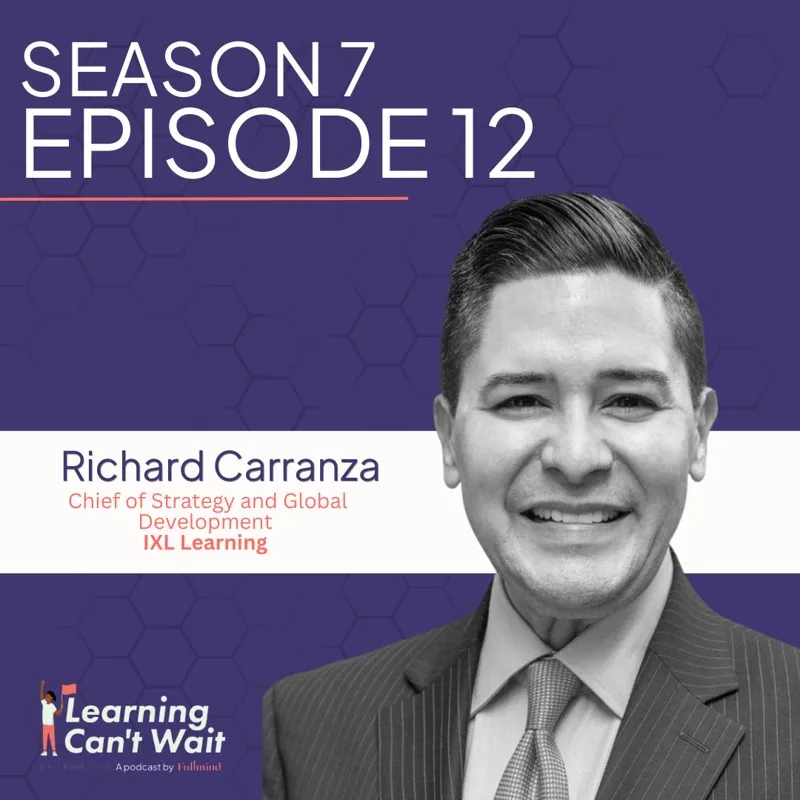
- Richard Carranza
 Hosted by Hayley Spira-Bauer, Chief Academic Officer at Fullmind
Listen now
Richard Carranza: IXL Learning, IEPs, Social-Emotional Learning
Episode summary
Richard Carranza, former New York City schools chancellor now at IXL, recalls entering kindergarten speaking only Spanish and why he renamed English learner departments multilingual learner departments. He argues schools must not return to the pre-pandemic good old days but keep the technology, connectivity, and parent capacity built during Covid, when New York moved 1.1 million students online in 72 hours. He describes edtech as an IEP for every student, insists it never replaces teachers, and warns that ignoring trauma and social-emotional needs loses students and educators.
Key takeaways
- Call them multilingual learners: add languages rather than treating a home language as a deficit
- Keep the bar high and build scaffolds; equity is never about lowering expectations
- The pandemic closed the technology gap in 72 hours; don't lose that capacity post-pandemic
- Adaptive tools can give every student an individualized plan without replacing great teachers
- Trauma shows up months or years later in attendance and behavior; address Maslow before Bloom's
About this episode
In this episode of The Learning Can’t Wait Podcast, host Hayley Spira-Bauer engages in an important conversation with Richard Carranza, a seasoned education leader with a passion for leveraging technology to create more equitable learning experiences. Richard shares his journey from working in the New York City school system to joining IXL Learning, emphasizing how data-driven EdTech tools can help personalize learning for every student—essentially creating an individualized education plan (IEP) for all. He highlights the power of real-time, actionable data in supporting both students and educators, ensuring that learning extends beyond the classroom and adapts to each student's unique needs.
Beyond academics, Richard dives into the crucial role of social-emotional learning (SEL) in student success, drawing from his experience as a superintendent during Hurricane Harvey and the lasting impact of trauma on education. He stresses that schools cannot achieve academic excellence without first creating environments where students feel safe, supported, and valued. Wrapping up the conversation, Richard offers candid advice for new teachers, urging them to approach the profession with passion and purpose. This episode is a must-listen for educators, school leaders, and anyone invested in the future of student-centered learning.
Episode notes
Richard Carranza’s journey in education is one of resilience, innovation, and an unwavering commitment to equity. Having led some of the nation’s largest school districts, including New York City, Houston, and San Francisco, Carranza has seen firsthand how systemic challenges can create barriers to learning. Now, as Chief of Strategy and Global Development at IXL Learning, he is focused on using educational technology to level the playing field for all students.
If your school or district is looking to bridge learning gaps, reach more students, or address teacher shortages, Fullmind can help. Our virtual staffing solutions connect you with state-certified, highly qualified K–12 educators who specialize in leveraging technology to deliver personalized, equitable instruction—no matter where your students are. Discover how Fullmind can support your goals for access and excellence.
On a recent episode of the Learning Can’t Wait podcast, Carranza sat down to discuss the role of EdTech in ensuring every student has access to high-quality, personalized learning experiences. His insights serve as a wake-up call for educators, policymakers, and school leaders who are striving to create a more inclusive and equitable education system.
The Challenges of Traditional Education Models
Carranza’s experience as an educator has shown him that traditional classroom structures often leave many students behind. He recalled how rigid curriculums and one-size-fits-all teaching methods fail to account for the diverse needs of students, particularly those from underserved communities.
“We have to meet students where they are, not where we think they should be,” Carranza emphasized. “Technology gives us an unprecedented opportunity to personalize learning and make education more inclusive.”
Many schools struggle with outdated systems that do not accommodate students who learn at different paces. Some students may need extra support, while others are ready to accelerate. This gap can lead to disengagement, frustration, and ultimately, inequitable outcomes. But with the right tools, technology can change that trajectory.
How EdTech is Personalizing Learning
Carranza highlighted how platforms like IXL Learning provide tailored learning experiences for students by using real-time data analytics. These tools assess students’ strengths and areas for improvement, allowing educators to customize instruction and intervention strategies.
“For a teacher with 30 students in a classroom, it’s impossible to individualize instruction for each student manually,” he explained. “But with AI-driven platforms, we can provide every child with a personalized learning path that adapts to their needs.”
The impact of this technology goes beyond just academic achievement. By allowing students to learn at their own pace and celebrate progress, EdTech fosters a greater sense of confidence and belonging. Carranza pointed out that when students feel seen and supported, they are more likely to stay engaged and persist through challenges.
Addressing the Digital Divide
Of course, leveraging technology to enhance learning is only effective if all students have access to it. The pandemic exposed deep disparities in digital access, with millions of students lacking reliable internet or devices for remote learning. While many districts have made strides in closing this gap, challenges remain.
Carranza believes that closing the digital divide requires a multi-faceted approach. Schools must not only provide students with devices but also ensure they have access to broadband internet and digital literacy skills. Partnerships with private companies, local governments, and community organizations can help bridge these gaps.
“Education is a civil right,” Carranza stated. “If we don’t address these inequities, we are failing our students before they even step into the classroom.”
The Future of Learning: A Call to Action
As education continues to evolve, Carranza urges schools to embrace technology as a tool for empowerment rather than a replacement for traditional teaching. He envisions a future where every student has the resources they need to succeed—regardless of zip code, background, or economic status.
For educators and school leaders looking to implement more personalized and equitable learning strategies, Carranza offers a clear message: be proactive, embrace innovation, and never lose sight of the students who need support the most.
Want to dive deeper into Carranza’s perspective? Check out some of his recent articles:
- Educating for our new normal: Rethinking the time, place, and means of K-12 learning
- Educating for our new normal: How the end of illiteracy can begin now
- What a data-driven K-12 leader prioritizes to drive change
The future of education is unfolding before us, and leaders like Richard Carranza are ensuring that technology is used not just as a tool, but as a force for equity, access, and student success.
Full transcript
Transcript generated from the recording; minor errors may remain.
Hayley Spira-Bauer: Welcome to the Learning Can't Wait podcast of Fullmind. At Fullmind, our vision is to ensure every child has access to an exceptional education. Each episode, we will be joined by Pathfinders within and around the education space who are bringing about transformational change. On behalf of deserving students, I'm your host, Hayley Spira-Bauer. Welcome back everybody to the Learning Can't Wait podcast. I am thrilled to introduce to you to today's guest. You may know him as the former chancellor of New York City Public Schools, but he is also the current Chief of Strategy and Global Development at IXL. I'm thrilled to introduce you all and welcome Richard Carranza. Richard, welcome
Richard Carranza: Morning, Hayley and good morning to everybody or good afternoon or good evening whenever you see us. It's good to be with you. Thank you for the invitation.
Hayley Spira-Bauer: It's great to have you here. I gave you the option of how you want to be introduced, and obviously I think you'll cover this with our first question, but your experience is wide reaching both in education and geographically across the United States, which I'm excited to talk about as I think you have a lot of perspective that may inform all of the positions and ideas and thoughts you hold today. So how about we jump right in? So Richard, I am curious how you came to be the personal and professional version of yourself.
Richard Carranza: Well, wow. So how much time do we have? No, I'm just kidding.
Hayley Spira-Bauer: As much as you need.
Richard Carranza: Look, I think fundamentally, I'm an English language learner. When I started my educational journey in kindergarten, in the hallways of Tucson, Arizona public schools, I only spoke Spanish. And while my parents were both bilingual, English Spanish speakers born and raised in the United States, they taught my brother and I, and they insisted that my brother and I would only speak Spanish until we matriculated into kindergarten and think about this. They had this faith, this tremendous faith that the public schools would do well by their children and teach us English and we would be bilingual, and they didn't want us to lose that ability to communicate with older generations in our family. I'm very thankful for that, but at the heart of everything I've done, I've never forgotten being that kindergarten student walking into a kindergarten classroom so full of excitement and joy to learn and just didn't understand what people were saying. So I've never tried to forget that. But that experience, I think has fundamentally shaped who I've been, not only as an educator, as a teacher administrator, as a system leader in education, but also just as a human being and the worth and compassion that public schools give to our students, some of whom are the most disenfranchised children, but all of that's played a role in who I am. I would also say, Hayley, that I am unapologetically a champion of equity for all of our children in our public schools. I think the public school system in America is one of those cornerstone institutions that guarantees the promulgation of our democracy. So we don't have the choice of not continuously getting better or doing well by all of our students in our public school systems. So all of those experiences and the experience of teaching in high poverty neighborhoods and teaching in school systems that are very large, all of that has shaped who I am as an educator and quite frankly, who I am as a person.
Hayley Spira-Bauer: I appreciate you sharing that story. I think we're going to touch a little bit here today on multilingualism in the United States and how we educate what we could do to better educate our multilingual learners. What I really, as you were speaking, what I connected to some of what your history and what your career has done is the idea that we celebrate the differences of our children that your parents really instilled in you. I think that's very, very beautiful
Richard Carranza: Here. Thank you. Thank you. Well, I'll just say this. So the celebration of who students are in the public school system is something I think public education is all about. But I'll give you an example. When I was, my first superintendency was superintendent of the San Francisco Unified School District in California. And while I was the deputy superintendent prior to my selection as a superintendent, when I took over that role of deputy superintendent, I was meeting with my English language learner department. And it struck me that when we speak a students developing English language proficiency, it's often in the deficit mode. So if you're an English language learner, you have to learn English rather than thinking about it. Well, if this student already has language capabilities in a language other than English, what did we continue to really strengthen their primary language, but at the same time provide that scaffolding for them to learn this new language called English? So they're not English language learners, they're multilingual learners. They're learning two languages at the same time. And if we're really successful, maybe three languages. So I renamed the department the multilingual English, the multilingual learner department, the MLL, and I was able to, because it really resonated with my colleagues and the community, I did that in every subsequent leadership position, superintendent in Houston, I did the same thing. We became the multilingual learning department, and then in New York City, same thing, multilingual learner department, which has really given us that mindset of how do we add rather than subtract and replace language,
Hayley Spira-Bauer: Words really matter. It is funny, a couple years ago, maybe two at this point, Fullmind, the organization that I work for renamed all of our services. So that multilingual was the nomenclature, and my colleague Sarah Nelson put out a thought piece about why we did that. And her story is similar just like yours, language matters. She's a multilingual learner. Her family spoke Portuguese at home and her family wanted to hold that. And so her story really just like yours, spoke to what you thought was best for kids. And what we know is that students that are bilingual or multilingual actually have an advantage over everyone else. I regret so much that I'm not because other than beyond my education, but that I didn't grow up in a home where I got to speak more than one language. You have so much more access to the world, so many more people that you can communicate with, which is so valuable and important. I'm wondering now, as you touched on in your commentary about your experiences experience being the superintendent or chancellor of many districts across the US. I know Houston's thrown in there as well. Can you talk a little bit about other than the unifying the language you use to address the multilingual learning department in each city, what did you find was both similar and different in the different cities that you led?
Richard Carranza: Yeah, so I think there's a lot of differences, of course, that are all very much locally based differences. The faces, the names, the context, those are all different and they matter. However, the issues since Brown v. Board of Education are fundamentally the same. How do we provide an educational system for all students regardless of what their economic privilege is, regardless of what their backgrounds are? How do we provide a public school system in a democracy that we call the United States of America that ensures that we're educating our populace to be contributing citizens to that democracy that we all believe in so deeply? So for me, the challenges have been while we want to, as a system provide those learning opportunities for all students, what I have found is that when we focus on actually providing those resources, those strategies, those support systems to all students, then it means that we have to in some way, shape or form get on the same page, if you will. So in order to do that, that means that some of the things that, well, I feel like teaching the dinosaur lesson today. Okay, second grade, you're going to teach the dinosaur lesson. Great. And then as I walk classrooms in third grade, they're teaching the dinosaur lesson, and then I keep walking, and in the fourth grade, they're teaching the dinosaur lesson. So that kind of disjointed curricula, that disjointed approach doesn't serve all of our students. So one of the biggest challenges has been how do we get everybody on the same page? I'm not talking about pacing guides, but I'm talking about what should students know and be able to do before they move to the next level of whatever it is, next grade level, the next chapter, the next unit, et cetera. That's difficult, especially in large systems because you can't use a cookie cutter approach. It has to be very, very much based upon who are your students, what are their conditions, what do we need to do? And I think this is really important, Hayley, we never talk about lowering the bar that students should be able to demonstrate proficiency in what we're talking about, keeping the bar high, and then we as an organization, build those scaffoldings build abilities for students to be able to engage and reach the bar that we've set for all of our students. That's what equity is about. And in every system that I've been a member of or a leader of, that's really been the day-to-day challenge to ensure those opportunities for all students.
Hayley Spira-Bauer: It's only been about three years since you were last in your role in New York City, but even in the past couple weeks, a lot has changed. We're at the beginning of 2025 when we're recording this, and there's a lot on the horizon. I'm curious what you see are some of the biggest challenges forward facing public education today.
Richard Carranza: Well, I think, let me just mention this because when I was in New York City as chancellor, I left at the very, very end of the pandemic. We had navigated through all the difficult decisions, all the difficult circumstances with the pandemic. We had open schools with students, were coming back, staff were coming back. And once we were able to do that is when I exited as chancellor in New York City. However, as I've had an opportunity to reflect upon these time periods, what we can absolutely never do is go back to the good old days and the good old days being defined as pre pandemic. Because pre pandemic, not all students had a great experience. Not all students had all of their needs met. Pre pandemic were not the days of wine and roses where everything just were exceedingly well. So for us, I think as educators as the citizenry of the United States,we can't afford to go back to the good old pre pandemic days.So that means what are the challenges that we address during the pandemic and how do we leverage those as opportunities post pandemic? Let me just give you one or two examples of what I'm talking about. So pre pandemic my entire career, and this is now my 37th year in education pre pandemic, we always talked about we have to close the technology gap. We have to close the technological opportunity gap, and that was always something we really talked about and we worked at and we chipped away at that through policy and just trying to make sure that we had what in place, what students needed. However, there was always something else that became more and more pressing. The pandemic wiped that out in a matter in New York City, a matter of 72 hours, we had a transition 1.1 million students, 80,000 teachers, another 10,000 administrators into a virtual environment, which means we didn't necessarily have the technology for all those 1.1 million students, which means we didn't necessarily have all of the educational technology platforms that we needed to migrate students and teachers to this new virtual environment. So what happened? We put resources behind those issues. So we got the technology, we did the connectivity, we built the partnerships with Wi-Fi companies and made sure that we had Wi-Fi for our students. We parked our Wi-Fi enabled buses next to neighborhoods that didn't have Wi-Fi accessibility. We made sure that we vetted and really promoted edtech companies that were giving us the right kind of information. By the way, that's why I joined IXL because that was one of them. But anyway, so we did all these things that prior to the pandemic, we all said was impossible. We did it. Was it perfect? Absolutely not. But was it years light, years better than what we had done prior to the pandemic? Absolutely. And we developed the capacity for educators to use these new technologies in new and different way. We didn't replace the educator, but we gave them tools to be able to do what they signed up to do, which is to teach children. So as we look at a post pandemic environment, why are we going to lose all of those things that we fought so hard during those really tough two and a half years? The capacity we built for educators and students, and here's often forgotten constituency parents to use technological tools in a new and exciting way, the ability for students and parents in their home to have perhaps a computer for the very first time, and that labels because students and parents weren't literally elbow to elbow at the kitchen table doing lessons and learning and being online. Think of the incredible capacity that parents now had that perhaps prior to the pandemic, they didn't have to have the technology, the connectivity, and the ability to advocate on behalf of their children perhaps they never had before. These are benefits that shouldn't go away post pandemic, but we should actually capture build into our educational systems and see this as new opportunities, our students and teachers and communities to further student mastery rather than, okay, we got through that pandemic. Now it's time to go back to what we used to do. And I think the recent NAEP scores showed that we've got some work to do in that regard and how do we use these new opportunities.
Hayley Spira-Bauer: I appreciate you adding that color, and I think you perfectly led me to my next question about technology. So let's start with IXL because you obviously called out there why you went to IXL. Give us a little bit more color. Why did you land at IXL? What did you think about the work that was happening there during your tenure in New York City and now what are you excited about while you're there?
Richard Carranza: I appreciate it. So I'm a storyteller, Hayley, so I'm going to give a little context to answer your question. So we think back to March 15th, 2020, and I still remember leaving the mayor's briefing at City Hall with all of my fellow commissioners and I as chancellor of schools, and the mayor has made the decision based on all the data, and believe me, during the pandemic, New York City was the epicenter of the epicenter of the pandemic and the outbreak. So we had this meeting and the mayor had made the decision, we are going to close the schools, we're going to transition Chancellor, you have until Monday at our press conference because we're going to announce it on Monday. So March 15th is when we had our press conference and announced we were switching to a virtual environment. Those 72 hours, I tasked my staff, I need you to find and report to me what are the most efficacious systems that we have in place? What do we have in place that we can then leverage into being tools for educators, students, parents, so that during this, what we thought was going to be a two week period, students don't lose two weeks of education, but we continue to educate. By far the most engaging platform we had was IXL Learning. And for me, that became very important because not only did IXL give our students the ability to take an assessment in less than 10 minutes, working on questions built on what their particular mastery of the discreet skills were, but then gave students and teachers a roadmap. Students had skills that they could practice. Teachers knew how students were progressing, and because of the algorithm, as students did better, the material became more and more challenging, which pushed better mastery of those particular skills for students. I was convinced, and the added benefit was that they were extremely easy to work with. We transitioned these 1.1 million students very, very quickly. So for me, the other lesson in why IXL was so important was that post pandemic, as we were coming back into the school in-person environment, we heard very clearly from our teachers and principals we're really unsure about what this is going to look like. But the one thing you cannot take away from us is the tools you've given us during these two and a half years. And one of those was very clearly, don't take away our IXL. They built that into what they were doing to support their systems. So for me, that was a game changer. And for me, I saw the power of having actionable data very quickly at the fingertips of educators and educational leaders to make educational decisions. So that's why post New York City, I was very honored to join IXL.
Hayley Spira-Bauer: That makes a lot of sense. When you see something that works and you have the data to prove it, you want to continue it. I obviously would be remiss if we didn't spend some time talking about technology and the role that it plays in a addressing issues of equity, issues of equity and access in schools. So you obviously, these are topics you named at the top of our podcast that are important to you. You are now in an organization that is edtech at its finest. What value do you see technology playing and how can schools that didn't get all of the roads and highways set up during the pandemic feel as excited as you do about the role of EdTech?
Richard Carranza: Great question. So let me give you an organizing concept. In education, we are very familiar as educators around an individual educational plan, an IEP, and typically an IEP is put together by a series of stakeholders, parents, teachers, educators, school social workers, et cetera, around the specialized learning needs of students in specialized learning, we call 'em special education students. Every special education student has an IEP, but I want to reemphasize individualized education plan. So while we think of that handful, and it's actually a big, it's an arm of students that have IEPs, we think, okay, it's a very designed curriculum for that student based on what their needs are and what they need to be able to not only do well in school, but to actually accelerate in school. Now, imagine if we had an IEP for every single student, and right about now, every educator, every classroom teacher is clutching their pearls and saying, my goodness, I don't have the time. I don't have the resources to be able to do that. But with educational technology, you do have that ability. So I mentioned IXL. So imagine you're a student, you walk in, you take an assessment. That assessment is no longer, no more than 30 to 45 minutes. And then based on that assessment, and let's just pick math based on that assessment in math, and you're a fourth grade student specifically based on your state standards and your discreet skills, where you stand, how do I stand in numeracy? Where do I stand on algebraic thinking? Where do I stand on number sense? So based on that assessment, you now have a skill plan, and if you spend 10 to 15 minutes every day working on a specific set of skills because of the skills that you need to develop and accelerate, you can now see in real time how you get better at mastering each one of those discrete skills. The teacher sees that as well. So the teacher then has the ability, rather than direct teaching every single one of their 25 to 30 to 35, believe me, class sizes are still big around the country. Then the teacher now has very specific information about what Richard needs. So Richard is doing great on number sense, not so good in algebraic thinking. So what can I assign Richard in addition to what's already been assigned that will help Richard practice? And here's the key point, not just when Richard is sitting in my classroom, but when Richard's at home or when Richard's riding the bus to his home, or when Richard's riding the bus to his afterschool program or when Richard's in his afterschool program or Saturday where Richard can pull up his computer log in and continue to work on his skills that have been identified that he needs to work on in mathematics. That's the power of educational technology, but it's also important that that technology is very much grounded in the individualized, hence, IEP individualized needs of every particular student. I think we are in an environment more than any time in our history in public education where we now have the tools, the professional support and professional development to be able to create an IEP for every student in our public school system. We've never had that ability before. I think we're in a bold new place as long as we don't forget those lessons and those real investments we made in developing capacity, developing and building, and providing the technology and the connectivity, and continue to embrace this as a way of individualizing the instruction for the needs of every single student. Now, the one caveat that I'll add here is this in no way means, Hayley, that I would or IXL, whatever ever advocate for replacing a well-qualified, passionate, well-trained, caring teacher for technology. That will never happen. But if you give that great technology and put that in the hands of the well-trained, passionate, caring teacher, you lift from my perspective, all of the barriers that are present for students to actually get what they need and deserve to be able to master their content.
Hayley Spira-Bauer: I could not agree more. And what's special about this conversation is you're talking about how we can meet the needs of every child. Now is a more important time than ever. The Nation's Report Card came out just a week or so ago, and students are faring worse off than they did before the pandemic. So not only do we have the tools and the means as you named, but we have the urgency because our students are in a place where they are struggling. Absolutely. I'm curious from your perspective, and I've heard your interviews before I read your Body of Work, I kind of know where you're going to land on this question, but I'd love for you to share with our Learning Can't Wait audience, how do you think supporting students' social and emotional needs plays into the academic needs of our students and how even technology can support them on that journey? Me?
Richard Carranza: Yeah, great question. So in education, there's the Bloom's Taxonomy of Learning, which we use. It's a taxonomy that we use to determine how much are students mastering what they should master, right? So it's the taxonomy blooms. And then on the other side, there's research from Marzano that talks about if a student doesn't have a warm, welcoming environment, an environment where they feel not only that their basic needs are met, food, clothing, shelter, wellbeing, but they feel comfortable in being able to make a mistake and know that they're going to be supported in doing better based on whatever they made a mistake in, whether it's social behavior or whether it's academic progress, creating that environment is also important. And Marzano wrote lots of literature about that. And so that's a social emotional learning. Who wants to go to an environment where it's nothing but a negative environment? So we have, in my very personal perspective, spent a lot of time recently in the last 20 years really focused on that Bloom's taxonomy, academic achievement, what are students mastering, what are they not mastering? And then what are we doing about it? Absolutely necessary. But what we haven't talked a lot about, and we're seeing really the effects post pandemic, is the Maslow conversation. What are the conditions that we're creating? What are the support systems that we're providing? What are the systemic supports to include students, make them feel like they're part of their educational experience, and more importantly, want to be part of that educational experience? So what I say to educators as I go around the country talking to colleagues across the country isyou cannot get to Blooms if you don't pay attention to Maslow.So it's not just reading, writing and arithmetic and that's it. No. If that's the case, why do kids even need to go to school? They can do that from home, they can do that from the library, they can do it from the park. The whole reason kids go to school is that there's so much about educating children and the socialization and getting along with people and learning to work in teams and learning to communicate and having a spark of educational learning. Maybe you looked at something, you saw something, somebody talked about something in school that sparks an interest in you, and then that leads you to be very passionate about something. That's what happened to me with music in school that sparked my interest. There was no way I was going to leave school, not only because my parents wouldn't allow it, but because I didn't want to miss out on the great educational opportunities as far as music was concerned in schools. Now, could somebody say, wow, he should have concentrated more on English writing? And of course, but I wasn't going to ever leave because I had a spark. I knew what was drawing me. So social emotional learning now is more important than it's ever been. And I'll give another example of why it's important. When I served as superintendent in the Houston Independent School District, we had a little weather event called Hurricane Harvey to this day, the most devastating natural event, most devastating event in the history of the United States. So we closed schools for two weeks, and within two weeks we were against all odds able to open schools again. But what we saw, that weather event that lasted about 48 to 72 hours in Houston, while that was traumatizing, the effects of that trauma we didn't see for at least six months to two years after we were beyond that traumatic event. Why? Because trauma affects people in different ways, but it affects people. It will manifest itself in behavior, in attendance, in eating habits in sleeping habits, in antisocial behavior. So if you don't have a mind towards addressing those social emotional impacts of a trauma, then it doesn't matter how great your curriculum is. It doesn't matter how great your interventions are. If students don't feel safe, don't want to be in school, don't feel like that's something that's going to help them get better, not only at academics, but at life. Then you're going to lose those students. And I think post pandemic, we've seen a decline of enrollment. We've seen a decline in student attendance in public schools across the country. Schools are talking more school districts are talking more and more often now about closing schools or right sizing their school system. So where did those students go? They haven't just disappeared off the face of the earth. They're finding other alternatives.They're voting with their feetif they're not feeling satisfied or actually embraced along Maslow's continuum of priority. So it's my very long-winded way of saying that if we do not pay attention to the trauma, and believe me, the entire world has suffered the COVID-19 trauma educators as well. If we don't pay attention to what are the signs, what do we do to help students navigate that? What do we do as a system to invest in systems and structures? Then my fear is that we're going to lose a generation of not only students, but a generation of educators who are going to say, I can't do this anymore. I'm out.
Hayley Spira-Bauer: Well said. And it's so important when we think about the long-term effects of trauma. You've named a couple of different historical events, and we've had a lot of historical events recently. I'm done with historical events. But all jokes aside, those have really significant impacts on our students, and so appreciate you addressing that. It's very top of mind for me. I just read Isabelle Hau from Stanford Accelerator for Learning's new book, Love to Learn, and really an episode on that book with her today, and it's speaking to exactly what you shared here. You cannot teach kids unless they feel loved and safe and supported. That will never happen. So I'm just collecting all the brilliant people who feel the same way, and we're going to keep talking about it because I think it's so important and part of what makes great educators. Great. Richard, my final question for you is about teachers again here, since we were touching on that, it makes a lot of sense to go there. What advice would you give a teacher who's starting their career today?
Richard Carranza: Wow. Okay. I have a reputation of being as blunt as a spoon sometimes, so I'm going to be blunt. Look, if you don't absolutely love the concept of impacting the next generation. If you don't love the fact and accept the fact that those little humans that walk through your door, whether they're little humans at four years old or little humans at 18 years old who just don't have the world worldly knowledge and vision that you may have as a teacher, then please, please, I beg you. Do something else. Do something else. But you have to be all in. You have to be passionate about educating children, all children, whoever they are that walk through your door. You're going to do whatever it takes to make sure those students are going to leave the time they have with you better, not only in academics, better in mathematics, but better as human beings that know how to work in teams that know how to live in a social confine, which we call the social contract, right? When you're in a classroom, you're part of the social contract. So that's part of educating. So my advice for teachers is you have to be passionate about serving the children, and you have to be passionate about making sure that what you do with those children leaves them in a much better position to be successful academically and societally, if you will, when they leave your care. So if that's not what you want to do, do something else. But if that's what you want to do, you're going to find yourself in a community and part of a community of educators that want to do the same work, and it's incredibly uplifting and incredibly honoring when you find that community because you know that you're making a difference.
Hayley Spira-Bauer: Amazing. Keep that blunt as a spoon attitude. I think it's what we all need to hear right now. Richard, thank you so much for joining us on The Learning Can't Wait podcast.
Richard Carranza: It's been my pleasure. Thank you for the opportunity and thanks again for what you do. I really appreciate it.
Hayley Spira-Bauer: Thank you so much, and thank you for continuing to share the important words that really impact our children's lives. Thank you everybody who tuned in to this great episode today. We'll see you soon. Thanks for listening to the Learning Can't Wait podcast. If you like what you heard, please rate, review and share this episode. Be the first to know when we have a new episode by subscribing wherever you listen to podcasts. If you'd like to be a guest on the show or have a suggestion for an episode, email us at podcast@fullmindlearning.com.