
Learning Can’t Wait · Episode 87
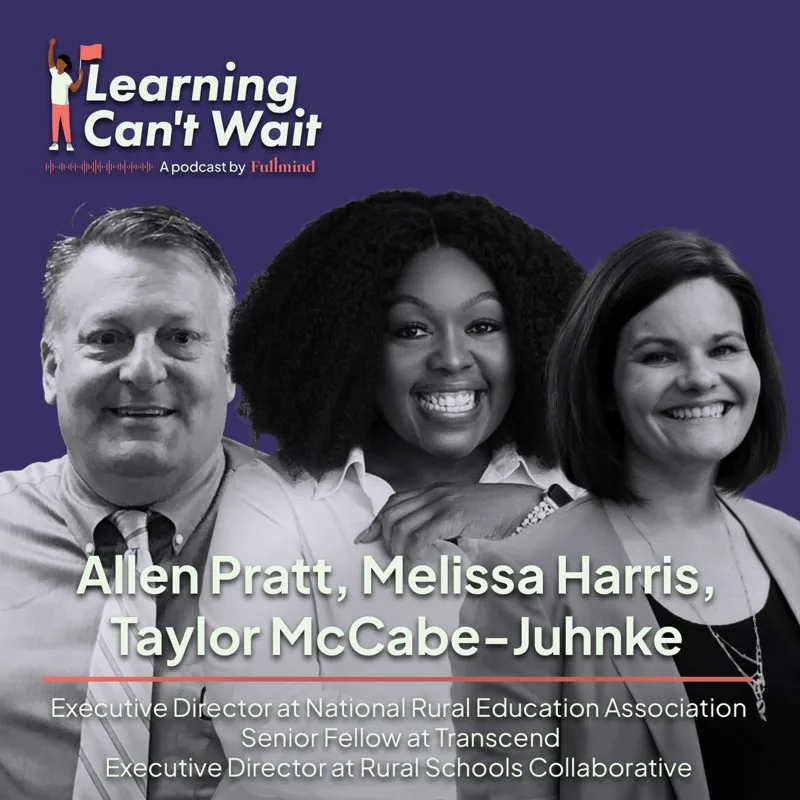
Melissa Harris, Allen Pratt, Taylor McCabe-Juhnke: Rural Education, Innovation, Collaboration
- Melissa Harris
- Allen Pratt
- Taylor McCabe-Juhnke
 Hosted by Hayley Spira-Bauer, Chief Academic Officer at Fullmind
Listen now
Melissa Harris, Allen Pratt, Taylor McCabe-Juhnke: Rural Education, Innovation, Collaboration
Episode summary
In the rural education miniseries, Melissa Harris of Transcend, Allen Pratt of the National Rural Education Association, and Taylor McCabe-Juhnke of the Rural Schools Collaborative push back on deficit narratives. Rural schools are scrappy, innovative, and central to their communities' economies and identity, and often solve shared problems like declining enrollment through cross-district coalitions. They discuss why collaboration is hard but grows the pie, the need for student voice and less standardization, rural underfunding by national philanthropy, and why AI and broadband are opportunities rather than threats.
Key takeaways
- Rural schools have always been innovative because they have to be; necessity breeds scrappy solutions
- Schools are often the largest employer, gathering place, and source of pride in rural towns
- Collaboration is hard, but when districts and organizations pull together the pie gets bigger for everyone
- 20% of schools are rural, yet national philanthropy gives far less than 20% to rural communities
- Student agency and community-taught trades matter more than standardization; AI and broadband can accelerate rural growth
About this episode
Welcome to Episode One of our Rural Education mini-series on the Learning Can’t Wait podcast! This week, Hayley Spira-Bauer hosts a panel of three incredible education leaders to help us dispel myths about rural America:
Melissa Harris - Senior Fellow at Transcend
Allen Pratt - Executive Director of the National Rural Education Association
Taylor McCabe-Juhnke - Executive Director at Rural Schools Collaborative
Tune in as our guests illuminate the many positive aspects of rural education, exploring how the "scrappiness" of rural schools inherently fosters a culture of innovation. The group also delves into the opportunities of AI and other technologies, while describing why collaboration between rural schools and communities is essential.
Join us every Tuesday at fullmindlearning.com/podcast. Next week, we continue our Rural Education mini-series by discussing collegiality in rural schools with Michael Gonzalez and Richard Wright.
Show notes from this conversation include:
Changing the One-Size-Fits-All Education Model from the North Dakota Department of Public Instruction
Rural Cultural Wealth: Dismantling Deficit Ideologies of Rurality from the Journal for Multicultural Education
Produced by Fullmind
Full transcript
Transcript generated from the recording; minor errors may remain.
Hayley Spira-Bauer: Welcome back everybody to the Learning Can't Wait. Podcast sponsored by Fullmind. I am so excited for this panel today I have Melissa Harris, a fellow and partner at Transcend, joining us. Hi, Melissa!
Melissa Harris: Hey! How are you?
Hayley Spira-Bauer: I'm pretty wonderful. I'm so glad you're here. Thank you for being with us.
Melissa Harris: Thank you. Thank you for having me.
Hayley Spira-Bauer: I have Allen, the Executive Director of the National Rural Education Association. Welcome, Allen.
Allen Pratt: Hey? Thanks for having me on. This is a great way to end my in my week.
Hayley Spira-Bauer: I could not agree more. And we have Taylor McCabe-Juhnke, the executive director of the Rural Schools Collaborative, and a title you won't see on Linkedin. But the person who introduced me to all the panelists today. Welcome, Taylor.
Taylor McCabe-Juhnke: Thanks so much for having me, Hayley.
Hayley Spira-Bauer: I'm so excited you're here. I'm so excited we're here together. I know that this Mini series on rural schools. The conversation is about to get a whole lot richer. So let's jump right in. My first question, for all my guests is always, how did you come to be the personal and professional version of yourself, for today you're welcome to extend that to how did you come to focus on rural schools as well, Melissa? I'll start with you.
Melissa Harris: I love that question. It's like it can take you in so many different ways. For me. I am a first generation college student.I've always knew that education was my purpose and my life's work. But my purpose has manifested in so many different ways. Over the course of my career. So I spent the majority of my career and time working at New York City. Public schools, hey? Y'all out there? And then from there had the great privilege of coming down to DeKalb, Georgia and doing some work here. But what's interesting is that how life works is my parents. Traveled to New York at the end of the Great Migration, and it was a homecoming to move back to Georgia.and how luck would have it! I'm now working for an amazing organization, Transcend education, and I had the great privilege of joining a rural portfol portfolio, and I get to spend my days, and my nights sometimes. Working with incredible rural leaders. From around the country, innovating and supporting young people. And so again, purpose just manifested in so many different ways and in so many different communities.
Hayley Spira-Bauer: I love that your journey has transcended, one would say, many different settings. And so your perspective. I'm sure you have a a variety of perspectives that maybe help to form the ethos that you'll share with us today. Thank you for sharing that, Melissa Allen. Same question for you.
Allen Pratt: So this is, I'm going to say, my career, and how I became into rural, and especially in what I'm doing now is is really accidental. And what I mean by accidental is, I was a teacher, a coach taught in rural schools my whole career, and I had someone come to me and say, you're gonna get your license, and you're gonna be a principal. And it was not a you need to do this. It was like, you have 11 months to get this going and that move changed my whole career in the sense of leadership. To get my doctorate to be in a role, to work in rural leadership, to work at the State Department, to roll, to work in the role I'm currently in now. So that person who I don't agree with all the time, and that person, not my friend. If that person didn't push me to do this I would don't know where I'd be. So it's it's kinda accidental, but it's accidental with a great purpose. I feel like to serve rural schools and communities and been the director of National Rural Ed, since 2,016. So it's been a a good journey for me.
Hayley Spira-Bauer: You know, some of the best things in the world are are created by accident, even, you know, penicillin and an as an antibiotic was not intended to be created. It happened as an accident so very cool, to hear that your journey to where you are today was a complete accident. As you, as you put it. But I'm sure as we unfold today we'll hear more about some of the intentionality behind your decision to take on the roles you've taken on and do the work that you're doing. Alright, Taylor. Last, but certainly not least. How did you come to be the professional and personal version of yourself?
Taylor McCabe-Juhnke: Yeah, I grew up in a small town in Kansas, and that's where I spent the first 22 years of my life. So I also went to college. There, at a teeny, tiny college classic small town story. I had both of my parents as educators at some point during my journey. So for me I think a lot of this work comes to me through lived experience of being being a product of a small town of being a product of public education in a small town, having parents who were in the public education systems. And you know the more that I found that I was passionate about work. The more I realized that I was the black sheep in my family for not having been in education before this, so my parents are not retired. They were educators. My grandparents were rural principals, rural teachers. You know my brother is an education. My sister in law is an education, and I think when I took this job everyone was finally relieved that I had joined the you know, family legacy, and finally doing something worthwhile, which is. Education, but on a national scale. So I feel really, really lucky that all the different odds and ends and different careers and mentors that I've had have landed me here into something that I believe really deeply in both personally and professionally so couldn't be more excited to to be with Rural Schools Collaborative.
Hayley Spira-Bauer: How cool that you're fulfilling somewhat of a legacy with your family and doing such important work. Taylor, what gets you fired up about rural education?
Taylor McCabe-Juhnke: Oh, man!
Hayley Spira-Bauer: You can't.
Taylor McCabe-Juhnke: Me up with just the best darn question. I get fired up about rural education because I think too often the national dialogue. Even the local dialogue is very, you know, centered around like gosh, if only we had 1, 2, 3, or gosh, this is really challenging, and I don't wanna gloss over that. You know, there are challenges that exist in small and rural places. But I also think that the national narrative right now sort of over, emphasizes those stories. And so if I can do one thing on this podcast or with my life's work, it's just to sort of, celebrate all of the assets that are in small towns, and how important that education piece is to rural places. So you know, Rural Schools Collaborative was originally found with a bunch of folks who said, We want to support the future of rural America. We want to support rural communities. How do we do that? And and where they landed was really investing in local rural schools and rural teachers, because they're often one of the largest employers in rural places. There's certainly a meeting place for events. You know the community. They're huge source of pride, actually. And a lot of folks kind of can come across different perspectives across the aisle to say, like we love our school, we wanna be at our school. And so if you can think about strengthening the bonds between these rural schools, these small town schools and their community and strengthening the school. The whole community benefits as well as sort of like the future generations of rural so that's sort of why rural schools collaborative and and why the work we do in partnership with you know, folks like Melissa and Allen. But also. I think that there needs to be more stories about what you get in small towns, which is a lot less red tape. You know. You have less layers of people to go through, you can be nimble, you can be innovative. And one of them, this I'd like to dispel is that rural schools are not innovative.Rural schools have always been innovative. They've had to be innovative. Because they're scrappy.And so I think that, you know, really celebrating the the assets that rural community have rural schools have the opportunities that there are in real education. Is one of the main things that I hope to get out of the work that we're doing nationally. You know, you get to know your students. You're often surrounded by really caring people who care about you as a professional and as a person. And a lot of folks also really enjoy myself included, a little bit slower pace of life and people not honking at you every time you leave your front door, so there's lots to be celebrated. And if that's all I do, I'll be happy with that.
Hayley Spira-Bauer: I love this the way you've geared your answer to really focus on so many positive aspects of of rural education. And I can tell you I've had a couple of different episodes recorded already with superintendents and teachers and other folks who work in rural schools today, and the the myth of lack of innovation, of rural schools. The episodes were entirely focused on the opposite of that which is like, here's all the innovation we're doing, because necessity is the parent of invention, right? Like you just have to be scrappy if you have less access and less resources, Allen, in your work over the past years you've been at your organization. Do you find like? Let's double down on that give. Can you give us some examples of how you've seen that to be true?
Allen Pratt: Talking about innovation in general. I mean it it, Taylor, hit it. Folks have to be innovative to to, to do what they need to do in rural communities. I mean, it started. If you go way back, it starts farms and and farmers or people that work, they they're they're gonna have to do things because the stores not 5 min down the road, and maybe an hour, an hour and a half. So those things are are very viable, but the community themselves, I mean. I I agree with Taylor. I mean. It's a slower pace of life. Sometimes in those rural communities. I I still live in a rural community. I live in South Pittsburg, Tennessee. It's 3,500 people. It's outside of Chattanooga. I'm 30 min away from stuff. But that 30 min drive that 30 min away changes the perspective of a lot of things. And I was just. I'm going to share a purse story. My son is graduating this year from high school. He just sent me the picture. They put every graduate up on the the walls going down the town. What what other I mean. That's the perfect example you have every graduate that's going somewhere to do something, either trade athletically for your school, whatever they're all posted all equally across the board, and they get their picture and they get their moment. You you wouldn't get that in other places. That's where rural communities are so special. All 3 of my children have went to the same rural high school that I was principal at. They have friends that they never lose from those small rural communities. Many still live in the area. Many don't, but they when they get together, it's like they've never lost a moment in time. So when you're talking about these rural communities of rural connections. It it's just about it's who you are. It's the context of what you're become. It's the group the village that raised you, and I think that's the key for us. And when I go to places I tell people I was in Montana 2 weeks ago. And I said, You've gotta tell your story to me and others. So when people are voting on policy, they understand who they're impacting who they're connecting with, because they need to know that if they change funding or they do certain things, it's gonna impact these small schools. And I think that's that's yeah, I don't know if I really addressed your question, but I think that's my answer to that question, anyway.
Hayley Spira-Bauer: Well, first of all, I love the story about your son and his name, and the name of the names of his peers appearing in the town. Congratulations on a family milestone there. I hope you took a picture of his name up there.
Allen Pratt: Oh, yeah.
Hayley Spira-Bauer: You know. Melissa. Now I'm gonna return back to what you said in your introductory statement, which is that you have lived experience of working and living in, not in rural communities. So tell us about kind of the dynamic nature between the statements that we hear Allen and Taylor making and your own experience, bridging both rural and urban environments.
Melissa Harris: Yeah, I love that question. And the thing is about New York City. There are 1.1 million kids. I love New York City right? However, it is so big to wrap your arms around everything that happens in New York City and coming into rural communities. I have to say I would say that I also had a deficit lens at first, now that I'm like really thinking of it, because most of the things that you hear around rural school districts is from a deficit. Lens of what rural school districts don't have. However, what I found is that many of the challenges that rural community faces communities face are the same challenges that are being faced in urban areas. However,rural communities have already started to come up with solutions and innovations around addressing them.So I think I'm not certain if this is in Washington. But definitely, let me just say, one rural community where they were facing enrollment, decline. They were lacking resources that were appropriate. They then decided to create like a coalition collective amongst 4 different school districts, so that they can ensure that their students had what they needed and the resources they needed so that they can get the education that they need. These are problems that other school districts other communities are having around under enrollment, enrollment, dropping resources. But we can't figure out necessarily in some other communities how to share resources between 4 schools in the same district, whereas you have 4 separate school districts that are figuring out how to come together 4 separate school districts for separate superintendents. Figuring out how to come together and do this in service of the young people. What's the same across the board, at least for me. Is a love for young people. However, something that you see in the rural schools in in the rural school schools that I've had the opportunity to be part of and being community with is something that Allen is saying around like the familiar nature. It's because you may have like this one school. And so the superintendent probably has, like a child in the school, 3 cousins, and so forth, and the learning happens within the school and without this outside of the school, because just that deep family sense that's happening within the community and outside of the community. It's been beautiful. Y'all I really like. Well, as you can. As we all know. Now, I am 100% rural.
Hayley Spira-Bauer: All, in.
Melissa Harris: I'm all in. I spend more time in rural communities. At this point in time than I do spend in urban communities, because even in addition to working in rural I also have family in rural Georgia. So that means that like, it's just beautiful. It's rich. It's amazing. It smells delightful. The drives are. I'm agreeing with everything that has been said so far.
Hayley Spira-Bauer: I don't have one.
Taylor McCabe-Juhnke: Also just vouch for that that both of these folks are often very hard to reach, because they are in somewhere that doesn't have cell service or doesn't have broadband. So these are the realist of real alien that you have today.
Hayley Spira-Bauer: Let's talk about the power of the collaborative. This is not this is a story I have heard now a couple of times over the past couple of weeks that I've been recording episodes with brilliant rural school leaders and folks supporting rural schools. What does the power of collaborative mean to you. And how have you seen transformation much like Melissa, shared in your own work?
Allen Pratt: Ca, can I? Can I start with this one, if you don't mind. So I I'm gonna say, I'm gonna start off. This is not deficit, but it is it. People need to understand collaboration. If it was easy. It would be done all over the world. It is not an easy process in in the reason being is in in. My dad used to tell me this rest is soul. We were in a small town, he goes, I said Dad. Why, there are 2 Baptist churches across the street from each other. And one's a first and one's a second Baptist. He goes because they couldn't get along. They couldn't be collaborative, so they split.
Melissa Harris: That's true.
Allen Pratt: So that's that's the story. People understand that it's not perfect. But when you, when you have an opportunity to have like minded individuals or like minded organizations, or like minded schools, pull in a direction where they know everyone's gonna benefit. And they're gonna get theirs as well. And they're gonna do some things to change and make things a whole lot better for the outcome, the end product which in our case would be the community being better, the students being better students, having more opportunities and just bringing things to those rural communities. That's when it's special. You. You talk about this. I look at collaboration as a championship season, where you remember those seasons when you've won it all, and you're a champion, and I've been a part of those. You take lessons from those years. You don't win at all, but you're still a team, and you have tough times. And they make you better in that championship run. That's what collaboration is. You're you're trying to get to this end goal. And Taylor and I always talk about it. We we talk about, we're together. And we're almost like prom dates of friends. Okay? And we're moving in the same direction. But we're each bringing unique talent talents through this dance floor about to get online. And I think that's what people need to understand. There's a lot of metaphors and other things in that that description, and what I'm doing. But it it is very difficult. And when you get it to the point where it's happening or starting to happen. It's the greatest feeling in the world, because, you know, you're all pulling in same direction. So I'll leave it at that, and you all can take it and go from there.
Melissa Harris: Allen. If you don't mind me just trying to jumping in, because when you, as you were talking, something that came to me was at Transcend. We really center our work in community based design. And how important it is for the full community. That's the folks inside the school and outside the school. To be together to bring this vision of what? The student experience would look like and do it together, and with the work that we do. We focus on these conditions for innovation. What that looks like is like, how much conviction do you have to make this change? How clear. Are you the road ahead? What's the capacity that you have within your school district and outside in the community? In order to get this work done? The coalition and the group you have, and the culture and the sweet thing about it when we talk about rural communities first off is the coalition, right? So back to. There is the collaboration that's happening on the community level and at the school level, and being able to really quickly draw coalition in order to move their work forward. Now, when you take it to a macro level, what we've been able to see from our vantage point kind of like how Taylor has served as a connector to bring us all together on this call the community and the collaboration that is building on a macro level, where we're all starting to figure out. Well. Everyone has a unique set, a lens that we bring into this ecosystem. How can we bring our fractals together in order to help push what's happening at the local level together, lockstep and faster. So no, we're not looking to be the outsiders. That kind of come in and mess up the ecosystem. We recognize that at a local level there are strong ecosystems that that exist in rural communities, and they're so ripe for innovation. So they're already innovating. But how? As on a macro level, how can we? As different organizations come together so we can shine the light on innovation that's happening in rural contacts, because big cities can learn from what's happening in rural. But then, secondly, how can we be the push right? How can we align ourselves to push urgently? So that because students can't wait, and we know that the students can't wait. But we can't. Go from our level a national level. To just go and muck up everyone's ecosystem. We need to better understand what's happening and respect what's happening at the local level.
Taylor McCabe-Juhnke: I'll also just add to it's been a privilege, being a part of Rural Schools Collaborative, to be able to collaborate nationally with groups like the NREA like Transcend and others, and also really at the state level, the regional level, the local level but when I think sort of more broadly about. Why collaboration in rural I actually wanna reference. One of my mentors and current board members. Brian Fogle. Who was the former CEO of the Community Foundation of the Ozarks, doing incredible work in rural Missouri, and he once wrote a blog that I felt so called out, and I'll tell you the story. Why, he said. You know when you're at a pot luck, and then there's there's only one, you know, dessert slice left, but there's still a bunch of people behind you in line, you know. You can either be the person that's like, I gotta get my slice of pie. And I'm like, oh, I am that gal. I really love dessert. You know. But but his end metaphor at the end of this blog to spare, to spare you the details. Was essentially like, that's often what's happening in real spaces, as we think that we kind of have to get that slice of the pie. And he's like, actually, when you collaborate, the pie gets bigger because you're essentially sort of like combining your power. And so I think that to me fundamentally aside from loving cake and pie like that makes so much sense about like, why do the hard work, as Allen mentioned, of collaborating? It's like, we're actually not taking each other slices of pie. We're growing the whole pie to be bigger, so that there's enough for everybody. And I think that I find that to be true in the work we do day in and day out. And so well, it's not easy. It's really important. To continue to do that collaboration.
Melissa Harris: The abundance mindset. Yes.
Taylor McCabe-Juhnke: And if there's extra pie, I will be there.
Hayley Spira-Bauer: Yeah, I know when I meet Taylor in person what I'm bringing for.
Melissa Harris: Hi! How's it now? I know Taylor.
Hayley Spira-Bauer: Let's stay on that collaboration right? Because education does not exist within the 4 walls of a school. There are for profit organizations, nonprofit organizations, governmental influences that really impact the execution of teaching and learning within a classroom. How do your organizations and even your your like specific philosophy about that interplay of the various stakeholders around a school really maximize their success. What do they need to do? How can we help our listeners to make sure that's happening in their rural environments. Anyone feel called to take that one first.
Allen Pratt: Go ahead, go ahead, please.
Taylor McCabe-Juhnke: I could take a quick stab, and the other folks can fill in. I think that it's really interesting for folks to realize that when rural schools succeed, sort of the whole community succeeds. And what I mean by that is when you think about sort of you know. In sort of a business sense if we think of world of sort of like this economic driver, but also a career pipeline for growing different businesses in the community. You're essentially training your future community members when you think about real education. And what that means is that that every role community member really should have a stake in how strong and how successful their students and their schools are. And so that to me really makes the case. For why, groups like, you know regional or local philanthropy like community foundations. Even just community members should be going in and volunteering in schools, giving to schools businesses should be thinking about how they can support the schools. You know, I think that that from a community perspective makes a ton of sense. And similarly, we also need to be thinking about. You know, how do we collaborate at other sort of different layers as well? So community colleges, you know, thinking about dual enrollment? You know, what are we doing to get those students up? Sort of post secondary opportunities? Higher education, often, you know, plays an important role in being able to give back to their communities and work authentically in a place based context. But I also will put a little feeler out there. Since I have this platform. Thank you for inviting me, Hayley, that you know, rural has historically also been significantly under funded by national philanthropy. So 20 of rural schools, 20% of schools are rural. And so if you're not providing 20% of your slice of funding to rural, then you're under funding under served population. And so if you stack that up sort of historically, I think there's been something like 9% of the top philanthropies are typically giving some, you know, dedicated support to rural. There's also the sort of historical inequity as well about how that collaboration and funding, you know, reaches these places so and then, on top of that, you know, as you go further down, the more sort of you think about economic disparity as well as a racial diversity that you sort of layer upon these different elements of underserved populations. The less sort of philanthropy is really reaching those places, so that to me is also really important of like, well, local collaboration is important, and it starts there. Regional and national folks also have some, you know, skin in the game. I need to step up and sort of make sure that we're really authentically supporting these places across the board. So I'll take a step back or get off my soapbox here. But that's that's definitely something that I'm happy to have a space to address.
Hayley Spira-Bauer: We want you on your soapbox. Taylor, like, that's why this podcast is happening because all 3 of you have very important perspectives and work that you're doing and so feel free. Anyone else wanna jump on there with Taylor.
Allen Pratt: I I mean the the one thing it when she was talking. I think I'll give you a quick story when I was principal, and coaching in the in the small town where my kids finish in high school and all that stuff. Our mayor would come to me and say, are your teams making the playoffs? And if so, you don't understand the economic driver that it does for our small businesses, little restaurants, some people when visiting teams come to town to the point where it makes fiscal years for these small towns. So so that's one thing component. So if that's plays, festivals, events, anything at the school community it automatically. People are stopping for gas. People are stopping for small things. You know. I I was doing some work in Nebraska. And I was talking to a guy. He goes, if you wanna see where schools impact the local economy, he goes. Just sit back at the high school at 3 PM. And see wh. Where the cars go from the high school parking lot to the local areas and how they're spending money. That's the impact. And I think that's very small to look at. But it's a very big multiplier of funds and economic side. So I think Taylor's dead on with that. I also think we don't do a good job across the country of having student voice in some of these conversations. A. And I think that's the ticket student agency student voice in what, how they're gonna be educated, what projects they need to work on and how they need to change their community cause. We don't ask them enough. We assume they're gonna be toe in line, and what we need to do. But we need to understand that the 5 day. Brick and mortar school day is no longer the same anymore. We can do things so much differently, and our students can have a major voice in that with dual enrollment with credits, or whatever maybe, but also community members come in and to teach classes, or to teach a trade that doesn't have to fit within the State Board of ed qualifications and ease of fit within what the community and what the region, and what the State needs. And if I can. I'm very anti establishment on certain things, because I think they mess stuff up and and a lot of these things. And this is my opinion, not the podcast opinion, a lot of these things that hurt schools. When we went to standardized stuff too much, when we when we took this great innovative landscape and made it very sterilized. And it doesn't fit every student. And I think that's the change. And I think we gotta get back to this open. The community is raising the children with the parents. The community is helping the community is gonna make this child a better person. They're gonna come back and then lead the community. And it's okay to go to college. It's okay to go to trade. We want them to come back to us. And I think that's my soapbox, and and I, I'll go to my death bed sayingwe don't need to standardize everything we need to make things workso.
Melissa Harris: I love it. Can I just like if I if you don't mind me joining you on a soapbox? It is now a stage. Okay.
Taylor McCabe-Juhnke: Hey? Get in the lab lately, Melissa.
Hayley Spira-Bauer: Come on up here, Melissa.
Melissa Harris: But one, I everything, everything, everything. Yes, yes, yes, yes, and all I would offer to this is all of our organizations. Have a great opportunity and have been shining the light on how all of this is working in certain rural communities. And so when Allen was talking right now I couldn't help but think about A school district Northern Cass, which is Dr. Cory Steiner, out in North Dakota and the policy work that has been done around competency or supporting competency based education. And so some of the work that's happening in Northern Cass. But then, looking at what are the policies that then support the work. And then organizations like ours being able to come together to then make a policy call or support policy leaders with understanding that here are a couple of policy shifts around assessments, funding and seat time that could really support innovation. And again, I can't say it enough. I sound like a broken record at this point. These are the things that we are seeing in rural communities that urban areas and suburban areas can learn from, because again, these districts are in a place where you can wrap your arms around it, and you can see how the policy is playing out in the classroom.
Hayley Spira-Bauer: I love that. And I as you're talking, I found some of the writings about this. One. Size fits all education model, and how we should change it. And I'll attach those to the show notes of this episode. Which can be found at Fullmind learning.com slash. Podcast if you're listening to this and would like to read some of the writings that Melissa reference folks, I'd be remiss if I did not talk or ask you. Excuse me. I'm not talking. You're talking. If I do not ask you about the part that technology plays in innovation in rural America. And we've had a significant influx of technology, based tools and materials and resources over the past 4 years as part of the pandemic accelerated by funding. But now we have a whole new introduction of artificial intelligence that's really rampantly rising. How should rural America look at, or how how does and how should you can share your opinion here, of course. Rural America. Look at technology, artificial intelligence, and the road that lies ahead.
Allen Pratt: So I'm gonna start just because I'm gonna say a couple of things throughout the bat. First of all, listeners that do not have a rural background. And you're listening to this, podcast do not assume that we're on AOL. Still, okay. Yeah, assume that we're on dial up. Still, okay. It's cause you go places and they go. Oh, God, you don't have Internet, do you? I'm like man. And I have better Internet than you do alright, because there's a lot of places that have fiber and we have. I have gig service in the little town I'll live in. And we have a lot of the technology we're using it. And and I've and Taylor's heard me say this before, and I'll use this example. My son, who's graduating high school when he was in fifth or sixth grade. He was running back and forth to the computer and his video game. Back and forth, back and forth, back and forth. And I go. What are you doing? He goes, Dad, I'm I YouTube, this game. And I now know how I figured out a couple of things on this. So it's like. And I said, So you're cheating? He said. No, no, no, I'm learning the game, so I now can master the different levels. And I I started going. You know what if we did that in school it would take us 15 weeks. It may take us 2 years to design the course, and we wouldn't roll it out for 3 more years because we'd have to talk about it for 19 months. Okay, so it's almost like we. It goes back to my student agency. We have to listen to them, use technology to our advantage, to make our work better. But be facilitators of this work moving forward to really entice their brain to say, Go, solve a problem, solve our community issues, be the next generation of leaders, and that that's my take on it. And I, I just think I think we're in a rapid growth for rural communities like never before. And I think it's gonna happen because of technology.
Hayley Spira-Bauer: Have to add that that exact situation has occurred in my home in the past month. My son has is very savvy with the Internet. He's only just turning 8 years old, and he is finding out how to solve the puzzles of the games he plays. I have no problem with that that's a skill that's like looking up something in a textbook. But I'm sure when your son was doing it, given his age and versus my son's age there was a different approach to like you. You questioned it. You wondered.
Allen Pratt: I thought he was cheating. Yeah, but but we're good because he wasn't. It was my deficit mindset to make him think that he was cheating. It was not, it was he was in the right, and he? And he's taking stuff apart and putting it back together with YouTube. And and what's the that's learning we shouldn't be questioning. It should be good. So yeah.
Melissa Harris: And we shouldn't hold back our school communities from experiencing what the benefits could be, as it relates to AI and the work that some of the work that we've done, and not yet specific to rural communities. But then just kind of doing a small pilot with about. I don't know. 1520 or so teachers. What we were able to find. As some of the findings were, one teachers felt that using AI made the content more accessible. They found that it enabled them to work with the feedback that, or work on the feedback that they were offering the students, and then the AI also help them with content creation. You think about teacher shortages you think about in some places where there is a lack of access, to certain resources, enroll communities and understanding. How AI could be an asset. It's really exciting to see then. How could AI, how is technology? Really supporting the urgent needs? In this comp complex, like world that we're living in right now, where everything is changing every single day, and just like that willingness to have an open mind. The telling people to have an open mind is not just for rural I'm with. I'm with you, Allen. No, AOL, right like folks are on broadband. But this is like across the country, where everyone, whether you know you, I I land in North Carolina, and whether the I'm in like Raleigh having a conversation, or if I'm in Edgecombe having a conversation, the conversation is still the same, and some of it is based in fear. And we need to like, move away from that and make sure that we are really What do you call it like just being open to the change, so that our students don't end up being left behind.
Allen Pratt: I I mean, I use AI every day in my job. It makes my job so much easier because it's it can help me craft emails. It can help me look at policy, legislated stuff. I can drop it in and get a pretty much a a 30 s drop of this is why this is important or not important. Well, if I can say, not reading 18 pages of something that saves time in my day, my son, I taught him this year. I didn't teach him. I just kinda added, so you need to try this. He's using AI every day for college classes, high school classes not to cheat, as my old mindset would be, but to actually look at it from a sense of this is different. This is the way I can learn the material quickly, and he he's better grasp of what's going on. So so you're right. I mean, Melissa is right. I mean it. It's it's a fear, but people were scared that the seat belt would change. How we drove a car as well. So I mean those things. We we gotta get past some of that as well.
Melissa Harris: Remember, we weren't allowed to have calculators in class. Remember that right? Like.
Hayley Spira-Bauer: Oh, my goodness!
Melissa Harris: I don't know if everyone remembers that, but I remember that I was not allowed to have a calculator in my class because I was cheating. Look at that.
Taylor McCabe-Juhnke: I think the I I definitely agree, and I think that Allen also brought up a good point, that even though we are all folks who are working on the national space like we can't speak for every single rural community, right? Each rural community is unique. And so, you know, there are schools that are on fiber. They're rocking it there, one to one plus plus, and that's fabulous, and that's something that we should really celebrate, that you know we have made a lot of progress in getting technology and getting broadband into a lot of rural spaces, and I will also add that that means that where that hasn't been the case, we're also starting to leave those communities sort of further behind, right? Because as folks move forward, then it just is like everybody has a cell phone. Everybody has broadband, you know. Everyone has a laptop, and and if that's still not true, in some cases, I think it's still important for us to name, that while also holding space for celebrating the progress that we've made and that sort of the traditional, unplug, disconnected, real school is not necessarily the norm in a lot of places. And and that's great, too. So I do think to just my my point. Personal. 2 senses that technology can also be really beneficial to rural communities. When you think about the potential for hey, this teacher has you know, upper credentials that will allow them to teach these dual credit type classes. But we're gonna zoom them in, because, you know, I mean, that's allowing for all sort of innovative ways for students to get access to higher level courses, etc, to think about like teacher and resource sharing. So that's that's just one example of how you know, technology can really benefit rural communities. But I do think that whether or not folks are like really jazzed about AI or a little bit nervous about AI. But the fact is is that it's here to stay. And so we really should be thinking, it's already here. And so we should really be thinking about? How do we thoughtfully prepare our role, our role teachers, our role students, to use it in a thoughtful and safe way? As it continues to sort of become a really a norm every day in both business and personal life. And I think that that will be really important. In the coming years for us to think through.
Allen Pratt: And I'm gonna say, Taylor brought up a great point. She made the point for why you should collaborate. Why should tell your story? Because you don't have all this. Then you need to tell people you need to let us know all 3 of us and say, we'll get your story out. We can help you fight this. We can get connect you the people, because that's what we do. And I think that's the most important part. But we don't tell the story of the ones that are flying high. Some of those will never know. They don't have. I think that's the big key. And that's why I said what I said that earlier. And I think that's why people need to know you're not at a deficit. Even those schools that may not have the connectivity, then it they're not at a deficit other than the fact that they don't have the technology that is not yet there. But the connection point of us rural but broadband folks, rural electric co-OP folks. That's the connection point that we can bring people to the table. That's the bottom line. So great job.
Hayley Spira-Bauer: I feel a little sad at the moment, because I know that the time is rapidly approaching for me to ask my final question, but I have to like double or plus one literally comments from each of what you've shared here, which is that we have a mindset today in education that we have to embrace what's before us. I I think every single one of you said something of that elk, and that schools are doing great work, and these are rural schools and urban schools and suburban schools, and so amplifying that voice. But also I love what you shared at that very end here, Allen, about amplifying the stories where it's not I I again. I've been recording a lot of episodes with rural school leaders, and I heard one the other day. That you'll hear in this in this Mini series, where somebody was on a panel and a big name phone Provider came to the panel because they were just curious and afterwards talk to the guest. It's T-Mobile, and it's Michael Gonzalez from the rural innovation zone in in Texas. And they made a connection, and it was really powerful about what now, what they're gonna be able to provide for their district. So telling stories is important. I love telling stories, and I wanna tell one more. Have each of you tell one more story here today? A little bit more advice and story. But what advice. Would you give a teacher starting their career today in a rural school? I'll start with you, Melissa. And we'll we'll continue onward.
Melissa Harris: Continue to dream and continue to think big and yeah, dreaming, thinking big. And there really are no walls, and there are no obstacles and our students. The sky is really the limit, and ensuring that their students are dreaming and thinking big and everything they do.
Hayley Spira-Bauer: That doesn't give you chills. I don't know, Allen. Now you're up next.
Allen Pratt: I'm gonna tag on lists. No, is not the final answer. Never take no. Because you're doing stuff for students. And you're doing stuff for rural communities. So no, at that moment, maybe a pause. But it doesn't mean it's over. So you always want to say it's it's a no, but you're saying, no. But what if we did this and so be creative? Be innovative. Do what you have to do, push the limits without getting in trouble. Obviously your job. But push the limits and and do what's best for students period. And and you're changing lives. You don't realize it, and it may be 20 years from now. But you're gonna run into one of those former students, and they're gonna say, you know, I'm so glad you were you did this for me, or I'm so glad you helped me out. Those moments are what it's all about. So.
Hayley Spira-Bauer: Plus one. And now, Taylor, same question for you. What advice would you give a teacher starting their career in a rural school?
Taylor McCabe-Juhnke: First, I would say, you're my hero, I'm so proud of you, you are a VIP. Second, I would also say, this work can be hard. And that's okay. But what's exciting about some of the research that's coming out right now, like through Johns Hopkins University's Everyone Graduates Center, you know, a lot of folks that have been in this space for a long time is that agency belonging connectedness, like relationships, is the biggest single indicator of is a student going to have successful attendance behavior, course, performance graduate and post secondary success. And so when your job is feeling challenging, if you can think about what you can do in that day to create a connection with your student, to make them feel like they belong, to make them feel like they are seen. They are heard. You're happy to have them there. You are doing your job, and the rest can wait and I'm still so proud of you, and you're still a VIP. So thank you for what you're doing. We need you.
Hayley Spira-Bauer: Some inspiring words to finish up our episode. Melissa Allen Taylor. Thank you so much for being here for one. You've decided on the title of this podcast which is now named Dispelling Myths About Rural America. And I'm so excited for this episode to reach our audience, I appreciate you all. Thank you and thank you to everybody who tuned in today.