
Learning Can’t Wait · Episode 131
Rita Ferrandino: Arc Capital Development, Federal Education Funding, EdTech Innovation
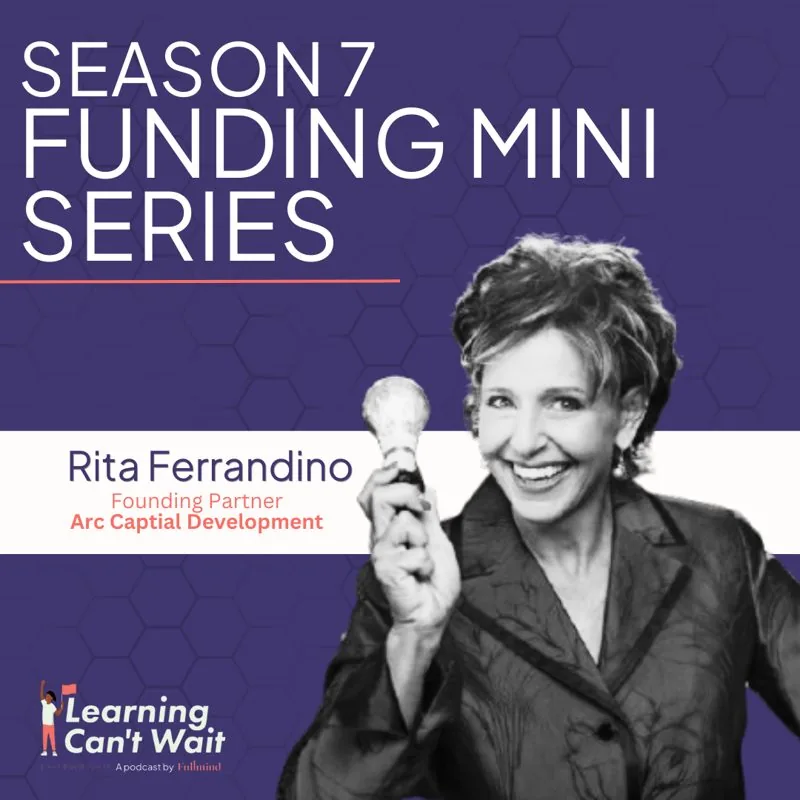
- Rita Ferrandino, Founder of Arc Capital Development, education investor
 Hosted by Hayley Spira-Bauer, Chief Academic Officer at Fullmind
Listen now
Rita Ferrandino: Arc Capital Development, Federal Education Funding, EdTech Innovation
Episode summary
In the funding miniseries, Rita Ferrandino, founder of Arc Capital Development and innovation consultant at Penn GSE, explains that she scouts global education innovations and connects companies to efficacy research. She names workforce modernization, safety, and public communication as key problems, then maps likely scenarios: federal dollars are about 10% of K-12 funding, states 47%, local taxes 43%, and each state's formula differs. She predicts districts will protect people before products, sees AI accelerating assessment-driven customization, and urges women-led coalitions and early selling for entrepreneurs.
Key takeaways
- Expect massive change; map where kids are going to school, federal executive orders, and each state's funding formula
- Federal money is roughly 10% of district budgets; state and local shares and priorities drive decisions
- Districts facing ESSER loss will cut underused technology and textbooks before cutting the humans who serve students
- AI's near-term power is assessment-to-customization and cutting paperwork, with third-party efficacy research still essential
- Entrepreneurs: start selling immediately and budget for sales and marketing; educators: find a mentor and stay
About this episode
In this funding mini series episode of Learning Can’t Wait, Hayley Spira-Bauer sits down with Rita Ferrandino—founder of Arc Capital Development, education investor, and innovation consultant at the University of Pennsylvania’s Graduate School of Education. Rita shares her insights on how research, funding, and innovation intersect in today’s EdTech landscape. From navigating federal grants to building meaningful university partnerships, she offers a behind-the-scenes look at how high-growth edtech companies can scale responsibly and effectively—while keeping student outcomes front and center.
Rita also opens up about the power of coalitions, especially among women in edtech and investing. She discusses her role in founding DOLS (Dirty Old Ladies of Software), supporting international education networks, and the importance of mentorship—for both new educators and aspiring entrepreneurs. Whether you’re launching a startup, teaching in the classroom, or just passionate about the future of learning, this conversation is packed with wisdom, warmth, and actionable advice.
Episode notes
In a landscape of unprecedented educational change, Rita Ferrandino stands as a beacon for those seeking both clarity and opportunity. The founder of Arc Capital Development and innovation consultant at the University of Pennsylvania Graduate School of Education recently joined Hayley Spira-Bauer on the "Learning Can't Wait" podcast to share her insights on education's shifting terrain—from funding formulas to the future of classroom technology.
"Get super comfortable with the fact that there is going to be massive change," Ferrandino declares early in the conversation. "It's coming fast and it's going to affect public school education and private school education."
If your district is navigating staffing challenges or seeking flexible solutions to keep student learning on track, Fullmind can help. Our state-certified, online-trained teachers support schools with live, virtual instruction across all grade levels—delivering stability and expertise when you need it most. Connect with Fullmind to learn how we can help your school thrive through change.
Following the Money
For educational institutions and vendors alike, understanding where the financial resources flow is critical. Ferrandino breaks it down with precision: only 10% of educational funding comes from the federal government, while states provide an average of 47%, and local property taxes account for 43%.
"All 50 states... can make their own funding formula decisions and they can distribute their money as they see fit," she explains. This creates a complex patchwork of funding mechanisms that educational leaders and vendors must navigate carefully.
With the end of pandemic-era Elementary and Secondary School Emergency Relief (ESSER) funds, school districts are facing difficult budgetary decisions. Ferrandino believes administrators will prioritize protecting "the human beings that are interfacing with students" over technology products, textbooks, or supplemental materials.
The Innovation Imperative
Despite funding challenges, Ferrandino remains bullish on education innovation, particularly through artificial intelligence. "I completely believe in the power of AI," she says, highlighting its potential for deeper personalized learning through improved assessment, customized curricula, and reduced administrative burdens on educators.
At Arc Capital Development, Ferrandino focuses on companies poised for scale—those that have moved beyond the early startup phase and reached an inflection point. "We're working with companies that have a founder that have taken them as far as they have gotten," she says. "They are positioned to be able to scale, and they need help in that inflection point."
Her work at the University of Pennsylvania complements this approach by connecting promising companies with research opportunities. This partnership provides "non-dilutive capital" for the companies while generating valuable efficacy data through third-party evaluation.
"We need to have evaluation of what's working, not working, so that we can continue to refine best practices to do what's best for kids," Ferrandino emphasizes.
The Power of Coalition
Throughout the conversation, Ferrandino returns to a central theme: the importance of networks and coalitions, especially for women in educational technology. As one of the founders of DOLS (Dirty Old Ladies of Software), she's dedicated to creating spaces where women can support each other through industry changes.
"The number of women investors is a pretty small percentage," she notes, "and the number of women entrepreneurs that are funded is even more pathetic." To address this imbalance, Ferrandino has helped establish women investor groups and strengthened international coalitions, particularly in Australia and New Zealand.
"We need to double down on coalitions," she says. "There is power in numbers."
Advice for Educators and Entrepreneurs
For educators feeling burnout, Ferrandino offers a refreshing perspective. Rather than leaving the field entirely, she encourages them to explore evolving roles within education: "There's a lot more part-time work, contract work. There's a lot of people now innovating new jobs, like part-time sub roles that have meaning, part-time STEM coordinators."
To aspiring entrepreneurs, her advice is straightforward: "Start selling right away. Learn how to sell. I don't care if you're not selling it for even a whole lot of money, just get some people giving you checks and get the ball rolling."
Looking Ahead
As federal policy shifts under new leadership, Ferrandino suggests closely monitoring developments at the Department of Education and state-level changes, especially in states with upcoming gubernatorial elections. "You need to go where the puck is going, not where it has been," she advises.
Despite the uncertainties, she remains optimistic about the future of educational innovation. Her open-door approach—"Just link in with me"—reflects a collaborative spirit that may prove essential as education navigates its next great transformation.
In Ferrandino's world, change isn't just inevitable; it's an opportunity waiting to be seized.
Full transcript
Transcript generated from the recording; minor errors may remain.
Hayley Spira-Bauer: Welcome back everybody to the Learning Can't Wait podcast. I have a guest on today who needs no introduction, but I'm going to give her one. I have Rita Ferrandino, the founder of Arc Capital Development and the innovation consultant at the University of Pennsylvania Graduate School of Education. Rita,
Rita Ferrandino: Welcome. I am so excited to be here and I'm so excited to talk about the future of education and where the opportunities are and what we need to be thinking about in order to be able to navigate in these unprecedented times. So I'm here. Let's kick
Hayley Spira-Bauer: It off. Yeah, no, I mean there's no one better than you who has really the view of so many different stakeholder perspectives in your work that spans a couple different sectors. So excited to dive in, but first, before we get into all the heavy kind of current events and what that means for schools and tech companies, I want to know about you, Rita. How did you come to be the personal and professional version of yourself?
Rita Ferrandino: Well, that's a big question. I will say I started in education publishing because I'm a double bottom line kind of gal, right? I want to be able to have impact and serve while making a living. So that's kind of the theme. Every day when I wake up, I'm always thinking about what am I going to do to make a better place? And I have always just loved education and feel like if you can impact education at whatever level from pre-K to workforce development, your impact is magnified and amplified and scales. So that's the work I do and I come to you today. I spend every day looking around the world for innovations in education to solve our most critical problems, and that's a pretty cool way to spend your time. So I am always looking for companies that have really critical solutions that with my consulting help or my investment help, we're going to be able to reach more people to solve those critical problems, which dovetails into my incredible role at the University of Pennsylvania's Graduate School of Education where I'm the innovation consultant. So I can also bring those innovations to Penn where we can do efficacy research and we can work with those companies to really be able to dive even deeper into the research to be able to again amplify their impact.
Hayley Spira-Bauer: That must be so exciting because you're meeting people that have big ideas and want to affect change now,
Rita Ferrandino: And we have a lot of critical problems.
Hayley Spira-Bauer: Yeah, I mean, that's actually a better plane. There's a lot of problems that we have questions about how to answer them. What are you seeing as the problems that are most commonly tackled right now? What are the big three that you see solutions for the most often?
Rita Ferrandino: Well, I think this whole teacher staff shortages in running education, whether it's K-12 or higher ed, I think that whole, we need to really modernize our workforce development in education, and there are really great solutions out there that we just need to be able to pretty easily bring in and affect change. So that's one of the areas that I think we can make impact fast to not just stabilize, but modernize that whole piece. I spend a lot of time looking at safety issues, whether it's cyber security issues or active shooter issues, and I think those are really important issues that are on the minds of leaders everywhere. I also really think that one of the places we can have a lot of impact is improving our communications in our K-12 and university systems. ([04:45](https://www.google.com/url?sa=E&q=https%3A%2F%2Fwww.rev.com%2Ftranscript-editor%2Fshared%2FjzteOgeIQ7YEciXPpr41bA09IjJmXroxXavqA-yrxNOgLoa8YIKg07m9NqjdO-jlnwHbxDrGrhB27etqNZHPe8KTsJY%3FloadFrom%3DDocumentDeeplink%26ts%3D285.2)): There's just a real need to modernize how we communicate with the stakeholders. And one of the things I like to remind people about is in K-12, 83% of the students in this country go to public institutions, and those public institutions are funded through federal, state and local money. That's all taxpayer money. And so we have to help institutions understand that they have to communicate to taxpayers, they've got to communicate in more modern ways with the audiences. They have to be able to help people understand why the money is being spent and how it's being spent. So that's an area that doesn't get talked about nearly enough that I think is really important, which is this whole modernization of communication to be able to help strengthen our public institutions.
[05:00] **Hayley Spira-Bauer:** Those are three big topics, and you're right though the third of which I have not seen as much attention on as the first two. The first one teacher shortages is the work that I do today at Fullmind, and the second one is one that I am concerned about every single day that I send my kids to public school. So I feel personally impacted by those two and glad that you are seeing such attention and innovation in the space to those topics. Let's touch on the third one though, right? So you and I, before pressing record on this episode said, well, Rita, you have a ton of experience in funding and in this space at a time when it's more uncertain than ever. So how are you feeling about the current climate and where do you think we should go as we tackle from all the stakeholder perspectives? We could start with the school side. Where do you think we should go right now? What should we be paying attention to?
Rita Ferrandino: Well, first of all, I think people need to just get super comfortable with the fact that there is going to be massive change. That is what's going to happen in education and it's coming fast and it's going to affect public school education and private school education. I just did a masterclass on this whole topic of likely scenarios to help people prepare and understand what may be coming. And we had so much outreach, we had to offer it again a second time, and we just booked a third time because so many people just don't understand the likely scenarios, and it's pretty simple to understand
Hayley Spira-Bauer: And thank gosh you're here to tell us.
Rita Ferrandino: So first of all, where kids are going to school is changing and where they go to school is really important for the funding formulas that we have. So the first thing I say to people is we got to understand where kids are going to school and the funding formulas around that. Around the federal government side, it's all pretty clear that many of the people in the new Department of Education run by Linda McMahon come from America First Policy Institute. She was the board chair there where they have a very distinct education policy. And so her administration is full of her colleagues from America First. So guess what? If you understand what America First is going to, what believe in, you're going to have a pretty good understanding of likely scenarios. Okay? There's also Project 2025, which has been, is clearly the roadmap. So if you understand Project 2025 and America First Policy Institute, you've got a pretty strong understanding of where things are going. ([08:50](https://www.google.com/url?sa=E&q=https%3A%2F%2Fwww.rev.com%2Ftranscript-editor%2Fshared%2Fsa_IQYstmb_14gWMP1jBx6UmN_y7dQQ5SpXzJJPQYOLaUCi9d8Bi9ZJQWvm3-DtlDQieSySR3RelbqUg3lkyEoEArM0%3FloadFrom%3DDocumentDeeplink%26ts%3D530.93)): Then you can just simply look at the Trump administration's executive orders in education to see where the administration is going to be putting their energy. And so we can map all that out, and once you have a map, then you can lean into the opportunities, and that's just always a good go forward methodology. So I think that you can map out the federal piece and you can do your likely scenarios. On the federal side, 10% of the money that is a spent in this country, 10% is from the federal government now, and it's distributed as grants through very clear formulas on the state level. The states provide 47%. The average is 47% of a school district's money comes from the state, and that budget is set by the legislative governing body, and then 43% of that comes from local property tax. And those local property tax dollars are, that's your local money. ([10:20](https://www.google.com/url?sa=E&q=https%3A%2F%2Fwww.rev.com%2Ftranscript-editor%2Fshared%2FYUJ6EUSUDMOHlqqW9p6Oap4Y9TckGpu9u9ndShKUkZnqfh3Kepw4s-66pSyNGDHF6Evuwt9_hUJQFB_AsOAzt30mzNk%3FloadFrom%3DDocumentDeeplink%26ts%3D620.01)): So people don't realize that all 50 states because of the constitution, the Constitution says all 50 states, they have a minimum amount that they need to spend on educating their students, but they all can make their own funding formula decisions and they can distribute their money as they see fit. So it's really important if you're an institution that you understand how your state money flows, and it's really important if you're a vendor selling products and services into education that you know where the money flows by state because there are no two states really alike. So if you're going to focus on selling into Pennsylvania, New Jersey and New York, you've got three very different state funding formulas and how that money flows and when it flows. So it's also exciting.
[10:00] **Hayley Spira-Bauer:** First of all, your energy is infectious, and second of all, you caught out something at the top, which was that you should expect change. Change is scary for folks. I think change is, we know change is scary for a lot of folks, but your reframe here about how there are opportunities, it is exciting. Not all of our budget comes from the federal government in schools is a really important call out. If you were a vendor in addition to learning each of the state's funding model, how would you be approaching this next year of selling and making partnerships and building your business?
Rita Ferrandino: Well, you can come to me and I will help you navigate that because it's so critically important. So I've been saying quite a bit,you need to go where the puck is going, not where it has been.So companies who are still trying to operate like they did in previous years are going to find that the puck has moved. It has, and that means a new strategy is needed and a new tactical plan is needed, and you need to be really smart to be able to maximize that this isn't child's play, right? You really need to understand that now because the states all have their own funding formulas and priorities, they all have governors that have mandates that they bring to their leadership because when they're setting the budgets, they have their own governor's priorities, and then you have the legislative body who have their priorities, and together all of that makes a budget. ([13:34](https://www.google.com/url?sa=E&q=https%3A%2F%2Fwww.rev.com%2Ftranscript-editor%2Fshared%2FQeVk3C-V-DYvi7AtUKu0dCXBBegO8CGg1tAnF7ewPvQ0j_yAwvHYzB9J4khyGAB-efvuZtMr5AtrJuF93dzGC_4T5kg%3FloadFrom%3DDocumentDeeplink%26ts%3D814.42)): You really have to be watching and understanding by state and state governors are four year terms. So they change, for example, New Jersey who have been very, very education with budgets that have been robust. They have a governor's race coming up. Virginia has a governor's race coming up, and both of those incumbents are not running. So there will be a new governor. And so things could change and flip very quickly. So it's not stagnant. You can't just say, oh, New Jersey. Well, you have to be following things pretty closely, and I think it's the responsibility of school leaders and of C-Suite education companies to have to really understand that. Again, public education still 83% of students, federal, state, and local money is how they're funded. They're public. So you've got to pay,
Hayley Spira-Bauer: And there are a lot of hours in the day that these vendors leaders work, the C-suite executives work, and some of them have to be devoted to current events. To your point, keeping track of who's in the seat, who's making decisions at every single level. I'm curious, Rita, when you think about the school leaders themselves and how they are prioritizing their budgets, you have your ear on the pulse, a lot of what's going on in the state and local levels at schools, what trends or what do you anticipate they will be prioritizing as they look? I mean, they have a lot of decisions to make right now with the end of certain fiscal funds like ESSER funds with the rise of AI, where do you think their attention is going?
[15:00] **Rita Ferrandino:** Okay, so first of all, I think with this downturn in money, we did lose the ESSER money. A big chunk of money is gone from many of our largest K-12 schools and higher ed. I will also say that they understand they have to make cuts and they have to make smarter decisions, but a lot of people put into place things that are really working, and I think that we're going to see them really wanting to protect the human beings that are interfacing with students. So I think that they're going to cut maybe technology products that aren't used as much, or maybe they're not going to buy new textbooks or maybe they're going to not have as many supplemental and they're going to do that before they cut the human beings.
Hayley Spira-Bauer: It's a strategy that I've seen as well, very much all over the media, but also directly from leaders, which is that if you have great teachers and you're building a great team, that's the first step. I threw in the word AI and then we didn't really touch on it. Let's just go there for now. We don't think AI is replacing teachers.
Rita Ferrandino: AI is going to make things go a lot quicker.
Hayley Spira-Bauer: So where do you see AI? How do you see AI changing schools?
Rita Ferrandino: Oh my God. Well, first of all, I completely believe in the power of AI because what we're going to be able to do is we're going to get a lot smarter about assessments ([17:36](https://www.google.com/url?sa=E&q=https%3A%2F%2Fwww.rev.com%2Ftranscript-editor%2Fshared%2FlYmwYulu9mDgCiTCSVsoNLIF5mOKqfdU4UMLvamK6NFYb_mdXxXIqJNp_fMkWl3B7PZtUysjZIktOng4wbdQ8LAPH9M%3FloadFrom%3DDocumentDeeplink%26ts%3D1056.68)): And being able to provide customized solutions and curriculum based on assessments. So I think we're going to be able to see really much deeper customized learning being able to happen. I think we're going to be able to take a lot of the paperwork that bogs so many of our staff in K-12 down that the AI is going to really help to speed a lot of that stuff up. So I just think we're at the beginning of the amazing things we're going to see with AI. Now because I work with innovative companies making big changes, I think we're going to just continue. So a lot of the companies are in development of their AI products and services, and so I don't think we've even begun to see the power of a lot of it. Code.org just came out with this really cool tutoring AI system so that you can use their free resources, you can then utilize their AI tutors. And I think that again, it's that assessment to customization that's going to allow faster learning to happen. And let's face it, we all want faster learning. We want more impact.
Hayley Spira-Bauer: We still have so much to be realized on that front, and I think we could probably do a whole other episode on that topic. I'd just be remiss if I didn't touch on it with you. I want to go back to something you said earlier on the call though about how, or maybe it was before we started recording, so I'll ask you to maybe to repeat it, but about how your work Arc is, but then your work at Penn really dovetails nicely together because we have the edtech companies that you work with, having the ability when the fit is right to do research with the Graduate School of Education.
Rita Ferrandino: So Arc is, what we do, Arc is a private advisory firm that specializes in high growth strategies, and we typically work with companies that are beyond early stage. We're working with companies that they have a founder that have taken 'em as far as they have gotten. They are positioned to be able to scale, and they need help in that inflection point. And so our customers come to us because they need high growth strategies and they need to develop their organization and often their sales and marketing strategies. The work we do at Penn, there are some of those companies that need to take the research that they have on their products and they need to take it to the next level. Sometimes I bring to Penn companies that can afford to work with the University of Pennsylvania for their research and development. And then sometimes we bring companies that just really fit and mesh into being able to get grant funding to support that research and development. ([21:07](https://www.google.com/url?sa=E&q=https%3A%2F%2Fwww.rev.com%2Ftranscript-editor%2Fshared%2FbNVPY9goLGkfU0flie9my7Ajbw6dCDrnzjSLLZ7-p1hEU--JZOzZzfFHfNrI6GeTvsq9c_VDELJzQ9_0FbWcTe4qWKU%3FloadFrom%3DDocumentDeeplink%26ts%3D1267.81)): And so for the companies that money that comes in through the grants is non-dilutive capital and to the university. That's kind of the lifeblood. Now we're seeing some changes at the federal grant level. Oh, that's what I was just going to touch on. How did you know? Go for it. Go for it. And I think that we're going to see that continuing to develop at the federal level where this administration is going to be willing to put research and development dollars into place at NSF, the National Science Foundation at the Department of Education, there are many other grants through other agencies at the federal government that provides R&D, but there's also a lot of philanthropic money available. And through those foundations, there's also potential for that work. The reason I'm so supportive of the federal government continuing with research and development is that it's really valuable to have third party evaluators being able to look at the efficacy of what's happening. And I think that that's the piece that shouldn't be cut. We need to have evaluation of what's working, not working so that we can continue to refine best practices to do what's best for kids to do what's best for kids so they can be faster and
[22:00] **Hayley Spira-Bauer:** Yeah, learn more, move faster. Exactly. Yeah. TBD on that, we'll see how this continues to unfold. The past two weeks have been, when we're recording this, have been particularly change oriented. And so I think there's still a lot appreciate your insights and foresight into where we think we should put attention on that. Rita, you are a really recognized voice in this space. What keeps you going and motivated, and where do you see yourself and what do you want to continue to be in terms of being someone that others look up to and look to for information about education and edtech in this
Rita Ferrandino: Space? Well, because I've always been on the side of innovation, I can tell you very clearly that I have tried more things that don't work. Failure matters. So when you talk to me, I can pretty quickly say, don't try that. Those do not work. But in this time of change, and I'm really emboldened and I have been spending a lot more time working,I think we need to double down on coalitions. And I think that there is power in numbers.And so I've been putting a lot of effort in to supporting the coalitions that I'm in and believe in. I am one of the founders of a group called DOLLS, which is Dirty Old Ladies of Software, and we have thousands of members. It's a free organization. And so I've been putting more energy into making sure that we attract new younger members into that women's organization and find more ways to actually get together face-to-face, to be able to support each other in this time of change. And another area I've just recently started to double down on is because I am an investor in education, probably surprising to some, not surprising to others, the number of women investors is a pretty small percentage, ([25:10](https://www.google.com/url?sa=E&q=https%3A%2F%2Fwww.rev.com%2Ftranscript-editor%2Fshared%2F-d5Getx8wSMxlNR08LTFJPoDDGNU4R5gbZ0Xn6zCdrfnMiFr4zVgZMy0ufcRhVHirYxRo3S_wTo86OSs7Dy6tFRiTUY%3FloadFrom%3DDocumentDeeplink%26ts%3D1510.73)): And the number of women entrepreneurs that are funded is even more pathetic. And so I've been trying to add my voice there and bring more women together. So we've got a couple of women investor groups now started that I'm pretty proud of. And then there's other organizations of women internationally that I've been talking with. I do a lot of work in Australia and New Zealand, and we need to be talking to our coalitions outside of the US as well as in the US. So that was a lot for me to say.
[25:00] **Hayley Spira-Bauer:** No, but there was a really clear theme there, and you called it out for me earlier, which was this mindset of women supporting women, which I am all about and love to hear. I am a member of DOLLS, although I'm so embarrassed to admit I have been to no events, but now I have no excuse. And you heard it here first, I will show up and I'm excited to really dive in. I think you're right that this is a time more than ever for us to be kind of holding hands, linking arms supporting each other.
Rita Ferrandino: And let's face it, men are good at their networks and they rely on their networks, and they are not hesitant to call in their networks when they need something. And so we just have to do a better job of supporting each other in that. So yes, I'm going to pester you next time.
Hayley Spira-Bauer: I'll be there. I'll be there with bells on. As my mom says,
Rita Ferrandino: We
Hayley Spira-Bauer: Do two Zoom calls a month for DOLLS. I know, I know. I love it. It's a commitment. It's happening. Unequivocal it. It is written in stone.
Rita Ferrandino: The other thing is you're based in New York, right? I
Hayley Spira-Bauer: Am.
Rita Ferrandino: So New York has an excellent EdTech meetup group.
Hayley Spira-Bauer: Yes. Jessica Millstone is one of my first guests that came on here. And one of my dear friends, so EdTech meetup, New York EdTech Meetup is a great resource. Do you mind sharing a little bit more about it?
Rita Ferrandino: Well, New York edtech Meetup has been so successful in bringing together the edtech community in New York. We started one in Philadelphia. Oh, wow. Because I needed another organization to You weren't doing enough. You weren't busy enough. No. Well, you know what they say, you give a job to a busy person.
Hayley Spira-Bauer: Yes.
Rita Ferrandino: But I know a lot of people, so it wasn't very hard to get it started. And once you get it started and you add the fuel, we had almost a hundred people at the last one in. And again, that's the stuff we need to be doing now, right? We need to be in coalitions and we need to be talking about the critical problems and finding ways to marry our solutions.
Hayley Spira-Bauer: Absolutely. Absolutely. Rita, I am grateful for the way that you approach problems, because even just on this short interview, but also in all of the ways that you come forward and share yourself with the world, you are energetic, you are passionate, you are committed. And right now you're highlighting a value that I think is so important, which is you're supportive. And I think that to your point, we need that now more than ever. And it's really, really amazing that you don't have one example of how you do that, but so many, and that is really inspiring. So thank you for sharing that.
Rita Ferrandino: Thank you. And everyone, anyone who's listening, just link in with me. I put a lot of effort daily into making resources available via my LinkedIn feed to share with our education community. And so I welcome that and then just reach out if you have any questions and I'm really happy to engage.
Hayley Spira-Bauer: I love that. I love that. Rita, one final question for you, which is what advice would you give, I'm going to change my normal question, which is what advice would you give an educator starting their career, but I would actually change it for you, what advice would you give an entrepreneur in EdTech starting their career today?
Rita Ferrandino: Okay, so can I answer the first one too? Oh my gosh.
Hayley Spira-Bauer: Please
Rita Ferrandino: Answer both. Yes. So I see here from a lot of educators who are just exhausted, who want to get out, they call me and say, oh, what opportunities are there out there? And what I always say to them is, where the opportunity in education is today is actually in the classroom or in the school districts themselves, and they're trying to reinvent themselves. You don't have to today just work the 7:00 AM to 3:00 PM job. There's a lot more part-time work, contract work. There's a lot of people now innovating new jobs, like part-time sub roles that have meaning part-time STEM coordinators. So first of all, that's where the need is and that's where the money is and that's where the opportunity is. So don't be so quick to throw in the towel. If you're a new educator, please get a mentor. The number one thing you need to do is find a more experienced teacher who's going to be able to help you navigate. ([31:00](https://www.google.com/url?sa=E&q=https%3A%2F%2Fwww.rev.com%2Ftranscript-editor%2Fshared%2FUxWDd6CXxQ969f2jgt-Os7zdf4V3EtVzA_gAIftEVZpekK1TdDSMAzus98LgQ4MJMa9E4b0PCsvz9qcp9hKRZLihmTc%3FloadFrom%3DDocumentDeeplink%26ts%3D1860.58)): Usually what young teachers really need is just some guidance on classroom management and parent management. And if you can do that, it's so much easier and you'll be so much happier. So go do that. And for entrepreneurs, capital markets are really difficult. Don't spend all your time and money just developing product and then leave no money for sales and marketing. The number one reason I think a lot of early stage companies fail. It's not because of the value of the product or service that they are bringing to market. It's that they have not, they spent so much money before they went out to market to sell.Start selling right away. Learn how to sell.I don't care if you're not selling it for even a whole lot of money, just get some people giving you checks and get the ball rolling. I do think it's going to be difficult to raise money.
[32:00] **Hayley Spira-Bauer:** Rita, you are a wealth of information. You are a light as your image from LinkedIn shows, and I'm so grateful you spend time with us here today, sharing with the Learning Can't Wait audience.
Rita Ferrandino: And I'm so grateful to have spent time with you.
Hayley Spira-Bauer: Oh my goodness,
Rita Ferrandino: Thank
Hayley Spira-Bauer: You.
Rita Ferrandino: And anybody who's listening, again, go to LinkedIn. Rita Ferrandino. I'm delighted to be supportive as we navigate these changing times and the likely scenarios that may happen may just make it easier for everybody to be able to find their way forward.
Hayley Spira-Bauer: Wonderful. And we'll link to all of the resources that were shared in this episode in my newsletter, as well as on LinkedIn so that everybody can access. If there's an upcoming masterclass from Rita, you can join it and you can also find her on LinkedIn on your own or find her via the way we share. Thank you so much for tuning in today.
Rita Ferrandino: Thank you. Enjoy. Bye.