
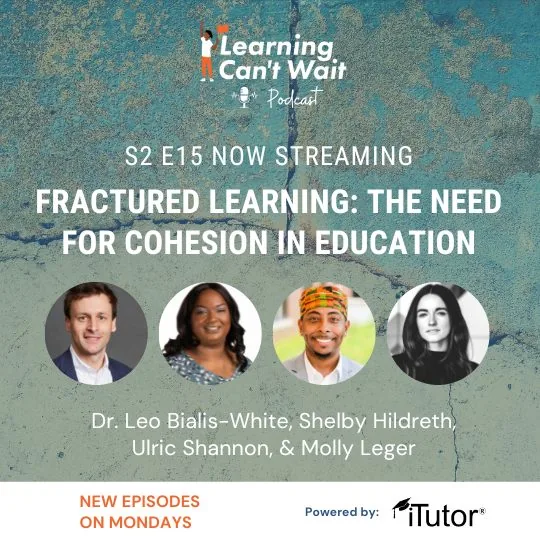
Learning Can’t Wait · Season 2, Episode 15
Fractured Learning: The Need for Cohesion in Education
 Hosted by Hayley Spira-Bauer, Chief Academic Officer at Fullmind
Listen now
Fractured Learning: The Need for Cohesion in Education
Episode summary
NewSchools Venture Fund partner Leo Bialis-White joins AUSL's Liberated Way team, Shelby Hildreth, Ulric Shannon, and Molly Leger, to define fractured learning: jagged, contradictory signals students get across classes, grades, and after-school programs. Shelby describes design teams that run empathy interviews and build a living graduate portrait, then map teacher, principal, and district behaviors backward from it. Molly argues districts adopted 75-plus tools without testing them against a shared vision, and Leo calls incoherence an equity issue since privileged families triangulate tools themselves. Coherence, they agree, allows differentiation; it means shared outcomes, not identical process.
Key takeaways
- Fractured learning is jagged signals across classes, grades, and programs; coherence must go beyond instruction
- Graduate portraits only work when they live in community, not in a file folder
- Audit edtech tools against the North Star; students used about 75 tools during the pandemic
- Incoherence falls hardest on kids whose parents cannot triangulate school for them
- Coherent systems differentiate; aim for shared outcomes rather than identical process
About this episode
In this episode, we gathered a panel of experts to discuss how fractured learning has become. Meet Dr. Leo Bialis-White, Partner at New Schools Venture Fund, and the Academy for Urban School Leadership Liberated Way Team - Shelby Hildreth, Director of Program Design, Ulric Shannon, Director of Purpose, and Molly Leger, Associate Director of Strategic Initiatives.
Time to tune in!
Learning Can't Wait is brought to you by iTutor.com.
Full transcript
Transcript generated from the recording; minor errors may remain.
Hayley Spira-Bauer: Welcome back everybody to Today's episode of the learning Can't wait, Podcast. We have an amazing group of individuals here today to talk about the topic fractured, learning the need for cohesion and education. Let me start by introducing our very first guest, Dr. Leo Bialis-White, a partner at NewSchools Venture Fund, Leo. Welcome to the podcast. Hello! So glad to be here. So glad you're here! And incredibly grateful that you've introduced me to the next three guests that we have coming. We have Shelby Hildreth, the director of program design from the Academy for Urban School Leadership on the Liberated Way Team Welcome, Shelby, Hi, everyone! We have Ulric, the director of purpose at the AUSL. Same academy for urban school leadership on the Liberated Way team. Welcome, Ulric,
Ulric Shannon: Happy to be here so incredibly grateful. You're here today, too. And finally, last, but not least, we have Molly Leger, the associate director of Strategic initiatives on the Liberated Way, Team Molly. Welcome,
Molly Leger: Hi! Excited to be here and to dig in.
Hayley Spira-Bauer: I'm really grateful. As I said I've been practicing a lot of gratitude. We're just coming off a holiday that's known for gratitude and thankfulness, so grateful that you all took time out of your schedules to be here. I know it's hard to coordinate so many people, especially from the Liberated Way team, who often are feet on the ground, visiting schools being part of the community. I know it's it's It's a challenging role to find yourself sitting down in front of a commuter for a whole hour of time. So thanks for making that time. Why, don't you start us off, Shelby, and tell us who is the Liberated Way team. And why are you constantly in schools?
Shelby Hildreth: Yeah, Absolutely. So. The Liberated Way team. Is a part of a AUSL. The Academy for Urban School Leadership, and AUSL has been a school management organization working in partnership with Chicago public schools for the past twenty plus years. In addition, we also operate the one of the longest running teacher residents these in the country, you know, and through the work of managing schools and training novice teachers a Us. As an organization has. I learned a lot about what it means to kind of operate schools, and and schools in high needs areas. And so our team is really the consulting arm of the organization that really tries to to take and distill all of those different pieces of learning and support other schools and districts across the country, and thinking about how they really transform Their schools in service of community, and really at the core of our work, is, how do we ensure that we're attending holistically to the needs of of students right like not just academics which are super important, but also how are you growing? Um! And in your social emotional skills? How are you being exposed to just different pathways, and really thinking about what's the community role Rightly thinking about the entire school community? But the community at large around what it is that we want for the students that go into it go into our schools. I think that's the learning that we, as an organization have had in operating schools, especially in a turnaround in a turnaround space is who's at the table whose voices are really being being heard? And So we really try to seek to hold space for all of those different people to really act as the leaders as they are in partnership and working for it really and strong outcome of strong and equitable outcomes for students in schools.
Hayley Spira-Bauer: You're setting the stage perfectly. Speaking of setting, being at the table, setting, maybe setting the table perfectly for our conversation around cohesion, which is the opposite of fractured learning. Obviously there's a lot of stakeholders, and I'm excited to dig into that in just a few moments, Leo. How did you at NewSchools Venture Fund come to know? Liberated Way team, and the work that they're doing. And why have you all taken such a keen interest in this team's efforts?
Dr. Leo Bialis-White: Yeah. Well, this is the fun. Part is getting to watch Shelby, Ulric and Molly work on the ground and bring some of their learnings to NewSchools Venture Fund. Um! Before we jump in i'll just share that NewSchools Venture Fund. We're a national nonprofit, we find fund and support teams of educators and innovators who are reimagining public education, so that every student finishes high school prepared and inspired to create a good life. And the main way we do that is, by working with organizations like Liberated Way. I think the idea of a whole school model, and one that thinks about the entire student. Experience is something that we saw as a real need in the field. And for me personally, the elementary school. I went to My mother was the assistant principal, and so she was able to create an experience for me that really worked for me. But obviously that's not the reality. For most kids and particularly low income students and students of color. We are not designing schools for a coherent experience. And so that's why I was so excited to elevate Liberated Way, work, and also continue to work with them.
[05:00] **Hayley Spira-Bauer:** I really love the way you shared part of the mission, and the work is that you're you're investing, and you're creating and helping grow organizations and and giving a platform to educations that are helping students be prepared and inspired to have a good life. I think that is such a beautiful, beautiful kind of goal to reach towards, and and something to unify. Speaking of coherence, unify your team in an effort to make the world better for deserving students. So thank you for sharing that. So there's a lot here. Right? Let's like. Step us back a minute just to talk about this idea of fractured learning when we say the student learning experience is fractured. What exactly do we mean, Leo? I'm going to kick it off with you to start us, and then we'll dive, maybe into a micro level and talk about what we're seeing and feeling and hearing within schools from the Liberated Way team.
Dr. Leo Bialis-White: Yeah, I I'd love to yeah share about the high level view, but really have a liberated team make it real for for the listeners. I think about this on a few different levels. When a child is in a school that day. They go from class to class in school activities after school activities, and oftentimes across those transitions. They're getting different messages, different signals and jagged experiences that Don't flow together to a holistic gestal experience. If we keep thinking beyond the day, and we think about from grade level to grade, level or institution to institution. The edges are equally jagged. The students are getting different signals, different experiences that don't work towards a unified experience or a unified goal for a self-determined life and increased life chances. And so we know that there are a lot of point solutions out there. But we think that there are schools who may benefit from organizations that can help think across the different elements of school and create cohesion across them. And again, as Shelby talked about Liberated Way takes that holistic view of students. They work with the school school community to make sure that all those touch points are aligned, and that's what got us so exciting. So I won't feel that thunder. I'll let them sort of speak more more deeply about what they do.
Hayley Spira-Bauer: Yeah, that's a perfect kind of baton pass to one of the members of the Liberated Way team. So we talked about the thirty thousand foot. Now let's hear from you know boots on the ground in schools, building schools, consulting with schools. What does it mean to have a fractured student learning experience from your vantage point?
Ulric Shannon: Yeah, I can take us off and start us here. I think that's a really interesting question. I think it. One starts with my own personal experience with education. We're at the development that passion for this work is it started from you know, attending a public school not being seen, not being heard, not being understood. You know, as even as a young child being pushed on being ready for the test. And that's what's going to tell you if you're incredibly smart and prepare for the world. Um! When I knew that I was like i'm pretty smart, but i'm just a really bad test tanker, or maybe it's the test and not me. So when I think about what it means like at the ground level of a of or a fractured learning experience. It is one that that, like our relevancy for schools and connections to students. Um! You would be surprised at how often we may shadow a student. You'll see a kid the entire day who is not extra question? Who does not have to respond to anything as long as they sit there and they're quiet, and then they're on time, maybe with their laptop open in the pen in hand. It is like the educational experience is happening. Um! And is that the true experience that a student would want to feel every single day. Um! It could be a pretty boring day. Now we also know that We often undermit an underestimate the abilities of students. We see. You know there's like a rigor and a lot of classroom, because it almost we know the work. Um! It makes me feel good as a teacher when i'm able to give good grades. It makes a student feel really good when they get good grades, and every parent was supposed to report card on Facebook. But um! We know that our students have so much more potential and probably way smarter than any of us. If we put the rigor and the challenge in front of them, they'll problem solve but I think it starts with the belief of students. Um! So when I think about that fracture system again, it was designed in a certain way, and it just operating as it is. But I think it is now the time warm, more more more more relevant than ever for us to really push that to Understand that the system is operating, as it is supposed to. And now it's time for us to change it. There's not one single principal superintendent or classroom teacher is going to change that. It's gonna take co coherence in collaboration of community parents, teachers, school leaders, business leaders to really reimagine what that soon experience should be every single day, so that every student has the opportunity to be accessible in school, and not just rely on one curriculum or one test or one one one adult in.
[10:00] **Hayley Spira-Bauer:** I appreciate about your response many things your first Well, thanks for being candid and and being vulnerable, and sharing a little bit about your own school experience. I know when people relate schooling to their own experience, it can be really powerful in helping us decide where we go as a society. But then also calling out the systemic in in kind of infrastructure of schools today, and how that may have led us here, Molly, i'm curious from your perspective, what hurdles teachers face as a result of this fractured point solution model, we named a little bit about the students. But how about the teachers? How does this impact them.
Molly Leger: Yeah, I really appreciate this question. It is something I think about often as a former teacher and as someone who study teachers. And now in this role. Really works to support teachers. You know,I think we're asking teachers to transform the student experience in an ecosystem that was not built for that transformation.And you know we've all heard those kind of pithy statements like the system, is designed exactly for the outcomes it achieves, which I agree with. And I think those statements actually hide the immensity of the challenges that teachers face as those who are often positioned as the frontline workers of transformation. And so ultimately, when we talk about school transformation, we are often asking teachers to change their practices, their mindsets, their routines, amidst a a district and school, and even State infrastructure. Um! That makes that super super difficult. Um! And it's for this reason that that Liberated Way team so often works to bring in district leadership and school leadership, so that those who are leading transformation represent the voice of the community, but also that they're not in this alone. It is so hard to be a teacher. Right now there is fear about the workplace. There is loneliness. There's isolation. There's frustration. And if we're taking care of teachers who are gonna be taking care of kids. We have to position position them to make sure that they are not in charge of transforming a system that is not set up for that kind of transformation.
Hayley Spira-Bauer: Teachers are absolutely on the front lines. They are, Molly, I think you call that out very in an Apropomian or Leo. Did you want to add something to that? Yeah, I mean, when we did a little bit of a step back like, who's talking about
Dr. Leo Bialis-White: Coherence and cohesion at schools, and there is a lot of dialogue about instructional coherence like does the curriculum map to the pedagogy. Does it map to the assessment, and I think that is obviously a place we want to start, and we do want folks to sort of learn about what they're going to be assessed on, there should be continuity. But I think what I've learned a lot from the Liberated Way it's beyond just instructional coherence that so much of this community buying is about the messages that they're getting in after school activities in different V in the hallway and if everyone's not using an asset based voice. For example, students, Aren't going to get that consistent experience, and Aren't going to feel that fully. And so I think we need to expand the conversation beyond instructional coherence to a a broader definition of coherence.
Hayley Spira-Bauer: And, Shelby, you started us off with that right? You talked a lot about the different voices, having everybody have stake at the table or a seat at the table. When you hear Leo share that. Obviously, this resonates deeply with you. Can you talk a little bit about how you go about achieving that outcome of having everybody being able to contribute to the conversation and build the school from the community level.
Shelby Hildreth: Yeah, I think a couple of things that I would share like Leo. I really appreciate your point around like It's It's everybody right like from the cafeteria workers to to wherever And I think you know, one of the things that we really try to do in our work is expand sort of the definition of what we mean when we say leader, right? A lot of times when we say leader, we we're talking specifically about the school principal or the the leadership team right like a assistant principals. But really, you know, when we think about leadership, it's, it's really everybody and everybody kind of having a role in being able to sort of support and support the overall vision, but really give feedback about whether or not what we're attempting to do is actually working for the folks that you know we're really trying to serve. And so one of the ways that we approach this is, we really spend a lot of time at the very beginning, thinking about. What do we want for the students in this particular context? And we try to bring everybody to the table to be a part of that conversation in some form. And so in our partnerships we form design teams, and so on. Those design teams we really seek to find a a representative group of folks at within a particular school or district context, to be a part of designing what our graduate portrait right like, which really becomes our North Star, and I know It's kind of like cliche, but I don't know what else to call it, but but becoming the North Star in our particular, our particular content, or, excuse me particular context. And so we bring this really diverse group of folks together that both sort of share the in in a collective learning and collective design, but also work to really build empathy about the experience of of folks of students in schools of parents and schools. And so, for instance, one of the very first things that we have our design team members do is actually find for a students and parents and that the folks that experience our leadership and have conversations with them, do an empathy interview to learn more about their experience. So as we're starting to develop what our graduate portrait is going to be right across our academic skills and pathways and social emotional leadership, we're doing that in a way where folks now have first hand experience or firsthand knowledge of what the the experience of a student or a a community member or a teacher member of that community is, and I think for a lot of our participants that really is very eye-opening. So a lot of things. You you assume that, you know, but we really actually going to talk to people and hearing from them actually makes a big difference. Um! When just like quick anecdote and anecdotal example of this is, we're working with a a district that we've been working with for for a long time to develop a graduate portrait, and we brought their district leadership team together as a part of this process. Um! And what was really interesting and like in that district leadership team, you've got folks that worry about finance and transportation. And since a little bit of everybody but that was your first activity was doing into the interviews with folks with with, with members of the the the school and district community, and when they brought their findings back I think it was really eye opening for for several people, especially those that are farther removed from the regular sort of day to day school. And and I just remember one of the reflections being like, if I don't make this decision right now, it has a lot of downstream effects for schools and people that I may never see, and so like really getting them to understand that, like even decisions at Central Office, there is a direct line to students around what that looks like. And so, being really intentional at all levels, and really working to the build capacity and move at all levels by designing this graduate portrait together, and then starting to think about what are all the various levels of leadership that we're going to have to leverage to move towards our North Star at the same time. It's not just teachers. It's not just school leaders, but it's. It's really everybody working in concert together. And so that's really what we seek to hold space for. With our partners is, is bringing all of those voices to the table,
[18:00] **Dr. Leo Bialis-White:** And I think there's a couple of innovations there that are a little or subtle, but really really important. So I think if you survey all schools that they have sort of a vision for our graduate, a lot of people would say yes, but I think that they like live in a file folder somewhere, and I think what Liberated Way really does is make it live and lasting and and community based. And so I think we should not, undersell the importance of not just creating a graduate portrait and making it living. The second thing is, I think. Similarly, if you ask people, you ask students feedback, there's a difference between asking kids about like what kind of food they want in the cafeteria versus like, How do their experiences flow together and build on each other towards that graduate portrait? So I think some of the most critical innovations are Liberated Way of holding, or both the like making, getting something off of a piece of paper and getting it to live, and also asking students really deep questions about how supports are woven together, and not just you know What's your favorite thing? What you what? When should the school dance be?
Shelby Hildreth: Yeah. And then one other thing that i'll add to that as well. Leo, is just that The other thing that we really try to do is once we have the portrait for students is starting to think about. Okay? Well, if that's what we want for students to what are the specific behaviors or practices that we would want to see teachers do that will create those types of experiences, and so, being able to outline that piece as well, and then, taking that all the way up to. Okay, Then, as a school leader, what does that mean in terms of my own leadership about how I support for teachers to create those types of experiences you back that all the way up to the district. What does that mean in terms of district separation? And so, as we get the graduate portrait really thinking about? What are those tangible things need to happen across the entire system, so that we're having. So that we're we're all having this conversation. It's really interesting to do this process as a district, because, with with districts, because it really become super e comprehensive and kind of all encompassing, and the the the anecdote that I just gave. There's one high school in that district, and so what we're able to do is think about this from like the elementary school level to the middle school level to the high School level, and eventually off into sort of post secondary. And it's been really really important to have all of those people at the table across those different grade bands, because what we're finding in conversations is that elementary school teachers didn't realize what they needed with what students need when they get to middle school and middle school teachers didn't know that. That. And so, being able to have those types of conversations across and and and amongst an entire community has been really important in the trade off is, it takes longer at at the front end to be able to design in that way. Because people schedules and it just there's a lot of iteration, but like that type of iteration and work, I think, really really pays off in the long run, because you're able to to create more coherence across the entire system as a as opposed to pulling one liver, and not not others, when you really kind of have to pull them in concert together.
[22:00] **Hayley Spira-Bauer:** Oh, my goodness, Shelby. So much goodness in there. I love your backward design kind of vantage Point I about the whole child again. We're not just talking right now on the podcast about academic solutions. We're talking about all the components, all of the profile for the graduates in your community. And then you, you kind of hit the nail on the head with what I was thinking as I was listening to. I was like, you know. I bet some folks are hearing this, and they're like, Yeah, that's going to take a lot of time. But it feels to me like a slow down to speed up process that allows for maybe not speed, but what we're aiming for on this conversation, which is coherence.
Shelby Hildreth: Yes, I I would agree with with all of that, and like it really is A is a slowdown and like that's why a lot of those documents where those different plans kind of fall by the way side. Um! Because we move too quickly. We don't get enough, buy in an investment, and, like we really work hard to make sure that we've got as much investment as possible, because It's going to take everybody to move this entire system. Within an individual school, or in an within within an entire district as well,
Ulric Shannon: You know. I i'm sorry I was gonna add. The The funny thing is as you talk about speed, and how fast we're moving. And the same by that we're moving extremely fast, and making quick decisions, and doing the things to and to students into families. School still looks the same as it has at one hundred and fifty years. I mean we may have chromebooks and some smart boards, but the experience is pretty much the same, for my grandmother was a school teacher for the time I was a student. So the crowd was in the classroom and the classrooms I visit today so like what is the real impact will change when it comes to speed, when we probably need to slow down and evaluate the entity as a whole to really create a new experience of what school? And I believeif we don't do it as educators and leaders in this space alongside with those students, someone else is going to step into this space and redesign it for us
Hayley Spira-Bauer: Absolutely. This is a critical time, and you know it leads me to my next question, which is really, i'm wondering from your vantage points, both Leo from yours, from the funding community, and Molly Shelby and Ulric from yours. In in the nonprofit space and in building schools and in innovating schools. How has the pandemic accelerated innovation? Obviously to your point? You're we're not at transformation quite yet. But how has the pandemic accelerated decelerated changed education. As we know it,
Dr. Leo Bialis-White: I can share a couple of thoughts sort of sector wide, I mean. First off it goes without saying. But schools, districts and States got a hundred and ninety billion dollars from the Federal Government with, you know, fewer restrictions, and they ever have nonprofits like AUSL Number. You wait. Got none of that. And so these school districts are at capacity, you know they're They're very low on bandwidth. They're they're having to fill vacant roles dealing with emerging issues, while also expecting to use this money for transformative change. So I do think there there's like an interesting dynamic where nonprofits like Liberated Way have a ton to offer. But they they didn't get any of that Federal money, and so can they get connected with the right schools to bring those solutions in and and be patient. I think a second thing is the funding community also has a role to sort of step up and support these types of organizations with patient capital, so that these innovations can be implemented with fidelity and be patient, and making sure that they can they can serve all students. I think the last thing i'll say on the answer. Front is like sixty-five of school districts have added at after school activities with academic interventions. They're still over one hundred billion dollars to be spent, and how all those things we've together are going to be really critical. So if you have a tier, one core, Ela curriculum, how does that map onto the literacy work that's happening after school or the tuneary work that's happening before school, and and remotely. And so those types of connections, I think, are actually really really important and shouldn't be overlooked. Um! So it's not just about adding things. But how are they moving together?
[25:00] **Hayley Spira-Bauer:** I think there is a puzzle that we're putting together right now in real time, and and it is somewhat of an experiment now that there are, for the next couple of years at least, an increase of available funds. So i'm glad you named that I know a lot of schools today are experimenting with supplemental learning, but also with the recent. There was a recent Brookings report about instructional time and expanding the school day, and and the advantages to doing that across the board. You know these are real decisions that leaders have to make as they come into the second half of the school year that will dramatically impact students, both social and emotionally and academically so appreciate you naming that Leo so Liberated Way folks Same same question, Different bit of a bend. But how has the pandemic changed? What you see in schools, in and around schools right now? And Are you experiencing some of the Are you benefiting from some of the increase in available resources? Or are you still facing challenges and implementing solutions that you find to be beneficial for students.
Shelby Hildreth: yeah, I'll. I'll kick this off. I think so. Yes, we benefited right like we've benefited from. You know, some of the some of the extra funding and that is changing now. So the the landscape, I think it's a little bit different. I think what we experience, though, is, there are a lot of new solutions. And I think new solutions are great. Innovation is great. Um! And I would say there's probably in some instances some oversaturation of solutions. And so it's hard for for schools and districts sometimes prioritize things that are going to stick right. And I think you know one of the things that's like really helpful about our process is, it allows us to not only develop a a a a new graduate portrait right in service of community and and and holistic, you know, child development? But really think about like, How do we make decisions different as a as a cohesive group of people. And so our hope is that we're able to arm our partners with new approaches for making decisions, so that when we choose a solution, or if we choose a new curricular material, or we choose a new partnership, it really is in service of our our vision, I think, in the middle of the pandemic, and probably immediately after that there was a lot of like we've got a lot of money to spend, so we're just going to spend it, but it wasn't necessarily, in a way that was coherent to use that again. That's really going to push student outcomes. And So I think the the hope now is that we're able to sort of like support our partners, and thinking a little bit more strategically about to how to deploy those resources. In a way that that makes sense for their particular school.
Hayley Spira-Bauer: Yeah, no, absolutely, Molly, Let's talk about those tools for a second, right. We know there was a report late last year from LearnPlatform that schools were using individual students were using seventy five tools, seventy five tools access during the pandemic, and teachers were at eighty six tools. We know that the increase of tools has led to some questions about data, interoperability, talk to talk to our listeners about the increase in tools over the pandemic, and what you think is the best step forward for using those tools in a coherent fashion.
[30:00] **Molly Leger:** Yeah, you know. You're Shelby and I. We this all hot in our work with districts, especially those bigger districts. And I think this conversation on tool use. It has to be disciplined a little bit. I think there's something to be said that there are many tools, and what we really care about is the coherence of those tools to the task and to the North Star that that task is supposed to move us closer to, and i'm not super good with metaphors. But i'm gonna i'm gonna try my best here, you know. I think, when building a house there, there's no single tool. Actually, there is a large number of tools, but they each have a purpose, and they're utilized by people who've been trained Well, we hope to use those tools, and in that way. The number of tools and how they're used is really disciplined by a couple of things. Right? We've got the purpose of that operation, be it building a house or improving teaching and learning and we don't expect everyone to be able to use each tool. But if you're charged with using a tool, be it an app or some sort of instructional tool? We expect that you know how to wield it as part of this kind of complex operation. So I think all that to say is, you know, in our large districts what we've seen is that there are vast number of a vast number of tools, and then these tools have been adopted over time for curriculum, for data, for assessment, for family and community engagement. But there just hasn't really been an analysis of whether or not that tool is high quality given the North Star, and that's the thing that I think is super important that when we think about the number of tool use, and how that's great created confusion, exhaustion, and really disjointed efforts. Um! We can probably boil that back down to a bunch of decisions that were made pretty high up the ladder of command that ultimately we're not made by situating the North Star Front and centered. I am a big believer, and I think we've seen in our work that people want to feel like they are part of a well oil team. They want to know that they have an impact in their role, and that that impact has fed into a larger impact of their team. And when you have just too many tools that aren't disciplined by how appropriate they are for a shared community vision, and they aren't accompanied by training. We just aren't setting up our folks to go off and thrive as part of a team. Some of the things that the Liberated Way team has done to kind of step back and combat this increase in tool use is to start with the vision, and then to do a bit of an audit, to think about what the most essential tools are, and what tools can be treated as kind of the fat that can be skimmed off, or which have to be adapted to get us closer to the vision, and I think that step back and those kind of audits just don't happen as frequently as possible, because there isn't often a really there isn't a really compelling vision that's community centered, and folks lack so much capacity that those kind of step backs often get pushed to the side to make room to put out some fires.
Dr. Leo Bialis-White: I love that, Molly, and I think one point I want to make is that in the absence of that coordination, who's going to lose out. It's the kids who's parents have two. You have parents who are working multiple jobs and it's The parents like the kids whose parents Aren't able to volunteer every day in the school, and make those connections and understand the difference between Lexia and i-Ready, and all of those different tools. And so this is not just an a real large issue. This is an equity issue, because the kids with privilege and resources are going to find ways to triangulate seventy-five tools. The kids who don't have that same access are are going to be left to figure out and make coherence on their own.
Molly Leger: I really appreciate that, Leo I. It is an equity issue, and we should start naming it as such.
Dr. Leo Bialis-White: I think something else that I wanted to like raise, and i'd be interested to hear a Liberated Way. Your Your thoughts on this is I don't want to conflate coherence and cohesion with a single experience for every kid, because I don't think that's what we're talking about. Um! A coherent school system can have differentiation can have response to intervention, and in in MTSS. But I' to know how you all think about that like the the the difference between a cohesive experience for all students, but not saying that every student has to get the same thing.
Shelby Hildreth: Yeah, I I really really love that distinction, Leo, because I think a coke piece of experience actually requires some differentiation. Right like It's it as we think about introducing students to new to new pathways, right to new pathways, to to really find out what sparks their interest. Well, that's going to look different from every per, every student. And so what should be coherent? That part of the experience is giving students exposure to multiple opportunities, to explore various pathways through partnerships in community or with institutes of higher ed, or bringing in different right, like. There's lots of ways that you can do that. So the thing that that that is the same is the is the the process of that exploration. But where that exploration takes any individual student is going to look a little bit different because all kids are different. Um! And so like being able to kind of respond to that, I think is is is really important in the in the work that we do. I think the other thing that's really important. In in our work is, you know, once you have a a a a portrait, a really strong, a really strong portrait of the outcomes in the the skills and dispositions that we want students to walk away from our schooling with. Every teacher is going to approach that a little bit different. I talk with my team a lot about It's it's it's outcome, not necessarily process right? And so like, How do we allow for getting to the same outcome in various ways, because that's where you get really great innovation.You don't get innovation by making everybody do the same thing in the exact same way.Um! And So how do we really leverage sort of a really strong, a really strong picture? I I think, in a lot of ways like having that really strong North Star actually is probably more liberating for for for for teachers and for school leaders, because what we're focused on is, are we getting the outcomes as opposed to Did you follow this specific process? That is a gigantic mindset shift. It takes a lot of time to get there, and everybody kind of goes on that journey a little bit differently. But I think ultimately that's where we're trying to to support our partners in getting to is focusing much more on on those outcomes, and that allows for some really smart differentiation, both in the student experience, but also in the teacher, experience, and the experience for parents right there has to be some sort of differentiation along the way to get the the people at the table that you need to be able to to to move students. In the way that communities want them to move.
[37:00] **Hayley Spira-Bauer:** I have to tell you right now. I have chills. I'm also on your website which is Liberated Way, Org, looking up your partner's schools thinking, When am I next in one of these towns to visit and see some of this in action as someone who Hasn't been in a school as a leader or a teacher for nearly six years. Now this is what I wanted. This is like the piece that was missing the backward design, the you know, identifying the problems and their roots bringing the right people to the table. It is such a breath of fresh air to hear how this team is so committed to ensuring that learning is right for each and every child there's no one size fits all solution, and that everybody needs a voice at the table. You know one of my questions that I had told you all that I might ask in advance was, Where do you see glimmers in in the future like What's your hope for the future? And you know for me, not to I'm. I'm not trying to center myself, but I have to say, like your work is what my hope is for the future, like what you are doing in schools today how you're sharing your vision and what you're doing to help communities build is really incredibly heartening after a lot of years of just trouble in schools and and difficulty and challenges. So I I want to say thank you as i'm listening to you for sharing just the efforts that you're making. And, Leo really to you for introducing me to this team.
Shelby Hildreth: No, we we appreciate it. We we're excited about. We're excited about the work, too. We're excited about where where it's going, and and all of the things that we're learning learning along the way. It's a you know it's it's been a great experience. So far we're excited, for for where we're going.
Dr. Leo Bialis-White: Yeah, the thing that inspired me most is right Now, in too many schools we don't as students how their their experience is jagged or coherent, and then on the back end we expect them to create the coherence. The onus is all on them, and Liberated Way flipping that they are asking the students, How is your experience coherent? And how can we make it more for him? They're asking the whole community, and then they are putting the onus on the community to do that work for in in on behalf of the students, and and that's the bright spot that i'm so excited about.
[40:00] **Hayley Spira-Bauer:** So I want to. I don't want to end the conversation. I don't, but I also know that as incredible community leaders. You all have places to go on, people to see and and things to do. So I want to wrap us off up. Excuse me with one question that each of you will answer, which is what is your greatest hope for schools over the next school year. So we're, you know we're recording right now at the end of two thousand and twenty-two. So let's talk about two thousand and twenty-three and two thousand and twenty-four, so i'll start with you. Ulric. What is your greatest hope for schools, or for the next school year?
Ulric Shannon: Wow! That is a a really big question now, and i'll answer it based on my own. My professional journey. Personal journey, I hope to see is that where a families and communities are true partners and the student experience I think every school wants to be known for something special, and what makes them special. But i'm really excited to see the increase in parent engagement across schools post pandemic, because school came home and parents got to see it, and now they have a different way our purpose for advocating for their own students. So i'm looking for it over the next school year to see more families, More communities really engage in that process of creating each school in every community to be elite in its own very special and unique way. Incredible, Ulric. I'm. Going backward through the alphabet. So next up we have Shelby.
Shelby Hildreth: Yeah, I would say, you know, in the in the next year. Oh, gosh! That's a It's a really good It's a really great question, and I think one of the hopes that I would have in that is that we really really rethink a the function that school serves But B how we really center sort of. Like everyone's humanity in this work, I think one of the things that gets lost. But I I I get really excited about in terms of our process is that all of these are people, and people have the own stuff that they're bringing to this work. And so not only how do we improve the experience for students. But how do we improve the experience for teachers? Right? How do we improve the experience for leadership? We know that people are leaving. And so how do we? We're leaving the profession? And so how do you really rethink how this system, how the system works? I think we're gonna be forced to to learn some new lessons in the next year or so, and so my hope would be that we were really starting off and starting starting the process of responding to those learnings in a way that really attends to the humanity of everybody that interacts with the the educational system.
Hayley Spira-Bauer: Awesome. Thank you for sharing Shelby, Molly. How about you?
Molly Leger: You know ultimately Like my colleagues, I I want all students to have opportunities to engage in liberated learning every single day. That, said I, I am a realist, and I know that's a transformational goal that's going to take far more than a year to accomplish. And so I I hope, over the next school year that we begin to take note of what we're learning from research on schools. Teachers are leaving in mass. Students are disengaged. Parents are angry and feel disenfranchised, and I think that the first step in change is recognizing the issue and beginning to understand why that is, and so given that over this next year I hope that we, as a collective, begin to to harvest the wisdom of a very broad basis, school community stakeholders, including teachers, students, and families, to better understand the challenge and how to move forward to fix it. Um! That's different. Right? We we're, we're still excluding these stakeholders. But I think that we need to start to build a true community in understanding this problem before we can go off and expect transformation to happen.
Dr. Leo Bialis-White: We are creating quite the call to action right now. With these final answers from everybody, Molly, thank you for sharing yours as well, a a very powerful and profound statement. And Leo last, but not least. Yeah. Well, I have to pick my head up after writing everything that was just said down from my own future reference. You know the the wonky answer is, I want to see us align time, people, money and strategy around coherence and and stop thinking about point solutions and think about the overall student experience. But, like that, translate to, Can you walk up to a student at school and say, do you feel seen? Do you feel heard? Are people helping you get where you want to go in life? And I did everyone pulling in the same row in the same direction. Can you? Can you ask a student that, And no matter what zip code they live in, no matter what the color their skin is. Can they say? Yes, you know, with real enthusiasm, That's the the feature that I want to see
[45:00] **Hayley Spira-Bauer:** So similarly important? Call to action for those folks listening in. We have all kinds of stakeholders in the education space that that listen into these podcasts. But if you take nothing else away from today's episode. This last question really was profound, and and did a lot to encapsulate the work of both NewSchools Venture Fund and the Liberated Way Team Ulric, Shelby, Molly, and Leo. Thank you so much for joining me here today.
Ulric Shannon: Thank you. Thank you for having us
Hayley Spira-Bauer: And for those of you tuning in thanks for joining and tune in again next time.