
Learning Can’t Wait · Episode 122
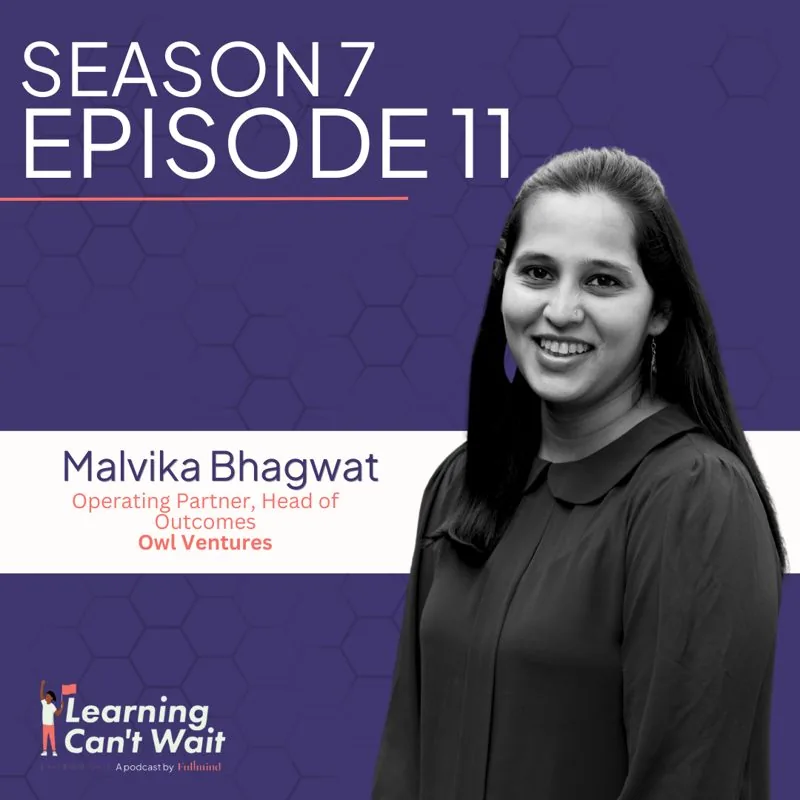
Malvika Bhagwat: Owl Ventures, EdTech Outcomes, Education Efficacy
- Malvika Bhagwat
 Hosted by Hayley Spira-Bauer, Chief Academic Officer at Fullmind
Listen now
Malvika Bhagwat: Owl Ventures, EdTech Outcomes, Education Efficacy
Episode summary
Malvika Bhagwat, partner and head of outcomes at Owl Ventures, shares how self-advocacy shaped her path from India's first IB program and liberal arts college to Harvard, Newsela, and Emerson Collective. She explains why randomized controlled trials are no longer the only gold standard for fast-changing edtech products, how Owl evaluates companies on scale, access, outcomes, and diversity, and why post-ESSER schools will favor tools built on efficacy over marketing. She is excited about generative AI, mental health tools, and outcomes-based contracting.
Key takeaways
- RCTs suit stable core curricula; iterating edtech products benefit more from formative and usability research
- Owl scores portfolio companies on scale, access, outcomes, and leadership diversity alongside standard VC metrics
- Building for Title I and free-lunch populations is both the right thing and a business viability question
- Outcomes-based contracting reframes districts and vendors as accountable partners rather than buyers and sellers
- Teacher prep programs should integrate technology; new teachers should advocate for what works and trust their gut
About this episode
In this episode of Learning Can’t Wait, we sit down with Malvika Bhagwat, Partner and Head of Outcomes at Owl Ventures, to dive deep into the evolving landscape of EdTech efficacy and research. Malvika challenges the traditional "gold standard" of randomized controlled trials, explaining why more dynamic, iterative approaches are essential for measuring the impact of rapidly evolving educational technology.
As schools navigate a post-ESSER funding reality, districts are making tough decisions about which tools to keep and which to cut. Malvika shares how Owl Ventures evaluates EdTech companies, emphasizing the importance of scale, access, outcomes, and diversity in determining long-term success. She also highlights key trends shaping the future of education, including AI-powered learning tools, mental health solutions, and the rise of outcomes-based contracting.
Tune in to hear Malvika’s expert insights on what it takes to build a sustainable, impactful EdTech company—and what educators and entrepreneurs alike should be thinking about as the field continues to evolve. Plus, don’t miss our discussion on Owl Ventures’ Education Outcomes Report, a must-read resource for anyone invested in the future of learning.
Episode notes
As school leaders navigate the evolving landscape of educational technology, one question remains paramount: which tools truly impact student learning? With budgets tightening in a post-ESSER world and AI-driven solutions emerging at an unprecedented pace, decision-makers must look beyond marketing hype and demand real, measurable outcomes.
That’s exactly what Malvika Bhagwat, Partner and Head of Outcomes at Owl Ventures, tackles in this episode of the Learning Can’t Wait podcast. With a decade of experience in EdTech investment, Bhagwat sheds light on what it takes to build a sustainable, research-backed product that can withstand the scrutiny of today’s schools.
Looking for EdTech solutions that actually move the needle? Fullmind partners with districts to connect you with state-certified teachers and research-backed instructional support—ensuring your technology investments deliver measurable outcomes for all students. Learn how Fullmind can help your school drive real results with every new initiative.
The Gold Standard of Research: Is It Still Relevant?
For years, randomized controlled trials (RCTs) have been the benchmark for evaluating educational tools. But as Bhagwat points out, in the fast-moving world of EdTech, that model isn’t always practical.
“RCTs made sense in the era of textbooks,” she explains. “Textbooks didn’t change for years, so you could collect long-term data and still have it be relevant. But EdTech products evolve constantly—sometimes every six months—making traditional research models less useful.”
Instead, Bhagwat advocates for formative research—continuous usability studies, logic models, and expert-driven feedback loops that help products iterate in real-time. This agile approach not only ensures efficacy but also aligns with the way modern technology is developed and refined.
School Districts Are More Selective Than Ever
With ESSER funds drying up, school leaders are becoming increasingly selective about which tools they invest in. No longer are districts simply looking for engaging products; they’re demanding solutions that integrate seamlessly into their ecosystems, respect data privacy, and—most importantly—demonstrate a clear impact on student outcomes.
“The noise is fading,” Bhagwat notes. “Schools are asking tough questions: Is this product working? What are students actually learning? Does it improve outcomes for all learners, especially those in Title I schools?”
Owl Ventures evaluates potential investments not just on traditional VC metrics like team strength and product-market fit, but also on three key educational impact areas:
- Scale: How many students does the product reach?
- Access: Is it serving diverse populations, including those in under-resourced communities?
- Outcomes: What measurable learning improvements does it drive?
- Diversity: Is the product and company a reflection of the community it is serving?
For school leaders, this means that the next wave of EdTech solutions will be held to higher standards than ever before. Vendors must not only promise results but prove them.
The Rise of AI in EdTech: Efficiency, Not Replacement
Artificial intelligence has exploded onto the scene, raising both excitement and concern in the education sector. But rather than replacing teachers, Bhagwat sees AI as a tool to enhance their work.
“AI is already making companies more efficient,” she explains. “Take Kyron Learning, for example. Educators can upload content, and the platform builds an interactive course for them. It’s like having a virtual teaching assistant that frees up time for deeper student engagement.”
While AI-driven tools can streamline lesson planning and personalize learning, Bhagwat stresses that they should complement—not substitute—the human connection that great teaching provides. The key is ensuring that AI solutions are implemented thoughtfully, with proper training and safeguards in place.
The Next Frontier: Outcomes-Based Contracting & Cross-Sector Collaboration
One of the most promising trends Bhagwat sees on the horizon is the rise of outcomes-based contracting, where school districts and EdTech companies form true partnerships rather than transactional relationships.
“When both sides share accountability for results, implementation improves,” she explains. “Districts aren’t just buying a product; they’re working with a company to ensure it meets student needs.”
Additionally, she highlights the growing collaboration between venture capital firms and philanthropic organizations. Historically, these two worlds operated separately, but today, they are increasingly aligned in their goal of funding impactful education solutions.
“This shift is exciting,” she says. “Everyone is uniting around the same mission—ensuring that students get access to high-quality, research-backed learning tools.”
Advice for New Educators: Embrace Technology & Advocate for Yourself
Bhagwat closes with advice for early-career teachers, reminding them that technology can be a powerful ally in the classroom.
“Don’t be afraid of EdTech,” she urges. “Advocate for yourself. Seek out tools that support your teaching, and push for better professional development in tech integration. The more comfortable educators become with these solutions, the better we can serve students.”
As schools continue to recover from pandemic learning loss, the focus on efficacy and outcomes has never been more critical. Leaders who prioritize research-backed tools and strategic partnerships will be the ones who drive lasting change in education.
For a deeper dive into Owl Ventures' research framework, check out their Education Outcomes Report—a must-read for anyone making decisions in the EdTech space.
Full transcript
Transcript generated from the recording; minor errors may remain.
Hayley Spira-Bauer: Welcome back, everybody to the Learning Can't Wait podcast. We are having a timely and an important conversation with an incredible guest. Today we have Malvika Bhagwat, the partner and head of outcomes at Owl Ventures. Welcome Malvika.
Malvika Bhagwat: Thank you so much for having me. I'm really excited for this conversation.
Hayley Spira-Bauer: You know how nerdy I am and how excited I am too. Head of outcomes. Could there be anything better when we're talking about EdTech?
Malvika Bhagwat: Not in my opinion, and I honestly joined Owl Ventures because of the title and because of the work I get to do every day. It wasn't for the investment, it was really for being able to support learners every day operationally, alongside now 90 plus portfolio companies. So I'm really fortunate for the work I get to do every day.
Hayley Spira-Bauer: I can't wait to dive in to one. What makes you so qualified to hold this position, which you absolutely are, and two, what type of work you're doing on a daily basis that's really improving the lives of students? I'm over the moon, so let's jump right in. Malvika, can you tell us how did you come to be the personal and professional version of yourself?
Malvika Bhagwat: That's a great question. I think now that I look back, the story makes sense, but ever since I was little, the one area that I've been passionate about seemingly has been education. I was in a typical school in India where rote memorization was kind of the way of learning. I went through that system up until my high school and at high school I had a choice. And I distinctly remember locking myself up in the bathroom for two weeks until my parents agreed to change my school and kudos to them. They followed my lead and agreed to put me in my city's first IB program, and I was the first graduating batch. So they had no data, no information. It was run by a French man in India and they were like, okay, we'll do this. And so that I think was pivotal in my journey of understanding the true meaning of education, understanding how education can truly shape who you are and give you a voice and identity. And part of the work of the school was doing community service and I spent a lot of time as part of that program working with underprivileged kids, helping them get better at their education outcomes as well. And I think that really stayed. And that theme is what drove me to the work that I do today, which is looking at data, being a nerd at heart and kind of understanding what's working and what's not working in the education space.
Hayley Spira-Bauer: Okay, hold on. That level of self-advocacy at the age that you did it is incredible. Do you have other examples from your childhood of times where you knew what you wanted and went after it?
Malvika Bhagwat: I think I did the same in undergrad where I really wanted to psychology and again, my parents so much appreciation for them. Again, they took a leap of faith the second time over and put me in India's first liberal arts program. And when they put me in the program, we didn't even have, it was a residential college, but none of the residences were even fully built when we went and saw the place. Wow. It was literally a construction site and I was like, here's where I'm going. And they just kind of protested and resisted and made me interview at other places, but eventually followed my lead and sent me to a campus in the middle of a valley with full faith that I'd figured it out. And two years in this college could not offer a psychology program. And I remember at that point, again, standing up and being like, I got this. ([03:44](https://www.google.com/url?sa=E&q=https%3A%2F%2Fwww.rev.com%2Ftranscript-editor%2Fshared%2FfYMuMKywklDspKI9gTJXQVqhcrYuajsSxIAvurMjFbUeLD_rHRxRws_wwErsU4Yb3so_l8rNNKFXE7bEtsoyItgqyXg%3FloadFrom%3DDocumentDeeplink%26ts%3D224.8)): I started applying to other colleges. I started simultaneously talking to the dean of the university I was at saying, I really want this program. Can we figure it out? And just as I was about to leave the university to go abroad, the dean called me and he was like, why don't you come back to campus for a week and let's chat? And I went back and they had found a psychology teacher that I got to interview and they were like, well, if you guys feel like this is a match, I think we can offer the program. And I was like, this is fantastic. And yes, but it's also the nimbleness and the flexibility that new programs can give you.
Hayley Spira-Bauer: Oh yes.
Malvika Bhagwat: And I think I have learned that that's also where I thrive. I've always been the first in any role that I've done at any professional setting and I love the zero to one being able to build from scratch and just kind of building a vision while working. And I think I get a lot of that from the two schools that I went to as well for my high school and undergrad because they were both being built as we were still learning there.
Hayley Spira-Bauer: Wait, I love that little detail. You kind of sprinkled in there that you've always been the first, you were the first IB student, you were the first doing the psychology program at this new university. You were the first in every role you've held. Incredible. That is such a testament to you as a human being that you have really become an expert in so many topics that you've been given the authority and autonomy to run. I love that little detail. You just sprinkled right in there. And also another kudos to your family for that level of support. As you look at education and you look at some of the challenges and barriers, especially right now end of 2024, this episode's going live at the beginning of 2025, that level of support from your family is instrumental too as you, and you've really given praise for that's beautiful, beautiful
[05:00] **Malvika Bhagwat:** And not something I appreciated as much in the moment, but now that I have a little one, I can only imagine how much courage it took for them to say yes to the risks that I wanted to take and they supported it and I'm a better person for it.
Hayley Spira-Bauer: I have a personal curiosity in how your psychology degree has served you. I too studied psychology as an undergrad and I felt really strongly that I needed to follow this path. I wanted to learn about people and why they do what they do and how they operate. And I can totally see through lines in my life today and all the jobs that I've held of how it's helped me. But I'm curious, in your line of work and the path you've taken, has that degree served you well?
Malvika Bhagwat: I think so. I think there's something, I mean psychology at the end of the day is understanding people and that's what we're surrounded with. And when you think about education and think about learners, that's what you're doing here. It's not like the data is helpful and the instructional materials are helpful, but all of that is in service of building better relationships between the students and the teachers, the students and the caregivers and students with the learning context that they're surrounded in. And so much of that context is actually rooted in what you learn in psychology. It's about, it's not just about the one snapshot in time, it's about what happened at home with this kid, what their relationship with their parent looks like, what other socioeconomic circumstances they grew up with. And I think psychology builds so much of an understanding of that. And the thing, actually, one of the strands I studied was called for that reason education psychology because it was really about teaching you the different ways that kids learn what mastery would look like, what the different competencies look like. ([07:20](https://www.google.com/url?sa=E&q=https%3A%2F%2Fwww.rev.com%2Ftranscript-editor%2Fshared%2FhGGvPvaK13a9aw_yURGGi4UkXOVvn8G-Kapv98tQOxBhs-niNwTFG0W0BLYD2Pl0QipsQAxi3KeKll9KMR8zS2qu5yM%3FloadFrom%3DDocumentDeeplink%26ts%3D440.36)): And so I think those are the two parts ahead of me, even before I knew it, that it would've been something in psychology or something in education. Funny enough, I don't even know if she remembers this, but I met the director or the head of Teach For India on the same campus where I was studying because they had just launched Teach For India program. And I happened to meet her and I was like, Hey, I think I'm going to get into teaching and I might want to do this. And she looked at me and after 30 minutes, she's very politely, not in the same words, but said, I don't think you have the patience for teaching, so maybe try something else. And she's not wrong. I think I really enjoy the zoomed out data version that I do now where I get to analyze data, look at, ask questions of it and truly understand all the different nuances and serve at scale. But I miss being in a classroom, but I tell that story mostly to be appreciative of the fact that she saw that early on and led you to a different journey.
Hayley Spira-Bauer: Well, not always. Everyone's a great fit for the classroom, not because it isn't necessarily interesting or exciting work or work they will find interesting or exciting, but because there's other things that they could do that impact students as well. So walk us through a little bit what has made you such an expert in outcomes and why everything in your career makes so much sense for what you focus on today?
Malvika Bhagwat: Yeah, I think a lot of it comes from,
Hayley Spira-Bauer: By the way, I need you to brag. This is where you get to be like Hayley here, all the awesome things I've done and I know that doesn't come easy to everyone, so please feel free.
Malvika Bhagwat: I think I really appreciate and I'm thankful for all the first chances I got. So the first job, I came to the US to start get a master's in education. I went to the ed school at Harvard, got my degree from there. And I was pretty clear that my focus was going to be data and assessment and learning English as a second language because that was the context that I knew. And I was going to go back to India a couple of years and work in India. And that was kind of my story at the time. And then I got connected to Newsela, which is the news and nonfiction content platform that is now, of course in millions of students are serving on it. But at the time we were a small startup and the leadership team took a chance on me then and let me run the entire assessment department right out of grad school. ([09:47](https://www.google.com/url?sa=E&q=https%3A%2F%2Fwww.rev.com%2Ftranscript-editor%2Fshared%2F7nYSZtKzXDw3EgfoqqHdxyZFZxZ3TpxGyBoYWWlUisIaTQ-P62aN0lJDqy0goknZ06rzyj_iIOKPOMwKO9c1S650kv0%3FloadFrom%3DDocumentDeeplink%26ts%3D587.55)): So right after finishing my undergraduate degree degree, and I think that's where, so I started in the assessment department and as I was doing all the assessment work of creating the formative assessment for the learners after every article and seeing what the responses were analyzing that data, the natural next question from them was like, okay, great, but is this product working? Is it actually improving learning from here? And we were at the right time in the company's history where we were like, okay, we're ready to take on this work and start doing some of the research and efficacy study work. And alongside the assessment design work that I was doing, I started working with a lot of the research, different groups that exist today. So WestEd, Digital Promise, NewSchools Venture Fund. We partnered with several different organizations with slightly different tweaked questions, some more around formative feedback, usability studies, and some around third party randomized control trial studies, all in service of understanding is the product working and what does working really mean? ([10:45](https://www.google.com/url?sa=E&q=https%3A%2F%2Fwww.rev.com%2Ftranscript-editor%2Fshared%2F5GLbngXK08QLGaRHjyEu49mJPaoua3BywyoYksOj5qjdqQ5UEx5lpCo1kUMzlERSEQvfrcm-CT__aPjpTD7NxjGOzfQ%3FloadFrom%3DDocumentDeeplink%26ts%3D645.39)): How often do kids need to engage on the product? What does implementation need to look like? How much progress can a kid really make on the product by using this product? All these different questions. And once you ask the question, there are 10 more to ask. And that's where I fell in love with this work and I did that and I've created the foundation for Newsela and that was fantastic and I could have stayed there. And then the opportunity came along to join Emerson Collective, which is the family office run by Laurene Powell Jobs to support their EdTech portfolio. And like I said, I think I enjoy the scale and zooming out one degree at a time. So having done that in the context of Newsela, I was really exciting to start supporting a portfolio of a handful of companies around this work. And so I started doing that and today, at Owl, a decade later of doing this work, I think it's been amazing to support now 90 plus companies globally thinking about outcomes and efficacy all the way from what is your logic model, what is your theory of change to what are the metrics that you need to think about in product? ([11:48](https://www.google.com/url?sa=E&q=https%3A%2F%2Fwww.rev.com%2Ftranscript-editor%2Fshared%2FgFN6UJgDm-5vbHFgYJRr8g-DLImMJbehxXXri-8uaxYwPwuixJgHBIY9V2lLOwo-C_oq-sCJXW7ylRtyTrHNDz06CSk%3FloadFrom%3DDocumentDeeplink%26ts%3D708.18)): What is the internal capacity you need at a product level to even do this work? And then what's the kind of right research studies and then how does that translate? So that's been a great journey. And now I get to do this with 90 plus companies. I sit on the board of LEANLAB Education, which serves at the intersection of research for schools and edtech companies. And then there are several sort of thought leadership groups that are working on this r and d problem and procurement problem, and I get to engage with them in different capacities as well. So it's been really exciting to evolve with every step.
[12:00] **Hayley Spira-Bauer:** I feel so starstruck for so many reasons. You've hit so many topics I care deeply about as a human and as a professional. But the news work that you did, I've told you this before, and I even talked about it on an episode I recorded with Louise Baigelman from Story Shares just today. I recorded it, I don't know, it's not going live. I'm not sure when it's going live. So it could be before, it could be after. But I just talked about with her how the differentiated texts that Newsela produced was the most important resource. And my first, well, maybe my second introduction to EdTech that I ever had when I was teaching fifth grade reading in Harlem and my fifth graders came in on average at a second grade reading level and finding them books was impossible because there was nothing that was engaging for them. And then even when I was teaching content, the biggest challenge to me was being able to grab something of their interest, but also of their ability. And so Newsela, that moment in Newsela's time was huge for me as a classroom teacher, I
Malvika Bhagwat: Feel so happy because that was a lot of us working around shared desks trying to build something great. And that was the premise for the founders, right?Kids are inherently curious, you just need to meet them where they are.And then building assessments for each of those levels just to make sure they had the right knowledge and understanding was key to your point. If there's a little bit of an entryway and you can give them that little bit of a branch, you can pull them right in with topics. So yeah, that was a really fun four years of my life.
Hayley Spira-Bauer: Yeah. Well, I'm grateful for you and the people that created that. Now I have a research question for you, Malvika, how valuable, okay, tell us what an RCT is and then I want to talk about how valuable is it in the world we're in today? Is it still considered the gold standard from let's say, your perspective and Owl's perspective, or do we have other types of benchmarks we want to use?
Malvika Bhagwat: Yep. No, that's a great question and I appreciate you calling me out on using an acronym that people may not be familiar with. It's kind of my job. So RCTs are randomized controlled trial studies. It's effectively the type of study that you do where the simplest way put, you give one group the intervention, you don't give another group the intervention, then you compare how they do. And the groups are randomized. For the longest time, it used to be considered gold standard in education, and a lot of that comes from healthcare because we do a lot of that in healthcare with drug trialing. I had say it is still important work when it comes to maybe core instructional products or something that is even maybe supplemental instructional products that is directly impacting what students are learning, but it's not the gold standard necessarily, right? Because a lot has changed. ([15:21](https://www.google.com/url?sa=E&q=https%3A%2F%2Fwww.rev.com%2Ftranscript-editor%2Fshared%2F9sfaQRhiC64MVQWnw-NjnsodbCLVPZK_wgXqSaRQLCD04k8Gqqsj2C_bO2YG2dEcwCvBuIg6ZBJedadSBxhw7f4izMI%3FloadFrom%3DDocumentDeeplink%26ts%3D921.59)): I think randomized controlled trial studies potentially in the age of textbooks or paper-based books was a different story because the textbooks didn't change for years on end and decades on end. So you could actually afford to collect the year on your data that you needed to do these analysis. And whatever data you got back would still be relevant because you were working with a text that didn't fundamentally change. When you put that same context in the context of an EdTech product, the product is changing every year, every six months, depending on the stage of the product, the constant iteration and feedback. And so at this stage, I mean the data that is probably more relevant is some of the more formative research that companies can do, which is bringing on a subject matter expert to give them constant feedback on their product design or engaging in usability and feasibility studies to understand how their product is doing for implementation. ([16:20](https://www.google.com/url?sa=E&q=https%3A%2F%2Fwww.rev.com%2Ftranscript-editor%2Fshared%2FfBUUVF9DOD7j355iTaCiLi-DwtyZpIR9kLPL1svSETGLFukTjoogDBwES5lLQHXW0KKZ1Mmzc_W5N86Muxei0nXyWEs%3FloadFrom%3DDocumentDeeplink%26ts%3D980.6)): And a lot of these other work survey designs, logic models, there's just so much more that can happen, which is aim more low stakes in some ways it's less time consuming. Some could argue it's more impactful for the product development cycle and what kids really need to meet them again just in time for what they need at the next step. And there's a place for randomized control trial studies, but I don't think it's something for everyone, and it's certainly not a tool for early stage products, which is what a lot of the gen AI products coming out right now are. And so I would not say it's a gold standard for sure from our perspective, but it's certainly something that we recommend to companies when it makes sense.
[17:00] **Hayley Spira-Bauer:** I appreciate that nuance in your answer. It provides a lot of guidance to folks that are listening even to this episode who are eager to do research and test the efficacy of their study. Knowing that the biggest, most expensive, most robust form is no longer the only way to validate your tool is really important. So speaking of tool validation and some of these edtech founders that are listening to this episode, the world has changed. We are in a post ESSER funding time of our school year, and schools are really cutthroat right now about what tools they keep and what tools they eliminate. How do you all approach this time in schools and the current financial changes that have occurred?
Malvika Bhagwat: Yeah, I mean think so we have invested in outcomes work since the inception of the firm and we're celebrating 10 years of the firm today. So this work has happened for a decade now, which in the context of EdTech as an industry is for a pretty long time just because the industry is still nascent or maturing, if you will. But one of the reasons we've done this work is because we've believed that long-termthe businesses that are going to succeed are the ones that are built on outcomes and efficacy and not ones that are built on marketing materialthat over time the noise is going to go away and people are going to start actually asking questions of is this working? Is this really helpful? What are my kids learning on the platform alongside other basics of data interoperability, data privacy, making sure that implementation is easy, device access exists, all the realities of a school need to be taken account alongside the data piece. ([19:02](https://www.google.com/url?sa=E&q=https%3A%2F%2Fwww.rev.com%2Ftranscript-editor%2Fshared%2F9vxU4zjGUJUZgr8IkLXl6fbKLBRFJx8EkqW0mWil0VAizB5WP3d5xwWuwiDiFEaYG6_7bOlVweZz6IiUbeyS7rIpkqk%3FloadFrom%3DDocumentDeeplink%26ts%3D1142.46)): And I think we are seeing that with covid. We saw that there were stats that were saying that there are over 1500 products sitting on the shelves of schools, and schools still couldn't find the right tools to use during the pandemic because some of them came with these challenges. They either didn't know how to use them, there was no professional development tied to it, or they didn't have seamless data interoperability or the learning outcomes just weren't clear on the product. And so now folks have started questioning that a lot more in their decision-making process. And what we do with our portfolio companies is use sort of in addition to the traditional VC metrics that we will evaluate a company on the basis of which is team and repeatable sales model and product market fit and all those other metrics. We also look at what we call outcome metrics, which falls in three buckets, which is scale. ([19:55](https://www.google.com/url?sa=E&q=https%3A%2F%2Fwww.rev.com%2Ftranscript-editor%2Fshared%2F8aKUXQrIHpluU9kbOOsSvNp4uGW1t8jRyTyNb5fbwcmSrbfBdbNrKlbyOfKVcHLnqUnLbD5THBqgf0TptRT7L2InEFs%3FloadFrom%3DDocumentDeeplink%26ts%3D1195.41)): So we want to know who you are reaching, but then access as within the scale, who specifically, which demographics are you reaching and are you built for the Title I schools? Are you built for the free reduced lunch populations? Because if you're not, it's not just an impact story, it's also a business viability and sustainability story. You're not going to succeed as a VC backed business if you don't build for the broad community and only build for the niche rich audiences. And so it's important from what's right to do and the access, but it's also equally important from a financial perspective. So we think about access deeply outcomes of course, and that's the journey that I've talked about, everything from logic models to RCTs. And the expectation is not that you come in with all the data, but it at least is that you're willing to conduct that research and conduct that work to take the steps with us and make progress year on year. ([20:56](https://www.google.com/url?sa=E&q=https%3A%2F%2Fwww.rev.com%2Ftranscript-editor%2Fshared%2FcuceeFIwIB1YtNIaJvN4XAiwEwiELmJBB5oRKoH1yQHpvf03pSbVVIIqWg7wxs59Dwzv4cq22AUG-tbKHdT1Oxi4Pjg%3FloadFrom%3DDocumentDeeplink%26ts%3D1256.26)): And then diversity. Diversity is a metric that we don't talk about often, and yet there is tons of data that says that the diversity of the teachers or of the leadership's building products for the students needs to reflect that of the demographic that they're serving. And so we spend a lot of our time actually looking at the diversity of founder CEOs, board members, and senior leadership team members in ways because those are the three that we can probably affect change the most because we want to make sure that those two are in harmony, the student group as well as the leadership group and all voices are equally represented around the table in the product development cycles.
[20:00] **Hayley Spira-Bauer:** For someone who is not very familiar with VC funding, they're getting a good crash course here of the gold standard, like Owl is known to be a very thorough, great partner in investment. And it is very interesting and exciting for someone like me just to hear the importance of these factors you're naming because it has driven so much of my work and even my career. So for folks that are listening in, take notes, if you're seeking investment, this is a good kind of crash course on that Malvika, I'm curious about what you are excited about looking forward. I mean the world has changed from a financial investment, or sorry, from a funding perspective for EdTech, but also AI has rapidly proliferated. There are more tools today that are AI based or AI oriented than there were for the past five years combined and every day there's a new one. So what are you hopeful for and excited about looking forward? It doesn't have to be AI, but in general, I'm curious for you.
Malvika Bhagwat: That's a good question. I think I am excited about AI and what AI can do just because I think, of course there's an eventual use case where all of this is going to be student facing and educator facing. But right now even the efficiency gains that companies are able to make internally with AI and gen AI tools have been huge. And some of the things that we're seeing like Kyron Learning is a great example for around, sorry, I'm going to say that again. I think Kyron Learning is a great example of what gen AI can do. And for those of you who haven't checked it, should they have a way that you can demo it on their website, but you can effectively create a course by just uploading some materials and then Kyron Learning can create the entire course for you. Or you can just type in a topic and it can create an entire course for you on that topic and then build in interactivity. ([23:39](https://www.google.com/url?sa=E&q=https%3A%2F%2Fwww.rev.com%2Ftranscript-editor%2Fshared%2Fm062ZWr4GITC3qgzsfYFlpIRjUy_DfJ5btVoJst8fasjIFngGWdwh5BFHZqfZNW_K4YSWZ3TB_DNZhrDyKNqwv-Ful4%3FloadFrom%3DDocumentDeeplink%26ts%3D1419.94)): So it's almost like you're working with an assistant, like a teaching assistant or a tutor to and clarify your thinking. And that's not replacing what the teacher's going to do because now it gives the teacher way more time or the professor way more time to spend time with the student exactly where they're stuck. And they're using this in the context more of higher ed institutions where obviously students are more able to interact with the tool and they can distinguish between where they need help versus where they just needed somebody to guide them through their thinking. But I think it's a fantastic use case of what can happen and how quickly you can reach so many students at scale. So gen AI is definitely one that I'm excited about. I think mental health and wellness continues to be a theme that both personally and as a firm we remain passionate about. ([24:28](https://www.google.com/url?sa=E&q=https%3A%2F%2Fwww.rev.com%2Ftranscript-editor%2Fshared%2FHJ0DnEtk58AbX5nMR66cvJJX2tqvl9mYHWI9cGjvwUjAZdpm1Oxf_RxwPERZIi7x-6rV0cA83wieVnGS2JMh1ti9b5Q%3FloadFrom%3DDocumentDeeplink%26ts%3D1468.01)): We've seen tremendous success across companies like Panorama and Hazel Health that are serving these serving up solutions to these problems in pretty unique ways in the K-12 context. And then as a theme, the one that I'm really excited about, or two themes I might name, one is the outcomes based contracting work that is seeming to pick up some work and some momentum. I think I am optimistic about that because I think for the first time it doesn't frame districts and edtech companies as a transactional relationship, but it brings them to the table as partners. And I'm hopeful that when you frame this relationship as a partnership where both sides are equally accountable, you can actually think about implementation successfully in a way that it can move the needle. So that as a theme I'm really excited about and I'm also excited about the way philanthropic groups and VCs are starting to partner more closely. For the longest time, these groups sat on two complete opposite sides of the conversation and it was very hard to see for-profit, not-for-profit partnerships. But now I feel like we're working in collaboration, we're constantly having conversations. Everybody is united around the same end goal, which probably we always were, but there's more momentum there, which has been really exciting and I'm optimistic for, so I said a lot, but those are all the things that I'm,
[25:00] **Hayley Spira-Bauer:** Yeah, but there's a lot to be excited about and it's a difficult time for kids academically and social emotionally, where in December we received some more data showing that we are not to where we were. The students are not performing in eighth grade math to where they were before the pandemic, despite many interventions. So to be hopeful is to continue to care about kids. So I appreciate that approach. Malvika, what advice would you give a teacher starting their career today?
Malvika Bhagwat: A teacher starting that? Goodyear.
Hayley Spira-Bauer: Yeah, a teacher. I mean, given that you got that advice, don't go in the classroom, but now you're seeing all these tools being built and you're seeing how important the outcomes are for determining the benefit for the kids, what would you
Malvika Bhagwat: Tell? I think I'd start with so much gratitude for what they're doing. I don't actually feel like I'm in a position to give a teacher advice. I think they should give me advice on what we should be doing better. But if they're new to this, I think embracing technology shouldn't be considered a bad thing and learning about the different tools. I don't even know if this is advice for teachers as much as pre-service like ed schools where I wish we were doing more conversations around integrating technology into education schools and the teacher training programs and giving them all the tools they needed to be successful in a classroom. And so I guess that self-advocacy maybe is the one thing I have done. And that's probably what I'll pass on to a new teacher isif you're seeing something work, advocate for yourself and trust your gut.And technology can be a friend, and technology is here to help. And it's not obviously the silver bullet, but it's one piece of the puzzle. And I hope we have more and more people coming into this confident about using technology in the right ways in the classroom so that we can serve more students successfully.
Hayley Spira-Bauer: Malvika, I love that you've taken from your own experience and you've shared that you've clearly, having that self-advocacy and knowing what you want has served you well and served us all well because we benefit from your insights and your expertise. Thank you so much for coming on the podcast. It was a real joy to hear you talk and share your story and your work.
Malvika Bhagwat: Of course. It was a pleasure. And for all that I said, we have something called the Education Outcomes Report. It's on our website. So if folks on more details on all the metrics and frameworks and examples that I mentioned
Hayley Spira-Bauer: It out, you're going to tell me that the thing that I was most excited to talk about today that I carefully pre-read for this conversation I forgot to bring up, this has never happened, and I sort of love that it did because I got so into hearing about you and your area of focus. Let's take a minute. It's okay that we ask the last question. Let's take a quick minute. So the Education Outcomes Report from Owl, which I literally had on my calendar the day that it went live so that I could read it, your we are really proud of this. Why are we really proud of this? What are we excited about from the report?
Malvika Bhagwat: So we are really excited because it really lets us showcase all the work that our portfolio companies have done. But I think for the field, what it has been able to do slowly is set the standard on metrics of what we need to be looking at from an outcomes perspective, from an access perspective, from a scale perspective. It gives examples like live examples of how each of our companies are thinking about this and let's us collect on your data of at a more portfolio level of how many students we are serving or what is the access metrics that are portfolio serving against industry averages. And so I think it's just a tool, it's a good tool at this point that people can refer to both for examples for how they can build up their own metrics and as an industry, what the norm looks like today in the space. ([29:45](https://www.google.com/url?sa=E&q=https%3A%2F%2Fwww.rev.com%2Ftranscript-editor%2Fshared%2FBUYwncKcDgu7V3evAtRoGmDm-TzCOdrWQCqMif_zbM058cYZVXPnRSU9caWzKTZOhVQiScmQdV4i_ZCx3c-9kXb0no4%3FloadFrom%3DDocumentDeeplink%26ts%3D1785.22)): And I've been, I think a personal sort of highlighter or win has been that I went and did a guest lecture at two different courses at school at Harvard, and for both of them, these were part of the pre reading materials and the fact that we can start looking at real world examples into pre-reading materials to give students a flavor of what this looks like in the real world and what this translates to all the academic learning that you're doing, where that results to has been really fun to watch and do not beat yourself up. I just mentioned the outcomes report as a,
[30:00] **Hayley Spira-Bauer:** It's so funny. It's funny. What I like about the outcomes report is one, I like the depth that it goes into on each of your portfolio organizations. I like, as you mentioned, the insights that Owl makes on what's coming, what's big right now in education that actually leads off the report. And then I like telling stories, which is why I host a podcast. And I really like the stories that you tell about each portfolio company because like you, Malvika, I care about data, I care about outcomes, I care about impact, and that's in there too. But I connect to stories and when I hear about Johnny, who, I'll use Kiddom as an example, I love those guys. But when I hear about Johnny and I hear about how this tool has really helped him be more effective in the classroom because of the way that everything's integrated, it's single point solution and all that. But I understand that. I know Johnny, I had a Johnny at some point. So yeah, it's a great piece and thank you for raising
Malvika Bhagwat: It. That's a good flag. Yeah, the marrying of the qualitative and quantitative is so important because the quantitative data can only tell a certain story. And the qualitative story is why you actually fully understand the context, the realities and what's happening. And so we try as much as we can to marry the two. So it's a long report, but it's one we really enjoy every year and we're proud of.
Hayley Spira-Bauer: Yeah. Well, Malvika, thank you again for coming on the podcast. Thank you for sharing so many insights with the audience. I know that a lot of the newer stage edtech folks that are listening today took some copious notes and maybe we'll do a re-listen, but grateful to have you here.
Malvika Bhagwat: Likewise. Thank you for having me. This has been really fun.
Hayley Spira-Bauer: And thank you to everybody for tuning in. I.