
Learning Can’t Wait · Episode 118
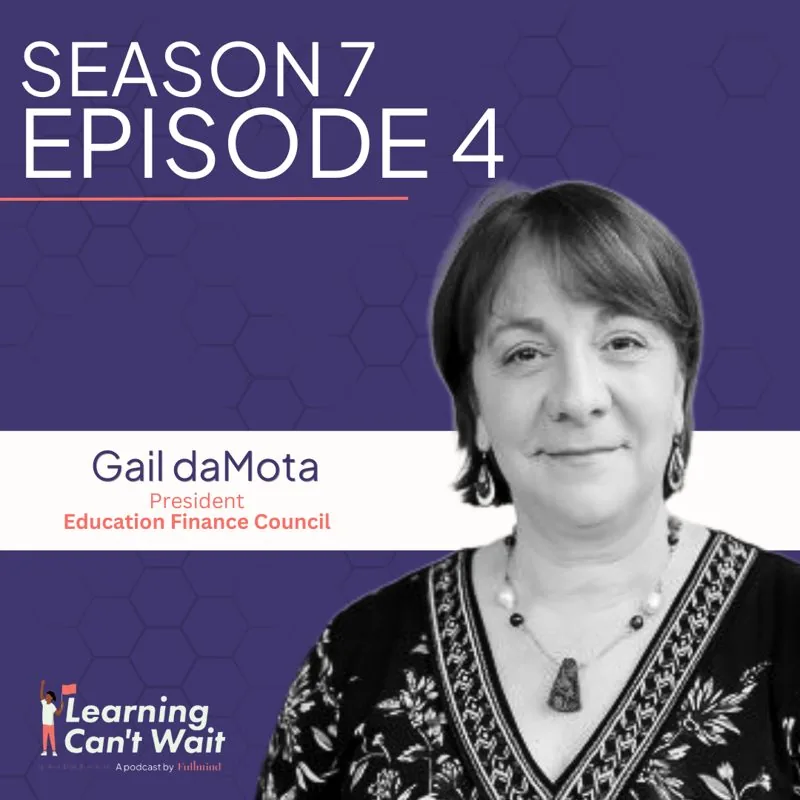
Gail daMota: Higher Ed Financing, Pell Grant Increase, Financial Aid Resources
- Gail daMota
 Hosted by Hayley Spira-Bauer, Chief Academic Officer at Fullmind
Listen now
Gail daMota: Higher Ed Financing, Pell Grant Increase, Financial Aid Resources
Episode summary
Gail daMota, president of the Education Finance Council, explains how its nonprofit and state-based members offer free FAFSA help, award-letter analysis, 529 plans, scholarships, and low-cost loans. She calls last year's botched FAFSA simplification rollout a fiasco that depressed completions and enrollment, and urges families to file this year. She describes how students fill unmet need with credit cards or costly Parent PLUS loans, and lays out EFC's policy agenda: a bigger Pell Grant, simpler repayment, Truth in Lending standards for federal loans, standardized award letters, and career-connected pathways.
Key takeaways
- EFC members are mission-driven state and nonprofit agencies offering free college-planning and FAFSA help
- Last year's untested FAFSA rollout crashed, delayed aid, and pushed completions down; this year's is in beta testing
- Unmet need after aid is often covered by credit cards or Parent PLUS loans, which lack ability-to-repay checks
- EFC wants a larger Pell Grant, simpler repayment, standardized award letters, and free aid separated from loans
- Career-connected learning, apprenticeships, and upskilling certificates deserve more funding alongside traditional college
About this episode
In this episode of Learning Can’t Wait, host Haley sits down with Gail daMota, the president of the Education Finance Council (EFC), to discuss the complexities of higher education financing and the importance of accessible, affordable education. Gail shares her journey into the education finance sector, where she has worked for over 30 years advocating for nonprofit and state-based financial aid organizations. They explore the challenges students face when navigating the financial aid system, including the impact of FAFSA’s recent rollout issues and the importance of understanding the various funding options available, such as scholarships, state grants, and low-cost loans. Gail also highlights the need for federal policy reform, including better loan repayment options and increased Pell Grant funding. Offering invaluable insights for students, families, and educators, this episode provides listeners with practical guidance on how to navigate the financial aid process, ensuring more equitable access to higher education.
Tune in to learn how you can make the most of available resources to secure the funding necessary for pursuing post-secondary education.
Episode notes
In a recent episode of the Learning Can't Wait podcast, Gail daMota—President of the Education Finance Council (EFC)—shared her invaluable insights on college financing, the challenges of FAFSA implementation, and the critical role of nonprofit organizations in making higher education more accessible. In this article, we break down the conversation, explore the broader context behind financial aid policies, and offer additional resources to help students and families navigate the complexities of financing a college education.
If your school or district is seeking to better support students and families through the college planning and financial aid process, Fullmind offers access to state-certified educators who can provide expert, real-time guidance on FAFSA completion, scholarship searches, and post-secondary planning. By partnering with Fullmind’s virtual staffing solutions, you can ensure your students have the tools and support they need to confidently take their next steps toward higher education.
The Role of Education Finance Council in Higher Education Finance
Gail daMota’s journey in higher education finance began unexpectedly. Starting in a trade school environment, she transitioned into roles that spanned from financial aid servicing to administering federal loan programs. Now at the helm of the EFC, her deep-rooted passion stems from personal experiences as a first-generation college student and American. This passion is echoed in the work of EFC’s members, who are primarily nonprofits and state agencies dedicated to serving local communities. These organizations offer a one-stop shop of services—from FAFSA guidance and state grant management to low-cost private loans—ensuring that students have access to the support needed for post-secondary success.
The EFC's mission is to empower families and students with clear, actionable information on financing college, emphasizing that financial aid is an investment in the future. For more details about their programs, visit the Education Finance Council website.
Understanding the FAFSA Fiasco and Its Impact on College Financing
A significant portion of the conversation was dedicated to the recent challenges surrounding the FAFSA rollout. Last year’s launch of the simplified FAFSA, which was meant to streamline the process for families, ended up being a “fiasco” due to inadequate testing and system crashes. According to Gail, this resulted in an 11.6% drop in FAFSA completions—a figure reported by Chalkbeat—that likely contributed to delays in college enrollment and forced some students to reconsider their college choices.
Despite these setbacks, Gail stressed the importance of completing the FAFSA as it is the gateway to both federal and state financial aid. The U.S. Department of Education is now beta testing a more robust version of the FAFSA, with plans for a stable launch by December 1. For families seeking the latest updates on FAFSA policies and deadlines, the Federal Student Aid website is an excellent resource.
Strategies for Affordable College through Nonprofit Support
One of the standout themes from the podcast was the focus on nonprofit organizations in addressing the true cost of college financing. Gail explained how many of these nonprofits not only help students fill out the FAFSA but also provide critical support services such as counseling, scholarship search assistance, and guidance on low-cost private loans. This holistic approach is particularly important as the actual cost of higher education often extends beyond tuition to include living expenses like food, transportation, and housing.
For instance, many state agencies work closely with local schools and community organizations to ensure students receive comprehensive support. Whether it’s through career nights, one-on-one counseling sessions, or workshops for high school counselors, these nonprofits play a vital role in demystifying financial aid. Families are encouraged to visit EFC’s dedicated Students and Families section for free expert help.
Policy Changes: Simplifying Student Loans and Increasing Pell Grants
Gail daMota was candid about the policy changes she hopes to see at the federal level, which include:
- Increasing the Pell Grant: Current Pell Grant amounts have not kept pace with the rising cost of living. An increase in Pell Grant funding would directly benefit low-income students by reducing the financial burden of college.
- Simplifying Student Loan Repayment: The complexity of current repayment options often leaves students confused and overwhelmed. Simplification would make it easier for borrowers to manage their debt.
- Enhancing Transparency and Accountability: Gail advocates for standardized financial aid award letters and clearer distinctions between loans and grants. This transparency is crucial in helping families compare financial aid offers effectively.
- Protecting Borrowers: She also called for stronger protections regarding the Parent PLUS loan, ensuring that loan terms are clear and that parents are not burdened with predatory borrowing terms.
These recommendations align with broader national discussions about making higher education more affordable and accessible. For more on recent policy debates, you might refer to analyses by the Brookings Institution and The Institute for College Access & Success.Advice for Students Pursuing Post-Secondary EducationFor students embarking on their higher education journey—especially those without a robust support system—Gail’s advice is both encouraging and practical: "Don't give up." She emphasizes the importance of seeking free assistance from nonprofit organizations, doing thorough research on available aid options, and not being deterred by initial setbacks. Whether it’s navigating the FAFSA process or understanding the nuances of different loan programs, reaching out for expert guidance can make a significant difference.This sentiment is echoed by many education advocates who stress that while the process may be challenging, there are abundant resources available to ensure that every student has the opportunity to succeed. Students are encouraged to explore scholarship search tools and other financial aid resources available through government and nonprofit websites.Additional Resources and InsightsFor those interested in exploring more about college financing and financial aid options, consider the following resources:
- Federal Student Aid (studentaid.gov): Up-to-date information on FAFSA, federal loans, and repayment options.
- College Board (collegeboard.org): Comprehensive resources on college planning and financial aid.
- The Institute for College Access & Success (ticas.org): Research and policy analysis on student debt and college affordability.
- National Association of Student Financial Aid Administrators (NASFAA) (nasfaa.org): Industry insights and updates on financial aid management.
The evolving landscape of college financing is influenced by policy shifts, technological improvements, and the dedicated work of nonprofits and state agencies. As the new administration brings potential changes, stakeholders—from policymakers to families—must stay informed and engaged.ConclusionGail daMota’s conversation on the Learning Can't Wait podcast offers a detailed and hopeful look at the future of college financing. Her insights underscore the importance of reliable, simplified financial aid processes like FAFSA and the critical role nonprofit organizations play in ensuring that students have access to the resources they need. As you navigate the complexities of higher education finance, remember that the journey is challenging but ultimately worth it. With the right support and informed decision-making, every student can find a pathway to success.For more inspiring conversations and expert advice on education, be sure to listen to the full podcast episode and explore additional resources on the Education Finance Council website.
Full transcript
Transcript generated from the recording; minor errors may remain.
Hayley Spira-Bauer: Welcome back everybody to the Learning Can't Wait podcast. I often feel like the guests that come on this podcast are so incredibly brilliant that not only are the audience members gaining new knowledge, but I myself am growing six new levels of intelligence from having them on. I am so eager to introduce you to another one of those guests. Today we have Gail daMota, the president of the Education Finance Council joining us today. Gail, welcome.
Gail daMota: Thank you, Hayley. I'm really happy to be here and to join you today.
Hayley Spira-Bauer: I feel honored that you're spending your time with us here on the Learning Can't Wait podcast, and as I mentioned just in your introduction a moment ago, I am hoping my brain will grow on this conversation. I know that my brain will grow. I will say that as I told you before we started recording finance, college financing post-secondary education is not a topic we talk about extensively here, which is why your presence is even more important, because I think in the coming years it's going to be even more important than ever before. So thank you for doing that and I'm going to jump right in with my very first question, which is, Gail, how did you come to be the personal and professional version of yourself?
Gail daMota: I actually kind of fell into it. I always tell folks, once you get into higher ed, you never get out, but I actually began in a trade school working with a trade school, and then I moved into being a financial aid servicer for various types of trade schools. And then I moved into the Federal Family Education Loan Program, which used to be the loan program, and then eventually Education Finance Council. And we are a very niche part of the higher education finance sector, so our members are all nonprofits or state-based agencies. They are mission-driven, so they're in business to serve the communities and their states and the people in their states are going to school in their states. So once I met these guys, I kind of stuck with them because I'm very passionate about their mission and very proud of the work that they do and the number of people that they help.
Hayley Spira-Bauer: It's funny. I had a question specifically about this level of passion because you've been in various roles at EFC over the years, so what helps you sustain that passion? I mean, you mentioned some of the people, but can you share a little bit about the work and how that inspires you to have stayed at EFC and continue to grow with the organization?
Gail daMota: Part of it's my background. I am first generation American. I am first generation female college. My brothers were also first generation, and so for us, education is a way to succeed in life. We relied on financial aid to be able to get our degrees into our education, and because of that, it changed our lives and I have seen it change the lives of so many other people.It's one of the few investments in life that is an appreciating asset.It alters your life for the better as long as you plan and do it smartly.
Hayley Spira-Bauer: Yeah. Before we get into some of the challenges and pitfalls, let's talk a little bit about the members that are part of EFC. You mentioned they're nonprofits, they're very mission driven. Can you maybe give an overview of the types of organizations that are component to EFC and how they're focusing on helping families plan and pay for college?
Gail daMota: Sure. Because they really hone in on the needs of the individuals within the states that they serve. So it's very specialized for those needs. So for example, the member, we have Massachusetts MEFA, Massachusetts Educational Financing Authority. They will have very different needs in that area, new England than somebody for example in New Mexico and our member in New Mexico, all of our members provide support services that are for free. They're a great resource to help you think about going to college and planning for college. They'll help you with the FAFSA. They'll help you understand your award letters. They will help you analyze different loan options. They are there to serve the folks in their state, and they offer a wide variety of services. Many of them administer the state 529 College saving plans. Some of them administer the state grant and scholarship programs, and they themselves have scholarship programs, and they also, quite a few of them also offer a low cost private loans, much lower than the family, the Federal Direct PLUS Loan program, the Parent PLUS program, much lower interest rates and affordable repayment plans as well. They're kind of like a one-stop shop
[05:00] **Hayley Spira-Bauer:** And covers such complexity on the topic of getting to college and supporting your own financial success through to and through college. Can we jump in on FAFSA for a minute? There's been a lot of discussion about the transparency of FAFSA and the simplification of FAFSA. How does the Education Finance Council feel about the state of FAFSA today and where we're going from here?
Gail daMota: Last year was a fiasco.I've been in higher ed for over 35 years. I've never seen a year like we saw last year, and it was quite frankly shameful.It never should have happened, Okay. FAFSA was simplified through the FAFSA Simplification Act. It used to have quite a few more questions. It was very complicated, and the Act was intended to make it shorter and more simple and easier for families to complete. Last year was the launch of the new simplified FAFSA. Unfortunately, it was launched without being properly tested. The system crashed. Many people could not get their FAFSA out on time and states had to extend when they provided state grants, people were not finding out what financial aid they were eligible for on time. And so schools had to extend out when the deadline date was for accepting their offers. And it was probably one of the worst rollouts of a FAFSA that I have ever seen. So after this, we call it the FAFSA fiasco. After this mass, the Department of Education committed to make sure the rollout for the FAFSA this year is not wrought with all the problems that they had last year and some of those problems and frustrations last year kept people from completing the FAFSA. ([12:35](https://www.google.com/url?sa=E&q=https%3A%2F%2Fwww.rev.com%2Ftranscript-editor%2Fshared%2FYmWys_PpzQCVPtruPuaeXcalbhRXFlzcc4lBU3eqVapk1RwGeggO2wUpA48kOyEhrYJ8gimA67zmP8CV4seEWi9fueQ%3FloadFrom%3DDocumentDeeplink%26ts%3D755.68)): We are encouraging you to please fill it out this year. It is the starting point of all financial aid, both federal and state, and so it is really important that you do complete it. Right now, the Department of Education is putting it through a beta site right now, and it's being thoroughly tested. It is scheduled to launch by December one, but later this month, you'll be able to log in and apply for complete the FAFSA before December one through one of these beta sites, and you will not have to recomplete it later on. It'll be good. It'll be valid. And so we do encourage you to please fill out that FAFSA.
[13:00] **Hayley Spira-Bauer:** So just putting some hard numbers behind what you shared here about last year's rollout, Chalkbeat reported in July that the completion of FAFSA, which by the way I'm definitely saying it wrong, was down 11.6% and then that could have resulted in less kids going to college. Did we see a lower enrollment in college post-secondary degrees this fall as a result of that, or are we still waiting to find out?
Gail daMota: I think there was a bump down initially, particularly in the freshmen class and in some cases even for the returning students. I think there was also transfers from some of the more expensive colleges to lower cost colleges because people were just uncertain about what their financial aid was going to be and what their affordability was going to be. But I think it's going to level out. I think it will level out. We're just trying to make sure folks know that we don't expect a repeat of next year. And despite any frustrations they may have experienced or have heard about, the FAFSA still is the first place they need to start in terms of thinking about financing their education.
Hayley Spira-Bauer: A lot of our listeners are K-12 school leaders, superintendents, principals, and various personnel that are in the administrative roles in K-12 institutions. They're listening to this in many cases, and they are providing supports for students and families as they complete, or sorry, as they prepare for post-secondary life. How does EFC and some of the component nonprofits help schools as they enable families to jump into this next stage of their child's life?
[15:00] **Gail daMota:** Almost all of our members have attend the career nights and provide counseling for students to plan and help them figure out how to pay for college. Quite a few of them also provide materials and in some cases, training for high school counselors to be able to provide information to families as well. I would encourage 'em to go out to our website, efc.org, click on students and families, and then click on Get Expert Help that will identify the members we have in each of the states that can provide them with some assistance or at least help guide them to where they can get direct students to get free assistance.
Hayley Spira-Bauer: I'm thinking back to my days in K-12 institutions, and I remember our first graduating class of 12th graders as they were going to college. All of them were accepted to two or four year colleges. It was a huge accomplishment. We were a charter school in Harlem, and I'm thinking about a lot of the financial struggles that students encountered that didn't have to do with the actual tuition had to do with their living, their food, just everything else beyond paying for their bill that came from their institution. Can you talk a little bit about how some of the work that you're doing support students in the ancillary financial issues that they encounter?
Gail daMota: Sure. Those issues still exist. Unfortunately, they are still there and they are still deal. And so when they get a financial aid award package, it's not just tuition and the sticker price of tuition isn't necessarily what they pay. There is tuition discounting. It's very real, but part of that is the total cost of education, and it includes money for food and transportation and things that is part of the budget that is packaged for that. And in some states there is some grant money to provide for that gap. But it is something that we are advocating to see more happen, particularly in the states, particularly in some of the real rural communities where it's particularly difficult for them to get the transportation because perhaps the closest institution is over an hour away. So when they're looking to fund that unmet need, and that is you have your cost of education that is calculated by the institution, and then you get your aid. ([18:06](https://www.google.com/url?sa=E&q=https%3A%2F%2Fwww.rev.com%2Ftranscript-editor%2Fshared%2FTVUufdTvnHW61pUUhDQPLh60qNOmfDeyv29Ub5J8zRWnA810LXOlUQz2BDnmcgHtvBlxhMvsE4tnoB0KQz48FlUZ8ss%3FloadFrom%3DDocumentDeeplink%26ts%3D1086.18)): So the FAFSA will tell you if you're eligible for the Pell Grant, if you're eligible for the federal student loan program, and the state will take that data and also look at whether you're eligible for any grants or scholarships through the state. And of course, folks should always do scholarships, searches and not pay for 'em. They're free. Do a scholarship search and try to get as much scholarship money as they can. But then there's generally always a balance left, an unmet need left to fill that gap. And so that's where I think we could come in. We did a white paper on it, a little research brief, and we found that a lot of people were turning towards a very expensive for-profit private loans, or worse yet, they were paying for the unmet need with their credit cards at a 29% interest rate ([19:00](https://www.google.com/url?sa=E&q=https%3A%2F%2Fwww.rev.com%2Ftranscript-editor%2Fshared%2FHhG94gzhe9pOGUYCOlSnxQmYaic-LVI5vm8XNzg-wEc0KgqVzxqBQhcSIC1_m3Xqbgi08yV4WBrF9rbYywgUg-bAcfs%3FloadFrom%3DDocumentDeeplink%26ts%3D1140.18)): Or some schools were packaging them for the Federal Parent PLUS loan, which is a loan that the parent takes out. That PLUS loan is not held to the Truth in Lending Act standards, and it has a very high origination fee and it has a very high interest rate. And so we also tell folks to please check the nonprofit sector. They offer low cost student loans that don't have origination fees, they have favorable repayment terms and they have much lower interest rates. So do your homework and do your shopping, and that can help some of that gap fund that gap that they'll need.
Hayley Spira-Bauer: I'm going to switch direction a little bit and talk a little bit about policy here. I know that you mentioned briefly in a prior part of our call today that you did a webinar with the federal government talking about FAFSA. What policy changes are you eager at EFC to see at the federal level to improve access to affordable higher education?
[23:00] **Gail daMota:** First, we'd love to see the Pell Grant increased. It hasn't kept up with the cost of living, and I think it needs to be expanded. There needs to be more funds available for students with need. We also would like to increase focus on simplification. Sorry, focus on repayment. Simplification. Right now, the loan program is one of the most complex repayment plans that you can see. There's so many options. It's very confusing and difficult to navigate. We'd like to see that more simplified and easier to understand and navigate. We also would like to see the government held to the Truth in Lending Act with their loan programs, particularly the Parent PLUS Loan program that does not have a ability to repay component when determining eligibility for it. And so parents at times are taking on debt that they have no hope of being able to repay. ([25:06](https://www.google.com/url?sa=E&q=https%3A%2F%2Fwww.rev.com%2Ftranscript-editor%2Fshared%2F_YytnFKUh5s_XEbD2Z9ZaCeDF0vtLN9kUncWvKG0dj9cklZ92GVVunZK-gcUaL65yzXt4xabYFTwzB1jIA26CYsFAAQ%3FloadFrom%3DDocumentDeeplink%26ts%3D1506.17)): We feel that's predatory. We'd like to see colleges not be allowed to automatically package the Parent PLUS Loan program and have to at least reveal their APR and other terms of that loan. We would also like to see a standardization in the financial aid award letters that families receive so that it is easier for them to compare the different offers to actually determine how much that college is going to cost. As I stated earlier, tuition discounting does happen, and that can be a big part of the package. So sometimes a higher cost college can actually come in at a very comparable rate as a lower cost college. So having standardized terms and the way they present some of this information can make it easier for families to really compare. And we'd like to see the free aid that does not have to be repaid, completely separated out from the loan programs that the person is borrowing from, and so that there's an understanding that this isn't free. ([26:26](https://www.google.com/url?sa=E&q=https%3A%2F%2Fwww.rev.com%2Ftranscript-editor%2Fshared%2F5Bp2IErnUJ3d8GrLtfZd6B9zNKEDsCEe6odQQ6F0Zoze8are0967zDE-KwVcLYZFVQhBA6mlkyIA3Q3QDLPX9Y9u24I%3FloadFrom%3DDocumentDeeplink%26ts%3D1586.99)): You have to pay this part back. This part you don't have to repay, and I think that's important as well. The other thing we want to see, and we have been very supportive of is what's called career-connected learning, education-to-employment pathways. A lot of our members are looking for ways to help people take some alternative routes rather than just the traditional college. There are a lot of career programs, apprenticeship programs, internships that we would like to see more funding and availability for that, and also help students figure out upskilling. There's some of our members offer programs that will allow people to take some of the certificate programs that they need to upskill their degrees, and those specialty programs can really make a difference on their income as they move forward. So we'd like to see some support for those types of programs as well.
[27:00] **Hayley Spira-Bauer:** You gave basically a playbook here. I know we have a new administration coming into office in just few months, and so I'm curious if the work that you're doing today is going to be how you think it'll be impacted. Everybody's impacted right in all sectors in all ways. How you think the work you're doing today and even some of the topics that you just raised here as suggestions for policy at the federal level, how it might be impacted by the new administration?
Gail daMota: I think that's a question all of us are asking right now. I have not seen a definitive set of proposals from them. I do think we might see a little bit more of a focus on college accountability and a little bit more transparency on the return on investment in some of the colleges or programs. Maybe on a program level, I would imagine that there's been a lot of litigation surrounding loan forgiveness with the current administration. I would suspect that some of that is going to be resolved under the current administration. I don't know that they're going to focus so much on the forgiveness piece. We are hoping that they'll consider the simplification of the repayment plans. There's been some discussion of that as well, but right now we don't have enough information to know what's going to be coming down the pike. It's just what we're hopeful for, but a little bit of a stay tuned. Yeah, it's still very early in the process and there hasn't been a lot of discussion about it, so we're just kind of hopeful and following closely.
Hayley Spira-Bauer: Yeah, I read a piece the other day that was pretty just bold about saying Anyone who thinks they know what will happen, I think really has to wait. We need more information pretty much across the board to figure out even, I mean, I live breathe K-12 education, and there are some proposed potentially very dramatic changes happening in this space, but we don't know yet. So I'll be staying and waiting with bated breaths beside you, Gail, as we see how and what changes, come down the line and then react accordingly.
[30:00] **Gail daMota:** Yeah, exactly.
Hayley Spira-Bauer: Gail, the time has flown here. I feel like, again, I definitely feel like I learned a lot from this conversation, and I hope our audience has to. I'm confident that they have, but I do have to ask my final question here today, which is wild because the time has really gone quickly. But I'm curious, Gail, what advice you would give a student who is maybe doing this somewhat on their own is starting to embark upon the next phase of their journey, including post-secondary education, who might not have all the supports in place and from their family for a variety of reasons. What advice would you give them?
Gail daMota: Don't give up if it gets frustrating. There is funds out there, college or training, any type of education after high school is available to you, and there are ways to have that happen. I would encourage them, if they really don't know where to begin in the process, reach out to one of our members. Again, that help is free for them. And if nothing else, they can get guidance on where to get some of those support services. Even for example, like the transportation or the food insecurity that you spoke of earlier, they might be able to help direct them to other state agencies that could provide additional support for them. They can walk 'em through the FAFSA completion process. And even some of our members have support services for once they get into school to help navigate through that whole experience. Or they can help connect them with coaches that might be able to help guide them through that. So I would just say don't give up. It can be frustrating and scary. Do your homework. Check out different types of loan programs. If you have to go and borrow from the private sector, do your shopping, but reach out to one of our members for the free help. I think that you can't go wrong with getting free help. Right. Yeah,
Hayley Spira-Bauer: No. And first of all, I just want to say I really appreciate the work that you're doing at EFC and the work of your component nonprofits. I know from my own experience working in schools how difficult this process and confusing it can feel, but there are incredible resources as you've shared here today, that can make it easier for students to pursue and have choice. I think more than anything in education, I want students to have choice, and it sounds like you're doing the work to ensure equitable choice for students all over the US. Thank you for that. And thank you, Gail.
Gail daMota: Thank you for giving me this forum to talk about the great work our members do. And again, colleges is affordable, higher education, post-secondary education.It's there for you and it's still worth it.
Hayley Spira-Bauer: Oh, I love that. As an ending. I'm going to stop right there. It's still worth it. Gail, thank you so much for spending your time with us today. It was a pleasure having you on the podcast.
Gail daMota: Thank you.