
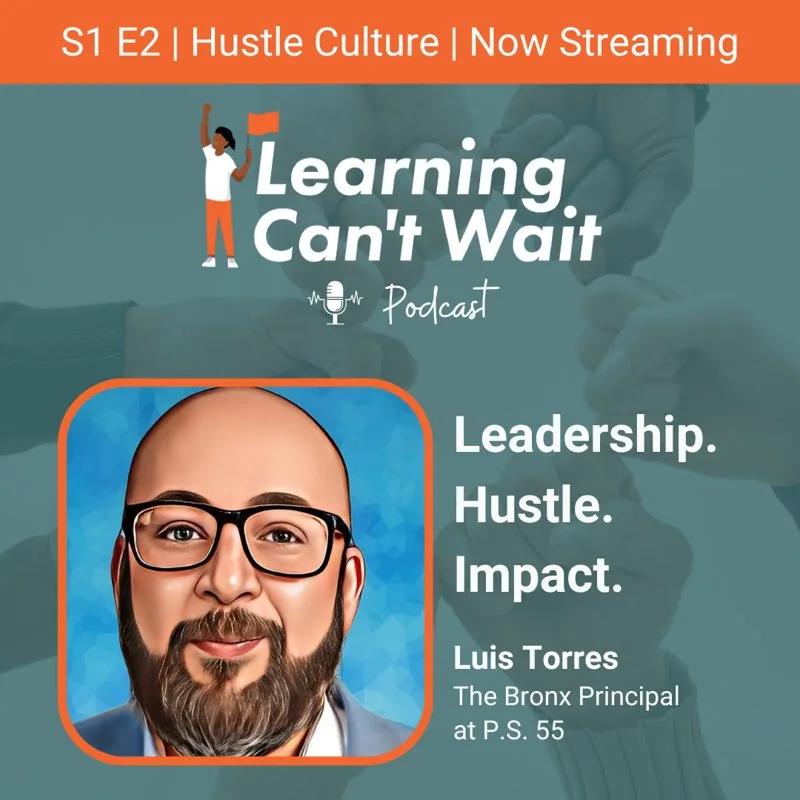
Learning Can’t Wait · Season 1, Episode 2
Hustle Culture
 Hosted by Hayley Spira-Bauer, Chief Academic Officer at Fullmind
Listen now
Hustle Culture
Episode summary
Luis Torres, principal of CS 55 in the poorest congressional district in the country, describes 16 years of building a community school with an in-house clinic, farms, and a food pantry. He explains that education ranks sixth for families until food, shelter, safety, health, and technology are met, how the pandemic exposed inequities, and how he and local officials ended the digital divide with devices, hotspots, and cable TV lessons. He urges leaders to hustle for resources, hire for empathy, and work on the system rather than in it.
Key takeaways
- Address families' five basic needs first or education will never be the priority
- Leaders must hustle and beg; begging is fine when the resources go to someone else
- Schools that show success often lose state funding, so build partnerships that cannot be cut
- Hire for empathy over book knowledge; ask candidates if they love children and why this school
- Fund the arts through small annual contributions from every business, pooled and sent to schools that need it
About this episode
Leadership. Hustle. Impact. Are these words you associate with education? How about community? Luis Torres certainly does. For over sixteen years Luis has dedicated himself to serving the South Bronx community by blending education and civic responsibility in a never ending pursuit to better the lives around him. In this episode, our host, Hayley Spira-Bauer, gets to the heart and soul of what it is to serve community, the struggles and triumphs that go along with it, and how we all might learn from Luis Torres' example of giving back.
Learning Can't Wait is brought to you by iTutor.com.
Full transcript
Transcript generated from the recording; minor errors may remain.
Welcome to the Learning Can't Wait podcast an iTutor production at iTutor. Our vision is to ensure every child has access to education regardless of circumstance. Each episode, we will be joined by Pathfinders within and around the education space. Who are bringing about transformational change? On behalf of deserving students, I am your host, Hayley Spau.
For today's episode I have with me Mr. Luis Torres, the principal of CS 55 in the South Bronx. Hi, Mr. Torres. How are you? Everything's great. How have you been? I am great. I think that being here today with you has been, I came off of a vacation, has been the highlight of me returning back to work. Wow.
That's, that's a, that's a compliment. Listen, it's not every day you get to interview your first, and I know you don't like this word, but your first boss, partner, not boss, partner. Partner. Fair enough. So the first person who made an impression on me in education, that I wanna introduce right now is Mr.
Luis Torres. Mr. Torres, thank you so much for joining me today in our Innovations and Education podcast. I'm so excited to be here. I mean, this is an honor to see someone that I knew when first started education and to be sharing this moment with you is, is very important. I'm not gonna get emotional.
I sort of promised myself that before we started talking today. Maybe I will, I don't know if I can keep that promise, but what I wanna do, if you could, could you take a moment and just tell everybody why maybe I'm so excited to have you here today. I have a million accolades I could say about you, but I want them to hear it from you.
What is, what is your role? What have you been doing? Who are you? I've been a principal for, over 16 years now, and I've been in education almost all my life. I would say I've been education now going on like 27 years. Before I went to education, I, I was in the military. Because I had a guidance counselor who told me that I would not be successful in college.
So in order to, to prove that guidance counselor wrong, I wound up, earning five college degrees and then went into education to make sure that what happened to me would never happen to another, you know, young man or a young woman under my watch. Wow. So five degrees, a lifelong career dedicated to serving others that is beyond impressive and inspiring.
I think that it's important for folks to know that you've been serving as a school leader in the same community throughout your tenure as a principal. Can you tell us a little bit about the CS 55 community in the South Bronx? Yes. So I've been here 16 years in the same school, CS 55. Our school serves the poorest congressional district in the country.
We have one of the highest crime rights in the city. But when you come to the school, you would never know cause we've been able to school that is a, is what I call a true community school. We have a hospital in the school with a nurse, dentist, psychologist, ophthalmologist, full-time on staff. We provide dental, ophthalmology, everything in the, in the, in the clinic.
We have farms upstairs in the school through the Green Bronx Machine. They're still in the building doing their thing, providing service to the community. We're opening up a food pantry. We're about to give away 500 pairs of sneakers. These are the, like, you know, the, the, the, the fun things that we do here every day.
Last week I had one of the Yankee players visit the school, Gio. So it's just a, a very special place. I'm so fortunate and blessed to have been the principal of this school for over 16 years. And I don't think it's just me or the other folks who have worked alongside you as I think you would say, who would, who have recognized your impact in the community.
Right. You've been recognized as a Cahn Fellow, an outstanding young educator for by ASCD, the Daily News, hometown hero, the educator of the. Of the year by the NAACP. And you are currently, you were, it was just announced that you are the president elect for the New York City Elementary School Principals Association.
Yes. Yes. That was a, congratulations. That was a great honor. I mean, to, to, to know that I will be, Working, you know, leading some of the work, and supporting principles across the whole city of New York is, is an incredible honor for me and, and something I, I look forward to. You know, I'm gonna go back for a second because as you started to talk about CS 55 and what makes it so special, you named a lot of the challenges that the community has faced over the years, but you put more emphasis as always on the ways that the community comes together to support one another.
The ways that school leadership have invested in the students. Can you point to one thing that has made your job easy? As you kind of have put into place all of these initiatives and all of these innovations for the people that you work with and the students that you serve. Is when I, when I came to realize as an educator that for many of our families' education this a six priority, it it, it's not cause they don't value education, it's because they have to deal with food shelters, safety, health and access to technology issues that, you know, other communities don't have to deal with.
But until we address those five other basic needs, You know, the families have to survive, right? So as a, as a school, we're a very unique place because we try to address those five needs, so then the families can then, focus on education. And that's always a challenge because there are some things that we have within our power, but then our, there are many things that we don't have power over, as a school.
so we. Enlist partners and we looked for different ways to address those needs. But the reality is, as a leader, it, it was hard for me to understand. I mean, I grew up in that environment, so I kind of understand what it was to live in it. But from the education point of view, because my parents always made education a priority for me, I never realized how challenging it is for many of our families and.
You know, we have to, as educators and leaders of our communities find ways to address those five basic needs or else we never gonna educating the. Right, because how can you focus on school when you're hungry or you ha you aren't having your ba basic needs met on a regular basis. So I'm, I'm kind of thinking now.
Right. So the past 18, 20 months have been challenging across the nation as educators, but how has having the Montefiore Clinic in your building served your community to support them in ways that maybe other schools haven't been able to do throughout the pandemic? So something that is a negative but also a positive is sadly, I, the pandemic was nothing new for me.
I've been living in pandemic conditions as the principal of this school for before the pandemic, you know, lack of resources. You know, health issues, wellness issues, all of that has existed ever since I've been here, even before I've been here. So, it's not that the pandemic changed anything, and, and sadly, you know, I, I'm comfortable in this, this world because I, I, I've been dealing with this all my career.
the, the bright spot of the whole thing was that a lot of inequities became more evident. So people were forced to take action and things that they have ignored for years. So the, the digital divide has always existed. Sure. And I don't understand how we never were able to get devices in every child's hands.
It took the pandemic to do that. We know the inequities with wifi, right. That existed before the pandemic. You know, why didn't we think about getting the hotspots to the families like we recently did, or, or fighting for shelters to have, wifi access because shelters were not providing wifi access to the residents that they supported.
So, you know, for me, these last few months was just affirmation of, of what I've been dealing with before the pandemic. And, and, and sadly, you know, some communities, struggled during this time. Because they did, they did not, know what to do, where, where we've been doing this for years, so we we're comfortable in this, this environment.
You know, we're like pigs in, in the mud, right? We're comfortable. Yeah. Yeah. Well, I mean, there's a type of resourcefulness that's required when you don't have. As a school leader to what, you know, your community needs. And so, like you said, I think it's unfortunate that you've had to operate in the school community for so long in that mindset.
but you're right. I mean, I listened to an interview you did. . The other, a couple weeks before, it was announced that there would be no remote options for schools, in New York City, and you were speaking about how families were staying in laundromats where there was wifi so the students could complete their classes with teachers.
And, you know, that's a reality for a lot of America, you know, New York City, of course there's, there's many places where stable internet connections is a limitation to students accessing their teachers during the pandemic, but it's everywhere. It's in rural parts of America as. And so getting kids the access first and foremost to ensure that they can interact with their teachers and their peers must have been a major challenge.
And how did you all address it? Like you got the students one-to-one devices. What did that look like? How did the rollout, what were the kind of challenges you faced in ensuring students had what they needed to be able to. I think, you know, timing is everything. Right. We were fortunate that the borough president was Ruben Diaz Jr.
Who, as you may recall, has done a lot for our school, has done a lot for our community. Mm-hmm. So having him as the president was very important. Then we had, our executive superintendent who was Meisha Porter, who was a school leader of a school similar to my school. It was a high school, but you know, it was in the community.
So she understood the challenges that were happening. And then the elected officials like Vanessa Gibson, the city councilwoman and Assemblyman Michael Blake and Assemblywoman Jackson, their mindset. Their leadership style was perfect to end the digital divide that existed at the time. They, they rallied resources.
They worked hard to ensure that every school had a device. They partnered with the Department of Education and, you know, we were able to make sure that every single children had a device in their hands. Then once we realized that every child had a device, we realized that the, wifi issue was. So one of the things that I did was I started TV channels through BronxNet, the local TV channel with a partnership with Max nabe and a few other people, educators, and others.
We were able to start these TV channels where we were providing educational programming to families that did not have wifi two cable. And you know, I'm still a principal, but I wound up becoming almost like a TV producer. I bet you were great at that and, and, and, you know, we rallied, you know, people, it wa it was, it was a cabled educational programming for the people by the people.
So we had teachers, parents providing the content, people liking it to PBS. It was like our own Sesame Street, but with a purpose to make sure that all families that didn't have access to internet can still log in and through TV, some educational program. And then we started shifting towards the real issue, which was around, wifi access in partnership with the local cable companies, the elected of issues and others, and the Department of Education and Meisha Porter, who started to provide, hotspots to the families.
And then we also addressed the issue of the shelters not providing wifi access. So that took the city, you know, Pushing on that, that issue, because I understand why wifi can be a safety concern in the shelter, but we need it in order for the children to be educated and, and I know you mentioned the story about the children in the laundrymat, that that's been going on forever.
Yeah. No, I, yeah, I remember. I remember. You're lucky if you live like near a college or a police department or somewhere that has wifi. But you know, having all these, smart people, these progressive people, these people that wanted to make sure that everyone had access to the internet and technology was very important.
And I think that the Bronx, was fortunate. That these people were in place. Yeah, absolutely. I mean, and you, you've just shared so much there. So there's this obvious effect of you in this community that you have dedicated your career to serving that draws people in, right? Like you've just named off some really important people that are very influential, both in the Bronx and through the city at large.
Talk a little bit, if you don't mind, Mr. Torres. How you make these connections, because I imagine that folks that are listening here are going to say, well, I'm not as charismatic or, I don't live in New York City. But there's obviously some intentional groundwork you've done to make these connections, not for your benefit, but for the kids benefit and, and this.
Right here is an example of how it pays off. So just uh, just wanna make one correction. Also Timothy Coleman, who was apparent liaison, was instrumental in the TV channels as well. But if anybody learns anything from this podcast, is thatas leaders, we have to become hustlers and beggars.We have to become hustlers and beggars.
Those people who hustle and beg will get the resources they need, and it's okay to hustle and beg when you're doing it for someone else. I don't care. I go to to an elected official and I beg for money if I need something for the school. And I'm not afraid to, to go and, and tell 'em, look, I'll do whatever I have to do to get this auditorium upgrade, you know, or a cafeteria move from the basement of the school.
So I'm not afraid to beg, you know, I know there's a song like that, but you know, the reality is when you do things for others, And you have a voice and you have access, then you have to utilize that to get the resources for those people who don't have that. So that's what I do. I do a lot of begging. I also hustle.
You know, you have to constantly be in the game, right? And present everywhere. Go to meetings, go to you see a grant opportunity, apply for the. Don't be afraid to apply. You know, a lot of people just don't take the time to do all of this. And I will, I'll hustle people, you know, like Will Smith says, you know, you put him on a treadmill and he'll beat you every time because he, you gonna, he's gonna have to die on the treadmill for you to beat him, right?
So it's the same idea, you know, if I need resources, I'm gonna do everything in my power to get those resources. And, you know, I go online, I go on social media, I'm on there, regularly. Posting things up, looking for opportunities to partner with people, looking for ways of getting resources, and that's what I do.
And in the last 16 years as principal of the school, I've secured easily, easily over 30 million in funding for my school and surrounding schools and, and possibly double that because there are projects that I, I don't even know that, how I impacted them, that have become reality. Our school loan in the.
Eight years I've been able to secure, 20 million in projects, wow. For the school. So, you know, it's, it's okay to beg, it's okay to hustle. Those 20 million are not going in my pocket. They're going to make the lives of our children better. And, and when you're doing things like that, it's okay to do these things.
Those are some big numbers. Those are some big, big numbers, and I think your message is a really important one. One of the things I say very often when I meet people is like, if I, by the time I leave this world, like if I have left the world better than when I came into it, I will feel confident that, that I've served my purpose here.
I think. And I know, I don't know if you're, you're pretty humble, so I don't know that you're gonna say this yourself, but like, I feel like the, the impact you've had over the past 16 years and beyond that, because I, I, there are countless other ways. I'm sure you've impacted people's lives, both in serving the country and even in growing up.
It, it's just incredible. It's incredible. And there's a reason why you've amassed such a following because. You're very intentional about how you spread the word of what's happening in your community and what great things the children are accomplishing in your teachers. And maybe we could pivot for a second and and shine a light a little bit about the teachers of CS 55 and how they've endured and how they've contributed because you amass us.
Staff of folks who stay there, I'm abnormal. Right? Like the last time we spoke, you brought in all wheels colleagues. So talk to me a little bit about how you've done such a phenomenal job hiring talent and retaining talent in the community. Yeah, I mean, it's, it's a commitment, right? Even when you was there, you was committed to the community he was doing, going far and beyond.
You know, you, you're humble yourself, but when you was in the school, you was doing things, taking children, ice skating, doing all types of stuff. There are children, you know, nor, and teachers in, in normal situations don't do for their children. And, and you know, you was doing that work. The reason why people stay in the school is cause the community is a, a very challenging community.
And unless you really wanna work here, You're not gonna wanna come here, right? So once you come into the building, you understand the needs of the community and your heart connects you to the school. And that's why it's easy to get people to donate and invest in the school because people realize the challenges that we face here every day, but it's poverty, it's crime, it's everything else.
And the teachers, they, they themselves become part of that equity warrior mentality. And wanting to, you know, make the world better for our children. It's pretty easy to, you know, motivate people to stay cause it, unless you wanna be here, you're not gonna stay here. For many years I've had zero turnover rate, and we've had people retire after 40 years here.
Sometimes it's, it is a plus. And sometimes it, it is bad too, right? Cause you want new blood coming into the school. But we have a foundation, here in the school and we have people who are committed that, don't leave. And I know recently you saw a few of them while we were talking, we got to see some of them.
But you have a foundation of people who are dedicated to making the lives of the families here better. And when you have that foundation, anyone comes in, Because part of that, because it's easy to gravitate towards that, it's not an easy place to work in. And I don't want people to think that this is like in any way a boutique school where their teachers are spoiled.
And it's not that. It's the fact that, the need is great here. And this is the type of of work philanthropists would, would love to do and, and this is the type of work where people who would probably go overseas to be the hungry would be doing that. You know, why go overseas when you have some of those conditions here in the community?
And, and I think there's, there's this unspoken piece that you're probably not naming, but it's the way that also your team is treated, right? There's a culture of respect and transparency, and when school leaders are looking to keep talent and keep people who believe in the work, not just of educating children, right?
Like that's part of being a teacher, but for caring. Caring about the social emotional wellbeing of the community as you named. It's not just about delivering lessons, it's about meeting the school community and the community at larges other needs as well. You have to find those like-minded people, otherwise they're detractors to the work.
I don't know if you remember the two questions I always asked during the interview. One was, do you love children? And the second was, why would you wanna work in this school? And if you can't answer, I actually, I actually do remember those questions. I remember everything about the day that I interviewed with you,
Yeah, I mean, if you can't answer those two questions honestly. , right? If you don't like children, then you shouldn't be in education. That's one. And two, if you're walking into my door and you're here to get a job in our school, are you willing to work in a school where sometimes, you know, people might not treat you the best way because you know their life situation might not be that great and they're not gonna be always smiling and you know, Saying good morning to you in the street and things like that.
It's not that they're bad people, it's just that, you know, life's challenges, have an impact and a toll on people. And you have to be willing to be empathetic. And, you know, not everybody, you can't teach empathy, right. That's something you have to come with, right? You gotta be willing to know what people are feeling and thinking and, and it's not an easy thing.
You know, I, I would take somebody who's empathetic over, someone who is book. Any day? Any day. Any day, right? Any day. Yeah. I could not agree more. I think that's true for like how I comport myself with friends and how, and work, what, whatever it may be. Empathy matters more than I, I personally think more than anything, and I think that for the work that educators are doing, yeah, a hundred percent.
You know, I'm think I'm thinking about the community. I'm thinking about the ways in which the school has advanced over the past 16 years. In what ways have you seen. Change happen and innovation happen from the bottom up, almost like from, not just from the leadership, not from you be not from like the, the superintendents or the, you know, district bureau, pres, whatever it may be, but from the ground up, what have you seen as change that has happened there, either from the students or the families or the teacher?
We, we've gone through a complete transformation here at this school. I mean, 16 years. When I first started here, a lot of the things that I was doing, people viewed it as fluff. You know, this community work, all this stuff, bringing these resources in. People said it was fluff. It was, just a show. Now they're replicating movies.
Yeah. , look at them now. We should have them on the podcast . Yeah. Now, now they, now they're, you know, trying to figure out a lot of the things that we've done over the years and, and, and we've been able to show that when you invest in these FU five other priorities. The students will then start to perform on level.
So before the pandemic, right before the pandemic, which was the last series of, state exams, we had shown some of the highest gains in the city. And here we are. A school was one of the worst. We were now showing, if not most, Some of the most games. We went from single, single digit reading levels to over four, over 35, 30 8% in literacy.
And then we went into mathematics over 34%. And these are I about children performing three and four. These are not even the children that are borderline threes that will become fours, threes and fours over time. But for a school that traditionally was like bordering 4% literacy, 5% mathematics, I mean, we just jumped above a lot of people in the city and and we started to show tremendous gains right before the pandemic hit.
Because what I learned over my 16 years is that when schools like ours show success, we get punished instead of. What do I mean by that? In 2011 when I was named outstanding educator for the country, that same year the school was being labeled a family school and they were talking about closing the school.
So that makes no sense. Here you have the principal is being honored nationally at internationally for the work he's doing, but yet the school is failing. That was a, a big issue for me. So when we started to show a lot of success and we started to get off the failing list, what happened? The state took the funding away.
They showed, uh, they helped us to get off that failing list. Cause they said you don't need the money no more. What they failed to understand is the reason why we were getting off that failing list is cause we finally had the resources that we need to be successful. So there's a major contradiction that exists where a school to show success instead of being rewarded is punished.
And for a long time I, I didn't understand how that worked and how that made sense to anyone. So what I did is I said, I'm not no longer gonna be dependent on that state funding no more. I'm gonna hustle for resources. So when they come and I'm showing success, I have this funding source that will cover whatever they're cutting.
And I'm not gonna be dependent on them anymore. So I've been able to create partnerships and establish partnerships, long-term partnerships that fill the gaps for anything that the state won't fund for the school. I get people to do it, whether it's healthcare, whether it's the arts, whether social emotional supports.
we have partners in place. That, make sure that those things never get cut and that this community will be able to sustain any cuts or anything that happens. So that's why also when there's a pandemic, while other people are, are struggling to stay afloat, we're, we're swimming backwards because we're able to sustain those hits because I, I've created an environment where, you know, we're not solely dependent on state or city funding.
Yeah, so that resiliency mindset of being prepared for anything allows you to face the challenges ahead of you, which, I mean, that's what the science tells us, right? Like having the mindset, you're speaking of, being prepared for any kind of challenge that presents allows you ultimately to tackle each challenge as an opportunity.
Right. Like I try not to call things problems. I try to call them opportunities because there's always an entry point at which you can enact change and, and improve, which sounds like is very much kind of your mindset when it has to do with the, the challenges of the past 18 months or the past 16 years, whichever, whichever timeframe you wanna really talk about.
I'm curious like how your perspective has changed though. Right? So when you started out, you were, you know, a newer principal, you went through a specific training program to become a principal. In what ways have you either better understood the system and how it works, which is what you're naming right here, or developed more savvy to how to take advantage of opportunities before you, like how have you changed as an educator since you began even as a teacher to where you are today?
So I was a very unique situation. I went into New York City Leadership Academy, so I went straight from being a teacher to a principal. I was never an assistant principal. Right, right. So I never had that administrative experience before I became a principal. So that was a challenge in itself. So my first few years, you know, I was just trying to figure out how things work.
And just trying to stay in the job because before me, you know, principals would come into the school, spend one, two years and then they would go, right? So I was just trying to figure out the job and how to sustain myself so that I can stay in the building, stay in the game, and be able to make impact. But as I, I became, more involved with the system, I realized that I couldn't work in the system.
Causewhen you work in something that is broken, then you become broken.So I started to look at the system differently. And I said, I gotta work on the system not in it, right? So I refuse to allow myself to be brought into the system even though I work for the DOE. I was not brought into the system and I don't follow a lot of what people would say are traditional principles, strategies, and, and, and routines and structures.
So, you know, I even had somebody say, oh, you don't look like a principal. I said, good. I don't wanna look like . What does the principal look like? Yeah, that's what I'm saying. I wear sneakers. I, you know, I'm, I'm bold. I have a beard. I know a lot of principles like that, you know, but it's interesting. So I, I, I refuse to allow myself to be drawn into a broken system.
So I work on it, and in working on it, you start to realize, The racism that exists, equities that exist in a lot of the structures that are currently in place. And I honestly feel that, the community where I work was created with one purpose, and that's to feed the prison system. And when I started to understand that, I said that, you know,my goal in life would be to open schools and close prisons.
That changed my mindset about everything. And when I look at the children and I see the inequities that they have to face and the challenges they face every day and, and the lack of resources and the community and the things, then I understand, you know what, what I thought was a myth is reality. You know?
Cause if, if you allow these things to stay in. All we're gonna do is continue to feed the prison system. And I, I recently read something where the owners of the prisons are upset cause we're not filling them enough private prisons. And there's people that are upset about it. And that's my goal is I those to be upset.
We shouldn't be preparing our children for prison. And, and sadly, there's a lot of structures that still exist in society that create that pipeline to prison. So one of my main goals as an educator is to dismantle the pipeline of prison and become almost like a plumber and like move the pipes around so that the pathway to college and career becomes smoother.
Because we, we also have to understand that not every child is meant for college. And I think that that's a big issue that we have right now is that we're not preparing our youth for careers. You know, we're, we're just banking on them going to college, and if they don't go to college's a bust, no. We should be preparing pipelines.
All types of jobs. It doesn't have to be a technical career. It could be a police officer environment. We need to create pipelines to these careers so that our children, you know, feed our own communities and then they can self sustain their community. You know, people always complain about police brutality, things like that, but why don't we create a pipeline where our children, police our own communities?
And these are the types of things and the type of thinking that I have that has shifted over the years. Some people, they value it and, and sadly I think I'm underutilized in the world and at some point I will leave. Right? Cause we all have to leave at some point and I just feel like I have more to offer.
So, so yeah. So you're talking about the cycle of poverty and disruption of, of the systematic racist principles and practices that exist and. So like, let's talk about how you plan to use your platform, as the president-elect of New York Elementary Schools to help other principals and school leaders disrupt in the way that you have.
Because giving students a proper education that thinks of them as a whole child is exactly what prevents the cycle of the school to prison pipeline from continuing, how do you plan to use that platform? To extend your impact, as you say. So I've been doing some of it already as the president-elect. I've been pushing the social media agenda for principals, but I also want to start to create opportunities.
I call it, marriage opportunities, where I start to create marriages between schools and partners, organizations, companies, not-for-profits. You know, I feel that there's, somebody's gotta create that link. Somebody's gotta connect that, you know, not every principal is a hustler. Not every principal is a beggar.
But if we could create structures where we could create these partnerships for schools that are lacking resources, right? So if you, if you, if you have a lot of health issues in your community, why isn't your school partnered with a hospital? Mm-hmm. , why isn't your school. Connected to a healthcare provider or service, they can provide funding for things so that you're not paying for it and you're providing a service to your community.
Right. So I, I wanna do a lot of work around creating partnerships for schools and providing them resources because, you know, a lot of the issues that we have is the schools don't have the resources to truly meet their communities. And I, and I wanna do a lot more mentoring the principals and guiding them and different things.
So one, one of the things I would love to do is create an environment where senior principals and, and new principals can, can collaborate more on things. And I, and I don't see it happening the way it used to at one time when I was a principal. Early on in my career where I could go to senior principals and they would give me advice and it's, it's just a, you know, I just wanna create a different culture.
I wanna create an alignment of all the resources that exist, not only in the Bronx, but across the city, so that schools can be better prepared and have the resources they need for their families. We, we just gotta do it. At some point somebody's gotta do that work. I mean, this is why you are the perfect person to be in this role, right?
Because you're right. Not everybody is the magnetic kind of connector that you are, and so let's leverage what you've learned. Let's leverage the people. I mean, I think that that ultimately, I'm saying let's, like we're on a campaign trail here, but you know, like ultimately that's how you use utter other people's talents.
Come together, bring a bunch of smart people to the table and enact change. That's what you're talking about. That's what you've done in your own community. That now has a much greater potential to reach more people very soon. . Yes. And, and you know, I, I hope you, I hope to be able to leverage this opportunity so that we can start, opening the eyes of some people who, who just don't see what's really going on, across the city.
And, you know, the have and have nots, the tale of two cities, all these different things that people don't understand and don't realize. And I also wanna advocate for those school leaders that may not be as politically inclined or willing to speak up. I wanna help to become a voice for them as well. Well, if that doesn't leave people with goosebumps, I don't know what will
So we're coming to the end of our time allotted together to be talking today. I feel like we could probably talk for hours, weeks, months, on end, and I would still not have dug deep enough into the surface so that people can hear all the incredible work you've done and continue to do in the way that you think about education.
But I'm gonna be respectful of time and we'll get, maybe we'll come back for another, another episode upcoming. But you know, just to kind of close us out, Mr. Torres, I'm wondering. . If you had the ability to innovate or transform one thing in education, what would it be? And. So I have a TED Talk where I talk about how other arts almost, not having access to the arts almost killed me, right?
The TED Talk was supposed to be about how having access to the art saved my life, but that was not a reality for me not having access. Was the problem, and that's why I wound up born into the military and doing all of that and it's, it was based on the fact that my community really didn't have strong arts programs.
The, the high school didn't take the time to know my talents. I really didn't have any way to gain access to a high quality arts program in a high school or college. And my TED Talk goes into one of the challenges, always funding, right? So arts is always something that's underfunded and not resource. If I had, and I was in a position where I could have a greater control of things, I would say, why don't, every single business in New York, there's 250,000 businesses and I did this research, for my TED Talk, and there's 1,800 schools or something like that.
Why? Each business give $500 a year, two dues. That would go towards arts education, because then when you look at it, it would create a pot of money where you can send a hundred thousand dollars to each school to create an arts program for that school, A high quality arts program. In those schools that don't need the hundred thousand, couldn't turn the money, right?
Cause there are schools that don't need it. They have, and then you can double that for those schools who really need it. And this is a very simple formula. It's not, it doesn't take rocket science to figure this out. And that can be used, that formula could be used to fund anything. So that schools that are lacking certain program, Could be fully funded.
The businesses which are always looking for ways to impact and and support would feel good that they're investing in the arts across the city or sports programs, whatever it is. And you create this partnership between private and public that could be sustained over many years. And then you start to bring equity to programs.
Now, sadly, you're gonna have some communities that don't want that. Why? Because they can control the scholarships as long as they can control these high quality programs. So if they're the only ones offering high quality arts, when their children go and compete against our children for scholarships and for seats, they're gonna win all the time.
Cause they have an advantage. It's the same thing with sports. You can have the most physically gifted child come from my school. Right. And then you have a child in another school that has access to a high quality program and cause he's being taught the right way and, and has all this good skills, the coach is gonna pick him over this child here.
And that's purposely done, I feel, when you eliminate arts and sports programs from schools. So if we wanna do this, let's figure this out. Let's get the funding. And I know this year they did a great thing and that's one of the reasons why I'm, I'm happy with Meisha Porter, the chancellor. They actually provided funding for the arts this year, which is really good.
But we wanna sustain that, right? We wanna keep that going. We don't want it to go away, like I said before, when we start showing success, right? So we gotta figure out ways to make sure that these things become self-sustaining and funded over time. That sounds like not just an idea, but some , but something, and I've heard your TED Talk a few times now, but something that is absolutely a reality and if anybody is capable of working on such an initiative, it is you, Mr.
Torres. I am beyond humbled that you joined me here today to take time out of your busy day, to talk about the myriad ways that you've innovated and transformed the community you serve. I just wanna say thank you from the bottom of my heart for being with me today. You are family. So like once you become part of the CS 55 family, you'll be family for life.
and you was, one of the, you know, people who came in gave 150% when you was here. The least I can do is, is give you back, you know, the hundred 50% you gave me. Well, I'm not far and I can't wait to come back. And I just wanna thank everybody who's listening with us today. I am sure, I'm confident there is not a doubt in my mind that you have been inspired by listening to Mr.
Torres talk just as I have been, and I'm sure it is the first of many times if you're new to Mr. Torres and the Bronx Principals, the first of many times you'll be hearing from him in the future. So thanks for joining us today and Mr. Torres, have a wonderful rest of your day. Thank you. Thanks for listening to the Learning Can't Wait podcast.
If you liked what you heard, please rate, review, and share this episode. Be the first to know when we have a new episode by subscribing wherever you listen to podcasts. If you'd like to be a guest on the show or have a suggestion for an episode. Email us at podcast@itutor.com.