
Learning Can’t Wait · Season 12, Episode 11
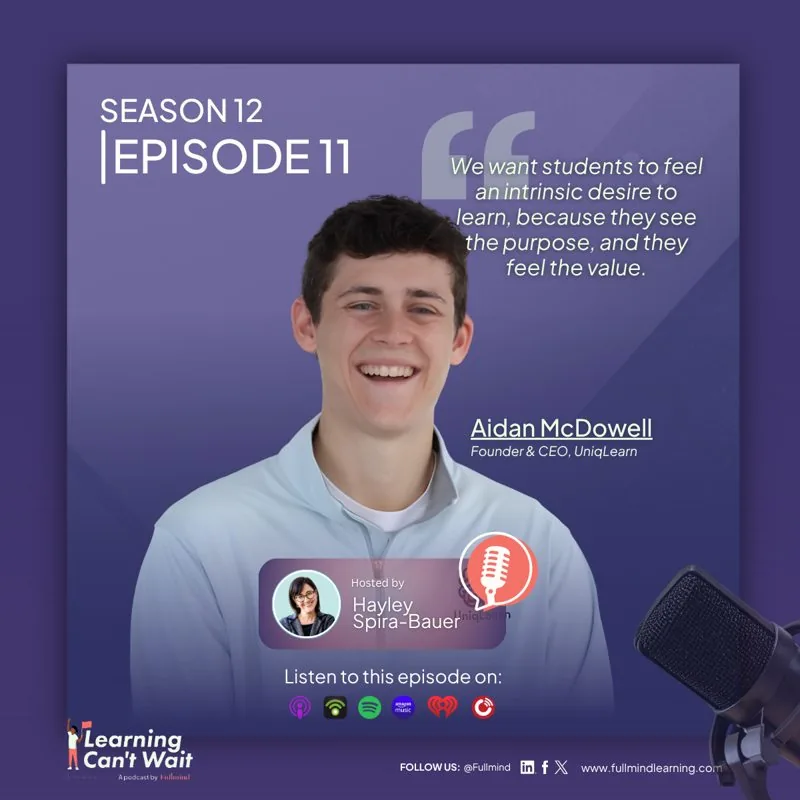
Aidan McDowell: Personalized learning, Student agency & Intrinsic motivation
- Aidan McDowell, Founder and CEO of Unique Learn
 Hosted by Hayley Spira-Bauer, Chief Academic Officer at Fullmind
Listen now
Aidan McDowell: Personalized learning, Student agency & Intrinsic motivation
Episode summary
Aidan McDowell, who founded UniqueLearn at 19, explains how a Spanish dual-immersion upbringing shaped his student-first approach to edtech. He describes UniqueLearn, which personalizes practice around a holistic picture of each student, and Unique Path, which builds custom career-exploration courses around any interest. Recorded as New York and Los Angeles moved to restrict AI, he argues blanket bans widen the equity gap, describes a pivot toward helping districts see and govern their edtech tools, and shares a story of a disengaged student who lit up.
Key takeaways
- A child is more than a reading level or test score; personalization should reflect culture, interests, and circumstances
- Unique Path asks students what they want to learn and builds a custom career course around the answer
- Blanket AI bans remove access at school for students who have none at home, widening the equity gap
- Districts often cannot see which edtech tools are used, by whom, or at what cost
- Founders should spend time in schools; the best product decisions come from customers' stated problems
About this episode
In this episode of Learning Can’t Wait, Hayley Spira-Bauer speaks with Aidan McDowell, founder and CEO of Unique Learn, about making learning more personal, purposeful, and engaging. Drawing on his own school experiences, Aidan explains how understanding students’ interests, cultures, emotions, and circumstances can help educators create meaningful learning experiences. He discusses Unique Learn’s approach to personalized practice and Unique Path’s student-driven career exploration, emphasizing intrinsic motivation and opportunities for students to direct their learning. The conversation also explores his concerns about blanket AI bans, his company’s shift toward helping districts manage fragmented technology and data, and why listening to educators and treating students as individuals should guide innovation.
Full transcript
Transcript generated from the recording; minor errors may remain.
Hayley Spira-Bauer: Do it, I dare you.
Aidan McDowell: Whoa.
Hayley Spira-Bauer: Welcome back, everybody, to the Learning. Can't Wait podcast. This is one of those episodes that has been a long time coming, mostly because when you try to sit a founder down, it is sometimes very challenging for them to be in one place for too long. And that is the case with this incredible next guest. We have Aidan McDowell, the CEO and founder of UniqueLearn joining us today. Aidan, welcome.
Aidan McDowell: Thank you, Hayley. It has been a long time coming, as you said. I'm super excited.
Hayley Spira-Bauer: Well, and, you know, important to say it's not that I believe you think this is unimportant, because you and I are both very excited, but rather, you are doing the most important thing, I believe, a founder, and especially a founder with no education background in edtech. Can do. You are spending all your time in schools, so I'm not mad. In fact, I'm really grateful that that's what you're doing, and I'm excited for you tell your story and why you spend all your time in schools on the podcast today.
Aidan McDowell: Yeah, I'm, I'm excited to share more. As a starting statistic, I calculated all of my travels this year so far, and I have officially been gone for over 50% of the year, so…
Hayley Spira-Bauer: You're not lying. Wow. Wow. That is a lot of travel. Well, maybe you could tell us how you got here then. How did you come to be the personal and professional version of yourself, Aidan?
Aidan McDowell: Yeah, from a personal standpoint, I always go back to my education experience. I think education is something that forms a lot of us, makes us who we are as learners, as people, as socializers, as friends. And I had, I think, a particularly unique learning experience. I grew up in Southern California. I was in a Spanish dual immersion program. There were 99 kids in my grade, 90 of which were first-generation Latino students who had Probably half a parent in the country on average, and just came from super underprivileged backgrounds, and I was very fortunate to come from a far more privileged background than a lot of those kids, and Because of that, probably had a million more words read to me when I was a child and just the diverse learning environments I grew up in, and the differences in culture and family values. And just the value that I feel like I gained there from being immersed in all of those different things. Very much formed me into who I am personally. I think that's also very much affected who I am professionally. I mean, I think as a founder. Professionally you are who you are personally, and so. The company I'm building is nothing short of an exact mirror of The pain points, both experienced and observed in that journey.
Hayley Spira-Bauer: You know, Aidan, you are a founder who started your company, UniqueLearn at age 19 before. Like, you barely even were out of school yourself. What were you seeing as a student that felt so urgent that you said, someone has to fix this, and it might as well be me?
Aidan McDowell: Yeah, again, it really stemmed from both my lived experience, but also the observed experience of those around me, seeing students coming from Such diverse backgrounds, such underprivileged backgrounds, and not being given. The support and resources that they needed. And for me, on my side, just the amount of disengagement and. What I would consider the logical reasons for disengagement such as not being. Explain the purpose of why we're doing what we're doing. Challenging a topic. I mean, the most vivid memory of this for me in school was in geometry class, and I was so upset to be in this geometry class. And very frustrated by what we were learning, and the Pythagorean theorem. My number one enemy and my number one driver. I just, I remember going to my teacher and asking her, why do we need to learn this? And she couldn't give me an answer. And I was like, but I'm just never gonna use this. Can you tell me when I'm gonna use this? And she couldn't give me an answer. And to this day, I've never used it. And it was experiences like that that just drove me to be like, you know what? This is a huge problem for everyone, and it needs to be solved.
Hayley Spira-Bauer: Man, oh man, it's so interesting to me because I don't think there is a single problem that schools are facing that doesn't touch this issue of motivation and engagement, even if on the surface it looks like it's a totally different problem. It is all connected to this particular topic. I'm really glad you raised it. You know, I'm gonna stay with this theme for a little bit, because you are very, very passionate and very, very… focused on this challenge, and you're part of a generation of… you're part of a wave of Gen Z founders in education. There's a lot of folks popping up that are on the, just out of school kind of end of the spectrum. And I think it is a really important and unique. Overuse the title of your company. Unique perspective that you bring to the table, because folks like me left school decades ago. So what do you think? People who have been out of school for decades might not know about the system today. As it relates to the topic of motivation and engagement, but maybe even further, technology, since it's evolved so significantly.
[05:00] **Aidan McDowell:** Yeah, I think there's a few advantages. I mean, we were just chit-chatting a little before we started, but… As you said in the intro, one of the most important things a founder can do is spend time with… in schools, with customers, right? Especially as someone who doesn't have that education background. And so, although I don't have the experience of being a teacher, being an administrator. I have as close, or I'm as close to my experience as a student as you can get. As a founder. I mean, I started it while I still was a student. Right. Right? And so having… that perspective on these problems. It allowed me to really take a student-first lens, and I think everyone that knows me and works with us would say that. I'm just desperately obsessed with the student perspective and the student side of the problems. Obviously, it's important to solve the problems for teachers and administrators and stuff, but when we think of what we've built, Over the last few years, it's just student obsessed. And from a technology standpoint, You know, as, as a, as a young gun, you kind of just click around and Play with stuff and break stuff, and all these things, and I think there's a level of… there's an appetite for risk. When you're younger, that maybe goes away a little bit. Obviously, there are plenty of risk-takers older than me, but. I think as kind of a kid, you're… happier to kind of play around and break things.
Hayley Spira-Bauer: Yeah, and again, I think it's a really important perspective and having been so close to the schools that you're building products for and the fact that you're… Very, very open about what your background is, and therefore spending a significant amount of time collecting data, inputs about the student experience, what teachers are facing, how students are feeling. It has led you to build a product that solves for a lot of the challenges you're naming. So, tell us about UniqueLearn. Tell us about Unique Path, tell us about all the challenges that are solving and how you're solving them.
Aidan McDowell: Yeah, so both UniqueLearn and Unique Path share the same vision for individualizing the learning experience. For UniqueLearn specifically. It helps teachers personalize practice for students based on their interests, and based on a holistic understanding of who they are, Both as learners, but also as people. And just really emphasizing the importance of understanding who a child is every day when they walk into your classroom, right?A child is more than a reading level. They're more than a test score.They have different breakfasts every morning. They get to school in different ways. They get different qualities of sleep every night. Some students don't have a bed to sleep in. Right? But where in education is that type of information accounted for? But it's real, right? And so UniqueLearn as a platform really focuses on. Trying to understand the student from that holistic perspective. And then create learning experiences that resonate with who they are, create a sense of psychological safety in the classroom when it comes to learning. For Unique Path, we wanted to extend that passion for a holistic understanding and. Being able to diversify learning experiences for students into career exploration. And we were very bold with Unique Path, very intentionally, we felt comfortable doing so, we felt like as innovative as we wanted to be and were with UniqueLearn, We felt like we had the safety of UniqueLearn to fall back on, that we could kind of push some boundaries with Unique Path a little bit. And Unique Path is really meant to challenge the status quo of a typical classroom structure, andBasically, a student is prompted with what I consider my favorite question in education, which is, what do you want to learn today?And it's just curiosity-driven, it's student-driven, there's no agenda behind it. I just want to know what you want to know. It's simple as that. Student types in any career that they're interested from teacher, doctor, lawyer, mainstream stuff, to more niche things, like, I want to be a college football coach or a scuba diving instructor, or a professional camel jockey. Whatever the interest may be, a student can put that in, and we'll create a custom course for them. That maps out YouTube videos, lessons, and hands-on real-world projects for them to engage with.
Hayley Spira-Bauer: So starting with UniqueLearn for a second, when I first met you and I learned about what your company does, I think I blurted out my personal opinion about homework, which is that it sucks and there's not a lot of research to support its efficacy below grade nine. Other than to promote the home-to-school connection and I was so excited to hear that you built a tool that would personalize, but also scaffold what students were taking home every day, because that is a more meaningful use of kids out-of-school time. As a mom to two boys in elementary school who have a million activities, you know, we don't even touch homework at night. We do it in the morning, because their brains are fried, I'm fried from working all day, and. You know, their homework doesn't give me an opportunity to really assess what they know as a parent, which most parents can't even do because they're not former teachers. So that got me so excited. Can you tell us though, like this isn't… I know, because I know your tools. This isn't just switching the activity out and saying like, for Joe, who loves baking, this has a baking story for their math word problem, but for… Emily, who loves soccer, it has soccer focused. Obviously going well beyond that. Can you highlight in a little bit more detail for UniqueLearn specifically?
[10:00] **Aidan McDowell:** Yeah, so there's a couple different frameworks, research-driven frameworks that we use to kind of power the platform. The first is called the four quadrant model. And it's what drives our understanding of a student holistically. It was developed by a Danish psychology professor named Jan Tønnesvang, and it was built in a clinical setting, so it actually had nothing to do with education. But what the four quadrant model lays out. Is basically, in order to analyze a client's phenomena, you must first understand all four quadrants holistically. And so those four quadrants are the singular internal, singular external, plural, internal, and plural external. And to go through those super briefly. Singular internal is basically your thoughts, your feelings, your emotions, things that are individual to you and others can't observe unless you share them, right? Singular external is more your behaviors, actions, spoken words, relationships, things that are still individual to you, But observable by those around you. Plural, internal is your family values, maybe your religion, your culture, things that are shared amongst your group, but not across a general population. And then plural external is like your government, your work environment, your natural environment, things that are shared amongst your general population. And the idea that Dr. Tønnesvang took with this is. Even if a phenomena or a problem lies solely with your actions, right, in the singular external. You cannot start to analyze and solve the problem without taking into account. The other three quadrants. And so we applied that, that framework to understanding the student. So to your point, it's not just a Mad Libs of changing out. Words and images, right? It's meant to be a representation of who the student is. Right? We want a student to see themselves. We want them to see their culture. In their learning experiences. We want them to feel like there was intentionality behind. What is in front of them on the screen. We want it to be adaptive to where they're at. We want to challenge them, but not too much to where they feel demotivated, right? And so it really taking into account that framework. The other piece is a framework called the four phase model of interest development, which for the sake of time, I won't go all the way into, but it basically puts forth an idea of. How can we understand how something goes from a brand new stimulus to what they call a well-developed interests? And so. You can think of it like a recommendation engine where, yes, we want to use the interest to. Kind of peak engagement in a learning experience, but we also want to broaden the student's perspective and set of interests. Help everybody get as excited as I am about it.
Hayley Spira-Bauer: I feel like I'm sitting in a really condensed college course right now that I want to take more classes about, because I've heard of neither of these theories. They make so much sense to me. When I was teaching in the classroom in Harlem, most of my students were Hispanic and African American, and none of the books looked like them unless I went out to find books and resources and texts that represented who they identify as, what their culture is, their religion. And that's just one component of what you're naming. You've extended it much further, and it really drives home the point that… There is a lot of research around the fact that when students feel represented and psychologically safe and seen, they actually perform better in school. Extensive body of research to show that that is true. How does that look now when we translate to Unique Path and kind of workforce career exploration in the K-12 environment? Is this for elementary school? Like, where… talk to me about how it's different. I mean, go through all of that for me, please.
[15:00] **Aidan McDowell:** Yeah, so Unique Path extends down to lower middle school, so right now we have 6th through 12th graders on the platform. Again, it's meant to be an extension of the same passion for personalization, just with that career and workforce lens. We want students to Number one, be exposed to things that they're typically not exposed to. Right? Oftentimes, students only know what mom, dad, and teacher do. And how are you supposed to know that you want to be a high in high-rise architecture? If you've never seen a tall building? Right? So giving students exposure to careers and to skills that are applicable to those careers through the platform. And also giving them an opportunity and what is typically a rare opportunity to drive their own learning. Right, how often do you get to walk into school and choose what you learn? Never. Right, and that's one of my biggest qualms with education. And yes, I understand there's a standardization effect and There's 30 kids in a classroom, and the teacher can't teach 30 different things, we can get into that later, but… We want students to be the drivers of their own learning and really drive intrinsic motivation there, a consistent theme across everything that we build, unique learn, Unique Path, and anything in the future. There are no extrinsic motivators. There's no coins, there's no, there's no store for skins or. Anything… there's no leaderboard, it's not about that. We want students to feel an intrinsic desire to learn because they see the purpose and they feel the value.
Hayley Spira-Bauer: But Aidan, what about tech and AI? We should ban it. Okay, obviously not my perspective. However, we're recording this at the end of September of 2026. We're releasing this next week. This is a huge topic right now in the education space. We have major cities like New York and LA banning AI. We have LA banning all technology altogether. We are seeing a pendulum swing like no other before. What do you say? To leaders when they are facing this particular challenge of tech and AI bans and the influence of a lot of different stakeholders.
Aidan McDowell: Yeah, the pendulum in education is a heavy one. I just watched the first Avengers movie last night.
Hayley Spira-Bauer: Love it.
Aidan McDowell: And I'm thinking… I'm thinking to when the Hulk comes in and has to stop that weird big robot flying fish thing. And he just, like, puts his hand on it. That's what I imagine, like, this pendulum swinging the other way is like, and.
Hayley Spira-Bauer: Mmm.
Aidan McDowell: We need to gather as a community to form. The strength of the Hulk to stop it. But, no, I mean, I think it's, um… Obviously, it's a super important time. And a lot of, I'd say, extreme policies and playbooks are being published and talked about, if I'm being honest, you know, I think the intent behind these AI moratoriums and stuff is decent. I mean, I don't think anyone is trying to hurt kids. I think it's just a sad representation of where education is at, in the sense that I think it's the laziest approach possible. I think a blanket ban is just, like, a cry for help, or a cry. For a inability to actually understand what's going on and what's valuable and how to control it. And so it's easier to just say, no, no, no, no, I told you so, just stop. That's it. Right? If you look into it, like, specifically the New York one, obviously, I've read a lot about. It doesn't really make much sense, like, the things that teachers are and aren't allowed to do. Like, it feels like they randomly, you know, chose, like, balls out of the little lottery machine. The features that teachers are allowed to use AI for, so… yeah, I think generally it's lazy, but again, I think the intent is there. Like there is, there is a. Good reason to be cautious. There is a good reason to have some discomforts with what is possible. But I think when you realize thatall you're doing is just widening the equity gap between students that have access and students that don't, Right? Now what you've done is you've given the students that don't have access at home, you've removed access at school. And so now the students who do have access at home are just going to keep kind of pushing their understanding. Of technology further and further. And the last thing I'll say on it… Is… I heard someone give a take that. This is the one case in education where the equity gap actually goes the other way, where students that do have access to the technology at home or at a larger disadvantage, because they're going to be using it to Just get answers and stuff like that. I think regardless of how you're using a technology. Exposure and experience with a technology is still valuable. And you're gonna have students entering high school and graduating high school that have never tinkered, that have never learned how to prompt correctly. Even if you're using prompts to quote unquote cheat on your homework, your learning how to prompt. And so I think that those, yeah, those are a few of my thoughts on that.
[20:00] **Hayley Spira-Bauer:** And I welcome those thoughts, and I think, you know, this discourse is fascinating to me. It's fascinating to talk to leaders about it from in-district. It's fascinating to talk. Parents about it. It's fascinating to talk to EdTech folks about it. I think my general sentiment is like, why are we throwing out the baby with the bathwater? This is excessive. I predict that we're going to see a pivot. And you are someone who knows a lot about pivots. So talk to us a little bit about the pivots you've taken as a founder. And how those pivots have made you better, and maybe the folks who put these moratoriums in place are listening and will reconsider their takes.
Aidan McDowell: Yeah, well, we, with our recent pivot, thankfully these moratoriums don't affect us nearly at all, so that's great. But yeah, I mean, pivoting is crucial, right? Like, things change, markets change. I think one of, as we've talked about twice now, the most important things you can do as a founder is listen to your customers and be with your customers. That's a core principle I've held since the beginning of the company, and I think we've taken to an absolute extreme. And over the last several months, we've pivoted really towards the operational side. Of school districts and helping leaders solve their district's biggest problem, whether it's cohesion across the system, observability, governance over tools that are being used. I mean, there's thousands of EdTech tools being used every year in. One district or in a group of districts, and it's impossible to know who has access to what, what data is going into what tool. Who's signing in every day? Are any of these working? How much are we paying? Which ones are we paying for? There is a superintendent that I heard that didn't even know how many schools they had in their district. You know, and that one was pretty concerning, but it's like, the lack of observability across the system is massive. And so in this pivot. We're really trying to help districts address this problem of siloed data sources, fragmented subscriptions, and a lack of observability across the district.
Hayley Spira-Bauer: This is a topic that LearnPlatform has kind of tackled in the past with their annual report showing how many edtech tools are being utilized by schools. Doesn't probably give the microdata that you're talking about, but every year, I wait for it to get published, and every year I'm shocked.
Aidan McDowell: Yeah.
Hayley Spira-Bauer: I can't even remember my like 1Password password. It's like unbelievable that as a teacher, you have to remember, I have a lot of friends that actually use some tools both as a teacher and as a parent. And they're like, I can't remember to log in or out. I'm like not able to find, it's concerning. And that's not where people's attention should be. So it's definitely an important challenge. I. It is tough to say I'm going to change direction. And one of the features that I've realized is most important in this space is adaptability. And I do think we'll see and I have seen and we will continue to see the companies that succeed and become sticky for leaders, and important to be part of their toolbox are the ones that are most adaptable. Because at the end of the day, we are not leading schools, even if we once did. And we are not leading classrooms, and we are not the students in chairs. And so, who knows better to solve these problems than those individuals.
Aidan McDowell: 100%. I mean, I think that's why listening to the customer is so important, right? We can sit on our soapbox and sit in our offices and discuss with our team what we think the best next feature is, or the best next product line, but if it doesn't tie directly back to a problem being expressed from those experiencing the problem, I think it's a mission set to fail.
Hayley Spira-Bauer: Can you give me an anecdote about how students respond to utilizing the tools you've built?
Aidan McDowell: Yeah, I mean, there's so, there's so many great stories, it's the single biggest driver of energy throughout the company is getting, getting messages both. Virtually and visiting classrooms in person, but… One of my favorite ones is, school districts in Illinois that we were working with. We were working with their elementary schools and. Before I walked in the classroom, the superintendent and principal warned me about a particular student who… Had some behavior problems and like to cause disruptions and never engaged with anything.
Hayley Spira-Bauer: My favorite kind of kids. I love those.
Aidan McDowell: Yeah, I may or may not have been one of them, but… you know, they're, they're warning me, which I thought was weird in and of itself. Like, you know, I, you don't need to, like, call out this one soon, like it. Like, students act out, whatever. But they came to me… And the student came to me after the class and was basically like You've inspired me so much, like, I want to start my own company one day. And it was, like, the sweetest thing, and mind you, he had spent the entire class absolutely glued.
[25:00] **Hayley Spira-Bauer:** Sure.
Aidan McDowell: To his UniqueLearn work.
Hayley Spira-Bauer: Yeah.
Aidan McDowell: And the teacher, the principal, and the superintendent were like, I have never seen that kid engage with anything like that. And he's like, what, like, what, what did you do? Like, what happened? And I was like, man, like, you… just gave them individual attention. We made him feel seen.
Hayley Spira-Bauer: Hmm.
Aidan McDowell: You know, rather than labeling him as the kid that's gonna act out. We just treated him for who he is, you know. So that's, that's one of my favorite anecdotes for sure.
Hayley Spira-Bauer: Oh yeah.
Aidan McDowell: Oh yeah, yeah.
Hayley Spira-Bauer: I love that, and I bet you you're gonna follow his journey and he's gonna make it happen, right? Because now he feels like he knows where to go and that is pretty awesome. That is amazing. So as a final question, we're like ready to wrap up here. I would ask you the same question I ask all my guests, which is what advice would you give a teacher who's starting their career today?
Aidan McDowell: We'll tell you what with a grain of salt because I've never been a teacher, but… if I… if I were to give advice to a teacher. Um… There's a few things that I would want to say, some of which may be taken well or not, but I would say. As we talked about, be adaptive, you know, as much. Effort and intentionality as you put into your students, they will reciprocate back to you. Again, it's not something that I have had the pleasure of experiencing, because I've never been a teacher, but I hear from teachers all the time, and I also observe it. It's very clear when students respect their teacher because their teacher explicitly respects them. And oftentimes, cares a lot more about who they are as people. And growing, forming humans than as learners. And I think one translates into the other a lot more naturally. So, I would say, you know, be AI native, be adaptive. And, really be intentional with how you treat students as people.
Hayley Spira-Bauer: Aidan, this was worth the wait, thank you so much for coming and joining the learning can't Wait podcast. You've been such a breath of fresh air.
Aidan McDowell: Thank you, Hayley, I appreciate it.
Hayley Spira-Bauer: Thank you to everybody for tuning in today.