
Learning Can’t Wait · Episode 205
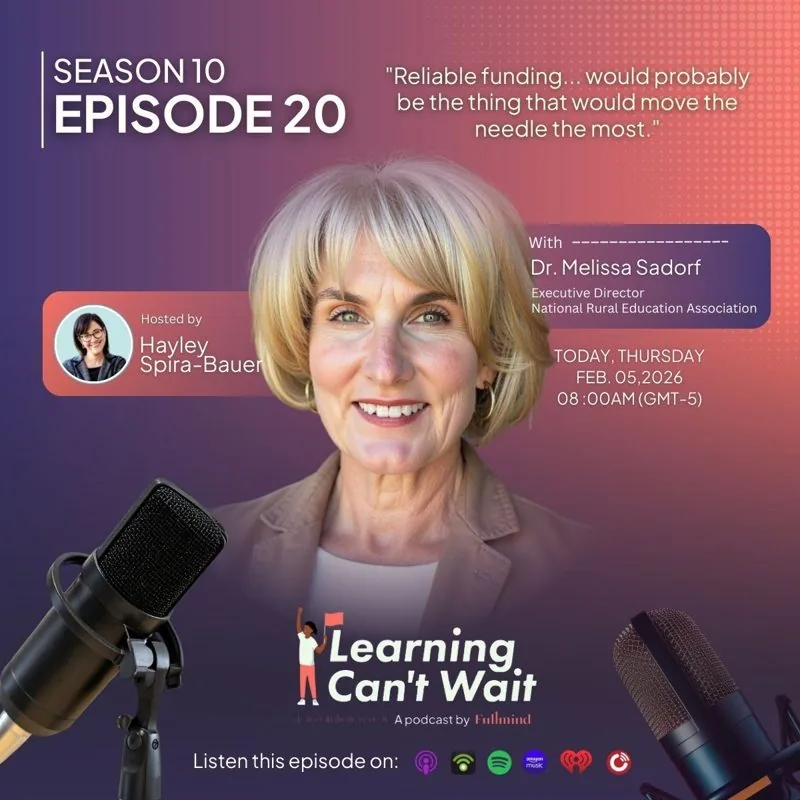
Dr. Melissa Sadorf: Rural education, Asset-based lens & Teacher retention
- Dr. Melissa Sadorf, Executive Director of the National Rural Education Association (NREA)
 Hosted by Hayley Spira-Bauer, Chief Academic Officer at Fullmind
Listen now
Dr. Melissa Sadorf: Rural education, Asset-based lens & Teacher retention
Episode summary
Dr. Melissa Sadorf, executive director of the National Rural Education Association, describes 32 years in rural Arizona schools, 12 as a superintendent, and how advocacy for rural voices led her to lead NREA and its 42 state affiliates serving 10 million students. She explains how rural is defined by access as much as geography, challenges deficit-based misconceptions, and describes rural schools as the original community schools. She walks through NREA's Why Rural Matters report and how leaders can pair its state-by-state data with local stories. Her policy wishes: reliable funding and a stronger rural teacher and leader pipeline.
Key takeaways
- If you think you're rural, you probably are; rural is defined by access, not just distance
- Rural schools are the original community schools and often the largest local employer
- Why Rural Matters ranks all 50 states on five gauges; pair its data with local stories to advocate
- Reliable year-over-year funding would move the needle most, especially after ESSER's end
- Teacher recruitment started failing in rural districts 15-20 years ago; leadership shortages are next
About this episode
In this "Learning Can't Wait" podcast episode, host Hayley Spira-Bauer interviews Dr. Melissa Sadorf, Executive Director of the National Rural Education Association (NREA), who shares her 32-year career in rural Arizona schools from teacher to superintendent before leading advocacy efforts. Sadorf defines rural beyond geography as issues of access to resources and human capital, challenges misconceptions of rural schools as "backwards" by emphasizing their role as community hubs and innovative assets, and highlights the "Why Rural Matters" report, which analyzes data across 50 states on student outcomes, mental health, policy, and more to advocate for 10 million rural students. She stresses needs like reliable funding, teacher recruitment/retention policies, and an asset-based lens, while advising new rural educators to build deep community relationships.
Full transcript
Transcript generated from the recording; minor errors may remain.
Hayley Spira-Bauer: Welcome back, everybody, to the Learning Can't Wait podcast. There is no topic that gets me more excited than the one I'm going to touch on today in today's episode, but really, it's the guest that has me most excited and lit up. I want to introduce everybody to Dr. Melissa Sadorf. The Executive Director of NREA. For those that don't know, that is the National Rural Education Association. Welcome, Melissa!
Melissa Sadorf: Oh, thank you so much, Hayley, it's great to be here.
Hayley Spira-Bauer: I felt a little starstruck when we actually met at the annual convening this past October, because I have been following you and the work of NREA for so long, and then it happened. We met.
Melissa Sadorf: Yeah, that was actually one of the highlights. It was nice to meet somebody that, is also a fellow podcaster, so you get… the pain and love that goes into each and every episode, but somebody that truly understands, rural people and places. It was fabulous to meet you, so I appreciate the opportunity to, to have met you in person, in real life, as they say, and to have some time to talk with you today.
Hayley Spira-Bauer: Yeah, I'm very excited to dive in, because Melissa, unlike you, I have never lived or taught in a rural environment. And so my… my passion for rural America has come from the work that I do now in virtual education, but more specifically has come from the stories that I have learned and heard that have made me fall deeply, deeply, deeply in love. With the incredible collegiality, community, and collaboration that you see happening in rural America. So, enough about me. Let's go over to you! I want to hear all about, you and your work and your journey. Can you start us off by telling everybody, how did you come to be the personal and professional version of yourself?
Melissa Sadorf: So, I love this question, because you could take it in so many different directions, but it wasn't… I don't think you can separate the two, quite frankly, from my perspective. I grew up rural, and went to a rural school, and knew from early on that I wanted to be an educator. I enjoyed working with children, and so being in a… a setting that was comfortable to me, was familiar to me, was obviously rural. So, I spent 32 years in public education, all of them in rural school districts and schools, as a teacher, a coach. An assistant principal, principal, superintendent, for the last 12 years of my career. So, pretty traditional pathway. And along the way, one of the things that I noticed was that there were a lot of things happening, particularly at the state level in Arizona, my home state. Where things were being talked about, and decisions were being made around education for the schools in the state that really didn't have a rural perspective. They didn't have an understanding that the decisions that were being made in Phoenix really didn't play out very well in rural Arizona. And so, I… I felt like I needed to do something about that, and so I started getting involved in advocacy efforts pretty early on. Arizona has a Rural Schools Association, which actually is an affiliate of NREA. And, I joined them, actually got involved with their executive board, and was pretty active with, telling the rural story in, both the local and the state, contexts, and whether it was speaking at subcommittee hearings, or writing op-eds, or working with others that were my neighbors and colleagues to. To ensure that people knew what was going on, especially if they were in rural communities, so that they could then elevate their rural voices as well. And so, when the executive director for the Arizona Rural Schools Association retired, it was a good next step for me coming out of retirement. I had retired, and it was a… it was a nice way to stay involved, even though I wasn't still a seated superintendent. And so I got to do a lot of that work at the state level. At the time that I was working with the Arizona Rural Schools Association Board, I also was exposed to NREA. And NREA is an amazing organization that does that same level of elevating rural voice. On steroids. I mean, it is across the country, we're focused on federal issues and concerns, and again, it's ensuring that the 20% or 10 million children that attend the country's rural schools have a voice in Washington, D.C. And that their issues and concerns are elevated. And so, I got involved with NREA, again, got involved with their executive board, and lo and behold, the executive director retired. I thought. Well, you know, maybe lightning can strike twice, and so I, I put in an application to be considered for the position, and the board did select me, and I have the honor now of sitting in the seat. Representing 42 state affiliates and 10 million students across the country that really deserve to have their rural story highlighted. So, you know, when I think about the professional and personal version of myself, you know, education is such a personal thing, and so even though it's my profession, it's my career, it's my passion, it's also deeply entwined with who I am. And so there, there's not really a separation between the two. I love what I'm doing right now, and have the, privilege of meeting new people and getting a chance to, like you, Hayley, that are passionate about rural education and want to do the same things around just elevating the rural experience and ensuring that people are looking at rural through an asset-based lens rather than a deficit, because we have a lot of great things going on.
[05:00] **Hayley Spira-Bauer:** It's so cool to hear that your story began and has stayed in the element of storytelling, and really highlighting the voices of, as you named. The children who are attending rural schools. Can you help me, in your personal opinion, how do you define rural beyond geography?
Melissa Sadorf: That's a great question. I get that a lot, and I've gotten a range of different answers. There are some that use NCES locale codes. So, NCES, the National Center for Education Statistics, which no longer is operating currently, with our current administration, but… They… they had a formula where they were able to determine, based on your distance from a city center of 50,000 people or more. And, that was the… the determinant. Are you considered rural fringe, rural remote? Anything, those definitions are, Used for a lot of our federal grant funding streams. But when I talk to rural educators across different states, what I often find is the definition becomes,if you think you're rural, you are.And it often boils down to access, issues of access to resources and supports. Human capital, those kinds of things, and then geography does play a part in that. There's a district I'm thinking of here in Arizona that is, as the crow flies, it's only 20 miles from Phoenix. But there's a mountain between Phoenix and this town, and so it's an hour, more than an hour, to get around the mountain to get to Phoenix. So it's an issue of access for them.
Hayley Spira-Bauer: Sure.
Melissa Sadorf: So if you think you're rural, you probably are. And even if you may not be rural. If you feel like there are concerns that you have around access issues, and you relate more with feeling like you're not being seen and needing visibility in your issues and concerns, you know, that's… those are our people. That's our tribe.
Hayley Spira-Bauer: Hmm. What do you think are some of the most common misconceptions about rural schools in America?
Melissa Sadorf: Mmm, what a great question. I'll preface this by saying, again, that there is a misconception that rural is backwards and broken and doesn't have a whole lot to offer. And that is a very deficit-based model. And the truth is, is that, you know,we don't live in the middle of nowhere. There's somewhere there, because we live there.And so, there are assets that can be tapped into in any rural community by any rural school or teacher. And so, I think the first thing to understand is that Rural America does have a lot of innovative things going on. There are assets within those communities that can be brought into the classroom or brought into the work of community building. And so, having an asset-based mindset, I think, is the first misconception that people… might need to be challenged on. I think the other… the other thing that people may not understand is that the school in a rural community really is the hub. It's the heartbeat of the community. It's where people gather on Friday nights for Friday Night Lights. It's where concerts and plays and holiday things happen. It's often the social center, it's the community center, because there's nowhere else for people to gather for things outside of the school day.
[10:00] **Hayley Spira-Bauer:** Melissa. Can I add… can I add an anecdote there? Yes. We were working with, the Lower Kuskokwim in Alaska, and when the community had a funeral, the school had to shut down for the day, because that was the… that was the burial ceremony location.
Melissa Sadorf: Yep.
Hayley Spira-Bauer: Yeah, like, I can put a point on that with an example, that this is, like, literally what started my obsession in learning more about rural America, because that's so unfathomable to me and where I grew up.
Melissa Sadorf: How interesting. No, I hadn't heard that. Thanks for sharing that. I… I… I hear examples like that all the time, where the community really does rely on its school to be the glue. They really are the thing that pulls people together. And, so I think that's important to note, that they really do serve… not only are they typically the largest employer. So, they are a workforce development partner, they are an economic engine within the community, they are also the glue that holds the community together.
Hayley Spira-Bauer: Yeah, you know… there are so many stories that can be told, I'm sure, of how beautiful this becomes, and it's interesting to me because I worked and taught and led schools in New York City, which is well known for Geoffrey Canada's Harlem Children's Zone, which attempted to make schools, or continues to, make schools the cultural and community center.
Melissa Sadorf: Right.
Hayley Spira-Bauer: Which is exactly the model you're talking about in rural America. Yeah, so let's, let's, like, put a fine point on this here. From your perspective, you recently published a report called Why Rural Matters. So, you've talked about approaching it through an asset-based lens, you've talked about storytelling. What does this report tell us that's happening right now in rural America, and what should we be paying attention to?
Melissa Sadorf: Yeah, great question. I, I wanna, I wanna start by addressing the, the, the, Harlem model.
Hayley Spira-Bauer: As… and it's a community school model, right? Yes.
Melissa Sadorf: And I like to say that rural schools are community schools. They were the original community schools, because they were what the community relied on to ensure that their children had a good launch into life. The report that is put out every other year by NREA called the Why Rural Matters report is a compendium of research data points. There are 35, 38, depending on the year, data points that include student outcomes, access to resources like Medical supports, mental health supports. Policy… is the policy of the state friendly to, to, to rural education in particular? Are there issues around human capital? Those kinds of things are laid out in this report. This year's report has 5 different gauges. That, that kind of put the different, issues into buckets. It talks about Native American students and Indigenous education, most of which are… they are in rural places, and the issues that those students are having with access. To high-quality supports, resources, teaching staff, leadership, and how it's playing out in some of the scores that are being seen on the NAEP or other high critical areas of concern. Lack of mental health supports, lack of housing, lack of transportation, lack of, of, nutrition, steady nutrition. But bigger than that, the report takes a look at all 50 states, because every state does have rural, even though they may not.
Hayley Spira-Bauer: Everyone…
Melissa Sadorf: Like, a rural there are… there's rural in every state. And, looking at that individual state's data points, it ranks them in those five critical areas, and, highlights where are things going well for rural students within that state, and where do policy makers and influencers need to pay attention when they're making decisions around policy, resources, budgeting, supports. The, the narrative around public education in rural schools, all of those things are a part of that report. And what we encourage practitioners to do is, whether they're at the K-12 level or they're at the higher ed level, is to use that report as the basis for some conversations when they're talking about, this is what is happening in my rural school, this is what the state looks like in terms of rural education, and here's how you can help. Here are the very specific places Where we need support. And knowing that this is an area of concern, here's how this impacts me on the ground in my school. So, pairing the data that is in the Why Rural Matters report with a story that just fleshes out the context of it. Makes a very powerful, way forward when rural leaders are doing their advocacy work. The Why Rural Matters can be a tool for them. It is an open source document. It lives on the NREA website at nrea.net. There's a research tab where you can pull down this year's 2025 report, as well as two years ago, the 2023 report is on there as well. So you can do a comparison. What states have, have grown in, in terms of, Critical need, and what states have done some growth to support rural education in their states, and no longer are quite the level of concern that they were in 23.
[15:00] **Hayley Spira-Bauer:** You know, the past 5 years have really altered education significantly, both because we talk about broadband, and we talk about distribution and equity of tools, as well as how the tools are being implemented with the rapid proliferation of emerging technologies like AI. Can you talk us through how this report is viewing rural America's ability to keep pace with more urban centers that are more resource-heavy at this moment?
Melissa Sadorf: So, I would say that that is pretty contextual. There are places that are keeping pace and are doing very well. There are bright spots of innovation in many, many rural schools across the country. And, we don't talk about those enough. We tend to talk about the places where there's no broadband at all, and they have no access. Outside of the school, where maybe they've gotten that Set up through E-rate funds or private part… private-public partnerships. But that final mile to the home just still isn't there, and there's concerns around being able to access Curriculum outside of the school walls during the school day. I wouldn't say that the report necessarily points to that, as far as technology and what's needed around technology, but it does point to, are there places where budget is a concern? Because all of that takes money.
Hayley Spira-Bauer: Yes.
Melissa Sadorf: Takes resources. Is there, issues around getting teachers and others under contract? So, what does teacher recruitment and retention look like? Because do you have the teacher that is using the AI tools at the front of the classroom? Or are you relying on filling gaps with not being able to hire a teacher with an online program? And do you really have the capacity to be able to fill that gap? With an online option if you don't have the person in the classroom. So, you know, budget and policy around that are things that that report can point to.
Hayley Spira-Bauer: Yeah, this is something I know a lot about. It is the focus of my work at Fullmind, and again, what has had me rub elbows with some of the most brilliant rural leaders doing incredible work and innovations across their areas, so… I can point to leaders in Texas, or Arizona, or Utah, which I think is really fitting for the conference being held in Utah last year, because I got the chance to learn about connectivity in the state from Matthew Winters, and I got to learn about how the state is really leading the charge with innovation, related to AI specifically. And I got to hear stories from leaders that, you know, are… doing work that I cannot fathom happening. Anywhere else. Just because I do believe that necessity breeds innovation, and leaders have, as we've named before, have really become focused on doing what's best for kids. Even despite challenges they may face, and so sometimes you just get the most beautiful accomplishments and creative paths forward that you otherwise would not be challenged to try to approach.
[20:00] **Melissa Sadorf:** I agree with that 100%. You know, we often call that a bailing wire and duct tape approach to leadership. You have to just get in there and get it done with whatever you have, and I have seen some extremely innovative leaders and teachers that are ensuring that whatever they can cobble together to make a program that's good for kids, that gets them where they need to be. They're gonna do it. You know, it's… there are some innovations that have come out of rural places that are models for what suburban and urban communities can do with their students, and it's pretty amazing to watch… What persistence and perseverance, because they care about kids, can result in.
Hayley Spira-Bauer: Absolutely, and you know, you touched a little bit earlier on policy, and how you were really interested in getting involved in the policy side of things when you left being a superintendent. Can you talk a little bit about what you would, if you could wave a magic wand, Melissa, what kind of policy change you would make That would most improve outcomes for rural students.
Melissa Sadorf: Oh, just one?
Hayley Spira-Bauer: Just one! Just one! You have to prioritize. Sorry, I'm sure you have many.
Melissa Sadorf: Wow, because there's a lot, but I… just one, I think that dedicated funding that is reliable would probably be the thing that would move the needle the most. And not because money solves all issues, that's certainly not what I'm saying, but having a reliable funding stream that can be relied on means that leaders aren't having to worry about You know, if they're in declining enrollment in a rural community, and you have a family that moved, and there goes, you know, a teacher because they took 7 of your students with.
Hayley Spira-Bauer: Right.
Melissa Sadorf: Depending on the size of the school. But that reliable funding means that I can ensure that I have programming year over year, and that I know I'm going to be able to fund it. Or that I am able to offer a contract to a teacher… And know that I'm going to be able to ensure that they're able to stay with me long-term, because I can ensure that they get the contract year over year. So, and the same thing with resources. If I have a resource that's doing amazing things to do Tier 1 instruction, but also Tier 2 and Tier 3 interventions with my students at the primary level that are struggling in literacy. Then I know that it's not just a one-and-done, and it was a nice-to-have for a year or two, but the funding, I don't have that reliably in my budget for the next year. I'm gonna have to cut it. So, I would say just that reliable funding, especially in rural communities, for all communities, really, but in rural communities. Even small blips in terms of budgeting can make huge impacts in what education looks like on the ground.
Hayley Spira-Bauer: Okay, one more. One more. This was, like, your big dream one. I think it's so valid. I think now… but I'm making a joke, but now more than ever, with the drying up of ESSER funds, I do believe that folks are feeling like the rug got pulled out from under them. After implementing solutions that were really beneficial to kids, whether it be increasing the number of teachers within a building, or running high-dosage tutoring at scale for the entire community, or building in more music and arts opportunities for students. Now that funding is gone, and not everybody planned for for the sustainability of those programs. So, I totally agree with you. Especially in rural America, funding… reliable funding is important. Can you give me one more? I know I only said one, but you have really thoughtful ideas, so…
Melissa Sadorf: You know, one of the things that has been a perennial problem in rural, we were the canary in the coal mine for it, was teacher recruitment and retention.
Hayley Spira-Bauer: Yeah.
Melissa Sadorf: And so, the teacher pipeline is a concern I know now in all locales, but it really, truly started probably 15 or 20 years ago in rural America, where it just was not easy to get applicants. When I was a superintendent, and in that job originally, at the very beginning of my tenure there, if there was an open position, we would have You know, not… 20 applicants, but we may have a handful of applicants for a position. It turned into none. Very quickly, that we would have open positions that would be unfilled for the year, or for multiple years. And my district was not alone in that issue. And so, if there are things that can be done to ensure that policy is pointed toward, ensuring that certification, especially for alt-cert pathways. That it's done so that rural communities are able to still tap into high-quality people, that maybe are going through a Grow Your Own program, or are going through some other way that they're getting their certification. If there are funding streams for higher education institutions to set up. Teacher prep programs that are innovative, that are pointed toward rural, that are, putting together high-quality, preparation programs that really Truly are ensuring that teachers are prepared to teach in rural places. That whole ecosystem of teacher recruitment and retention, and there's not probably just one policy that would be required, it would have budget impact, it would have, higher ed impact, it would have grant implications, Butthe issue of not having the teacher at the front of the room, I think, is the biggest problem that our schools are dealing with right now.And it's going to be, and has already started to be an issue, that closely behind teachers is leadership. And now we're having a more difficult time finding principals or superintendents that want to sit in those seats in these smaller schools or rural schools. And, when you don't have a leader, that's even more difficult to try to maintain a school environment.
[25:00] **Hayley Spira-Bauer:** Yeah, no, this is… so real, and becoming a more, like, pertinent, recurring issue. You named schools that, you know, can't find a candidate for a position, and sometimes wind up year over year not having teachers in a role, and I see it all the time. That… that science, that science role is often one we hear, oh yeah, we haven't had a physics teacher in 3 years, which means, you know, 3 classes of students have not had instruction. From a science teacher, you know, that's… hundreds of kids in many districts. And it's pervasive, and it is really, really… Troubling.
Melissa Sadorf: Yeah, I agree. And, kindergarten is another, special education is another. Yeah, and, and let alone, the, the arts. Or, you know, music, art. Even, physical education. So, all of those… Things just really play into what kind of environment are you able to create in a school, and, the nice-to-haves. Sometimes they're not just nice-to-haves, they're really needed in order to provide, a whole, whole child experience. Which they deserve. Whether they're in a rural school, they should not be bound by zip code, being the thing that determines whether or not they have a high-quality whole-child education.
Hayley Spira-Bauer: Here, here. You know, Melissa, I listen to you speak, and it's with such fervor and such passion, and such a depth of experience and expertise. I wonder, you know, as my final question, what advice you would give an educator who's starting their career in rural America today?
Melissa Sadorf: I, I would say… Make sure that you know what rurality is. If you have lived in a rural place and have an understanding of rural, you are light years ahead of some people that are taking positions, and they've never lived in a rural community. And so, learn the place where you're going to be living. Connect with the community. Make sure that you're getting involved. Ask questions. Listen more than you speak those first years. My husband calls it me listening. I'm not always listening to understand sometimes I'm listening to talk next. But, you know, pay attention to what the community celebrates, and what they're proud of, and what they're protective of. What do they want for their children? Because rural communities are, are very, Proud of their school, they're proud of who they are, they have long memories. And, and so, coming into a, a rural space… That relationship building is really important. It's part of the job. That making sure that you're building trusting relationships with the students, their families, the community at large, so that you're able then to tap into the assets that we talked about earlier, that infrastructure of the community that can step in and help support you and be a guide on the side when you need some assistance. So, I would say, you know, make sure that you are, aware of, of the community that you are stepping into and, Be open to learning about it and, and, getting involved.
[30:00] **Hayley Spira-Bauer:** Amazing. Melissa, thank you so much for coming on the Learning Can't Wait podcast and sharing so much beauty about rural America and the work you do.
Melissa Sadorf: Oh, well, thanks for the invitation and the opportunity, and I appreciate the time.
Hayley Spira-Bauer: And thank you to everybody who tuned in today.