
Learning Can’t Wait · Season 12, Episode 1
Dr. Denise Reading: Workforce Alignment, Rural Education Equity & Opportunity Access
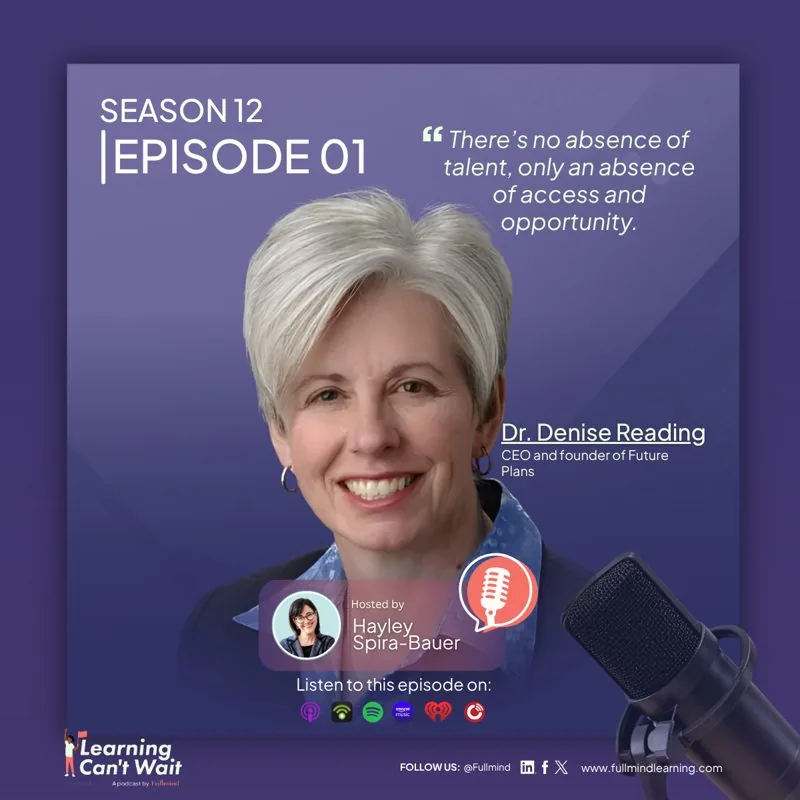
- Dr. Denise Reading, CEO and Founder of Future Plans
 Hosted by Hayley Spira-Bauer, Chief Academic Officer at Fullmind
Listen now
Dr. Denise Reading: Workforce Alignment, Rural Education Equity & Opportunity Access
Episode summary
Dr. Denise Reading, CEO and founder of the nonprofit Future Plans, draws on her childhood in rural Northwest Arkansas to explain why she is committed to eradicating poverty rather than managing it. She lays out a five-step process of assessing strengths, coaching, exploring, preparing, and placing, and argues communities must own the work with schools as trusted hubs. She shares results from Latham, Ohio, where a small school built a workforce center and students launched seven profitable businesses, and discusses generational bias in rural communities.
Key takeaways
- Start with each person's strengths, then match them to real opportunities, rather than steering people into open jobs
- Rural students face generational bias; assessment data gives families a fresh start
- Schools are the trusted hub in rural America and can host workforce and community centers
- In Latham, Ohio, students built seven profitable businesses and 22 took home their first paychecks
- Hire from the community: field staff should have lived experience where they serve
About this episode
In Season 12 Episode 1, Hayley Spira-Bauer kicks off the new season with Dr. Denise Reading, CEO and Founder of Future Plans, in a powerful conversation on eradicating poverty through education and workforce alignment. Drawing from her upbringing in rural Arkansas, Dr. Reading shares how systemic bias and lack of access—not lack of talent—hold individuals back. She discusses Future Plans’ five-step model for helping individuals discover their strengths, connect them to real opportunities, and ultimately break cycles of generational poverty. The episode emphasizes that when people understand their value and where it is needed, entire communities can transform.
Full transcript
Transcript generated from the recording; minor errors may remain.
Hayley Spira-Bauer: Welcome back, everybody, to the Learning Can't Wait podcast. It took us time in California, plus a happenstance meeting, to get today's guest on Learning Can't Wait. It is Dr. Denise Reading, the CEO and founder of Future Plans. Denise, I'm so happy you're here.
Denise Reading: Thank you. I can't… I can't wait for this conversation.
Hayley Spira-Bauer: I met you on the side of a hotel at ASU+GSV. We were introduced by your dear colleague, Krista, and from the moment I met you, I just knew this is what passion plus fire looks like in human form.
Denise Reading: Thank you. Sometimes people say, it looks like crazy, but anything that really, really changes the world often looks like crazy in the beginning.
Hayley Spira-Bauer: You know what? I think that's fair, and there are a lot of people benefiting from that passion and that fire, and I'm excited for you to dig into it today, so why don't you start out by telling everybody, how did you come to be the personal and professional version of yourself?
Denise Reading: So, I… I can't start talking about who I am without talking about where I come from. I come from Northwest Arkansas, and in Northwest Arkansas, when I was growing up, it was very rural. It's not the Northwest Arkansas people know today. We always would say, thank goodness for Mississippi, because on every scale, especially in education. Mississippi would be 50, and we'd be 49. And so it was a place that was under-resourced, maybe undervalued education, Generally, there were… there did not appear to be opportunity. And it's… living in Northwest Arkansas that has brought me to this commitment about being a voice and a resource to rural America, and to making sure our young people get every opportunity. I left Northwest Arkansas because there were no opportunities for young women who graduated from college of any… if any meaningful kind of Jobs that would relate to what we wanted to do. But, I should just say that I grew up as the daughter of a cattle rancher. I lived in the very rural part of northwest Arkansas, and when I was about 10, they decided that we were going to have a new busing route, and all the little country kids were going to go to a little suburban school. And so, I rode the school bus through what we call the hauler, and as we would go through the hauler, we would pick up, you know, the Davises, and the Davises lived in a school bus. And then we'd go a little further, and we would pick up the Fitz, and at the Fitz house, it might be the Fitz, and some cousins, and some other people in this little tiny house. We'd go along a little further, and we'd pick up the Greenleys, and one of the girls was in my grade, and she got to school, and every day we got to school, she was in my class, she'd show up in one outfit. Go to the office, put on a nice outfit, come back to class. And that nice outfit, she was the smartest girl in my class, but the principal knew that if she looked like she was a real poor girl, she might not get a chance. And it was in that experience of watching how my little peers were treated. In school, because they came from this rural area. That I… I realized that… that there is this other bias in our nation that somehow says that there's something wrong with people who are poor. There's something wrong with people who come from rural communities. And when, in fact, they just haven't had access or opportunity. And so, this has kind of been at the root of why I'm passionate about this work. I want to see everybody have the opportunity.
Hayley Spira-Bauer: I'm smiling because this is obviously so personal to you and your experience growing up. I know that you've talked before about ending poverty one person at a time. That's both an incredibly humble and incredibly ambitious goal. How do you hold both of these truths?
Denise Reading: So, you know, one of the things that I've spent my adult life doing is looking for ways to use education to help people advance, right? And at one point, we thought education, for education's sake was your way out of poverty. Then we thought education to prepare you for the workforce is your way out of poverty. What we learned were a couple of things that were not… not happening. People were not starting with the individuals. They were saying, education for workforce, and we'll tell you where you should go. I remember very, very distinctively that all the young poor women in an urban community I was working in, when they went to get assistance for education, they ended up being put in STNA or nursing aides jobs. And they didn't have any interest, they didn't have any ability. You'd walk by the classroom, 7 out of 10 of them had their head on the desk. Yet, that was the job we most needed for people who were undereducated, and so we just plugged them in, right? And so it became really clear to me that we had to start with the individual and recognize that every individual has innate abilities that are needed in the world of work. And we had to find a way to find them. And bring them forth so that they understood them. And then help them see who needs them. And if we could do those 3 things. That was… that was, like, 70% of the battle. The 30% is exposure, training and certification, placement. But 70% is, I have something to offer, I understand it, and I know who needs it. And that changes the game completely.
[05:00] **Hayley Spira-Bauer:** The know who needs it part is very different than the path that you often hear related to helping people find their greatness. Where did it come from, and how have you seen it make the difference? Like, folks who are just out there trying to help people realize their greatness is… that's still wonderful, but you're arguing that you can't Just help folks find their greatness, but you have to help them discover who needs it.
Denise Reading: You know, one of the things that we did early, and with our research, and you know, I've been on all sides of this. I was… I built the Global Corporate College, and we served 47, countries and 50 states of the Fortune 5000… the Fortune 500, rather, and help them do their incumbent worker training. So I got this real corporate feel, like, Denise, where's the workforce? Where's the workforce? How come people aren't coming with the skills I need? I was in higher education for a long time. We lose half the people who go into higher ed, and half of those who graduate don't go into anything they studied. Again, a misalignment between what do I want to do and what are the opportunities. And in my mind, if we could first start with the people. Find it, and then look at opportunity. We would realize that, probably, the way the data would fall out about people's strengths would be an exact match to the needs of the marketplace. And that is exactly what we found through Future Plans. When we've assessed over 36,000 people, given them individual coaching, at the very same time, we've been looking at their market, their local market, the national market, the virtual market, you know, and saying, here are the opportunities, here are the people. Now let's match, instead of driving one towards the other.
Hayley Spira-Bauer: Yeah, I understand the logic behind it. It seems like A plus B equals C, and yet it's not where you often hear workforce development solutions going, and so I think it is important to call out and double-click on, because I think it's an integral piece, as A lot of folks are turning more attention to workforce readiness and helping children find, or students find their path in life. Why do you think there is so much attention today on workforce readiness, CTE, and a lot of the, alternative pathways that you see being built across the United States right now?
Denise Reading: So I think it's kind of like 3 spaces, right? I think there's a national discourse that is saying what is the value of education? If education's supposed to help us have a better life, be better citizens, be able to make critical decisions and problem solving. You kind of look, and you look around the nation, and you might not give us a very high score, right? The cost. For the result. We still know that a college education is needed for a lot of jobs, but where is that value proposition? And I think as a nation, we've become more attuned to talking about things, not just as the intrinsic good, but what's the financial impact to us? I also think that as The kind of the political atmosphere has begun to shape state policy. The mandate to schools is, hey, you need to prepare the graduate for life. And so, in America, if you prepare the graduate for life, it also means work, generally. And so, how do you do that? And again, I want to go back to the other question. It's that maybe we learn how to prepare, but we still don't know how to get them connected to that last piece. So we see all of these new pieces. The state of Ohio has just passed a bill. That really reflects the five-step process that Future Plans has, piloted over the last five years, that every… we'll start this career pathway in middle school. We'll go through the five steps of assessing, of coaching, of exploring, of preparing, and being placed. And it's that piece right down here, being placed, that we believe people have a big gap, and they don't know what to do about that, right? So, I think part of it is the discourse, the political discourse. I think part of it is frustration on cost. I think Another part of it is, we need everybody who can work. We have a population shrinkage in this country, and we need every able-bodied person, and by that, what I mean, able to work mentally and physically. And… and so many people who have different abilities, different, neural wiring, etc, they can work. So I'm saying everybody who's able can work, and we need them all. We need people coming out of corrections, and we need the parents of the kids, and we need the kids. We need everybody. We can't leave nobody behind, or we don't fulfill our economy.
[10:00] **Hayley Spira-Bauer:** You know, you're… this… this phrase, leaving no one behind, is so important. This… this… I am very drawn to, a saying that I've heard out of another nonprofit called All Means All. When we say we're talking about helping kids, we mean every kid, and I think leaving the one behind is really along the same vein. But our systems do… often do exactly that. Where do you see the biggest gaps right now, and how communities support their residents?
Denise Reading: You know, it's interesting that, this is true everywhere, but in rural communities where you have generations of the same families living there, that all means all. Leave no one behind. Recognize everybody has individual greatness. Has this, unique barrier of everybody knows your business and has known your family's business and your family's family's business. And so, bias is very heavy. Oh, you're such and such family. No one in your family's ever graduated from high school. You're such and such family. Your people are all… never received a check except from the government. You're such and such family. And so, young people in rural areas, they face a different kind of discrimination. One that is generationally put upon them, by the behavior of the adults in their lives. And they carry… they carry that burden sometimes. And so we have to do even more work to say, hey, let's give everybody a fresh start. And by using assessment, by using science and data to talk about gifts, people are often quite surprised. I mean. I, you know, I had a high school principal saying, yeah, this kid, there's nothing we can do with him, we're probably gonna, you know, move him out next week. Took his assessment, took his coaching. Showed up to class every day, got into his math, quit being a behavioral problem because he had a goal of where he was going. And, I mean, like, it happened literally the next day. This young man showed up as a different kid in school. They were gonna kick him out that week, and he changed because he had a plan. And that principal said to me, you reminded me, we can never give up on anybody. If they're not connected.It's probably not them. It's probably us.
Hayley Spira-Bauer: Hmm. You know, you've already spoken a lot about future plans and your five-step process, but paint us a really clear picture now, because I've… I'm a curious person, I want to hear all your thinking and your philosophies and how you think we got here. Now, obviously, you've built something, you have an incredible team. Talk to all of us about what is Future Plans, and how are you achieving the ambitious goals that you have right now.
Denise Reading: So, Future Plans is a nonprofit that is committed to eradicating poverty, and I want to be really clear, eradicating poverty, not managing it.We believe that you can end poverty, and you should end poverty. We as a nation should end poverty. And we have great evidence for that. I'll share a story later. But we believe that in order to do this, everything needs to happen in a grassroots community. That the people in the community who are living in poverty, who are living in these rural spaces, they know better than anybody what the barriers are. They have ideas about how to overcome those barriers. They simply have not had a voice or someone who can support them in that effort. Now, with that, we believe that every person should go through this 5-step process. So, in middle school to high school, that could take 4 or 5 years. But for an adult, it could happen in 4 weeks or 4 months. First, let's find your greatness. Where is your greatness? And we do that with assessment, and we look at it from 360. So, we look at your personality, we look at your interests, we look at your aptitudes, we look at your values. But even once you have all of that, and you find out you're awesome with all things numbers, but you say, I only want to go to high… I only want to go to high school, I don't want to do anything else. Well, what are the jobs that you could do? And in a coaching conversation, you could learn that, well, if I'm just going to graduate from high school with my gift of numbers, I could be a cashier, doesn't pay great. Bank teller, probably gonna be AI'd out. Bookkeeper. Well, that may be out in the future, but it's the first step to accounting, and in… Cleveland, and in Appalachia, it paid between $28 and $36 an hour. That's a good job for a high school kid, right? But if you say bookkeeper to a young boy who's never liked reading, he'll tell you, you didn't listen to me.
[15:00] **Hayley Spira-Bauer:** I hate to.
Denise Reading: I don't want to work in a library. So, the next part, coaching, is where we really help people think about how they take their greatness and understand who needs it? What are the possibilities, and what do those possibilities mean? Then we do discovery. So now I know They're bookkeepers, and I go out and I discover what that job looks like, and I go to all kinds of activities. I might, because I can't go, because I'm too far away, I might do it through simulation, I might do it through some new AI education in the school, I might do it through all kinds of edtech. Then, I prepare. One of the biggest barriers for preparation in poor areas is we don't have the classes, the teachers, the tools to prepare. So now, we say, what are alternatives to prepare? So, can we come up with shared teaching across five rural schools? Can we come up with new tools to get those certifications, those courses that are needed? And then can we get placed? And placement can mean a lot of things. Placement means I'm on my way to post-secondary, that's what I need to reach my dream. I'm on my way to the second short-term certificate, because that'll give me the best launch pad. I'm on my way to the job market. And, and so those 5 things, whether youth or adults, and what's been really cool about our work is that I think our work with youth I don't think… our youth work has inspired families, and so there are areas that we're working in where we've had four generations of poverty, serious opioid epidemic, all the things that go with it, corrections, trafficking, homelessness, all that. And in a very short time, in less than, kind of, 16 months, we saw… The kid who was on a pathway's mother. And then we saw the grandma, and then we saw Uncle Joe, and now we have a whole community where people are working for the first time, and we have broken the cycle of generational poverty by first inspiring youth. To find their greatness. And then their families have followed.
Hayley Spira-Bauer: That is so beautiful and so incredibly impactful to think about overcoming the cycle of poverty and the Generational component to this. Seems like my internet is slow right now. Can you still hear me, Denise?
Denise Reading: I can.
Hayley Spira-Bauer: Did you hear me the whole time, or did it break up?
Denise Reading: Nope, I heard you.
Hayley Spira-Bauer: Right, I'm just gonna take a quick show note for editing. I'm gonna say it again, too. And I'm gonna keep my camera off for a second and give my computer a minute so I can chill out, but what I said was. That is so beautiful for you to talk about overcoming the cycle of poverty and working from all angles to ensure that not just one… not just the child, right, the youngest member of the family. Is… reaching greatness, but also every member of the family. You've alluded to this and referenced this, but you and I both have something in common, which is a deep passion for rural America. Talk a little bit about why you… have dedicated so much of this work in rural America, beyond just your connection as someone who grew up in rural America, but how this impacts… these issues impact rural America even more greatly than some of their neighboring areas.
Denise Reading: So, I spent, decades working in urban America, did many programs, for urban youth. But in about 2016, I began to look at what was going on in the country, and I come from a rural area, and I'm thinking, you know, I think it's easy to not notice rural America, because we don't drive past it in our everyday lives, if you know what I mean. And the fact that it is rural means that it's spread out in ways that we don't always see the poverty in the same way we see it in our urban communities right in our face. So I began to look at that and started to see, well, what's going on? And there are some groups that are doing some good work out there, but not very many. You know, when I went to Appalachia, there were not a lot of national programs. When I went to programs like ASU+GSV, and all the new tech, there wasn't a single workshop for 3 years. That had the word rural, used a rural example or a rural application. Even as recently as this last conference, there was one program on edtech that was rural, and it was in a distant building, like, okay, far away from everything else was hard to find. I think we have an inherent bias in the country about what it means to be living in rural America, and a lack of understanding about it, and I think… As a nation. We need to be everybody, everybody living their best lives, everybody striving forward in the best direction that they can, and I believe that there has to be inclusivity. One of the things that's interesting is that I did a project with urban and rural schools. And one of the urban leaders said to me, you know, Denise, the difference between me and my rural colleagues who are trying to end poverty and help our kids is that I can tap into 100 assets in my urban community to teach tech. To help with tech, to do tech field trips. And my person in the real communities said. We don't even have a tech company in our county. You know, it took that… it took the school district realizing they were the tech company. The service center was the tech company, and that's how we got tech internships.
[20:00] **Hayley Spira-Bauer:** Wow.
Denise Reading: Really wasn't a tech company. And so, the… for me, it was, where is the greatest gap And whereas there not a lot of noise. With competition of different, you know, what's the best tool, what's the best of this, what's the… We wanted to go in and listen to the people, and let the people tell us what they needed, then find what was right for them. Instead of inundating them with all these tools and things that they should have, because they are there in that big marketplace, you know? It's not… it's not the first marketplace. It's why we have a rural health disparity. It's not profitable to do rural.
Hayley Spira-Bauer: Yeah. You hit the nail on the head. America is not talking enough about rural America, which comprises, geographically, the largest portion of our country. I… have become… super obsessed with learning everything I can about the collective experience, but then also context, relational experiences in various communities, because no two communities are alike. You can't look at New York City and Los Angeles and say that the experience of living in those cities is the same. It's not, for a host of reasons. And for similar reasons, you cannot say that living in Southwest Texas is the same as living in Appalachia. So, as a result, you have to deeply know the experience of the individual community, and I think you're speaking to that here, when you talk to listening, more than just telling folks what they need to do, or how they need to do it. It is… deeply concerning to me, as well, that when you go to these big national conferences, there are very few sessions on rural schools, rural America. There are also very few sessions, in many cases, on special education, which is a compounding issue in rural America. With limited access to the resources that large urban districts have, you also have limited access to exceptional special education teachers. Servicing our children for this from educational justice. So, it is… Truly worthy of all of our time and attention, and dedicated time and attention at that, not just an afterthought.
Denise Reading: You know, it's interesting. We made two commitments when we started Future Plans. One, we would be informed by the people we serve. And number two, everyone we hire to work for us in the field will come from the field. So they will have lived experience. They will know the people. They're their neighbors, their cousins, their relatives, their friends, they've, you know, whatever. And what we've learned by that is, you know, just the thing you said about special education, one of my people in the field said to me a few weeks ago, you know, if I could be doing anything, I'd be helping us think more about special education as a part of what we do. We've had some good success by by accident, but not by plan. And she's, like, in the field going, here's the by plan. And the Department of Disability Services in Ohio said, we really want to be a part of this. We have resources. We'd like to jump on the wagon here with you all. And so, again, by listening, being in the field. And having people who work for us who are in… this is their community. This is their community, and they're saying, here's what we have to have that makes, you know, Adams County and Ashtabula County, which are, you know, at opposite ends of the state, in Appalachia, in Ohio, different from one another. Here's what makes us the same. Here's what we can learn from one another, and here's how we can apply what we've learned from one another a little differently. And if we give that to the people, the people will… they'll shape it, they'll move it, they'll… they'll make it their own, and that's what's critical. And I can't stress enough this… Whole idea of how we have tried to manage the other. Manage the other to be like. Who? I don't know. So, you know, I don't want rural America to not be rural America.But I want rural America to have the options of all America. And the only way that happens is when they own it.They own the future. And using the schools as a hub, using the schools as a central place that people trust in rural America, a lot of times the least trusted place in other areas of the country are the schools. But in rural America, there's still this trusted, convening, you'll see everybody in town on Friday night, you know, it'll be football. I mean, this is where we gather. And the schools can play such a huge role, but again, they haven't… they haven't been given the chance to to sometimes know how they could do that. What could they add? How can they change the learning blocks? And so we've really seen just so much innovation in the schools, in the rural schools, by just kind of saying, you know, it doesn't have to look like this. What would you do if you could? And then we'll give you the tools, or the help, or the support to get there.
[25:00] **Hayley Spira-Bauer:** I love that. I, I was just on Dr. Melissa Sadorf's The Rural Scoop podcast, and I talked a couple of stories that have been really powerful for me, but one of them was Fullmind was serving the Lower Kuskokwim in Alaska. And we were doing high-dosage tutoring, and we had incredible results 3 years over running. But I learned something, because I'm not from rural America. I didn't teach in rural America, I didn't go to college in rural America. I've only spent my time in urban and suburban settings. But Fullmind has really opened up my ability to learn about rural America, through our work, and in the Lower Kuskokwim, the schools are the community hubs. And when the… when there's a death in the community, the school closes down, as that's where funeral and ceremonies are held to honor those who have passed. And it really opened my eyes to… well, what could life look like if we all were a little bit closer to one another? And that, to me, is… what I feel is most disconnected from large cities and even suburbia is, you know, we're neighbors, and we're here if you need a cup of sugar, but in rural America, you are very interdependent, to really help the community thrive. And there's beauty in that, and there is resourcefulness in that, and there is… Absolute… brilliance in the creativity that gets born of need, and so I really appreciate the way you speak about the work that you do in rural America, and you are not providing limits in that conversation, but rather recognizing that the talent and the know-how and the ability to implement good ideas is all within the community, right? Because that is often what gets overlooked.
Denise Reading: You know, the example, my… one of my favorite examples is this little place Latham, Ohio, and the superintendent there, just been a great champion, and the teachers, and… and this is a place in rural America where there's no cell phone or in and out, 30 miles in or out, so you drive in east and out west, right? There's no stoplights, whatever. There's a gas station that has some food in it, there's an auto parts store, there's a big lumber industry, but that's a limited extraction industry, which is a great industry. But it's, like, limited jobs, right?
Hayley Spira-Bauer: Hmm.
Denise Reading: The kids there, and their families, this is a place that… four generations that I was telling you about. So the principal, as a part of being a part of this process, kept saying, well, I gotta quit making excuses. I gotta quit making excuses that there's nowhere for my kids to work, that it's 45 minutes to the closest CTC, you know, the ones who can are going on to college, 10-15%. And he said, I gotta… I gotta change what we're doing here. And one of the things he said to me is, like, I think if I just had this building on the campus. That I could get the adults to come here, right? And so he asked us this, and we always call this workforce center a fancy pole barn. And if you're from rural America out there, you know what I'm talking about. It's a metal building, it's beautiful, but it is $250,000, okay? This is not expensive. And then he sent out a message. If you ever went to school here. If you have kids here, if you have relatives here, if you drive by here, and you want a better life, if you want to do something with your life, come on up and meet us at our new Workforce and Community Center. And that started happening the day after we cut the ribbon. And the first person to come back, finish her GED, and get a job as a medical assistant was a 62-year-old woman who'd gone to school, dropped out, had cared for her neighbors, her family, but didn't know it was a job. Because her grandchild was in that school. She came first. Then. He said, we still have this… we don't have a problem, Denise, people are coming. They're coming, they're coming, they're coming. We still don't have jobs. And so we had a big meeting in the gym, invited companies from all over, and said, this is what we're going to be producing, if you're interested. And people were like, yeah, that's great, but nothing really happened. So then the kids, and the teacher, and the superintendent said, well, if we don't have any businesses, maybe we should form some. So they built 7 businesses. In an academic school year, all of which are profitable, I got a note the first day that 22 students took home a paycheck that didn't come from the government. First people in their family. They have tech company, they have food company, I mean, you name it. They have a health and fitness company. This is a town that had nothing. Now you can go to the campus and get some services, right? And what the kids are learning, they're using their assessment data saying, hey, we're like our own town now, so they call their campus West LA, which I think is hilarious that they named themselves after a big city. West LA, and at West LA, I want to be in finance, so I manage all the books I have QuickBooks, and I'm certified, and I'm helping to manage the books for all these little businesses. I want to be a politician, so I'm the mayor of West LA, and I'm using leadership skills, and I'm getting credentialed, and I'm in hospitality. I'm, you know, I'm in tech, but there's no tech out here, so what could I do? Well, I can self-teach, and I can build websites for other people. I can begin to do some basic AI coaching. Do you get this thing?
[32:00] **Hayley Spira-Bauer:** I mean, incredible.
Denise Reading: So, I mean, this isn't decades. Of making this happen. This is in, like, 24 or 36 months. From we started assessing people and found out they had greatness, to people in the community going, wait a minute, we have greatness. We should do something with it. You know, nobody's gonna understand us. We're kind of out here in the middle of no place. We're gonna have to do it ourselves. Hey, do you all have some tools or things that you could help us with how to set this up? Never mind, we got it. Every time I go there now, they're doing something new, and my most favorite thing is those businesses from 90 miles around are now coming to that little rural area to interview kids.
Hayley Spira-Bauer: That is incredible.
Denise Reading: Tell me that's not, like… Can you believe that? So when I say…
Hayley Spira-Bauer: Can believe it.
Denise Reading: Eradicating poverty? You have to…
Hayley Spira-Bauer: You have to dream big.
Denise Reading: So we is the people. They just need support. They just need information. They just need exposure and access, and that's what Future Plans is doing. We're in the conversation. And we're… we're sometimes out there looking for this, I don't know, math thing that everybody needs, you know? And bringing it back and saying, how about this, everybody?
Hayley Spira-Bauer: Denise, you've given us so much to think about, and so much information about how future plans and how you have dedicated your work to eradicating poverty. As a final question, if you are talking to a young person in one of your communities who's listening right now, and they don't believe zip code is their destiny, what advice would you give them?
Denise Reading: I would say… I grew up in a community that was one of the poorest places in the United States. And it would be really easy to think that there was no hope, or no opportunity, or that if there was going to be opportunity, I have to go. That same community today is the third wealthiest place in the United States of America. It's the home of Walmart, Tyson Food, and J.B. Hunt, all number one in their fields. You know how it became number one? Some good old boys had some side hustles that they turned into businesses that became a big thing that picked up the economy for everybody in that region. We don't know which one of you is that good old girl or that good old boy, but someone here is. What we know is there's no absence of talent. It might be you. And so, if you think about where I came from. Why not here? Why not you? There's nothing. There's nothing stopping us but our own belief in ourselves. That's it. Anything else, together as a community, we can overcome and figure out how to get there.
[35:00] **Hayley Spira-Bauer:** Denise, thank you so much for bringing your heart, your passion. To this podcast, I am so grateful for our run-in in California, and also just for being able to follow your journey.
Denise Reading: I am so glad we met. I'm so glad that you're giving voice to rural America in this way, and doing the work to help schools, and those who support schools, and, you know, it takes this whole grassroots group But we need people like you who'll lift up the voice, tell the story. There's a lot to be offered out there. Let's let no one go undiscovered.
Hayley Spira-Bauer: I'm not even gonna say anything further, because there's no better way to end this podcast. Thank you for joining us, and thank you to everybody for tuning in today.
Denise Reading: Thank you.