
Learning Can’t Wait · Episode 68
Jean-Claude Brizard: Digital Promise, Innovation in Education, AI in Education, Learning Science
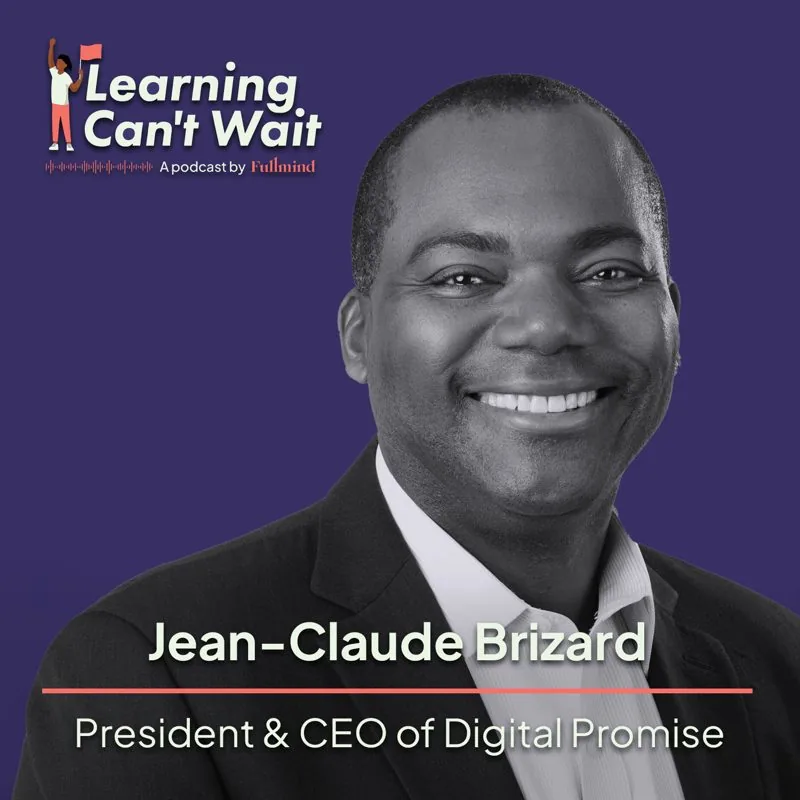
- Jean-Claude Brizard, President & CEO of Digital Promise
 Hosted by Hayley Spira-Bauer, Chief Academic Officer at Fullmind
Rebroadcast .
Listen now
Jean-Claude Brizard: Digital Promise, Innovation in Education, AI in Education, Learning Science
Episode summary
Jean-Claude Brizard, President and CEO of Digital Promise, traces his path from teaching at Rikers Island to leading a national innovation nonprofit working with roughly 300 districts and 27 countries. He explains how learning science research should translate into curriculum and teaching practice, why regional variation in education is both a challenge and an asset, and how the new Future Lab pushes beyond current practice. Topics include AI-supported, strength-based IEPs, computational thinking, and learning and employment records that give students ownership of their credentials.
Key takeaways
- Digital Promise pairs learning scientists with practitioners so research becomes classroom practice
- Regional variation in schools is an asset for learning what works, but complicates uniform implementation
- AI can make IEPs strength-based and specific, with benefits that extend to every student
- Computational thinking, not coding, is the future-ready skill students need
- Learning and employment records could give students agency over credentials beyond the transcript
About this episode
Welcome back to the Learning Can’t Wait podcast! Today, host Hayley Spira-Bauer sits down with Jean-Claude Brizard, President & CEO of Digital Promise to explore innovation in education. Listen as Jean-Claude explains how “controlled meandering” has influenced his path in education, along with his ongoing drive to fight injustice.
Hayley and Jean-Claude explore the benefits of variability when it comes to learning approaches, and Jean-Claude illuminates how digital promise is working to build systems that can help leapfrog some of the challenges we have in front of us.
Produced by Fullmind
Full transcript
Transcript generated from the recording; minor errors may remain.
Hayley Spira-Bauer: Ayley Spira-Bauer: Welcome back everybody to the Learning Can't Wait. Podcast I know that the guests who listen to this podcast do not need a full introduction for the amidable. Yes, I have on here today, but I am going to give you one, nonetheless, because I'm incredibly honored. They've chosen to spend their time with us. I have Jean-Claude Brizard, the CEO and President of Digital Promise, global welcome to the podcast
Jean-Claude Brizard: Hayley. It's great to be here. Thank you so much for having me.
Hayley Spira-Bauer: It's an absolute honor, as I said a moment ago, to be able to interview someone with your experience in the field of education, the work you're doing today. I am particularly excited about all things innovation. And so I think we're gonna have a good time chatting.
Jean-Claude Brizard: Awesome looking forward to it.
Hayley Spira-Bauer: I'm gonna start us off with my typical first question, which is, how did you come to be the personal and professional version of yourself?
Jean-Claude Brizard: You know it's a it's a great question. And I'm getting to a place in my career where it's hard to separate the 2. What's professional. What's personal? Because it's part of same the same passion. I guess I would say the foundation goes back to my parents. Who are both educators. Also and with my grandfather, who was a a classical musician conductor, I'm sorry. And all of them use their bully puppet to fight against injustice in the country I was born in Haiti and and that foundation around, making sure there is a voice making sure there is. Advocacy has always been there which has allowed me to what I call controlled meandering So I didn't fully. I didn't choose to become a teacher. You don't do what your parents do. You try to do something different? But since I did that again because of a push for my mom, I've always looked for opportunities. And when someone's bring something to me, I take it II drive my assistant crazy because I take all kinds of meetings, but that those kinds of experiences, connections. Professional experiences have allowed me to understand and shape that kind of honeycomb that I think I am today. And again, it's being open to all of those kinds of experiences we need to help me. And I say, 1 one last thing on that is the the the mentoring the support of of others. From days of being a teacher, and the assistant principal was my Ap. Was still very good friend today. All these people also helped me understand how to navigate and meander and all these folks think that give a ton of credit to for who I am today.
Hayley Spira-Bauer: I love that term controlled meandering, you know. It's so well describes people that have a thread, but take different paths to follow that thread. So you've had time in your career as both a teacher, a school leader, a system leader, and you obviously just identified something that your parents really instilled in you and your family instilled in you, which is fighting injustice. How has that thread guided you to the role that you're currently in?
Jean-Claude Brizard: Positions and jobs I've taken and where I've taken them. For example, my first teaching job in New York, I sort of landed there by accident. Lous well, great experience, formative experience, lousy experience. At the same time. My first job was Rikers Island teaching at Rikers in New York City. But in every place I've been to, from the High School I moved to from the middle school to the High School, where I became principal, etc. All have been the kind of schools that serve. Mostly kids were poor, mostly kids who are at risk, mostly kids of kids of color. So has I've driven me to these places. In fact, my last position before Digital Promise. I was at the Bill & Melinda Gates Foundation. First of all, the foundation has that kind of orientation. It fit me really nicely. It it lives by a model of impatient optimism which is described me to a T, and at the same time the portfolio I held in the President's office looked at education. From PD workforce. Pdo. Post secondary completion was initially the the push and looking for places in this country where folks are doing that kind of work really well and for us to sort of fund and support again, looking at kids who are typically excluded from full participation where they were going. So every place I've been has has been that and our strategy now Digital Promises again, looking at kids who are been historically, systematically excluded. And we feel that if we over index on that if we can. If we designed for that, every child will benefit
Hayley Spira-Bauer: What I really find intriguing about the lens you're using at Digital Promise is this focus on transformation and breakthrough almost like disruptive technologies. And how we make sure that people have access to them. Can you talk about just generally first, what does innovation mean to you as a leader in this organization? And how does that vision of innovation really translate for the work you do day to day.
Jean-Claude Brizard: You know, it's it's a it's a fantastic question, because Digital Promise of its core. Again, we came out of the Us. Government, who created by an act of Congress was designed for innovation. So when you talk about innovation and Digital Promise, it's a bit like, what are you talking about? This is what we do. It goes. It goes, it goes hand in hand. So we have a large big of learning scientists. What X person how kids learn? So they do a ton of work around understanding neuroscience. Understanding. For example, the mental model of mathematics that kids bring to schools. So that's one big part of organization. The other big part, of course, is how we can leverage technology as a means to getting to those kinds of places, but because of who we are. We also have a large break of practitioners. Because we don't just think and publish, we think we publish and we do. We demonstrate what this looks like in in practice? But at the same time I've always been a believer. Let's go back to to one of my mentors who said to me many years ago, always try to remain as an outsider in your own organization. And what that means to me here Digital Promises, even though every team I have have a an innovation bent. But we, they tend to live within the zone of proximal development of the sector of people, etc. What I think about is, what is the next layer of innovation that we need to get to? If I didn't give you a concrete example. This is what I mean what that means. I was at the place called the Ilab at the University of Washington a few years ago, and I was working out with a co-founder, and she showed me a brain scan and said, Do you know what that is? And I said, No idea. And she says that's a child who is ready to learn to read. As you can tell that from the neuroscience, from the nuance, from that kind of brain scale, and she says absolutely and while she was geeking out over the the, the the psychology of it all, or the biology of it all. I kept thinking about, what does that mean to how we design curriculum? What does it mean? How we design pedagogical practice? What does it mean for the teacher, for the principal, for the superintendent in the school. So that's the layout to live in. And for me. That's the kind of next generation. Innovation I think about as well, which is. How do you think about those kinds of things that can help you now understand the science of reading, for example, but takes you one layer, be be beyond that and pull. So I mean, I borrow a lot from Rebecca Winthrop up at the Brookings Institution. Who talks about this idea of leapfrogging inequality? So for me, that is a key that if we can really leverage really well, and then translate that to real stuff that happens in schools. There's a magic there that around the kind of leaf frogging around innovation which I think about all of the time
Hayley Spira-Bauer: That is so interesting, and I love the way that you, in your own answer here, have just provided both the philosophical and the practical, which is what you said that your organization is all about. You're living and breathing it even in your reply. That's incredible. I you know I hear a story like that. And I, too, think about the incredible implications across the system. You know. But I have this question about W. One thing I talk a lot about with guests is how different things are from state to state right? We don't have a unified education system where everything comes from the top down. It's regionalized. Is that a challenge for your work, or is that actually like something is an advantage where you can bring together ideas and help people grow off one other. How do you? How does Digital Promise kind of confront the regionalization of education?
Jean-Claude Brizard: There's so many, so many approaches to your question, I think, is both a massive challenge and an asset.Let let me qualify that we. We work in nearly 300 school districts in the Us. And 27 countries around the world, I can tell you. Sitting with the Ministry of Education from X country, you can talk about a an approach to practice. And you know that can cascade from the mothership down to all the component parts. Right? It will easier for coherence. But to give you an example, when I sat with David Banks, the Chancellor of New York City schools, when he was about to enter, a few of us said to him, the biggest asset you have in New York City is variability. You can find the best school and the worst school in the country. Right here in your city you can find all kinds of practices. Right here in the city the question is one of knowledge, management, one of knowledge, qualification of understanding, the difference in the variability in the variations, how to like harness, that to inform other people's work. So when I was issued, kind of another example, as a CEO, we were very reluctant to mandate a uniform curriculum, although we know to best practice, actually could be a good thing for a city that had a a massive set of variations and expectations, etc. But the same time we we look for a different way of doing that. Which is, how do we create really high quality stuff leveraging, for example, nationally board certified teachers and master teachers in creating. And then folks see it as an amazing example, and they borrow from it. So to to specific? To your question. I was in Lexington, Kentucky, yesterday without global cities network. So we had Shanghai, Melbourne. We had, Bermuda, Us. Virgin Islands right Dallas Denver, all in the same room. And we're talking about practice. So what do we discovered? Well, not discovered. But we we all know is that we are more alike than different. The challenges we face are very similar. And what's amazing about that kind of entourage kind of familiar is that you see the variations in approaches, and that in itself informs the innovation that needs to happen. So get my point is that when you look at the legal innovative schools, and when they come together from Gosh, 40, 45 states in the Us. The challenges are not different. But what you see are amazing implementation efforts which vary a little bit, but informs the process and people the geek out on that kind of work the challenge that we have next think we should take that kind of network conversation and make it public. To the world, which is our next layer of work. But again, the variation is an asset in the sense that you see different minds and different approaches to the work. But at the same time, too, it's challenging for implementation. Especially if you're looking for uniform implementation.
Hayley Spira-Bauer: Sure, I think I think that's I mean, so real right. You have both this benefit and this drawback to the regionalization of learning no different than, I guess, as you would say, the leaders coming from various countries together, who may be using the same research to inform what they advise their their school districts to do. And yet they all do it differently because they're in different countries with different programs. And such one piece of work that I know you're really excited about as it relates to innovation and cutting edge thinking is the recent introduction of the future lab. Can you tell a little bit about what this means, what you're hoping for, and what the expectations are for the impact of the future lab in the future.
Jean-Claude Brizard: Absolutely. First of all, we we we launch this in partnership. With a number of organizations. One is very new. Call learn learner studio. And they're thinking about this idea of horizon free innovation. Basically, we're living in horizon 2, that's 1, 1 one organization. We also partner with the jobs for the future. JFF, the base in Massachusetts. They have. They have a they have a lab, the JFF lab. We're partnering with them as well, too. In that case is really live workforce innovation, education to employment, innovations, etc. We also partner with the Teach For America reinvention lab, we're thinking very deliberately about next again, not about talent, development necessarily, but next generation learning. So that kind of collaboration is an important one to highlight. But it goes back to our strategy. So every team that we have within Digital Promise, you know, are innovative. They live again within that zone of proximal development. But then, having a small group of people or leader who is agitating and pulling, not just internally, but externally, to look at the next layer of things we need to to think about is important. That team is allowed to go beyond the zone of practical development. And you say, what is the next thing that perhaps could be in leapfrog right? To paraphrase Rebecca Winthrop to a leapfrog to the kinds of challenges that we actually have. It could be existing within. Digital promise. If you look at the leads, profile again goes back to who we are. She is a learning engineer. Which is that learning scientist expert. But you know, also does and bills right? So the idea of not just leveraging the brain trust of amazing researchers and practitioners. But also and again, including our internal staff, we talk about what is that next thing? So? But it still goes along the lines of what we do? It's around how kids learn. How do we get better at that? Right? To really understand what that means to really understand the idea of learner variability to really understand the ideas around employment innovation. So one of the things that we've been working on, for example, really leans on the ideas of ethnographic studies. So I talked about, how do you control meandering? How do you understand the professional journey of people and build systems around that? So it's not just around academic learning. It's around the journey all the way to economic mobility. But so this team is given the freedom to to take expensively about the charges that we have in education. Again, education all the way to education, employment. And how do we can build systems that can help us lead for out some of the charges that we have in front of us.
Hayley Spira-Bauer: That is so exciting. I actually had a reinvention. Lab, team, member on the podcast and I remember it was Mike Yates and Mike and I talked about this idea of like agitation, what you're naming and really thinking well beyond the scope of what exists right now, and I think that can be so hard for people. And yet I would also argue that the past year of changes in machine learning and AI and all these other. I would say there's sciences. But maybe there's sciences that people just generally weren't considering part of the future of teaching and learning that now are, opens up a door completely huge door for for innovation, and as you keep naming, leapfrogging that no one could really put their head around before.
Jean-Claude Brizard: Yeah. So I mean, so, what's interesting about AI, or even the kinds of the kind of defense technology is that it's not new and it's not new in education. Mean. The first thing showed up was Carnegie learning back in 1975. So it has been around for a long time. Yes, it's grown hockey stick in the last couple of years and open. AI did a really good job of getting everyone to be obsessed with AI, both the Dystopian view and innovation view. II am. I am quite bullish about what technology can do for education. I discovered that as a first year physics teacher in New York City, in Brooklyn, New York, where I was in a vocational high school and leveraging technology. These are not the kids who should be taking the New York City regions and doing well. I had no 100% pass every year. Excuse me. So like leaning in and leveraging technology, so I can give you tons of examples. I did a a panel yesterday 2 days ago. I'm sorry in Lexington, Kentucky. But when the teacher of the year and an expert, may I? In Singapore? And when I was in the room talking about leveraging, I policy practice and workforce innovation one of the things we talked about was looking at the individual education plan. The IEP for kids with special needs right now, the system doesn't support. I meaning even the technology system, is not supported. Very well. The IEP is a deficit. The focus bureaucratic document doesn't do anything for for people. But there are ways of taking that document and making more strength based more learning, science focus. And if you add an AI chide bot for a teacher or a student, you can get very specific to the needs of a child. But so in this case, with looking at Adhd, we're looking at autism. You you knew name, did do a diverse diversity in the question of How do we recreate the experiences for young people and for teachers frankly, in getting very specific to the needs of those children looking at leveraging the the technology, the science that we know on on science. Learning that we are actively working on yet another way of be frogging and pushing specifically for kids who are webacon divergent issues. But once you do that. Any you now create a structure that can benefit every single student. In any school we talk about differentiation. We talk about getting personal personalized. And we know from people like Todd Rose. There is no such thing as the average student. Yet in every in education everything is designed around the average student. So leveraging that kind of technology and work. You can get very specific to the individual need of a child, although in design for special needs kids but can serve every single student.
[18:00] **Hayley Spira-Bauer:** I often say, rising tides lift all ships. So if we're benefiting our most vulnerable population, there's benefit for all I have to go back to your comment that AI isn't new, and II like, am distinctly remembering one of the first iterations of Microsoft office and the the little character clippy that used to pop up, and would use what you had written in the document to advise other things that you should look at, and II tell my colleagues all the time like Clippy was a but that's that's essentially what could be was. And so III feel you. It's definitely not new but I love the idea of leveraging it. And I you know IEPs I have to tell you it's something that I hadn't given a lot of thought about the structure of candidly, I was an educator. For a very long time I was a school leader. I myself have disabilities. And when I saw the way a nature scientist writer described dyslexia through an assets-based approach versus a deficit approach. My head exploded, it completely redesigned how I viewed not just dyslexia, but so many other aspects, and and myself even receiving an an Adhd diagnosis not even a year ago. When I learned about what the you know developmentally, environmentally, proactive pro-social behaviors of that condition were for me, and how it's manifested in my own life. I thought back to all the learnings I had had previously, of which there was just such a as you sign a deficit based approach. I think it could be profound. I know it could be will be profound. That that type of work
[20:00] **Jean-Claude Brizard:** Absolutely. But again, it comes back to making sure that our educators understand the role of technology and how to leverage it to support. I mean, people like us have to be the design phase and supporting the kind of innovation. But at the same time. It's an edtech tool and making sure that we still understand the importance of the instructional framework, the high quality pedagogy, all that still matters ethically all kinds of implications for preservatives, for teachers in service, professional learning and professional development for teachers. All of it think we matter a ton.
Hayley Spira-Bauer: You have, like a 30,000 foot view of this space of the school-based positions, brick and mortar, you have the view of the nonprofit supporting this work of the edtech companies that are creating tools to aid leaders and teachers and students. How is the ecosystem evolving right now at, you know, both in relation to the past 4 years, which, you know, we we all know we had a traumatic and challenging 4 years of in teaching and learning, and as we face the future of really embracing new technologies, even though they existed before, but really embracing them like, where? Where do you see the ecosystem evolving over the next 5 to 10 years.
Jean-Claude Brizard: It's a great question. So part of my so first way to concern is, I think, a a biggest challenge is one of coherence. You got lots of pieces doing things. Making sure it. It comes together. In a way that serves our our children, I think, is really important. So lots of activities, lots of folks from funders to government talking about next generation innovation. One of the things I'm most excited about passes at the Federal level is the need act and eev act which is gonna focus on. If you if you know DARPA, and how dopa help with the military. The the GPS is one of the most famous outgrowth of of DARPA. You said the same amount of money is not being spent on educational research. So you think about that, maybe next 5 to 10 years, and that would have passed the kinds of tools and solutions and different frameworks for education, I think, is gonna be really exciting. And the Institute Institute for Education Sciences, part of the Us. Department of Education are thinking to that very, very, very deeply. So one, I think the science. The research and development piece is going against steam, because so far, it's bipartisan that if conquest can get functional, we're gonna get this thing through the other. Frankly. Again, both worry and and opportunity with the advances of technology. And AI, you're gonna see, I think next generation data analytics. It predicts about analytics. So really helps us to try to understand both the qualitative and the quantitative right to paint a picture of a child. So the interventions can be targeted appropriately. Again, if we're not careful, it can only benefit maybe only some kids and not every kid. Another thing that I'm excited about that we are working on, too, is beyond the future of work orientation, like computational thinking. So what that says very simply, is that moving away from teaching kids coding right? How to code to instead understand algorithmic thinking? So then, AI is already coding. Right? So I understand how to debug when something goes wrong is not working properly. Can you manage the machine? Can you be in control the machine? By the way, pilots. I'm a commercial pilot. So pilots already doing that right, they're managing the technology. And if you take up, if if you fly planes all tech AI all around you. But they're in, they're in control. They're in charge. So computational thinking skills are the kinds of future skills. Kids. Well, present skills, kids need to do really well. So I see all kinds of employment innovation coming. One more, I mean, there's so many more. But I'll give you one more. I'm really excited about. It's a a a heavy movement that was launched by the Us. Chamber Foundation. That dot commerce. Everyone's on board, and we're a big part of it on the learning and employment record. So a redesign of the record right now, the transcript, the student record is a one, maybe 2 dimensional construct doesn't tell you anything about a person does not honor all learning. But you have an early on the learning and pulling record, which is digital nature where you can put any credential would be micro a badge or diploma. Right? You can paint the picture. Can you can meander right and pull your learning and then cobble what you want for a position you see moving down the road. So that for me really is exciting, because it brings. It allows for competency based education to really take hold. It allows for a person to have agency on their record. So right now, if you want to copy college Transcript. You gotta go and pay money to get you on your high School high school transcript. Good luck with that right. This is microfish somewhere sitting in a in a basement. But you think about that kind of stuff living electronically in your pocket. And you have agency and control over. That that for me is is amazing. Near term future that is, coming frankly to America into the world.
[25:00] **Hayley Spira-Bauer:** The first time I heard about this initiative that that you're working very closely on my my immediate reaction, which I think goes unstated because it's the premise of why you built and why you're working on. This is the is the incredibly powerful impact it has on equity and the ability for also students to follow pathways that match their skills and interests in a way that current transcripts don't allow, for I think about my my own husband is an artist, and, like school, just did not work for him until he discovered art and all the pieces related to art. And that you know his transcript didn't reflect the true, like genius and talent that he is, if I do say so myself. But until he really discovered what his skills aligned to, and his passions were, and there's so many children for whom that's true. That current transcripts don't really reflect the dimensionality of an individual, but rather a structured system. That was that was built ages ago and has continued onward without real iteration or change.
Jean-Claude Brizard: Give you an exception. Yes, I had this yesterday morning with a bunch of high school kids in Lexington, Kentucky, who across the State, build a coalition to redesign the school report card to really inform young people in their choice of school. It's brilliant document, and it really elevates in a powerful way, student voice, right? I mean, I wish I could show we showed to the audience it really is amazing. But the same time this young person was telling us that AP History, she's gonna run to go to the history test. She doesn't fail it. And I'm saying, oh, my God, what she is doing in with influencing policy, not just Kentucky, but the country. She and her friends have raised millions to support this work both local foundations and national foundations like kidding me. This is social studies in in its essence, and and and but to see that that skill not recognized is my point right? So she should get a micro credential for that should be part of a London record. Instead, she may have to in an essay somewhere in the college application, explain what she was doing, but it should be a recognized credential for that kind of power. And, by the way. I mean she I mean, was she in 4 kids? Very poise, well spoken in front of like 30 adults explaining this from across the world. Right? It was the best thing I've seen in years. And to see that still not get the kind of recognition it deserves to be pains me, because that is really what school, when education, what learning is, is all about.
Hayley Spira-Bauer: And also it's what drives student motivation them being involved in projects and what what we know about kids and humans in general is that the more motivated they are personally about work or project or connected they feel, the longer they can endure the challenges, the, the, the difficulties that are before them. What what is better than that? Have kids pursuing work? That they are passionate about? That makes a difference for others. I love that, Jean Claude. I am devastated to be at the end of our time to get today, because I feel like we could record hundreds more episodes based off of the the nuggets here. But I know that there are many places and spaces. Our listeners can find more of what you do, your work, your team, and the incredible, powerful work of Digital Promise. But I have to have to wrap us up and I have to ask you my final question, which is, you've been a teacher, you see, teachers every day. What advice would you give a new teacher starting their career.
Jean-Claude Brizard: Yeah, any great question. So I'm I'm I only know 2 teachers I've met in the last 4 months. One is the Utah teacher of the year, and of course, yesterday, 2 days ago. Sorry the Kentucky teacher of the year, and these are like one of the middle folks. They're not like superhuman, you know. But what they have done is it goes back to back to. Your first question is, they've opened themselves to massive kinds of experiences. The 1, 2 days ago talked about how he leverages AI in his classroom and give us concrete example, how he has elevated his pedagogy in his assessment. Leveraging the technology. So when I was at the first teacher,don't get locked into your classroom, and think that the world is 4 walls around you. Open yourself to the kinds of professional learning and experience, you know. Be hungry to learn.If you, if you're your district, will allow you go to conferences, go to places, look for opportunities for the network. I'll tell you.That's been my greatest asset over the last 35 years in this business is my network.Iiii cherish the opportunity to meet and talk to educators from around the world to learn. And I say to people,I became a much better teacher when I became a principal, because I got to see a lot of teachers teach.I became a much better principal when I became a superintendent, because that's all. A lot of principles lead to schools. So that kind of experience is seeing and understanding others beyond the textbook. I think I would say, go for that, and you'll be amazed of what you're actually learning about the profession.
[30:00] **Hayley Spira-Bauer:** That is wonderful advice. And really it matches with so much of what you've shared here today about bringing people together and learning from one another. Jean Claude, I am so grateful that your assistant still permits that controlled meandering, because that's how we met, and I'm grateful to have you in my orbit and to learn from you and what you've been doing and the work that you've accomplished with your team. Thank you so much for being on the Learning Can't Wait podcast yes of course.
Jean-Claude Brizard: Thank you.