
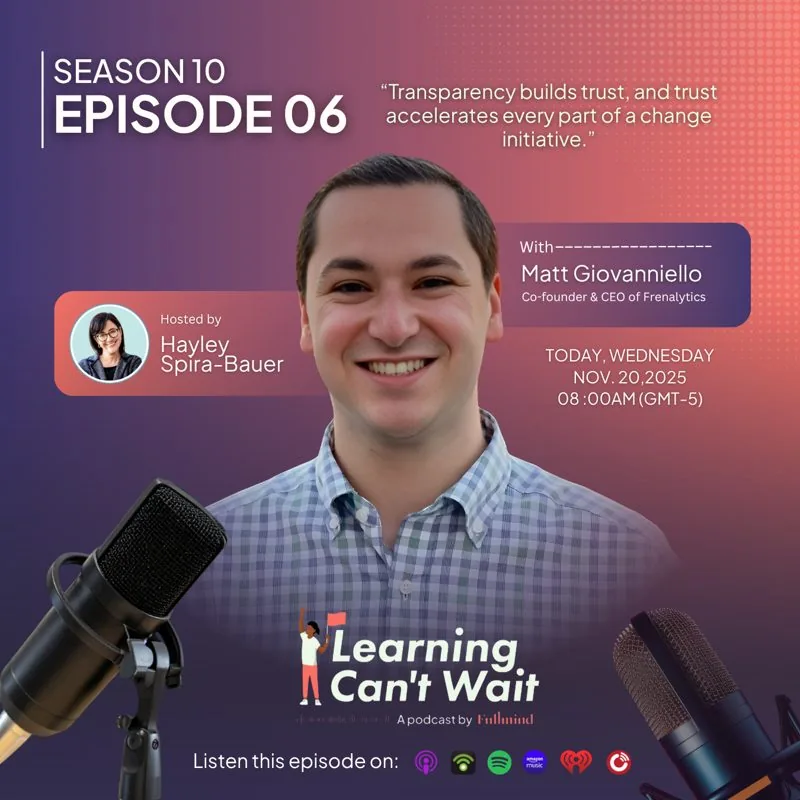
Learning Can’t Wait · Episode 191
Matt Giovanniello: Digital Transformation, Leadership & Organizational Change
- Matt Giovanniello, Focusing
 Hosted by Hayley Spira-Bauer, Chief Academic Officer at Fullmind
Listen now
Matt Giovanniello: Digital Transformation, Leadership & Organizational Change
Episode summary
Matt Giovanniello, co-founder and CEO of Frenalytics, shares how speech services as a child, a family of educators and clinicians, and a PowerPoint game he built at 12 for his grandmother after a stroke led to a company now serving special education and English learner classrooms. He explains how winning Digital Promise's Vital Prize reshaped his approach to co-design, previews a chapter in a Harvard Education Press book on the myth of the self-sustaining genius idea, and describes what makes district partnerships endure, including how to own it when integrations go wrong. He closes on AI's promise to cut special educators' administrative load.
Key takeaways
- Healthcare and special education share goals and the same kinds of passionate practitioners
- A genius idea is not self-sustaining; co-design with teachers, families, and students raises the odds tenfold
- The best partnerships don't feel like sales; be honest about what you can and cannot do
- When something goes wrong, acknowledge it, accept responsibility, and bring a plan
- Special educators spend over half their time on non-instructional tasks; responsible AI can give it back
About this episode
The episode features an insightful discussion with guest Matt Giovanniello, focusing on the evolving landscape of digital transformation, the power of collaborative leadership, and strategies for successfully driving organizational change.
Full transcript
Transcript generated from the recording; minor errors may remain.
Hayley Spira-Bauer: Welcome back, everybody, to the Learning Can't Wait podcast. We have my dear friends and incredible EdTech founder, Matt Giovanniello, the co-founder and CEO of Frenalytics, joining us today. Matt, welcome!
Matt Giovanniello: Hayley, I am so excited and happy to be here. Thank you for having me on! I am such a big fan of Learning Can't Wait, and I cannot believe I'm a part of this season.
Hayley Spira-Bauer: You know, it's long overdue, because the only other moniker I didn't give you in my introduction is that you are also my co-captain in all things boat cruises at EdTech events, which we could talk about at some point during this conversation, but we are long overdue to record this. There's so much for us to talk about, I… I think we should just jump in. How do you… how do you feel about that?
Matt Giovanniello: Yes, let's do it. Ahoy! Let's go!
Hayley Spira-Bauer: Oh boy, we should use only, like, boat-related, language during this conversation. We'll see who can keep it up longer. It'll be a really interesting game for our listeners to try and pick it out. Let's drop anchor. All right, Matt. You know my first question, because you're a listener, which I really appreciate, but I can't wait to hear your take on it. How did you come to be the personal and professional version of yourself?
Matt Giovanniello: Hayley, I love this question, and my answer to it has changed since I heard you asking it to the first guest that I listen to episodes on. I think I'm coming out of my shell a little bit, and I feel more comfortable Actually answering this as… Hopefully, as honestly as I can. I'm at a loss for words, which is kind of ironic, because nowadays, I don't stop talking, but the reality is,I didn't speak at all until I was 3 years old.I received speech services all through preschool and elementary school, and now serving as the CEO and co-founder of a company that supports students with unique learning needs, including those with speech services. It's really come full circle. So, I think my personal experiences from before I can even remember absolutely influenced it. I also need to give a lot of credit to my family, because I come from a family of both educators. My grandma, who sadly just passed earlier this year, was a veteran English teacher in the New York City public school system before becoming a preschool teacher. My aunt is a 24- or 25-year veteran special education teacher, and so I was surrounded by teachers who served as excellent role models, and also, I come from a family of people in medicine. My mom is a pediatric nurse, my dad is a psychiatrist, my grandpa was a radiologist, and so I think I was surrounded by these two industries that I became so passionate about, and to no surprise, I was a pediatrician 3 years in a row for Halloween, and then I wanted to be a teacher for every grade I was in in elementary school until I graduated out of that. And realized that I wanted a career in tech. And now here I am, working in tech with both of these industries at this company, and I think a lot of those really young, influential experiences shaped who I am today, not only personally, but also professionally.
Hayley Spira-Bauer: How do you see the… different sectors intersecting in your work today, like healthcare and education, because I always found that an interesting part of your story, and I'd love for you to just lay it out for the audience.
Matt Giovanniello: They seem so different, I'll be honest, but there's a lot more overlap than a lot of people think, especially in my line of work and the way that I define and think of healthcare and education as the two industries that Frenalytics operates in, at least. For a quick backstory, the way that I got started with my company was when I was 12 years old, my grandma suffered a really severe stroke while undergoing open-heart surgery. Things went south, she became paralyzed on the right side of her body, she had irreversible brain damage on her left side. This was 2008, Hayley. The iPad wasn't even a thing yet, the iPhone just came out. And touchscreen computers were novel, and something that not a lot of people had. And yet, in the hospital setting, even with these, you know, quote-unquote cutting-edge technology advancements happening in the mid-2000s and late 2000s. She was still using flashcards to relearn things through cognitive therapy that she so desperately needed to learn. And I can identify with it as a 12-year-old more than she could, as a 79-year-old stubborn Italian woman born in Brooklyn. And sure enough, she refused therapy, and I realized that that wasn't the answer, and she so desperately needed something. I'll get more into my founding story in a little bit, but that was the world of healthcare I suddenly got thrown into, and when I did a ton of research and applying for our patent around Solutions for older adults with brain injuries, i.e. Dementia, stroke, and traumatic brain injury. I realized that the goals and the aspirations and the way that physical therapists, occupational therapists, and speech therapists, let alone doctors, nurses, and others, were working with these patients, in the next couple years, it became really similar to the way that, as we entered education. Those same practitioners, plus teachers and aides, would be working with students with disabilities. And so, while on the surface they seem like two completely independent. Maybe couldn't even be farther from each other industries, I think that the patients and the students that are at the center of all the work that we do have really similar goals, and they are supported by really similar Oftentimes incredibly and almost too passionate of Of educators and of clinicians.
[05:00] **Hayley Spira-Bauer:** Okay, but now you have to tell us the founder story, because you can't tell us that tidbit without giving us the whole scoop.
Matt Giovanniello: What a tease, right? Hi, Captain! So, plus one. So, on a serious note, though, my grandma really struggled going through therapy, and while there were advancements in physical therapy to help her moving again, albeit she remained in a… In a wheelchair for the remainder of her life. She did regain some mobility, but the progress that she made on a cognitive therapy basis was… was awful, to put it bluntly. She wasn't making the progress she desperately needed. She didn't want to participate. The therapy was… Boring, was non-personalized, it wasn't engaging, and perhaps most importantly, it was really, really tough for both us as caregivers and also her clinicians, the experts. To measure and know what progress she was achieving over what period of time, and how significant it was. And so, my solution to this as a 12-year-old boy. Was to create a PowerPoint program. I was a nerd then, I'm still a nerd now, but what rang true was I realized that there was this huge problem that my family and I were facing. And that I could use technology to solve said problem. Instead of these flashcards, how about we turn it into a fun, interactive game of sorts? It was called Grandma's Ultimate Challenge, and it presented the same skills that she needed to learn on those flashcards and in real life, but in a digitized, fun, personalized, and interactive way. Those questions ranged everything from a package bouncing on her front stoop and saying, you received something, what's your address? To a family photo from her favorite vacation, and an arrow flying around the screen saying, who is this, and how do you know them? And everything in between. A fake conversation with her sister to go over multi-step processes and how to carry out an effective conversation. Colors, numbers, shapes, sizes, the whole nine yards this program tried to teach and reteach her these pieces, and I cannot claim credit for her learning everything that she did. But for the time that she spent into this game, not only did she really enjoy it and love it, but she learned a little bit along the way, and that little bit was a huge milestone for all of us. That was the foundation of Frenalytics 0.0.1. And it was not until I showed a family friend at dinner one night when he came over our house, he later became my co-founder to this day and good friend Chris, he was the one who realized that I was sitting on this technology that could be applied to more than just one person. How do we scale this to the masses, and… the original context of that were the millions of patients worldwide in the U.S. With dementia, the hundreds of thousands with a traumatic brain injury, and the hundreds of thousands in the U.S. Turned millions abroad that are suffering from a stroke and the detrimental effects like my grandma did in that year. That was how we went through the process of Applying for a patent around the unique methodology of evaluating a person for the extent of their medical or their cognitive decline, and turning it into a software solution to help them learn those skills that they were now struggling to learn. It seems like it's, again, very much a different industry, but that same technology, that same approach, that same research, and maybe most importantly, that same passion is what we were able to turn around at the peak of the pandemic. When we realized that educators, especially special educators, were dying for a solution that met the needs of their students in the wake of this emergency remote learning that students were now going into literally overnight, because special ed was similarly A lagging industry where paper and pencil and flashcards, believe it or not, were still the norm and the status quo that had to be disrupted.
Hayley Spira-Bauer: And so, you tell this story, and I'm hearing you, and what I'm taking from it is… you're an entrepreneur, but you're also an entrepreneur who has deep roots and passion and mission-driven alignment to solving problems to people that you love and who are affected. But you're like, if I can solve it for my grandma, I want to solve it for other people, too. I love that, Matt! I love that.
Matt Giovanniello: Exactly. I like to use the line, Hayley, that I learned many years ago about running a business that has a double bottom line. I think there's a quote on my college campus wall in one of the buildings that said. Go out into the world and do well, but more importantly, go out into the world and do good. And I think that you can do both. I don't think it has to be one or another in this world of entrepreneurship, and the fact that I can be at the head of two industries colliding together and being able to affect change with that double bottom line, it brings me no greater joy than to be in this spot.
Hayley Spira-Bauer: Yeah, I used to feel guilty when people would ask me, like, oh, is your company a non-profit or a for-profit? And I don't know if you have a similar reaction, but hearing that quote and hearing how you talk about doing well and doing good reminds me a little bit of that. Being in a mission-driven, for-profit organization is not shameful, and… The world needs lots of smart people to be on all sides of the equation helping kiddos.
[10:00] **Matt Giovanniello:** Absolutely. I agree with you, and I similarly felt a tiny bit shameful at first, also when I began this, because I think… the preconceived notions behind nonprofit organizations and for-profit organizations are almost a little bit flipped. Nonprofit organizations, especially the larger ones, have a ton of resources. But traditionally, when you think of a nonprofit, they tend to not, and they tend to be benefiting not the stakeholders of that organization, but the people that they serve, and I think that that definition holds true of many for-profit organizations that we know. The fact that for-profits can get as many resources as they can to affect as much change as they can makes me proud to run one, but it doesn't mean That the decisions that we're making are merely to benefit our bottom line, and to benefit my own personal pocket, because that is sure… sure as hell not the case.
Hayley Spira-Bauer: Well, and that, like, is a really interesting segue here, because you and I had a really cool conversation prior to starting this call about your founder's story and how your work today is very different than the work you founded with, in large part due to… your collaboration with Digital Promise. So, can you tell us a little bit about this coming soon chapter in a book being published at Harvard, and how you changed course based on what you learned about effective co-design principles?
Matt Giovanniello: Yes, so for quick background, or I'll try and make this quick at least. About 2 years ago, maybe a little bit longer, we were invited to participate in a national research and development and go-to-market competition for very early-stage edtech projects through Digital Promise's collaboration with the National Science Foundation. It was philanthropically funded by the Walton Family Foundation of Walmart. The Schmidt Futures, and the Bill & Melinda Gates Foundation. Digital Promise was the one managing the project. When we got invited to this, I think it opened my team's world, and especially my eyes, to the fact that we were following an existing R&D and go-to-market process that was not in line with best practices for what inclusive R&D and co-design looks like in this world of education. I think in part of it, it wasn't the world that I started in. In part, I think you don't know what you don't know until you learn it the hard way. Like, there's no, you know, step one, step two, step three guide to building and running a properly run… a properly developed and successful edtech startup. If it was that easy, everybody would do it. So, I think Digital Promise's answer to that was to run this competition. We not only got accepted, but we won it, and it was an incredible experience, a really challenging one. But it was a coming of age, and I think that we are way more mature and way more confident in what we can bring to the world of special education, English language learners, and students in multi-tiered systems of support, commonly known as MTSS, as a result. And some of the claim to fame that we got from participating in it, of course, made us better in what our offerings are, and just, we're happy to kind of shout it from the rooftops. After we completed that competition, Digital Promise reached out to us one day and said, hey, we have a special project for you, would you like to take part in it? And without getting any more details beyond that, I said yes. Little did I know what we were signing up for, and what that offer would be. It turns out Digital Promise was invited by the Harvard Education Press to write a book around R&D best practices, how edtech influences the world of education, and best practices for if you are a new startup in this world of edtech, like we were at one time, what you should be doing to, like I like to say, trip and fall a little bit less than those who have come before you. And so, as a for-profit company, we were invited, which I hear is a rare thing, to have this offer extended to you. We were invited to write a chapter, within this book that is, that's getting published any moment now. The title of the chapter is An EdTech Developer in the Ecosystem, The Essential Role of Practicing Teachers. I cannot claim any credit for this, other than passing the project along to Caitlin on my team, who is our head of research and design, and she spent a painstaking few months not only writing the chapter, but going through an editorial process that neither of us were familiar with, but similar to going through Digital Promise's Vital Prize Challenge, we are so much better off as a result of it, and we're really proud to share our findings and to tell our story of an EdTech company finding themselves along the way and learning some really powerful lessons that we can pass along to the next generation of EdTech startups coming soon.
Hayley Spira-Bauer: Okay, first of all, this is huge. I am so excited for y'all, and Caitlin is amazing, so I love that you give her credit, because that is another excellent quality about you, which is humility, for writing the piece, but wow, that's exciting, I can't wait to read it, but now I'm gonna ask you the TLDR, because One thing I know about you is that you really are great at mentoring other EdTech founders in the early stages of this design and build process. So, what's the TLDR? Like, what did you learn that you feel like is really important for product design?
[15:00] **Matt Giovanniello:** The TLDR of the chapter especially is that this coming-of-age kind of story starts with an arc of my grandma and me, and this original creation that Caitlin calls a, quote, genius idea. There is often a preconceived notion that genius ideas can just become successful on their own without all of the other pieces in place. And so, the beginning of the chapter goes through this myth of a genius idea being self-sustaining, and me thinking that just because I came out with something amazing means the world immediately wants it. And we learned that the hard way for a number of reasons on a healthcare basis. But the biggest piece was headwinds that nobody ever would have expected, i.e. The start of the COVID pandemic. And when it became literally impossible for us to scale our early-stage pilots and implementations in home care agencies, in nursing homes, in private practice, because of the state of the world, especially in New York, where I'm based. That made us have our, literally, our backs against the walls and say, okay, now what? Conveniently enough, at the same time, one of my longtime best friends from high school, she was participating in Teach For America at the time. She is now a veteran special education teacher. She reached out to me and my team that spring, that summer of 2020, and said, hey, I'm now a Zoom school teacher. You post a lot about Frenalytics for healthcare, is there any way that I can make use of this similar technology for my students in my high school life skills classroom? I have very limited resources, I had before COVID, I have no resources now, like, can you help me out? What can we do? And my friend's name is Jen Sovieski, she gets a call-out in this chapter. She was the one that kind of gave us this light bulb moment to do a bit of a pivot into this world of education. There are so many pieces that had to happen right since then, and we're really grateful that a lot of things align, but I think The chapter tells this kind of uphill battle that all education companies are going to face, whether you know it or not, our particulars of that story, and how once we fell into the groove of going about co-design hand-in-hand with educators. Administrators, parents, and even students with disabilities, we increased our chances of success tenfold, because we now acutely understand the problems that we're trying to solve, and can better build solutions to meet those problems, instead of assuming, or filling in the gaps, or thinking we know better. I think that Caitlin did a really great job painting that picture of this original kind of seed of an idea, and how it bloomed along the way, but it really had to find itself. It grew sideways, it died a little bit, it got replanted, and it found all of these new ways to kind of morph into a plant that we never expected.
Hayley Spira-Bauer: I love that. You know, it… The Founders Road, I've heard, is very lonely. And you often are traveling on this path, you know, by yourself, but it sounds like you… found a way through the project at Digital Promise, but also collaboration across industries, to ensure that you weren't alone, and now you're paying it forward. Talk to me a little bit about why you care so much about mentorship. Is it because of the loneliness, or is there something else driving you?
Matt Giovanniello: The loneliness is real, but I thinkthe single best way to combat founder loneliness is community.Community is crucial. I think we know that to be true in the world of education overall, and district leaders, including superintendents, that I know you and I talked to, Hayley, many of whom came on this podcast. They would agree that when you're at the top, it could be really lonely, and who to turn to becomes very limited, and who you can trust is even more limited. I think the community that… maybe I accidentally built a little bit along the way, has been the greatest motivator for me to keep going, and people for me to turn to that I can trust and say, I'm having this issue, I need to be transparent about it, or I'm trying to figure out, you know, what comes next in the growth of this company, because there is no playbook. And trying to get some answers, or even suggestions, or just a shoulder to lean on, or an ear for somebody to listen to. I think the community piece is super, super critical, and… I'm so grateful and thankful for the people who I met in my early stages, especially as we transition to education, that showed me the ropes. I think a couple shout-outs that are very much in order. You, obviously, you're one of my early meets. Within the world of education, as we went to EdTech Week, or as I went to EdTech Week for the first time years ago, Brett Roer, Tiffany Law, Jacob Kander, all of our friends, the cast of characters, and all of the superintendents who took a flyer on us, Tanya Wilson. Joe Mulligan, there's countless people that when they first… Tammy Williams, when they first met me, something about them made them think that they should invest in me. And I'm eternally grateful for all of them, and then some who are not popping up in the top of my mind right now, and I think that's what fuels me and drives me to want to pay it forward to this next generation of EdTech entrepreneurs. There have been a lot of different mediums and ways that I've met these folks. And I think that there is that special piece, that special spark that goes off in my head that they exhibit that makes me want to pour into them the same way that people poured into me. And so that's what… that's what motivates me. It's… it's just such an exciting thing, and, you know, the stats unfortunately show, as I'm sure you know, Hayley, that about 90% of startups fail for one reason or another. The odds are stacked against you.
[20:00] **Hayley Spira-Bauer:** Yeah.
Matt Giovanniello: Any way that you can get the support that you need to go against those odds. Anybody who receives those supports would be really grateful, and I know I was, and I know this next-generation would be too.
Hayley Spira-Bauer: I love that. And, you know, at the end of the day. There are so many bets that people can take. There's a… there's a… sorry, there's a limited number of bets people can take in decision-making authority positions at schools. You and I have just sat on… you led a panel, I led a panel on partnerships with our… with school districts and decision makers within the individual unit schools and the larger districts at large, and so it says a lot that you want to help folks understand how to make sure that, one, the bed is worth taking, and two, it ultimately pays off. And the advice that you often give mentees allows them to be better on behalf of kids that we serve. So, let's talk a little bit about What you think matters when you're building a partnership with a school or a district leader.
Matt Giovanniello: There are a lot of things. I think… what I've learned as of recent is that our best sales conversations and our best partnerships are exactly that. They're partnerships. It almost doesn't even feel like you're doing a sales demo, or that you need to convince the leader on the other line much that you'd be great for each other, and not only that, but that there's a pervasive problem that that district or that whoever it is has. That you're able to capably solve. And I think that's the first and foremost piece. The second, you know, maybe tied for number one, is being authentic and being genuine, and you telling them what you're capable of doing, and what you're not. And I think similarly, if… when district leaders come to you on these calls and say, hey, like. This is the timeline we're up against, or this is the funding we have, this is the problem that we're solving right now versus one that we're trying to solve later, or this isn't a problem. I think the more that we could be transparent and open to that, I think that you know, if the vendor partner on the other line is receptive to that, and they can meet them where they are, and meet the mark of what their needs are, that results in a really enduring partnership. I use that word kind of on purpose, Hayley. I know a few weeks ago, we held a panel on this, on what it takes to build enduring EdTech and district-level partnerships. I'm so glad we get to continue, you know, singing and shouting from the rooftops what that looks like and feels like and sounds like, at future conferences, but I think, in a nutshell, those are some of the top pieces that pop up to me about what a really meaningful partnership looks like and how that's changed for us over the years.
Hayley Spira-Bauer: Can I tell you that one thing we didn't talk about on the panel, but we should definitely integrate it to the next conference we attend and put this show on the road, and I want to hear your take on it, is… What do you do when something goes wrong? I… it's really easy to talk about, like, okay, to be proactive, you should do X, Y, and Z, but I want to hear you talk about what to do when something goes wrong. And you don't have to call out a particular example, but, like, obviously, please draw on your experience of when something went wrong, how you handled it, and what the response was from the other side.
Matt Giovanniello: I'll give you an example, just because we have one right now, in the spirit of transparency. Not everything goes right, and I cannot and should not pretend that it does, and I think anybody who does say that, they're probably fooling themselves, or they're lying, similar to what you mentioned at the beginning of our podcast here. We have a district where our integrations are taking significantly longer than anybody anticipated them to be. It's not necessarily a fault of our own, it's not necessarily a fault of the district, but it's these third-party players, both on the district and our side, that are making things last a lot longer than they need to. And on a good day, that's annoying. On a bad day, when there are regulations around special education and reporting and compliance deadlines, that put this district in… possible peril, or in some sort of liability situation, that's where the stakes get really high. And so, texting the relevant players at this district and emailing them on an almost daily basis is what we're up to now. We can't be silent anymore, that's not an option, and we need to give the state of affairs in a really honest way. I think it's easy to cast blame. We can't cast Blame. You know, we're equally at fault for this not happening sooner than it should have been. And I think that just being open about that will result in a more enduring partnership long-term than it otherwise would. Although, I'm the first to acknowledge that conversation's really hard, and when hard things happen, people don't want to pursue them. It's easier to just… Be silent, or blame, or whatever it might be.
[25:00] **Hayley Spira-Bauer:** Reduce the friction, but in a manner that's not productive, right?
Matt Giovanniello: Exactly right, and I think that, you know, the conversation I'm going to have with this person, literally right after your podcast, is the next step that we're taking, in addition to what I was doing this morning, in working through these remaining steps of saying. Here's the state of affairs, I know you're less than thrilled with us, you know, I'm very sorry that it's taking as long as it is. It shouldn't have. Just acknowledge it and accept responsibility. And then, here's the plan for what we need to do going forward. If I had a magic wand and I could do things, you know, haphazardly, I would, but we need to do this the right way. Here's what that looks like. How can we support you to make sure that, one, your staff understand, and two, how do we right this wrong? It's already happened, what do we do from here?
Hayley Spira-Bauer: Refreshing. I really have seen it modeled well. When you do exactly what you just said. And it's super hard to, like, eat crow and put the hat in your mouth and, like, all the metaphors that.
Matt Giovanniello: I promise.
Hayley Spira-Bauer: They're not related to boats, but we could make one here. When you're… when you're off-charted course, but, I've seen it done really, really well, and it comes by just saying. Here's what we did wrong, here's how we're going to fix it. Is there anything that you think I'm missing, right? Like, is there anything that you wish I were doing that I'm not currently doing right now to right this wrong? So you… I mean, you… A+, which is, like, not like I'm grading you here, but, like, I am so on point, on the same page with you right now, because it is such a hard conversation, and I think when you talk about building trust with partners and being a partner, not a vendor, this is how you build trust. This is how you build trust. I love… I love the approach you take, and I really think we should integrate that into our next roadshow conversation.
Matt Giovanniello: I agree. I will update the show notes right now. Otherwise, you walk the blank.
Hayley Spira-Bauer: Matt, what has you really excited for the rest of this school year? We're, you know, we're recording this right after Halloween. It's a heavy time of year for school districts. It's when kids are really settling in. And even IEPs and 504s are being updated continuously, and maybe even parents are starting to request new services for their kiddos. What has you really excited about the coming year, and what's going on at Frenalytics?
Matt Giovanniello: A couple of things come to mind. First, our team is growing, so I'm very excited to see what that will look like in the months and the years to come, and how we can better support our districts, both new and upcoming as a result of that. But more broadly, across the industry. In our particular world of special education and supports for English language learners, although I know this to be the case across education more broadly, I think the… reception to AI is only growing, and I think districts are becoming less skeptical and having, you know, fewer cold feet scenarios, and they're more willing to embrace it and adopt it and support their teachers in their own adoption at the classroom levels. And I'm very grateful for that. Because, going back to our space, traditionally. IEPs and the maintenance of them, progress monitoring, communication, everything in between, has been a pen and paper, or maybe, you know, 2010s, 2020's version, a spreadsheet effort. But it's incredibly manual, it's extremely time-consuming, and one of the biggest sources of teacher burnout has to do with the amount of time that teachers are spending on non-instructional admin tasks. For some educators, especially in special education, it takes up more than half of their time. It's insane. And I think that with this wave of AI being responsibly integrated within schools, yes, there are a ton of efficiencies gained that we already know about in developing differentiated lessons and making sure that communication back to home is done in an efficient and more consistent manner. But all of the non-instructional tasks that teachers, especially special education teachers, are facing right now, I think that they're not only learning about it, but they're actually saying, hey, I think I'm ready to adopt these AI tools, whatever they might be, to make my job more efficient. And so, I'm excited for that, because any time saved by a responsibly introduced and used AI tool to cut down on the amount of admin tasks and non-instructional time. Means that more time gets spent with students, more time gets spent on differentiating instruction, meeting the needs of learners and their IEPs, and that gets poured back into the progress on their goals, and so students can close the gaps that they're facing right now, and achieve their fullest potential, because we know they can with the right supports. We just need those there.
Hayley Spira-Bauer: Yeah, absolutely. It is a very exciting time. I think, having just recorded an episode with our dear friend Rebecca Bultsma. I have a lot of excitement and a healthy level of respect for the trepidation that some leaders are feeling about integrating AI, but… Gosh, I wish I had the tools that are available today when I was teaching in leading schools. I can't imagine the time saved that you speak about, how much it would have impacted me as a professional in serving my kids and meeting and exceeding their needs, right? Meeting and exceeding their goals, and really ensuring they got what they deserved. Like, wow, I am jealous!
[30:00] **Matt Giovanniello:** It… it stuns me, the amount of time that teachers spend on all of their instructional, but also non-instructional time, that I think AI will be able to kind of reduce, in a word. I think the needs of students are only growing, as you know, Hayley, from your time in teaching. I think back to when I tutored students back in high school and in college, there were two, potentially three students who now that I know my job and this world a little bit better, we're classified for special education services. Did I know this before I said yes to tutoring them? Absolutely not. But I think their needs were pretty apparent back when I was working with those kids. I can't even imagine what the variety of needs look like in a standard classroom now. Compared to what I saw 10, 15 years ago. Right. Teachers have a lot on their plates, and as we speak about a lot, in addition to being a teacher, you're also a social worker, you're also an administrator of medicine, you're doing all sorts of pieces, you're a liaison to parents, you're a liaison to advocates, you're a liaison to your own administration. You're doing all sorts of additional work that teachers 15, 20, 25 years ago just simply were not doing. And part of that is because of the needs of our students growing over time. There's nothing wrong with students requiring more individualized needs whatsoever, but in order for teachers to be able to balance that on an already full plate, something needs to change. And I think that these AI solutions, in part, are the answer to that. I don't think we can just throw an AI solution in a classroom and think that all of our problems are going to be solved. As I'm sure you agree with Hayley, and hopefully others listening to this, if you throw software at a problem without treating the underlying problem, the problem will still be there just with AI software. Like, nothing's gonna change. We need to solve the root of a lot of these issues, and then… augmenting it with these new technologies, I think is really the best way to go about it. It might seem obvious, but that's how I see it.
Hayley Spira-Bauer: No, I… it needs to be said, and right now, I'm taking notes from everybody I talk to. I'm trying to get smarter on a topic that is new to me, and so thank you for sharing your opinion here, but you know what, Matt? As I predicted, this has turned into a 3-hour tour… no, I'm just kidding. We could talk for days, I mean, we do, we talk all the time, but we could talk for days about these education topics that both of us are so passionate about, but I've had an amazing time just listening to you and learning from you, and hearing how you approach so many parts of running Frenalytics. I'm wondering, as a final question, what advice you would give an EdTech founder starting their career today?
Matt Giovanniello: That's a really good question. I thought I had a solid, snappy answer. I don't know if I do, other than… And this advice applies to a lot of things in life, in my opinion. More often than not,you're not going to get a golden invitation to begin, so take it upon yourself to just start.I think that as I went through, I began. Nobody gave me license to do so, and yet here I am. I think that starting gets you halfway there, and you'll learn so much along the way, and if you align yourself with the right mentors, the right coaches, the right advocates, the right founders who are a couple steps ahead of you. I think your chances of success will be so much greater than, one, if you don't start at all, you will never get anywhere, you'll never achieve anything. And two, if you start and you're a little bit misguided and you don't exactly know what you're doing, and, you know, you let that intimidation overwhelm you. I think just get started is the biggest piece. I think as you're in pursuit of a problem, what we learned the hard way, and I'm really glad that we did, is that building solutions in pursuit of an actually pervasive problem, alongside the needs firsthand of teachers, admins. Students and parents through a co-design process is critical in order to make it in this world of education nowadays. There's not enough funding for schools to be spending their hard-earned dollars on less-than-stellar solutions, and so to know what their problems are, to serve them in the best way that you can, is an incredibly important piece in edtech, as I'm sure it is elsewhere. But you gotta start first. That's my biggest advice.
Hayley Spira-Bauer: Matt, it is such an honor to know you and watch you do your thing. I am so grateful that you came and joined us on the podcast today, but also, you shared some secrets, which is, again, one really special thing about you, is you want everyone to win, and you want everyone to win in service of kids. So, thank you for sharing some secrets, but also sharing your story here on the podcast today.
Matt Giovanniello: Hayley, it was such an honor to be here, thank you again, and I can't wait to listen to this season's guest! I'm so honored to be a part of it.
[35:00] **Hayley Spira-Bauer:** And thank you to everybody who is listening to this episode, and to all of our episodes here on Learning Can't Wait.