
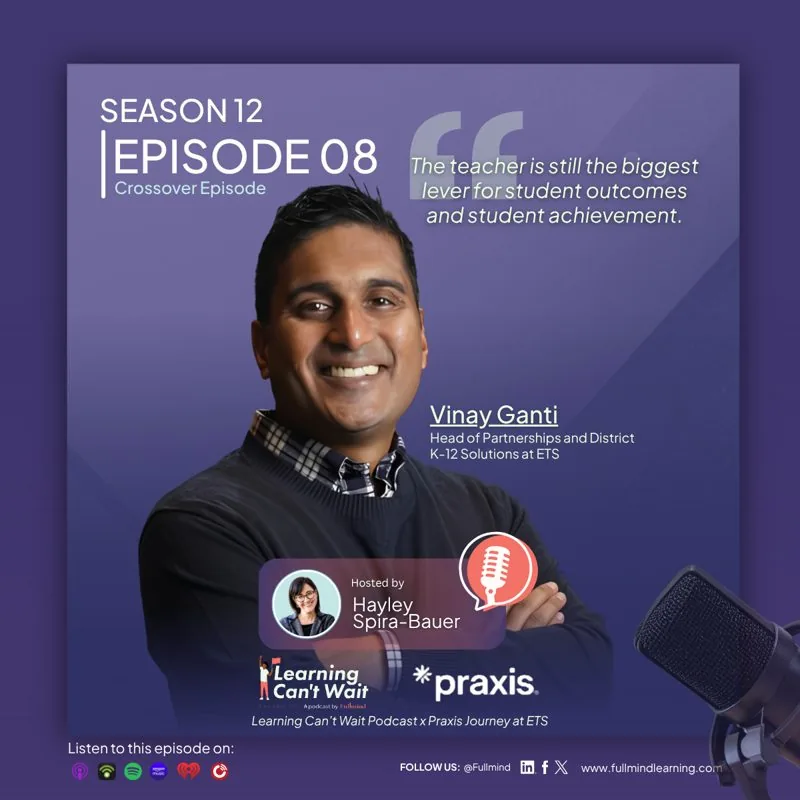
Learning Can’t Wait · Season 12, Episode 8
Vinay Ganti: Teacher Retention, Educational Innovation and EdTech & AI
- Vinay Ganti, Head of Partnerships and District Solutions at ETS
 Hosted by Hayley Spira-Bauer, Chief Academic Officer at Fullmind
Listen now
Vinay Ganti: Teacher Retention, Educational Innovation and EdTech & AI
Episode summary
In a crossover with ETS's Praxis Journeys podcast, Vinay Ganti traces a path from NYU law and business school and adjunct teaching to 2U and ETS. He argues education should learn from other industries, that teacher shortages reflect wider economic options for women and antiquated five-day in-building staffing models, and that early-career teachers leave over lost efficacy and poor principals more than pay. He and Hayley discuss school redesign, virtual and international teacher strategies, scaling bright spots through edtech, and ETS's move beyond certification toward teacher mindsets and durable skills.
Key takeaways
- Education is not a snowflake; it can borrow proven practices from industries like healthcare
- Teacher shortages reflect better economic options elsewhere and staffing models with no flexibility
- Early-career teachers leave over lost impact and bad principals; people leave managers
- Use every staffing strategy: homegrown, virtual, international, and redesigned schools
- Give yourself time; teachers often don't see the whole classroom until year three or four
About this episode
In this special crossover episode of Learning Can't Wait and ETS's Praxis Journeys, Hayley Spira-Bauer sits down with Vinay Ganti, Head of Partnerships and District Solutions at ETS, to discuss his unconventional journey into education, the challenges facing K-12 schools, and the future of teacher recruitment and retention. Vinay shares how his experiences in higher education, edtech, and innovation shaped his passion for education as a tool for life-changing impact. The conversation explores teacher shortages, leadership, school redesign, innovation in education, the role of edtech and AI, and the importance of supporting educators through strong professional pathways and mindset development. Ultimately, both guests emphasize that improving outcomes for students requires investing in teachers, embracing innovation, and sharing successful practices across school communities.
Full transcript
Transcript generated from the recording; minor errors may remain.
Hayley Spira-Bauer: Welcome back, everybody, to the Learning Can't Wait podcast. This is a special crossover episode with ETS's own Praxis Journeys. I'm excited to welcome Vinay Ganti, the Head of Partnerships and District Solutions at ETS, to join us here today. Welcome, Vinay.
Vinay Ganti: Thank you for having me, Hayley. I'm excited for the conversation.
Hayley Spira-Bauer: I am as well. It's fun to have a conversation about the topics we're planning to discuss, but it's doubly fun to have a crossover episode. Who knows where it will take?
Vinay Ganti: I agree. I know, this is a first for us. We're still a relatively young podcast, so we're super excited for the opportunity.
Hayley Spira-Bauer: That's great, I love that. Well, why don't you start us off, and I'll ask the first question. How did you, Vinay, come to be the personal and professional version of yourself?
Vinay Ganti: You know, it's funny, you already gave me warning that that was going to be the first question, and you say you start off all your podcasts with this one, so, you know, for me, the… sort of where I ended up today, professionally and also personally is, I think, like the Steve Jobs quote, like, things only connect the dots in hindsight type thing. I didn't really have a plan to get here. I do know that there were some key moments on the professional side that, sort of started when I was in grad school slash professional school. I did a joint law and business degree at NYU, and towards the tail end of that, I had gotten very close to a handful of faculty there, helped one of them, like, migrate… I don't know, for those of you who remember, I graduated undergrad in 05, and And, a special school in 2010. So, not, like, forever ago, but long enough ago where, like, things like the course packets were still a thing. You'd have to go to the, you know, the local copy center, spend hundreds of dollars on these massive books of, like, copyright material that was in addition to whatever textbook was also required for a given course. And one of the faculty members, she's like, you know what? I want to, like, digitize my course back. Figure out how to, like, have everything available on Creative Commons, and offer it to free to all my students. And I was like, that's a great idea. I was like, I'll help you do that. And she actually paid me to do it, which is also great. I was like, but… and I sort of threw it out there, I was like, but I want to be able to teach the course in the fall, after I graduate. And she's like, okay. So I became an adjunct professor, like, sort of on a whim. While I was still trying to figure out what I wanted to do after school. And, like, I knew I didn't want to do some of the traditional career paths that came out of, you know, business or law. I didn't want to do corporate law. I sort of turned down my author at a law firm. I didn't want to go into, like, consulting or banking and other things. And through that experience of teaching, being an adjunct, which is still one of the more interesting experiences of my life, I… started to really realize that I really liked education and as a profession, but also that there was such a massive disconnect between, like, how these undergrads were interacting with technology and how we were teaching. And at the same time, I had sort of had a different mentor slash faculty member who once told me, he's like, you know, whatever you do, be willing to do it for at least a decade, because it's going to take at least that long to get, like, enough industry and other expertise in that space to actually provide meaningful value. And the edtech industry was kind of starting to really boom, so I sort of I networked my way into a company at the time called 2tor, which ended up becoming 2U, which was one of, like, the fastest growing online education companies out there from 2011 to about 2020. I was there for 4 years, I did a variety of roles, and it culminated with being the general manager and SVP for their partnership with UC Berkeley, where I launched the first-ever online degree in data… master's degree in data science. Grew that, sort of established that partnership in a good space, and then sort of had some, some personal issues that I had to deal with that, I was going through a divorce at the time, and so I ended up moving back east and sort of refining myself, but then sort of came back to education, and my roles since then have always been on the education side of things, either on the go-to-market, revenue, strategy, those sorts of things. On a personal level, you know, I grew up in Florida, I was born in New Jersey, grew up in Florida. And, you know, my… always had, you know, you know, a deep under… like, interest in education from a… a lot of it was external, right? Like, in the beginning, you know, I mean, I grew up in a pretty, sort of, model minority, South Asian professional household, you know, education was the most important thing. My dad was a physician before he retired, my mom an audiologist. So education was always, like, top of mind. I had the privilege of going to very good schools growing up. I went to Brown for undergrad, so it always was around education. As a… as a thing, but to be perfectly frank, I think, you know. I always approached it from a very, like, privileged, sort of, like. Sort of lens, sort of like, I never really appreciated, sort of, the lever or the exponential impact it could have on an individual. Really until, I would say I graduated from Brown, and… started to… and living in New York, and starting to really get more exposure to, sort of, less fortunate upbringings, and… or… and even, like, some of my own friends from Brown, sort of really appreciating the stories that it took for them to get to that amazing point, where they were able to have the platform that is one of the best schools in the country sort of unlock doors for them. And so, for me now, that really is sort of the… The sort of thing that keeps me in the space, keeps me in education, is the potential for impact and the potential for outcomes. You know, I think I'm in the good fortune now of being in a role where my job is to help incubate new solutions to help teachers in their careers right now. So, whether it's teacher retention, teacher upscaling, teacher recruitment, really helping districts with all these challenges. But ultimately, like, you know, the sort of north star there is always going to be the student, right? Like, a higher… we know that the teacher is still the biggest lever for student outcomes and student achievement, so it's, I've been very fortunate to have a career to date that, as maybe circuitous and non-linear as it's been at times, I've been able to always sort of fall back on impact and scale of that impact as sort of drivers for me to continue to want to get up in the morning and keep doing what I'm doing.
[05:00] **Hayley Spira-Bauer:** Leaving the world better than you found it. Wanting… yeah, wanting to ensure.
Vinay Ganti: Or at least not worse. At the very least, not worse than we found it.
Hayley Spira-Bauer: Right, Charlie. No, absolutely. You know, I always love talking to folks that aren't necessarily… teachers by trade who have chosen this path because of either the impact that they've seen on their own life or other people's lives. Yours is definitely circuitous in the sense that you graduated with a post-secondary degree that wasn't related to teaching and learning, and yet you found your way drawn back to here time and time again. I think we need all kinds of people supporting educational efforts across the sector. Otherwise, we'll wind up with Everything being too homogenous, without any pushback or challenging to the ideas that we hold most dear.
Vinay Ganti: It's funny you mention that, because I do feel as though that is a… that is a very much a symptom that I see happening in education in general. As somebody who still, to this day, feels like an outsider in the space, even though I've been working in it now for 15 years. Almost uninterrupted, is this sort of, like. That we're a snowflake, and that we really can't learn from outside industries or outside perspectives, because education is so unique, and so specific, or so particular. It's so contextual to this gov… to this, country, or this or that, that. And I just look at, like, other industries that also have such a strong Like, social impact expectation, like healthcare and other places. And they've had to disabuse themselves of that. Like, mindset? And I am… I am optimistic that education will get there, but we still have a lot of work to do. Where we sometimes over-index on internal expertise and under-index on just, like, how do we solve problems, and are there best practices elsewhere that we can use to sort of accelerate solving that problem, right? So… Yeah.
Hayley Spira-Bauer: I totally agree with that. You know, when I look at sometimes how… businesses are either… these edtech vendors, businesses, are able to thrive or not on the Vine. Very often, it's… you know, the mindset isn't always scale-oriented, and it's tough. It's a really tough pill to swallow to be, focused on the double bottom line, both impact and keeping the business alive. I would say that, conversely, one of my big challenges to education companies when I meet them, doing mentorship, or just out at conferences, is often, okay, you're not an educator, that's okay. Who is advising your product development? That is an educator. Do you have recently, retired or educators that have moved on from the classroom recently? Do you have an advisory board? Are you doing discovery with your… Leaders that are buying the product, are you doing co-design? And if the answer isn't an affirmative yes, that also has me concerned.
Vinay Ganti: Right. Right. No, 100%. And I think… I think, yeah, you need to have both, right? You need to have, sort of, a Swiss Army knife of perspectives to be successful. I think I also think, too, like, we are… we are… as an industry, we're handcuffed by just not having the right, like, macro incentives at times. You know, if you look at, sort of, like. It's a lot of the innovation that's coming out of, like, Medicare and other things from a healthcare perspective, right? Like, with, like, accountable care organizations, getting paid on outcomes, not fee-for-service, right? There's… there's larger shifts happening In theory, over time, will result in much better outcomes and cost savings and other sort of desirable things that the healthcare industry wants to see writ large, or parts of the healthcare industry wants to wrath. We… I think education has… has sort of lost that sort of, like. Ability to agree on what the outcomes are supposed to be, because education partly has become so politicized, and as a result, so fragmented over the last three decades, three, four decades. You know, it's like… it… it's not… clear to me, for example, that we can align right now as a society on what the top three most important things are anymore, for, like, a K-12 district to care about. And, like, so I think, to your point, I think that only adds to the challenge of, like, an EdTech company then trying to go in and scale nationally, because the sort of priority set is so different now from one region to the next, or one community to the next, and it really shouldn't be, right? Right? We, like… So, I mean, I'm probably speaking too far, but… but there should be some commonality there that everyone can latch onto, and I think that's also part of the reason why you're not seeing a lot of… from, like, a venture and a capital market standpoint, we don't really see a lot of successful exits. Companies in education outside of the publishers, like the 800-pound gorillas who've been there, you know, the HMHs and the… and the… and the, you know, McGraw-Hills, who have been there for centuries, like, there aren't really any other people who are able to… other companies who are actually able to reach that, like, echelon of being a behemoth. I mean. We're seeing Chegg completely get eviscerated. 2U almost went bankrupt, right? So all of the, like, success stories of the mid… of the 2010s are all getting destroyed now, because either AI or overexpansion, or just couldn't make the economics work. Yeah, and so, we… We're… it's definitely a challenging industry, so you kind of have to be motivated by something else. Beyond The financial return, if you really want to sort of last in this industry, because the financial return may never be there. For a lot of these companies.
[12:00] **Hayley Spira-Bauer:** Well, good thing I started on this career path, because I care deeply about outcomes for all kids. And I never became a teacher because I thought I was going to make money. Ever.
Vinay Ganti: Out.
Hayley Spira-Bauer: Ever, ever. I don't think any teacher starts the Like, because they have dreams of getting big pockets, so…
Vinay Ganti: No.
Hayley Spira-Bauer: I do think, though, that's part of the problem. I think you alluded to that a moment ago, but it's part of the problem that education is not a lucrative pathway, and it's valued in our society. So when you do have external pressures, like politicization, politicalization, localization of education. People are quick to flee. Most educators today do not want their children to become educators. That's bad!
Vinay Ganti: Yo. Yeah, I mean, I think, I think…
Hayley Spira-Bauer: Yeah, go ahead.
Vinay Ganti: Yeah. No, no, no, and I think on that front, I think we're facing a lot of, like. Some of the things that we don't want to talk about around the teacher shortage, and this is my personal opinion, so this is not, like, the ETS or Praxis view on this, but, like, personally, is, one. A big driver of the current teacher shortage is exactly what you're saying, which is that the role itself, relative to other… what other available roles there might be out there in the economy for people who historically were the most likely to become teachers. It's just, like, it's just… the graph is just widening. And what I… what I really mean by that is, like, you know, for most of… like, since the industrial model of education came out, the majority of teaching spots were filled by women. And women now have that much more access to other potentially more economically lucrative roles, right? It's the same reason… it's part of… in my opinion, it's part of the same reason why we have the nursing short. Like, so many women now can just go become doctors instead. If they're gonna work the long hours, and be… do all that work, and they got all that study, like, maybe, like, a subset of them are gonna be like, well, I'm just gonna go get an MD now instead of an RN or an NP. Right? And so I think one of the areas that we really need to sort of think more proactively about is, like, how do we bring more men back into the teaching profession? Because, like, it's actually… in some ways, it's almost a good thing that we have a teacher shortage, because, like, a lot of the reason why we have it is because people have gotten better economic opportunity elsewhere. I think the second, sort of, piece of that is, I think, you know, is really antiquated staffing models, right? Yeah, and I know there's great work coming out of, like, ASU with, like, team teaching model and other stuff to try to really think creatively around what the 21st century, like, staffing model could look like for teaching, but… and I think the pandemic really sort of brought this to the fore, which was, like. You know. If you're competing against industries that have a hybrid or even remote work option, it's a really hard sell now to convince somebody to want to be in a K-12 building 5 days a week, 40 hours a week, right? They want to at least have the ability to have that flexibility. Right? And so we don't talk a lot about the larger issues. We talk about, like, things like salaries. Is an issue. But if you look at the data, the reason why early career teachers leave is not… salary's not, like, the top one or two reasons. Correct. It's like, number one is that they've lost faith in their ability to, like, make an impact in the classroom, usually, right? Because they don't get enough support, or they don't feel ready when they show up on day one. We can talk about some of the things that we're working on at ETS Praxis to move the needle there. And then number two, they hate their principal. Or they don't like their leadership, right? And that's not… once again, we're not a snowflake. That's true for all industries, that's true for all employers, right?
[15:00] **Hayley Spira-Bauer:** Bosses are a big deal.
Vinay Ganti: People don't leave bad companies, they leave bad managers, right?Yes. Like, Gallup has been publishing data on that now for decades, right? So we know that. And so it's a great example of a place like, let's not be a snowflake. Let's actually realize that that, like. You know, being a good… People leader is a critical part of being a good principal, because otherwise you're going to contribute to the retention issues you're trying to solve for. And so… I think that, you know, what we're seeing today is a… yes, there are, like, we should be paying teachers more, absolutely, we should be treating it more like profession, absolutely. We need to sort of have greater… and that comes also with greater accountability and greater opportunities for individuals to show their proficiency in certain areas and be rewarded for that. Some more laddering and more incremental steps in their careers around how they can make more money through merit and also through tenure, right? So there's all these things we could be doing, but I also think we sometimes need to, also acknowledge some of the larger, like, demographic shifts that are driving some of this. And where I sort of see that, really coming to fore is that we have, for example, an international teacher solution that we bring in. Like, J1 teachers on culture exchange, so it's a temporary thing, they come in for 3 to 5 years, and then they go back, and, you know, it's not a new model. Other businesses have been doing it for decades. And oftentimes I hear people like, oh, you know, I'd much prefer to have a homegrown model, but, like, we'll sort of explore this as well. And it's like, it's one of those things where it's like, I don't know, I take a slightly different view. It's like, no, we should be doing everything. Like, we should be having… we should be having every single strategy, right? We should be using virtual. We should be using.
Hayley Spira-Bauer: Yeah, I was just gonna say, this is, like, my bread and butter. Having this conversation about how we solve this particular challenge right now to overcome the obstacles that you named is where I live and breathe, and every single day. Yeah, I know this challenge very well. I know that… and I think, you know, you brought up a lot of good points here around what are the forces that are causing the shortage, how we should be viewing the shortage. You named, in particular, you know, attracting talent to the profession is vitally important. Agreed. But… What excites me the most is thinking about how… School redesign permits really dramatic outcomes and change for the profession and for kids. We are leaning on a system that has existed for centuries, and our outcomes are not… Validating that everything we're doing and have been doing is enough. Right. Is enough. It's not enough. And so, when I see schools being innovative, I look at a lot of what's happening at Digital Promise, and how their innovative schools operate. I look at network models across the country. I see what our partners at Fullmind are doing, how they're implementing creative solutions offering more options for graduation, different pathways. That is exciting to me, because…
Vinay Ganti: Interfering.
Hayley Spira-Bauer: We have a very deep understanding of how children are different. Than what we thought they were back in the day. Our, you know, our diagnoses of children with disabilities are up. Our multilingual learner populations are up. We need to be thinking differently than we did when we treated a classroom as a monolith. And so, I feel particularly excited, as I'm sure you could tell, about… by these models that… that do. Provide schools the opportunity to, A, solve problems quickly, just through some simple redesign and outside-the-box thinking, but also, B, have the outcomes to show that it's effective, as effective, if not more than. The alternatives.
[20:00] **Vinay Ganti:** Yup. No, I agree. I think that… I… I think that… the… that innovation in K-12 has always been there. Right? We've always… there's always been bright spots. That's right. And we do a very bad job of highlighting those bright spots, and talking about them, and disseminating them, and trying to replicate them. Part of it, I think, is… there wasn't… there wasn't always the right… what's that incentive structure to reward those types of innovation, right? You know, I oftentimes think about the Louis C.K. Bit when he talks about the math teacher. Have you ever heard of it?
Hayley Spira-Bauer: No, but I think this is the first time someone's brought up a Louis C.K. Bit on the pod. Please, continue. I can't wait to see where this is going.
Vinay Ganti: Obviously, you know, source… You know, people may obviously, understandably, have strong opinions on the source, but the bit was more about, you know, like, you know, interviewing a teacher is like, oh, so, like, we want you to teach these, like, like, middle school kids math. They're like, oh, do they want to learn math? No, not really. You have to try to make them learn math, and, like, it's like. It's like, oh, and where do you find these kids? You know, just the ones that live near the building, right? And then it's like… it's like, oh, and what do I do? What happens if I'm successful? Nothing. Nothing happens, right? Like, and it's just like… 6 whole things, like, haha… when you sort of take a step back and you sort of frame, like, why would anybody want to enter into that sort of dynamic, right? But… But there are successes out there, and that's the thing, that's the thing, is that we're not…we don't talk about the successes enough.And I do think we are in this interesting flexion point where, the… those successes can actually get what's the word? Sort of, not documented, but sort of incorporated at scale in a way that they haven't been in the past because of things like AI. I know that's a buzzword, but, like, there's, like.
Hayley Spira-Bauer: Yeah, I know.
Vinay Ganti: Edtech, that's where I feel like edtech can start to play a much more impactful and meaningful role going forward, is sort of how do we take these and replicate them elsewhere in a world where we actually don't necessarily have to drive up costs and other things where superintendents right now are so, like, you know, worried about budget uncertainty, the enrollment cliff, and other things, right? Or lower property taxes, maybe economic decline in their community, right? So they're not going to have more money to spend in the foreseeable future. So is… is there a way to sort of reposition edtech as the sort of, like, low-cost way to replicate the bright spots of innovation, right, in this country?
Hayley Spira-Bauer: I started a podcast so we could talk about the bright spots. I am… I am an eternal… realists bordering on optimists, and I do believe that for every challenge that you hear about in education, there are bright spots to balance them. And I think it's important to share those stories because, as you said. Very often, schools are siloed. I, I, you know, we work with rural partners that are 4 hours from the nearest year. I spoke to a new partner of ours, actually, today's episode, so this is… this episode that you and I are recording is being released at a future date, but the date… the episode that's being recorded today is with the Director of Special Education for a community called NewView. There are no stores, no grocery stores, there's no… Like, their community is so rural, it's lacking basic access to medical facilities. You know, grocery stores. So these communities, how are they to learn from their neighbors when their neighbors are a two-hour drive? That is… so incredibly challenging, and it's one of the reasons I do enjoy, you know, this podcast, and convening at conferences, and getting to hear directly from leaders, and… bring together all of these people from disparate worlds so they can learn from one another. So, I think it's cool what you're suggesting about edtech being a conduit for duplication and scale of good idea. I see that to be true.
Vinay Ganti: Yeah, I mean, it's a great… like, a great example of that is I actually had somebody on our… on Praxis Journeys, so we… we created Praxis Journeys with the same people, right? To sort of focus on the bright spots in K-12, the innovative things that are happening. And, you know, I actually had a superintendent come on from West Virginia, one of the poor, sort of, districts of West Virginia. Like, I think like, I think every single student at that school is on, like, a subsidized lunch, or free lunch, and free breakfast, right? Type of… it's like a full Title I sort of school. And so one of the things that they did is they actually brought a mobile dentist. To the district.
[25:00] **Hayley Spira-Bauer:** Right.
Vinay Ganti: Every campus, right? And she's like, and the first time we did it, the number of teeth that had to get pulled from our… you would be amazed, because, like, it was likely the first time those kids saw a dentist in, like, over a decade.
Hayley Spira-Bauer: Yeah.
Vinay Ganti: And it's the same thing where it's like, you know, I went down there to talk to a bunch of superintendents in West Virginia in January, in the heart of that snowstorm, one of the real bad ones. The conversation there was, like, yeah, we need to open back up school, partly because, like, we're worried about whether or not our kids are going to be hungry for the next four or five.
Hayley Spira-Bauer: Of course, of course.
Vinay Ganti: Because, right? And so you, you know, when you sort of think about, like. The challenge is that… yeah, and so… to your point, I bring that up because, like, yeah, that rural district that you talked about, you know. They might have some problems unique to them, but there are probably other rural districts out there in this country that have come up with some innovative ideas around how to address that thing, and sort of, like, sharing that is probably… is, like, 70% of the battle.
Hayley Spira-Bauer: Absolutely.
Vinay Ganti: Nope.
Hayley Spira-Bauer: Well, yeah.
Vinay Ganti: Like, and when it comes to, like, BrightSpot, one thing I definitely want to plug on our end is, like, you know, one thing, you know, most people who If you're a listener to this podcast and you're a teacher, then you may know about Praxis, because you have to take Praxis as an exam to get certified, depending on what state you're licensed in. Or if you're a superintendent or others, you might know about Praxis more from, like, that perspective. One thing that we're really pushing on over… right now is, like, going beyond being seen as just providing that high-stakes certification exams around subject matter, and really starting to create tools that can really help with the development and the upskilling and the ongoing support of teachers around dispositions and mindset, durable skills, like the three C's, ethics. AI literacy, so really touching on a bunch of different areas that historically maybe have been seen as, like, meta, or… sort of, like, surrounding a teacher that maybe historically we had sort of just assumed would be taken care of by the EPP or whatever sort of educational experience that teacher has had before coming. But what we're seeing in the market today is that so many more teachers are coming from quote-unquote non-traditional pathways, or places where, like, those supports oftentimes aren't there, or not there in the same way. And districts are having to now ingest all these different pathways of teachers at all different starting points. So we're actually really excited about Figuring out how to become a more deeply embedded solution partner with districts, help them identify innovative ways to support their teaching workforces, going forward. So, sorry, I…
Hayley Spira-Bauer: No, I love, I love, I love that plug. I am a huge believer you can teach skills. And it is more challenging to teach mindsets, and I do believe that when I hired, when I was a brick-and-mortar leader, I hired for mindsets. And now at Full Minds, we have thousands of teachers on our roster, and we hire for mindsets, because skills can be learned. And mindsets that… my most important mindset is that every child can believe. Every single educator needs to feel that way. I don't believe in bad kids… these are my personal mantras here. I don't believe in bad kids. I don't believe… I don't believe that anything is outside the realm of possible, for children. And so, I do think we have to be realistic about how we scaffold and support learners. But mindsets are the make-or-break reason a school and a classroom will succeed. It's awesome to see and hear it more defined. I feel very fortunate to work with some incredible recruitment colleagues, that this is the heart of how we find great teachers. And you and I have talked a lot about how you continue to build on those mindsets and continue to ensure that teachers are growing and evolving their understanding. I think That's another mindset, is like, if you're done learning, you shouldn't be in the classroom anymore.
Vinay Ganti: Yeah. Yeah, well, so it goes back to sort of treating it like a professional, right? And as opposed to just a job, and sort of supporting that journey in a way that makes sense and is meaningful, and ultimately leads to better student outcomes. That's… which, ultimately, that matters, what we care about.
Hayley Spira-Bauer: Yeah, we said we're not in it for the paycheck, we're here for the kids, so there you go. Vinay, I think you and I should answer the same last question, and then that is the, what advice would you give a teacher starting their career today? And I'll let you start.
[30:00] **Vinay Ganti:** Yeah, I mean, I think the… the first thing I would say is, You know, there… it's sort of like a continuation on the treating it like a profession type thing, is, you know. Having a humility and a acceptance early on that, like, you are gonna kind of be bad at it at the beginning, that's okay. And so give yourself the patience to, like. Get better, right? I think, like, you know, I think the… there's so much pressure now placed on teachers to be able to make an impact on day one, because, like, you know, and and I think the types of people now who are continuing to choose this profession, you know, you have to have a pretty, sort of, heroic, sort of, orientation to want to become a teacher at this stage, I think, because of so many reasons… there's so many reasons not to do it. And I think sometimesThe heroism sort of trait can sometimes spill over into martyrdom.Right? And so I think, sort of, give yourself a little bit of time to get good at the profession, because I think where we see the biggest challenge is not only on the front end of the pipeline or the pathways, but it's also on the three-year sort of retention mark, right? Which is like… and part of it, I think, is because we've sort of created an unrealistic expectation on how quick it'll take to get good at the craft. Right? It's going to take you time. But, like, you know, and there are going to be students who slip through the cracks along the way, and that's not your fault, that's just, like, the nature of the system that we've created. And, you know, but if you can make it to year 4 or Year 5, you know, that's… that's where, like, you can start to see the magic of your own abilities in some ways, right? Because, like, you could really take what you've been doing now and make it your own. I remember, a former… boss of ours, of mine, and then sort of a friend, Dr. James Lane, who, was a… who's now CEO of a staffing company called Unlimited Instruction, but before that was at Praxis, and before that was CEO of EDK International, who… at Rising, and before that, he was on the Cardona administration, so… and State Superintendent in Virginia, and so forth. He used to always say, like, you know, my first year as a teacher, I could only see this bar. So I could basically maybe see, like, the 3 or 4 students directly in front of me. Right? And chances are, they were, like, the middle ground… the middle students in the distribution, and so, like, you know, I could only help… but I was only… like, the kids who were super smart… not smart, smart, smart, but kids who got things quickly, kids who struggled, I just wasn't there yet in my first year to even, like. Address that. And then in year two, I was able to, like, widen it a little bit more. But it wasn't really until year three or four where I could really sort of see and handle the full classroom, right? And I think that's a pretty, like, eye-opening perspective for somebody who's so accomplished in education, and at this point in its career, makes things look so easy, and so… it's such a command of everything, that, like. It's gonna take you time to, like, build that crap, right? So I would say, you know. Ignore the best of your ability, the pressures and the short-term expectations placed upon you, and treat it like a craft for your own sake, I think would be the advice that I would get. As somebody who's never really taught in K-12 myself. So, take it with a grain of salt. Bye, cheers.
Hayley Spira-Bauer: I love it. I'll build on yours for my response, which is the advice I would give a teacher starting their career today is to connect with other educators. This is incredibly hard work, often thankless work, and…
Vinay Ganti: Yes.
Hayley Spira-Bauer: The best way to get through it is to befriend the neighbor… the neighbor teacher. Befriend a mentor, or ask someone to be your mentor. Connect with other educators who teach your grade level. If you can't find communities and spaces to do that easily, like, through your school. Go online. There are so many places you can convene and find other educators to help lift you up, and Help you improve your profession. If it weren't for those educators, so many of myself and all my friends would not still be in education. We were alternatively certified Teach For America, teachers in 2006, and… everything about who I am today as an educator is due to the peers that I met and the mentors that I had. The folks who walked in my classroom, sat in the back, and just smiled at me while they ate their lunch so that I didn't feel so alone. And the people who, you know. Suggested that we go to a new PD together. Whatever it may be. I have the best, fondest memories of those early years that you name… you talk about when a lot is going wrong and it's really challenging. That was made better by peers and colleagues and now friends that made it all possible.
[35:00] **Vinay Ganti:** I 100% echo that. Yeah, that is a great, great one, for sure.
Hayley Spira-Bauer: Vinay, this has been such a pleasure. I don't know that you and I talked about almost much of what we planned to talk about today, but this has been such a delight. I'm so glad we were able to join forces and bring our two podcasts together.
Vinay Ganti: Likewise. Likewise. I'm looking forward to maybe doing it again in the future.
Hayley Spira-Bauer: Agreed. And thank you to everybody from Learning Can't Wait, and from Praxis Journeys for tuning in today.
Vinay Ganti: For sure. Bye.