Learning Can’t Wait · Episode 65
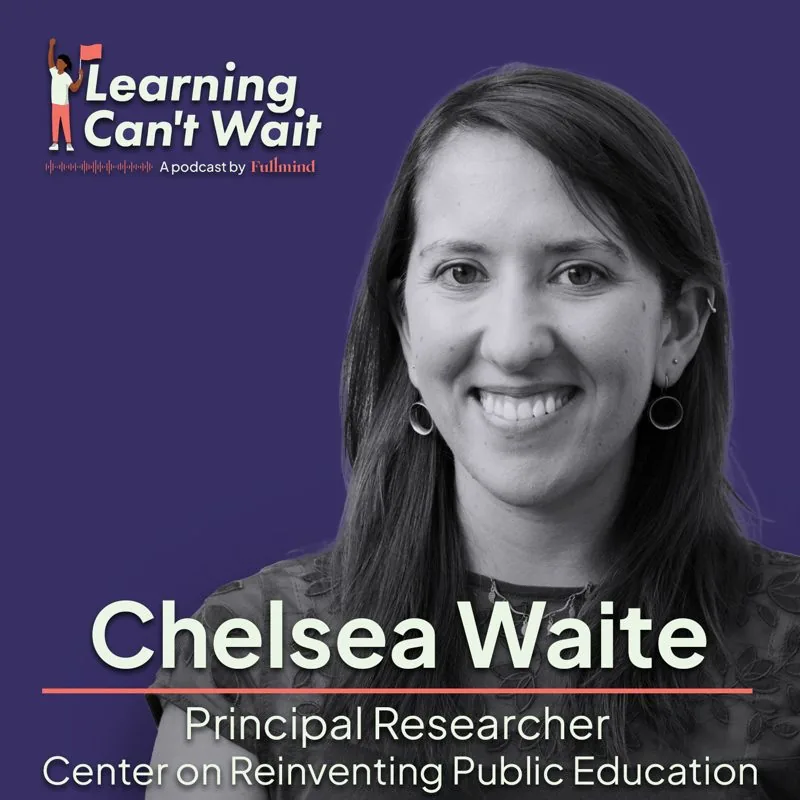
Chelsea Waite: Innovation, Multilingual Learners, AI in Education, Teacher Shortage
- Chelsea Waite, Principal at the Center
 Hosted by Hayley Spira-Bauer, Chief Academic Officer at Fullmind
Listen now
Chelsea Waite: Innovation, Multilingual Learners, AI in Education, Teacher Shortage
Episode summary
Chelsea Waite of the Center on Reinventing Public Education describes the Canopy Project, a national database of schools redesigning learning to be more equitable and student-centered. She explains why she calls herself a grounded optimist, shares findings on how schools serve multilingual learners by valuing home languages, and discusses how schools can draw on community members alongside certified teachers. The conversation covers post-pandemic student wellbeing, the limits of flashy technology, and advice for new teachers to find places where they can teach differently.
Key takeaways
- Innovation usually means getting creative on old, persistent problems, not adopting flashy new tools
- The Canopy Project (canopyschools.org) lets leaders filter innovative schools by model, setting, and focus
- Schools serving multilingual learners well prioritize students' home languages rather than English alone
- Staffing models can draw on community mentors and youth workers alongside certified teachers
- New teachers should seek schools where teaching is collaborative rather than solo performance
About this episode
On today’s episode of the Learning Can’t Wait podcast, host Hayley Spira-Bauer has a conversation with Chelsea Waite, Principal at the Center on Reinventing Public Education. In this fascinating discussion, Chelsea explains how she’s recently realized that the three institutions with the biggest impact on her life—school, church, and community theatre—are all shrinking today. Hayley and Chelsea explore what it means for institutions to change, and how they can best understand the needs of the communities they serve.
Chelsea also discusses her work researching the effects of the COVID pandemic on learning, and explains why she believes that the best innovations are often not the most flashy.
Join us every Tuesday at fullmindlearning.com/podcast. Next week, we talk to Hedy Chang, Executive Director of Attendance Works, and Malika Elwin, Executive Director of Attendance, Research, and Innovation at NYC DOE.
Full transcript
Transcript generated from the recording; minor errors may remain.
Hayley Spira-Bauer: Welcome back to the Learning Can't Wait podcast everybody. I am so excited to get together today with our esteemed Guest, Chelsea Waite principal researcher at the Center on Reinventing Public Education, Chelsea. Welcome to the Podcast
Chelsea Waite: Thank you so much. Hayley. It's great to be here I
Hayley Spira-Bauer: Ask my former guests, as my listeners well know if they have any recommendations about someone who they think would be an amazing guest, and Mr. Evan Stone, of E, for E. Recommended you, and I am so grateful that he did so. Thank you, Evan. If you're listening this conversation is sure to be an interesting one. Chelsea, you have such an incredibly interesting purview and education. I'm excited for you to dig in.
Chelsea Waite: I'm so excited to talk a little bit about what I'm learning, and I'm really grateful to be here.
Hayley Spira-Bauer: So why don't you start us off by telling everyone? How did you come to be the personal and professional version of yourself.
Chelsea Waite: This is such a great question. I recently had a sort of revelation about this. Actually. Currently and public education, you know, working pred predominantly, studying public schools. I am on a nonprofit theater board. And I am involved with my Unitarian Universalist church here in Seattle, where I live. All 3 of those things have sort of like long, a long set of roots. Sort of early in my life I grew up Unitarian, Universalist, which is a like a non Creole religion that's more defined by a set of principles than a set of sort of hard beliefs. And those principles are things like the inherent worth and dignity of of every person and use of the democratic process, and things like that pursuit of justice. I also was a theater kid in like starting an elementary school and going through high school and even parts of college and I think I loved making theater because it was this like real life venue where kids can make art for a real audience? And then I also wanted to be a teacher, probably starting in high school definitely through college. That was sort of my like. My like best bet for what I probably would do after college and so all of those things it's funny to like. Think about what those things were to me when I was a kid, and how important they were. Think about how important to to me. They are now and then. My revelation is that these are all 3 institutions that are like shrinking today. Churches, nonprofit theaters. And I think we have to admit, you know, based on sort of recent trends and enrollments, and even just population shifts public schools. And so I'm like, really coming into this like new found idea that, like the thing that I want to do in this world is to support the sort of strength and like evolution of institutions that I really think matter. I think, like churches are places where people find community and meaning, I think, like theater and arts are places where we like make new things, and like influence, culture and sort of reach out to each other in ways that sort of don't happen in in normal spaces. And then schools and and like learning environments, I think, are just such critical places where we like, become and develop who we are going to be. So that that you you're like one of the first people. For to whom I have shared that recent revelation.
Hayley Spira-Bauer: Okay, so that is really profound. And such an interesting thread that you're recognizing. How did you come to realize it? Was it like a moment where you were reflecting somewhere, or was it in preparation for this, I guess. Like, where did your was your light bulb moment
Chelsea Waite: I was at a board meeting for the theater that I'm on the board for, and we were talking about sort of like this, like persistent challenge of the business model of nonprofit theaters. And then, only a couple of days later, I went to sort of a learning session at the Unitarian church, where folks were also talking about how sort of churches writ large and like Unitarian churches, are no exception to this. Are just seeing their like membership decline seeing their members like disproportionately become older and older. And they're starting to question, like, you know what is church like? Where is church? How does church happen? Who is church for And so both of those things I was like Whoa? And then, you know, I'm having so many of the same conversation in in education about like, what is school? What is it for? Where does it happen? Who teaches in schools. And all of that, I think, is like coming from this place of like. These institutions have been around for a really long time. They were sort of designed, many of them in totally different eras, where like needs and sort of culture, and even, you know, the economy were very different. And they need to evolve. And I think one of the things that I studied in my master's program, which was focused on social innovation was about basically like, how do institutions change? And how do they, you know, change from the inside? How does sometimes they become change due to external pressure? How do they sometimes like change together by partnering and working together? So this question about sort of institutional change, I think, is also like a theme woven throughout all of that.
[05:00] **Hayley Spira-Bauer:** Oh, that makes a lot more sense. You have like building blocks, 1 one kind of realization that let upon another. So let's let's talk about education, what is going on from your seat where you are, which you told me the acronym for your organization is actually which was new for me. I don't know if all the listeners know that. Sophie, what in your seat at CRPE right now, and the work you're doing here as well as the work you've done in your previous roles. What? What's the kind of state of the Union?
Chelsea Waite: Yeah. Well, first of all, it's funny that you sort of phrase it that way. CRPE. The center on reinventing public education, has a report that we're now putting out every year for at least the next 3 years after this we've done it for 2 years, so far called the state of the American student and part of what that is trying to do is track and aggregate sort of all of the research we can find about how young people are faring. Especially after the COVID-19 pandemic so knowing that there was a huge disruption to learning and impacts on young people's sort of social connections and development and mental health. We're we're trying to continue to make sure that attention is drawn to the the sort of long tail of impacts on kids and young people. This year's report was focused on older adolescents, basically students who are in high school now, or have, you know, since gone on to postsecondary pathways? After being in high school during the pandemic and the news is not good, like young people are in many ways really suffering the the impacts both, you know, socially and economically and in terms of mental health. And so like that key message, which I think is one of CRPE, real like anchor strategic commitments to continue drawing attention to those issues is then sort of matched by another, a different and related organizational interest in find, in understanding and surfacing and sharing sort of promising solutions where schools as well as you know, other creative entrepreneurs and sort of creators of learning environments in the education system are like trying new ways of, you know, bucking old assumptions and and trying new ways of designing far more equitable and responsive, and in many cases sort of more individualized learning environments that take into account that young people are all different from each other. They have sort of different and differentiated needs. And as Todd Rose says jag and profiles. And they have. They bring both sort of strengths and needs to the table. And so can our learning environments and education systems better. Flex to, and then sort of respond to and support those strengths and needs. So that's sort of like writ large. One of the big things that CRPE is focused on, and and several of my projects at CRPE are really, but are really anchored in that like identifying possible solutions and understanding them, and building evidence for them. In order to then hopefully see them like spread and grow and one of the projects that I lead, the end that I actually have led since 2,018, before I joined CRPE, is called the Canopy Project, which is a national scan of schools and learning environments that are designing more equitable and student centered spaces for young people.
Hayley Spira-Bauer: So typically. You know, when we talk about these big topics in education, there's like a level of optimism or pessimism. And it sounds like the work you're doing allows you to focus on the optimistic aspects like, what's working. How do we replicate it. So I would ask you, Chelsea, Canopy project is a perfect example. So you're welcome to talk more about that if you'd like. But what's giving you like a large amount of hope right now, what can the what can the folks listening do their own research on be excited about? Look for schools that are in implementing. What's something that we can all just, you know, have as a as a feel-good, exciting future pathway for education.
[10:00] **Chelsea Waite:** Yeah. Well,I am an optimist, but I call myself sort of a grounded optimist.Not just head in the clouds as much as like II wanna see the sort of potential in things, and like help that potential to grow. So you know, as a as a researcher, I would say that those are the kinds of projects that I'm most drawn to and I do think I mean one of the headlines from canopy since the beginning is that schools all over the country in a wide and diverse range of circumstances, working with a a really diverse range of young people. Are finding ways to innovate, by which I mean, mostly kind of getting creative to solve problems that don't have obvious solutions. And so actually, one thing that I think is important to say is even though a lot of what you know CRPE is interested in is emerging solutions and promising solutions that address pandemic impacts on kids. We also know that the pandemic sort of serve to just like deepen many of the pre-existing inequities that we already knew about, and that are kind of hardwired into education systems. So these are not just problems that arose from the pandemic, but problems that have really been persistent in education. And II think the thing. That sort of keeps me going, and gets me excited to do the work that I do is getting to highlight examples of not just where people are sort of, you know, educators and leaders are developing like new or flashy, or like wild kind of different models for learning. But where they're developing models for learning that are really targeted at creating a better and a more equitable and a more student centered experience, especially for young people who have not had that in the way that our education systems were sort of originally constructed. So getting to learn from those leaders like those are folks who are focused on like real problems in the world and getting really creative to solve them. They believe that there are solutions. The solutions are sometimes sort of counter in some ways to what the current system, you know, leads people to do. But but they're out there and they're working. And they're working in public district schools. They're working in charter schools. They're working outside of the public school system. In all of those different spaces. So II think one kind of message of the project is like whatever you thought innovation meant in schools. There's probably sort of a wider playing field. Then you may have known, because this project is aggregating together a whole lot of different people's perspectives on where and how schools are innovating
Hayley Spira-Bauer: Someone tipped me off to an article this morning that feels so spot on to what you're saying. It's coming an education week by Alfie Kohn, and it's called the Sneaky Conservatism of edtech. And it's basically about how like there's so much. There's so many features. There's so many things there's so many, you know, like bells and whistles, and like that's actually not what is really hoping, or it's not always what is really needed. And yeah, can can the teachers lectures be jazzed up by a tool or a technology, sure, but, like what is really like learner centered. What is teacher centered? I'll I'll definitely share this piece with you. It's coming out September twenty-sixth is supposed to come out tomorrow and Education Week September 20 seventh. But it really speaks to your point about one. It isn't that we have to build something new. 2. It's not always that. The answer that is the shiniest is the right answer. There are things that have been working in schools for years, decades, even months, that show really promising effects that we can lean on. When you told me about canopy. I really, I was like, wow! I didn't know this existed like it felt really eye opening for me, and I was super excited. So folks listening have not done their research. Where can they find the? It's not on the CRPE website, it's or it links through the CRPE website. But it can be found on its own. Exactly. Yeah, it has its own landing page. And part of that is because, it's a project that it's kind of collaboratively
[15:00] **Chelsea Waite:** Stewarded. It's not just a CRPE thing. It's currently led by CRPE and transcend education. Another nonprofit and we have a range of it. We have 12 advisors from different nonprofits and research organizations and schools who are also involved. It's funded by collaborativefunder cohort. So the project can be found@canopyschools.org and on just on the homepage, there's there are kind of 2 things I would call out. One is, there's an interactive data portal kind of maybe we should change that term. It's sort of wonky. But there is a place where you can actually like access and browse the data yourself. These are annual surveys of school leaders whose schools have been nominated to the project by education organizations that have some kind of expertise and lens into sort of innovation, and k, 12, or with with an equity lens. So the data portal you can. You can either kind of go straight to a school's profile if you kind of know a school that you want to check out? You can also go to sort of like an overview map and filter and sort for things like. I want to see where public district schools and rural areas are really focused on project-based learning. And it'll you know, pop up a list of schools that are currently in the database that meet that criteria So that is one of the the key resources of canopy. We also then do annual reports where we're kind of analyzing the data that came through in the survey that year. And this year we we actually got. We got a little ambitious. We published multiple reports. There's one that is kind of an a flyover overview of of key trends in the data. But there's another. I'll just give one more example. There's another one that I think really kind of sort of speaks to, what we're talking to, which is focused on how schools are designing really meaningfully inclusive environments for multilingual learners in particular. And the kind of key takeaway from that paper which is both drawing on survey data from the canopy survey as well as some interviews with school leaders and canopy. The key takeaway is that you know, these schools are really prioritizing students multilingual development in multiple languages rather than seeing English language, sort of proficiency as the be all and all goal.And it's a simple but in some ways totally counterintuitive idea to the way that our schools and education policies are set up to really prioritize English.But part of what you know the school leaders are are saying, and what other research backs up is that there are in in many cases perhaps unintended, but real harms that come to young people when they're home or native languages are sort of being d prioritized to when they're being told. That's not. You know. That's not what we do in school. And so these schools are really embracing multilingualism. And they and the paper goes into some details on how they do that. So that's a great example of like solving problems that you know, getting innovation means solving problems that have sort of plagued education for a very long time. And sometimes don't look flashy. But then I do think there's a role for creative sort of breakthrough technologies that can sort of slot in in support of these like broader sort of visions and instructional models that schools are developing. So it's not that technology doesn't have a role to play but that to your point about the the article that you were just talking about. You know, if if the sort of flashy technology is like the beacon that is sort of inspiring, or like leading the charge, and you know what a school is trying to change. At least I think I'll I'll sort of go into my researcher mode and say in the canopy project, that is less what we see schools talking about. It's not like we want to figure out how to be like an AI focused school. It's like we are leveraging AI in these really specific ways with our specific student population to try to solve some issues that have been sort of at the root of why our students are not thriving.
Hayley Spira-Bauer: I think that's such an important distinction. I also just want to go back to the piece you shared about the multilingual learners, and they that schools are approaching. You know multilingual learners are some of the largest growing populations of students in the United States, and the work that's being done to support them is really disparate across the country right? There's politics that play into this. There's regional needs that play into this. There's funding issues that play into this. But the solution you're naming here seems like it'd be not very costly and like easy to implement which I think could be what may be so powerful about the particular research like. I read it before our conversation. And I thought to myself, exactly what you said. Wow! Chelsea, that is like so small but obvious and also profound. And and it is amazing to hear the ways in which schools are leveraging and like a strain space approach to to teaching and learning for kids.
[20:00] **Chelsea Waite:** Yeah, yeah, I totally agree with you. I think that is where sort of like the to to your point earlier, where the optimism can like really find ground to to thrive. I will say, I think. And this is a this is a big part of sort of what CRPE's research and and lens is all about. There are. There are so many kind of zones of wishful thinking that are easy to fall into when sort of landing upon an an idea that just seems like so like a gimme like, of course. But then kind of runs into all kinds of walls, and one of which came through in the in the papers, findings around. Just who are the teachers like? Where is the pipeline of sort of multilingual teachers who can be? You know, the the supporters of a an environment learning environment that prioritizes multilingualism. So it's I agree with you that it's sort of a it's encouraging that it it's sort of starts with a mindset shift more than some like massive sort of overhaul of like what a school is or like where it happens. But I also think that there are like real structural barriers that both those schools are facing. But then you know, other schools that might be trying to do this would also face. And that you know, as as you know. Well, like the where schools find educators, is just like a multi faceted problem these days. Cause it's both about like a sort of the pipeline and and access to trained educators large, but also, then, if you are a school with a particular sort of instructional model, a really tight mission and vision. You actually need not just any teacher. But you need a teacher who really like gets what you're trying to do, and probably has some sort of experience and history teaching in that kind of environment. Oh, Chelsea, do I ever understand that? You know?
Hayley Spira-Bauer: Not super like you're right. It is hard because there's this really significant regionalized need. I actually, on Friday shared and working research paper from Annenberg Institute at Brown, which I know you're familiar with the but they shared a unifying framework for understanding and predicting vacancies. And last year there was this like media attention in this really UN help, unhelpful way where it was like. There are teacher shortages. There are teacher shortages, are there teacher shortages? We're so caught up on this idea like, are there? Yes, there are, there always have been. They're just not everywhere. And it's not a national problem if you aggregate the data. But if you aggregate the data even like within a district find that there are shortages. So they actually, you know, the team of you know, craft at all, have started to really dig in like, how do we actually look at teacher vacancies? So we can get a better understanding. But it speaks to your point that this is a real issue you have in some districts hundreds of languages represented in their school. So how you how do you address the multilingual learner needs in both languages or for all languages, if you have hundreds. That would be a very difficult feat to accomplish on site. If that is what your framework is limited to or like your school's implementation is limited to.
Chelsea Waite: Yep. Yeah. I love it when like one of the things that I think we saw happening during the pandemic. But also sort of both, you know, with history before the pandemic, and, you know, ongoing sort of creativity after since then is schools that are sort of thinking more openly about, like the the boundaries of their school and the permeability between the school and the community. So, being able to leverage community assets. If your community also, you know, if you have kids speaking 100 of hundreds of languages, you've also got other community members, families speaking those languages. Not. All. Those people, of course, are like traditionally certified educators. And are there sort of staffing models and ways of designing your school such that you could sort of leverage those community assets for learning, you know, in partnership with certified teachers. And we had a great, we've seen that happening. It's happening all over the place. I'm sure there are many examples, but just one that comes to mind is in Central Falls, Rhode Island, where they were really focused on helping sort of be. They were creating kind of learning hubs or learning pods of young people who are especially sort of at risk of disengaging or actively disengaging from school, especially immediately, sort of during and following the pandemic and working on finding adults in the community who can be sort of mentors, coaches for those young people and support them in like making progress in their work, kind of re engaging in school, thinking about like who they are and how who they are, relates to. You know what they're learning in school, and who they want to be in the world. And all of those things are like that's kind of like youth development skills that are a not always kind of forefront at the forefront in traditional classrooms. And then BI think you know. Not not always, taught reliably in sort of traditional teacher prep programs. So we're definitely seeing lots of schools kind of leveraging like the, you know, community social workers in their in their communities or other like youth organizations. Whose expertise maybe is not education per se, but is like working with and supporting young people.
[27:00] **Hayley Spira-Bauer:** And that's why I think the the unabridged version of CRPE, which is a Center on Reinventing Public Education, is a really topical one for conversation. In that. You know, reinvention doesn't have to mean like complete redesign or complete disrupt like there. There are many ways to engage and rethink problems before us.
Chelsea Waite: So well fed. Yep.
Hayley Spira-Bauer: Okay. So I, you know, I'll always ask this ending question of what advice you would give a teacher. And it feels weird to say that we're already at the end. This conversation has gone so fast and I feel like I could talk to you about so many topics that you're studying, or have studied, or even are thinking about. So stay tuned for more, Chelsea. But I'm wondering what advice you would give a teacher who's starting their career today. Given what? You know. All the things you know. What would you? What would you advise them?
Chelsea Waite: Yeah. I love this question. And I, when I was reflecting on it. Went back to sort of my own early experience, like in the beginning of our conversation, I talked about how in high school and and most of the way through college. I thought that I was probably going to be a history teacher. Actually, I thought I wanted to be a high school social studies. Teacher. I majored in history. So hey? To kind of test that idea by doing. I also wanted an experience living abroad if I could sort of get if I could find one. So I ended up teaching English in Brazil for 2 years. And that experience was incredible in a wide range of ways. And also kind of taught me that I didn't want to be a teacher, or at least that was my kind of one of my takeaways coming from it. And when I look back, especially knowing what I know now, some of the reasons why I thought I didn't want to be a teacher in the end, were predicated on a very like traditional, narrow view of what a teacher's role is. I was alone in my classroom every day. I was like at the front of my classroom every day I was kind of responsible, for I felt actually it. I felt like I was tapping into my theater skills. I felt like I was kind of like acting and performing, if you will. And I couldn't imagine doing that like for my career in the long term. And I think my mistake was was thinking that that is all that that teaching can be and so again, going back to like many of the themes that we've talked about. There are schools like whole schools, and then certainly sort of programs within schools where it's possible to teach in very different ways, to be much more kind of guiding and coaching young people as they are, kind of following their interests or or working on a project. That is less so about you being in the front of the classroom. Sort of conducting. There are, you know, places where schools are experimenting with and developing much more collaborative teaching models, where you are not the only teacher in your classroom, you actually have a team of teachers who are all you know, working together, with a larger group of students. So I didn't know that when I started, and I think, for anyone who, whether you're, you know, just getting into a career in teaching or like you're a few years in. And you're like, Okay. I guess I've like I figured this out. I can do it now. But it's like really hard to imagine doing this for years on end. My humble advice as someone who did not end up being a teacher is to to try to find places where you can teach differently, and ways that actually sort of like connect to. Why you wanted to be a teacher. In the first place, whether that means like really helping young people to like, discover who they are and who they want to be in the world or getting to collaborate with other amazing educators or helping educators to like grow their skills. I think it.It's a profession where we think there's sort of only one way of being a teacher.And I think, increasingly again, based on what I'm seeing from this sort of set of schools in the Canopy project. There are schools out there that are like desperate for folks who are like, I wanna teach. I wanna work with young people, but not in ways that you know. Most classrooms are set up so it's out there can find it. I love that. And I think it's you know it's tough, because
[32:00] **Hayley Spira-Bauer:** The way we grew up is not how education is or has to be. And many of us, you know, we're learned in that stage in the stage model. So I appreciate the perspective you shared here. And also you have the bird's eye visibility. You know there are schools that are are teaching in new and innovative ways that are re redesigning. What education and learning and teaching and learning look like for kids. So. Chelsea, it has been such an honor to have you on the podcast today. Thank you. So much for sharing your wisdom and the work you're doing at CRPE. And the kind of project it is. It is really opened my eyes, and I hope our listeners as well.
Chelsea Waite: It has been a blast. Hayley, this is yeah. Thank you for creating such a generative conversation. Space.
Hayley Spira-Bauer: That's very kind of you. Thanks for seeing that. And thank you to everybody who tuned in.