
Learning Can’t Wait · Episode 77
Erin Mote: InnovateEDU, Student Mental Health, AI in Education, Authenticity in Leadership
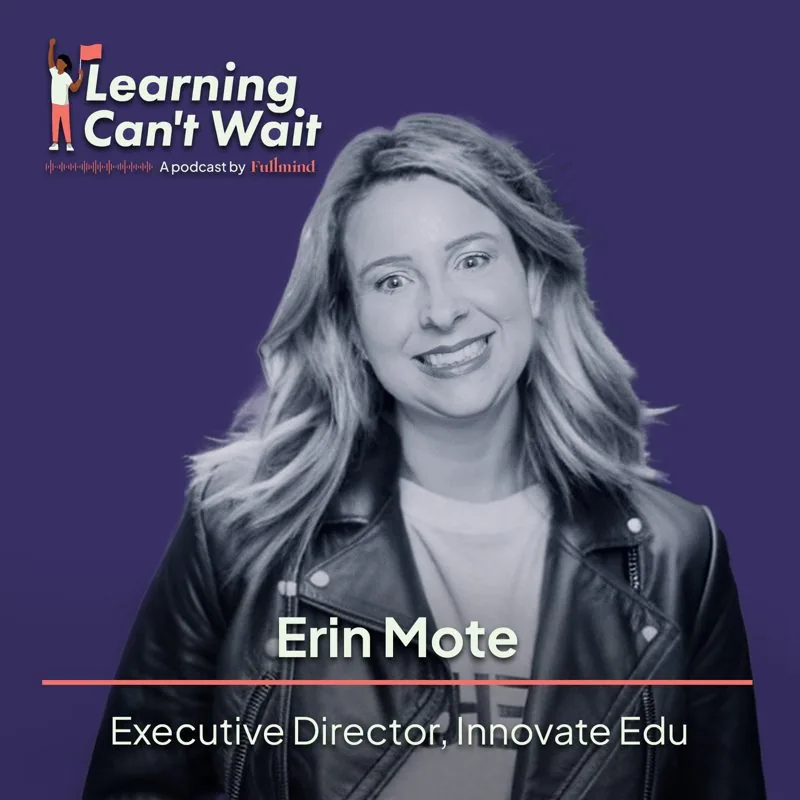
- Erin Mote, Executive Director of Innovate Edu
 Hosted by Hayley Spira-Bauer, Chief Academic Officer at Fullmind
Listen now
Erin Mote: InnovateEDU, Student Mental Health, AI in Education, Authenticity in Leadership
Episode summary
Kicking off Season 5, Erin Mote, executive director of InnovateEDU, credits mistakes, authenticity, and learning from anyone for who she is. She calls education America's greatest national security crisis, notes young people are opting out of post-secondary pathways because school isn't working for them, and argues AI and student disconnection both demand renewed human relationships. She describes the Pathways Alliance's national educator apprenticeship standards, Project Unicorn's push for data interoperability, and InnovateEDU's 80% common strategy for building coalitions. Her advice: take care of yourself and ask for help.
Key takeaways
- Young people are telling us school isn't working by opting out; treat that as broken product feedback
- AI democratizes expertise, so students need critical examination skills and a human in the loop
- Connection to caring adults reduces youth suicidal ideation severalfold; every student needs to be seen, known, and loved
- Educator apprenticeships with a mentor teacher of record, like training doctors, make teaching sustainable
- Find 80% common ground across political and organizational lines, as rideshare apps share a tech stack
About this episode
Season 5 of the Learning Can’t Wait podcast has arrived! To kick off our new season, host Hayley Spira-Bauer sits down with Erin Mote, Executive Director of Innovate Edu. Tune in to this thought-provoking conversation where Erin describes why she believes that the state of education is our biggest national security crisis.
Erin and Hayley explore how mistakes are part of constantly learning and why technology and AI doesn’t mean we need to lose our human connection. Additionally, Erin shares her work and thoughts about how to share the same infrastructure and standards throughout the education sector.
Produced by Fullmind
Full transcript
Transcript generated from the recording; minor errors may remain.
Hayley Spira-Bauer: Welcome back. Learning Can't Wait podcast listeners. It is Season 5, and we are starting with the bang. I wanna welcome you, Erin Mote, the Executive Director of InnovateEDU to the Podcast and really get it. Our listeners excited for what we're gonna talk about today. Welcome Erin.
Erin Mote: Hi, how are you. I'm doing great. As I told you before, we started this recording. It's snowing here in New York, and I am happy. How are you? I'm great. I'm in sunny 70 degree Arizona and as I told you, I don't love the snow so I can look at your snow. But and hear your joy, but I wouldn't share it. I think most of the time. I would rather be in sunny seventy-degree weather. So glad we both have our individual joy. Right now, it's gonna make for a great conversation.
Hayley Spira-Bauer: I know I'm so excited to have you on the podcast I have been looking forward to this. And II told you, when I asked you to be on the podcast that I really wanted to have you kick off season 5. We've had 4 seasons of incredible guests, incredible topics, incredible speakers. But this feels really important. I know you are doing incredible work in this space, and the listeners are always excited to talk about some of the topics that we have planned for today. So why don't we get started?
Erin Mote: Great
Hayley Spira-Bauer: Erin? How did you come to be who you are today, the professional and personal version of yourself.
Erin Mote: I made a lot of mistakes. Yeah, you know, I think this is nobody says that except people, I think, who are constantly learning, and I feel like that is the thing that has made me. Who I am is that I'm constantly learning something every day. With a I hope a perspective towards anyone can be my teacher. Sometimes. That's my 5 year old. Who, you know, teaches me about the latest thing on Roblox, because yep, she's 5 and playing Roblox already. She has an 8 year old, brother, so but you know, to the folks like Ed Gordon, who is over 100 and helped create Head Start. Wisdom is all around us. And it's really about how we listen to it, and how we bring it in. And so I've just made, you know, tons of mistakes in my life, and instead of letting those knock me down. I've just gotten right up again and and ask for advice and help when I need it. And I think the other thing is just authenticity. Kind of know what you you get when you meet me, whether you're meeting me for the first time, or whether you've known me for 20 years. II just have who I am. And I don't try to be someone else. I don't try to hide the complexity that sometimes is my life as a working mom and as a technologist, and as somebody who works with policy makers. It. Just, you know, I try to be my full self and I think that is what frankly, has led to. How much success I've had in the work of connecting people to do work that's really hard, that maybe they don't see themselves in that bridges on common alliances is because of authenticity and candor, and frankly. Just a willingness to learn and to not think. I'm the smartest person ever in a room.
Hayley Spira-Bauer: So there's nothing better than when someone proves their own point. You started out by saying you came to be what you are today because of mistakes. If that's not authentic, I literally don't know what is like. Yes, first of all. That's how we learn like you said. But
Erin Mote: Secondly, like you just said, your willingness to learn from everyone and anyone without limit, and that
Hayley Spira-Bauer: Is so authentic to who you are as a person. It you know I know you through the amenable Juliana Finegan. And you know, she said to me, Hayley. What you get is what you what you see is what you get like. Erin is passionate. She is caring. She is real. Talk to me a little bit, Erin, about how that presents itself in terms of your passion for the work you do, and what you pursue, what you have pursued as your career. And really your life.
Erin Mote: Yeah, I think that you know. I feel a sense of urgency 10 years in and InnovateEDU. That is more urgent today than it was when I founded the organization in 2,014, and for so many reasons, because one, I have seen what we can do together as a sector when we row in the same direction, and what we can do for kids, what we can do for educators, what we can do for families and communities, what we can do for ourselves as a sector, to evolve our sector, to be more of a learning ecosystem focused on continuous improvement. And so. You know, when I think about this like I, this authenticity piece of it, it also means like, sometimes you have to say the hard thing, and and that means like not everybody likes you like not. Everybody loves the person who says the hard thing or who. I don't know if I can say this, but you complete me. Who says, like bullshit? On things on LinkedIn? You know, who calls out bias in so many forms in our space and in our sector. You know. So you have to know, sort of like what's possible. You have to know that like sometimes you're gonna be unpopular, or people aren't gonna like what you have to say. But I think when you have the kind of moral clarity that I have around the urgency of what we need to do for our young people.I believe education is our greatest national security crisis right now.and as someone who came from the National security sector. That's a big statement that you know it's not Ukraine. And it's not, you know, something that's happening overseas. It's what's happening in our own communities and schools. And I don't say that to be isolationist. But because I think we are a country that believes in American exceptionalism. And yet we're also a country that's content to have the largest number of kids in poverty in the developed world, to have maternal mortality rates in the 30% for women who are African American. We can do better. And we need to do better. And we just need to like, take it on.
[07:00] **Hayley Spira-Bauer:** Your boldness is part of what I think makes you such a visionary leader. I mean to to make a statement like you just made that the largest crisis is on our own soil in our education systems. And that's what drives. Your work is powerful. And I think there's a lot of people who agree with you. You know you mentioned that when you founded InnovateEDU, you feel like it's urgency, and its importance is even more true today. How do you feel like the rise of attention on artificial intelligence and the changing landscape of both education and workforce has accelerated InnovateEDU mission.
Erin Mote: Yeah. Well, let me take on the workforce and education right now, because I think it's hard not to pay attention to what our young people are telling us. Which is sort of the heart of user centered design. As a technologist, our young people right now are choosing not to pursue post secondary pathways into institutions of higher education. They're telling us. Education isn't working for for them. They're saying they're not meaningfully connected to school. They're not meaningfully connected to the learning experience. And so. You know, wh. If you're in a if you're in a for profit situation, what your customers are leaving, you know your products broken in our education system, I think we need to hold up the mirror and say. Why are young people not choosing these pathways that we've set out? As a society? Why are young people saying, This doesn't work for me. Why are young people raising their hand and saying, I want something different. And it's not just, you know, in students who have the privilege to do it. It's in students who are, think, you know, who come from communities where college has been held up as this sort of golden ticket out of their communities. And I could talk on another podcast about why that that is a super dangerous narrative for our country, to say, in our most effective communities, you need to exit. We'll talk about that, maybe another day. But that's a big one. But I think our young people are saying, this isn't working for us. Our own. Our own students are saying, II don't like this anymore. And so we have to put them at the center of the way. We're designing learning experiences. I think we have to think about evolving from schooling to learning as an ecosystem, and you know the admin of technology with AI and AI has been around for a long time. So you're gonna hear me say that as a technologist like, I wanna make sure right? But what is new is the breakthrough into consumer consciousness? It's it's very similar to like what happened with the Internet. And when it was able to, you know, go from a computer terminal to a phone with a BlackBerry to an iPhone to now like you can't imagine not being able to order groceries. A car. Your laundry, you know, schedule whatever you need to schedule from from your pocket like. So AI is going to transform the way we interact in society much like the Internet has transformed the way we consume information, the way we think about knowledge for good and for bad. But I think the thing that's critical about both the connected. Why students feel disconnected from our system, and why we need to be attentive to AI actually calls on us to renew the fundamental building block of why education matters and what education is. It's the relationship between each other. It's the relationship between the learner and the person who is providing the wisdom. And so in AI, if that's the, you know democratization of expertise, then we have to equip our young people to with the skills to be sort of critical examiners of that expertise, to have a human in the loop, to continue to build our humanness as the rise of this technology happens. I think the same. For how we have to think about we engaging students back in school, I think we have to listen to our young people about their experiences and what's not working. Guess what they're gonna tell you. And we have to renew our commitment to forging connections between caring adults and young people. And when we do that, the research tells us research from the CDC that we reduce suicidal ideation in young adults by 3, 4 x times. And so this focus back on human connection, connections to the, to schooling, to the place of school, to the learning, experience being in the loop. The strengthening of our relationships, the strengthening of our ability to build that type of learning ecosystem is, I think, what young people are calling for is what AI is calling for. There's no silver bullet. But I'd love us to talk about. How are human this as a focus in education to build a learning ecosystem could get us where we all know we need to go.
[13:00] **Hayley Spira-Bauer:** You touched briefly on the impact that relationships and connection for students in school building has on their mental well being, we'd be remiss if we did not touch about touch on the topic of the absolute crisis we have on our hands of student mental health. And I would argue. Educator mental health as well, being there, both from like a a direct trauma experience as well as a secondary trauma due to the past 4 years of really challenging schooling behavior and not schooling behavior, really, really challenging environment, of being in schools. And really just epic proportions of rates rising quickly. When I think about how you yourself are calling out right now. Yes, we want to continue pursuing the technology. You're a technologist. This is important. We have to adjust our way of thinking. But really we have to focus on people that gives me pause in a very positive way. Because there's so many anti-technologists, so many Luddites out there who are worried about our human connection, our experiences, people. It really does highlight how the 2 are not mutually exclusive, like there is. There is a commonality in the rise of both at the same time.
Erin Mote: Yeah, it's a false dichotomy, right? Like to say that technology means that we're gonna lose our human connection. That's a choice. We would have to make and and II postulate that we can make a different choice, and I agree with you. I think we have an unprecedented crisis frankly across our society, around mental health right now. And for me I'm a mom, too. So like I was a mom during the pandemic, I mean, we almost quit kindergarten during the pandemic. I think we were like 2 days away from just like. You know, no longer doing 6 h of kindergarten on Zoom and I was ready to just quit kindergarten and redshirt, my son [student]. Right. But that's a real that's a privilege choice. First of all, that out, and also like, because the connect. He wasn't connected to folks in the classroom. He wasn't connected to his peers. And so I think we really need to be thinking about. How do we create anchors for our young people? Real life anchors like not anchors that exist in Roblox or anchors that exist in a virtual space. But how do we create places and spaces with meaningful connections with folks that they value? And they see as connected to them. And that doesn't also have to be just an educator that could be a paraprofessional, a coach, a tutor. There's just. There's many places where. If we thought about, how do we strengthen the human connection. I think we would be seeing our young people say. You know what? I don't need affirmation from the number of likes I get on my TikTok Video, or the number of people who watch my insta reels, or who look at my Twitch, that, like the the way that I am seen that I am known, and that I am loved is what really matters, and I don't think we should be shy about saying that thatour young people all people need to be seen, need to be known and need to be loved.
Hayley Spira-Bauer: You know, one of the repeat guests we've had on the podcast is Hedy Chang from Attendance Works love that lady I mean just brilliant, brilliant beyond measure. But in the first appearance that Hedy came on we had a assistant principal of a school district in New York who has exceptional attendance rates. The school is well known for their attendance rates and their their like lever, that they pull for attendance, which sorry I should back up and staff all this a bit. Mental health is connected to attendance. We see that with higher attendance. They have more positive outcomes on their student mental health readings, self assessment, and reporting of mental illness, so just to name that the 2 are very well connected. And the school leader said that they have a very robust mentorship program in their school, so any adult in the building could be the custodian could be a counselor. To be a teacher is connected to kids in the cohorts. Follow through the length of high school. And it just speaks to what you're saying here, like, there is a student is with a teacher or an adult in the building throughout their time, which is showing better mental health outcomes better attendance, and ultimately is helping this district thrive and serve as a real model for how you create that connectedness within the building. You know, it's it's building blocks here.
Erin Mote: Yeah. And I think we have to. To your point about educators. I think we have to be as attentive to the connectiveness of our educators, in their school communities or in their professional learning communities, as we are to our young people like I. The thing that I love about educators is, they are constant learners, right? So one of the things I don't want us to see is a toggling down of opportunities for our educators to grow and have professional development. The inability, you know, the inability for folks as we face educator shortages, seeing folks having to give up their prep period or give up the time that they have in professional learning communities. In order to staff more classes, we we really need to be attentive to making the education, profession, a sustainable profession. And that means looking at the working conditions that our educators have and the working conditions that we're creating. And so we do a lot of work at InnovateEDU on a diverse pathways into the profession through an alliance we have called the Pathways Alliance, where we built the national guideline standards for educator apprenticeships with the Department of Labor and the US Department of Education, which have now been adopted from 2 to 28 States in one year and one. And it's a it's amazing. But one of the things that the research tells us about educators who stay in the profession that deeply informed. The work that we did on the national guideline standards is that when a teacher is an apprentice, when an educator is an apprentice, they are not the teacher of record in their classroom. They have a master teacher or certified teacher that's mentoring them, that they're learning from, that they can make some of those mistakes that I talked about earlier. That they, you know, aren't put forward as the teacher of record on the first day that they're taking on a new job that we're appreciating the professionalism of educators and the need to build those capacities and dispositions. And so, you know, when II built a school in Brooklyn. That I'm still that I get to be the founder of. So I get to like wave at homecoming and graduation. But I'm no longer involved in the day to day operations but what we built Brooklyn LAB.
Hayley Spira-Bauer: When Eric and I were sitting around the table in Brooklyn in 2,014. We looked at each other, and on this napkin, where we literally built our school design, which I still have the napkin. I also saved, like the champagne cork from my engagement on all these things. It's not framed, it's like, but
Erin Mote: One day I'll frame it when my kids are in college, and I can get to get some free time. Yeah, when I get some free time. But it says teachers trained like doctors. And so I just want us to think about the way we train doctors in our society that we create pathways for them to develop the knowledge capacities, the mentor capacities, the ability to learn in groups the ability to learn in professional communities, the ability to make mistakes, the ability to have an attending and a mentor like. That's the way we should be thinking about our educators. It's as an important profession as a doctor. We need to think about that when I and I'll just bring back, like, if education is our greatest national security crisis, we need to really be investing in the people who are gonna help us solve that
Hayley Spira-Bauer: Here. Here educators deserve to be on a pedestal. Erin, you are incredibly well known for bringing people together, and I imagine in that work you do of bringing people together for collaboration. You get the ability to see really strong partnerships develop. And I'll use your words here that compliment one another versus compete with one another. Can we talk a little bit about? Because I think this is now like having a step back a bit from the conversation of you know, teacher development and student mental health. But it's really talking about the the professional learning that happens within the nonprofit space for the people that are are sometimes influencing these, the things that get built and the decisions that get made. So let's talk about that. How do you? How do you facilitate a collaborative relationship. In the, let's say, non-profit space akin to the type of collaboration you're talking about for educators in their early years of learning to become a teacher.
Erin Mote: Yeah, so at InnovateEDU, we have this thing that we call 80% common. And it's a really deliberate strategy to not get everybody to 100 agree to try to get the number of organizations that we bring together in partnership to degree on everything all the time is impossible. And so just like recognizing that. Like. You know, you can get often to 80% or 60% that you can get to common ground frankly across political lines, across geographies across. You know the types of structured ideological situation we have right now in our country around, a whole raft of education issues that you have to look for common ground. You have to pursue common ground rather than pursue difference. And so this comes from technology, right? I'm an enterprise architect by training. And so maybe some of your listeners use Rideshare. They use Uber. They use Lyft. They use maybe something that's unique to their contacts. Maybe they live in Austin, Texas, and they have like Ride Austin, or some other local ride, sharing app. What you might not know about those ride. Sharing apps is on the back end. They are all using the same payments platform, the same mapping technology, same customer ticketing system, the same trunk. As we call it the same text stack. It's 80%. Maybe I love it. Yeah, maybe 90% common since the last time I looked. But those 2 distinct brands, Uber and Lyft, for example. Have have built around the 20% differential. The thing that's different about them. So Lyft has their like pink sort of more fun. Brand Uber chose a more corporate focus. They sort of built different things around the user experience. They share a lot of the same safety features. The user experience has a brand connotation. But actually, the infrastructure is common. And so. Thinking about that that the experience that you have is is different, maybe when you use them. But all the things that undergird that technology is the same. And so how do we get to commonality on infrastructure? How do we get to commonality on the operating tech stack of education? And so how do we have common a common definition of the competencies and dispositions it takes for an educator apprentice. We build the national guideline standards, and there we built 2 sets of standards, one for collective bargaining environments, one for non collective bargaining environments. That's how we got to the 80%. There, we had to recognize the context in which people were operating Project Unicorn, our longest alliance that focuses on data, interoperability and education. We started that alliance. Nobody knew what data interoperability was. And then this August First Lady Jill Biden stood up in the East Room of the White House and said, we need data, interoperability and cyber security to come together. And so how did we actually get there from, you know. A conference room where nonprofits and Standards, bodies and the K-12 advisory board and industry. We're all thinking about data, OP interoperability, thinking about how it could help share information about young people in a secure and private way, how it could inform data driven instruction. How did we get it to a place where now, you know, it's the second biggest challenge that CIOs and CTOs talk about across the country, and they use the word interoperability. They don't say things like my systems just don't talk to each other. It's cause we all rode in the same direction. We said, our big goal is this. And that's what we're gonna row towards in the same direction. So it's about clear vision. Clear goals and finding common ground.
Hayley Spira-Bauer: This is not easy work. And your emphasis on 80%, which, to be candid, I had not heard that before as part of your work, but makes so much sense to me. It also highlights. One of the one of the beautiful things about our world is the diversity of it. So it's not saying, you know, I think about this one kids book that talks about all the kids. If everybody was the same and more the same outfits, it would be so boring the world boring. So I appreciate both the emphasis on. There's a lot more we have in common than we know, especially in such a fractured environment today. But also, you know, we're individuals. And we have, you know, unique vision and experiences that help develop who we are and what we build and how we create. Oh, Erin, I am am like feeling dread about getting to the end of a conversation. Given our. You know how long we typically record these episodes, because I feel like I could talk to you for days about literally everything that has come out of your mouth. You really are so incredibly inspirational, as you know teams are doing. II think about the word interoperable. Just to go back to this point. Interoperability anonymous with Project Unicorn like it, literally the 2 just go together. When I think about where it came from, and I'm sure so many others feel that way. And how proud you must have been when First Lady Jill Biden shared and use the use the language and called for action there. But I do feel like we have to get to our final question, which you know it. Especially someone who has built a school and it and speaks with school leaders on a regular basis, came from your last call. Being with a superintendent. I'm sure you have really important wisdom to share. But you know, Erin, I ask everybody at the end of the conversation what advice you would give an educator who's just beginning your career today.
Erin Mote: Take care yourself. I have come to realize that I can only be my full self when I take care of myself, and that means, you know, when I get enough sleep. Something basic like that. But also when I find joy in sort of small moments, and experiences when I can take one of those mistakes that I talked about, and sort of. Just say, like, Yeah, that's a mistake. Let me get back up from that and and I think the last thing I would say is, ask for help. This is something that I have not always been great at just to be radically candid, I've not always been great at asking for help and saying I need some help here, or I don't know how to solve this problem, or what am I going to do? The when you invite wisdom and learning. You'd be so surprised. What happens? I think that what I have discovered is thatvulnerability is my superpower.
Hayley Spira-Bauer: Here here again, I mean Erin. Thank you so much for calling out the things that are hard to say both on this podcast and in real life. I think it's a sign of a true. A true, like empathetic human who's willing to stand up for what's right, say it out loud and call it out upon themselves as well. So so grateful. You're joining us here on the podcast today. Shared so much. I know we can have 8,000 more conversations, and maybe one day we will on the podcast and other places and spaces thanks for taking time out of your day to be here with me. What a pleasure! And enjoy that snow! Thank you, and enjoy that 70 degrees. And thank you to everybody who tuned in.