
Learning Can’t Wait · Season 1, Episode 6
The Student Mental Health Crisis
 Hosted by Hayley Spira-Bauer, Chief Academic Officer at Fullmind
Listen now
The Student Mental Health Crisis
Episode summary
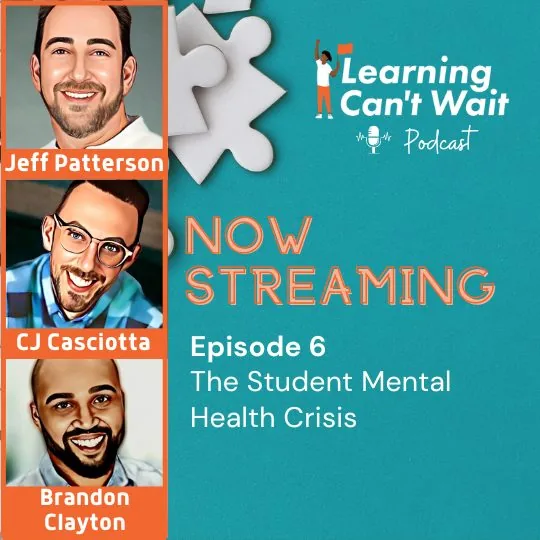
Brandon Clayton, CJ Casciotta, and Jeff Patterson discuss the student mental health crisis. Jeff shares how Gaggle's monitoring intercepted a New Jersey student's suicide note. Brandon describes students without healthy coping skills, rising vaping and anger, and teachers exhausted by the Great Resignation. CJ frames the pandemic as a convergence of tipping points and urges local, grassroots agency. All three agree SEL must start with adults, that caregivers need care, and that teachers deserve real compensation. Hayley closes with a personal reflection on school violence.
Key takeaways
- Gaggle flagged a student suicide note in a Google Doc; that scenario repeated over 1,400 times last year
- Students lack healthy coping mechanisms, showing up as vaping, anger, and reactive conflict
- SEL work has to start with adults; there is little SEL content for educators themselves
- Make it okay for teachers to take time for self-care, and listen before offering quick fixes
- Teachers' impact is a policy question too: compensation should match a lifesaving profession
About this episode
In this episode, Hayley Spira-Bauer interviews a panel of academic experts about the state of mental health in a post-pandemic world. The COVID19 crisis affected students and teachers in unprecedented ways, and two years later we are still trying to find the new normal of education. Brandon Clayton, CJ Casciotta, and Jeff Patterson help us face the hard truths by sharing their personal journey's creating organizations that support those in mental health crisis. This episode explores the importance of taking action NOW, and ways that you can make an impact in your community.
Learning Can't Wait is brought to you by iTutor.com.
Full transcript
Transcript generated from the recording; minor errors may remain.
Welcome to the Learning Can't Wait podcast an iTutor production at iTutor. Our vision is to ensure every child has access to education regardless of circumstance. Each episode, we will be joined by Pathfinders within and around the education space. Who are bringing about transformational change? On behalf of deserving students, I am your host, Hayley Spau.
Thank you so much for joining us today for our episode on student drivers labeled Urgent Student Affairs, the Mental Health Crisis. Joining me today are three very brilliant, very passionate educators. I'm gonna call all of you educators. You may describe yourself differently, but I'm still gonna say you're educators.
starting us off. I'm gonna welcome CJ, Jeff and Brandon to the table today. Thank you so much for joining me. Thank you. Thank you. Thanks. I would love for you each to describe your heart work and what led you to education and or the care of students. Why are you here today? Why is this topic important to you?
We'll start off, we'll go alphabetically by first name, starting with Brandon Clayton. All right, thank you very much. As was mentioned, my name is Brandon Clayton, and, why am I in this work? I've been an educator for about 10 years. Well, first of all, I got four kids, all girls. So I'm invested. I have stakeholders at home waiting for me, so we gotta get this right.
so I got, I've been in education for about 10 years, teaching as a math teacher and a second. I quickly learned once I got into teaching that it wasn't as cut and dry and straightforward as I thought it was a little bit messier, which means I, there was relationships. I was on my knee asking questions and giving hugs, and I was like, what's going on?
I thought I was gonna teach my curriculum. So that's when the shift started to happen for me, Hayley and I realized, okay, there's something more here than just teaching my curriculum and following scope and sequences. After teaching in many different schools, I realized that teaching students who are the struggling students who are having a tough time academically, behaviorally, those are the ones I vibe with the most.
So I interviewed to be with those students. Long story short, we did well in our academic scores in the classrooms that I was in. I was brought to the district to be a coach, an s e L specialist, and I got a chance to see from K through 12, not just my classroom, what was going on with. Students all across the district and with teachers.
And so they gave me a different framework after those two years. I'm now in the position, of the Texas Tech Principal Fellow, where I get to see from the principal's perspective all that's going on from the behind the scenes, if you will. So I'm, I'm in this work because I know that there's more here than just filling a student's head with knowledge.
And I know that there's a holistic person here that needs to be catered to. And I was that kid. I grew up in a poor home. It was a blended family. Two families under one roof in a poor neighborhood in the hood as they called it. We was in South Dallas. I dunno if anybody ever been there. This is, Texas.
But we grew up in that neighborhood and I know what that's like. I'm now in a very exciting role working with iTutor and with Claris in which we've created curriculum, SEL curriculum. That helps teachers to make those connections, one with themselves and with their students. So that's what's brought me here and that's what keeps me here.
Thanks Hayley, for asking. Of course. Now listen, before we go on to CJ, I just wanted to point out the term, give a literacy moment for SEL l I am confident that most, if not all of our listeners knows what that means, but SEL stands for social and emotional learning. It's something you're going to hear. I am confident referred to a lot during the course of this convers.
We'll get to it more in a little bit, but bef, without further ado, CJ, tell us a little bit about who you are. Yeah, thanks for having me, guys. I'm, I'm sort of the odd man out. I am not a traditional educator. I'm a, I'm a media producer that got into the field of social-emotional learning and, and edtech.
And I feel like a student who is sort of building the plane as I'm learning how to be an. But we created, about two years ago now, this platform that we keep building that's really based around teaching kids social-emotional learning in fun and interesting ways. We describe it as TED Talks meets Sesame Street.
So we have these characters. It's an alien and a robot. They sort of host this intergalactic news show where they're very interested in why earthlings are so strange. And so what they do is they go out, well. They partner with kids a lot to interview. Really interesting, strange, weird grownups. Sometimes they're kids too, but anybody who's using their strange and crazy imagination to make their communities a better place.
So we've had New York Times bestselling authors. We had ti time magazine's, first Kid of the year interviewed. And then we've had, some of my favorites is people that not a lot of people have ever heard of, but are doing really fun, creative, interesting work on the ground, helping their neighbors, helping their communities, and really practicing these social emotional skills.
In real life and, we, we really work hard to make this sort of group of people that we interview and we showcase diverse so that kids go, oh my gosh, that person sort of looks like me. Or they have a similar story to how I grew up, or who I am so that they can understand and believe, you know, much more readily that this is some sort of.
Pie in the sky kind of idea, to to be a social, emotionally intelligent human being or to, to, to use your creativity and your imagination and your own weird sort of story to help others in your community that this is indeed possible and, intangible. And so it's called, I don't think I mentioned the name.
It's called Ringbeller. And, who's just gonna say, CJ go ahead please and tell us the name of that amazing site. Oh, yeah. No, it's called, so, it's called Ringbeller. And, and yeah, we're having a blast, just putting these videos and these, little interactive lessons together out 1,350 classrooms right now around the world.
And we just love hearing teacher feedback and it's, it's fun kids, could really take to these characters and these lessons. CJ, thank you so much for sharing that. I can't wait to hear a little bit more over the course of this podcast. And last, but certainly not least, Jeff Patterson, Hayley, CJ, I'm, I'm like you.
I don't think of myself as an educator. I'm, I'm not a traditional educator. In fact, in my LinkedIn profile, I say coach and cheerleader. So I I, my background, I started Gaggle about 21 years ago. It's an EdTech company focused on helping to keep kids safe. And I like to describe what we do as we are a early warning system of kids in crisis so that we can alert someone in the school system to prevent a tragedy from happening.
And I know that's a lot of words. I'm a storyteller, right? I believe stories are powerful. So if it's okay, I wanna tell you a story that sort of highlights what we do as a company, but it's, it's dark and I apologize for that. We're here on this podcast because we know we're living in difficult times for kids.
So this is a true story from a school district we partner with in New Jersey. It was a Friday evening and they had a boy who pulled out his Google Chromebook and he opened up a Google Doc and he started writing and he said, I'm tired of faking my feelings. I've got no one who loves me. Not even my.
My only choice left is suicide. So he writes this in a Google Doc and what my company does is we sit behind the school's digital tools, and we're looking for these cries for help. And the technology highlights them, and we have people that are reviewing these 24 hours a day. Our safety person recognizes this, you know, credible threats.
So we called our emergency contact, which was the principal. The principal started calling home while the assistant principal called the local police, you know, for a wellness check. The principal got ahold of parents and the parents said, no, our, our son is fine. He's, he's upstairs into the room. We just finished dinner.
But when they went to look, he wasn't there. And that's why it became so important that the assistant principal got a little to hold of local police cuz they knew in this town exactly where to go. The trains were in through on their way to New York City and there's a certain spot where two kids before had jumped in front of the train to commit suicide.
And sure enough, they found this boy walking to that spot. Wow. So Hayley, Brandon, you probably know this, but like we are in the middle of a student mental health crisis. It was going on even before the pandemic. Right before the pandemic. We had 6,000 kids a year that were taking their own lives. And, there were stats before the pandemic of 3000 high school students a day were attempting suicide and, and people attempt before they succeed.
And all of that points back to the, the what's going on in their mental health and why they get to that spot. Right? We're identifying thousands and thousands of kids that are basically self-harming and cutting themselves. That story I just shared happened over 1400 times last year. And it's just, it's gotten so much worse during the pandemic.
I'm looking forward this conversation about how, how we can inform the world and how we can do a better job with helping kids. Jeff, while it's a dark story, you told, it's an important one, and you started actually to lead us into what I think always helps ground our conversations is in a little bit of research, right?
So before the pandemic, we were seeing that one five children was affected by mental health, illness and struggles, and those numbers have only. Most recently, a coalition of the nation's leading health experts declared a national emergency surrounding child and adolescent mental health. I think that's an important step, right?
So like, let's start from recognizing that there's a problem and, and data is always a good way to ground ourselves in that particular problem. So from people at, in maybe Jeff's vantage point and CJ's vantage point, we're reading the numbers, we're following the numbers. My my own vantage point, we're thinking about the numbers.
How can we better build products that support the wellbeing of children? But from Brandon, your own vantage point as a school leader, as a teacher, as someone embedded in the school, how is this mental health crisis. Actualizing in your day-to-day, like where, where, what does it look like, feel like, sound like in a school today?
I won't say it's post pandemic. We're definitely not in a post pandemic world quite yet. But you know where we're living right now. That's a big question, and I know it's tough for me to answer for all schools, but I'll answer for the school I'm in now, I'm at a high school and I've been to elementary, middle school, I, I get a chance to move around.
So here's what I'll say. From what I see, students are having a difficult time finding healthy coping mechanisms so we adults can struggle. And do struggle, and we can pull out the numbers for that. Those are all types of ways that adults are trying to, medicate and escape and all these ways of dealing with what's going on.
Now, you put that inside of a body of a seven year old, of a 10 year old, of a 14 year old. And all their worlds are being shaken at home, at school, in between, and they're trying to make sense of it. So they're looking for coping. So we saw a huge rise in, in, in drug use right now. Vaping is huge right now.
I don't know if y'all hear about it, but on our campuses is huge, just looking for something to escape. They're finding ways to use that in in this. Kind of a cool thing. People are having a difficult time processing anger. So when there's a confrontation, we're really seeing that there's a need for anger management.
Like we're asking the question, do, is there any other way that we, and they're like, no. They, they talk to me like, this is what I need to do. So there's a very, there's more of a reaction to everything and not knowing how to cope with what's going on. And as teachers and adults, we know that the issue in front of us.
That was being brought to the office or that's being brought up, that's not the issue, right? There's a lot of layers of other stuff going on that I can't figure out how to filter through. So those are some of the ways that I can see it is students are having a difficult time knowing how to deal with what I'm feeling.
divorced, I'll mention that as well. Whether it be drug and, again, divorce or academic, some of the smallest things or big things will set students on different courses, from young to old. So I think that's the biggest thing I'm. With boots on the ground, you know, a lot of this information, I'm sure.
And then Gaggle is keeping, from my understanding, kind of copious records and notes and data on trends. So is what Brandon's sharing reflective of the trends you are seeing on the backend at Gaggle? Oh, a absolutely. Right. And, and I, I think Brandon mentioned, Anger management, the coping mechanism for when there's a conflict, right?
Adults aren't good at conflict and kids are still learning conflict, and yet they haven't been around each other for, in some cases, 15 months. And now they're basically back into a boiling kettle of, of emotion and, and hormones, right? And so, you know, I, I love the idea of focusing some of the SEL work on, on conflict resolution and, and coping mechanisms too, right?
I recently read that therapists are no longer telling kids don't cut. Right? Because in a way, cutting is a release of some of that emotion. Of course, it's not something we want them to do, but better that than suicide attempts. So yeah, absolutely. We're seeing in our statistics, dramatic increases in bullying, harassment, depression, self-harm, and the suicide idea.
You know, it's tough because as we mentioned, these rates were dramatically increasing prior to the pandemic, but we'd be remiss if we didn't name the fact that the pandemic has increased the ACE scores of students all over the world. Right? The trauma scores is basically like the equivalent of an ACE score here, different types of abuse, neglect, and other adverse childhood experie.
And so when trauma scores increase for children, it becomes difficult to lead with productive coping mechanisms, productive conflict resolution strategies, because your brain wiring is somewhat altered from that increase in your trauma, right from, from the trauma that you've experienced. And the pandemic alone has increased the trauma scores of many, many, and most students across the United States.
Like I I, I, I sit with that. I think about that a lot because. We were already up against so much prior to the pandemic, right? The rise of use of social media and the negative impact that that has had on children. It is like a big number that I used to hear a lot in schools. You have a, if I can speak into that a little bit cuz it's something I'm thinking about a lot.
It, when we talk about the pandemic, it's like, it's really a convergence of a few different tipping points all at once. You know, a a, a medical pandemic is something that just sort of broke the camel's back, you know, so to speak. You know, you talk about social media, you talk about, just the divisiveness that we sort of have felt as a nation.
You know, again, you add sort of something that exacerbates all of that and gives a really great sort of reason to be even more. Isolated, upset, divisive. It's like, it, it was sort of a, a, a storm, you know, in the, in the making wave. Perfect storm. So really what we're trying to figure out, I think as a culture, we need, the question we need to be asking, especially when it comes to our, our kids in the next generation, is these things aren't going away necessarily.
I don't think we're, we're looking at a, going back to normal situation. I think it's idealistic to go, let's just throw away every social media platform there is. There's a lot that needs to be regulated around those things, but I think the question we need to be asking as a society is how do we want to shape and steward this new.
Culture, how do we, what, what do we want this to be about? It's, it's, it's time for like a new bill of rights. It's time for, you know, for think tanks and for gatherings like this to go, okay, this is what we're dealing with. This is, you know, it happened, we were maybe careless about the fact that , it happened.
and I'm, I'm talking about everything that sort of got us to this point. Now let's pick up the pieces and figure out how we are gonna take ownership of this collectively, collaboratively, inclusively. And I'm a bit worried that I'm not seeing enough of those kinds of conversations. By the way, this, I don't know, those conversations are going to necessarily happen on Instagram, on Twitter, on, on these places that are, that are sort of inherently designed to keep the conversation polarized, keep the conversation, blunt.
they need to be happening in our communities at a local level. In long form conversations like, like this, like we're having right now, you know, in, in a podcast. And what better place than a public school? You know, what better place, what better sort of beacon libraries. You know, what, what better place to have these kind of conversations than these places that have not gone away.
They have proven the test of time. They, they, they made it through this, you know, really dark. Let's, maybe let's lean on them a little bit more, versus trying to, to, to rush to, you know, the, the end, the metaverse, the quick answer , the, the, the change, so to speak. I'll open that up to, to everyone who's, who's joining.
Right. Jeff and Brandon, you know, CJ asked a good question here, does it land with you? Do you feel compelled to add some of your own perspective on. So I, I, look, I, I'm struggling cuz like, I mean, I've watched the congressional hearings around Facebook and them sort of inciting, essentially hatred by controversy.
But this is what our media does too. CJ, I, I don't know the answer. Who's, where are those conversations gonna happen in a responsible way? I don't know anymore. It's not gonna happen on the campaign trail. It's not gonna happen on social media. Does it happen on our news media? I don't think so. I, no, it's, I think it's genuinely gonna happen in small, yeah.
Maybe localized communities and conversations like this that are, are a little bit less concerned with how they're positioned outward, to your point, and more concerned with the hard work and outcomes that, and the future we all imagine. It's the grassroots, right? It, it . This is something I come back to a lot like in education.
Is it top down or is it bottom up? This, this is a theme amongst, I know you haven't heard the other podcast yet, , Jeff and CJ and Brandon, but this is a theme. Is change going to happen from the top down or is it going to happen from the bottom up? Jeff, I hear you saying bottom up. Not to to oversimplify, but.
Well, was it, Winston Churchill said, you can count on the Americans to eventually do the right thing after they've tried every other thing first. And so maybe that's a bottom up right there, right? It could be. It could be. You know, I think one thing that's being said that, I'm going to say outright as well, is a lot of the conversations we're talking about are having with adults.
So I, you know, it's funny cuz we're talk, when we start getting to solutions, we're started talking about adults and although this is a, a crisis dealing with our students and our children, it seems to come back to that. And one of the things that we spent. A time when we're developing this, SEL and that I've seen as well, and this can be very frustrating because much of the, the challenges you're seeing are connected directly to adults.
It could be a teacher, it could be a parent. So one of the, the ideas that I put forth was we had to put our own masks on first. We have to put our mask on first, cuz it's easy to see this and say, the kids need help. Here's a, here's what you need. And the adults have to breathe. They're, castle. They're, they're the gurus when it comes to SEL.
I'm sure you guys are, know that, but one of things, there's some not, there's some vigorous nodding happening across the board. For those of you that aren't looking at the video screen , one of the things that, you know, we, we got so. When we were developing the course for my district where we were developing it for iTutor and there's so much content out there for students, guys, there's so much content in that you guys are creating, and I found in the research there's so little content for SEL work for educators and adults because we can track students, we can give it to the students.
But when I looked at CASEL's research, I remember reading a statement that says this idea for us to go to the adults first. I was like, oh, that makes sense cuz I, because when I did these presentations in schools, I said, okay, how many of us are struggling with self-management? ? Like, they're like, yeah, there's, there's a whole industry about motivating adults.
There's a 10 billion industry about getting adults. Like, do I want to do this? Do I have a goal setting at attitude? Am I even aware of what's going on with me right now? How can I teach that? How can I model that? If I'm not showing that? So I think that's one point that I'm hearing and I want to put a, a, a pin in to say, if it's going to start anywhere, it looks like it's gonna start with you and I it's gonna start with us.
Like you say, having these conversations. Not simply just giving the initiatives to schools and saying, here's for the kids. The kids give this, but what are we doing in our classrooms? One teacher at a time to say, Hey, are you healthy? Are you happy? So those are the some of the things I, I want to put out there.
Br Brandon. That's so good. I, I can't tell you how many times in like the past year, you know, I've heard things like, Well, you know, Instagram's really, it's really r rough for, for, for teenage girls and you're for preteen girls, you know, and I'm like in my little corner going, I, I've actually, I'm, I'm a 36 year old man and it's pretty rough for me too.
Like, I don't, I don't know what, like, I don't, I don't know what this like siphoning of, you know, it's, it's, and I don't, but we don't wanna talk about that. Like, it's, it's genuinely like we at least, you know, I'm a kind of a, a millennial exer. You know, cusper and I think we we're really to, to blame for being sort of that, that frog in that boiling pot of water.
It, it, it really has started with us and we've got kids now who are modeling our decisions and our, every time we sort of just accept that this is the way it is. But one of the things that I, I wanted to say, Hayley, you know, really quickly about the whole bottom up, top down is it feels like we've had that conversation for so many years and it feels almost like a, a, we're doing ourselves a disservice by making those things, a dichotomy.
Like I, I feel. When we talk about us in the grassroots level, sort of even shifting, I, I, I want to sort of invite us as like, shift our mindsets from thinking that we're on the bottom to maybe use, I'm a language guy, you know, , I'm a writer, but it's like calling ourselves stakeholders, calling ourselves, you know, advocates and, you know, words that empower.
That's cause it's true. It's like we're, stakeholders, community builders. It's not at, we're we're not at the bottom. We, we actually are, you know, the ones who get to decide, you know, I remember, one of my favorite writers, Wendell Berry, and, and you know, he get got sort of flack all the time for going, like, really?
Are you gonna, he would always talk about activism and change and, and and stuff. And you know, people would be like, well, you know, how are you gonna change the world? How are you actually gonna change this stuff? And he was like, I, you know, like one of the easiest things you could do is go plant a garden in your backyard.
And then he kind of goes and talks about how at first you're kinda like, come on, Wendell, that that's a little idealistic. He goes, no. It's like you, if you start planting vegetables, all of a sudden you're not dependent. That's like one last thing you're dependent on, you know, from the grocery store. But there's one, and he kind of showed all of these little, you know, examples of how there's really tangible ways you can start to change things.
On the ground level. And so I just wanna encourage, you know, people who are listening to sort of think that way and, and, and, and remember that they actually do have agency. I know that's a really tough. Thing to, to remember, to be convinced of now. Cause we've got this whole machine that's telling us that we don't, and that we have to sort of just accept the way things are.
But you do have agency and, you know, just because something might not go viral or you might not reach a million people,you can go really, really, really deep with three or four.I mean, I'm sure Brandon, I'm sure you've got 10 kids in your mind right now, that you, you've changed the course of their life forever through math and through the stuff that you've been doing.
I mean, that is to, to create a culture where, Somehow put more emphasis on the, the, the numbers and the virality of things versus that is, I mean, we, at some point you gotta go. That's actually just a false paradigm. That's good man, you, you know, I wrote down Go granular and I think it's so easy cuz I think it's so easy to disconnect ourselves from the results, right?
And we can simply say, man, those people need to get that right. The school district needs to get that right man. The politics they need. It's so easy and comfortable, as I said in my chair. But you started, you started us on a conversation pathway where we have to take ownership and you said plant your. Oh my garden.
Yeah. Did you plant your garden? And sometimes in every school I've been in, there's, there's a group, man, I hate to say this, but there's a group that will, will fester on that negative, right? They'll just be like, oh, these, this kids, these school. But if you ask, but are, what are you doing to plant your garden?
Oh yeah. How are you manifesting these things in yourself, in the, in your classroom? So when I was teaching, when I closed my door, I'm like, I don't know what's going outside the hall in everybody else's classroom in this district, but I know in this classroom, We're gonna have a great time. We're gonna build.
So I love that. If we could even think about for each person, are you a parent? Here's what you can do. Do you have a kid? Do you know a kid? Have you seen a kid next door here? Did you say hi to that? You know, but it seems so insignificant. Are you a teacher? Oh, you're in a great place. Are you a principal?
Are you, are there, you know, we talked about this before we started with Hayley about how we, the, the wording and, and you mentioned the stakeholder. So I'll be like calling all student stakeholders. All kids think, do you know a kid? Have a kid want a kid connected to kids? Feel that kid's gonna play any role in your life?
You want to listen to this. The question really is, what role can I do to start to move this needle the right way as opposed to just pointing to the needle and say, look, see, I told you so. Look, look, I, man, I tell you. So I love that you got us on that, that thread. Because now we are having to think about what am I doing to move this thing?
And what I shared earlier about going into classrooms, I just said, look, this is all I can do. And you mentioned it, right? My goodness. I'm in a cla, I'm in a high school where there's 2000 kids. It can seem overwhelming. What are we gonna do? I can't believe they're doing, look at all those kids. But I got this one kid in my office.
Now we're talking. That's all I got. And he just, he just had a, a, a child at 18, he's a junior. I'm coaching them through it. Like I can't do, but I can do this one. I had another young lady who was failing and she, I encouraged, I said, look, you have to pass. You must, you gotta, and she was so encouraged and she was in tears and she came back and wrote a thank you letter and you know, thank you.
Letter from Kissers. I'm like, It mattered for that one. It wasn't, it wasn't in like text form. It was like real handwritten . I know, right? , that's . I know they can't see it, but I still got it. It was like one of those activities that the teacher does, or Thanksgiving. But yeah, she wrote it. I was like, wow. She wrote it and was, thank you.
But for that person and that generation and all the people, she's going touch it matter. And I just want to, and I'm gonna stop with this, CJ. . I just want to, re highlight that point that if anything else from this, from this podcast that people are getting is asking themself that question, what am I doing to move this in the, for some of us, it may mean doing some internal work on me.
I'm learning to breathe and I want to be a better model. I need to control this so that I can show better. For other of us, it may be different things, but I love that conversation, so that's I'll. You know what I, there's several different things came up in these conversations. One is like, if we're gonna focus on kids SEL, their emotional learning, it probably really starts with the adults.
Cuz they learn, they watch what we do, right? How do we handle conflict? How do we handle our anger management, right? So I like the idea of focusing a lot of attention on the, the adults and helping them to sort of build better SEL skills so they can impart those of the students. I, I have an unpopular.
it's unpopular my mother. It's unpopular to everybody because it's, so I was, I grew up in a very strong church community with a set of values and it was around helping others, right? And, and it was a, some humility and that turned the other cheek. And that whole sense of values that I grew growing up was spectacular.
Now I've since become an atheist. That's the part my mother's not gonna, like, she's still hoping I'm gonna become a minister. But I think you are start imparting to kids and adults. There is meaning a meaningful life is helping other people. Right? I get joy when I get to help somebody else and you got that note from the student.
Or when I help someone find a job and they're really appreciative, right? I, I, I get to help other people and that's, that's the meaningfulness of life. And I think if we can get back to that mindset, I think we'll be in a better. Yeah, I'm listening to all of you and there is definitely this theme that I, that I feel like I have to name, which is like, you can't do everything, but you can do something.
So what are you doing? And like as our listeners are here, I imagine though if they are educators, they're tired and they, they might not wanna hear that they have to do another thing. So how can we help educators who too have endured a lot of trauma, who too have been on the front lines and who may also be suffering pretty dramatically from their own mental health crisis to do something.
How can. Support those folks in doing something. So that's, that's a good question. I'm on campus and we are dealing with that. See, it's so cool. You know, you get on the podcast and we have this space and this, we're just sitting all nice and we're talking and, but you are right. In real world, this is a real thing that's happening.
And the question that was asked to me by my principal is like, what are we gonna do? Because teachers are feeling it. They're getting exasperated. , what they calling it? The Great Resignation or something. I heard that word pop up somewhere. Yeah, that was, that was last week's podcast. The Great Resignation: Teacher Edition.
We talked exactly about that. Wow. The rising rates, rapidly rising rates of teacher resignations. Wow. So I'm living that. That's what I'm in right now. So it's like cool. We are talking, oh yeah, this is, but I'm like, this is real. And I remember a teacher yesterday, he was looking on Instagram, and he was like, oh, I just found out I'm in a minority cuz everybody else is leaving.
I'm staying . So he was. This is a minority, but this feeling, what are we gonna do with the teachers? And so I, I, I, mentioned to do a monthly potluck deal and we're doing birthdays and, but, but the point is we have to start thinking about the caregivers, and not just those we're giving to and saying what we're doing.
And here's what I'll say. The first things that come to my mind is we have to make it o, if we're talking about educators, I'll say this for anybody, but if we're talking about for educators in particular, we have to make it okay for them to create the space and time for self-care. We have to make it okay if, if you're an educator, And, and educators know what I'm talking about.
You can feel guilty taking time for yourself. You can feel guilty taking a day off. You can feel guilty like, man, I, I, I don't want to have to get a sub. And sometimes, depending on what position you're in, if you're the administrator, you have a role in that to help alleviate you. It took me about a year to learn to be okay with that.
I went into a different position where I wasn't in the classroom and I couldn't, I was like, it's okay. You gotta stay home. Really? Yeah. Stay home. So, and it takes a while because we're not used to that. We're taught, right? We're givers. We, we got into this profession to pour out ourselves, but now it's the season where we need to be poured into and we need to take care of ourselves.
So while running was good, sometimes holding on is good, uh, for that different season too. So I would say make it. For educators to create the time and space to take care of themselves so that they can truly give and they don't have to feel that the add, the additional stress of, no, I have to be here and I have to keep moving, pushing, giving.
No, I had this conversation two days ago with, my goodness, this is so real. Two days ago. Cuz they're coming to me as an administrator and they're like, I got grades that's due. We so, so the kids get to go home, but they're grading all these essays and they're like, I said, look, I have to look at 'em. Do what's best for.
I had to tell 'em, now I don't know about the, yeah, we got the cut, cut off time. But dude, what's best for you? So that's been my message, Hayley, is, how do we start their conversations, making sure our educators feel loved enough to say, what can we do to create that space and time? I could go on with ideas I have about creating space in our school and time in our school to say, it's so, you know, like I, I like the idea of having a little cafe, kind of, you know, the Starbucks field.
I would love to have a room like. And they just kind of go in there and just, we're thinking about you just go in there and get you some, we always have tea, coffee in there for you cuz we're thinking about you. But those are, that's kind of where I'm going with it. So, yeah. Jeff, I'm wondering if you've seen, just as it relates to this, in the mental health crisis for, for teachers and and educators within a school, I'm wondering if you've seen or hear of this crisis as well in parallel to the student.
Just, just via the, the platform of serving kids and their wellbeing within schools. Like does this pop up for you too? It does. Right. And so here's, there's a couple different ways that we're seeing it pop up. One, we have a, a teletherapy solution. We offer to schools, to school districts so that they can get kids who don't have access to mental health support to get a, the.
And more of our schools are starting to ask us for providing staff therapy, whether that be group therapy sessions or one-on-one therapy sessions, cuz the staff is getting burned out. And if you don't have a coach or a therapist, now everybody listening to this, you should find someone who you can be, who can be a coach or a therapist too, becauseyour mind is a terrible neighborhood to go into by yourself.
It's scary inside there. Sure is. So something you can talk about what's going on in your head is so, so important. So we're seeing it from that way. You may or may not know that I, I post ed open edtech jobs on LinkedIn once or twice a week, and there are so many teachers, educators that have basically been, you know, paying attention to my posts and are just anxious to get out because like they're feeling the stress.
Right. And so going back to, I think Brandon, you said this like, how do we give care to the caregivers? . Right. And those teachers are the frontline caregivers and, and they need more support. And I think it's supposed just to be heard and appreci. That's good. Yeah. Creating that. I like what you're, and, and, I like what you said about her to appreciate it creating that time.
Just hear what I have to say. Because in the hallways, Jeff, I'm, I'm getting that and I have to stop and I'm busy. We are all busy, but just being able to stop and look in their eyes and hear that complaint. Yeah. And making that connection means a lot for teachers. So it's good stuff, brother. Yeah.
They just wanna be those. You're right. This is really the hardest year we've ever. And I appreciate that you're sticking in here. You're doing a great job. People just need to hear that our brains are wired to perceive positive. Feedback and negative feedback the same way, right? So it does the same thing in, in all of the flashing lights in a PET scan when we're sitting under it and we get praise or we get critique.
And so if we can really pile on that praise to help continue to motivate people and, and target the behaviors we need them to continue doing the fortitude, the grit, it, it can be challenging, but also balancing that I think with what Brandon named, which. Also the self-care. It's an overused term right now, but, and I'm gonna go back to kids for a second because I think if we model it as adults, then our kids pick it up.
Right. So I imagine, and now CJ, I'm gonna turn to you for a second. I imagine that the intentional teaching of strategy that you build into some of these videos shows that, right, the , the characters taking deep breaths to get ahead of the situation in front of them, right? So can you talk to us a little bit about the intentionality and that, and that all of us can feel free to weigh in of modeling these behavior.
Whether it be the administrator modeling for the teacher or the teacher modeling for the kid, gosh, I just, I just drop cartoons and play with puppets for a living. So I'm gonna just, I'm just gonna give a big disclaimer about, about that. I'm, I'm, I, I make sure to, just thank my, my kids' teachers, you know, all the time, especially this year of going, Hey, we, we know it's been, it's been really rough.
And, and I, I think, I mean, I, I don't, maybe, maybe I'll write a song where one of our characters sings this, but it's. Talk about, I, I don't know. You know, we were talking about plant your garden, plant your garden, plant your garden, and I think that that's really helpful, for so many things. But I do think in this particular instance, we need a lot of gardens to connect with each other in order to sort of change this cultural sort of understanding of the role of a teacher.
Because there's so many err roles in our culture that get paid really, really well. A doctor, you know, like gets paid really well to help save your life. And yet we give our kids a way to these professional. Caregivers that have gotten master's degrees, sometimes doctorate to, to educate them. And we're literally not putting our money where our mouth is.
And so self-care is great and, you know, modeling is, is great, but we have to figure out, I think as a, a society, at least here in the States, how we're going to beyond praise and beyond gratitude, how we're gonna really level up and, and, and show teachers that this is a profession. That deserves, the compensation that a doctor would have or somebody else would, you know, because it, it is, it's lifesaving, right?
I mean, it, it's so economically connected to the future and the health of, of, of our, our country. It's like, it's a big deal, is what I'm trying to say. And we don't treat it like the big deal that it is. I mean, any, anytime you, you look at sort of, You know, history and, and, and you know, the research behind what makes a really good economic engine and what makes for a really healthy society and a, a diverse society that's inclusive and civically minded.
And, you know, it's like education . It's like, it's not, you know, it's a pretty, you're, I mean, brand, your math teacher, that's a pretty simple math equation right there. And yet we, we still haven't figured it out. I don't know if that was the answer you're looking for, cuz it has nothing to do with, with robots and aliens, you know, strategically , taking deep breaths.
But that's what comes to mind about being intentionally strategic. It's like, okay, let's then be intentionally strategic from a policy level. I definitely don't have all the answers, so I didn't have one answer I was looking for, but I think, I think that's a, I think that's a strong one right there, CJ.
Yeah. Yeah. And I, and I always think about this CJ, that you put that vote out there in this school, you're gonna get a hundred percent backing, so you wanna run for that. We're like, we got you. More support, more, you know? So, but I think the challenge as we're talking about is, and here's what teachers are feeling.
What do you do right now? You know? Right. Like literally today, this, this week, the, the, so we're, we're, we're faced with what, what can I give right now? And I think, for those who are listening and are in positions to give, Having those conversations, listening. The first thing I think you mentioned, Jeff, is listening because sometimes we can get into these conversations and not really know, right?
Because I haven't, now I'm out of the classroom and I have to be honest, I don't know everything. I'm in the school now. I'm in a different position, and I have to be humble enough to say, so if you're listening to this podcast and then you are in a position to make a difference for educators as an administrator, as a district leader, superintendent, whatever, it.
One of the biggest things we can do is open up the door to listen and say what? What's going on? And I think for a lot of our teachers, they're gonna find sola and satisfaction just from that along. I know there's no solution, but I want to be able to say what CJ just said. I wish they would be. We have more recognition.
I wish people would. Thank you for giving me the time just to say, Thank you. I don't need more money because here's the thing, there are some quick fixes that are real cool out there and, there's a difference between restoring a teacher's spirit and, you know, having a quick fix. You know, I, there was this blog I saw, you can't Netflix your way out of this , you know, so it was, it was something like that.
But we, we tend to do that. We tend to want to binge and it doesn't quite fix it. But, it's quick to fix it. Sometimes you can give money, Hey, here's some money. One of the district come in. That's one of the ways we're trying to, to, meet CJ is to say, look, I know we are not paid enough. The government has created funds where we can support teachers and give them more money, and maybe for some that's helping.
but what can we do small time? I think just, just listening and starting to make movements toward that direction makes you feel good. Like, okay, I felt heard and I see that you're trying. You don't have all the. But a lot of teachers are frustrated cause I feel like they don't see those avenues opened up for them, that they can just say, okay, let me talk, are you listening?
I said this and you know, and, and yeah. So we're winding up our time together, which is like incredibly sad for me because this conversation has been so rich with so many topics that I think we could probably do entire other podcasts on. We started our conversation just to like bring us back to the beginning.
Talking about students and the mental health crisis, but very quickly landed on teachers and as an educator myself, who's no longer in the classroom. Full transparency. I really appreciate that the conversation went there. So I'll end with a final question. What advice might you give an educator at the start of their career today?
That will help to drive students forward in their mental health state of affairs. I'll start with Jeff going backwards here. Since you were the last to introduce yourself, you'll be the first to, to close this out. So look, I, I'm not an educator, so I, I take whatever I say with the big grain of salt, but if I was a new giving advice to an educator, I would, I would say, look, write down the why, why right now you're a young person going into the education field.
Write down why you wanna do this, why this is something you're passionate about, and maybe read that every morning, or review that once a week. Right? And maybe even keep track, because it's a, it's a long marathon. So maybe even write down some of those special moments you had with the kids so that they stay fresh in your mind and that continues to motivate you for the work that you're.
I love that. And for those of you listening that heard the podcast interview with Morty Ballen, the SVP of Christel House International, a low-fee private school system internationally. Jeff, that was the exact same answer. So I think you're onto something both of you, and maybe I'll need to meet CJ, you're up next.
again, I just feel like Jeff, I mean, Jeff had a brilliant answer and, again, we're, I, I'm, I'm not an educator, but I, I think where my mind sort of gravitates to is, I'd imagine if I were an educator, it'd be really easy to see the class or my class as one sort of giant collective. And in a way it is, it is a small community, but to remember, to fight to see the individual.
And their own unique stories that they bring and their own unique ways of, of thinking and feeling and trying to be attentive to that. And I, I think it goes without saying, the only way to have that energy and strength to be able to do that, I think is to take care of yourself and to remember that you are an individual with unique needs and desires and to take care of those before you come in.
And. Really easy to say. We're not necessarily in a great system that fosters that, but I would say if you can, I just remember being a kid and times just feeling like one out of 25, and it was those teachers that saw me as one in a million . How as, I mean, those are the teachers. I remember their names and I remember the effect that they, they add.
I mean, we're, and each one of us is one in a million, and so yeah, that's my, that's my. Love that. And Brandon, finish us up. All right. I'm gonna finish it up. I'm gonna say, I'm gonna reiterate what's said, but I, I remember it this way.Teachers got into what they're doing for the outcome, not the income.They got into it for the outcome, not the income.
And you said something Jeff and CJ about going back to remember that. I have to stop her because we, we are not robots and we have to find ways to bring ourselves back to that. So whatever that way is, it may be journaling, so some teacher may decide, I'm going to just start writing two things down. That was awesome.
Today. Some teachers may form a little group, like we have other groups that we form where we can talk about things that aren't working. But how about groups? We get together and say, Hey, what worked for you? This. Wasn't that cool? But we got into it for the outcome. And, we wanna make a serious outcome and a change in our kids.
So I will f find ways to remember, and that's why we got into this thing. And then lastly, CJ, what you said, which is really exciting, I didn't even think about it until you said it, is, uh, remember the impact teachers made on me? I have, I still remember her. , Ms. McDaniel, she got on her knee and she says One day you're gonna be a meteorologist.
I'm not a meteorologist , but it's like, are you doing that too on the side, Brandon? I know, right? . But what that said to me in that moment is, I believe in you. I was in fourth grade. She says, I, it, it was saying to me, I believe in you and I see some greatness in you. I can do that. I can own that. I can't change what's happening in the nation in this whole campus, but I can make that difference in that one kid because I'm looking for outcomes.
So that's what I would do. I was focused on the outcome and an educator. That's my new favorite story, by the way. That's just great. , she said Which one? You're gonna be a meteorologist , and I'm not a meteorologist , but it didn't matter because she saw me and she said, I, that's a real, that's, that's really good, man.
Good. I, again, I just wanna say I could go on with this for hours, but y'all are busy people, so I'm gonna, I'm gonna stop us right here and leave the audience wanting more. CJ, Brandon, Jeff, thank you so much for joining on this extremely important topic. I am incredibly grateful you took time outta your busy schedules to be here with me.
Absolutely. Great to meet you guys. Thanks for curating it and, and setting it up. It's a really important conversation. Mm-hmm. So thanks to everybody joining us, and we'll be chatting again soon. So I felt it important to come back on because after I turned the recording off for today's podcast, I actually shared with our guests that today was a particularly hard day for me.
today there was a TikTok viral message that went around, all over the United States. Suggesting promising pre being a premonition about, school shootings and violence that was going to happen in schools. And I was struggling today to come to work and to be present. I have a kindergartner who is for the first time in school, and nine years ago when Sandy Hook shooting happened, I was a kindergarten teacher who was responsible for door duty in the morning and door duty meant that I.
Parents and guardians separate from their kids, when they entered the school building. So hugs, sometimes tears. And in the morning of Sandy Hook, I saw this mother hug her daughter and really squeezed tightly for an extended amount of time, which was very uncommon. And I thought to myself, wow. It's like this parent is hugging their daughter for the last time and they're saying, , which is a terrible thing to think.
And then Sandy Hook happened and the world forever changed and has never been the same. And I shared that with CJ and Brandon and Jeff, who were very, very gracious and empathetic and kind. And I wish I had recorded the response because. Jeff shared that Gaggle has been dealing with an influx of threats using their software, and all of them are affected.
CJ and Brandon have children in schools, and Brandon works in a school and took this podcast from a school, and it was an emotional moment and I regret having not shared it on the podcast, but have been really trying to hold it together today. And this crisis is real for so many, it's real. For educators, it's real.
For non-educators, it's real. Grownups, parents, guardians, non parents, non guardians. And the wellbeing of our children is the wellbeing of our future. And so it is a heavy one. And if you're still listening, I appreciate you joining me in this experience of vulnerability. And I just want this day to be over, to be honest with you.
I wanna be able to look back and say, whew, our children were okay today. And they'll hopefully be okay tomorrow. But I know that more changes needed. So thank you for listening to this qui. I felt I owed it to my listeners to share it and not exclude it from. The attached piece of this podcast recording.
Thanks for listening to the Learning Can't Wait podcast. If you liked what you heard, please rate, review, and share this episode. Be the first to know when we have a new episode by subscribing wherever you listen to podcasts. If you'd like to be a guest on the. Or have a suggestion for an episode, email us at podcast@itutor.com.