
Learning Can’t Wait · Episode 201
Dr. Marina A. Badillo-Diaz: Youth mental health, AI companions & Ethical AI practice
- Dr. Marina A. Badillo-Diaz
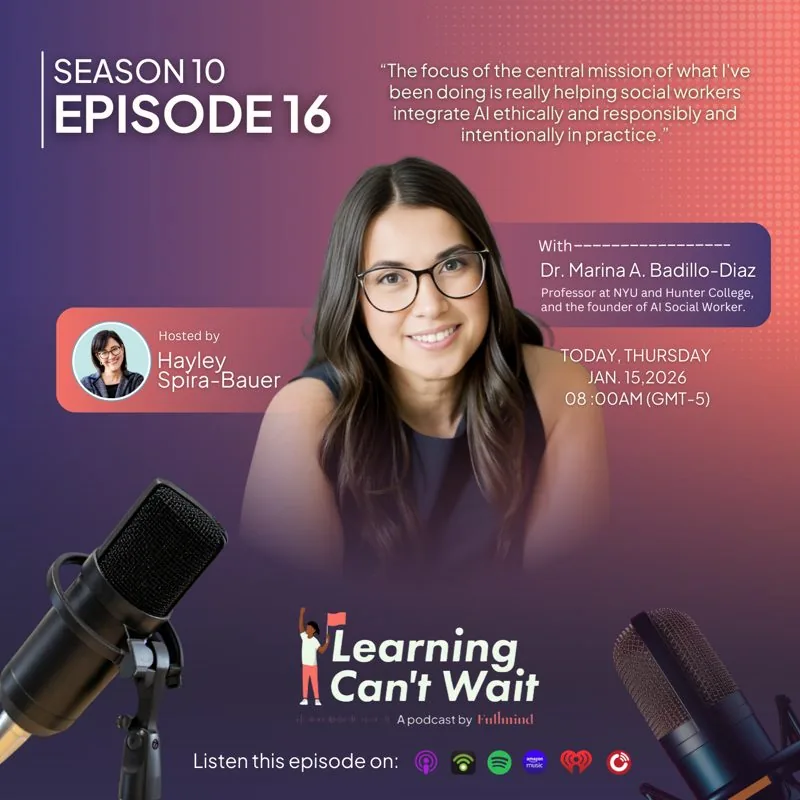
 Hosted by Hayley Spira-Bauer, Chief Academic Officer at Fullmind
Listen now
Dr. Marina A. Badillo-Diaz: Youth mental health, AI companions & Ethical AI practice
Episode summary
Dr. Marina A. Badillo-Diaz, professor at NYU and Hunter College and founder of The AI Social Worker, talks with former Harlem colleague Hayley about mental health professionals and AI in schools. She explains that teens are forming relationships with AI companions without safety guardrails, how to assess those relationships, and the misinformation and deepfake harms schools face. She shares research on how school social workers use AI to save time and get creative, with firm rules on privacy, FERPA, and keeping humans in the loop, and points to therapeutic chatbots designed in partnership with schools as a hopeful model.
Key takeaways
- Teens are using AI companions designed to mimic relationships; ask what they talk about and how it feels
- Deepfakes and AI-generated sexual images are already harming students in schools
- School social workers use AI to save time on communication, resources, and session materials
- Never enter student-identifiable information; push districts to buy tools with privacy guardrails
- AI will support administrative tasks but cannot replace the human relationship in counseling or teaching
About this episode
This episode explores how AI is reshaping school-based social work and youth mental health, through the lens of Dr. Marina Badillo-Diaz’s work as a professor and founder of The AI Social Worker. The conversation covers global disparities in access to mental health care, how AI tools and AI companions are already part of students’ lives, and why ethical, human-centered integration of technology is essential. Dr. Badillo-Diaz describes both the risks (from deepfakes to unsafe chatbots and child exploitation) and the possibilities (equity, access, support for neurodiverse learners, and time-saving tools for practitioners), emphasizing that AI should support—not replace—the human relationships at the heart of social work.
Full transcript
Transcript generated from the recording; minor errors may remain.
Hayley Spira-Bauer: Welcome back, everybody, to the Learning Can't Wait podcast. I have been having some incredible conversations about what is happening in schools, but have not touched on a particular topic yet. Which is mental health and the professionals who support mental health with the use of AI. So I'm really excited to introduce you all to… See, it's always me.
Dr. Marina Badillo-Diaz: I'm really excited to introduce you to Dr. Marina Badillo-Diaz, a professor at NYU and Hunter College, and the founder of the AI Social Worker. Welcome, Marina, how are you? I'm good, thank you so much, Hayley, for having me on the podcast today. Really excited to chat with you.
Hayley Spira-Bauer: You know, it's a blast from the past. Marina and I worked together in Harlem for a few years, but I have been following your journey, Marina, since we last worked together. However, feel really excited to hear about not just your journey, but specifically where you are now. So I'm gonna jump right in with our first question and ask you. How did you come to be the personal and professional version of yourself?
Dr. Marina Badillo-Diaz: And I love this question because it really forces you to really reflect on, like, how am I… like, how did I get here today? I think for me, you know, being a social worker has really been a part of my professional journey, and being in the social work field, you know, we have a lot of core values of community service and, you know, supporting those that are most vulnerable. And I think, for me, that's really been a thread throughout my professional career, and has really gotten me here to the point today. I'm really a big advocate. We're gonna be talking a lot about AI and mental health, and youth mental health in particular, because my background, as you know, in schools and school mental health. But then I think also personally, I mean, the journey, Hayley knows I'm really big on traveling and, pushing myself outside the boundaries, and I think that has also really led me to just have an appreciation. For where I'm at right now, and always wanting to continue to grow. So, and I'm excited to be talking about that with you today, too.
Hayley Spira-Bauer: Let's touch on that travel for a second, because… One thing that I appreciate about travel, which I'm sure you do too, but I'll let you speak for yourself here, is that you get to see how other people are living and experiencing the world.
Dr. Marina Badillo-Diaz: Yeah.
Hayley Spira-Bauer: Let's start from a mental health perspective. Do you have any observations from your time abroad about how mental health in youth differs from where you were to here in the United States?
Dr. Marina Badillo-Diaz: Yeah, I… one thing I always think about is access and equity. So… and even here in the United States, it's certainly not a perfect model either. And so, even just going around the world and kind of seeing how mental health is even addressed, how it's awareness and advocacy around it, it's really different in different spaces and different cultures. There's always intersections of gender, identity, and of course, socioeconomic status. And even in the United States, we have a huge disparity. And that's why I think a lot about AI as well, too, in this space, is because even internationally, I'm having conversation with folks, even in South Africa, Sudan, Canada, about how AI tools could really help level with equity and access. But there's still always concerns around that, too. So I'm really excited with this technology to hopefully bridge some of that, but we also think about some of these ethical and real harms and considerations of this technology, too.
Hayley Spira-Bauer: I mean, you can't go a minute when talking about student mental health without bringing in the conversation around the play of technology here. Social media, now artificial intelligence, and all the things it can do and put at kids' fingertips. So, what's your stance? I mean, you obviously have an organization called the AI Social Worker. What is it that you are… Like, your ethos in this work?
Dr. Marina Badillo-Diaz: Yeah. So, really, the focus of the central mission of what I've been doing is really helping social workers integrate AI ethically and responsibly and intentionally in practice. And so, yes, I am certainly an advocate and a user of artificial intelligence, but as I mentioned earlier, you know, our social work… You know, values, we really are centered on, you know, human-centered practice, the relationship, confidentiality, privacy, we care about harms to the marginalized community and advocating for those who are most vulnerable. And so, as I'm using this technology to integrate it in my practice, recognizing, oh, this is going to really impact our field broadly as social workers. Also being from K-12 education, I was like, oh, this is definitely changing the game for K-12 education as well. And so, that's what really launched my brand in the beginning of, well, January 1st, 2024, to really promote advocacy and awareness and provide just tools and best practices to the field of social work.
[05:00] **Hayley Spira-Bauer:** And what would be your hope right now that social workers who are in schools would be… how would they be discussing AI with their students? And maybe, like, walk us through all the ages? Like, I'm always very curious about the spectrum of ages and what's appropriate for each demographic group, so… Like, if you were to give a PD session to elementary teachers versus middle… versus high school, what might you say?
Dr. Marina Badillo-Diaz: Yeah, no, definitely. And this is something I am doing right now, and I think it's so important in this space to raise just even us adults and professionals, the psychoeducation behind AI companions, and how our youth are using AI chatbots.
Hayley Spira-Bauer: So, research is showing, that our teens, our young people, are absolutely using AI companions. These are…
Dr. Marina Badillo-Diaz: AI chatbots that are designed to mimic human relationships, common ones out there, are Replika, Character AI, teens and young people can just generate and create their own type of personality, style, liking of another person. They're developing relationships, and I say relationships right in quotation marks, I know our viewers can't… our listeners can't see. But, you know, but it's a real concern, right? Because we think about their relationships and their emotional, social, skill building during these critical ages of development, that we need to not only, one, recognize that teens are using chatbots, but also have these conversations about them, and also talk about the real dangers and harms. Unfortunately, we have had cases in the media, right, that young people are dying by suicide about this, so now you're taking a high schooler or young person who's has vulnerable, you know, mental health distress, and they're using an AI chatbot. These companies don't have safety and guardrails in place. And so, other things that I also talk about in my sessions, too, is asking the important questions. Of assessing what is their relationship like with their chatbot? What are they talking about? What are they using it for? How does it feel to use… to talk to these chatbots? How is it impacting your, you know, your relationships and things that are going on in your life? And then especially with, you know, younger kids still need digital literacy as well, too, but I also think about how are we going to include parents in this conversation, right? Especially as chatbots are just part of the home, right? We have Siri, we have Alexa, and young kids are talking to Alexa and Siri, too, right? They're having these conversations with them, so I think it's so important to teach children, also just recognizing, you know, it's… it's not a human, they need education around what AI is also. And also helping parents set boundaries with their… with their children as well, too. So I know that was a long-winded answer, but…
Hayley Spira-Bauer: No, but I mean, I asked a big question, right? This is, like, the crux of how we need to be thinking and interacting with both our students and our technology today, because… the train is on the tracks, it has left the station, and at this point, we're not gonna stop the train. So we need to be proactive in how we educate our youth. And our families, actually my podcast that is being… that was released on Tuesday and recorded right before this one was literally about parents learning how to interact with AI. And really take ownership of the direction and shaping the future of AI in our children's lives. It is such a big question.
Dr. Marina Badillo-Diaz: Yes, yes, I absolutely agree. And we already know that research has shown, right, the negative, detrimental, emotional, social effects that social media has, right? There's even countries like Australia who's banning this technology now for young people, and now I'm thinking we're throwing AI into this mix with AI chatbots, AI companions, and so what is this gonna mean? I mean, social media has been harmful enough. With… Self-esteem, depression, isolation, constantly being compared to, just the social impacts of their lives being on social media, and then now you want to throw a synthetic AI companion that's really replicating a human relationship is designed to do that. What is that going to mean for their well-being long-term? And they're growing up with this technology, right?
Hayley Spira-Bauer: They're native to it, right? It's like how my kids are native to computers, they're also going to be native to artificial intelligence, and… having them learn good habits right now is hugely important. I… someone I had interviewed a couple months ago had said that they do a lot of metacognitive think-alouds in front of their younger kids when they're interacting with Alexa, or they're interacting with even their computer, to really help kids understand, like, what's human and what's not, which later becomes these middle schoolers and high schoolers who can easily identify what is a real image versus a fake image, what is a video versus not a video. I don't think they'll be easily able to identify that later.
[10:00] **Dr. Marina Badillo-Diaz:** Damn.
Hayley Spira-Bauer: I think the technology will get better, but for now, they can.
Dr. Marina Badillo-Diaz: Yeah, I know, and that is definitely a real concern too, right? Of the misinformation that our young people are going to be exposed to because of deepfakes, that it's gonna look so real. So that's certainly a concern of the misinformation that they're going to be constantly bombarded with, and this sort of, like. Fake reality. But the other piece I'm also concerned, too, with deepfakes is… the ability, especially with generative AI, to make child pornography, and it's happening across schools even now, right? We know that teens already were sexting and sending photos and videos, but now you can make AI-generated images. And of course, from school administration standpoint, a school, you know, counseling, school social work standpoint, we really want to care about the, you know. That about as well, too, because we know it's going to be really impacting the lives of young people, both The person who has been harmed by this, but also those who are also making this content to using this technology inappropriately.
Hayley Spira-Bauer: I'm gonna switch gears for a second, because obviously it's easy to talk about the harm that we can encounter with social media… with social media, with AI, but I'm curious about what benefits you see right now in improving your practicing as a social worker. I know there's a lot of.
Dr. Marina Badillo-Diaz: Yeah.
Hayley Spira-Bauer: Kind of conversation around how this can reduce teacher prep time and grading and all these other aspects. What about for social workers? Is there a place for it? Like, what do you think, and what are you teaching right now, at NYU and Hunter?
Dr. Marina Badillo-Diaz: Yeah. So, so at NYU, I'm actually teaching a postgraduate school social work course, and I do a whole module and series on integrating AI into practice. I've also been doing research across the country of interviewing school social workers of how they're using AI in their practice, and bottom line is that, yes, school social workers are using AI, just like teachers. And similar trends too, right? They're finding that it's really helping them save time. That was… that's been a big trend overall across the board, is being able to save time, and also get more things… more things done. School social workers are using it to help with communication, draft newsletters, emails. They're using it to also find resources in the community, to connect families to community resources. They're also using it to create worksheets for their sessions, or just even getting recommendations on treatment interventions. One of my favorite ways of using artificial intelligence in my trainings is saying, you know, you're working with an 8-year-old a student who's working on emotion regulation, they love the Disney movie Frozen, how can you use that movie to create, you know, play therapy and activities to work on emotional dysregulation? So there's really creative ways that school social workers not only are… can use AI, but it's really been helping being time-saving and just being more efficient, and also just being more creative and practice as well, too.
Hayley Spira-Bauer: At the top during your introduction, you made a brief comment, but I want to dig into it a little bit more, because with the use of AI in schools, especially with students under the age of 18, we have to be concerned about PII and cybersecurity. So, how are you addressing that as well, and what are you teaching the young, future population of social workers about really putting this front and center?
Dr. Marina Badillo-Diaz: Yes. So,using AI comes with great responsibility, and even though it can be time-saving, and I certainly know that from my own practice too, but it's not going to save you all the time, because you have to, as you mentioned, we have to care about ethics, FERPA, privacy, confidentiality. So, in my trainings, I teach a lot about how can you ensure that you're prompting, that you're not putting any personal identifiable information. Human in the loop. You… I always say to school social workers,you know your communities best, you know your students best, you always have to double-check the content that any AI tool generates, because it can make mistakes, it's biased, it hallucinates, and your practice wisdom, your knowledge, your experience has to be in critically reviewing anything and editing it as you see fit. So, I think those are definitely the basics, and the most important things to really emphasize if school social workers want to use AI in their practice.
Hayley Spira-Bauer: And probably, too, like, what tools are… like, being really mindful of what tools they're selecting, where that information is being exported, and how.
Dr. Marina Badillo-Diaz: The community.
Hayley Spira-Bauer: Like, one of our rules internally at Fullmind is you cannot refer to a student by first and last name. And if you're using AI, don't put student information at all in the AI. Like, you cannot have anything that draws back to a student. You can always put in a sub when you're using AI, and then replace it with a student's information in your communications, etc.
Dr. Marina Badillo-Diaz: Yes, no, absolutely, 100% agree. And in part of my, you know, trainings and advocacy, too, I really talk… I talk about how we should advocate for school districts to purchase an AI tool, because that comes with privacy, guardrails. And… and it's not just, you know, for teachers, but it's also for us school social workers and school counselors, too. I mean, we have even more of an ethical obligation, with our licensure to ensure we're not putting anything identifiable. We really want to protect that, and so if we're going to choose to use any of these AI tools. We really want to make sure we're never putting any identifiable information, and that we are choosing tools that do come with privacy settings. I know there's so many tools out there that are free, so it's… it's certainly… I care about equity and access, so I know we could use, you know, MagicSchool AI, even ChatGPT, but if you're ever going to choose to use those tools, I always say you have to make sure no student information in them. And when you can, see if your school district can purchase an AI tool, because that would bring a lot of privacy and, security. More so.
[15:00] **Hayley Spira-Bauer:** So what about…
Dr. Marina Badillo-Diaz: Using AI as a social worker.
Hayley Spira-Bauer: There's a big dialogue. Again, you're the first person I've talked to on this specific topic, so I'm gonna reference what I know. In education, there's a lot of talk, like, oh, can AI replace tutors? Can I… should AI replace teachers?
Dr. Marina Badillo-Diaz: Yes.
Hayley Spira-Bauer: Social workers!
Dr. Marina Badillo-Diaz: Yeah, Hayley, this is coming up in our profession, and when social workers and I talk about this, I say, we are not the only ones who are grappling with this conversation, right? And, you know, I think this is… it… it definitely puts a huge anxiety, you know, on the profession. It's coming up on conversation. Because this technology is certainly going to get more sophisticated, we know people are using it for mental health, right? So I've had conversations with therapists, social workers, counselors, being like, are our jobs gonna be eliminated because of artificial intelligence? And my take, on this is that because we are a human service profession, just like teachers, I think there's gonna be room for AI to support in some of the tasks that we do administratively. Maybe it can't support with mental health, providing, you know, advice, support, therapeutic, you know, there's certainly therapeutic chatbots out there that are being used in tandem with therapy, but I truly don't think it's going to be fully replaced because of the human experience and the human relationship, and that human connection. And that's just as important for teachers with learning, right? That can't be replicated with a chatbot and a relationship, and… tutoring with an AI chatbot. So I think it's gonna be the same for a school social worker as well.
Hayley Spira-Bauer: Totally agree.
Dr. Marina Badillo-Diaz: Yeah.
Hayley Spira-Bauer: Alright, Marina, now I'm gonna, like, drop us from this, like, wheelhouse of talking about AI for a second.
Dr. Marina Badillo-Diaz: Yeah.
Hayley Spira-Bauer: Student mental health, you know, because of some of the factors we already discussed, is really at an all-time low.
Dr. Marina Badillo-Diaz: Yes.
Hayley Spira-Bauer: And we're seeing increased rates of anxiety, depression, other mental health disorders. At numbers, we haven't seen. Ever before. And you could always argue that diagnosing is higher, and people are more savvy, we talk about it more often, so people are more willing, there's less stigma.
Dr. Marina Badillo-Diaz: Yam.
Hayley Spira-Bauer: What has you really concerned, and what has you really hopeful?
Dr. Marina Badillo-Diaz: So I think what does have me really concerned is, like, the continued disconnection and isolation, because that does have a direct impact on mental health. Certainly the rising rates of depression, suicide, anxiety disorders, you know, that's continuing to rise, as also, I know technology is also continuing to rise, right? So I feel like this is happening in duality, that, that is what really, really concerns me about The future and their mental health. We're losing those connections, those human interactions, And for me, what makes me hopeful, because I do want to stay in a hopeful space, is I hope that equity and access can grow because of technology. And I think it's already happening right now. Because I think one of the reasons why teens, and even just adults, are using AI chatbots is because it is accessible. And at any time. So if you're in distress, you could pick up your phone, and you could talk to an AI chatbot and get relief, and it's a non-judgmental space that they can get advice and help solve a problem, and help walk through, you know, their emotional… their emotions. And I think what's also making me hopeful in this space is there are companies out there that are really doing an intentional job of being evidence-based, putting in guardrails and parameters. So I'm thinking of one company in particular. They're called Alongside. And they're here in the United States. They've been around, for a couple years. And they are in the space of youth mental health, social-emotional learning, and school. So what they do is they have a therapeutically designed AI chatbot for young people, for middle school and high schoolers. School districts can purchase it. And they have access to the therapeutic app, it's called Kiwi, and they can text it on the weekends, outside of school hours. What I appreciate about this app is that it does put guardrails in place. It times them out. The other piece is that if a young person says, I'm suicidal, I am being abused at home. Because it's the company, they have to alert the school district, and so they deploy the school team to then do that wraparound crisis assessment. Because one of my biggest concerns, again, is that, yes, teens are turning to AI chatbots because they are in such distress and suicidal, but the AI chatbot's not going to do a wellness call, or call the police, or call 911, or get a parent involved. But when companies, like, alongside are really thinking deeply about how can we work in partnership. With schools. With community mental health agencies, I think that's where my hope lies with this technology and mental health.
[20:00] **Hayley Spira-Bauer:** Oh, that's really interesting. I can see the value in having something that is, like, school-based and supportive in that way, and, you know, at the end of the day. The world is ever-changing, and we can't predict what tomorrow holds, but when we really think about what kids need right now, and I appreciate your emphasis on equity and making sure we're including everyone in our conversation here, especially with the mental health needs, we see, you know. Early diagnoses or early signs of mental health disorders is really indicative of long-term struggle, if not, you know, adequately intervened as quickly as possible. So, having many avenues to intervene and support seems as beneficial as possible.
Dr. Marina Badillo-Diaz: Yeah, and I think this is going to be really big, especially for our students with special needs, neurodiverse, that having access to tools like AI, especially for communication, helping with, executive functioning skills, like having access to some of this technology and support with, just with accommodations for the classroom. I think there is going to be opportunity, even helping neurodiverse students practice social skills with in a contained AI chatbot space.
Hayley Spira-Bauer: Yeah.
Dr. Marina Badillo-Diaz: There's been some, some work being done on children on the autism spectrum, and using an AI chatbot to help with social skills. So I do think there's real opportunity, andI definitely sit in the gray all the time with this tech.I personally know how helpful it is, and it's changed my life, my practice. And I certainly, you know. Advocate a lot for in my trainings and the work that I do in the social work field, and at the same time, recognizing we need safety and guardrails and protections as well.
Hayley Spira-Bauer: It's a very balanced approach, which I appreciate. So, Marina, imagine a new social worker entering the profession today who is hesitant to incorporate AI into their practice. What advice would you give them?
Dr. Marina Badillo-Diaz: Yes, okay. So, and this definitely comes up, right, all the time, that there's a lot of social workers, even new ones, even experienced ones, that are like, I'm really AI-curious, and I want to know more, but I don't know where to start. And I say, lead with curiosity and having an open mind. I think one thing there's a lot of Hesitation, resistance, concerns. And then another piece of advice that I also give is, you know, our field as social workers, we are grounded by ethical principles. We do have a… our NASW code of ethics, we have a tech code of ethics that was designed and developed in 2017. So this is prior to AI coming out, but there's still some really good, just. Endearing codes that are really helpful for integrating, technology into practice, and our, national organization, the School Social Work Association of America, we are also launching, in a couple weeks. Our national guidance for school social workers and how to integrate AI. So it's really staying human-centered, it's really staying, always checking the responses, never just taking AI at face value, leaning into your own, ethics and your own, training and your own education and your own practice wisdom, and start small. You know, I think the beauty of this is that You know, I'm gonna put a plug in for my website, theaisocialworker.com. But I have a whole free, you know, prompt library for social workers that they want to, you know, for different social work tasks. Start there. You don't have to start big, it's maybe just writing an email, you know, thinking about a challenge that you're having with a student, and different ways to approach that in therapy with them in the classroom. So I think it's just kind of starting low stakes, not all your tasks all day long throughout the day. And continue to practice. I mean, it takes several hours, you know, to really practice and get confident, and continue to grow and learn. You know, we are still learning as we're still growing in this, you know, era, and it's gonna continue to shift and change. So, you know, following, There's some really great people in the LinkedIn space. I also have a community as well for the AI social worker. We're always sharing resources and information, and best practice, so hopefully those are some great tips that people could walk away with.
[25:00] **Hayley Spira-Bauer:** Well, speaking of learning and growing, I have learned and grown a lot during this conversation. Again, this is a new-to-me topic, and I feel like I have obviously not mastered it, but I have a good foundation now where I can dig in a little bit deeper. I'm on your website right now, theaisocialworker.com, and I'm looking about all the resources you have. Like you said. Free prompt library, free guidebook, a community, a template, ChatGPT… like, there's all sorts of things in here that people can dig into, and, you know. In addition to the theoretical conversation that we've had about future and current, it's also really beneficial to have practical information that people can apply tomorrow. So, if you know a social worker who would benefit from any of these tools, have them listen to this episode, and direct them to Marina's website, theaisocialworker.com. Marina, thank you so much for coming on the podcast! Thank you so much for having me. It's been such a great conversation, it was great catching up, too. Oh, I love to reconnect from people… with people from a past life, this has been wonderful, and thank you to everybody who tuned in today.
Dr. Marina Badillo-Diaz: Yes.