
Learning Can’t Wait · Season 1, Episode 14
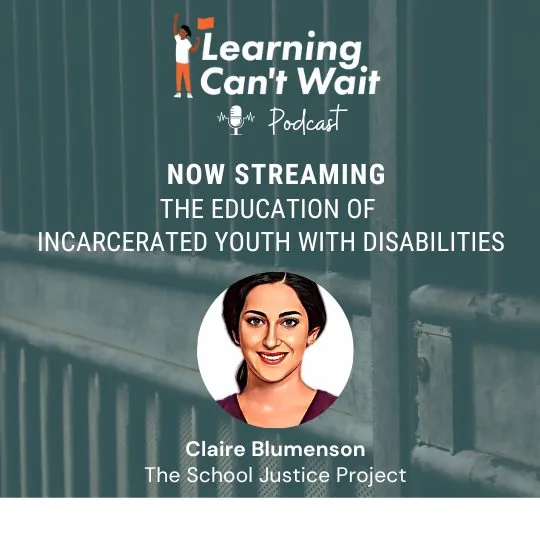
The Education of Incarcerated Youth with Disabilities
 Hosted by Hayley Spira-Bauer, Chief Academic Officer at Fullmind
Listen now
The Education of Incarcerated Youth with Disabilities
Episode summary
Claire Blumenson, executive director and co-founder of School Justice Project, explains how teaching at an all-boys Brooklyn charter during the zero-tolerance era led her to law school and a DC public defender fellowship inside a juvenile facility, where 80% of youth had special education needs and nearly all were students of color. SJP's six lawyers represent older court-involved students with disabilities, fighting inferior packet-based instruction and the credits issue, where coursework completed in out-of-state placements fails to transfer. She describes a class-action suit over the DC jail's halted instruction during COVID, a contempt ruling and extended eligibility, and pending legislation to appoint special education lawyers in adult criminal court.
Key takeaways
- About 80% of incarcerated youth have special education needs versus 15-20% in the community
- Special education rights continue through age 21 and are identical inside facilities, but rarely honored
- Credits earned in out-of-state placements often don't transfer, resetting students to freshman status
- DC jail students received no instruction during COVID; a judge held the district in contempt and extended eligibility
- Lawyers, teachers, agencies, and policymakers must work together; center what students say they need
About this episode
The School Justice Project (SJP) champions an extremely vulnerable population: incarcerated youth with disabilities. The SJP’s mission is to ensure every learner, in or out of prison facilities, receives the education they were promised and deserve. Their current class action lawsuit against the DC prison system underscores the impact of their efforts. Featured guest, Claire Blumenson, pulls no punches as she forces us to look, and not to look away, in this pivotal moment.
Learning Can't Wait is brought to you by iTutor.com.
Full transcript
Transcript generated from the recording; minor errors may remain.
Welcome to the Learning Can't Wait podcast, an iTutor production at iTutor. Our vision is to ensure every child has access to education regardless of circumstance. Each episode, we will be joined by Pathfinders within and around the education space who are bringing about transformational change on behalf of.
Students, I am your host, Hayley Spau. Welcome back everybody. I am so excited you're joining us today. Our special guest, our podcast guest is Claire Blumenson, the executive director and co-founder of School Justice Project. Claire, welcome. Thank you. It's great to be here. I am so excited to have you on the podcast today for a variety of reasons.
One of which is as with many of the guests that have been in the early days of this podcast, you and I know each other personally from our days in the classroom. Yeah, I, it feels like it was just yesterday, . It does, and I think that what is particularly interesting about many of the folks that I keep in touch with today, and I think you're no exception to this, we were really touched by our experiences of being teachers and in the classroom and whether our career has kept us in brick and mortar schools or not, we are doing work that impacts the lives of children everywhere.
Absolutely. So without spoiling your own introduction, the work you are doing is, something I followed for a very long time and something I'm extremely excited for you to tell others about today. So why don't you just dive right in and tell everybody. About your journey in education and, and what you've built at School Justice Project?
Absolutely. So as you said, my, I'm currently the executive director and co-founder of an organization called School Justice Project. And we're special education lawyers who work with young people in the juvenile and criminal system to make sure that they have access to special education, both during incarceration and throughout the reentry process.
And my, my Path to School Justice Project, it. Actually relatively straightforward now that I'm looking back, but I certainly didn't think, you know, 10 years ago or whatever, that I would be starting a, a nonprofit. So I got interested in education at an early age. You know, I was always interested in tutoring and, and.
You know, what life in the classroom could look like. But I was also extremely interested in the law as a tool and an equalizer. Both my parents were public defenders and so I sort of had these, these dual, not necessarily opposing interests, but just sort of parallel interests in education and in sort of law and public defense.
And so in, in college, I spent a lot of time looking at how education, sort of the disparities in education and also how education could be. And improved in, in the country. And so after college, I did Teach For America where I met you. And, and I absolutely love teaching. I taught at a all boys charter school in Brooklyn and it was an incredible experience.
I loved my students. I loved my school. But I will say that, you know, it was during the time of, where zero tolerance policies were at, you know, the, the height. And so students all over the country were getting suspended or expelled for things like, you know, bringing a chain wallet to school and that kind of thing.
And, and so as much as I loved teaching and as much of a difference as I felt, you know, the teachers in the, in the classroom were making, I also kept going back to this idea. You know, maybe the career for me was to, to focus on education, but potentially through sort of illegal service. Then, so I ended up going to law school really focusing on the intersection between education and the justice system.
So, you know, as, as many classes as I could take on things like education and the law, education policy, juvenile justice classes, children in the law, and I, I tried to sort of figure out what a career, in this space would look like. And, you know, it, the, it, it wasn't quite clear to me cuz I, I think.
Weren't a lot of options out there. But my second year summer in law school, I had a, summer internship at the DC Public Defender Service, and there I was able to, spend the summer working with the Public Defender service, but inside a juvenile facility in dc And during that time, I, I was, you know, pretty shocked by what I saw.
So many of the young people who were in that facility were actually ages 17, 18, 19, and 20. So these were the oldest students and I. Third and fourth grade. So no, I had no experience working with, with older students, but I also knew that these young people still had, had a right to special education through the age of 21.
and in, in DC through the semester in which they turned 22. So here were these young people who still had a right to education who were in the juvenile system, but also could simultaneously be involved in other systems like the criminal system. So there it was sort of a, there are so many cooks in the kitchen, so many agencies, that they potentially could be committed to.
And, and there were just like absolutely no services specifically dedicated to these older students with disabilities. And when I talk about older students with disabilities, I mean the inside the juvenile justice facility, over 80 student, 80% of the students had special education needs. And that's compared to like 15 to 20% in the community.
So 80% inside facilities, and then 15 to 20 in the community. So that, I mean, the, the, that's just, an appalling. Appalling difference. So, you know, I, I really was struck by just the disproportionality that I was seeing there. And when we talk about disproportionality, there's, there's both the element of disability but also race.
A hundred percent of the young people who were incarcerated were students of color. Basically 97% black. Present Latinx. And so, you know, this, this, and this wasn't a coincidence, right? We, we know that we have a system that's been built on racism and continues to perpetuate it. So I felt like, like there was really something there and, and when I looked for what services were sort of available for older court involved students with disabilities, there just wasn't much out there.
There were not organizations that were specifically dedicated to this oldest population of students. And most special education lawyers actually are. Private, you know, they, they are paid like $500 an hour or something to work with families who can afford them. And they also generally work with parents of students because your, your special education rights center to you when you turn 18.
So, so anyway there, this was just sort of a completely unrepresented population, in the field. And so I did a, an Equal Justice Works fellowship that. The public defender service where I was able to provide special education, legal services to young people who were committed to DC's juvenile justice agency and placed inside that same secure facility.
And so from that app, during those two years, you know, I learned a whole lot, and, and saw how many systemic barriers there were. And so I, I met my co-founder Sarah, who was also doing a post-graduate fellowship. And the two of us applied for an Echoing Green Black Male Achievement Fellowship in 2013 to to get seed funding to start School Justice Project, which, you know, does the, the same thing that that fellowship had done.
we provide special education, legal services to older court involved students with disabilities in dc. So that's, I know that's, that's a lot. But that is sort of the, how I ended up at School Justice Project and, and I can tell you a little bit more about what we do shortly. Yeah. So that is quite the origin story.
And Claire, you know, you said it yourself, but when you look back, it is so obvious to you now what your path was and how linear it is. And I think that's what. Some people so successful at being impactful, they feel called to a particular cause and a particular effort, and they really champion that effort in a variety of ways and continue to build upon their knowledge and experiences.
So, It's really wonderful to hear just what led you to this and also alarming to hear some of the highlights of your experiences and learnings during your time that led up to the founding of School Justice Project. So, Claire, I, I'm wondering, was your co co-founder an educator as well, or ? She actually, she was not.
she was very much in the sort of public defense and actually more interested in the adult population. You know, when, on my first day when I met her, she's like, and yeah, I know you were a teacher, but I just want, wanna let you know, like, I'm not a kid person. I really don't like kids. I know I'm working just the setting, but I see myself more in.
Adults had it. And which is funny because, you know, 10 years later Sarah and I are still working hard at it doing, you know, the same, the same work we were doing back then. But it, you know, she, she was really passionate about sort of prisoners' rights and reform and being able to make sure that young people are, you know, anyone who's incarcerated, that their rights are able to be enforced and also, you know, working hard to get them out of facilities.
So, so our. Really, we see it both as increasing educational equity, on the education side, but also decreasing the use of mass incarceration. So we use our education arguments to try to get young people out of jail in prison, and we, we believe, you know, fundamentally that. Young people are better educated in the community and that they belong in the community.
So anyway, Sarah was coming at it from much more of, of the justice lens, and I was coming at it from more of the education lens and, and so together, I think we've been able to, to really sort of blend those together well. Well, and it's right in the name school Justice. Exactly. , I mean, it makes a lot of sense.
So, so let's, let's start there then. Why, what are the challenges, that students with disabilities that are incarcerated or within the system face that are, are some of these barriers that you're naming? What, what makes it so much more difficult and challenging? Yeah, great question and I could probably like talk about this for at least the next seven hours.
So, I mean, there, there's some key barriers that, we saw, you know, right from the beginning. So first of all, getting education inside secure facilities is just. Difficult, often young people are coming to facilities not having, had great experiences with education. As I said, the like 80 to 90% of young people who are incarcerated have special education needs.
So, so they already, you know, had special education needs while they were in the community schools. And often those, those needs went unmet. And so when students end up in the. In the justice system, they've, you know, already had some experience with educational failure often, whether it's like suspensions, expulsions, or just not having their needs met and feeling frustrated and sort of disenchanted with school and, and then once inside it's so rare that you actually are getting a good quality education, like, you know, rights in what you're entitled to aside, just like the actual quality of the education that you're getting is often abyss.
You know, students will get things like work packets. Math is just math. Like there's not, whereas, you know, in the community there's algebra and geometry and different types of math, but often, you know, in secure facilities you're just like going to math class and whatever that means, and students are getting packets.
They're not necessarily getting the, the services that they need. So, And all of this is, is even pre covid. So we'll get into sort of what's happened with Covid and how that's just had, you know, devastating effects on students. But even pre covid, just education inside facilities is often inferior. So, so that's a key thing that we've worked on.
And, and sometimes the, this is also related, it's really hard for students records to transfer back and forth, and so students will get to facilities and they've already taken. , you know, this, these classes. But they're placed back in them again. And so this can lead to what we always call the credits issue, which is sort of the second primary focus.
So education inside facilities is being bad, that's one thing. And then the second primary thing is, is the credits issue. So the credits issue for me, like this was one of the biggest reasons why we had to start School Justice Project. And I feel like I've gotten so many gray hairs over the course of the past 10 years trying to deal with the credits issue.
And it's still, you know, they're, it's, it's just this monster has so many heads. It's like you cut one off and like a thousand more grow or whatever. So one issue is that students in facilities, they're, they're sent all over the country. So DC students are sent all over the country in to different juvenile facilities to be, you know, rehabilitated and, and so they're sent there by the DC.
And yet they'll come home and find out that English one in Iowa, which they took after being placed there by the DC government, isn't gonna count for English one in DC. And so, I mean, it's just, it's so totally outrageous that students have to go through this. They'll find that, you know, they've spent years getting A's and B's inside secure facilities all over the country, and then they come home and instead of being a senior in high school, they, they're still a freshman.
They have to start all over again because the credits that they took didn't count. And, and the, the school completed. It's devastating. I know. Like, and I, I just, it's, it's so frustrating and outrageous to me, and it's not even my life. You know, directly affected by this. So you can imagine for young people how, just how much of a setup this all feels like.
And so, so the credits issue, I mean, another sort of key part of it is sometimes students will get moved from placement to placement over and over. And so they're, they're sort of at placements for too short of a period of time for their credits to. Accountant accumulated. Yeah. Yeah. And so being able to like transfer and accumulate at credits so that you can work towards a diploma is a really big problem.
And luckily we, you know, we've been working on both a legislative solution for that. And then, you know, I think over the years we've. Sort of developed some tactics to, to help our individual clients. But there, this is really a systemic issue. And so no matter how much we are able to like address this for the individual clients we serve, there'll continue to be young people coming after them who will experience the same thing.
So we, we need to really fix the system here. So, so yeah, the, the credits issue and then education during incarceration are two of the largest issues facing court-involved students with disabilities. For the educators that are listening who may be less familiar, What this looks like for an incarcerated student, they're probably picturing, well, when I have a student with disabilities in my school or my classroom, there's someone who's advocating on their behalf their, you know, their documentation, their IEP, their 504, making sure that goals are set, they're working towards those goals.
What does that process look like when a student is not in a school but is in fact incarcerated? Is there still the documentation kind of process renewal? Does it look the same? Or is it drastically different as well? Well, it, it really should look exactly the same. And I, you know, I think the, the level, the quality of the school inside the facilities is a, You know, an important, obviously a critically important factor.
I mean, there's still special education coordinators inside schools. There's still special education. I mean, inside facilities, there's still special education teachers inside facilities and, and the rights that special education students have in the community are the same inside facilities. And, and that holds true, you know, again, for the 18, 19, 20, 21 year old.
So, Yeah, so it really should be the same. It's just that that's often not how it plays out. Sure. So in theory, this is a continuation of the type of structures and supports that would help implement an IEP or 504, however, due to some of the issues you named earlier, that isn't the reality. Exactly, which obviously exacerbates in addition to the curriculum that you're naming as, as not being as rich and fruitful and maybe engaging, it is also problematic for a student with disability to not have the, interventions and supports.
What about, related service providers? Are related service providers still present in, in these facilities as well? Yep. I mean, students, students should really be getting the exact same thing that they're getting in the community related services, specialized instruction, all of it should really just be the same once they're inside a facility.
Often that's, again, just not the case. I think another sort of barrier to E, even if the school is good inside the facility, it can also be really hard for the school to operate within sort of a Department of Corrections setting. So, you know, in order to teach students. There needs to be like corrections officers or you know, youth development officers who are moving the students to the classroom from their cells.
And so if the students don't get to the classroom because, you know, all movements been stopped or something like that, it's really hard for the teachers to teach. But again, you know, if that, that can be frustrating, right? Because you have different agencies that are all sort of tied together trying. You know, make sure that the students can get what they need or sort of hindering that.
but ultimately, like for whatever reason, whether it's the, the, sort of core agency or or prison agency, or if it's the school or education system, the bottom line is that the child isn't getting what he needs. Well, you wouldn't need this if, if they were right. Like School Justice Project clearly wouldn't have been built if just as still was working as it should, so, right.
So if you could organically, you know, work themselves out, I would love to be out of a job, but unfortunately, you know, the, it's sort of like the more we got in there and, and. Started realizing what the problems were. The worse, like the more we saw how just like pervasive and systemic everything was and that it, you know, there were not things that could be worked out, you know, student by student that like there needs to be some serious system overhauls.
So the big elephant in the room that you alluded to earlier is covid. Yes. How has Covid altered for better or for worse, the. Education of students with disabilities in the system. I mean, covid has been a total disaster. I mean, obviously for, for so many reasons. I mean, the same things that are, you know, affecting everyone.
Students who are incarcerated have family members who are dying and family members who are out of work because of covid, instability and housing, food insecurity, tho, those kinds of things are all really having a huge traumatic impact on our clients. But then if you look to the education piece alone, I mean, it's just been a complete disaster.
so for students in the community, you know, obviously in March, 2020 things were bad for everyone. The school sort of didn't know what to do. Everyone's trying to figure that out. But eventually things got figured out, right? Students got laptops and access to internet. You know, obviously there, there are still huge equity issues at play in the community, but the school system started.
To sort of get their bearings and figure out how to handle things for students who are incarcerated. That just never happened. Like students just did not get education for the entire period of covid. And unfortunately, like, you know, so often the case for students who are incarcerated it, their voices often get silenced.
Right. And, and, Very often the last priority. And so everyone was so focused on community schools and what was happening in the community that, you know, the students who were inside facilities, they just effectively got left behind for this entire period of time. So, you know, we've worked, we partnered with, law firm and, the Washington Lawyers Committee.
So we partnered with, Them to file a class action lawsuit that basically addressed the, this challenge of students who were incarcerated in the DC jail. Not having access to education during covid. And, and this case is still going on. I will say in, you know, I won't get into all the details of it, but, so in June there was an injunction, Judge Nichols, recently, I guess, two weeks ago, ordered DC in contempt of his June 16th prelim preliminary injunction, which was basically saying that they needed to provide special education to students at the jail.
And so, even though he said that, you know, back in June, students still weren't receiving it. , you know, by mid-February. And so the judge said like, okay, DC you're in contempt. Students are still not receiving their IDEA mandated specialized instruction and services. So the district is gonna have to basically remedy this.
And so to remedy it, there, there are a couple things that the judge said that the district needed to do. And so we're hoping that this will at least like, be some, some measure of progress on the case. But I, I will say that it's also. It's difficult that we have to be like this deep in litigation for, for students to be getting something that they've been entitled to this entire time.
And as you know, there are time constraints with eligibility and that students, you know, they're, they're, they're trying to get their education and they, they just can't. And so all of this time that's going by is really, really wasted time for them. And it's really tragic. And it, you don't get that time back.
Right? Right. So for, for the folks that are listening that are non-educators, what happens is, is. The, the larger your gaps between instructional time too, the sequence of information in your brain, the connections that your brain makes to pri previously learned content, it weakens and it, it is harder to regain.
It's, it's much like I haven't ridden a bicycle in 15 years and the last time I tried to ride one I literally couldn't get back on. And so it takes a lot of time. It's going to take intensive support in order to remedy this gap of instruction that the students, your clients are actually seeking. So, so this is an active lawsuit.
Yes. It sounds like there's updates happening regularly. Yes. It's actually moving quite quickly, which is, you know, for litigation, which is great. Well, and then like we said, time is of the essence. Time matters, especially time boxed, students with IEPs in 504 s that you run out of time, like you turn, as you said in DC you said the age was 21 in your 20 or your 22nd term when you're turning 22.
So for many of them, they're probably aging out after two years of loss instructional. That's right. And luckily the, one of the things that the judge said recently was that he ordered extended eligibility for the necessary amount of time that the students would need to have received the education.
oh, so, so, okay, great. That's so, which is great. Which is huge. But you know, to, to what you were saying about that doesn't sort of change the, the sort of learning process, right? That. Everything should be relatively sequential and it would've, you know, but luckily there are, the IDEA does provide sort of a structure to be getting compensatory education, and so it's not necessarily like a hour for hour thing, right?
That it, that it might take more education to actually like, catch up on what you, where you would to, to get you to where you would have been had you had the proper education in the first place. So, yeah, so that's sort of where we are. And you know, I have to say, it's been great. You know, we're a small organization, well, justice Project has, well we just hired our sixth lawyer, which is exciting, but there, so there are six of us.
And so it's been amazing to work with Washington Lawyers Committee and Terris, Pravlik & Millian. Oh, the law firm, I mentioned because they have such extensive experience doing this kind of complex litigation. So for us, you know, this has been really important for our clients and, and we hope really important for the city and potentially, you know, could also provide precedent for, for other jurisdictions.
Yeah, absolutely. I imagine DC is not the only place that has, I would, I would imagine not the only place that has suspended. You know, typical instruction for students that were incarcerated during the pandemic. That's right. And you know, if, if we learn anything , if we've learned anything from our work it, we see that, you know, throughout the country, students who are incarcerated are not prioritized.
And so, You know, I think one of the largest learnings I've had having like been in the classroom and then sort of in the courtroom, is just the importance of prioritizing, you know, the students who need things the most, right? And so students who were in foster care, students who were homeless, students were in the juvenile and criminal legal systems, and their educations have so often been disrupted that we need to.
You know, put so many resources and prioritize their education moving forward. And I think that's especially true after Covid. Yeah, I'm, I'm sort of at a loss of words, which is rare for me, Claire . But I'm a bit at a loss of words, just, just at the gravity of the situation. And, you know, when you talk to your clients and, and I'm wondering like, in your experience, in your advocacy work and, and just like moving the needle forward, What is the hope?
Like what is the hope for these, for your clients long term? Again, you said if I put myself out of a job, you gave one scenario in which you could put yourself out of a job. What is the goal? Like if at the end, what will you hope have hap has happened for. Students everywhere that are incarcerated or in the system?
Yeah. I mean,students who are incarcerated should have the same shot, the same chance as students who are in the community.And, and so, you know, I think our goal is to make sure that their educational experience, it is high quality and, and is, you know, the same as students who are in the community at excellent high quality schools.
You know, ideally they won't need special education lawyers unless they need them the same way. You know, rich families from the suburbs need them, right? Like, you might want one to come to a IEP meeting with you to help advocate, but you shouldn't need one to basically like undo the past seven years of, of educational neglect, right?
And so, so the role of an education lawyer for those students should change. And, and for us, like we hope that we're able. Until that happens, we hope to be able to grow capacity, not just like at SJP, but sort of citywide capacity and, and attention on the issue so that any student who's involved in the court system has access to a free special education lawyer.
Seems like a pretty good to me. Thank you. I'll keep you posted on how it's going. , one thing I'll say on that, DC actually, ha, we, we've been working on some really cool legislation that would make, available three special education lawyers in criminal court. So like in the same way where you could get a.
defense attorney appointed to you, you could get a special education attorney appointed to, to you, and DC already has that in the family court. Like for juvenile cases or neglect cases. You already can get free special ed lawyers who are paid by the court. That creates sort of a market. So if you're a private special education lawyer, you could still make money representing people who can't pay you.
So it's like a. Great. Obviously a great incentive, but the problem is even though you still have special education rights after age 18, it, they don't, for some reason, this has never like translated to the adult criminal court, and so we've tried to close that gap and so legislation was introduced last Feb, February on this.
And we believe, I mean hopefully it will pass. I think it's, everyone seems to be in favor of it, but this would be the first panel of its kind in the country. And so what we're really hoping is that we can get this passed and then, you know, train other jurisdictions on sort of the benefit of this legislation and the benefit of special education lawyers, in criminal court.
And so other jurisdictions could actually, implement the same thing. So that's, that's one of the sort of current systemic advocacy goals we have going. Also incredible. And I can, I can see the impact it would have to have those types of supports in place automatically. Not based on like the, the size of your bank account.
totally. At the time when you engage, so, exactly. That's incredible. Thank you Claire. I'm wondering how your perspective has changed since your early days of it being a little, being a little, being a tutor in schools, to being a teacher in an all boys charter school to where you are now. How has your perspective working across and with all types of students developed?
That's a great question. You know, I think, I, I think when I was younger I had this sense that like, if you could, if there were, you know, good schools, the world could be fixed, , and, you know, I, I don't think I, I sort of fully grasped the impact of, you know, historical racism, current racism and, and just sort of the, the what needs to be changed.
That's sort of, You know, just the specific like world of education, but that obviously has impacted ha had an impact on education from the very beginning. And then, you know, our current education systems continue to perpetuate the problem, right? So, so everything is obviously in intertwined and inextricably linked.
but I think I, the way I saw things, it was just like a lot more through siloed, then teaching. I, I saw how incredible, you know, good schools and good classrooms. You know, the incredible difference that they could make. And, and you know, how, just how important, You know, the classroom is, and I think, you know, but I still saw at that time that even no matter like what was happening in schools or in even like within the education policy world, that there were just still, again, so many other issues at play.
And so again, that's sort of what brought me into the legal sector because you know, if kids are getting kicked out of school and don't have much re, re. There is not a whole lot that teachers can do. And I think as a teacher I really felt that like, you know, that there's, there's this element that's outside of your control, right?
So now I would say, you know, Probably like the most important sort of learning or or perspective shift has just been like how important being able to sort of view and attack things, sort of different systems and see the different layers, how important that is and that it's, it's critical to have. You know, educators and policy people and agencies and lawyers all working to improve educational equity and to, and to make sure that, you know, we can write this system because, you know, lawyers can't do it alone.
Teachers can't do it alone. Like there's,there's no sort of one sector that's gonna be able to tackle the issues because they're just so deep.And so we need to sort of work together and we sometimes, you know, we have to be working in opposition in order to get. To the sort of unified goal, right? And, and so like lawyers can hold school systems accountable and, and yet, like still have the same goals.
So, so I think to me, I've just sort of, I've spent a lot of time thinking about how important it is to have different stakeholders and have everyone sort of at the table. Yeah, that is, that's profound. I mean, at the end of the day, If what we're all working towards is equitable access to high quality education, it takes every angle to achieve that.
You're right, it can't happen with just the teacher. I don't know if you're wa if you're watching Abbott Elementary right now, but it is like this show about, a teacher in Philadelphia who. You know, she's young and she's bright-eyed and she's like, I can change every, and like through the course of the season, she's realizing like what her locus of control is, but also how much, and I just watched another episode last night, but like how much working within her school is like one example, microcosm of your bigger picture and bigger vision.
How working with everybody is so necessary for student. To grow holistically, not just one student, but all of the students. And so just, I keep drawing parallels to the show because I, I really, it really resonates with me and it's apparently resonating with much of America. Yeah. But I, I really understand your point quite well, which is, it, it, it takes so many people's investment and collaboration.
It's not one person's job. Totally. And, and I think the other thing, I don't think I understood at first, but I definitely learned, well in the classroom and now, you know, working with clients. It's definitely the case. It just the importance of, of. Sort of centering the student, right? That you know, as a teacher, you don't know better than the student comes to the classroom with his own set of experiences and, and knowledge and goals and dreams, et cetera.
And the teacher can help be sort of a guide and a steward to, to access things, but thatthe student is really the one who, who needs to be centered.And so, Being able to make sure that like we're building systems where we're focusing on, on what students are saying they need, not like necessarily what we think they need.
And same thing with clients. You know, we do express interest representation. There might be, there are times where I might disagree with a client that like the route that they're taking is a one that you know is the best. But you know, I can do some counseling, but ultimately a young person. Themselves and, and is able and cap perfectly capable, better able to make decisions for their own lives.
and so being able to make sure that you're sort of centering the young person instead of putting your own opinions or biases or perspectives, in front of theirs. I was going to ask you as a final question, as I often do, what advice you would give an educator at the start of the career, their career, but I think you just gave it.
Yeah. I would say that that's the advice. I mean, I'll give you an opportunity to add to it, but like, that sounds like really the advice that you would give. Yeah. No, I, I mean that, that's, I think my, my clear answer. And that, and I will say that like having. You know, in both the classroom and the courtroom that that has served, to be the most important learning and that the relationships that I built with students, the relationships I built with clients, that was everything.
Right? And, and so, you know, anyone who's starting out on their, you know, educator journey, just being able to, to really form those relationships and really get to know your students. I mean, that that can. I mean that's, that's the one , that's the thing to do the work. That is absolutely the work. Claire, it has been an absolute honor to listen to the drive, the passion, and the vision that you and your team are collaborating on to support students throughout Washington DC and it sounds like the country, your view is really inspiring and I feel so grateful you shared.
What is really important time, that you could be spending doing other things with us today to talk about School Justice Project and your journey? Well, thank you so much for having me here. It's been really great to talk with you. And also if anyone listening has any questions on the litigation, my colleague Teo Bell, is, is running the litigation for our team and she's, she's incredible and would be happy to, to talk with anyone about that as.
Great. Well, thank you again so much for coming, and thanks to everybody who joined us today and is listening. Thank you so much and good to see you. Good to see you too. Bye.
Thanks for listening to the Learning Can't Wait podcast if you liked what you heard. Please rate, review and share in this episode. Be the first to know when we have a new episode by subscribing wherever you listen to podcasts. If you'd like to be a guest on the show or have a suggestion for an episode, email us at podcast@itutor.com.