
Learning Can’t Wait · Episode 123
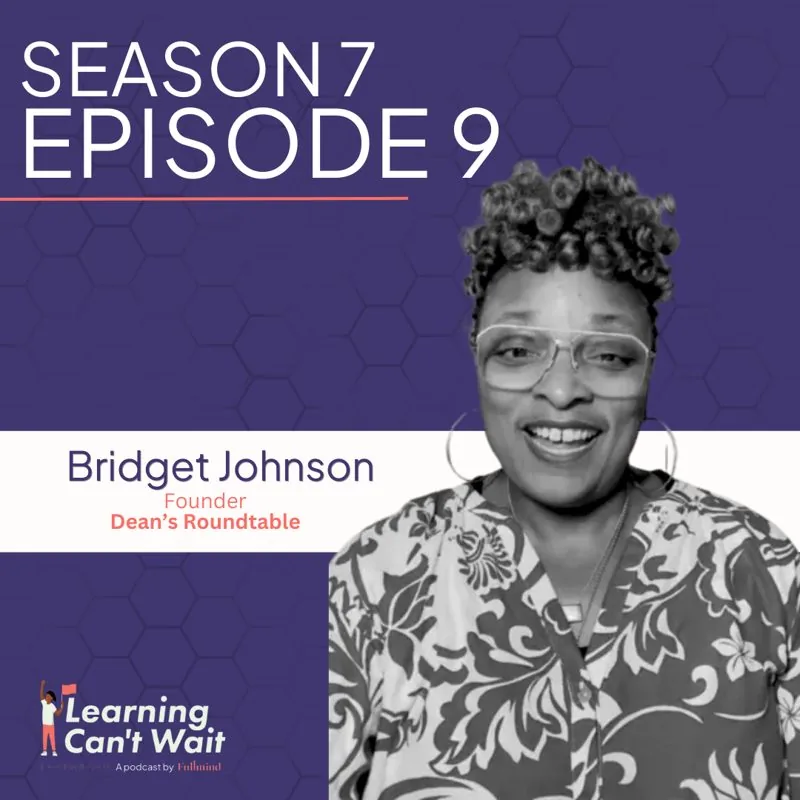
Bridget Johnson: Dean's Roundtable, Student Life, School Deans
- Bridget Johnson
 Hosted by Hayley Spira-Bauer, Chief Academic Officer at Fullmind
Listen now
Bridget Johnson: Dean's Roundtable, Student Life, School Deans
Episode summary
Bridget Johnson, founder of The Dean's Roundtable, describes stumbling from corporate finance into education through coaching, becoming a boarding-school dean, and creating the professional development that deans lacked. She covers today's hot topics for student life professionals, including AI and deepfakes, mental health, bias, legal risk, and dean burnout, and the proactive work of partnering with counselors and planning for the first 90 days. She offers a step-by-step playbook for difficult parent phone calls and urges new deans to build community rather than lead alone.
Key takeaways
- Deans had virtually no dedicated PD; The Dean's Roundtable fills that gap with a small conference, podcast, and online community
- Dean tenure has shrunk to roughly three to five years; boundaries and self-care are survival skills
- Partner with the counseling office and plan for the first 90 days' social inflection points before they happen
- Before a hard parent call: check yourself, make a plan, stick to facts, role-play, and give both sides grace
- Build relationships with families early by showing up where parents are and sending a dean's newsletter
About this episode
In this episode of Learning Can’t Wait, we sit down with Bridget Johnson, founder of the Dean’s Roundtable, to discuss the evolving role of school deans in student life and support. Often seen as the disciplinarians of a school, deans actually play a critical role in fostering student growth, decision-making skills, and overall well-being.
Bridget shares practical strategies for deans and educators to shift the perception of the Dean’s office from a place of punishment to one of guidance and support. She highlights the importance of proactive student engagement, key decision-making moments in the school year, and how social media impacts student choices today. We also explore how deans can build strong relationships with families, navigate tough phone calls home, and ensure they aren’t doing this work alone.
Whether you’re a dean, teacher, or school leader, this episode is packed with insights on creating a supportive, student-centered school culture. Plus, learn how the Dean’s Roundtable provides ongoing community and resources for educators tackling student life challenges.
Check out the Dean’s Roundtable Podcast!
Episode notes
When students hear "the dean wants to see you," their stomachs often drop. The dean's office has long been synonymous with discipline, a place students associate with getting in trouble. But what if that perception changed? What if the dean's office became a hub for support, growth, and personal development? That’s exactly what Bridget Johnson, founder of the Dean’s Roundtable, is working to achieve.
If your school or district is looking to build a more supportive, student-centered culture, Fullmind can help. Our virtual staffing services connect you with state-certified educators and school leaders who are trained in best practices for student engagement and well-being—empowering your team to shift from discipline to development. Get in touch to learn how Fullmind can support your goals.
In a recent episode of Learning Can’t Wait, Johnson shared invaluable insights on how deans can shift their role from enforcers of discipline to architects of student well-being. Her experience as a seasoned school leader has taught her that a proactive, relationship-driven approach can transform student life and create an environment where students thrive.
Changing the Perception of the Dean’s Office
"The first thing I want to do is dispel the myth that we’re here to punish," Johnson explains. "Instead, we’re here to support students in their growth and learning."
For Johnson, being a dean isn't about catching students in wrongdoing—it’s about guiding them through the decision-making process. High school is filled with pivotal moments: the first school dance, homecoming, football games, social media pressures. These are times when students are navigating new social dynamics and making choices that could impact their futures. Johnson advises deans to be proactive, identifying these key moments early and preparing students to make better decisions before they face difficult choices.
One of the most effective strategies? Peer leadership. "I can’t say enough about the power of student leaders," Johnson says. By involving older, well-respected students in mentorship roles, schools can create a culture where making positive choices is the norm rather than the exception.
Building Stronger Relationships with Families
An essential part of a dean’s role is establishing trust with families. But for many deans, especially those in boarding schools where parents aren’t on campus daily, building those relationships can be a challenge.
Johnson recommends that deans be visible and proactive in reaching out. "Go where the parents are—sporting events, plays, parent-teacher conferences. Introduce yourself before there’s ever a problem," she advises. A dean’s job is much easier when parents view them as allies rather than adversaries.
She also suggests creative ways to connect with families, such as a Dean’s Newsletter or informal parent meet-and-greets. The goal is to establish rapport before a difficult conversation is ever necessary.
Mastering the Art of the Tough Phone Call
Every educator dreads making a call home to discuss a student’s poor behavior. Johnson provides a practical roadmap for handling these challenging conversations with confidence and care.
- Check Yourself First – "Before you pick up the phone, ask yourself: How am I feeling? Am I coming in hot? Did I eat today? Have I had water?" Johnson emphasizes that parents can sense your energy, so ensuring you’re in the right mindset is key.
- Have a Plan – Bullet-point key facts and desired outcomes before dialing. A clear structure will help keep the conversation focused and productive.
- Stick to the Facts – Parents may respond emotionally, and that’s okay. Your job is to remain calm and objective.
- Practice If Necessary – If it’s a particularly tough conversation, role-play with a trusted colleague beforehand.
- Follow Up – If the call doesn’t go as planned, don’t be afraid to follow up later to clarify or offer support.
- Give Parents Grace – "You never know what else a parent is dealing with," Johnson says. Approaching conversations with empathy can make all the difference.
Why Deans Shouldn’t Go It Alone
Perhaps Johnson’s most important piece of advice for new deans is this: "Don’t do this work alone."
Deans often feel isolated, carrying the weight of student discipline, family concerns, and staff relationships on their shoulders. But they don’t have to navigate these challenges by themselves. Johnson founded the Dean’s Roundtable to provide a space where deans can find mentorship, resources, and community. Through online networks, blogs, podcasts, and one-on-one coaching, she’s helping deans become stronger, more effective leaders.
"We have a community here to support you," she says. "There’s no need to reinvent the wheel. Lean on those who have been where you are."
Creating a Culture of Support
The role of a dean is evolving. No longer just the enforcer of rules, today’s deans are positioned to be advocates, mentors, and guides for students navigating the complexities of modern adolescence. By focusing on relationship-building, proactive student support, and strong family connections, deans can transform their offices from places of punishment into centers for student success.
If you’re an educator looking for support in your role, the Dean’s Roundtable is a valuable resource. Because, as Johnson reminds us, no dean—or educator—should have to do this work alone.
Full transcript
Transcript generated from the recording; minor errors may remain.
Hayley Spira-Bauer: Welcome back, everybody to the Learning Can't Wait podcast. I am so excited to introduce you to our next guest. We have Bridget Johnson, the founder of The Dean's Roundtable here today. Bridget, welcome.
Bridget Johnson: Oh, thank you so much, Hayley, for having me. It's such an honor to be here. I really appreciate it.
Hayley Spira-Bauer: It's a pleasure for me to have you. As I really felt odd last week when I was on your podcast not asking any questions, so now it's my turn.
Bridget Johnson: It is your turn, friend. Fire away.
Hayley Spira-Bauer: Yeah. Do you mind telling folks, what's the name of your podcast? We're going to give you that moment to just spread the word.
Bridget Johnson: Yeah, absolutely. Thank you so much for that. So my podcast is called The Dean's Roundtable podcast, and we are very new. We currently only have two episodes that are ready and Hayley's being one of those, but we've already recorded five and so we're so excited and it's really just about student life issues. So Hayley and I talked about neurodiversity and learning differences and how we can be more mindful in that space. I've done one on mental health issues. I've done one on civil discourse and yesterday I did one on what we call the parent phone call, difficult conversations, and so all the things, and so I'm so excited to be able to launch it and have that platform.
Hayley Spira-Bauer: Amazing. Well, let's jump into the podcast here and have you tell a little bit about your journey, how you came to be. I always ask the same first question in my guess, which is how did you come to be the personal and professional version of yourself?
Bridget Johnson: Yes. So the professional version of myself, I never thought that I would be in education, quite honestly. Full disclosure, I went to college, majored in finance and international business and thought I was going to be in corporate America carrying my briefcase with a corner office, blah, blah, blah. And so I took accounting. I was like, Ooh, don't love that. But I still stayed the course until I graduated and had a job in corporate America and absolutely hated it. Really just did not, it was not what I thought it was going to be. It didn't fulfill me, didn't fill my cup. And so I was an athlete in college and so at the same time, my coach, because I actually ran a bit after college, asked the group if there's anyone who was interested in coaching part-time at a private school where we had often trained, and I was like, oh, sure, whatever. I don't really love kids.
Hayley Spira-Bauer: You're like, I need out of finance.
Bridget Johnson: I got to do something. And so the original plan was for me to show up there three days a week and work with a certain group of runners. I started showing up four days a week, then five days a week, and then I started having dinner. They were like, do you want a job here? And I was like, ah, yeah, I think so. And so that's how I kind of walked into the world of education, kind of stumbled in, maybe I ran in because I was coaching track, but so I started as assistant registrar and realized, realized I did not want to be a registrar. And so then a year after that I moved into the admissions office, which I absolutely loved telling families about this opportunity that I didn't even know about myself growing up. And so being able to travel the world actually, because I did some international travel as well, letting people know about this opportunity and living in the dorm and coaching, I really loved it and I was like, I found my thing. ([03:44](https://www.google.com/url?sa=E&q=https%3A%2F%2Fwww.rev.com%2Ftranscript-editor%2Fshared%2F8Ozqil7CWs9SGntZYPlM1Y3krruJT7jucEyr8mlrWDX_xmZKmZVH8RQ9RM6ObUhkt4C_zRpl9ciV4vilQAzgIRLlyHs%3FloadFrom%3DDocumentDeeplink%26ts%3D224.56)): And so from there, I was doing a lot of different things on campus outside of coaching, I was doing some student support work. And so at one point I had to make a decision, do I want to be director of admissions or do I want to go the dean of students route? And so chose the dean of students route and moved from that school to another school in the northeast right outside of Boston and was the dean of students there for five years and loved it. It was hard, but I loved it. And I feel like that's where I got what I call my leadership chops. From there, it was a lot of interesting situations to deal with. And so after five years, decided to kind of step off the school campus directly and work with a nonprofit organization that placed students of color in private schools. So I was the associate executive director there for six years and then really just decided to branch out on my own. And so you're probably wondering where did The Dean's Roundtable come in? And so when I was still a dean, I realized there was no professional development specifically for this group of people. There's virtually nothing out
Hayley Spira-Bauer: There can confirm.
Bridget Johnson: And so I got together with two other colleagues that I had met in my travels and said, Hey, you guys want to pull something together for a summer conference? And they agreed. And that's how The Dean's Roundtable was founded back in 2012. And we've been going strong ever since. It's a relatively small conference by design. We want between 50 and 60 educators in the room so that we can break up into smaller cohorts and really get to know each other and network and commiserate and talk about hot topics and bring in experts in the field in various areas so that they get that professional development that they need. So about three years ago decided to expand and not just do a conference during the summer. So now we've got the podcast going on. We blog every week. We have a newsletter and we also have what's called Office Hours. So it's an opportunity for student life folks to drop in and talk with other people and see what's going on. And we also launched an online platform called The Dean's Roundtable online community where again, people can come in, commiserate, ask questions, get resources, and just kind of be connected. So important to be connected and build community. ([06:20](https://www.google.com/url?sa=E&q=https%3A%2F%2Fwww.rev.com%2Ftranscript-editor%2Fshared%2FCsC5hU6xS_qX88O5T7gXA_sfoWY10T72f6SoiggGzZaIyqGIcJ8Rh1Kdod1ii5M8HKMEi1Xk1yrthqZk68qQpIHh2c4%3FloadFrom%3DDocumentDeeplink%26ts%3D380.93)): That was long.
[05:00] **Hayley Spira-Bauer:** No, but there's so many. I'm like, I have 65 million questions right now. So first co-sign my story that I was a dean for exactly eight months, and it was so challenging. And I did have professional development, and that's the only reason I survived that eight months because I had some, it wasn't PD meant for student life folk, it was PD that was meant for supporting students with significant trauma. And that was really helpful in me being more effective at what I was doing. So what are some big topics in the student life community right now? It's been a while. Couple years. I'm imagining some of it is mental health, what
Bridget Johnson: Absolutely mental health, what else
Hayley Spira-Bauer: Are some other big topics?
Bridget Johnson: AI for sure, and how students and adults are using it on campus. And there have been some disciplinary issues or concerns surrounding that with what they call deepfakes and things like that happening. So how are you managing that self-care related to mental health? But a lot of times when we talk about mental health, it's on the student side, but I really have been really kind of top of mind for me is just making sure that these folks are also taking care of themselves because we also don't talk about that enough as well. So bias is another thing that we've talked about quite extensively and legal hot topics, what are schools being sued for? What do you need to make sure that you're being aware of what you need to dot your i's and cross your T's in this particular area? Handbooks. So all the things. And then really just dealing with difficult conversations. All of those things have been kind of top of mind topics, I would say for student life professionals.
Hayley Spira-Bauer: I have a parent, I have so many questions about social media. My kids are not on it. He just had the most fascinating conversation with my son right before this recording. He literally pulled up my name on his school computer and he likes to see mommy's famous because the internet has pictures of people. I don't think he understand, but he goes, mommy, look at this picture of you and daddy and then Wesley and me, you covered up our faces. And I said,
Bridget Johnson: Yeah,
Hayley Spira-Bauer: Anything that I have that's public, I cover up your faces because you're still a minor and I don't want your faces out on the internet. And then he was like, why do you do that? And I was like, well, maybe we should ask Bridget that question.
Bridget Johnson: You should absolutely ask that. And so we don't want minors' faces to be kind of floating out there on the internet so people can use them for whatever thing that they want to use them for or maybe do some sort of reverse search and find you. Protecting our little ones is very important. And thinking about internet safety and being a good kind of steward of the internet is also important in what we want to teach our children because it's the wild wild west out there right now.
Hayley Spira-Bauer: Oh boy, it sure is. It sure is Bridget. Oh my gosh.
Bridget Johnson: And our kids are so trusting and they think that everyone has good intentions when they do not. And so I think that would be what I would say, because everyone does not have good intentions. We hope that they do, but some people unfortunately do not.
[10:00] **Hayley Spira-Bauer:** No, and you brought up a bunch of really important topics that I think a lot about as it relates to students in schools. I'm curious for your take on what's the current status of Dean burnout? Is Dean burnout as high as teacher burnout is right
Bridget Johnson: Now? Yes, I think, but there's only one dean at your school, and so it probably feels a little bit different. When I stepped into the dean's office, I would say probably the average tenure of a dean is probably five to seven years is what people were saying. I think that has changed a bit. I would say three to five maybe, but thinking about how we can find ways for not to cope, that's not the word I want to use, but to be able to do this job more. And that's where the self-care comes in. And setting boundaries, especially in a boarding school. Boarding school can be really all consuming. I
Hayley Spira-Bauer: Mean, your whole life is wrapped up
Bridget Johnson: Home sweet work is what I call it.
Hayley Spira-Bauer: Oh, wow.
Bridget Johnson: Because I mean, you literally live there, and so you have to figure out how to set some boundaries for yourself and how to take care of yourself and be okay with no being a full sentence sometimes, because you do have to kind of protect yourself and protect your sanity.
Hayley Spira-Bauer: Right now I think education is more difficult to sustain than ever.
Bridget Johnson: Oh, absolutely. Absolutely.
Hayley Spira-Bauer: You and I both were not school-based during the pandemic, is that correct?
Bridget Johnson: Correct. Yep.
Hayley Spira-Bauer: And I can't even fathom how challenging. I mean, those years were very traumatic and very, very difficult for teachers and educators. And so the repercussions are students that are academically further behind than ever mental health rates that are on the rise or mental health problems that are on the rise. And quite frankly, I've heard, this is anecdotal, the other two items are stats, but I've heard anecdotally just that kids don't know how to be in school anymore.
Bridget Johnson: They really struggle with that because they sat in front of a computer essentially by themselves all day. And for kids who hadn't been in school before, we'll start there with that segment of people not knowing how to interact when someone sitting right next to you. And so that's a challenge, but also those who've now kind of figured out how to kind of work as an individual and now having to come back and work in a group or be in a group setting, those social dynamics can be really tough. And depending on what was happening and what sort of environment you were learning in at home could have also been traumatic and led to other issues or concerns as well. Unfortunately,
Hayley Spira-Bauer: And I know that not all of the work of student life professionals is specifically surrounding the reactive. There's a lot of proactive work that happens so that you can avoid the defensive moves later
Bridget Johnson: On you try, right? Yeah, that's the goal. Can you
Hayley Spira-Bauer: Talk about, in your experience, what are some of the best deans doing proactively in schools to support students in where they are at this moment in time and the end of 2024?
Bridget Johnson: Yeah, so I think talking about things before they happen, I put that in quotation marks is really so important. And what I mean by that is pairing with your counseling office to tackle issues. I can't stress that enough. Having that partnership with your counseling office so that the deans and the counselors are working together and the kids feel like there are options in terms of, because everyone's worried about getting in trouble. And so that's what the dean's office is virtually seen as the place where you go when you're in trouble. And so the first thing I want to do is kind of try and dispel that myth and say, we're here to help you and support you in your growth and learning. We want what's best for you. We want to kind of shield you from the things as best we can from the things that are really could be detrimental to you both mentally and physically, but also help you to learn and grow so that when you leave our doors or the confines of our school, that you are a functioning human being and you can do some things on your own and you know how to face challenges and you know that everyone's not perfect even though they look like it on the internet, and you'll be okay. ([15:01](https://www.google.com/url?sa=E&q=https%3A%2F%2Fwww.rev.com%2Ftranscript-editor%2Fshared%2FzBSEEIi4-Gkd36azjwSYKOS7L4LnEB8GX9PgFbxe8PfAoVSdDXnHhjFHUuPtkRCRqOcd1PJdvVhtUnDvtSaYyRcdR8c%3FloadFrom%3DDocumentDeeplink%26ts%3D901.67)): And so what I would often try to do is look at the calendar and look at the schedule and see those inflection points where I know that there're going to be some real wrestling with decision making. And so what I tell new deans, I do a portion for new deans at the conference the first day is look at the first 90 days of school. The first 90 days have some real interesting pieces there that you want to talk about early, the first dance, the homecoming, the first football game, all of those kind of social settings where kids have to make some decisions, let's talk about that, especially for freshmen who really want to belong and have friends, and some of the decisions they make are poor based on that. And so talking about those things, not only with the adults but with the peers, peer student leaders, I can't say enough how important those are, but looking at those points and talking about kind of social media now, because let me just be clear, social media now was not what social media was when I was a dean, so oh my goodness. All of the things that students have to contend with and kind of filter out and what's real and what's not real, all of those things are so important to talk about. So that's what I would say to new deans.
[15:00] **Hayley Spira-Bauer:** Yeah, I'm curious about how this interplays with families as well. I felt like when I was a dean, establishing relationships with my families was so vital to my success in the building with kids. Can you share a little bit about your experience with, again, proactive relationship building with families, what it looks like when it's at its best and what impact it has?
Bridget Johnson: Absolutely. And that is so important, Hayley, and it's trickier. I'm going to give you kind of two paths. It's a little bit trickier when you're on boarding school because you're not seeing the parents on a regular basis. And so the first school I worked at was a hundred percent boarding. There were no day students, and so everyone lived on campus and you really didn't see parents, parents weekend. There was an occasional weekend where parents would come if they happened to be in town, to kind of take their kids off campus. And so for me, prior to a dean being a dean, working in the admissions office, I actually got to make those relationships with parents because I saw them before. They were actual part of the community. And so that's one of the things that was a perk of being there. I could actually call up a parent and if the dean was going to be called, there was going to be an issue. ([17:54](https://www.google.com/url?sa=E&q=https%3A%2F%2Fwww.rev.com%2Ftranscript-editor%2Fshared%2FNbHdP32TPsofVhUzu9qakOT4RPwiQAbJ6FN9temcNzOfq9_3linFJiiFl96Vd7Dj_fp5_8rObrSSnVN-uQq1GDR2tzM%3FloadFrom%3DDocumentDeeplink%26ts%3D1074.3)): I could kind of be an intermediary. And so one thing I would say is I look for those people on campus who are intermediaries, who have relationships with particular parents beforehand, but in terms of what you can do to build relationships yourself, you have to get out there. And so whether it's sporting events, plays and musicals and orchestra and all those things go where the parents are and introduce yourself, parent teacher conferences, deans don't generally have a space in that really. They may kind of address the entire community as a whole, but go and introduce yourself. And I also, a lot of the schools have advisory systems, and so I always encourage deans to be advisors. Another way to kind of get your foot in the door with parents, but you have to be visible with the advent of social media and all the things that are out there and the ways that schools are communicating. ([18:57](https://www.google.com/url?sa=E&q=https%3A%2F%2Fwww.rev.com%2Ftranscript-editor%2Fshared%2FzUbJFPWcvniIwKJOlypL8wAr3VzIAe7AOseqpuB2XwaFX2Z1xq9f5XEcfPRu6WY8q_B6Awcn_Y3XCnBe1dqNFLytSS8%3FloadFrom%3DDocumentDeeplink%26ts%3D1137.15)): Could you be doing a Dean's newsletter does kind of say what's going on campus? So that's another way for you to reach out to parents because ideally you want to be able to know someone before you have to call them with some disturbing information about their child or upsetting information about their child. It's not always possible. Let me be clear. I understand that I worked at a school with 700 kids, I didn't know a lot of those parents, but when you do have to make a phone call, you don't want to kind of launch into what's going on. Why don't you just ask a couple of questions about the parent to try and get to know the parent first in that way.
Hayley Spira-Bauer: Oh yeah, let's do this. Let's talk about this, right?
Bridget Johnson: Because
Hayley Spira-Bauer: That phone call home to a parent when you are a dean or a school leader or even a
Bridget Johnson: Teacher
Hayley Spira-Bauer: Can be so daunting,
Bridget Johnson: Daunting, stressful, anxiety provoking, all the things.
Hayley Spira-Bauer: Absolutely. Yeah. So tell us what advice you give to educators who have to make that phone call. Obviously, we heard you a moment ago, you shared really wisely form relationships first.
[20:00] **Bridget Johnson:** Number
Hayley Spira-Bauer: One in life is relationships.
Bridget Johnson: Absolutely, chef's kiss.
Hayley Spira-Bauer: Let's assume they did that. What's that phone call sound like when little Janine stole something at the school?
Bridget Johnson: So the first thing you do is check yourself. How are you doing? Are you coming into this conversation hot? Have you been doing 17 other things before you are supposed to make this call? Have you had any food today? Have you had some water? Are you dehydrated? Where are you? That's the first thing because they're going to feel the energy that you're bringing to the phone call. So that's number one. Number two, have a plan. Don't just say, I need to call this parent and then just start rattling things off. Make some bullet points, especially if it's a particularly disturbing conversation that you think you may be having. Make bullet points. Be clear about the pieces that you need to share and what your desired outcome is. Now I know that might not go that way, but at least you have a plan and a framework so that you're not scrambling trying to figure out what to do in the moment. ([21:15](https://www.google.com/url?sa=E&q=https%3A%2F%2Fwww.rev.com%2Ftranscript-editor%2Fshared%2F75m6jO2pHKNxnEm4Jq7skwumwRxT_TytXnAHrcuq2rJc3L094rLrHqI1ysmDEMu6RJDcz2_Qx5M-nfFRnEdljq4Coeo%3FloadFrom%3DDocumentDeeplink%26ts%3D1275.52)): Number two, you need to check your emotions and make sure that you're just dealing with the facts. Parents aren't going to necessarily be able to do that, and so they're going to have emotions when you're calling about their child. They are admittedly going to be kind of in defense mode, and so you need to be okay with that, embrace that, understand that, but you have to keep the temperature level low. You are managing the conversation. And so if they start ramping up, you can't ramp up with them. If they start to make some personal jabs or accusatory remarks, you can't go there with them. You have to kind of stick to the facts and stick to your plan. And even before that, I encourage people if it's a particular difficult conversation, you haven't had many of them role play it out. Have someone that you trust that you can help you walk through that so that you know what to say or know what you want to say when it gets difficult. ([22:21](https://www.google.com/url?sa=E&q=https%3A%2F%2Fwww.rev.com%2Ftranscript-editor%2Fshared%2F_RMdBtnuPLlW6ouh2N84OvNraUpmbtypZIjUF7tvfpbXjGEuf6FvYpns2NWnD-6FXMXKJDmaW8SNa7X51zwtuH0oOwU%3FloadFrom%3DDocumentDeeplink%26ts%3D1341.55)): And also give yourself some grace. Think about if the call didn't go exactly the way you wanted it to, you can call back. It's not like it's over and that can't do anything after that. Give yourself some space to be able to say, well, maybe there's some things that you didn't relay that you wanted to or you just didn't feel the call ended the way you wanted to give yourself the opportunity to be able to call back and if there's any way that you can prep parents ahead of time, sometimes that's not possible and I understand that, but if there's any information you can give parents ahead of time so they can calm down themselves before entering the phone call, it's also helpful. And then lastly, what I would say is we never know what people are dealing with, and so we think parents are just being difficult for the safe of being difficult and they're entitled, butwe don't know what they're dealing with at home.You may have just one of their children and they may have several others or they're dealing with fill in the blank. I'm not going to give additional examples there, but we have to also try and give parents some grace as well. This is a stressful, high anxiety provoking situation for them dealing with their child. They love their child so much and want the best for them and don't want them to be in any pain or discomfort or uncomfortable. And so you have to understand the angle at which the parents are coming in as well.
Hayley Spira-Bauer: Those were some hot tips there. Those were some really, really great tips. I appreciate the practicality and even the sequencing of those suggestions. I know that, again, it doesn't just have to be dean, but teachers have to make difficult phone calls all the
Bridget Johnson: Time. Absolutely.
Hayley Spira-Bauer: And now that I'm on the other side of it and I have kids, I've gotten a few phone calls over the years and I always tell them, don't be nervous. It's okay. I've been in your shoes. Like, okay, what did they do? How are we handling it? Let's talk about this as a team.
Bridget Johnson: And I know they really appreciate you doing that because it's a lot. And then one other thing I will say is debrief your phone. Call, either with yourself or someone else went well, what didn't go well so that you in the future can learn from those calls.
Hayley Spira-Bauer: Bridget, this has been a wealth of information. I do a ton of content here about tools and academic and what's happening with classrooms right now and the reform movement. And what I really love about this conversation is I think it's given keen insight into, again, not just deans, but supporting students with all these student life issues that you've named here and helped give directionality to the folks that are tackling them and a lot of nuggets to really think about. It's wild to me that we're already wrapping up the together by so fast. Fast. I know you sort of answered this previously, but new deans starting their career. One piece of advice would you give them,
[25:00] **Bridget Johnson:** Don't do this work alone.There are plenty of people, whether on your campus or other deans in the area that are happy and willing to support you in that work. Don't feel like you have to do all this work alone. You have to be the leader alone because that's a hard place to be in, and that's not fair. You have a lot of decisions to make and you've got a lot of people who are your constituents, both students and parents, and a lot of times adults on campus that you manage. Don't try and do all this work alone.
Hayley Spira-Bauer: I love that. That's wonderful. I mean, they could check out The Dean's Roundtable.
Bridget Johnson: Absolutely. We're a community. We're here to support. We're here to help you. We've got an online community. We have podcasts, we have blogs, and I'm also there for one-on-one coaching and support.
Hayley Spira-Bauer: Amazing. Bridget, thank you so much for coming on the podcast today. It's been a pleasure having you,
Bridget Johnson: Hayley. The pleasure was all mine. I really enjoyed this conversation.
Hayley Spira-Bauer: Me too. And I really look forward to getting some feedback from our listeners on today's episode, what resonated with you. Thanks for tuning in today.