
Learning Can’t Wait · Episode 204
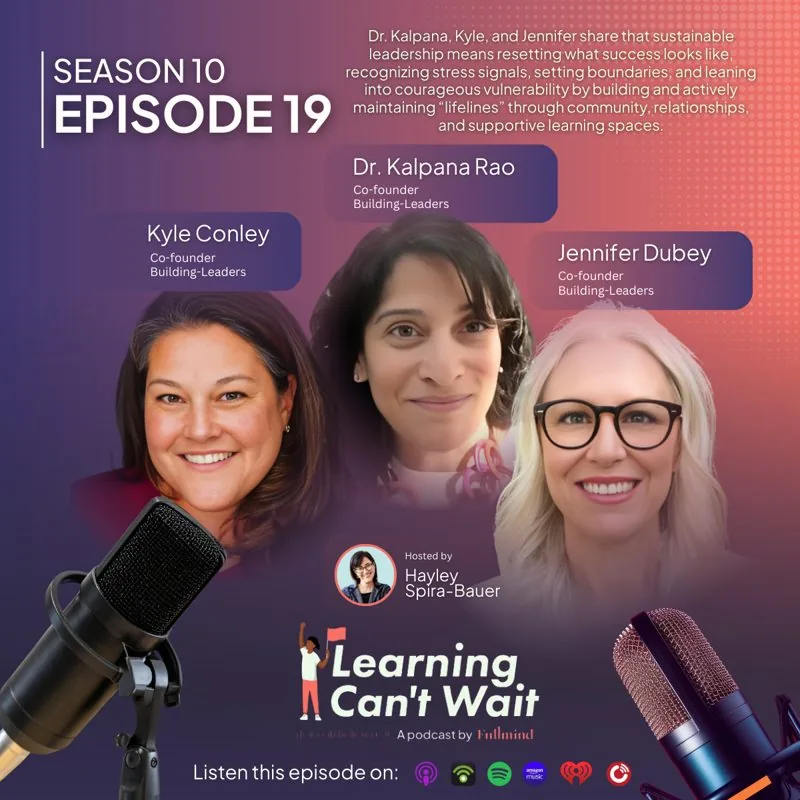
Dr. Kalpana Rao, Kyle Conley, and Jennifer Dubey: Lifelong learning and “lead learner” mindset, Psychological safety for leaders and staff & Global perspectives on schooling and context
- Dr. Kalpana Rao
- Kyle Conley
- and Jennifer Dubey, Are reimagining school leadership by centering lifelong learning, psychological safety
 Hosted by Hayley Spira-Bauer, Chief Academic Officer at Fullmind
Listen now
Dr. Kalpana Rao, Kyle Conley, and Jennifer Dubey: Lifelong learning and “lead learner” mindset, Psychological safety for leaders and staff & Global perspectives on schooling and context
Episode summary
Kalpana Rao, Kyle Conley, and Jennifer Dubey, co-founders of Building Leaders, discuss the isolation of the principalship and what they see more clearly now that they coach leaders rather than lead schools. Kyle reflects on being promoted before he was ready and trying to be someone else's version of a principal; Kalpana contrasts U.S. accountability culture with more holistic systems abroad. They describe Building Leaders' school visits and communities of practice that let principals learn from peers and from schools in other countries, name sustainability and staffing as the top challenges, and propose splitting the principal role and offering coaching throughout a career.
Key takeaways
- Principals are often promoted before they're ready and try to be someone else's version of the role
- Schools abroad tend to educate more holistically; U.S. accountability can narrow what counts
- Peer visits and communities of practice break the isolation of being one of one in a building
- Dividing principal duties between instructional and operational leaders reduces burnout
- Coaching should be available throughout a leader's career, not just in year one
About this episode
The episode explores how three co-founders of Building Leaders—Dr. Kalpana Rao, Kyle Conley, and Jennifer Dubey—are reimagining school leadership by centering lifelong learning, psychological safety, and global perspectives for principals who are often “one of one” in their buildings. They trace personal journeys through classroom teaching, turnaround schools, global education, burnout, and recovery to highlight the need for more holistic definitions of success for leaders and students, beyond test scores and rigid accountability systems. The conversation surfaces post-COVID challenges like sustainability, staffing crises, and rising student needs, and shows how Building Leaders creates peer communities, reflective school visits, and coaching to reduce isolation and elevate the expertise of current practitioners. Throughout, they argue for structural shifts—shared leadership models, ongoing coaching, and deeper community engagement—so principals can lead with vulnerability, purpose, and balance instead of exhaustion and compliance.
Full transcript
Transcript generated from the recording; minor errors may remain.
Hayley Spira-Bauer: Welcome back, everybody, to the Learning Can't Wait podcast. Today we have a panel, and I love a panel. You get diversity of thought, opinion, and voice. And we have 3 incredible folks joining us here today. We have Kalpana Rao, Kyle Conley, and Jennifer Dubey, all co-founders of Building Leaders. Welcome, everybody, to the podcast!
Kyle Conley: Thanks! Thanks, Hayley!
Jennifer Dubey: Thanks for having us.
Hayley Spira-Bauer: So we're all recording from different locations, which makes my screen a really cool Brady Bunch picture right now, but I'm really excited to have all three of you here joining me today. I know you're building something new, but you all come with a breadth and depth of experience in the education space. And I'm really excited for you to share that here, so I'm going to just start us off by asking, and I'll start with you, Kalpana, how did you come to be the personal and professional version of yourself?
Kalpana Rao: I love this question. I… I think I started really even in high school, middle school, high school, thinking a lot about racial and social justice issues, and kind of acting up and noting disparities. And then eventually decided to apply my effort towards that, towards addressing those in education in specific, you know, in particular. I ended up teaching in a various turnaround schools from Compton to Milwaukee to Boston to Denver. I was a school leader in Milwaukee, Boston and Denver as well. And at some point, the challenge of turnaround work, and really sometimes the challenge of being a principal, is And also, maybe the American myth of, like, your work and your productivity is your self-worth, which we know is not true. But at some point for me, that meant burnout. I then later went abroad, and I did totally… well, not totally different work, but I worked in nonprofits, and really just found myself again, found my hobbies, found balance, found well-being again. And that was all amazing work in Australia and South Africa, but eventually I missed schools, because schools are amazing. And I went to the other end of the socioeconomic spectrum and was a principal in Japan at an international school for several years. And that was also really, really beautiful and amazing work. I did that through COVID, which has its own special type of challenges, and frankly, I burnt out again. And so I am kind of resetting, re… you know, refocusing, redesigning what leadership and success looks like. I coach school leaders, and I'm building something exciting with Jen and Kyle right now.
Hayley Spira-Bauer: I appreciate the, you know, breadth of your experience and really the types of different school systems you had the opportunity to teach and lead in. I think that will add a lot of color to our conversation today. Kyle, same question for you. How did you come to be the personal and professional version of yourself?
Kyle Conley: Thanks. I also… I really love this question as well. I think I've reached the age where I can safely look and see the connection of how my personal and professional lives have sort of connected with one another, through my career, you know, as a teacher, I was a district administrator, school assistant principal, and principal. That professional side of me lining up right now with where I am personally as a partner and a parent, having an opportunity to move my family abroad to go work in global education, I've really been centered… I think that the common theme is is really looking carefully at how people learn and how we, whether that's, you know, students or adults. And just trying to, you know, really explore, how we can serve those that are learning, and when we can turn that curiosity into, into something great. So, I think that that journey of, like, watching my personal and professional lives come together has been really very beautiful, and so today, I really see myself as someone who's building spaces for that learning. Obviously, I'm starting this Building Leaders venture, but I'm also, I'm also a coach and a mentor. I'm a parent, and I'm an elected official on our school board. So, there's a lot of opportunities for me to really explore that question of how we learn best.
Hayley Spira-Bauer: You probably have a lot of free time, too, based on all the things you just shared that you're doing. You know, I always tell folks. Educators have to be forever learners. Because, one, we're always knowing, we're always finding out more information about brains, and brain science, and how our brains operate. We still don't have all the answers. And two, if we expect our kids to be continuous improvers, we should be too. So, excited to dive into your own opinion on that front, given that it sounds like you two embrace the idea of forever learning and forever improving, Kyle.
Kyle Conley: 100%, lots of thoughts.
Hayley Spira-Bauer: And Jennifer, last but not least, how did you come to be the personal and professional version of yourself?
Jennifer Dubey: It's perfect that you're just talking about forever learning, because I was gonna share, first and foremost, I see myself as a lead learner, and that is really… and as well as a, recovering overachiever. And those two things really, I feel like. Kick off when I reflect on, like, my first year teaching, and really, for the first time in my life, struggling mightily with doing something on my own. Like, being able to just get in a class, you know, plug away at something, work hard, and get my laurels and my achievement, and teaching was… Not like that. That's not how you become an effective teacher. It's about collaboration and community and relationships, and building off of that for the rest of my career and my personal life, I've just deeply invested in what does it look like for my own constant learning, as well as for being in spaces and creating spaces for people to learn, from the rich, full experiences that they bring. From failing, and that being okay, from being able to be really open and honest. So I've coached, I've been a school leader, and I've also created and led a lot of programming where folks are able to kind of be in spaces that they can be safe to try, and be honest and open, and keep learning and growing. So, yeah. The lifelong learner, as well as lead learner, really resonates for me of who I am, personally and professionally.
[05:00] **Hayley Spira-Bauer:** I see why y'all got together to do something awesome, because there's so much similarity and threading between what each of you have shared so far about what you believe to be important as professionals as leaders and systems, but I want to dig in a little deeper to that. Now that you're on the outside of supporting school leaders instead of being one, Kyle, I'll start with you. What do you see differently? What's clearer now that wasn't when you were in that seat?
Kyle Conley: When I was… when I was a school leader, I mean, I think I've had a lot of time to really reflect on this. The reality is, is that I, like so many other school leaders, was probably promoted to the role of principal before I was ready. I was a fantastic teacher, I was, you know, I was… I was really driven to have high levels of impact, and it turned out that all of those skills that made me successful as, like, a teacher coach. As an, you know, even as an assistant principal, did not necessarily mean that I was prepared for the principalship. So, and one of the things, when I… when I reflect on that, I… I think what was at the core of what I would do differently, or how I see the role of principal differently, is I think I was trying really hard to be somebody else's version of a school principal, whether that was, like, you know, something that I had read somewhere about, you know, what needs to happen in order for you to be successful, or some policy that I needed to have in place, and I don't think that I really had a good sense of who I was and what I stood for. Because if I could do it differently now, I would be much more intentional about building, learning spaces for my teachers. You know, I was… I was the principal of a capital T turnaround school in Aurora, Colorado. Aurora is a designated refugee relocation city. About 20% of my 750 students were new Americans that had come with refugee status. And, and the rest of them spoke Spanish at home. So we were, we were a beautiful, wonderful, fantastic school with really amazing teachers, and I sort of had it in my head that because we'd been given this capital T turnaround school label, that somehow I needed to flip everything upside down, instead of really building vulnerable, safe spaces for my teachers to thrive. And so that's something that I absolutely wish that I had had the maturity of leadership in that moment to recognize.
Hayley Spira-Bauer: Yeah, that's… it's… hard, right? Like, I learn from doing, but education doesn't feel always like you can learn from doing, because children's educations are at stake.
Kyle Conley: Yeah.
Hayley Spira-Bauer: And so, for leaders, taking risks, and teachers taking risks, is scary. Kalpana, talk to me about your philosophy on risk-taking in education. How does your experience in the U.S. Versus abroad really inform what you believe today?
Kalpana Rao: Oh… So much, I mean, I was a school leader for… and a teacher and educator for a long time in the U.S, and so I grew up in that system, if you will, as an educator. But once you leave it, and this will probably come back to this metaphor again, but, like, you can then look at that fishbowl quite differently, because you're not in it anymore. And so, I have a lot of critical thoughts around… accountability and how we use it as a tool, you know, like a punishment, you know, and a whip instead of, you know, it being a carrot or a bar to set. How holistically we educate or don't educate children. There were so many places outside of the U.S. Where, you know, I would be at a school, supporting one of my leaders, and, you know, the lines weren't super straight when they came in from recess. They lined up, and they talked, and the line was pretty crooked, and it was pretty loud, and then the teacher would come out, and they'd more or less quiet down, and then they'd get back to class. And it's okay. Like, it was okay that they weren't, like, perfectly straight, like, they were lining up in prison or something, you know? There were things that we've come to emphasize in the US sometimes around discipline or order or the way that turnarounds, you know, and other types of schools have to be successful. And the rest of the world has really different ideas about that, and they're more holistic. They care a lot about the socio-emotional side of things. They… So I think a lot of that has been really, really different. There's a lot of critical thinking and well-roundedness that I see in other schools and other school systems than I see sometimes in America. And that, again, comes back to the accountability focus, that we get really hooked on the numbers and, like, only what kind kind of students they are versus what else they have to offer. And so, you know, in so many places in the country, in the U.S, we're cutting programs, we're cutting opportunities of other ways of knowing kids. You know, and other ways for them to shine. And that's not to say that they shouldn't also be able to shine academically, and they should be able to read at grade level and all that, but that there's more paths, there's more holistic ways to look at children than just a number, than just a test score, than just the reading, writing, arithmetic stuff that often happens in the U.S. That's… that's a major, major one for me.
[10:00] **Hayley Spira-Bauer:** Yeah, and… you get this really kind of seesaw approach from the media about where we have to turn our attention. Like, is it NAEP scores, or is it the mental health of students? And I think what I hear you saying is it's not an or, it's an and, right?
Kalpana Rao: That's an and.
Hayley Spira-Bauer: Put them both together. That's what makes a whole child, and that's where attention should be. So, I'm curious, Kyle, it looks like you wanted to jump in. Why don't you jump in right there? Go ahead.
Kyle Conley: Yeah, I was just gonna… I was just gonna build on that. I mean, Kalpana and I, especially, have done so much in the global space, and the schools that are most effective for their students are not choosing either or, right? They really are understanding who their kids are, where they're coming from, and then building on that context to make sure they're successful. So, I just wanted to, like, echo that this is, you know, this is something that Kalpana and I and Jen feel really strongly about, is that there's so much to learn from the global conversation and from schools outside of our local context that, That just feels like an entirely different way of educating kids, and one that we can really learn from.
Hayley Spira-Bauer: So, Jennifer, what are you doing together inside of schools now to help bring the knowledge all three of you have gained through your experience to light?
Jennifer Dubey: Yes, so we are focused on… creating opportunities for building leaders to get together with other building leaders to focus on that isolate… eliminating a lot of the isolation that people feel. You know, we call ourselves building leaders. Like, literally, you're in a building, you're one of one, in your role, leading. Who are your lateral colleagues? Who are the folks that you can go to to be open and honest about the challenges you're facing? About the opportunities in front of you and how to really maximize them, and the learning you need to do in a way that you can still show up and be leading for your team and your staff. So, the first thing we're doing is, like, creating spaces to bring those folks together so that they can access their own expertise and lived experience, share it with each other, access theirs. And then make new meaning, together. Get new ideas, get new perspectives. One of the key ways we're doing that, too, is through, also allowing to eliminate the isolation from great ideas and from great models. So we're going on school visits with folks, going to schools that are a reflective point for folks to be able to see something that's working and ask themselves. Hey, how did… how is this leader making that happen, and what does that mean about what I could be doing in my leadership and my community? And we've… I've seen, you know, we've been leading visits like this for… Years and years, and over time, we've just seen it's such a powerful space in 48 hours to bring people together. Shift their perspective by literally getting onto their building and going to see something new, connecting with people who get it, who they can be open and honest with about what they're seeing and what they're thinking about at home, and then use that as a real catalyst for what they're gonna go do on Monday when they go back to their buildings and their spaces. And so we're really excited. Our first school visit's coming up, in March 4th to 6th, in Chicago and Northwest Indiana, and we're just so… it's such a gift to be able to, like, help people come together and access that fresh perspective.
[15:00] **Kyle Conley:** I just want to share, too, if I can jump in, Hayley, as well, like, everything that Jen just described, at the core of it is our core value that you heard in the beginning about us, about our commitment to lifelong learning. And… and really what's at the… the most, I think, important core value of… of this approach is specifically because we are… we are not, we are… we are valuing and… and elevating the collective expertise from a group of school principals and school leadership teams, rather than our collective. Expertise, right?We aren't saying, this is what you need to know, and this feels like a really fundamental differencein what you will hear, like, just really, I think, hopefully. In terms of a deep belief and a fundamental design structure is, how do we elevate the voices of the people who are doing this work every day to say, this is what's working in my school, this is the goal that I have, I need to see how it's being done in other areas, or I need the space to reflect on what's working, and then get out of the way of that learning, provide examples, and then get out of the way. And that feels really fundamental.
Hayley Spira-Bauer: Yeah, like, I'm not in a school anymore. I wasn't… one of the things that I think is so important, and I'm sure people are tired of hearing me say this, but I wasn't in a school during COVID. I think the game changed pretty significantly. Teaching and leading during COVID. And so, the best people are the folks that still have their feet on the ground, that are doing this work. I love, love building leaders' emphasis on having their voices be amplified, and their experiences be shared.
Jennifer Dubey: Yeah, I would add, too, that I think, school leaders get a lot of training, right? There's a lot of training, and there's a lot of professional development that folks get, and even to become a school leader, you're going to get a degree, right? You're going to get a license, you're gonna go through a set of credentials. And the thing that I think really, that is rare for folks and that we're looking to provide is that leadership development piece, that opportunity to be connected, not to, like, do this this way. And there's a place for that. There's absolutely a needed place for training, and implementing what you've learned and programs, etc. But this is more about, like, an organic reflection on yourself and your leadership, and a chance to be in space practicing that with others.
Kalpana Rao: And Hayley, if I can add on to that, I think what makes building leaders special is… so when you're the leader, as Jen said earlier, you know, you're one of one, but also… There's external pressures, there's often not other people that you can maybe safely say, I don't know, or I'm struggling with. And the need for psychological safety, we know, right, allows people to, like, take risks. To do different things in their school. And so, you know, going back to the question you asked earlier, how does a leader, like, think that way, creatively, daringly. If they're feeling constrained by a lot of different things, right? Whereas when you are in community outside of your school, going to visit some other place, you're with other people where you get to bounce ideas off of, right? You can be creative, you can think totally outside the box, you can ask questions and say, I have no idea what they were just talking about. I don't know how that later did that. I've never heard of that system before. Cool. There's not… you're not going to get in trouble with anyone, right? And you're also not competing with anyone else let's say, in your district or network to be better than or to do something faster. You are just a learner who has expertise and also has things to grow, and you get to do that with other people who are similar to you. And that's pretty special, because when you're doing your job day to day, you don't have that opportunity, generally.
Hayley Spira-Bauer: Hmm. So what are the top 3 challenges school leaders are bringing to you all right now?
Kalpana Rao: I mean, I… I think, you know, of course, sustainability is really not a joke. You know, you mentioned post-COVID work in schools. I think that because COVID both made everyone really look at their own well-being in a way that they hadn't before, I think that is now good, and it's in the forefront, but then how do we hold that and the work we do? But COVID also meant that it opened the box as to what's happening in schools, so now people have more scrutiny, more… Information more, you know. Oversight, maybe, into what that is, judgment. And so, how do leaders keep doing this work that is quite difficult, that everyone seems to have an opinion on, everyone thinks that they know how to do, and everyone's telling them how to do? How do they stay in this work, stay fueled? I think that's a huge challenge that, leaders are still facing right now. I also think that worldwide, this is not just in the US, but there is a staffing crisis. Like, people are leaving the profession For various reasons, but they're leaving the profession, and more and more people don't want to necessarily take, especially the spot of the principal. People are often like, I'm good, I'm good, I'll be a teacher leader or assistant principal, but I don't… I really don't want to take that top, top level of accountability and responsibility. So… between leaders not necessarily wanting to stay in it, and also teachers. Like, in the US, there's a huge teaching shortage, right? And so, again, coming back to some of those things that came up post-COVID, but, like, how do we balance compassion for our staff and our educators, and at the same time, make sure that we are meeting the needs of our students? Because their needs also changed significantly while we were in COVID. So there's… those are two big things. I think the staffing crisis and sustainability And just continuing to figure out how we meet all of our students' needs. Around the world, again, we are now more aware of socio-emotional needs, mental health needs, neurodivergence, so many different things, and how do we do all of that inside of a classroom? Language, culture, everything, how are we doing that? How are we meeting the needs?
[20:00] **Kyle Conley:** The other thing that's come up a lot is, there's just a hunger for, you know, as everything in our society has become, more, globalized, right? Like, there's a hunger for creative solutions to similar problems. And what, what excites me about that, that sort of lens is, you know, I really, I really believe, I've seen, I've been a part of, the fact that you can't see what… you can't be what you can't see, right? And when we're in a school district, and we are, you know, maybe we have, you know, I know when I was in, in, in Aurora Public Schools, I had fantastic, colleagues and, and, and folks that were leading other buildings around me, but the reality is, we were all sort of swimming in the same water. Like, to go back to this goldfish analogy, right? We were all swimming in the same water. We were all being informed by the same bits of data, or the same speakers, or the same whatever, just even just contextualized influences. What I'm seeing right now, and what we're hearing from school leaders, is a hunger to look beyond their own small fishbowl, and to get some creative new ideas and new perspectives. I have, you know, as an example, leading a community of practice where I had a couple of, you know, well, I have lots of these stories, but in one example, a school principal in Denver, Colorado, became very close with and very aligned with the school principal in India, and the two of them would go back and forth and really, like, explore their challenges from an entirely different perspective, right? The school leader in India was not seeing the, you know, they might have a similar problem, but their approach to the solution was so completely different because of their context. And so what I think we're hearing a lot of is, help me see things from a new perspective. Help me see how other people are solving a problem, and help me get some new ideas and some creative solutions.
Hayley Spira-Bauer: Can anybody share an example of something they've seen recently, like, post-COVID, in a school that they wish everybody knew about? Like, just an example of either a tool, or camaraderie, or a system that really struck you.
Kyle Conley: I don't know how… how precise this is, but let me tell you what is on the front of my mind when I hear this question all the time, is, I have… having… having worked in… in… In probably about 35 different countries. I can tell you that what I've come to really understand is the importance of context. And I believe that other places I've visited, other than the United States especially, are so much more focused on understanding the community around them and the influence that that community plays in the education of their students. So, when you ask me this question, like, what do I wish? I can share just, you know, an example of, of a school in Mexico whose students that were graduating, and they, they were, you know, they were being successful in school, but they had to leave their community to go find professions. They had, you know, they had to move far away to find a job. When there was actually, like, a BMW manufacturing plant very close and in town. But their students were not graduating with the skills that they needed to go and work locally and to be a part of their own community. And so it wasn't until, you know, this is the practice that I'm preaching again and again and again, it wasn't until the community sat down, and the schools sat down together, and there was an actual conversation of, like, this is what we want to be true for our students. And schools being able to say, okay, we can provide those things, but we didn't know that that was, you know, that this was a community influence. So, that level, what I wish right now for our schools more than anything is that they would have those conversations. They would bring community, they would understand where they are and where their students are coming from, and what their parents are hoping for, for them to be true at the end of their education experience.
Hayley Spira-Bauer: Yeah, I think it… to the… to bring it, like, a little full circle, Kalpana brought up at the beginning of the conversation the importance And relevance of, you know, cultural competency, and the experiences and lives of our kids. And Kyle, you're naming here that beyond the individual child, we also have to attend to the community perspective, and that extends.
[25:00] **Kyle Conley:** Not just within one home, but, you know, in the larger region that a school is located. I think that it is…
Hayley Spira-Bauer: Not as common… I know it's not as common practice here, to your point, in the United States, to have that type of learning. And I'm thinking about, when I've seen it done well, how it really changes the dynamic nature of What a school can be, and how families and community at large get involved in a system.
Kyle Conley: Yeah, we have to stop disconnecting our students from where they come from and what they need to learn. That disconnection is… harmful.
Hayley Spira-Bauer: So a few of you have mentioned, just the sustainability of the profession, both teaching and leading. If you could change, like, one policy or structural issue to make school leadership more sustainable… What would you change? This is for anyone who wants to jump in.
Kalpana Rao: I… I… when I think about school leadership and sustainability, I…I don't want to say the role of being a principal is impossible, because there are principals who are out there doing amazing, amazing things, and I don't think it's impossible, but I do think it's very overloaded, and I think it's very overwhelming.And for all the reasons that we've talked about even right now, right? Of all the things that come at you, all the expectations, the trainings, blah, blah, blah, all the things. So, one structural change I think I've seen can be really effective is when the school principal doesn't have to hold all of the things, doesn't have to, especially in the U.S, where there is the expectation of them being a strong instructional leader. And also holding the strategy, and also holding the operations, and also hold… it's also, also, also, right? So, when there are intentional ways to divide up that work, and make sure there's maybe two people, at least, who are really… not just taking the work and multiplying it times two, but really trying to divide it, but being very aligned, right? So that operations support the instruction, right? But that this person who is in classrooms and giving feedback is not also making the schedule and, like, figuring out recess duties and, like, also making sure the water pipe that burst has to be… Because then they suddenly won't do an observation, right? Like, there's all of those competing things, whereas when the roles are divided, and in really intentional ways. I'm not going to say it always has to be instructional and operational, but I think some splitting of the work, so that people can really dive in, and people in their school know who to go to for what. Allows people to really excel, and the school to get all the things that it needs, but not one person to be expected to hold all of that. Because what it means for most school leaders is going in at 7 or earlier in the morning, and staying till 7 or later at night, and then checking emails until, like, 11 o'clock at night. And that is not… Even if you're doing it for many years, that's not probably sustainable, you know, from a perspective of good health and well-being, so… Splitting things.
Hayley Spira-Bauer: I thought some of the best schools I've seen operate have two principles. One leads the operational aspects of it and financial aspects, the other leads the instruction, academics, teacher quality coaching, etc. And that really permits, like you are sharing here, it reduces burnout, because you have… Tailored purviews and really tailored foci.
Kalpana Rao: Hmm.
Kyle Conley: There's districts that are doing exactly that, right, that are making that district practice, and I think that's part of why we love what we do, is because we can… we can shine a light on that and share for those principals who are feeling overwhelmed, a superintendent who wants to make things better, we can… we can share some examples of where that's working. My, my one, policy that I would love, or structural issue, I would just love, this isn't gonna surprise anyone, but, I would love to see more opportunities for shared learning experiences, more cross, you know, cross-pollinating of ideas and, and different approaches. That just feels, like. That done in a vulnerable way is, you know, with vulnerability is really the most powerful thing I think we're doing.
Kalpana Rao: Can I add one more? Yeah, of course. I also think that, like. Coaching should be offered to principals throughout their career. A lot of times it's offered when people just become a principal, like they're transitioning new into that role, or… or maybe as part of a program, but just having that be something, kind of almost like employee assistance, right? Like, almost like that. Having it accessible whenever you think You need that, because going back to what we've talked about already, this need for a psychologically safe space to just vent, to just process, to make sense of, and then to work out, here's the goal that I have, and here's how I'm struggling to get there, and to talk about that with someone who's not associated otherwise with your district. I think it shouldn't be limited to when you're in a program or in your first two years of being a principal, like. I coach people who have been doing it for years. That's not… the need to keep being creative and being strategic doesn't stop if you're an effective principal, right? So having that safe space and that separate way for someone to really see you and really know you is incredibly powerful, and that's partly what people are getting in our program as well, is just a chance to be seen and explored, and for them to do the exploring and seeing as well. And so I think coaching would also be something really great to add on to people's shared learning.
[30:00] **Hayley Spira-Bauer:** I love that, and I think it really leads well into our last question here, which I'm gonna do kind of lightning round style. What advice would you give… I'm gonna do it as a leader, not a teacher. What advice would you give a leader starting their leadership career today? Jennifer, I'll start with you.
Jennifer Dubey: Find, assemble, and activate your lifelines.Like, who are the people that you are going to be able to reach out to when you need to make that tough decision, when you are not sure what to do with that great opportunity? Assemble them. Line them up, and set up… set yourself up proactively with ways you're gonna stay in contact with them, because, you need to have them activated, not just kind of on hold, so that you are constantly using them to nurture, the work that you're doing, including, like, getting cheerleading when you need it.
Hayley Spira-Bauer: Kyle, same question for you.
Kyle Conley: You know, I think that I would… I would recommend that they really get very clear about why they're leading and who it is that they serve, and letting… and… and spending time reflecting on how that purpose is driving priorities and decisions. I spoke earlier about, like, sometimes we just, we get influenced by, you know, maybe the principle we had as a teacher, or, you know, whatever, whatever influences we have, like, naming those. But then building this space and vulnerability to ask the questions and, and reflect and build relationships with staff and families and students. Before making any big changes. That feels absolutely essential, and I'm probably echoing exactly what Jen said, but I definitely would recommend that all of our school leaders consider themselves to be learners first and foremost. They're finding mentors. Owning what they don't know, and holding expectations, high expectations, with deep care for the community. I just feel like, above all, vulnerability is an act of courage, and when you act… ask for support, you can find that it's out here. But you have to have the vulnerability to ask.
Hayley Spira-Bauer: And Kalpana, last but not least.
Kalpana Rao: You'll see some common, or hear some common threads. I think the first is, you have to know what Unhealthy, chronic stress, or… dissatisfaction in this work looks like in you, because it looks different in every person, and as Jen kind of said, have the people in your life who will call you on that, and will, you know, throw out a lifeline if you don't go to throw one to them. So people who will hold you accountable for that. I think… Establishing your boundaries, and also just knowing what refuels you. So what… picking up on what Kyle said, why are you in this? Where's your happy place in school? You know, how can you shift yourself To know when you need to put a boundary down, and to say, no, now I'm going into this place, it sucks a lot of my energy. Not that means you don't do the work, but being more careful, but also knowing what gives you life, why are you still here, why do you choose not to go into education consulting like everybody else at this point, right? Why are you still a school leader? And tap into that, because that's energy, that's really powerful, and it'll be critical to get you through the long term. And the last is. Just finding the balance between humility and confidence, so knowing that you are for sure doing some amazing things right now that nobody else is doing, that is serving your children so well. That your teachers are so thankful for, and you have things that you could learn by asking questions, by getting out, by getting feedback. So just finding a way to balance between being really confident in yourself, but also being humble enough to know that there's more that you could do and more that you could learn, and there's places to do that as well.
Hayley Spira-Bauer: Incredible. Kyle, Kalpana, Jennifer, thank you so much for coming on the podcast today and sharing what Building Leaders is up to and why you all have dedicated yourselves to this work.
Kyle Conley: Thanks for having me.
Kalpana Rao: Thanks so much for having us.
Hayley Spira-Bauer: And thank you to everybody for tuning in today. It's been an incredible episode with these three incredible leaders.