
Learning Can’t Wait · Episode 86
Jessica Sie: Innovative Education, Professional Learning, Charter Schools, Mindset
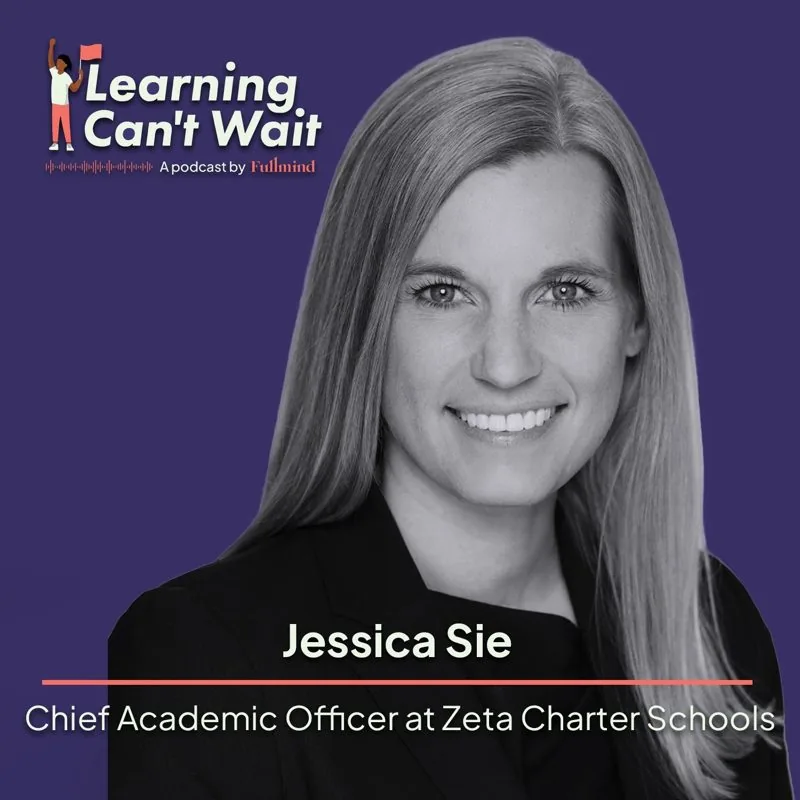
- Jessica Sie, Chief Academic Officer at Zeta Charter School
 Hosted by Hayley Spira-Bauer, Chief Academic Officer at Fullmind
Listen now
Jessica Sie: Innovative Education, Professional Learning, Charter Schools, Mindset
Episode summary
Jessica Sie, chief academic officer of Zeta Charter Schools, describes her move from Denver public schools to New York's charter sector seeking innovation. She lays out Zeta's professional learning model: grounding in mission, vision, and values, practical teachbacks like medical rounds, immersive days where teachers experience school as students, organization-wide book clubs, and leaders coaching in classrooms daily. Zeta's design rests on rigorous academics, whole-child mind-body-soul cultivation including daily meditation, an innovation culture with Z Lab, and family partnership.
Key takeaways
- Innovation includes applying ideas that worked elsewhere, including from business and nonprofits, to education
- Teachbacks let teachers rehearse lessons and get feedback before facing students, like pilots in simulators
- New teachers start two weeks early, immerse as students, and align personal purpose with Zeta's mission
- Annual all-staff book clubs have read Mindset, The Culture Code, The Power of Moments, and Hammond's work
- Effective schools sound like student talk and laughter, with principals coaching in classrooms every day
About this episode
This week on the Learning Can’t Wait podcast host Hayley Spira-Bauer sits down with Jessica Sie, Chief Academic Officer at Zeta Charter School.
In this inspiring episode, Jessica describes her passion for breaking down systemic and structural barriers to education. We learn how Jessica defines innovative work and why she believes some of the most exciting ideas to transform education might be coming from different sectors entirely. Finally, Jessica shares her philosophy around teacher professional development and why she always grounds her work in its core mission, vision, and values.
Join us every Tuesday at fullmindlearning.com/podcast. Next week, we begin our Rural Education mini series! Speaking with teachers, superintendents, non-profit leaders, and governmental advocacy groups, the Learning Can’t Wait podcast will dig deep into the current state of rural education and how we can best set rural students up for success.
To kick off the series, we’ll speak with Melissa Harris, Taylor McCabe-Juhnk, and Allen Pratt to dispel myths about rural America.
Book recommendations for this week’s episode include:
Mindset by Carol Dweck
Culture Code by Daniel Coyle
Power of Moments by Chip & Daniel Heath
Culturally Responsive Teaching and the Brain by Zaretta Hammonds
Produced by Fullmind
Full transcript
Transcript generated from the recording; minor errors may remain.
Hayley Spira-Bauer: Welcome back everybody to the Learning Can't Wait. Podcast I have both a brilliant educator and incredible leader, and someone who I now consider my personal friend on the Podcast Jessica Sie, the Chief Academic Officer of Zeta Charter Schools, Jessica, welcome. Thank you, Hayley. I'm thrilled to be here. I'm so thrilled to have you the first time I met you last fall at New York EdTech Week. And I heard you share a little bit in a session, and I said, I need to know that human. And as soon as I met you the feeling kept growing, and I'm so excited to know you, but also to have you share here today some of your beliefs and ethos and practices, and even your career journey, so that other people can feel as excited about knowing you, even if it's just through the podcast.
Jessica Sie: Thank you. I'm really excited to be here and to share the incredible work that we have as educators.
Hayley Spira-Bauer: Why don't we start off by answering my famous first question, which is, how did you come to be the personal and professional version of yourself?
Jessica Sie: I consider myself to be a lifelong learner. I is absolutely one of the reasons that I became an educator when I think back on that journey, and what that looked like for me. I think it really started with a childhood where I move frequently due to my father's job. We moved to a new state every few years, and I think that instilled in me just a curiosity for the world and a love of learning. The first stop we would make when we got to a new city in a new state, was the library. And thinking about where we would find our local public library, and I grew up in a family of readers and learners who were just curious about the world, and I couldn't think of any better career than a career in education where I not only personally get to learn every single day and grow and stretch myself, but I get to share that love of learning with both kids and adults. When I think about education specifically and my own pathway, I I knew I wanted to be a teacher. Starting at 16, I had to write a research report which is such a great assignment from my high school teacher about what we wanted to do. We had to research what salaries would be, what training one would need for different roles. And and I knew, after talking to a couple of teachers at the local elementary school, that that was my pathway, and I started teaching in Denver, Colorado, and had a wonderful experience at a public school there, and thought that I would teach second grade for 30 years, and then transition into being a prep professor to hopefully teach others to be teachers. And after a few years of teaching in Denver, Colorado. I just got really interested in where the most innovative work in education was happening, and in particular what it would look like as a collective of educators to break down systemic and structural barriers that currently lead to inequity and education. And I wanted to work with like-minded educators who were radically transforming the way we think about teaching and learning to create the greatest equity for all kids. And I was really inspired by the New York City work that was happening, particularly in the Charter School sector, and the pace at which change was made, the big, innovative ideas that I saw being brought to life. So I moved across the country in 2011 and packed up my bags, and haven't looked back since I love it here. I feel so lucky every single day to get to learn from the amazing kids in our schools the teachers that I work with the leaders that I work with and am really grateful to be in a job that I personally am so deeply passionate about, and find such purpose in every day.
Hayley Spira-Bauer: I know we're going to come back to talking a little bit about the charter movement in New York. I consider myself like born and raised in the charter movement of New York, despite having started in the public schools in New York. But I wanted to come back to you and double click on the idea of innovative work. Can you define innovative work like, how? What does that mean to you, Jessica? And what were you looking for when you were scoping out the field.
Jessica Sie: I define innovative work as thinking about the current state opportunities for change and then ideating, so that either a new way that truly hasn't been done before is taken to create stronger outcomes. Or and this is one of my actually favorite types of innovation thinking about an idea that has worked exceptionally well somewhere, but perhaps not in that exact place or way. And so I think innovation can take so many forms. And in education I really see it as an opportunity to do something new that has not yet been done, or an opportunity to apply something, whether from another school or educational place of work or from a different context. And I think some of the most exciting ideas in education have actually come from learning, from the business world learning, from nonprofit social sector. And it's exciting to think about just the potential for transformative change and education when we open ourselves to those possibilities to wonder what if and imagine how we could make those opportunities come to life for kids and adults.
Hayley Spira-Bauer: Really interesting way of putting it. What I appreciate amongst the many things you said is knowing that all of our answers are not in one place and having to look around and see. I remember you know I work in virtual education. I remember distinct conversation about tools that exist for the business world that could be applied to the classroom to optimize teacher impact and efficacy.
Jessica Sie: Anyone.
Hayley Spira-Bauer: Like. The first time I heard that I I thought, what are you talking about? These are totally different professions, but I sat on it for a minute, and it really resonated. Can you think of one one particular example of either something you've taken or something you've seen adapted from business or nonprofit in education that has been successful.
Jessica Sie: I can think of so many examples, and one of my favorites is thinking about. When a doctor is learning, they go through medical rounds. When a pilot is learning to fly, they go through flight simulations, and I see teaching is the exact same way. And as we are thinking about professional learning for teachers. The most effective way to learn to be an excellent teacher is to put yourself through those simulations or those rounds, and I have found it to be so profoundly impactful to engage in what I would call a teachback. Where you've studied a lesson, you are ready to provide that lesson to kids. And before doing that in a group of colleagues, perhaps with your manager, perhaps with others who have the same job as you do. You actually teach it back and practice the launch of that math lesson or practice the conferencing you would do during a science experiment and then get feedback before you get in front of the kids, so that you have the opportunity to refine the way that you're thinking about that lesson to ensure that the most excellent instruction is provided for students each and every day.
Hayley Spira-Bauer: So we did it. We jumped right into that professional learning topic. You gave me the perfect segue to do so. People who work with you. I'm told. Are very excited about your belief system on professional learning your ethos, how you approach it. You happen to be? Obviously not by accident in a network right now, that also significantly values teacher, professional development. What's your philosophy here? And how does it look where you currently work.
Jessica Sie: I would love to share more about that, and am so grateful for all the opportunities I personally have had in professional learning, and when I moved from Colorado to New York, from a district role to a charter role, it was incredible to be surrounded by educators who wanted to pour into me. It was also a little nerve-wracking to show up for the first weeks of summer training, and to be shared a book and let know that I had about 2 h to prep a lesson, and then I was gonna teach that back and get it video recorded while teaching. And through that process of my first couple of years of teaching here in New York I learned so much about myself as an educator. The thinking that goes into lessons in the power of reflection to be able to innovate and grow and improve every single day. So when I think about my theory of professional learning and the work at Zeta Charter Schools that I'm so grateful to be able to lead. I believe excellent professional learning starts from a place of mission vision and values. Why we do this work, and the purpose and passion that each of us have as individuals and collectively to be educators, creating transformative outcomes for students. And then, from that place of mission vision values, I think about the practicality we learn by doing.Students learn by doing. And we as adults, as students learn by doing.And so excellent professional learning is practical. It means that we study the work together from curriculum to data, and then we try it on and make mistakes and learn through that with an incredible growth mindset. And so really the philosophy of professional learning that I personally hold as an educator of almost 20 years. And that I lead at Zeta Charter Schools and other places that I've worked over my couple of decades almost in education. It's all about why we chose to be educators, the purpose and the passion that fuels us every day, and then how we really practically start to teach and plan for that teaching, give it a go, and then reflect on that practice to get better every single day in service of students.
Hayley Spira-Bauer: I know that the application of this is very carefully thought out and plan. So walk me through a year at Zeta. Where? What? What does professional look like from the beginning to the end? What could a teacher expect.
Jessica Sie: Teachers and Zeta and my hope for teachers across our nation and our globe is to come in and be greeted with a sense of excitement about the deep value of the work that we do as educators and the excitement for learning every day.There's no other profession where you are both in front of a classroom, teaching others every day, while also learning yourself every single day.And that is such a special gift. And so really, practically, when teachers start at Zeta, we actually welcome our new teachers 2 weeks before we welcome other teachers. We also welcome new leaders before our teachers, so that every adult at Zeta gets a personalized learning experience. It's gonna prepare them excellently for day one. And that starts from the onset with understanding who Zeta is as an organization, our mission to provide free high quality, public education. Pre-K to 12, to every child in America. And we think about that as impacting the amazing students in our Zeta schools and also sharing what we are learning far and wide so that others can learn and impact kids across America. And we welcome new teachers into that through a series of sessions where we talk about our mission, our vision meaning when kids have an excellent learning experience at Zeta pre-K to 12. What are they able to do? How are they going out into the world, ready to lead lives of their passions and fulfill the hopes and dreams that they each have as individuals. And we talk a lot about our values, the core values of purpose, excellence, and community that we live by each day at Zeta and enable us to be a really effective adult community working together. And so through these sessions. Teachers have this really profound opportunity to think about their own purpose, meaning why they chose to become an educator, and to actually align that with the collective purpose we have at Zeta. And I think that's so important that we honor people's individual reason. They chose to work in education, and that those 2 things work beautifully in harmony to have an organizational purpose and an individual purpose. We also get really practical about what's the work. And so Zeta teachers then experience an immersive day where they actually get to put on the role of a student, and they get to engage in classroom learning experiences as a new teacher from engaging in a read aloud to solving math problems. Doing a science experiment. And we also have an incredible specialty program where our students are musicians. They take violin lessons, piano lessons, play soccer do taekwondo. And our teachers actually get to do that work. And so throughout this day they immerse themselves in what it feels like to be a Zeta student and really learn about our school design through that lens. When I think about the most important thing for our teachers to learn, it is a deep internalization of the mission vision values that I shared about a minute ago. And the school design, and what our school design means for them as the teachers who are the most important people for their kids lives. So at Zeta our school design has 4 main pillars. It starts from a premise of rigorous academics. Every kid deserves an excellent education, and the ability for teacher to know them as an individual. What are their profound strengths? What are the opportunities for their learning, and we're deeply committed to making sure every single child gets that rigorous academic education. Something that's really unique about our approach is the whole child aspect, and in particular we think about that is a mind, body, soul, cultivation. Our kids engage in meditation, which we call Zen. Every day. They engage in specialty classes, and have the opportunity to be a part of a learning community and a personal community where they have friends and are welcome to school each day with deep, deep care, and engage in circle practices where they're able to be seen and known and share their feelings and get to share about their own identity. We also have an innovation culture. As I shared earlier, I'm deeply passionate about innovation. And at Zeta we see every child and every adult as an innovator. And we actually engage our kids in powerful Z Lab work where at Z Lab, we learn design thinking and kids create projects to impact the world. And, lastly, we have a deep belief in family partnership, and ensuring that our families, who are the most important people in their children's lives, are able to deeply partner with us, and we learn so much as a community together in support of every student's success.
Hayley Spira-Bauer: You just painted such a beautiful picture of how you bring people into the community of teaching and learning at Zeta. You've also really articulated so clearly the steps by which you do that effectively, and what you round the learning in are there particular texts or resources that you are like leaning on regularly. For our listeners to be able to look at that you would say, yes. Read this book. This will help you on your journey, for professional learning, as well.
Jessica Sie: Hayley. You know that one of my favorite things is to give book recommendations, and the spark that comes into my eye when I get to recommend great books. So thank you for asking that question. There is so many amazing pieces of literature that have shaped who I am as an educator and the work that I lead one of the most powerful. My perspective is Mindset by Carol Dweck. We have all of our teachers read Mindset before joining us, and then we lead sessions in partnership with principals and assistant principals who are truly the leaders of professional learning across our schools, and we lead a growth mindset session, because, as educators, our commitment to a growth mindset rather than a fixed mindset is so essential to propel our own learning forward as well as to model the learning mindset that we have as lifelong learners at Zeta. We also and choose a book each year, and this is a tradition that, I think, is so special that every adult in our community reads a book. And then, when we launch our all-Zetas training, so after the new teachers have started, our new leaders have begun. We have a big week of professional learning where we welcome all Zetas together, and my favorite part of that week is an organization wide book, club. And so hundreds of people. And in previous organizations, I've led thousands of people actually read the same book and have this beautiful discussion. 2 years ago we read The Culture Code by Daniel Coyle, which is an incredible book about trust, vulnerability and building strong organizational culture. Last summer we read The Power of Moments, which is a beautiful book that really illuminates when we think back on our lives from one's eighteenth birthday to getting a driver's license to a peak, personal or professional moment, it breaks down the science of why those moments are so memorable, whether because they help us learn something new about ourselves or peak of our lives. And how we can actually use that knowledge to create more moments like that every single day. And so we went into the year this year as educators thinking about, how do we create those beautiful moments for our kids every single day? And I'm so excited as we think about the book that might be next. Each year I read so many books in anticipation, and am thinking about a couple of books for this year that really hit on the themes of questioning and innovation, because I think. Where we are globally right now, there has been no more important time to be able to ask really powerful questions and to think about what we believe and why and how we engage and really powerful discussion with others, to take different perspectives, understand our own perspective, and then use that understanding to innovate and design to create a more just and equitable world together. And so I'm excited for us to choose the book for the summer, and to welcome ours back in August with that book discussion.
Hayley Spira-Bauer: And every single book you suggested here. I can't wait to hear what you make the actual look this summer. And for for folks who are listening to the podcast if you go to our website, Fullmind's website, you can find a list of these book titles with their authors. Attached to this episode. If you didn't catch exactly what just said right there. You know.
Jessica Sie: Absolutely. That makes me want to recommend a couple more. We are also incredibly committed to our work in equity, and thinking about how, as educators, we have the opportunity each day to support our amazing and brilliant students to create culturally responsive classrooms that lead with instruction that is beneficial for all kids, and particularly our students who identify as black and Hispanic to have powerful education. I am deeply inspired by Zaretta Hammond's work and the book Culturally Responsive Teaching and the Brain. And that's something that we have brought into professional learning with all of our teachers. So that they have the opportunity to learn from her work and bring that into their classrooms. And I would also say more broadly, just how essential it is that in choosing books that our students read and giving them access and opportunity, that we are bringing in multiple perspectives. And at Zeta we work incredibly, thoughtfully to ensure that every single child has access to a wide range of books, both whole class novels that we read, as well as the classroom libraries that kids can choose books by authors of diverse perspectives that have narrators of diverse perspectives. And I think that is essential to the work that we do in education, as we all work in pursuit of a more equitable world together.
Hayley Spira-Bauer: I love it. I this could just be a book club, and I'd be I mean I'd be sad because everyone would be able to hear all of your ideas and thoughts, but I'd be really excited because I have quite the list. I read a bunch of the books you said, but there's a whole bunch I haven't. And now I got some stuff to read.
Jessica Sie: I hope you enjoy them. I can't wait to hear about it.
Hayley Spira-Bauer: I, you know I'm going to tell you, you know. I'll tell you how I feel about him. I feel like there's always a book on rotation in my audible or not audible, the Libby, my Libby app, or my hoopla app from the library. That I'm listening to when I'm doing laundry, or I'm on a walk. And it really, I feel so grateful that so many texts have been written make me better at doing the things I want to do. So thank you for recommending a bunch more. Yes, I'm really grateful when you think about walking through the hallways of an effective school. What does it look, and what does it sound like? I know you're in schools all day. Every day I have tried to meet up with you in New York City, and you're like I'll be in the this corner of this borough at this time, and it's never the same place which also is by design. I know Zeta doesn't have a central office that is consistent year after year, so that you can be present in your schools. But back to the original question, What does it look and sound like in an effective school?
Jessica Sie: There's something so magical about walking into a school, and my experience in teaching in different states, in and visiting schools across the nation is, you can really learn a lot about the community of a school and the culture of that learning environment. As soon as you walk in the doors through the way people interact the sounds that one hears when I consider an effective school. The first thing I think about, and this is deeply tied to my own beliefs in people being whole and a whole child education. You see, kids are happy. They have smiles on their faces. You hear laughter in the classrooms, both adults and kids, as they engage in the joy and work of learning together. You hear different voices as I walk through the hallways. I really listen for how much am I hearing teachers talk? How much are kids talking? Are both our students and our adults asking questions and engaging in the types of dialogue that spark, light, bulb moments. And get our students excited for learning new things and pursuing their pathway of being a lifelong learner, really knowing what their own identity is, why they believe what they believe, and the passions that they want to pursue, and the hopes and dreams for their future. I also look for professional learning coming to life, and for me ideally, that looks like the principals and assistant principals who are the incredible leaders of their building. Being in classrooms and meeting with teachers every single day that looks like principals and assistant principals, watching the work of teaching and learning, being in classrooms to see, what are the questions teachers are asking? How are they presenting information? How are they conferencing with students as they work, and really being there as thought partners to understand what students know and support them on that learning journey. It looks like principals and assistant principals actually coaching in the moment. And one of my favorite ways to spend my day. An ideal day for me is when I get to be in a school and coach, a principal, an assistant principal, a teacher and a kid, and to have that opportunity to be able to walk side by side with school leadership, and then model and support, and saying, here's how I would try it. Sharing with the teacher, getting their feedback on how that opportunity for coaching is impactful, what more they might wanna know. And then actually having the opportunity to coach students myself and to let others in. On my thinking, to pull back the curtain when I asked this question, here's why I asked it when I was wondering about how a student thought about a question. Here's what I was hoping to learn. And here's what I did learn. And sometimes that's something we might anticipate as educators. Other times we're really surprised. And that's a wonderful thing. And so when I think about walking through the hallways of buildings, our Zeta buildings that I love being in. And, as you said, I'm in every day, and have had the wonderful opportunity to actually have a desk at different schools each year, as our Zeta schools have been growing, I look for the signs, the sounds of teaching and learning. I look for leaders, teaching teachers through the daily work of the teaching and learning in classrooms and coaching. In the moment I also look for planning meetings, and I see planning meetings as the critical lever that enables teacher success that can happen during a common prep period, and as Karin Chenoweth shares so beautifully. The school schedule is one of the most impactful aspects of ensuring teachers are able to learn, because during a common prep teachers can come together as a teaching team or come together with their manager, or, in our case, an assistant principal, or a principal, and learn together, and that experience of learning in a community of learners that have, like minded purpose and passion, is so powerful. Really, practically, for us. Planning meetings look like coming together to understand the standards and the curriculum. What are we teaching and alignment with New York State standards? Why is this information so important to kids? What makes it relevant? Why is it relevant? Right? Now we actually I was delighted in reviewing some work that my team had been working on today, that a new science question I was looking at for the first time was about the earthquake. New York had an earthquake so recently, which is not something I had experienced, and how exciting for kids that they're gonna actually take an assessment and be reading along and see that it's about the earthquake. And I am just so appreciative to work with a team of committed educators that make the work relevant for our kids. It also looks like studying the data and understanding. What do we know about kids and why? And really thinking about? What are the brilliant strengths, and how might this student help others learn? And what are the opportunities? What do kids not yet know? And how do we take them on a joyful learning journey to get there? I think effective schools show up in so many ways, and in some would say, the ultimate hallmark is a school where from the students to the teachers to the leaders there's a spirit of humility in the growth mindset and an openness to sparks of innovative learning that make us each better every day.
Hayley Spira-Bauer: A misguided piece of advice I got early on, which was about classroom management. And about how quiet a classroom should be. And how it resonated with me. This is very early in my teaching career. And it resonated with me like. Wait, that doesn't feel right. But I was young, and I was new, and I was really learning a lot. And so I adapted that as best I could for a while, until I really developed a sense of self and knew it wasn't right. And when I became a leader and I would coach teachers, I remember saying. The goal is not quiet. The goal is joyful curiosity. Is engagement. The joy is interaction discussion. The goal is that I or you, the teacher, are talking the least out of everybody in the room, and you. So you beautifully wove that picture of a building and a classroom in that way for our listeners here. Thank you. Thank you for doing that. So just you know we're we're ready to wrap up this episode. I'm sure there'll be more in the future if you'll if you'll let me. But. I'm curious what advice you give new teachers starting their career. What would you give it? What advice would you give them today?
Jessica Sie: The advice I would give new teachers is to know your whyeducation is such an incredible profession, and it's essential that we really reflect on why we do this work. Why, we've chosen to dedicate our lives to educating others. And when I think about purpose. Why we do this work, how it brings value to others and passion what we love about the work that we do. The power of purpose and understanding. Your why is profoundly impactful on your best days. And even more profoundly impactful on those hardest days.And we all have them. There's so much research that teaching is a profession where there are high highs of joy and excitement, and there are also honest challenges, and when educators know their why, and are able to say, I chose this, this is the work that I want to be in. It is bringing value every single day.and as an educator being able to come back to that and to inspire ourselves is incredibly impactful. My second piece of advice is really tied to the work that I lead at Zeta, and believe in deeply as a human is to build one's mindfulness and ability to restore.And at Zeta we think about that as our purpose, passion, and power. And that the power aspect is really building your own toolkit, meditating with the adults that when we start professional learning, we actually meditate as an adult community, just as we do in our classrooms with kids and being able to have connections and a learning community of adults and know we can rely on one another, and we're there to support and learn. And so, as an educator, build that community, be there for your colleagues, and be unafraid to reach out for help and the support that you need and enjoy the journey. Lifelong learning is such a gift, and as educators we are so lucky to get to engage in this work together, and with our students every single day.
Hayley Spira-Bauer: That's good to see you are a gift. Thank you so much for sharing some of your personal belief system. The belief system of the district, the charter network you work in now and also just inspiring me. And I'm sure some of our listeners with your words. Today, I appreciate you coming on the podcast.
Jessica Sie: Thank you for having me, Hayley. I really appreciate it.
Hayley Spira-Bauer: Thank you so much to everybody who joined us today. Take a look on the episode, notes at Fullmind, learning.com slash podcast to catch some of those recommendations Jessica made, and to re-listen to her episode. Thank you. All.