
Learning Can’t Wait · Episode 79
Steven Weiner: Education Reform, Student Outcomes, Teacher Roles, Education System
- Steven Weiner
 Hosted by Hayley Spira-Bauer, Chief Academic Officer at Fullmind
Listen now
Steven Weiner: Education Reform, Student Outcomes, Teacher Roles, Education System
Episode summary
Steven Weiner of the Center on Reinventing Public Education describes moving from teaching physics to maker education to research after wrestling with what a grade actually means and why school abstracts learning from the learner. He walks through CRPE's Teaching Reinvented report, a study of 32 educators in unconventional roles who were almost uniformly happier and more fulfilled despite isolation and thin support. He argues change needs permission from policy and unlearning by educators and families, and that AI and instability mean new teachers must be ready for change.
Key takeaways
- Grades and percentages abstract learning into identity, making students feel innately bad at subjects
- Public education is a set of ideals and principles, not a set of institutions
- Educators in team-teaching, teacher-leader, and micro school roles reported more satisfaction, even when work was harder
- Policy permission is not enough; educators must unlearn the my-classroom-is-my-kingdom identity
- CRPE's School System Innovation Grant studies 11 systems with continuous stakeholder engagement in change
About this episode
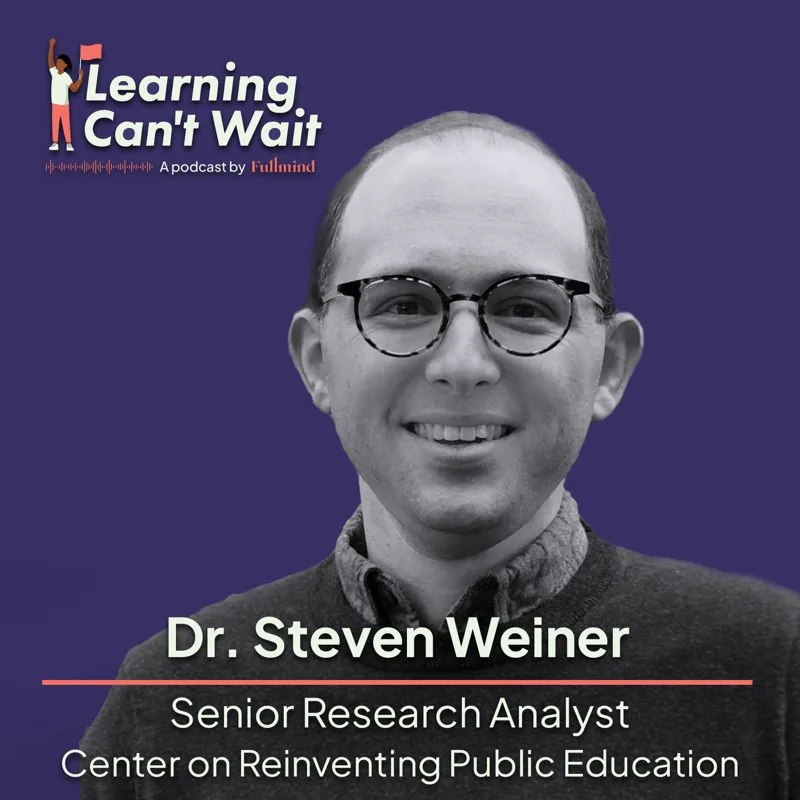
On this week’s episode of the Learning Can’t Wait Podcast Hayley Spira-Bauer sits down with Senior Research Analyst at the Center on Reinventing Public Education, Dr. Steven Weiner.
Listen to this delightfully nerdy discussion where Steven shares his research on unconventional learning environments and what insights we can gain from them. Hayley and Steven also discuss why they both believe that being a teacher right now means you better be ready for change.
Produced by Fullmind
Full transcript
Transcript generated from the recording; minor errors may remain.
Hayley Spira-Bauer: Welcome back everybody. I am so excited for today's episode of the Learning Can't Wait. Podcast as you listeners know, I love, a recommendation, and today's esteemed guest is Steven Weiner, a senior research analyst at the Center on Reinventing Public Education. Welcome, Steven. It's so great to have you here.
Dr. Steven Weiner: Thank you so much, Hayley. It's great to be here.
Hayley Spira-Bauer: I said you were recommendation, but I didn't say who your colleague, Chelsea Waite was on the Learning Can't Wait podcast last season and told me you need to meet Steven. And I think you love to have him on for a guest. And so I love a recommendation. I'm so excited you're here. Shall we jump right into it? Absolutely, and it's great to be recommended by Chelsea. It's a hard act to follow right there. Oh, I know her episode was wonderful. I love. I always love grounding ourselves in research. It's hard sometimes to do in the, in the practice of education, and we'll probably dive into that a little bit today, too. Alright, Steven. So I want to know, how did you come to be the personal and professional version of yourself.
Dr. Steven Weiner: Yeah, it's funny that you mentioned research kind of off the bat there, and like what that means, because I started my journey in education. I guess, after my formal education as a student, I almost immediately went into the classroom as a teacher. This is like coming up on almost 15 years ago, when II started teaching, and I taught physics. Mostly I taught Earth science as well, and also some mathematics at the middle and high school levels. And it was actually something that I think for a lot of us like you go through your life. And you. It's like the one thing you were like, I'm never gonna do this. And it's like I definitely did not plan when I was like younger that I was going to be a teacher is going to be a middle or high school teacher. And in fact, I think I remember in middle school being like, oh, there's no way I could ever do this. This is such a hard job. But I ended up doing it, and and teaching science, which also sort of was like my initial career trajectory is to go into physics. I thought, man, I'm gonna do research. And I'm gonna discover dark matter or something like this. And and what I what I learned was that it wasn't III think I learned it too late in the my own educational trajectory which is like that field just wasn't wasn't for me, and I was much more interested in helping other people learn and helping them kind of build, their own sense of wonder about the world. And so I did that for a few years, and it was a great education. Probably the best education for me was being the teacher both with like, with regards to like learning how people learn and learning myself about the best, the subject matter frankly, but the to your question about what made me the the person I am. It was just realizing how flawed frankly the educational system was. I remember having moments in my probably fourth or fifth year teaching where I just had this like deep crisis of like, what is a grade? What is a a percentage. What does it test mean? And why is it so hard for students and parents and teachers to separate out the student from the learning that the student does meaning like, why is it so hard for us to not recognize that? For example, learning how to do the quadratic equation in math? It's not a personal thing. It's not some deeply set thing. It's a learn and skill. Right? And I started to really wrestle with like big, fundamental questions around, like, what does this? How does assessment work in education, especially at the higher level? And it started to come up with? And this is getting out, maybe in a little in the weeds. But I started to come up with like a real working theory of around the fact that education is so abstract when you are at that level, and you get a test, and you take a test on a whole bunch of random facts, and then you get back a grade. And it's so much easier, unfortunately for students and parents to just say, Oh, I don't really know what this means for my skills, for my personal, like individual growth on any particular thing. It's like, I'm a math person or I'm not a math person, right? What does an 83% mean? Well, it means a bunch of abstract things. But eventually it just means, I'm kind of okay at this subject. So I got very obviously disillusioned by the sort of abstraction, and the way school makes students feel bad about themselves in an innate way, and not give them a sense of empowerment to improve their learning and their abilities, and and take like an asset based approach. So I can skip ahead a few years and say, I jumped ship from formal education and worked for a few years at a science center where I was very much into the maker education movement. And that, of course, is something that's sort of the opposite of school. In some ways it's about students having very specific. We often fun ideas about what they want to do or learn or make whether it's with like high tech stuff, like microcontrollers and coding. Or if it's something, you know, they just want to build a Tree house. So they want to learn how to knit and these things Set felt so much different than school, because it was so concrete. And you could help people abstract or or not abstract. Really, they couldn't sort of separate out themselves from the things that they were doing and and they and they could also just bring their passion to it. So yeah, how did I become a researcher? It's like, I have. Seems like, maybe a a hard right turn. But what I learned in both the formal and informal education systems is that there are these big institutional challenges. In school. People don't think school can or should be fun can or should be student, led, student passion students, passions, driving school. It has to be this kind of rigid top down highly dictated thing. But, on the other hand, you go outside of school, and you have people who are just not. They don't like accredit this work as real learning, like what happened in the help put together a maker space at a science center. And it was just not something that people saw as real, like rigorous education. So both of these things put together really drove me to go back to school and study kind of the institutions of education, and why they are so hard to change. And that was, my trajectory into grad school. But it also drives me now because II ask the same questions literally every day, which is, why? Why is school so hard to change?What keeps a system that almost everybody would agree is pretty darn broken going.And yes. So that was I really appreciate, Steven, how you shared
Hayley Spira-Bauer: It almost was like you kept stepping back. You kept stepping back to look from further away at the problem. And now you do this work that is really centered around understanding the problem. It's, you know, education is so nebulous and nuanced. I appreciate what you said here about how abstract it is. I never thought about it that way. But it really is. It really really is.
Dr. Steven Weiner: Yeah. A turning point for me was when I went to my principal as a teacher. And I was like, what does a grade mean like? Can anyone just tell me what is an 86%, what is even A B, and and it became very obvious to me that this was like just a structure that we've all been handed, and because we all went through it. Most of us went through it. We just don't question it. And yeah, III, you are right. II feel like I keep stepping back, which is funny, because, like in my heart of hearts, I like. I love my work now. But I do feel like I had to do this like II actually wish I could still teach like, every day I like working with kids. But this was like I felt pushed. Yeah, you felt called to it. I mean, that's huge. That's huge.
Hayley Spira-Bauer: You know. As with my interview with Chelsea, I was really fascinated by the work that that each of you or the organization CRPE, as you call it for short, is at, is focused on, and I know very recently, at the end of 2023, CRPE, you just released a new study on teaching. It's called Teaching Reinvented: How Unconventional Educator Roles Pave the Way for a More Fulfilling and Sustainable Profession. Now, full disclosure. As you know, Steven, I am big on unconventional teaching roles as I work for an online education institution. And so I have a deep seated interest in this topic, which is why Chelsea introduced us. But I am here to learn. So talk to us about this work, this study your findings like, let's let's dig in
Dr. Steven Weiner: Right and well, for for people who don't know what CRPE is in the Center on Reinventing Public Education. I just remember when I came across the opportunity to work work with them in I think it was early 2021, and I just saw their name like what they did. Which was this sort of amazing intersection of just really thinking boldly and bravely, and questioning the fundamental assumptions of what education is, but doing so in a way that's like directly tied to policy and to research, but also to the practices of what like educators are doing, what leaders, superintendents, principals are doing. So they kind of have their we have this very broad perspective that, like links, policy, practice, research, all in service of like a very bold idea, a very bold mission around. Not being afraid to step back, not being afraid to question the kind of fundamental assumptions of things that we just take for granted about education.We like to say that public education is a set of ideals and principles, and not a set of institutions.And this is, I think, something that like it just we embody it in all of our work, including the work that you mentioned around. The the teaching, reinvented report. Yes, and I do know that you're you're very very much. On our way of length around, rethinking what it means to be a teacher the report that recently released, and II kind of let their research and writing on it was maybe on some level, motivated, or at least energized by my experiences as a teacher and just feeling like man. And this is way before the pandemic. Just thinking like, this is very hard job. This is a but possibly the hardest job, and and with multiple jobs buried into it, and I feel also like I was a quite privileged teacher. I taught, you know, kind of a solidly middle class I taught in Charter schools. With like fairly reasonable student to teacher ratios in the classrooms. But even given all that, it's a crazy role. It's a hard role you're doing a million things. And you are also really supposed to be doing a million things differently for differentiating, for all sorts of different student needs and interests and skill levels. Yeah, yeah, II right? And and it's funny. I remember being a teacher in December year, the school year started. I was like, how did how did I do this last year? You kind of get your sea legs? I felt like every year alright. So this report was born, I think, both out of the general sense that teaching is hard, but also the more immediate issues of the profession in general is like, particularly in crisis now, like it's always been hard. But right now we're we're seeing like some red, flashing lights around I mean, for for years now we've seen like the number of the years that a teacher stay in the role. The attrition for, like early career teachers is just getting higher, but also, like the number of teachers getting into prep programs. Teacher Prep is really really dwindling, and the gap between teacher pay and other similarly educated professional professionals pay. It's getting worse, which means you have like a penalty if you get a bachelors or a masters in teaching versus a bachelors or masters in like marketing or finance. So there's huge systemic problems. And then there's also just the problems of like teachers feeling even more burnout, even more demoralized, I think, as a term that some researchers are using to talk about teachers just not feeling like they have a like a deep connection with their with why, they're doing what they're doing. And the profession's like core the things that made it fulfilling and special and meaningful are being lost. And on that note, and that takes us to this report. What we wanted to do is because this is a qualitative report. We actually didn't wanna necessarily do huge big sample size. Studies of teacher, you know, kind of do do something big with like surveys or anything. But we wanted to dig in on the special places that we could find where. Systemically, the teaching role was being reimagined. And we did find, although not like all over the place, not not in great numbers. They're still quite rare. But we did find examples of both, like big districts, but also small, like companies and small micro schools that are really doing it. They are reimagining what it means on a daily basis to be a teacher, not not in some crazy way. It's not, like, you know, completely different. It would, I think, be very like, identifiable as a teacher to some people. But in other ways it would be like some of these teachers just work from their homes, and they have students come to their homes. Or some of these teachers work in teams. And so they're kind of working with like 60 or 90 students at a time, but also with 3, 3 or 4 other teachers at a time. So like, there are all these different configurations that we found and And in addition to finding these configurations with like teachers working in teams or teachers who are empowered to help drive the policies of their school. That was another leading educator kind of role leading teacher role what we heard was that teachers really liked these new roles. They were, they were really, really satisfied. And and so we interviewed about 32 teachers educators in in all these different kinds of roles, and no matter where they came from, if they came from a different background. If they didn't even have a professional teaching background, although most of them did.We heard they liked it, E, even sometimes, if the work was harder they didn't always know what they were doing. They, you know, some of them said that. Yeah, they kind of thought lost sometimes, or even isolated. But almost all of them said they were happier and more fulfilled, more satisfied in these in these roles. So that's one big takeaway from which is huge kind of at the top of the conversation. Here
Hayley Spira-Bauer: Satisfaction is at an all-time low for teachers. And so if you're finding something that is satisfying in the profession. That's a important indicator.
Dr. Steven Weiner: Yeah. And and again, like, it wasn't so right. First off, gotta preface from the research perspective, right? This wasn't representative. This was the small sample size, and we went out of our way to find places that were doing different things. But we didn't go out of our way knowing what the teachers were going to think of these roles. And they weren't always. You know, glowing reviews like there were downsides to the roles. As I said, you know, some teachers felt isolated. Some teachers felt like they were kind of given permission to do innovative things, and told sort of a little bit of how to do that. But then they didn't get kind of the systemic support they needed, because no one really knows what to do. Sometimes when you're doing something new. So it wasn't. You know, perfectly rosy. But but yeah, I mean, I think it says something when you have educators who are saying this is exciting. This is fun. People who we talked to one early career teacher, who, after her first year almost quit and said, This is this is just too hard to be an elementary school teacher. It was right after the pandemic. And she was gently quick, convinced to try a team teaching role in her school. Actually, I think she changed to a different school in her district, and it was like 90 day, and she became not only happy and kind of fell in love with her job, but also found herself learning from her peers and having confidence. And it was it was a real game changer for her to to make that switch to a different, a more unconventional world
Hayley Spira-Bauer: Like any good researcher. You're qualifying that this was like, not at scale. And this is somewhat anecdotal, like, what does it mean for the profession to to find these places, these pockets
Dr. Steven Weiner: Of change. Yeah, what's the scalability of it? Yeah. And we asked, we asked a lot of the educators this question. Ii think it's a complicated answer. II do think first, though, we want to make sure we save like it was in pockets. But those pockets had a great range, right? So we were talking to parents who turned micro start a small school for other neighborhood students or family friends, students. And then they ended up basically starting their own school. But then you also have old legacy, comprehensive high schools pulling in at a systemic level team teaching or schools in rural areas that are in the turnaround status. But the turnaround becomes a way to empower teachers to run those schools. So that doesn't that what that tells me is that yes, this is rare. It's not happening as much as I think we would love to see it. These sorts of experiments or these these changes happening. But it can happen almost anywhere it can happen in public system. We had one example of a a system which they actually were working with the teachers. Union to change the teaching role for a certain set of schools. That's huge, right like this can be done, I think to say, can be done at scale. I think we're we're we're hopeful. And we see some of these places working in multiple schools. We see some of these systems, these unconventional roles taking in place in, in a variety of contexts. But they can happen, and they can happen in the public system as well as outside. And I'm kind of more. You know, unconventional outside the system learning environments.
Hayley Spira-Bauer: I interviewed. I met with someone for the podcast at the beginning of season one. So this is like a year and a half ago. And they were a former governor. No, named because. They never came on the podcast they're a former governor. And they said that they think real systemic change is going to have to happen from a governor who is willing to take risks and think outside the box. What! How does that land with like even what you just shared here like? Do you think it can happen at the school level, the district level. Do you think it has to happen from the state level?
Dr. Steven Weiner: Well, II definitely can't take credit for this idea, because I feel like this is a refrain. You hear? If for decades now in education reform, which is. It has to happen everywhere like yes, I mean, we have evidence of governors of States passing legislation where they give schools and districts permission to do things differently. But we have to also remember thatgiving someone permission to do something differently doesn't acknowledge and honor the fact that they've never done it before, and an education is such a strangely rooted institution in all of our brains, in all of our hearts. In our deepest memories of what it means to be a student. And go to school. So yeah, I mean, I think it can happen. But something that we heard from teachers, from educators, even in these unconventional roles is that you know you got it. You have to do some unlearning. You have to be vulnerable team teachers. They were talking about the, you know, veteran teachers who've been teaching for 10 or 15 years, working with other teachers, and like
Hayley Spira-Bauer: Kind of like being like, Hey, II don't know how to do everything or teaching experience was literally, I got married July seventh, 2,012. I started team teaching with Hey, Jen Jenkins, if you're listening, Jen Jenkins. 2 weeks later we began, and I said, I got married twice this summer, like I had been teaching for however, many years, and I think like 8 years, 7 years at that point. And I was like, I have to unlearn everything I know about own like being my own person in the classroom.
Dr. Steven Weiner: Right? It was wild. Yeah. And so like, I think that, yeah, you know, II appreciate when a governor comes on, or you know, a politician comes on and says, like, this is only gonna happen if I do something. But you know, there's great research. And if you've heard of the book, the what does it call. I think it's like the black box of the classroom. I think that's Larry Cuban. II could be getting that wrong the Larry Cuban has been writing about the idea of reform without change for years. The idea that we are, constantly from policy, asking teachers and principals to change things or measure new things, and that doesn't quite get to the heart of changing the way a teacher, or a principal, or a parent, or even a student at a certain age has come to expect the system to work, and they're an understand their role in it. Right? Like to go from like this is my kingdom as a teacher this is my. My classroom is mine to being like, I'm gonna share it with 2 or 3 other people, and we're gonna all like. Have a say in how each other is teaching and what we do like. That's a huge paradigm shift. Or, on the other hand being like, I'm gonna start a micro school, my community. And I'm gonna invite in some people who maybe weren't formally trained as teachers to work with students because they have other skills like their small business folks in the community. They run a coffee shop or they run a, you know other other things, or they are an engineer, and they're gonna work with students. It it's all. I think. I think this is why this is also hard, because, having the top, having the policy. Having systems supporting educators is important and having having people support these changes, but then just wrestling with our own. Our own images of ourselves and our our identities as educators.
Hayley Spira-Bauer: It's hard. It's like, really, really hard. Oh, I'm actually now really reflecting on your comment that that all the people engaged in the system have to buy into the system. And I'm specifically thinking about the role of families in that.
Dr. Steven Weiner: Yeah, no, I. It's funny because I, like you have worked in public and public charter schools
Hayley Spira-Bauer: And with with there's like a different expectation in in many charter schools, for how a family engages in the school day. Example, like parents having a teacher cell phone number in a public school. No in a charter school. Yes, way. And so I'm even thinking about that. And what implications there are. I mean, if it were to be system wide and a public, so you'd really have to buy, you'd really have to help engage families in the understanding, the research behind the decision and the way the way that supporting a student and surrounding a student is most impactful.
Dr. Steven Weiner: Yeah? And I can point to II would direct you to some other research that we were doing at CRPE. There's a relatively new program, although it's actually, it's sort of been in the works now for over a year called the School System Innovation Grant. I can find it online. And this is a program where we are. We kind of help to select for for funding. But then we're also doing research and learning around 11 school systems, mostly districts, but also some charters who are trying to make large scale systemic change. And one of the things that we, when we were designing the criteria for like who are the right places to look for what are the right systems to bring into this program who are like right on the cusp, we're ready to make change. Well, we wanted to know, like, have they been working with stakeholders in their community, have they? You know? To what extent have they brought in parents or students, or community members into the conversation? And ha! And do they have, like a a system to continue that because it can't just be this one like, Hey, we're gonna go and reach out. You know. Get your thoughts on a like a, you know, survey or something. And then, you know, do the thing we want to do. It's like, How do we really engage people continuously through the process. Because I think another issue when we think about change is we don't realize that every year in a school you're bringing in a huge new number of people, right? And then a bunch of people.
Hayley Spira-Bauer: You're consistently educate people on a regular basis. Oh, yes, man, this work is challenging Steven. This work is so challenging.
Dr. Steven Weiner: Yeah, it it certainly points to. Why? Why? Why? We're still. Why, we're still wrestling with this beast of of systems. Change in education. I think.
Hayley Spira-Bauer: I could talk for days about this topic. I mean you. You study. This is your whole job. So I understand. You know. As we're kind of rounding out a particular portion of our time together. I
Dr. Steven Weiner: Feel like it's a good time to ask you the question, what advice would you give a teacher starting their career today. I find that this is an extremely difficult question. Ii think that there's what's funny is that there's 2 reasons. I think this is. This is difficult. One is, for all the reasons we talked about, and for kind of recognizing that many systems are not changing yet we're certainly not changing significantly. There's many, many. I think there's something like 14,000 school districts in the United States. It! There aren't a lot of places that are doing something different. I think if you're a teacher who is looking to do something different, you that might actually make your job a little bit easier and more selective, and where you want to go? But if you're not, I would still say and maybe you weren't expecting this. But II actually think that the conversation around AI and technology is it it it makes it. I feel like very hard to say what the teaching role is going to be in 5 to 10 years and maybe more broadly like, what is our society going to be? What are? What's the economy and our job landscape gonna look like in 5 to 10 years. Given rapid technological change. Never mind other major issues like social and quality issues and climate issues. I think being a teacher right now means honestly, you better be ready for change. Hmm. Yeah, so true. II you know it's funny. I talk a lot with colleagues about how
Hayley Spira-Bauer: The world is different today than it was a year ago. But it is going to be very different in 10 years, and how the education our kids are receiving has to change in order for the students to be prepared for that. But you're right. It goes back to teachers because what they teach will change, how they interact with technology. And we don't even really know what it looks like. Yet we have an idea. But we don't have a real granular picture.
Dr. Steven Weiner: Yeah, yeah, I would say what I was teaching just frankly, what I was teaching 10 years ago was also pretty outdated like it was not. I don't think of the stuff that is happening in schools right now be a I mean, this is a huge generality, and I think that a lot of the school districts that we're looking at CRPE and the the States and the districts that are looking at like developing portraits of graduates and kind of reorienting towards competency based education. I feel like they're starting to get it. They're starting to like, become relevant for for students. But but yeah, I mean with with the AI and other technological and and through global challenges, I just don't know if we know, I mean, school is based on this idea that, like, there's a pretty stable world.and we have 10 ish years to prepare students for a stable world. If that's not true anymore, what does school look like, you know, and how and how much different is it going to look? Because, you know, you have these like very rigid courses, and these sequences that never change over decades like, can that really continue? If the world is changing in the way it is
Hayley Spira-Bauer: My desires for starting a micro school are only inflamed after our conversation during the pandemic all my friends were like, Can you please just start a school, and I'm like, you know. But yes.
Dr. Steven Weiner: I can. I can point you to the opposite argument there, which is, I mean, and I go through all these thoughts on my own, which is like, you know, even even at the maximum of micro schools and charter schools. Like the vast majority of students, the vast majority of students are still in public schools. Well, that's what I said. I like no jokes. Even that was, that was my exact argument is like, no, because I think people with like my
Hayley Spira-Bauer: Philosophy about this not to sound over and have an overinflated ego. But I think people that are rabble rousers that have this philosophy, that systemic change needs to happen need to stay in public education. So that systemic change can happen.
Dr. Steven Weiner: Yeah. And III really think that we all need to really step back and dig into like a reimagining not just a reimagining of what we think school can and should be, if we think it should be like a disaggregated you know, millions of micro school start our community. But we also have to start to think deeply about the change process. How do you get people who don't spend all of their time thinking about this? To to walk down that road with you because you can imagine some Utopian future. And I think a lot of people, especially in like education, thought, leadership, like we like to say, Hey, here's our goal.But but the goal is only half of it right? The leading and the design of that transition to the goal. We've never done before, like we've never gone from a system like we have. Now, with all of these schools, all these districts, all this policy to a different one like that's just never happened. So how do we do that?
Hayley Spira-Bauer: How do we do that? I hope you invited me here to overwhelm you with big question. I love this. Are you kidding me? This is like, this is the nerdiest kind of way my brain operates all the time, and I hope you take there's a compliment. Middle schoolers. My goal by the end of the year is for you to become a nerd and identify as a nerd. I think that is like the highest, highest honor. That is my nerdy brain. I love this type of conversation. I'm so glad. Chelsea introduced us. I really am grateful to be in your orbit and hear you share so much about your current work and what you're thinking about the future. Steven, thank you so much for coming on the podcast
[32:00] **Dr. Steven Weiner:** Well, thank you so much for your time, your kind words, and for being a nerd with me. Yes, yes, I love it and thank you. Everybody who tuned in hopefully, you feel a little nerdier at the end of the conversation that you did at the beginning.
Hayley Spira-Bauer: I'm actually gonna re-record our intro right now, because I knew you had a doctorate. But I didn't call you Dr. Steven, so I'm going to just re-record the intro really quickly, although I love my intro, before maybe they could splice together. This okay. Welcome back everybody. I am so excited to have you here at the Learning Can't Wait podcast today, especially because our guest was recommended by another guest from Season 4 Chelsea Waite, and I love a recommended guest. It always gets me excited to figure out what exactly about the new guests?
Dr. Steven Weiner: Who is Dr. Steven Weiner from the Center on Reinventing Public Education? Oh, man, there we go! See, this is what happens. This is what happens? Okay.
Hayley Spira-Bauer: Cory, I'm so sorry. Take 3 welcome back everybody. I am so excited for you to join me here on the Learning Can't Wait. Podcast today our guest was recommended by Chelsea Waite from Season 4. She is a colleague of Dr. Steven. Weiner from the Center on Reinventing Public Education. I love. When we have recommended guests, it always makes for a fun conversation. Steven, welcome to the Learning Can't Wait podcast Hayley. Thank you so much for having me. And it's great to be here. I also really appreciate the doctor title there, because it's almost it's been actually just over a year since. I was allowed to be called that so incredible. Well, happy, almost one year. Anniversary. Let's dive in.