
Learning Can’t Wait · Episode 197
Roberto Vargas: AI learner profiles, Student data privacy & Human-centered technology
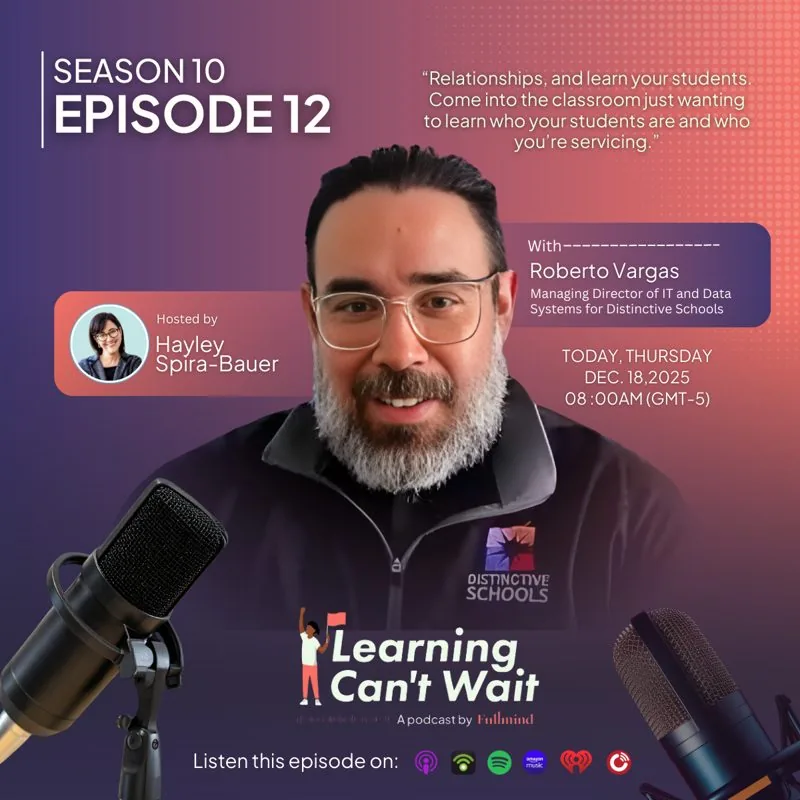
- Roberto Vargas, Managing Director of IT and Data Systems at Distinctive Schools, uses technology, data
 Hosted by Hayley Spira-Bauer, Chief Academic Officer at Fullmind
Listen now
Roberto Vargas: AI learner profiles, Student data privacy & Human-centered technology
Episode summary
Roberto Vargas, Managing Director of IT and Data Systems at Distinctive Schools in Chicago, explains how a south side CPS student became the leader of a charter network's technology and data. He describes what people miss about school IT, from security to infrastructure, what he expects vendors to say about student data before being asked, and why change management is the biggest AI challenge. Distinctive built an AI playbook starting with student voice, then staff and parents, and is piloting NotebookLM learner profiles that let teachers group students by attendance, IEP status, or learning preferences in seconds.
Key takeaways
- School IT is the electrical system of the building; everything runs on it and must be secured
- Vendors should volunteer their data policies, storage, and why they need each student data point
- Distinctive's AI playbook started with student voice; students flagged bias in AI grading
- A playbook, not a policy, can be revised as staff, students, and parents add input
- NotebookLM learner profiles compile attendance, assessment, and listening-conference data for teachers
About this episode
This episode explores how Roberto Vargas, Managing Director of IT and Data Systems at Distinctive Schools, uses technology, data, and AI to better serve students while fiercely protecting their privacy. He shares his journey from Chicago Public Schools student to building tech and network data leader, emphasizing the often-invisible infrastructure and cybersecurity work that keeps modern schools running. The conversation dives into how his team evaluates edtech vendors for student data protection, builds a human-centered AI playbook with real student and staff voice, and pilots AI-powered learner profiles in Notebook LM to give teachers instant, holistic insight into each child. Throughout, Roberto stresses that AI is here to stay, that students are already “AI natives,” and that educators must stay ahead while grounding everything in relationships and deep knowledge of students.
Full transcript
Transcript generated from the recording; minor errors may remain.
Hayley Spira-Bauer: Welcome back, everybody, to the Learning Can't Wait podcast. This took a minute to get to, but it is happening now. I am so excited to introduce you to our next guest. We have Roberto Vargas, the Managing Director of IT and Data Systems for Distinctive Schools, joining us today. Roberto, welcome!
Roberto Vargas: Thank you so much. Excited to be here. Really glad that we finally found some time to get this going.
Hayley Spira-Bauer: You say we so generously, but this really was a me issue, so thank you for your grace, but also very eager to have this conversation, I think. You sit in a really unique spot in education and the education ecosystem. And it will be incredibly enlightening for our listeners to hear how you make decisions, what you're prioritizing, and how you're looking at the current education federal fiscal climate, as you think about how it impacts, Chicago education for kiddos, so… Should we jump right in?
Roberto Vargas: Yeah, let's do it.
Hayley Spira-Bauer: Roberto, can you tell everybody how you came to be the personal and professional version of yourself, please?
Roberto Vargas: Yeah, for sure. So, I am a product of Chicago Public Schools myself. I grew up on the south side of Chicago, born and raised, and I always tell that my why and my origin story for what I do and where I'm at right now is because I was the students that we service. So, I always had it in my mind after I got out of school that I wanted to do coaching, because I love sports. And I went back to my elementary school and coached, and did a little work there for a little bit, and then, you know, just remembered those relationships that I had with teachers in my past who were like, hey, you know what? You can do better. Here's how you can do better, and here's what is out there for you that's just not in this neighborhood, right? Like. Think outside of the box, look for more opportunities, and, you know, just the trajectory of that message really got me thinking and wanting to learn more every single day of what I'm doing. And that's pretty much how I got to where I'm at here, is just learning, like, always putting my hands into something and trying to do something different. And always trying to service the students that we support. So I actually started off in one of our buildings as a building tech, and I remember going into that building fresh, new, not having any idea about what was going on, but I would go around to the classrooms and say, hey, what can I do to make your day-to-day easier on the tech side? Like, what can I help you with? And then from there, kind of bounced around a little bit in the network to a couple of different schools, made it up to the network level of Chicago International Charter Schools, which is the authorizer that, holds the charter with just, CPS. And from there, I was doing a lot of data reporting and building out tools for teachers and principals so they can get to know their students a little bit better, with their data, and we're doing a lot of NWEA data, attendance data, you know, just things of that nature back in the day then, which were really cool because you could really see teachers grounded in that work of trying to be better for their students and learn a little bit more, and taking that information to help them grow better, to be more successful in their classrooms. And then I had the opportunity to come back to, Distinctive Schools and doing similar, similar things in the role that I'm at now. And that's pretty much where I'm at. That's how I got here, and I've loved every… every path upon my journey here has been an awesome one, and I really appreciate all the people that I've met, and the things that I've got to do to get here.
Hayley Spira-Bauer: You know, it's interesting, because I often think about the tech support role as telling me to restart my computer or plug in the printer when I'm having some sort of problem, but you've sort of highlighted so far, very quickly, how integral the function of IT and data systems and technology are to a functioning school district. Can you talk a little bit about what people… you think people don't really know about this role and its function?
Roberto Vargas: Yeah, I often laugh because when there's something wrong with, like, a website, they're like, put in a ticket, it's IT, or it's like, I don't control the internet, so there's really nothing I can do I can't do much with that. But, you know, when you really look at the… space that we're in now, everything is technology, right? There's one-to-one devices, everything is cloud-based, everything's on the internet, everything needs a connection to something. Smart boards, whatever it may be. And if something goes down. I've found that… there's times that… just, like, folks don't know what to do right now, and it's like, how do we get back to, kind of, like, a way of, like, paper and pencil, too? Like, how do we commingle the two? Because if a building internet goes down, and teachers are like, I don't know what to do because the internet's down, like, where do we… where do we land on that, right? But it's also just, like, the space of, like, okay, yeah, we need to be able to have a set number of devices. We need to make sure that we're doing the back-end security of making sure that student data is protected on our network, and on how we're connecting to the network, and what devices we're bringing into the network. So, it's just a lot of that. Back end that people just don't understand. Like, everybody just thinks it's, like, it's running because it's running, but there are people who are in the back end making sure that There's security levels, there's different ordering procedures, there's different materials that are being bought, there's infrastructure, and there's just all these different things that help run a building. And I think, like, that's what really people don't understand on the back end. It's like, there's IT putting a ticket, they're gonna tell you to restart it, like you said, which is usually the running joke all the time, is like. Just restart it, have you restarted it? I give people a hard time on the network team, because they'll ask me for something, and I'll look at their computer screen. I'm like, why do you have all those tabs open?
[05:00] **Hayley Spira-Bauer:** Yeah.
Roberto Vargas: What are we doing right now?
Hayley Spira-Bauer: Sounds like you're talking to me, yep.
Roberto Vargas: Yeah, but but yeah, I think it's that piece. There's… I often think of it like when you build a house. So I've also, like, had to experience the rebuild of my house, and the frame is the building, right? Like, it's the… the wood, the architecture, all that. But then the next thing that goes in is the electrical. Like, when you think about that kind of thing, of how technology works, it's the same thing. So, the building goes up, then everything electrical goes in. Lighting, cabling, internet, all of that good stuff. And that's how you kind of just have to think of the infrastructure of what a building looks like.The brains of that building is the technology side of things.And, you know, we have to treat it in a good way so that it can be… You know, beneficial in working for… For everybody throughout… throughout the time that we're there.
Hayley Spira-Bauer: A key component that you mentioned, and I know to be true, is the cybersecurity aspect of a school. Students' information is federally protected, locally protected, their data is vitally important, more than… more so than adults! So, let's talk a little bit about when you're considering vendors, what you expect as base case for the vendor to talk about when it relates to student PII and cybersecurity.
Roberto Vargas: Yeah, so that's been a huge thing, and it's a big undertaking when you really look at it, and the amount of people out there who are quote-unquote trying to protect student data, but also not understanding, like, what exactly they're protecting. It's just very much, when I have conversations with vendors. It's… I want to know those guidelines now of what's your policy, how are you protecting the data, where are you storing the data? And, like, I want to know what exactly you're pulling from that student data. Like, why do you need this information, and what is it going to do once it goes into your system? I was just having a conversation with somebody recently, and they talked about how, the data that all of these companies are pooling. Like, at one point, we're gonna get to where it's… that data can be affecting that student later on in their life, right? Like, a student now, if they want to apply to Harvard or Stanford or wherever it may be in this big elite school. They're gonna have all this student information that's been there on the internet for so many years that we've been scraping and collecting and putting into systems, because, like, it's just in their… it's in the policy and procedure of things. So it's like, how do we manage that? How do we stay safe with that? And that goes into a lot of the conversation that we, that I look into when it comes to… Partnerships, and what exactly it is that these companies are trying to take from us.
Hayley Spira-Bauer: Yeah, it is… such a vital piece, and I see so often leaders talk about, I've heard leaders say things like, if they don't bring it up proactively in the first call.
Roberto Vargas: I already know there's a problem. Yeah, 100%. 100%.
Hayley Spira-Bauer: So, shifting gears slightly, I know that in your role, you also are really excited as I hope you would be, given your role, about artificial intelligence and the potential that it holds to improve student performance, data infrastructure and intelligence, and a whole other efficiency, all the things. Talk to me a little bit about how you're approaching the introduction of artificial intelligence at Distinctive, and what challenges you've faced so far in doing so.
Roberto Vargas: Yeah, I think the biggest challenge that we've run into is change management, right? Like, getting folks to change that mindset of. AI is something that can be beneficial to them. It's not always cheating. Distinctive Schools is pride… you know, we've prided ourselves… prided? Is that a real word? Distinctive Schools is pride…
Hayley Spira-Bauer: Let me get a new word today.
Roberto Vargas: We're making it a new one.
Hayley Spira-Bauer: Worry, yeah.
Roberto Vargas: Regular new word, prided. But Distinctive Schools is very proud of, like, being human-centered, and what we've tried to do with everything that we've put out in AI is grasp people's perceptions of it, right? So, we created a, AI playbook, and from that AI playbook, we have taken student voice first, and we built it out. So we essentially built it out, we put in everything that we think was gonna be what we needed for the network, for the students, and then we had learner, we do learner advisories, where we have students come in from 6th grade through 12th grade. And we put it in front of them. We said, hey, we know that you all are using AI, we know that AI is everywhere around you. Here is what we think AI is going to look like for the students in the buildings. You take a look at it and tell us what you think. And those students, they did a gallery walk of all the sections of the student portion of it, and they wrote down notes. I don't like this, I don't want my teacher to use AI to grade my work because of biases. And they understood this, which was amazing.
[10:00] **Hayley Spira-Bauer:** Mmm…
Roberto Vargas: So we took that information, and that's how we started building everything from the ground up. And then we took that, we sent it out to staff, we sent it out to parents as well, to let them know, hey, this is what we're doing to make sure that your students are protected within our buildings, and within the AI world of what we're doing. And from there, we even gave them a Google Form. If you see something that you want more information on, or you want us to change something, put in the request, and we'll take a look at it, and we'll take that information and we'll run with it, and we'll put it into the next iteration of the playbook. And that's why we went with a playbook, so that we can make those changes. We don't want to do a policy. Yes, we are using some of our acceptable use policy, our student policy, our handbook, but it's a playbook in the sense of. We can change it, we can add more things to it, and we can do different things. And now, the next portion of that is we do an, we have an AI expanded design team, which we've taken teachers and staff from all of our campuses, and we bring them into the room. And now with them, they are also taking this playbook, and we're putting frameworks into it, and different ways that they should be… that teachers should be using it, and having them take that information, and again, splitting it out and getting that… that voice. And then the next version of this is… the dream, is that we get parent information in there, right? So yes, we do that form, but we also want to have some kind of parent advocacy in it as well. So that parents can understand. What it is that their students are doing, because there's a lot of students… a lot of parents who are, you know, first-generation Americans here in our… in our network, and are not native English speakers, so, like, they don't know, kind of, what their students are doing, and they're relying on their students to also kind of explain it to them. So we want to get that information and that voice, so that they can also know this is what AI is, this is how it's shaping the future of your child, of your student, and this is what we're doing to make sure that they're in a safe space with it.
Hayley Spira-Bauer: Alright, well, there are a lot of AI naysayers. There are a lot of folks that are fearful, reticent for adoption, concerned about even PII, going back to that topic as well.
Roberto Vargas: Yep.
Hayley Spira-Bauer: What do you say to the naysayers?
Roberto Vargas: You just gotta do it. Like, it's here. It's here.
Hayley Spira-Bauer: Who cares? Just go!
Roberto Vargas: That's right, that's right.It's not going away, it's only changing, it's only shifting to be something different, something more.And our students are using it. It's being put into every single thing. And, like, you know, I'll use Mike Yates as an example here, where he talks about… he gives the history of AI and how it's been, like, since the 60s and 70s. And we use AI every single day when we're talking to Siri, or we're talking to Spotify, or, you know, your Alexa, and all this other stuff. Like, it's there. That's all AI, it's just not LLMs. Like, that's the shift, right? The shift is LLMs. The large language models. But… It's there. Like, just do it. You just have to… you just have to do it. What I suggest for people who are afraid of the AI portion of things is look at NotebookLM. NotebookLM is a great tool. And what NotebookLM, what I love about it is that it only looks at what you put into it. So it's a safe space, right? It's your comfort zone of AI. Get used to it, load something. Play with it. Do whatever it needs to so that you can get that AI feel, and then step out a little bit more of a comfort zone and do something different, right? And I think that's what it is. Like, those naysayers, it's gonna be here. It's here, it's already in the hands of students. I mean, they do it on Snapchat, they have their own apps, there's all kinds of different things. We have to be able… we have to embrace it, we have to do it. But we have to make sure that we're staying ahead of the students, because if we fall behind, and we're a step behind, then we're already going to be lost to the cause.
Hayley Spira-Bauer: Yeah, I think often about… the digital natives, which is, like, when I was teaching, those… the students I was teaching were digital natives. They didn't exist in a world without the internet, they know… like, personal computers were part of their language. This population of kids that are in schools today are AI natives, and… To your point. They know, right? Like, you said you did a focus group with them, and they came equipped with the understanding of bias.
[15:00] **Roberto Vargas:** But a lot of adults still don't understand the inherent bias built into our LLMs.
Hayley Spira-Bauer: As a function of, the information we fed into these large language learning models that are dictating much of our society right now. We're going to be behind if we aren't ahead at this point.
Roberto Vargas: 100%.
Hayley Spira-Bauer: You know, Roberto, there's another application you told me about before our call today that has me beyond thrilled, and… I used to say that every student needs an IEP, and it's really hard to do that, but you have found a way to bring a personalized learning plan for every kiddo. You're trialing it, you're testing it. Talk to us a little bit about that initiative.
Roberto Vargas: Yeah, so we have an AI design team. It consists of myself, our Executive Director of Strategy, Molly Quinn, and our Executive Director of Education, Jane Zott. And we have been working with our Vice President, Katie O'Connor, on this, and she came up with this idea of having a learner profile built out And we were trying to figure out what the best way to do it was. Was it NotebookLM? Was it… Google Gems, was it PlayLab, and we're just trying to figure out, like, all these different things and all these different tools. And the one that, you know, I was like, hey, this is gonna be a real easy win, a real… a real quick… well, not so much quick, but a… well, yeah, it's a quick implementation process of putting it into NotebookLM. And again, it's that we're protecting the student data because it's only what we're putting in there, it's not going out to the interwebs and grabbing from anywhere else. And what we did was we took all of our students' information, from attendance, assessments, behavior, grades. We also do listening conferences with students, and we put that information in there. And the students are also building out their own student profiles. In, like, a Google Slide. And with that Google Slide and all that information, we're compiling it into one, and we're dropping it into NotebookLM. So, NotebookLM is now this driving source of a learner profile for teachers. And when we sat there and we worked with them in the first pilot meeting, we were together for about half the day. Once we started digging in and actually showing them how they can put this information in there and how they could build out these students, the amount of just, like, shock and mind-blown looks on folks' faces, to, like, go in and say. Show me students who like to learn this way. And it's, boom, here's a list of those students, and here's how they say they like to learn, and here's… and it's like, group these students, or group students who haven't been at school for… who have less than 80% attendance, and it's gonna group those students, or… show me students who, you know, have an IEP who have a low score here, and it's grouping those students, and it's taking just all of that information and allowing them to like, have it at their fingertips immediately, instead of having to, like, sit here and go through all of this information that they're looking through and creating their own notes. It's right there for them. And it's like, they were just like. Mind-blown of how quick and easy it is, and how they can do… like, the amount of work that they didn't have to do to do that, but then the amount of work that they could put into their students, because they have that at their fingertips.
Hayley Spira-Bauer: That is the use case for AI that I want to see everybody having, right? Like, that level of insight is so hard to gather, and if you're a new teacher. You may not even know how to triangulate all that information.
Roberto Vargas: 100%.
Hayley Spira-Bauer: Right? Like, I… I used to coach teachers, and I remember we would sit down with, like, every data source, like, any math assessments, any reading assessments, self, you know, self-assessments, and we would sit there, and we would be able to tell a story about a kid. But a lot of new teachers required hand-holding for that. The fact that you can… Still support your educator, but get this picture painted in mere seconds? That gets me really excited.
Roberto Vargas: Yeah, and it's really exciting. I mean, and it goes back to what I talked about earlier with the, like, data reporting, right? Like, I remember teachers having to print out those reports and hand score all of their kids so they can know where they're at, exactly like you were saying. Like, you had to sit there and manually do that, but now we found a way that we can compile it all for them, and it's like, here's the… here it is. Run with it. Go learn about your students.
Hayley Spira-Bauer: Roberto, by the time this episode airs, which is next week, it's going to have out… this is going to be an outdated question, because that's just the way of AI, but what is a tool that you're currently using that's new to you, that you're very excited about? Either for professional, like, personal professional, or at the school systems level.
[20:00] **Roberto Vargas:** Yeah, I have been geeking out on vibe coding and using, Lovable. And I've loved that. Like, I've actually used it in… two different, like, activators now for… for activities. Built out a website, literally sitting right there in front of them as I was about to present, I was… threw it in there, vibe-coded an application, and was able to have that. Spit up a website for me. I could just say, hey, create an image using Gemini, and load it into the site. We're all gonna take a look at what your thought process was and how you created this… this app, so… or this… this, image, I should say. Which I think is really cool. And I'm also really loving Nano Banana Pro. Like, I just love Google's names for stuff, too. Like, who would name, like, an application Nano… Nano Banana Pro? But yeah, I really love…
Hayley Spira-Bauer: What is Nano Banana Pro?
Roberto Vargas: Oh, so it's their image creation tool.
Hayley Spira-Bauer: So, Gemini, if you go into Google Gemini.
Roberto Vargas: You pretty much get hit with, like, a, hey, this is our new application, and it is called Nano Banana. Pro. And I think that Gemini has… or Google themselves, have really stepped up their image creation capabilities, and we had a really good time yesterday using that with some of our teachers. I'm creating just images from scratch. It's been really cool.
Hayley Spira-Bauer: I love that. Well… I always love to hear what other folks are using, both for their, you know, personal efficiency, and also to help make the work they do more effective. It is… what a time to be alive, Roberto!
Roberto Vargas: What a… It definitely is a time to be alive. You know, when I think about being in a school district.
Hayley Spira-Bauer: And the insight you have, into trends and learning and technology. One question that comes up for me is. How are the students handling… An uncertain future. You know, with AI, there's a big belief that the students' professional careers are forever altered in ways that we still can't anticipate. Is that something you hear from the kids? Do they have any recognition of that, or are we just… they're just, like, trusting faithfully in their leaders?
Roberto Vargas: I think that kids are just trusting faithfully in their leaders, to be very honest. I don't believe that a lot of them are looking forward to like, looking forward, period. Not two, but looking forward. In terms of what this is gonna be for them in the future. I do… I don't want to say all of them, but I do know that there's some that do and have that understanding of what's going to happen in the future, but I think that's where our role as educators comes into play, is that we need to make sure that we are giving our students the right tools. And the right information, so that they can be… you know, AI literate in terms of what's happening in the world with AI and what's going to happen in the future with it. So it's really… I think it's really… the onus is on us to make sure that we are providing Our students with those resources and those capabilities to be successful in the future.
Hayley Spira-Bauer: Alright, so as a final question, then, we're gonna speak to those teachers. What advice would you give teachers starting their career today, Roberto?
Roberto Vargas: Relationships.Relationships, and learn your students.come into the classroom just wanting to learn who your students are and who you're servicing. Like I talked about earlier with the first question that you asked me, those teachers that pushed me to be better and to be successful and to think outside of the box and to, you know, have a plan for the future. Were the ones who built relationships with me. Like, they genuinely sat with me and had conversations with me and, you know, and knew what it was, who I was, and where I was coming from, as well as all the other… my other classmates as well. But, like, those teachers are always the ones that I will always remember. It's because of the relationships that they've built with me, they got to know me. And honestly, as a new teacher, those kids want to be there with you. You're their person for the majority of the day. Like, teachers have students longer than parents have students, like, when you really think about it. So, when a student comes in, and they have a new haircut, hey, tell them, hey, great haircut. Even if they don't have a new haircut, but it looks different to you, hey, great haircut, because that is going to immediately spark that student, that you like that student, or not like that student, you appreciate and you've noticed that that student.
Hayley Spira-Bauer: I've noticed, yeah.
Roberto Vargas: Yeah, and they're gonna give you all of their attention, they're gonna give you whatever it is that you want from them that morning, or that day, because you have shown them that you've paid attention. So, relationships, learn your students, Those are my… those are my… Key… Keywords for new teachers.
[25:00] **Hayley Spira-Bauer:** Roberto, thank you so much for… sharing what… you all are doing at Distinctive Schools, but also your personal philosophy, and how you're approaching integration of new technologies in a time when there's more to think about than ever. I have so enjoyed this conversation, and more generally, just watching how you approach it all. So, thank you for coming on the podcast.
Roberto Vargas: I really appreciate being here, hopefully we'll do it again in the future.
Hayley Spira-Bauer: And I won't, I won't reschedule this time. Again, thank you to everybody for tuning in today.