
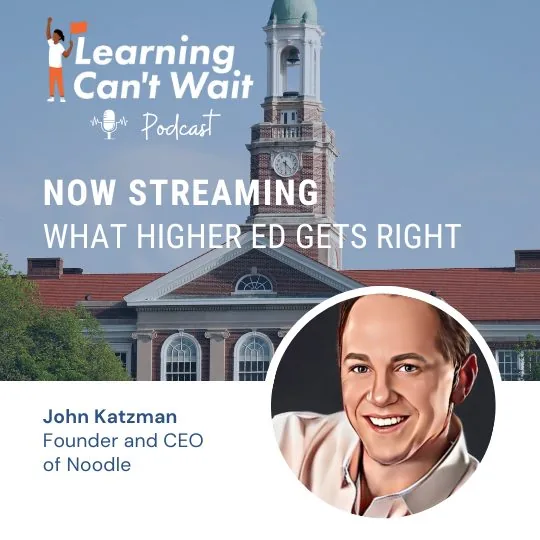
Learning Can’t Wait · Season 1, Episode 11
What Higher Ed Gets Right
 Hosted by Hayley Spira-Bauer, Chief Academic Officer at Fullmind
Listen now
What Higher Ed Gets Right
Episode summary
John Katzman, CEO of Noodle and founder of The Princeton Review and 2U, explains why he prefers higher ed to K-12: universities move slowly but understand innovation, while K-12 has a governance problem. He defends higher education's scientific culture and export value, calls lifelong learning a space four times larger than graduate school, and names two missed K-12 reforms: one-size-fits-all curricula like Common Core, and data introduced as a tool to fire teachers, which poisoned trust. He proposes measuring long-term outcomes such as employment, health, and citizenship, and a state-level experiment running a clean-sheet governance system beside the current one.
Key takeaways
- Education marketplaces are weak because almost nothing is measured in ways that matter
- One-size-fits-all curricula keep failing; stop treating each failure as an execution problem
- Data arrived in K-12 as a surveillance tool for firing teachers, so educators distrust it
- Measure long-term outcomes: employment, health, happiness, and citizenship, tracked at the state level
- A mid-sized state could run a clean-sheet governance system side by side with the current one for a decade
About this episode
It’s no secret that the times have changed, including the public perspective of higher education. It’s easy to focus on the negative and much harder to empower the positive. In this interview, Hayley Spira-Bauer and John Katzman discuss what higher education gets right - and it’s an inspiring list! But that's only one piece; let's dive in with Katzman and hear how he thinks K12 spaces need to be shaken up to keep up.
Learning Can't Wait is brought to you by iTutor.com.
Full transcript
Transcript generated from the recording; minor errors may remain.
Welcome to the Learning Can't Wait podcast an iTutor production at iTutor. Our vision is to ensure every child has access to education regardless of circumstance each. We will be joined by Pathfinders within and around the education space who are bringing about transformational change. On behalf of deserving students, I am your host, Hayley Spau.
Welcome back everybody. I'm so glad you're joining us. For today's episode, we have the Chief Executive Officer of Noodle, Mr. John Katzman. John, welcome to today's episode. Thank you for having me. I'm so glad you're here. I, I know that the title I just named for you is probably just a, a, a station in time of where you are at this very moment.
I would love if you could share with our listeners a bit about your educational journey so they can understand just how you are moving the needle and how you have moved the needle in so many areas of education throughout your. It's very kind. When I graduated, college, I started The Princeton Review and ran it for 20 odd years.
First in terms of test prep and then a broader college admissions at that kind of focus, and graduate school left there after taking a public to create 2U, which. Works with universities to create online programs and, ran that. And then, just before the IPO in that case left to create a portfolio of companies that I called the Noodle companies trying to solve different problems in the education marketplace space.
I, I, you know, we'll talk about it more, but we, I think the biggest problem. In education, it's, it's very hard to measure anything in ways that matter. And as a result, the marketplaces are just kind of crappy. Like it's finding the right school for your kid, finding the right curriculum for your school.
Like any number of decisions that should be really data rich aren't. So people make a lot of bad decisions and there's a ton of inertia and I thought, you know, let's hit at that in a variety of ways. And see which ones stick. And one of them, the one I run and ran is Noodle itself, which works.
Universities, across us at this point, about 30 universities to use technology to lower the cost of higher ed while raising student faculty engagement and raising capacity and resilience. And it's been a great ride so far. I think you really live up to the term you have in your LinkedIn profile of education entrepreneur.
where, where does, you know, how, where do you find that spirit? How does that spirit move you as you think about your career? Does it, it's not a typical path for someone in education, right? So to call themselves an education entrepreneur, what does that mean for you? Well, number one, to me, a a lot of us, almost everything you look at, you think, you know, that could be better in this way or that way.
Right there, it's very rare that you say something is perfect. I feel that way on airplanes. So, like, airplanes seem to me to be pretty much perfect. Every somebody's smart has thought about every facet of that. . Whereas most objects including Air Airlines service, there's probably something that could be better to be an entrepreneur versus just a A A A whir is it requires two things.
First, that you're gonna do something about it and not simply note that it could be better, but you know, you're gonna step in. And two, which ones you're gonna step in on are things that are large enough to be scaled business. That, that there are plenty of problems that you can decide to solve that are really important to solve.
Like, you know, your kid's teeth aren't straight, right? But, but which are the problems that actually you can create at either non-profit or for-profit business of, you know, a couple hundred million, you know, if, if, if you were attacked it. So what are the problems out there and what are the problems big enough that you're gonna solve?
Is there, is this a process you go through in your head? Is this a, a framework you've, you've developed yourself? Like how do you decide where your energy gets spent and where you invest your time and attention to solve problems? Mostly like everybody. You flow where the world, takes you a little bit.
You know, you wanna be opportunity driving and not opportunity driven. , but, and in the broad context of, of, you know, you wanna be in the education space versus pharmaceuticals or something like you, you choose a lane, but within that lane, you know, there're an awful lot of, of, of, of inviting targets and, the only mistake is to, is to pick too many targets.
Something that I'm every so often guilty. My mantra because it takes somebody with the disease to recognize the disease and other people, is thatthe plural of focus is lack of focus.That you can't be focused on a lot of things, pick something and do it. So I have found, you know, it's also just experiences I have found that when I work in higher ed, higher ed moves slowly, but they understand innovation and.
If you are patient and thoughtful, you can navigate that, whereas K-12 really doesn't move at all. And I think we have a real governance problem to be solved there. And every time I do K-12, it ends badly. So I, I tend to like higher ed businesses more than K-12 businesses. I like B2C businesses a lot. I like dealing with people because a transaction's so straightforward.
I'm going to do this for you and you're gonna pay me that where. It gets trickier when educators are involved and then administrators. And in the case of K-12 than the administrator's, administrator, you know, the, the district or the state, all the stakeholders. Leveling on leveling on a lot of stakeholders.
Yes, yes. So there are some great businesses built in K-12. I'm just, I, I just personally. Have found it to be insanely frustrating and so I, I I tend to focus elsewhere. So higher ed is where you've planted roots. What do you think you, you named a little bit about the, the pace at which higher ed moves the, the willingness for adoption of, of innovation and ideas.
What do you think as a society, we're getting right about higher education. We're getting a lot right. You know, and it, it's so easy to take pot shots a. , the spirit of looking at the data of the scientific method of making your assertions have to prove themselves to your peers is alive and well, and, and critically important, in an era of BS.
Second is it's our fifth largest export, service export. We bring students from all over the world, and I think America has benefited from, from, from the brains we bring. And from the values we export, through our schools. Third, the Silicon Valley narrative was, you know, we're just gonna have badges.
We don't need higher ed. You know, we can, and the data suggests that that hasn't worked out, that, that, that educators like degrees. Because to some degree, what's baked into that is the same reason the New York Times is more reliable than Twitter or Facebook. It there's a system of people who are devoted to the institution and to making sure that its students and graduates are the ambassadors of its brand.
In a way that they feel good about, so who you bring in, what you teach them, how you evaluate them. It turns out a pretty good product that employers. Continue to find increasingly useful when they, when they hire. So, so you don't think higher education institutions are going anywhere, even though the narrative in Silicon Valley had maybe pointed in that direction for some time, you think they're here to stay and the desire for folks to continue to get those degrees for a variety of reasons.
If I'm hearing you correctly, the import export narrative is also really interesting to. It provides a worldly benefit, not just a singular benefit. It's not just the the egotistical desire for it to improve oneself, but rather the kind of reverberations across society that higher education institutions offer.
The strength of the US economy over the past hundred years is largely due to the fact that we were in front on educating more people at a university level and. Other countries caught onto that and started beefing up their own higher education infrastructures is when they started closing the gap in terms of growth.
This is a real driver of American innovation and, and American economic growth. So I think there's a lot good going on there. And the, the, the question is number one, where do we go from here? Right? The lifelong learning space. Is already like four times larger than the graduate school space and it's growing pretty quickly.
The notion that badges could replace higher ed is nonsense, but the notion that by the time you're 21, you've learned enough to take you through to retirement is also nonsense. How does higher ed become a more important player in the lifelong learning spaces? I think it'll be really interesting. And the other question is cost.
Like it's. Too expensive. And when people complain about universities, it mostly, they're complaining about the cost of it. I think that's a fairly accurate statement, at least from my own noble position over here in the K-12 sector. I, you know, it's interesting because you're talking about the lifelong learner space.
You're talking about continuing education and I, I think for a lot of people there's an obvious. There's an obvious, kind of synergy between what you are naming as higher education and and beyond. Let's go backward though. Let's, I'm gonna now reverse this back into the K-12 space. I know there's a lot that you think we can, as a society, be doing differently to improve education.
As you said, it has not changed. It has been stagnation Central for the past couple centuries, but let's start with the positive. I'm an optimist. What do you think is going well in the K-12 sector? It has changed significantly in the past couple centuries, but it hasn't changed much in, in, let's say, the last, I don't know, 80 years.
Right? We did, we did start educating. More people, people of color. True. More possibly we, we women, you know, wasn't probably about a hundred years ago when we first really committed as a country just to getting everybody a K-12 education. The other things would do well. People ask so much of schools that has nothing to do with education in terms of feeding kids in terms of being a hub for the community, athletic.
Just having students have a place to go, while their parents are at work, back when people went to work. And it does an awful lot of those things, you know, really, overall pretty well, possibly to the detriment to my earlier statement about focus of teaching. You know, I think, I think. The K-12 world pushes back pretty hard as a cam when political forces work to hobble it and to hobble it's ability to teach science.
Or actual history or any number of other topics. And I think it's a strong community that believes in, in, in speaking truth. Well, and it's a right, I, yeah, I could not agree with you more. And I think we see as a society that's at play very heavily these days, and as a public institution, I think you are more, p politics are more impactful, more kind of a driving force in a lot of how we operate.
Absolutely. So, so John, now the real question is where is there opportunity for improvement? What, what is, and I, and I know you have a really important perspective on this, what is it that we are due are failing in as it relates to K-12 education? From your, from your vantage point? I think a lot of the, the problems, you know, I, I spoke about assessment.
And you think about how we assess. Not just an individual kid, but how we decide what's a good school, what's a good teacher, what's a good curriculum? And there's so much in an information age that we could be doing to collect data in a more systemic way, and to use that data to actually affect change wildly more.
Than we do. There are two things that, that I consider both missed opportunities for real reform over the past 30 or 40 years. The first one is this notion of one size fits all. This notion of I know what every kid should learn, which is such a moronic statement, right? Like anybody who sat every kitchen though this.
When did that, when has that turned out to be right? They clearly have never been in a classroom though, . Or maybe they haven't, they've just forgotten what being in a classroom is actually like and they've never had a sibling or two kids and realize that, you know, they're just different. People wanna learn different things that are good at learning, different things.
And the notion once, once you walk down the road of one size fits all education, it just can't go. . And you know, there's, there's something I talk about all the time. I, I forget where I first read it, but in every religion there's this like moment where back in the day you were saying, well, our God is like way better than your God.
And and we're gonna go to war and we're going to kick your butt because we have this, you know, terrific God. And then they would lose. Some more and have this like, I won't say come to Jesus moment because this is across a lot of religions. Come, come to this moment of like, wow, you know, we can, we can either agree that our God maybe is that great or doesn't care that much, or we're just not praying hard enough and, and that notion of we're just not praying hard enough every time we hit a place where one size fits all fails.
We come in and say, well, it's just an execution problem. We just aren't good enough at teaching all of the same stuff. Like the same stuff to every kid. And I'm just curious. At the moment somebody says, yeah, this has been litigated. It's a bad idea. Let's move on. And that comes to Common Core and it comes to any number of things that were going to be the silver bullet.
That this is what we should teach everybody the new math that didn't turn out to be a, a, a big win. The whole language, that's number one. So this last round of it, Common Core made me insane because we have been down this road so many times, and the only good news is I want a lot of. From friends who insisted that, Common Core was gonna result in higher AP scores.
And you bet on it at the right time. You bet on that. On it. The easiest money I've ever made. So, so that's number one. And number two is in terms of technology and data. We walked in and I, I, I somewhat blame the Gates Foundation and others. Although there, there are plenty of people you can look at. And they walked in with data.
They walked in with the chops to collect and use it, and they said, you know what we're gonna use data for is to figure out which of the bad schools and which of the bad teachers, and we'll close the bad schools and we'll fire the bad teachers. And then you would kind of get 'em drunk and say, well, yeah, how many teachers are bad?
And they would go like half. And it's like, okay. So now we've drawn the lines. We know exactly what data's gonna be used for. It is an attack on. The entire system and what's come out of that is a deep skepticism about technology and about data that this system is more a surveillance tool than it is a support tool.
That the data is only gonna be used to make my life harder, not better. And as a result, the the way schools use data is just wildly less effective. Then the way anybody uses data in any other part of the world, like we,we have poisoned the well for data and for technology, and it's really gonna take a concerted effort to gain back the trust of educators.
John, are we even measuring the right data? , right? Because you're, you're naming the kind of data that we've been using to effectively determine if schools are successful, if teachers are successful, is there other data we should be considering and paying attention to as it relates to the success of the students?
Absolutely. So let's, let's start from a thought experiment. , I'll bet you that I could get everybody who's watching or listening here to agree on the goals of K-12 education, right? And everybody's kind of, wincing and, and laughing, and the answer is, of course, you can. The goal of K-12 systems is that the students you have over the next 40 or 50 years will be well employed in jobs that they like and to pay a living wage.
They'll be happy and healthy. Low suicide rates, low alcoholism, low obesity, and they'll be good members of society. They won't go to prison. They'll vote and they'll be engaged members of the community, and you could tweak around the edges of that. You could say, well, this is more important than that. You know?
What about self-actualization? Like you could play, but at the root, if that's what the school system turns out, we feel pretty good about our. Like that's a good start. You probably should have put a bet down before you did that cuz you're clearly a betting person. I am a betting person. Only on, only on random.
Impossible to prove assertions and only, where the bet is. Pushups, for the most part, . But if you think about that, if you think about, okay, yeah, those are reasonable goals in one form or another, and we can argue around the edges, but those are good things to measure. Well, we don't measure any of them.
We don't actually look longitudinally. At this kind of school versus this kind of school. Here are all the inputs. Here's what they're doing. Here's what curriculum materials they're using, teacher training and and professional development, and just look and over the next 10 years, how do the students do in things that really matter, that we all agree matter.
And you don't have to wait 40 years to have a pretty good hunch. You can look at a middle school. How do their kids do in high school on those measures? , do they go to college and then do they graduate college? So it's like one of those, uh, uh, images on the net that you know, it, it it, back when bandwidth was a little bit slower, started fuzzy, and then, you know, and then sharpens.
You'll have a pretty good hunch within three or four years what's working. And then a better hunch in five years and a better hunch in 10 years. And meanwhile, you're continuing to evolve your practice based on what you've learned. That's the way you use. Right in large numbers, kind of like an epidemiologist, and not in any way, in neither formative nor summative, just how do we make the system better.
So I think when you start with data, you've gotta start with measuring the right things. The right things aren't things you can measure right now, like grades or attendance or support. Those are all gameable and they really don't matter unless they turn out to be highly predictive. And the fact is, as you focus more and more on them, They are less and less predictive of long-term outcomes.
I'm just, I'm thinking to, who should be measuring that? Right? Like I asked this question like everybody there e everybody along the stage, the journey of a, a child growing to adults. First you have K-12 as the stakeholders that care the most, right? The school system. Then you have higher education or career and technical readiness and folks that are moving into the, you know, career space instead of choosing to go to college and university.
But I wonder, like economists seem to be very, very worried and attuned and, and attentive to this type of data science. I feel as if, especially if it's predictive of our workforce. That would be the, the population of folks who want to pay attention to this problem. Yeah. Look, the, the first thing, are you going to be employable and employed and agile enough that as the economy changes, you can get another job?
And it'll be good. So we're not creating these cogs that as soon as anything changes, you know, that become useless. If I had to list among the three, that would certainly be an important one. But health and happiness has gotta be up there somewhere. Right? And citizenship has gotta be up there someplace.
And some of the economists can look at the first one, but the rest of us, especially as parents, probably will look at all three. I was just thinking the, the second one, it speaks to me very deeply as a parent as well. I, I, I care not. Much about with relate relation to my own children. I care that they're good people and they're healthy and they're happy.
So you're right. I think parents will be the, the real data scientists on that front. Right, and, and this stuff, by the way, there's, there are plenty ways to measure it. Right. Like we, we do have a sense from the IRS of what you're making. We do have a sense from all sorts of, uh, data feeds as to your health or your state of mind.
Gallup polls thousands of people a night, and both, voting records and pr prison records are, are, are in our hands. Like there are starting points for this thing that it's really just a matter of caring and patience. Like the fact is, We jumped into things like Common Core with almost no evidence that it would matter, right?
We just said, oh, this is intuitively a good idea that everybody should learn this here. , you're really taking a scientists approach and saying, well, we're, we're gonna, we are in fact trying different things. We're doing this gigantic hundred year uncontrolled experiment all the time, and let's just start controlling it.
Let's just start actually paying attention to what we're doing with, with different kids in different schools, and then wait around to see how it goes. So how much of the onus of paying attention to that is on the government, federal, local, state? Like how, how much responsibility to own and manage that should we depend on our elected officials for.
It's gotta be, the state has the data. It's very, very hard to imagine. I, the education is local enough that an initiative like that from the feds would be hard. Anybody below the level of state doesn't have access to the data. Anybody outside education system doesn't have access to the data either. So they're doing all this through a screen door like I.
The, the logical place to do it would be at the state level. But by the way, gathering the data in a systemic way with a good attitude is like the first thing we can do. It's by no means the end game, but it is certainly a, you know, table stakes. Like if, if we're going to take the scientific method seriously in terms of not just teaching it, but using it, you start with.
At iTutor, we talk often about OODA loops, observe, orient, decide, act. Do it again. Do it again. Do it again. I, I hear you. You have to start with the data, but that's not where you end. I'm wondering too though, as we're talking, I know the last time we chatted and as we were getting to know each other and prepare for today's recording, we were talking a lot about reinvention and some, some really quality testing of reinvention.
And you named it right? A little bit at the state level, different states feeling willing or different local officials feeling willing to try new ideas. I I'm gonna twist this question a little bit cause I'm not just gonna ask purely about the reinvention, but what do you think we can take from higher education and bring to K-12 to help?
Or, or, or what could inform us about how to improve the, the current operational state? If you, if you look at the. 30 years. There are a couple things that we can take from K-12 and a couple things we can take from higher ed, like what we learned through Common Core and the accountability movement, what we've learned from the charters and the choice movement, that's all K-12 in higher ed, the move online.
And, at this point, if you look at graduate school, if you look at adult learners, it's already half. And moving more that way. And so, you know, how do they think undergrad versus grad, adult learners versus kids, where's the point to which online learning can be a more important part of K-12? In what ways, you know, where do you bring in tech and the notion of com competition?
No University really has geographic hegemony and to the degree they do like state systems, you talk to a chancellor at any state system and he'll tell you. She'll tell you the that, that each university within the system pushes back hard on any encroachment by the central authority on. Their academic freedom or, or what they choose to teach, how they choose to teach it, who they have teaching.
So even within a system, in almost every case, the real power to make decisions is happening at the school level, right? The system controls the purse, strings and, and very little else. And that's, I mean, where you see true innovation in schools is where you shine some light. I, you know, this week I actually posted an article on my LinkedIn about a school in South in, excuse me, in North Carolina that had been really braced and prepared for the pandemic prior to the pandemic hitting in the sense that they had been a technology first school, but they had also been a social-emotional first school.
They had already invested in infrastructure and systems and policies that supported the wellbeing of their students. And so the transition. Remote learning, they thrived. And I think you're right. I think learning from. Educators and school leaders that are really forward thinking about how they measure success.
Right. To your earlier point and what matters more than just performance towards a, a, a bunch of kind of uniform standards, that's where you see children thrive. Yeah. I, you're there. So the question for me would be if you synthesize that, imagine a state said, and I'm, I'm actually looking for a state who wants to play.
I think I have a university or two and, and, and then I need a, a, a, a pretty good sized founder. But the state could be that. Imagine you said we're gonna spend three years, we're gonna bring in educators from a variety of levels, but we're also gonna bring in people who really understand the transportation industry and the trans transformation of that industry by things like, We're gonna bring in people who really understand the construction.
And why it costs so much more to build a school than, than, than to build anything else. And how we might think about construction of schools differently and ownership of those buildings differently. We're gonna bring in labor people from other industries and, and say, what are, what are ways of empowering teachers, but having unions that in no way are seem to be or are inhibiting innovation.
Like how do we, how do we do labor differently? Right. And you look across every part of schools with different groups of experts from other areas and from education, and the, the goal over those three years is to create a. From a clean sheet of paper, this is what a state system might look like. These are the laws and regulations that would be part of that.
And the state willing to say, if it doesn't look crazy, let's run that side by side with our current system. The problem isn't that in the school, the problem is everything above the school level. Let's give schools a choice. So they wanna be in that system, or do they wanna be in this? And over the next decade, let's see how it goes.
Right? And, and you have the regular legislative process on the one side continuing to evolve regs. You have your school boards, you have all the stuff you have now, and on this side you have this new system, which in my eyes would probably not have school boards, or districts. And you know, since it's a kind of v1, you're evolving it over that time.
But then the question. How happy are the teachers? How do they retain? How happy are the students? How do they thrive? Like what are the measures that we were talking about? And right from the start of the experiment, we know what we're looking for and if we're right, if this system is better, as it evolves, we just start moving schools over, and at the end you just shut.
This governance system, and now you've got a new, clean, shiny one and you don't try to do it in a week. You're thoughtful about creating it, and you don't try to measure it with like an increase in test scores in year one. You look at it over time and against real measures. This is an audacious idea. It's an audacious idea, and it's one that challenges the status quo, which is where innovation comes.
As we started with, you said there are two, two sides to the coin, entrepreneurs and winers. This sounds like the entrepreneurial spirit coming up again to rear its head and I won't call it an ugly head cuz I think it innovation on behalf of students is never ugly. It can't be that the system we came up with eight years ago or more a hundred years ago is.
The very best pod what we have now, the set of federal, state, district laws and regs. Is as good as it gets. It just can't be that we have now perfected K-12 education governance. I think that is a, a really interesting thought and I think that the listeners here today, are going to definitely have more questions after hearing this kind of 30,000 foot view.
Innovation and reformation of the education system that you've played out here. I'm curious, do you have a short list of states you, you wanna see taken on the AB testing? It has to be a big enough state where you can do an AB test that will be significant. It's probably gonna be a state that is centrist or purple, because like in New York, it would be a great place to test it, except it's never gonna get.
Like, it, it, there's, there's just too much pressure for the status quo. So, and, and it probably shouldn't be, you know, one of the largest states in the country. It can be a good sized state that, that, you know, it'll be a governor who wants to be president, you know, who says, let's take on a tough issue in a different way than we've taken it out before.
It's not just bla about like, I'm gonna increase funding, or I'm gonna increase accountability, or I'm gonna give every kid a scholarship to whatever it. , it hits at something deeper and and harder. I, I got to know Paul Volcker, late in his, life, and he had very strong feelings about people believe in public policy versus public administration, that everybody wants to make policy, but the reason people don't trust government is not necessarily that they don't agree with the policies.
It's the government executes them so badly. And what if we really focus here instead of the curriculum and we're gonna solve it with new math or with Common Core. What if we focus on the execution of a governance system that makes sense, that allows for innovation, that encourages measurement. Just a different approach.
And, and it'll probably be a, or she'll be, or there'll be a, maybe with a tech background or a data background. Because, cuz a lot of this is, is stuff that's been learned in in industries. That are fiercely innovative and perhaps an entrepreneurial background, right? Usually entrepreneurs are a little bit more, are a little less averse to risk.
So this, this requires a little bit more willingness to branch out of what is expected. I, you know, I wonder sometimes, I've seen a lot of data that entrepreneurs gamble less, and certainly like things like going to Vegas and. You know, betting slots, I don't do it and I don't think it's a matter of risk.
I think it is. We. Can't possibly be as good as we can be. So I'm not gonna say, I'm not gonna crap on the system and say it's a terrible system. It, it just is a suboptimal system. And the notion of examining it and looking to change it is not about taking risks. It's about a, a willingness to, to re-examine assumptions.
Mostly when you really screw something up badly, it's cuz your assumptions were. There's a lot about our society and the way we educate our youth that I think most folks would agree are in some serious need of reformation and change. And I, you've, you've here laid out one method to do that, which I love.
I, you know, John, as we're wrapping up our time together today, I always ask this question, but I'm gonna tweak it slightly for you. I always ask, what advice might you give an educator at the start of their career? But I'm gonna ask you what advice you might give an education entrepreneur at the start of their career.
I've given this advice, I think a lot of people assume that people like to learn because the kind of people who we are and who your listeners. Do educators like to learn? Most people, they actually don't like to learn. Learning is hard. It's painful, it's not fun a lot of times, and and you do it cuz you have to, either because somebody's grading you or because more.
As you get to be an adult, I want to be over there and in order to do that, in order to code this, I need to learn. Language. In order to get along in Germany, I need to learn German. You've gotta develop systems that start with the assumption that, that you're not gonna just sprinkle sugar on it, and all of a sudden education becomes like this Great.
Tasting fun thing. It's hard. And you've gotta love that harness. You've gotta love it. The way an athlete loves working out, they hate working out. They do it because it gets 'em, it gets 'em in in the shape that they wanna be in and, and they try to make it as social as possible. They try to make it as engaging as possible, but, but they acknowledge at a core that it itself is not.
There's like a love of the game quote that used to be on tv in the commercials on Sunday, on Sunday night. Footballs like, like, you gotta love the game. I'm like hearing that echo a bit here in your statement. You don't do these things because it's easy. You do it because you love the idea or you love the, the thought of bringing opportunity and education to people in different ways, places, and spaces.
Well, and for an education entrepreneur, for somebody who wants to, again, either a non-profit or for-profit, create change. Taking from that and saying, okay, things are as they are for a reason, right? The inertia that exists isn't going to magically part when I walked through, and I've gotta be attacking something.
That is large enough to to, to put the next decade of my life in cuz of no immediate miracles like this stuff.Education's hard. Learning is hard.And, building an education, business and again, or organization. , you know, is a commitment. So it's gotta be worth doing. It's gotta be a big enough target that you wake up every morning saying, yeah, I'm gonna, I'm gonna kill that.
I love it. That is great advice, John. Thank you so much for sharing your thoughts, your wisdom, your expertise, your experience with all of our listeners here today. I'm really grateful that you joined us for today's episode. Thanks again. I'm sorry for rambling. I appreciate, listen, the, the ramblings where the good, the good stuff comes from.
It's where the, it's where the real insights happen. All right. A pleasure having you done. Thank you.
Thanks for listening to the Learning Can't Wait podcast. If you liked what you heard, please rate, review, and share this episode. Be the first to know when we have a new episode by subscribing wherever you listen to podcasts. If you'd like to be a guest on the show or have a suggestion for an episode, email us at podcast@itutor.com.