
Learning Can’t Wait · Episode 206
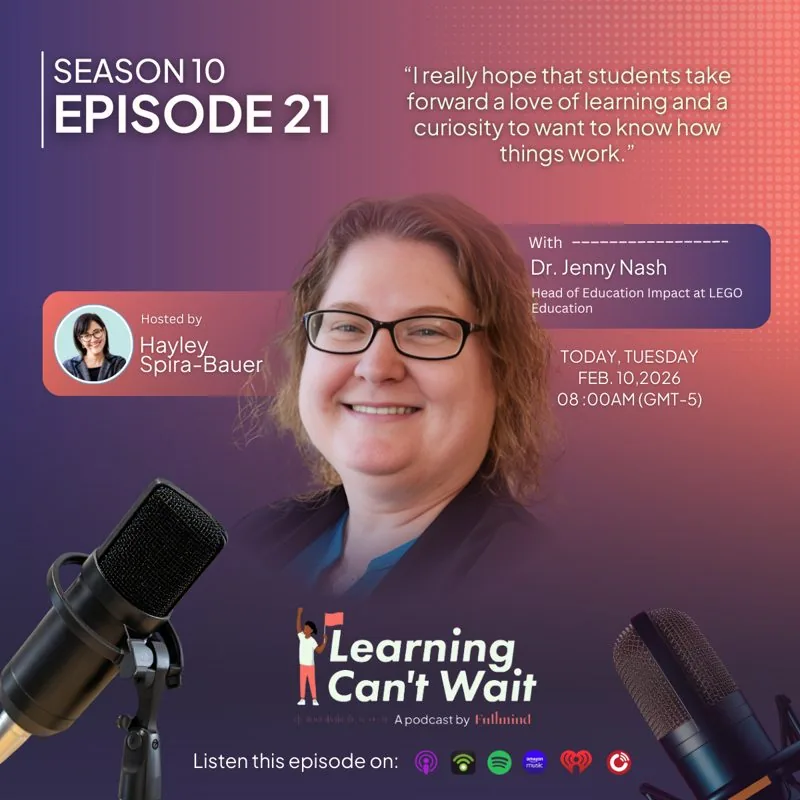
Dr. Jenny Nash: Hands-on Learning, Student Engagement & AI Literacy
- Dr. Jenny Nash, Head of Education Impact at LEGO Education (U.S.)
 Hosted by Hayley Spira-Bauer, Chief Academic Officer at Fullmind
Listen now
Dr. Jenny Nash: Hands-on Learning, Student Engagement & AI Literacy
Episode summary
Dr. Jenny Nash, Head of Education Impact for LEGO Education in the U.S., explains how a hands-on science teacher in West Virginia changed her relationship with learning and led her to a career in STEM teaching and then LEGO Education. She describes standards-aligned science and computer science lessons built with input from hundreds of teachers and thousands of students, including deliberate choices about screen time for K-2 learners, and why the goal is to demystify AI rather than just use it. She argues assessment should capture collaboration, problem solving, and understanding, and advises new teachers to learn alongside students.
Key takeaways
- LEGO Education builds lessons from standards so teachers can bring bricks into rigorous instruction
- Hundreds of teachers and thousands of students informed the science, computer science, and AI materials
- K-2 lessons balance Coding Canvas screen time with unplugged learning, based on educator input
- The goal is to demystify AI: how it works, how it is trained, how to ask good questions
- Assess collaboration, iteration, and explanation, not just concept mastery
About this episode
In this episode of Learning Can’t Wait, host Hayley Spira-Bauer sits down with Dr. Jenny Nash, Head of Education Impact at LEGO Education (U.S.), to explore how hands-on, inquiry-based learning can re-engage students in classrooms amid a growing disengagement crisis. Drawing from her 20-year journey as a STEM educator and education leader, Dr. Nash explains how LEGO Education designs standards-aligned science, computer science, and AI learning experiences that make abstract concepts tangible, joyful, and meaningful. The conversation highlights the importance of teacher and student voice in product design, age-appropriate AI literacy, collaboration over isolated screen time, and redefining assessment to include durable skills like creativity, resilience, and teamwork—all with the goal of helping students build a lifelong love of learning.
Full transcript
Transcript generated from the recording; minor errors may remain.
Hayley Spira-Bauer: Welcome back to the Learning Can't Wait podcast, everybody. I know today's topic is going to perk up a lot of ears. Have you heard of LEGO? How about LEGO for education? With us today, we have Dr. Jenny Nash, the Head of Education Impact at LEGO Education in the U.S. Welcome, Jenny!
Jenny Nash: Thank you so much, I'm so excited to be here and get to share with everybody.
Hayley Spira-Bauer: You know, I am beyond thrilled. I already told you how my home looks like a LEGO museum, but I specifically wanted to call out your title today, because we're not going to be talking about what's happening in my house. Or any of our listeners' homes. We're actually going to be talking about how LEGO, brick by brick, fits itself into brick-and-mortar schools.
Jenny Nash: Yes. Oh, I love that. And it really, truly is… think about the power of what you see your own kids doing at home, and the natural curiosity, and the learning, and the creativity that they have. Now let's bring that into the schools and transform learning. And think about how powerful and impactful that truly is, and we get to do that every day. It's such an amazing mission to think about how we transform teachers for how they're teaching, and students for how they're learning.
Hayley Spira-Bauer: That is a big mission, but at a time when students are… Removing themselves from school, detaching their emotions from school, disengaged from school, and these are not my own words, but these are the words of some of the biggest publications in media right now, talking about the disengagement crisis. It is more important than ever to think about ways we can bring really reinforcing, engaging tools like LEGO into classrooms that really reinforce and impact students' lives. So, we're going to jump right in, and I'm going to start off with asking you, Jenny, how did you come to be the personal and professional version of yourself?
Jenny Nash: What a fun question. Probably like so many people, I am who I am because of the people that I surround myself with, and the experiences that I've had, of course. And I have been so lucky, over my work life, 20 years of education, where I have been able to work and grow with such talented, amazing people that are just driven by that mission to impact students and learning in positive ways. That's super important to me. I'm very mission-driven. I really want to see the fact that we can transform education, and being with others that are mission-driven really helps me be who I am, both personally and professionally. So, Hayley, actually, I grew up in a small area in West Virginia, and I was the student who liked school, but did have to really work hard to do well in school. It didn't always come easily to me. But I had a science teacher my senior year, Mr. Beckelheimer, shout out, who really changed that for me. We got hands-on, we were being very experiential in our learning. Every single day, we were doing something exciting, and it just changed the way that I understood science and I connected things. And I kind of had that moment of, aha, of, wow, like, this is what learning could be. So, you know, 20 years later, I've been in education, I've been a STEM teacher, a science teacher, computer science teacher, and that experience kind of still drives me. It's what drove me into education, deciding that, hey. If I'm gonna be a science teacher, I could really transform the way that students learn and experience learning, and that is kind of what drove me into education and science specifically in the first place. I started teaching with LEGO Education, though, when I was a STEM teacher. And again, there was that transformative moment of seeing the impact of that hands-on learning. You know, when you get the bricks in hands, there's so much thinking and creativity that's happening. And that, again, drew me to this opportunity to change the way that students can learn when they have those really strong manipulatives in hand, and what bring me… brought me eventually into working with LEGO Education. And so again, I've just had this amazing journey of being able to focus on those missions, be driven by it, find those right people to help also drive it, find those right tools. And a lot of just doors opened into helping other people meet that same mission that has really driven me, both personally and professionally, And it's not just about the student learning, it's also really been about the teacher learning. I've been in professional learning with teachers for so many of those years, really driving their own learning and helping them see what they can do. And so I think that those pieces, and again, those people and those experiences drive me back to the fact that kids can't wait, the future's not gonna wait, and we have an opportunity to make learning joyful and meaningful for students. Both kids and adults for all types of students. And so, at the end of the day, it's really those things that have driven me to where I am today, and the fact that it's just really who I am. I'm just about learning. Lifelong learner, I want other people to love learning, and that kind of drives me every day.
[05:00] **Hayley Spira-Bauer:** Your passion is so palpable as you talk about getting kids' hands on tools and manipulatives to help make learning more experiential. For those of us that are unfamiliar with LEGO for Education, or LEGO Education, can you talk a little bit about before this recent release, which we'll get to, what are we looking at when we say bricks in schools? Are we talking about teachers putting Death Stars together? Like, what does that mean?
Jenny Nash: What a day that would be in the clash. It really, truly, if, again, you kind of take that picture you have about LEGO bricks and how that allows you to create To model, to investigate, to try things out. And sometimes you try and you fail, and it doesn't go together the way you think, and then you've got to try again, right? It just allows that kind of natural iteration and thinking to occur, and problem solving, and all of that to happen. Now, now bottle that up. And put it with a science concept, or a computer science concept, right? And give it to those teachers in a way that allows them to meet the standard expectation of what they have to teach. So we're starting with standards, we're building it from standards. And creating a lesson and an experience in a classroom that teachers can be confident bringing in, knowing it's going to be rigorous, and teach the students the concepts they need to learn. But in a really fun, engaging way that students are going to both be excited about, they're going to understand, you know, we can bring in a lot of those interests that students have. So that it creates this kind of meaningfulness and connectedness to them, and now they're able to connect that into these difficult concepts. I mean, go back to your own learning. There are so many abstract concepts that we think about in STEM and computer science. We're making them tangible for students through this work and through this, kind of curriculum that we're creating. So, 45 years of history with LEGO Education, our mission has always been the same.Engage more students in hands-on learning, both inside and outside the classroom, and so it's really combining that educator experience and expertise with those LEGO bricks, with these lessons, this curriculum that we're creating that, again, is very purposefully built, that allows these amazing kind of inquiry-based experiences to happen, and that meaningful learning to happen in classrooms.
Hayley Spira-Bauer: So nobody knows what's happening in classrooms better than teachers, and so often on this podcast, when I talk to educators, we discuss what they wish or want out of edtech. And I would say, like, LEGO Education and the happenings, especially more recently, are really edtech. They're an EdTech title and name, but also edtech adjacent in a lot of ways. But, well, for now, we'll say that you fit squarely into that category of EdTech. How are teachers and educators informing LEGO Education's… LEGO Education's pedagogy and product decisions right now?
Jenny Nash: That… I love this question, because it's so important to everything that we do. So when you think about an edtech company, which I think makes sense to put us in that category, absolutely, it's really our job to support teachers by providing the tools building their confidence, helping them feel very prepared to teach in areas of science, computer science and AI, STEM in general, right? And do it in that kind of age-appropriate way that's going to be very engaging for students. And you said it right off the hand, there is that kind of piece where teachers recognize students are not engaged, and we need to get them re-engaged with learning. So, to your point, who better to go to than the teachers? So we have a responsibility to build these tools and help them be supported, but we need that from them. We need to have that strong understanding. And I'll challenge you even further to not just ask the teachers, but we are talking to the students as.
Hayley Spira-Bauer: Yes!
Jenny Nash: And that's, like, so important. It's making such a difference. So when you think about our LEGO Education science, our LEGO Education computer science, and AI materials, we were in hundreds of classrooms, talking to hundreds of teachers and thousands of students. I think we lost count somewhere after 3,000. And it's really about getting them to help us design that learning. What's going to help that teacher be successful? What support systems do they need in place? Where are the teachers really getting it, and learning it, and taking it further than we even thought they could, versus, oh, okay, they didn't quite make the connections we wanted them to there, like, let's go back a little bit. And that really is truly driving a lot of what we're doing. A great example I'll share with our computer science and AI materials We actually had a lot of strong conversations with educators about the K-2 space, so our youngest learners, what's age-appropriate when we're talking about that AI piece, that computer science piece, and bringing screens into the classroom? So we have quite a lot of good dialogue and documentation that went behind that, and at the end, when you really look at what we developed for that K-2 space, you'll see quite a balance happening between lessons that do involve being in Coding Canvas and doing that screen time, and ones that don't, and students are really learning in more of that unplugged manner. And that was a direct result of those dialogues we were having with educators and saying, this is what we feel like is most appropriate for our students, and where we need to meet them as we go. And then, like I said, of course, taking in those data points for our students.
[10:00] **Hayley Spira-Bauer:** A lot of the lessons are really designed around passion points. We talk a lot about student passion points, and.
Jenny Nash: What a second grader cares about, and what a sixth grader cares about, quite different, right?
Hayley Spira-Bauer: Yeah.
Jenny Nash: So again, bringing in that student piece as well, and thinking about what are those passions, what are those interests, how do we frame the learning around potential problems that they're solving, or ideas that they're creating? And again, we were able to take a lot of that in for learning. So, in a way, we're not just thinking about how the teachers can help us build it, but the students themselves, honestly.
Hayley Spira-Bauer: Yeah, no, it's such a valid point, and I think that's a huge, important component of product design that often gets overlooked. They think if I have the educator's perspective, I obviously am catching the student's perspective. But it also is really interesting what you're saying here about K2, and I think a lot, I have one K-2 student and one, 3-5 student in my home, and when I think about what AI looks like for the K-2 student, and I've done a lot of reflection on this, and I've gotten to interview a lot of smart people on this topic. For me, what I have now kind of solidified in my head is Good use of AI is really understanding what questions to ask. And so much of thinking about how we want AI to work, or how AI works. Revolves around that idea of asking really open discovery questions that allow for an in-depth understanding. And I don't just mean on LLMs, but I mean overall. And I can see the deep connection, even to LEGO in classrooms. With that framing in mind for early childhood. No, they may not be, like, sitting on a computer and typing into ChatGPT. How do I use these three…
Jenny Nash: Great.
Hayley Spira-Bauer: But rather, what types of questions do I need to ask if I want to build something with a moving part on LEGO, on a LEGO tool, right? Like, there's so much discovery that is inherent to the use of AI in early childhood. That I can see such a logical connection, even as you're talking to me here.
Jenny Nash: Yeah, absolutely. What a great example, right? Thinking about that questioning piece. AI is such a vast taste of itself, right? Like, there's so many parts of it in itself, and It's part of that broader computer science discipline and learning. So there's so much for building the foundations and the literacies that students need, as you're saying, to be successful as we grow them up through this. And learning how to ask good questions doesn't require a computer, to your point. That is a foundational piece to help students start to understand. And then I think unpacking, you know, what are these types of AIs? How does it work? It's one thing to ask a good question, and it's another thing to ask a second good question, a third good question, and how you're training it over time, and we really dive deeply into that kind of focus of training, and absolutely a kindergarten can understand that, but it looks quite different, and you're building a foundation of how they're going to then grow with it over time. That's gonna help them be on that screen and ask that question and use the more generative AI in a very successful way in the future. It's absolutely about building those pieces and thinking about what is age-appropriate. And we absolutely, again, just spend so much time purposefully talking about and making sure we're getting those right educator inputs into what is age-appropriate, where should students be. What's that long-term goal we're trying to get them to? And then how do you break that down over time? So everything that we've created with that LEGO Education, computer science, and AI, very progressive, really builds on itself, thinking about how they're understanding something in kindergarten and what that looks like then in first, second, third, fourth, as they build up through it. So just that interconnectedness, even, of the learning that allows for not only strong learning in the moment, but over that time period is also so vital to what we want to do and make sure that students aren't just playing with a tool in the classroom. It's really meaningful use of that technology.
Hayley Spira-Bauer: So, you know, you're talking here about a curriculum to help inform and engage students in these principles and practices and ideas. And when you talk about curriculum, it's very easy to assume that assessment is purely based off of some sort of summative or formative assessments throughout, and then summative assessments at the end of a unit. What does impact look like for LEGO Education and classrooms today? Like, how are you measuring the efficacy of what you've created and what you're implementing?
[15:00] **Jenny Nash:** Yeah, great, again, just great question, because if we're going to bring this into education, at some point, we really do need to think about that impact piece. There's so much to do, and to teach, and for students to learn in what is really a very limited time, we do have to be very thoughtful about how we bring that in. So. I think I'll back up for a second and just say a couple of things about our focus has really been about as we were kind of saying, AI not just as a tool, but really understanding how it works. Andone of our biggest goals has been to demystify AI for students, right? It's not this magic thing that's happening in the background. How does it work? What are those basic AI literacies and skills that they're going to need? In order to use that tool better, but really understand how it works, and so how do we get under the hood a little bit with them? How do they understand, how you train, how you utilize the kind of classifiers that are involved? I could give maybe some examples of lessons that we have around that. But it's really then about helping them have that better understanding of how to engage with it, as we said, right? And then the second piece, I think, that we've been so careful about is that safe, supportive environment in which they can do it. So, I can't overemphasize the importance that we think about The safety and data privacy and some of those things that we absolutely are keeping in mind as we've built these tools, because when we start to talk about assessment, that our minds kind of tend to go that way. And so we've really tried to be more thoughtful about what is appropriate, what is safe, and how do we help students engage in that best way based on those things. Now, having said all that, I think going back to this idea of, you know, what does it look like potentially to kind of measure what's happening? And it really starts to come back to, what do we want students to take away from this? I think about, collaboration as a big piece. And if I use that as an example for a second, when we think about computer science a lot of times in classrooms. Students are sitting very independently. They're on a computer, right? We think about that image of them at a computer, but they're very independent often when they're doing that, and So we thought about the importance of how to teach, how to collaborate in a computer science environment. So we've got four students working together. You saw this, right, when you experienced the materials. Four students are working together with different roles and very different kind of purposes, making sure that those are all rotating. In the fact that they are working with the model, they're working with the code, they're working with, you know, the ideas or the AI piece, and so much of that is driving this idea of collaboration. Well, that immediately changes the way that we want to assess success, and think about what success looks like, because now, success is that those students are collaborating well together. They're coming to a great output because of the way that they've come together and brought their ideas together, and building a stronger connection and understanding to the materials through the dialogues that they're having. And so, at the end of the day, having them be able to kind of explain and discuss How they solved a problem, or how they came up with a new iteration of whatever they were working on looks a little different because they're able to lean into the way that they were part of that group and add it to the overall success. So, I challenge us all a little bit. It's not just about making sure they understand the concepts and make those connections. Absolutely important, can't take that away, and there's so much more that we need to be looking at in terms of how they're using the tool to problem solve, how they're creating with it and not just using it, how they're collaborating with it, how it is driving forward the skills And those kind of, the durable skills and future-ready skills that we talk so much about, in addition to understanding the concepts. And again, you know, not to completely overemphasize it, but not just kind of using it, but under… truly understanding how it works. As they're getting into it. So, I flip that idea of assessment a little bit on its head of the first questions we really need to ask is how important it is to assess so much that's happening all at once that's not just the concept itself.
Hayley Spira-Bauer: I love that. I think of nothing better than a joyful, loud classroom where kids are engaging and interacting with one another, and it is… I think a lot of people find it hard to assess how students are able to master that as, like, a durable skill, as you named, right? Like, that is not what typical assessment providers in our space are measuring, and yet it is the real world, right? Like, life is a group project, so…
[20:00] **Jenny Nash:** Yes! I want to be teaching that! Absolutely. Yeah, how often do you really sit at the computer by yourself and work on a project? And to your point, those again are the things that we should be thinking forward. What are we really teaching these things to students for? What… why? What is the why? And part of it is that future readiness, and part of it is so that they truly understand how they work. So that, again, demystify it, really understand how these tools are working for themselves. That's the kind of thing we also need to be assessing.
Hayley Spira-Bauer: Yeah, speaking of the future, I'm wondering 10 years from now, what do you hope students who learned with LEGO Education remember or carry with them into adulthood?
Jenny Nash: That's it! That's the question. Right there? That should be our purpose, is what is that future gonna look like, you know? I talked about my own love of learning and lifelong learning. I do hope that students really take this, and it helps them build a love of learning, because they find learning joyful. And I think we talk a lot about that, obviously, at LEGO Education. The engagement factor drives pretty much everything we're doing. We want students hands-on, we want them engaged. And we want it to be joyful and exciting for them, because when I love the learning, when I'm excited about the learning, I'm actually learning it, like, I'm digging in, I'm learning it, right? More so than when I'm not excited about the learning. And so I really hope that is a big piece That students are taking forward into adulthood is a love of learning and a curiosity to want to know how things work. So that they'll constantly be learning. Now, couple that with, I think, a lot of the things we just said, the collaborative skills, the creativity, the problem solving, the communication, all of those things. As a means to be able to articulate their understanding of how things work, their willing… their ability to ask questions, to be curious, and learn more. Like, I think those are skills that are really going to help them be able to do that as they get further along, and I do hope that they also take away you and I mentioned earlier, when we were chatting about, you know, failure's okay, and how do I go forward with that? Coming up with an idea that's different than everybody else's is okay. And how do I be confident about that? There's a confidence piece that I also think it can build and really help students as they grow into adults, going out to work in all of these great different careers that they're going to have. And it can all start now. I mean, like we were saying, it can start with kindergartners. It really can totally start now, yeah.
Hayley Spira-Bauer: I mean, the lesson that my kids have taken from a build breaking, a LEGO build breaking.
Jenny Nash: Is applicable to every aspect of their life. They constantly will say, remember that time when I worked so hard building? It's Always a Star Wars kit. Yeah!
Hayley Spira-Bauer: The blah blah blah, Ma, and then it broke, and I remembered… That's okay, I can rebuild it, or maybe now I can make something different that's even better than I had before. I swear to goodness, this comes up, I mean, weekly in my house. Because these are lessons that really are vital to being resilient. In our world. And I know we're not necessarily saying that this is the exact lesson high schoolers are learning when they're using the curricula, but I do think it's so salient as a mom with the skills I'm trying to teach my kids that they come from LEGO.
Jenny Nash: Yes, and they don't give up, and they keep going.
Hayley Spira-Bauer: Yeah.
Jenny Nash: They come up with something new? And it's always so powerful. We've tried to, again, very purposefully create, through the 5E approach that we use in our lessons, there's an elaborate phase, and we're very purposefully trying to get all of the groups of students to create different things, so to your point, how can I take this and do something different with it? That's that curiosity, that's that questioning, that's that, I'm not gonna just settle for one thing, I'm gonna think outside of the box and take it further. That's gonna build a great future for us, these future leaders that we have in schools today, to be able to have that mentality and that ability to take it further with that resilience, with that kind of self-efficacy behind it. It's just incredible to think about what it'll look like, you know?
Hayley Spira-Bauer: I know, you'll have a whole bunch of people who can handle challenges and overcome obstacles in ways that maybe they wouldn't have been able to otherwise. I know it definitely makes a point in my home. You know, Jenny, I have to ask you, though, because I've mentioned my kids' favorite sets. Do you have a favorite LEGO set?
Jenny Nash: Oh, that is a hard one, because I have always been a fan of LEGO sets and LEGO bricks. You can't see them, they're all over the office. I have quite a few favorites, including, I'm also a Star Wars fan. I have become a bit of a botanical.
[25:00] **Hayley Spira-Bauer:** Oh, the botanicals are everywhere in my house!
Jenny Nash: Also, also definitely one of my favorites, but I gotta tell you, I'm a little biased. Our LEGO Education science materials are some of my favorite of all time, and I've been with LEGO Education for 11 years, and taught with it an additional 10 years. I have quite a few years behind me here. As a former science teacher, and the ability to use that They're no longer wired, they're not tethered, so that very unplugged hardware piece to create movement and models that help students visualize and create with just difficult concepts in science.
Hayley Spira-Bauer: Yeah.
Jenny Nash: I gotta tell you, I just love it, and I pull it out and play with it all the time myself, just creating different things and coming up with different ideas, and so… it is really, honestly, one of my favorites, and it's designed to do so many things. You know, you buy the set, you bring it home, you build it. Of course, that's the LEGO for at-home experience, and… Ours is meant to build 120 things, right? It's made to have over and over and over in the classroom, so it's something that I just constantly pull out and build something else, and it brings me that joy, and it meets my, you know, science teacher heart, and does me good. And so, honestly, it's one of my favorite sets.
Hayley Spira-Bauer: I love that. I love that. I, I have not had my hands on a science set, but I can imagine, based on what you're saying, what value it would bring. Science was always my favorite thing to teach in the classroom. My kids always felt, you know, you could, as you say, get your hands involved. You could grow a plant in an elementary school. In middle school, you could be learning about roller coasters, and I can think already of so many applications that you must have dreamed up over on that end.
Jenny Nash: So exciting.
Hayley Spira-Bauer: Concepts.
Jenny Nash: You know, for my final question, I just want to know what advice you would give a teacher who's starting their career today. Yeah, I would first and foremost say, what an exciting time to come into education with the explosion of AI and the opportunities to really transform the way students learn and get them hands-on and keep them engaged, you know? I know there's… there are negative things out there about it, but also there's excitement behind that, so I would say, what an exciting time. And… with that. Be ready to be a learner. I think that teachers are absolutely not confident in computer science, not confident in AI. They're learning it along with students, obviously. We, again, in some of the data that we've been working through, we've heard that from teachers over and over again. That's a critical barrier for them, is they don't feel confident and prepared to teach. A lot of these concepts. So, my advice is. Give it a try, jump in, you know, don't hesitate, and just be ready to be that learner with your student. Students are brilliant, and they come up with things that I can't even imagine sometimes, and they push our thinking, and that's one of the things I love so much, isstudents still push my thinking today.And as a new teacher, that's difficult to come into and kind of know how to navigate that and be that learner with your student. So, I would say, you know, just… Let go of all your worries, let yourself be that learner with your student, which will make you more confident to try something that maybe you don't know as well. And if nothing else, you're modeling learning for your students, which is always a bonus. So just kind of be ready for that, and be willing to take it in, and give your students kind of that agency to help you learn as well.
Hayley Spira-Bauer: Ugh, Jenny, so many great insights from this conversation, and you've really warmed my heart just thinking about… the incredible amount of excitement and inspiration little learners and big learners must feel when they get to engage with these tools in the classroom and learn with LEGO, so thank you so much for coming on the podcast and sharing today.
Jenny Nash: Oh, thank you so much. Hayley, what a great conversation! It was so wonderful. Thanks for having.
Hayley Spira-Bauer: I mean, I think I could nerd out on this topic for days, but I did have to cut myself off because, you know, our listeners have important places to be and things to do, many of them being in schools themselves. So, I had to cut us off, Jenny, but just know that I'm really excited to hear from someone as excited and passionate as you on a topic that is so important today.
Jenny Nash: Oh, thank you so much for the kind words, and I hope everybody else is just as excited.
Hayley Spira-Bauer: Yeah, and thank you for everybody who tuned in today.