
Learning Can’t Wait · Episode 130
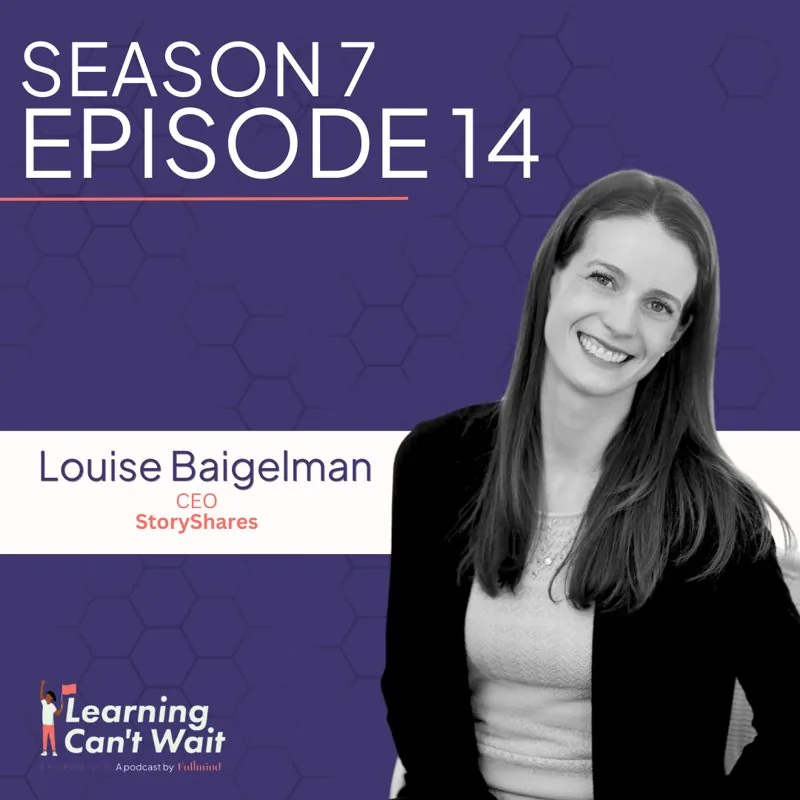
Louise Baigelman: Storyshares, Literacy Engagement, Struggling Readers, High-Interest Books
- Louise Baigelman
 Hosted by Hayley Spira-Bauer, Chief Academic Officer at Fullmind
Listen now
Louise Baigelman: Storyshares, Literacy Engagement, Struggling Readers, High-Interest Books
Episode summary
Louise Baigelman, founder and CEO of Story Shares, explains why she built a library of accessible, relevant books for older students who passed third grade without becoming proficient readers. Early-grade reading strategies still work for teens, she argues, if paired with the social-emotional realities of adolescence. She describes new decodable chapter books that look like YA novels, a pilot with coaching that produced strong efficacy results, stories of students finishing their first book and writing sequels, and a development process driven by pilot classrooms and teacher feedback.
Key takeaways
- Many students pass third grade without reading proficiency, yet literacy instruction stops
- Core early-grade reading practices apply to teens when married to adolescent social-emotional needs
- Decodable chapter books with photographs and YA-style design avoid the stigma of babyish texts
- Efficacy research matters in a post-ESSER market and also surfaces negative feedback to improve on
- Find each student's spark, whether cooking or skateboards, as the hook into reading
About this episode
In this episode of Learning Can’t Wait, host Hayley Spira-Bauer sits down with Louise Baigelman, Founder and CEO of Storyshares, to explore how educators can engage struggling readers through high-interest, age-appropriate content. Louise shares how Story Shares collaborates with teachers at every stage of content development, using direct classroom feedback to refine their literacy resources. She highlights the importance of choice in reading engagement and offers valuable advice for new reading teachers—encouraging them to find each student’s unique spark to foster a love of reading. Tune in to learn how adaptive literacy tools are making a difference for students and educators alike!
Episode notes
Reading is a gateway to opportunity, yet millions of students struggle with literacy due to a lack of engaging, accessible materials. In a recent episode of the Learning Can’t Wait podcast, Louise Baigelman, CEO of Storyshares, joined host Hayley Spira-Bauer to discuss how her organization is revolutionizing literacy education by working directly with teachers to create high-interest books that help struggling readers succeed.
If your school or district is struggling to close literacy gaps or needs access to certified educators for supplemental reading intervention, Fullmind can help. We provide virtual, state-certified teachers trained in evidence-based literacy strategies—ready to support students at every reading level and help your school unlock better outcomes. Learn more about how Fullmind can support your literacy goals.
In education, there exists a significant gap that has persisted for decades: older students who didn't master reading in early elementary grades often continue to struggle throughout their academic careers, with few resources designed specifically for their needs. This challenge has remained largely unaddressed until Story Shares entered the market with an innovative solution.
"Traditionally we teach students how to read in kindergarten through third grade, and we expect that by third grade they've learned how to read and they then can use reading to learn new things," explains Louise Baigelman, founder and CEO of Story Shares, on the Learning Can't Wait podcast. "But the reality is today for many reasons, a huge number of students get past that third grade point without yet being strong readers. But literacy instruction has stopped."
Baigelman's insight into this problem came firsthand during her time as a fifth-grade teacher working with multilingual learners and students reading 3-5 grade levels below expectations. The challenge was clear: how do you help older students practice reading when the only accessible materials are written for much younger children?
The Innovation: Age-Appropriate Decodable Texts
Story Shares' approach represents a significant departure from traditional literacy resources. The company has developed decodable chapter books specifically designed for adolescent readers who are still building foundational skills. These materials maintain the dignity of older students while incorporating the structured literacy approaches proven effective for building reading proficiency.
"I had a couple of conversations in a row where people said it would be impossible to make a decodable book that was engaging for a teenager," Baigelman recalls. "I couldn't get that out of my head. I was like, it doesn't feel impossible."
The solution was surprisingly straightforward but required rethinking traditional formats:
- Creating anthologized decodable texts that function as chapters in a book that resembles a young adult novel
- Using photographs of middle schoolers rather than cartoon illustrations
- Designing books in formats that mirror what peers are reading
This approach tackles both the technical aspects of reading instruction and the critical social-emotional components that affect adolescent learners. As Baigelman explains, "So many of, if not most of the core practices and strategies that go into teaching reading in the early grades in first grade, second grade are applicable to teaching reading in middle school or high school, but you have to marry them with the social emotional components that are present when it's a teenager learning to read."
Market Validation and Growth Strategy
Since its founding in 2013, Story Shares has received significant recognition, including awards from the Library of Congress, Teach for America, and Forbes 30 Under 30. More importantly, the company has demonstrated real-world impact in classrooms.
"Students who had never finished a whole book and who just avoided reading... when they had Story Shares book choices as part of that independent reading time, they not only finished their first ever whole book, but they actually would nudge their peers and say, 'you need to read this,'" Baigelman shares.
The company's growth strategy follows three key pillars:
1. Continuous Product Development
Story Shares has developed six decodable chapter book series and plans to expand with knowledge-building decodable texts that incorporate subject-area content like climate change and American history.
2. Research-Based Validation
In the post-ESSER funding era, schools are increasingly selective about educational technology investments. Recognizing this shift, Story Shares has prioritized efficacy studies to validate their approach.
"There's a valuable emphasis on using research-based approaches and products and strategies and not wanting to take on new things if we're not sure they actually work towards the impact that we're going for," Baigelman notes.
3. User-Centered Design Process
Critical to Story Shares' success is its collaborative approach with educators. As Baigelman explains, "Our teacher community is really a big part of forming the ways that we develop content." The company regularly conducts classroom pilots and integrates teacher feedback into product iterations, allowing for responsive development that meets real classroom needs.
The Leadership Lesson: Finding Opportunity in Overlooked Problems
Story Shares' success demonstrates how innovation often emerges from identifying overlooked gaps in established systems. By questioning the assumption that literacy instruction should end after third grade, Baigelman created an entirely new product category that serves a significant unmet need.
This approach aligns with classic disruptive innovation theory, where new entrants address underserved segments of the market with solutions that established players have overlooked. By focusing specifically on older struggling readers with age-appropriate materials, Story Shares has carved out a unique position in the educational materials market.
Looking Forward: The Power of Interest-Driven Learning
As literacy education continues to evolve, Story Shares' emphasis on student engagement and interest may prove especially prescient. Baigelman's advice to new reading teachers speaks to this approach: "Find that spark for the student, whatever it may be. What are they interested in? What do they love? What brings them alive? And use that as your hook and your entry point to getting that student to love reading."
This insight—that literacy is built through engagement with personally meaningful content—could reshape how we approach reading instruction for students of all ages. As schools increasingly prioritize personalized learning, Story Shares' model of providing diverse, accessible, and engaging content may well represent the future of literacy education.
Full transcript
Transcript generated from the recording; minor errors may remain.
Hayley Spira-Bauer: Welcome back everybody to the Learning Can't Wait podcast. We have an incredible guest on today to share her story, which I am using as a punny start to the conversation because we have Louise Baigelman, the founder, and CEO of Story Shares. Louise, welcome. Thank you. It's so great to be here. I'm so eager for you to talk about what you created in 2013 and why you created it and why you didn't do it sooner so that I could have used it as a teacher, but I am excited it exists. Now. Let's kick it off by starting with our first question. How did you come to be the personal and professional version of
Louise Baigelman: Yourself? Yeah, so I think where I am now has been formed by so many experiences and people and books along the way. For me as a kid, I loved reading and writing and I think those both a huge impact on both my experience with different contexts and perspectives and lenses and stories, and also just feeling connected to the power of books. And then when I was a teacher, my students I think really had a huge impact on forming me into the person I am and also in starting Story Shares as a way to address the needs that I saw among them and that I felt needed solution and that there was one possible if we could figure it out.
Hayley Spira-Bauer: That's incredible. I know that your time in the classroom seems really impactful on what you've built. Tell us about Story Shares, why it's known as an approach to diverse and accessible libraries. Was the title from the EdTech Insiders podcast you did tell? Why did they name it that and what are you building or what have you built, I should say?
Louise Baigelman: Yeah, so Story Shares is focused on supporting adolescent literacy, providing pathways for older students who have not yet become proficient readers to learn to read, to be able to read well, and to learn to love to read. And that requires books that are both accessible and representative and relevant and engaging. And what's interesting about literacy instruction is that typically, traditionally we teach students how to read in kindergarten through third grade, and we expect that by third grade they've learned how to read and they then can use reading to learn new things and to access the in every other class and subject. But the reality is today for many reasons, a huge number of students get past that third grade point without yet being strong readers. ([03:15](https://www.google.com/url?sa=E&q=https%3A%2F%2Fwww.rev.com%2Ftranscript-editor%2Fshared%2Fl9Db5ub9Gc9eakbM07YusYyh9NZfcUUO1uIQwQs_jKNe4goOicMsTOgwYMXO8OOrsrmZ_44p3Qd-GDL_Otly5M78jeY%3FloadFrom%3DDocumentDeeplink%26ts%3D195.85)): But literacy instruction has stopped. And so for me as a fifth grade teacher, I was working with multilingual learners and students who were 3, 4, 5 grade levels behind in reading, and I knew that I couldn't get them to improve their skills to practice reading, to reading if I had to offer them the books that were written for first second graders. So that is what inspired Story Shares iswe have to be able to make a book that supports older students who are still learning to read without making them feel baby-ish and stigmatized.And so we set out to do that.
Hayley Spira-Bauer: Louise, I know you know this because I just told you, but you and I have the same exact story about teaching fifth grade reading, and I shared this recently on LinkedIn that when I was hired to teach that fifth grade reading class, the hiring, the person who hired me, Dr. Sam Bragman, said to me, your job is to get kids to fall in love with reading. Because once you get kids to fall in love with reading, everything else happens. Exactly. I love that.
Louise Baigelman: And
Hayley Spira-Bauer: You recently in a parents.com article said that reading for pleasure will always be relevant, and it speaks so much to my own philosophy about teaching kids to read and also creating lifelong love of reading. So I really connect with that, and I just wish you had created this tool when I was teaching fifth grade reading. Do you hear that a lot?
Louise Baigelman: Yeah. Well, it is amazing the number of teachers out there who are in classrooms, whether it's fifth grade, eighth grade, 11th grade, and have been doing so many things to try and fill the gaps to get their students to where they need to be and who say, I wish I could find books earlier that were made for my students and gave them choices that they could use to scaffold up their skills and to transform their relationship with reading and their experiences with reading.
[05:00] **Hayley Spira-Bauer:** I love that. And I think that it really speaks to this approach to personalized learning of making sure that you're not just meeting the academic needs of kids, but to me, Story Shares really fills the social and emotional piece as well. You wouldn't give a kid who broke their leg and needed a cast pair of glasses, so you have to approach teaching in the way that we approach kids and their individual interests and needs with the same care and attention that we do to so many other things.
Louise Baigelman: Yeah, exactly. And I often talk about some of the reason that we haven't more broadly started solving this literacy challenge for grades three and up is because it takes just a little shift in perspective, but I always say that so many of, if not most of the core practices and strategies that go into teaching reading in the early grades in first grade, second grade are applicable to teaching reading in middle school or high school, but you have to marry them with the social emotional components that are present when it's a teenager learning to read and all of the different associations they've already developed with reading and the things they love and care about and are inherently interested in. You have to bring those into play and marry those with the best practices in literacy instruction, and then you actually can address it comprehensively.
Hayley Spira-Bauer: Just to brag on you for a second, this is like a tool that's been around for over a decade. It has. You and the tool itself have won multiple awards. You were named Forbes 30 under 30, the International Library Association, 30 under 30. You've received awards from the Library of Congress, Teach For America, Milken, and Penn GSE Reimagine Education for your work with Story Shares. So first of all, congratulations. These accolades are not as important as the impact. I'm sure that teachers feel having your tools and having Story Shares in their hands, in their tool belt, but are still huge testament to the importance of what you're building and what you've built.
Louise Baigelman: Thank you.
Hayley Spira-Bauer: What I would ask you next is what's next? What are you focused on right now to help bring Story Shares to the next level in impacting students and teachers?
Louise Baigelman: Yeah, we have big plans for the next phase and for next year. 2024 was a really exciting year for us as far as growth and impact. We developed these decodable chapter books for older students where we played with the concept of decodable books and structured literacy for those students still building their foundational skills and knew that there are huge gap as the science of reading has been sweeping through classrooms. And it actually started because I had a couple of conversations in a row where people said it would be impossible to make a decodable book that was engaging for a teenager. And so you're
Hayley Spira-Bauer: Like, I'll take
Louise Baigelman: That
Hayley Spira-Bauer: Challenge.
Louise Baigelman: Yeah, I couldn't get that out of my head. I was like, it doesn't feel like it's challenging, but it doesn't feel impossible. And so we batted around all these ideas and came up with the decodable chapter book where we essentially anthologized these little decodable texts and made each one a chapter in a book that looks like a YA novel. And then we just used pretty simple concepts around, not cartoon line drawings, but photographs of middle schoolers and making the book not a little bitty square, but something that feels like the books their peers are reading. And those have been really amazing for us. So we've developed six decodable chapter book series this year and next year we have big plans to develop many more, including some knowledge building decodable texts that help provide practice and background knowledge and vocabulary across the different subject areas. So climate change, decodables or American history, because that's another big need we've heard. ([10:17](https://www.google.com/url?sa=E&q=https%3A%2F%2Fwww.rev.com%2Ftranscript-editor%2Fshared%2FAcqSTLSZLpxaOVpTctOo4vudaNbEifTKyAM2Nf6Zid8lhnQdLdz9SKNmG_tWV62Y9_uPCgnUWiPOmEarRUKMb4L0tSc%3FloadFrom%3DDocumentDeeplink%26ts%3D617.64)): And then we had our first efficacy results where we did a pilot and were able to provide not just the books, but surrounding resources for educators, teacher coaching and training and some lesson plans, so a more comprehensive intervention program, and we were blown away by the results from that. So we're really going to take that to the next level next year to get a larger study that really proves out the effectiveness of this approach. And then we are trying to grow our reach. Just make sure that the teachers and students who need these resources know that we exist and are able to find them.
[10:00] **Hayley Spira-Bauer:** Okay. This is a lot. So we're talking, you're tackling the country's most media friendly topic, which is decodable text, phonetics, phonemics, and phonics learning for older kids, which the Sold a Story podcast did a deep dive on. We're seeing some parents in Massachusetts suing the original creator of the curriculum that Sold a Story was about, and you are like, you know what? I'm going to create a tool that tackles this known needed problem, which is older kids who did not learn to read in K three, which is what you said, which is amazing, first of all. That is so cool. I am dying to see a copy of one of these books actually.
Louise Baigelman: Yeah, I'll send you.
Hayley Spira-Bauer: And then you kind of segue quickly into this efficacy study. Something important that I think as it relates to both the Sold a Story podcast, which is that research tells us the curriculum that most American schools were using did not effectively address all learners to teach them to read. So you diving into an Efficacy study I think is important one, to validate what you're doing today, but also two to hit this post ESSER fund period that we're in right now where the only thing schools are buying are things that either have a ton of stickiness in their community or are proven to work. So as a fellow, almost like vendor in this space, I understand why an efficacy study would be important.
Louise Baigelman: Yeah, exactly. There's a valuable emphasis on using research-based approaches and products and strategies and not wanting to take on new things if we're not sure they actually work towards the impact that we're going for, and so we want to make sure that we are able to prove that out, but also be able to gather data that can help inform the next things we do and how to build it to really meet the needs of the students and teachers we are trying to serve.
Hayley Spira-Bauer: I feel so silly sometimes because, not silly, but selfish, because when I talk about how badly I want research for every implementation, at Fullmind, I always admit like, Hey, I'm also being selfish. Like, yes, I want to know how your kids are doing. I want to tweak the implementation, but I also just want to know what's working and what's not holistically so that we could be better for the partners. We have all the partners, not just you, but everybody, and I'm glad you called that out because sometimes I feel like, does the school want to hear how selfish I am? I mean, it's ultimately selfless, but it feels selfish to be like, but I need this data too.
Louise Baigelman: Right. No. Yeah. I think it is. It's part of being a learner too, right? You don't just want to do a research study for validation. I mean, of course that's an important part, but also with the learner mindset, it is how do I understand the areas for growth andI want negative feedback if it's out there so that I can address it.
Hayley Spira-Bauer: Yeah. Yeah. I imagine you have some really good stories from students who have used Story Shares. Are there any that you can think of to share with the audience here that feel particularly impactful?
[15:00] **Louise Baigelman:** Yeah, so we do hear amazing stories from teachers and classrooms. One of the things we hear often is that students who had never finished a whole book and who just avoided reading, so in an independent reading period, for example, was doing anything they could to not actually sit down and read for obvious reasons, because they didn't want to have to pick up the fluffy bunny and read that in eighth grade that those students, when they had Story Shares book choices as part of that independent reading time. They not only finished their first ever whole book, but they actually would nudge their peers and say, you need to read this, and they would go back to their teacher and say, can I have another one like that? So those are always really inspiring. It shows the actual transformation, not just in, I finished a book, but now I want to read another one. And then, yeah. One of the other stories that I love is a student who even one step further finished a book that had sort of a cliffhanger ending and was so desperate to find out what happened that he wrote his own sequel to the book. So that was even more all the way around that cycle of literacy from a striving reader to becoming actually a writer.
Hayley Spira-Bauer: Oh, I could picture this so clearly in my head, I'm thinking of a few students who are now 25, by the way and have their own kids, but I talked to you regularly who would've really loved that and had those texts. I remember, I'll never forget, there was this graphic novel called Babymouse. It's still in libraries. It has a pink cover, but it was one of the only graphic novels with simplistic texts that I was handing students because of their reading level and the frustration. All they wanted to do was read Diary of a Wimpy Kid like the kids who could access Diary of a Wimpy Kid in fifth grade, but they couldn't. Diary of a Wimpy Kid is not a straight graphic novel. It has embedded paragraph between the pictures. Yeah, I love that. I love that, Louise. Those are really powerful anecdotes that speak to not beyond the research, but the testament of creating that lifelong learner. Getting kids to fall in love with reading. Reading unlocks so much for so many, and to have the ability to choose what to read is a powerful choice.
Louise Baigelman: Absolutely. Yeah. Choice for engagement, even alone, right? Opens a lot of doors for students. Absolutely.
Hayley Spira-Bauer: Louise, I imagine you encounter teachers who are rabid consumers of Story Shares that are just trying to get their hands on it. You yourself have an education background. Are you working with the teachers as you develop the product to ensure that it is fitting appropriately into their libraries? Tell me what part the teachers play in your product development.
Louise Baigelman: That's a great question. It's one of the key pieces for me is, and for my team is always keeping really closely in touch with teachers at every stage of development. It informs really how we make new content and also what we add to the suite of resources we have, because I, at every level as we gather feedback, so we pilot things from a new book series. When we first did our first decodable book series, we brought on about a dozen pilot classrooms where we wanted their very specific feedback on the books and what worked and didn't, and we got some great insights that completely informed the development of the second series. And so we try to take a very adaptive approach to the way that we make new content. I think it's one of the key ways that we've been able to grow, because we're not just saying, well, we know what everyone needs and we can make it perfectly. We're trying to acknowledge the importance of the shifting landscape, the variety of perspectives, and always get that feedback at every step so that we don't just end up kind of putting on blinders and making the thing we think we should make. So yeah, our teacher community is really a big part of forming the ways that we develop content.
[20:00] **Hayley Spira-Bauer:** My final question for you is just about those exact teachers is what advice would you give a teacher, maybe a reading teacher starting their career today?
Louise Baigelman: Yeah, so I think that one of the things I would say for a reading teacher, and especially I'll say even a secondary reading teacher, is
Hayley Spira-Bauer: Do it.
Louise Baigelman: Find that spark for the student, whatever it may be.What are they interested in? What do they love? What brings them alive? And use that as your hook and your entry point to getting that student to love reading and to practice and to improve, because it could be anything. It could be the student loves cooking or skateboards, or they want to chat with you about their friends, whatever it is. I think that that connection point is really what opened so many doors and helps to get over those barriers that come in from a skill perspective. So that would be my
Hayley Spira-Bauer: Amazing Louise, it is such a pleasure to meet you. I have loved learning more about Story Shares, and you can tell I'm a huge fan of what you're building and what you've already built. Thank you so much for coming on the podcast and sharing with the Learning. Can't Wait. Audience,
Louise Baigelman: Thank you so much
Hayley Spira-Bauer: For having me. It was such a pleasure having you on and learning about Story Shares, and thank you to everybody who tuned in today.