
Learning Can’t Wait · Episode 199
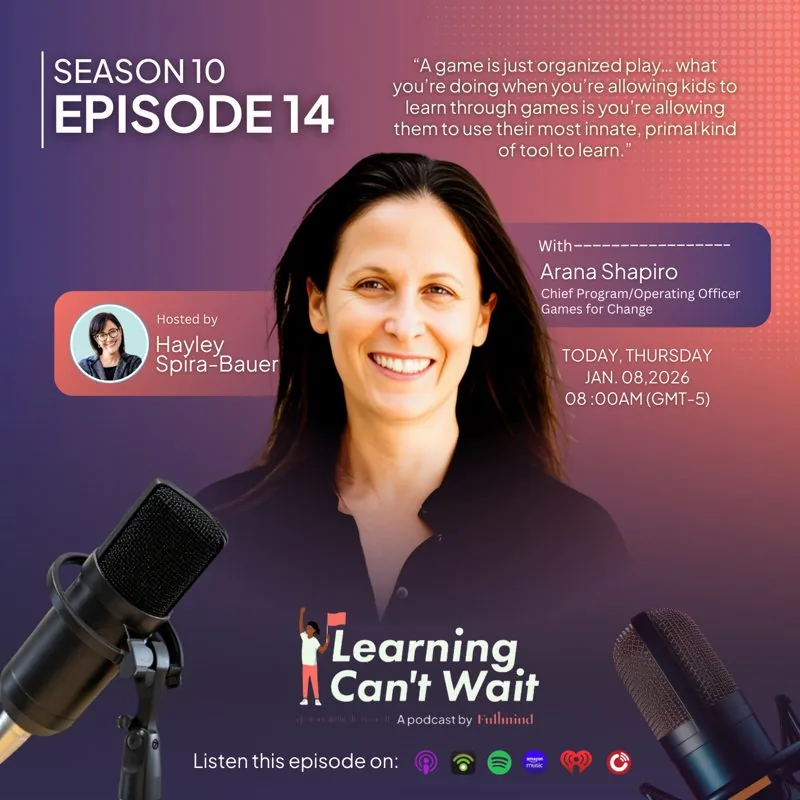
Arana Shapiro: Game-based learning, Purposeful integration & Student agency
- Arana Shapiro, Technology for deeper engagement and social impact.
 Hosted by Hayley Spira-Bauer, Chief Academic Officer at Fullmind
Listen now
Arana Shapiro: Game-based learning, Purposeful integration & Student agency
Episode summary
Arana Shapiro, Chief Program and Operating Officer at Games for Change, explains how a non-gamer teacher came to see games as a tool that reshapes learning. She describes her ideal classroom as controlled chaos with students moving with purpose, recommends Minecraft as the best open-ended starting point, and argues for purposeful technology integration where games are treated like any other classroom media, with discussion before and after. She outlines Games for Change's free Student Challenge, Game Plan teacher PD, and Raising Good Gamers for parents, and explains why play is the most fundamental way humans learn.
Key takeaways
- Games are organized play, and play is the most fundamental way humans learn
- Treat a game like a movie or book: discuss why you're playing it and what it means afterward
- Minecraft's open-ended world beats narrow learning games for choice, collaboration, and problem solving
- Headlines should shift from fear of screens to investing in teachers' ability to integrate technology
- The free Games for Change Student Challenge has had students design social-impact games for 11 years
About this episode
The episode explores how games can transform learning when they are used intentionally, highlighting Games for Change’s work to help students and educators harness play, game design, and technology for deeper engagement and social impact. Arana Shapiro shares how she moved from being “not a games person” to seeing games and organized play as powerful tools for student-centered classrooms, purposeful technology integration, and empowering young people as changemakers through programs like the Games for Change Student Challenge and Game Plan.
Full transcript
Transcript generated from the recording; minor errors may remain.
Hayley Spira-Bauer: Welcome back, everybody, to the Learning Can't Wait podcast. You know, there's nothing better than thinking about games and how games can transform schools, students, their excitement and motivation to be there, and how games really influence education today. And I have an incredible guest here to talk about that very topic. We have Arana Shapiro, the Chief Program and Operating Officer at Games for Change. Welcome, Arana, how are you?
Arana Shapiro: I'm good, I'm happy to be here, thanks for having me.
Hayley Spira-Bauer: You and I are both a bit under the weather, so if you're listening to us for the first time, this is not what we usually sound like, but the content will be as excellent as always.
Arana Shapiro: 100%, absolutely.
Hayley Spira-Bauer: Why don't you tell everybody who's listening, how did you come to be the personal and professional version of yourself, Arana?
Arana Shapiro: Yeah, you know, I, it's funny enough, I'm not a games person. I didn't grow up a games person. Like, I didn't play a lot of games, I didn't… I wasn't into video games or anything like that, but I have been always into teaching, and, really, like, loved working with kids, and I loved working… thinking about how you could explain something in different ways and help people understand things. Like, that's been a constant through my life. And, and… when I started to… to think about how you engage young kids, because I worked with young kids at the beginning, I really started to think about how you could… how they played, and how they… how they interacted with each other, and how, that kind of play brought about new learning, and I started to experiment with it in my classroom. Like, I started to just think about, well, what if we tried this in a more playful way, or what if we… what if we played… you know, like, a game that was already a commercial game, but I changed some of the rules so that it had some content in it, and I just started to think about those kinds of things. And it really transformed the way that I thought about learning, and it really sort of brought me to a new place where I was… where I really thought about games as a tool for learning, and how you could use games, game design, to reshape the way that, that kids were learning things, and it really changed my whole practice and my whole career. Hope you're on mute. You're on mute.
Hayley Spira-Bauer: Thank you. If you think about an ideal Learning environment. What does it look, sound, and feel like, Arana?
Arana Shapiro: That's such a good question. To me, the ideal learning environment is sort of loud. I always think about, like, this kind of controlled chaos that we kind of strive for as teachers that's really hard to get, right? Like, I think that sometimes, you know, if you walk into a classroom that looks a little bit chaotic, but controlled, if you're not trained in education, you may be a little thrown by it, but… and… or you may think, like, oh, that teacher's not really working that hard, but it' It's so hard, right, to get that kind of controlled chaos. So I think it's a little loud, it's a little bit exciting. I would… I always look for kids Moving, on their own through the classroom with purpose. Collaborating with each other, sharing ideas, making mistakes, and the teacher really kind of almost hard to find in the classroom. Like, I like this idea of, like, a teacher there when you're needed, but not hovering over kids, and really allowing Students to explore and, find things out for themselves, and then learning that really important skill of knowing when they need help, and going to a teacher, or going to a book, or going to a computer, and finding the help that they need. So that it's really… I mean, I'm a very, kind of student-centered educator, as you can probably tell, and really allowing kids to… to be in control of the classroom, Or at least feel that they have ownership over their learning and the classroom that they're in. You're on mute again.
Hayley Spira-Bauer: Sorry, do you have a short list of games you recommend to friends who are asking for high-quality games for their kiddos or for their classrooms, if they're teachers?
Arana Shapiro: So, it's a really short list. Whenever anyone asks me… so, I have a group of educator friends that ask for that kind of thing, and then I have a… I'm a mom, I have two kids, and so I have a group of, you know, mom friends or parent friends that are asking for those same things. And really, it's the same thing. I generally tell people that if they're looking for a place to start with games in the classroom or at home, to look at Minecraft. To me, Minecraft is a perfect example of a game that does all of those things that I just said a perfect classroom would do in the game space. It's open-ended, kids are able to play things that have already been designed, but they also are able to create their own worlds, and and in the creation of their own worlds, they have to make choices, they have to solve problems, they have to collaborate, they have to think critically, so I think And… but they're playing a game, so they feel it's fun, and they feel like they're, they're… they're playing a game, which is always a driver motivator for young kids, and so I always tell people that if they're looking for the best in class, Minecraft is probably the place to start. The problem with, like. Games… I mean, games are great, but the problem with learning games, or games that kids may play to learn any specific topic, is that they're very narrow, right? They've been designed to teach this one thing, and so I always think, like, if you're looking for something that you know, is… you get more bang for your buck, basically. It's like, you go to these sort of open-world, kind of, Minecraft Spaces where you can… you can decide what the learning's gonna be, basically. Rather than someone deciding it for you.
[05:00] **Hayley Spira-Bauer:** Okay, so we have Minecraft as the number one recommendation. I love that. It's actually funny, one of my colleagues in this space just posted something about what game, so now I have a perfect recommendation from the source themselves. And I think a little bit about schools and how they integrate gameplay into their teaching and learning. When you are watching this rapid development of technology, I'm, you know, at a greater pace than we've probably seen in our lifetimes. How do you… desire for school leaders to think about integrating game… games into their school day.
Arana Shapiro: So… I get… this is a question that I get a lot, and, you know, and being in the games and learning space, I think there's a… there's a… a… sort of preconception that I'm gonna say, like, kids should be playing games all the time, and there should be games everywhere, and technology should be everywhere, and, you know… and I actually don't believe that. I really have a strong belief in the purposeful integration of technology into any classroom, so any piece of technology, whether you're talking about… and I've been… I mean, I'll… I've been teaching for a long… I've been in the education space for a long time, so, like, I remember when it was, like, people were having all these these conversations about one-to-one laptops, or they're having conversations about smart boards, they're having, you know, so it's been all… it's, you know, and the conversation is the same. It's like this… it's a… it's a little bit of a panic and a little bit of a curiosity about how we're gonna bring these things in, and games are the same. I believe, again, in the purposeful integration of technology. So, at any point that you're using any of these technologies in the classroom, there should be a real clear reason how it is the best tool As opposed to any other tool that you might use, right? So why do we use a computer instead of a book? There has to be a good reason for that. Why do we… you know, any of those kinds of things. Like, a really clear, purposeful use. For games, I think about games as a piece of media, right? So, for a very long time, teachers have been bringing media into the classroom. A book was a piece of media, a movie is a piece of media, you know, like, whatever it may be. And, if you're gonna bring games into the classroom in any way, shape, or form, you need to treat it like that. It can't just be like you plop… so what you see a lot of times is teachers say, okay, now we're gonna play a game, and so the kids open up a computer, and they play the game that's, you know, about whatever they're learning, and then they close it, and they go. And you would never do that with a movie. You would never, like, show a movie and not have a discussion afterwards, or have a conversation before about how it has to do with the curriculum.teachers need to learn how to treat games as a piece of media in their classroom, so there has to be a conversation about why we're playing this game, and what we're going to learn from it. And then afterwards, there needs to be a conversation about helping students make sense of what they just experienced, and how it integrates into the learning that has happened. So again, like, if I was gonna see games being used in classrooms in the most ideal setting, it would be really thoughtful, really purposefully, and And with a lot of intention.
Hayley Spira-Bauer: So, there's a lot of media attention right now on how computers aid our kids' education. I believe that was almost an identical headline to something that appeared a couple weeks ago, and subsequently, there have been numerous outlets posting pieces about computers and screens eating our kids' education. And you've provided here a perfect antidote for intentional integration of screens, technology, games, we'll call all of it one category of tech. Into a classroom. If you were gonna write the headlines yourself, what would you… what would you say if you were gonna write the piece as rebuttal to the current, diatribe?
Arana Shapiro: I think, I mean, I think for me, the headline would be, we're investing in teaching educators how to purposefully integrate technology into the classroom. We're investing in how to help educators understand what's happening in the, in the, you know, in the world of educational technology. For… and… because I think that there's, you know. With all of the technology that's coming into classrooms. Whether it's games, whether it's computers, whether it's AI, there's… there's always… teachers are always absent from the conversation. They're always… teacher education is always missing, right? And I think that, you know, teachers are really smart and creative, and they are doing a job that is really hard, and quite frankly, doesn't earn… you don't earn a lot of, you know, money or glamour or anything. So you have to be really invested in it, and if you're really invested in something, that generally means you want to learn about it. And for some reason, we don't… give teachers the kinds of continuing education and learning opportunities that a lot of other professions have. And I think that, for me, the headlines would shift from the fear of kids being around technology to the investment in helping the adults in their life understand how to use it, and help them navigate it. And that doesn't mean, I just wanna, like… that doesn't mean that I… shutting it down, right? Like, I'm actually a big proponent for keeping things open and, and having kids experience technology. But if the teachers are prepared, and the adults are prepared, then when they come across things that are scary, or things that are questionable, or things that… they have people around them that can help them navigate that, and then they learn how to navigate it in the world when they're on their own. But… But the way that we're doing it now is we're kind of saying, like, this is scary, we shouldn't have kids doing it, they shouldn't be able to experience it, and let's just shut it down so teachers don't have to deal with it. And then when we do that, we don't give… we don't help… the kids have no tools, right? Because they're gonna… they're gonna encounter it one way or another eventually.
[10:00] **Hayley Spira-Bauer:** Best to equip them and prepare them.
Arana Shapiro: Exactly, exactly. So… So yeah, so the headlines for me would shift away from the scariness and into, like, the solution, and really the teacher… putting some… giving the teacher some advocacy and tools.
Hayley Spira-Bauer: Talk to me a little bit about what your work is like at Games for Change. What is, like, the mission of this organization? How are you impacting the space, or hoping to impact the space?
Arana Shapiro: Yeah. So Games for Change is a non-profit, we're based in New York City, and the, the, the, it… it's… the mission of the organization goes beyond work… in education. The mission of the organization is really to help, understand how games and immersive media can drive impact. Beyond entertainment. So, you know, you can think… the best analogy is, like, you know, we think about movies, and then there's documentaries, right? And how documentaries are meant to teach and to help drive impact. I mean, movies do that too, but, you know, like. It's the same thing, right? That we're thinking about how can games be used as a tool to drive impact in the world, not just a tool to entertain. Or, they could do both at the same time, but right, can they be used as a tool? Within the Games for Change kind of universe, and again, we do a lot of things, we have a department, for lack of a better word, called, Games for Change Learn, G4C Learn. And that… that department works solely on all of our, teacher and student-facing, programs, and we have a bunch of them. We have a… our flagship program is called the Games for Change Student Challenge, which is a… game design challenge and competition, where kids are, challenged to design games around social impact themes, so the themes change every year, but kids learn about the themes, either in their classrooms or at home. We have curriculum, we have tools, we have tools for teachers, but we also have tools for parents who just, like, see that their kids really love games and want to, like, help them get do something with that love. And they learn about themes, they then learn about… and they learn about game design, and then they design a game. And they submit it to the Student Challenge, and that game gets judged by a panel of expert judges, and then we have an awards ceremony, and kids win prizes, and then it starts all over again in the following year with different social impact themes. And that's been going on for 11 years, it's completely free, and and the goal of that program is just to help kids, really become, change makers, right? Like, they're… like, they're… they're… they're… and feel like they have… they're empowered to make change in the world. So it's… it's less about… I mean, it's about the game design, but that's really a vehicle For understanding problems that may exist, and feeling like you have some advocacy, and, you know, and to either be able to teach about the problem or propose solutions about the problem, all through a game. Along the way, kids are picking up these kinds of future-ready skills, or they were formerly 21st century skills, like. Critical thinking, problem solving, systems thinking, collaboration, communication, right? Because they work… they work in teams to create these games, and you have to, in order to design anything, if you move through the design process, you have to… You know, think critically, iterate, problem solve, all of those things. So that's our… that's our main student-facing program, and then we also have an educator-facing program called Game Plan, which is a, professional development program. It's a deep dive into professional… into all things… things games and learning. Teachers will learn… come away with a, kind of a… more tools for their toolbox about how to integrate games into their classroom, but also how to design experiences that feel game-like, so they don't have to be actual games, but how to, like, how to create curriculum that… that… takes the best of how game… that thinks about how games engage students, and then, you can design curriculum that does that same thing, right? So big challenges that, you know, and then you're, like, kind of leveling up as you move through different smaller challenges to then… solve some big problem, which is basically how games roll out. And so those are our two main programs that we have, and again, like, you can see that really it's about helping educators and kids leverage games to think about how they might be used beyond just The playing of games, which is super fun and exciting, but, you know, like, if you've got this platform, maybe we can use it for more.
[15:00] **Hayley Spira-Bauer:** And why games? Like, I know, personally, there's a body of research that tells us how the integration of game in a student's learning experience improves outcomes, but can you tell it for the audience that's not as familiar as me?
Arana Shapiro: Absolutely, yeah, so there is a body of research, you know, but the question of why games, to me, is… goes back to what… how I started the conversation. You know, if you look at how… kids learn. Young, young kids, like, even babies, they play. Like,play is the most fundamental way that people learn.They… like, if you… if you watch a baby. They're… you know, and you… or even, if you have a baby and you put, like, a mobile over their crib, right? Or, like, something that they can play with. Like, you see that they're interacting, they're playing, they're seeing what something can do. They're shaking things, they're hitting things together, and then when they start to interact with each other. Babies, little kids, they're doing the same thing. The way that people, human beings, make sense of the world is through play, whether we think about it as play or not. That's how we make sense of things. We understand their affordances by playing with them, and then we understand what value things have. Or things being actual physical things, or other people, or situations, that play is the most fundamental way that we learn. And so, what games do… the difference between play and a game is that games… games just organize play, right? Like.A game is just organized play.It puts a set of, structures in place that take the play and make it into a game. So, for example, you could… you have rules when you're playing a game, you have, a goal that you're trying to reach, you have… there's a challenge, right? There's things that you have to do, which we call, core mechanics, but That's all that a game really is, it's just organized play. And so. What you're doing when you're allowing kids to learn through games is you're allowing them to… to use their… the most, kind of, innate Primal kind of tool that they have. To learn. So it sticks, right? Like, none of us forget how to walk, right? We learned it through playing, we learned it through trying, we learned it by pulling ourself up, and taking a few steps, and falling down, and then getting back up, right? It's about the deep, deep Engagement and understanding that's built, because you're allowing kids this opportunity not to just be told something, not to just write about something, but to actually interact with it, and play with it, and understand it at a much deeper level.
Hayley Spira-Bauer: I love it. And I think a lot about how this shows up in our everyday lives. I know you named not everybody thinks of certain interactions or certain experiences as game, but it really… they really are games. I think of… Everything related to business and working as a game, to be honest with you. I could really…
Arana Shapiro: Absolutely! It's all made up, right?
Hayley Spira-Bauer: Yeah, yeah.
Arana Shapiro: I'll just stretch yourself.
Hayley Spira-Bauer: Our decision-making process is a logic game, like, there's so much about this world that can be defined as a game.
Arana Shapiro: Absolutely. Yeah.
Hayley Spira-Bauer: How does Games for Change… I mean, it has a pretty large community. How do you leverage that community, and what does that, like, how does that community inform some of the actions or programs that you iterate.
Arana Shapiro: That's a great question. So, we have… we do have a large community, because, like I said, the organization is bigger than the work that we do in education, and so we have, you know, in our community is really… there are educators. And, but… and students, but there's also policy makers, and game designers, and, you know, academics, and nonprofit leaders, and all these different people who are thinking about games, and they're all thinking about them in different ways. We bring everyone together. In our community, once a year with… we have a festival in New York City called the Games for Change Festival, where everybody comes together. It's coming up in July, it's in the summer. And and… At that festival, what's really interesting is to see all of these different, stakeholders interact in different ways. And, you know, there are small ways that we do it, and there are big ways that we do it. Like, for example, since we have this in our community, all these game developers, we will have, you know, as part of the student challenge for edu… for students, rather, we have, you know, workshops led by people who work at Unity, or people who work at Minecraft, right? And they're talking to kids about different parts of the game design process, or they're talking to them about. Different career pathways, if we're working with older kids, in-game design, or we're talking to them about, you know, storytelling. Like, all these different kinds of things that have to happen when you're creating a game. So we'll leverage that, community and bring them into education programs. At the same time, you know, we work with, We'll… we'll work with game developers if they need help. Developing a game that's for learning will bring educators to them to help them understand, like, what educators are thinking about, or how to really think deeply about a learning goal, you know, and what does it really mean, and what are the things that kids are really doing, that would demonstrate that they actually have learned. And all of these things are… they're really, like, it's very symbiotic, right? Like, you can't really… create a learning game without understanding that. You can't really, you know, like, there can't be… learning can't happen in a game without the engagement and the play. So, those kinds of things we'll do a lot of, The other thing that we have a big… focus on right now, which is, is that we have an initiative called Raising Good Gamers, which is about helping parents understand what's happening when kids play games. And that's a really, like, kind of cross-stakeholder initiative, because we have… we're working… it's the intended audience is parents. But we're having kids involved to help that… to asking them what do they want their… their parents to know about games, right? Like, what is it, like, about the games that you love? What is it that your parent doesn't understand? Like, tell… like, how can we add… how can we… help parents understand that through the… we do a series of workshops, and we have resources, and… but then we'll also, you know, we'll also, have, game developers parents talking to game developers. What am I scare… what am I… what's scaring me about games? And… and… and so, like, so we're… we're always trying to think about ways that we can bring the different audiences that are part of our community together to make… games more… I don't… to make it… to make them feel more, you know, inclusive, to make the gameplay feel less scary, to make the learning more deeper, like, all… we're… you know, we're, like, really trying to bring people together to make that… All of it better.
[23:00] **Hayley Spira-Bauer:** You called out one particular subpopulation, which are parents, and I feel that deeply. Like, I felt it as an educator, too, like, trying to understand how, when, where, why to integrate game, but now as a parent to a 9-year-old. Who is so reinforced by playing certain games. We really, we really do try in our house to play more open-ended games. A big one for them is Zelda. My children love Zelda. And there's so much creativity in it.
Arana Shapiro: Totally.
Hayley Spira-Bauer: But, a couple seasons ago, I actually had a student on who plays competitively in esports, and he gave me some advice off-camera, like, when the video had finished recording on the podcast, and then I made him come back on and say it again, but I didn't quite capture the essence as well. And it has transformed how I interact with about games, and what he said to me, like, what I get scared about is, like, the addiction factor, because There's… my kid is so reinforced by playing a video game, it's that dopamine hit.
Arana Shapiro: Yep. And what he said to me, the child said to me, [student], was.
Hayley Spira-Bauer: You have to wait till there's, like, a real pause point, even if it's an open-ended game. So, like, get at your kid's level and say. What's the next nat…
Arana Shapiro: That's a hundred percent, yeah.
Hayley Spira-Bauer: And it really transformed how I interact, because now I recognize, like, not everything is a stop point, or a checkpoint, as he called it, but rather, I have to be more understanding of the logic of the game, so that I can easily help him transition. Not so small, but, like, really.
[25:00] **Arana Shapiro:** Yo! So this is… what you're saying actually gets at the essence of the work that we're trying to do with parents, because what the problem is that parents don't understand what's happening when kids are playing games, right? Like, they're not… we're not… I think… Largely, the population of parents didn't grow up as gamers, right? And I keep thinking, like, oh, maybe it's gonna change, actually, as these kids become parents, right? Like, they're gonna understand it a little bit more, but I think that, like, what you're getting at is, like, there's this disconnect, because we don't… because parents don't necessarily understand, and so what we're trying to do is help parents understand why kids like playing games, what's happening when they're playing games. Where, where the, like. Where you're coming… where there's pain points, right? Like, with parent and kids, and how you can avoid those, but also what's good about playing games, right? Yeah. And, like, not coming at it from a, like, they shouldn't be playing games, like, put them away, but… but from a, like. They've been around a long time, they're here. They're not going anywhere. Kids really like to play them, and there's really good stuff that happens when they're playing games, and so how do you help kids Tap into the good stuff. But… and also. Protect them from the bad stuff. Addiction may be one of them, right? But I mean, addiction is a big word. I mean, I would say more, like, it's like, you know, there's, like, this… There's, like, this, like, urgency that comes, like, I see… I have a 10-year-old, so, like, I see it with my 10-year-old, too, like, it's, you know, he's… he's in it, and that's a good thing, right? Like, he's solving problems, he's doing stuff, it's not like they're doing nothing. But it's… but how do you, like, help them understand what… what's happening when they're playing, and then also… how to transition in and out of it. Yeah, so that's a… this is an area that we're starting to do a little bit more work in, just because there seems to be a big need for it, and really helping parents be able to, Just come at it with a more positive. Attitude, I think, is part of it, also. Like, really, that will go a long way with kids, too, just being like, I don't… we don't need to battle about this. It's cool that you want to be playing games. Tell me about it. Tell me about what's happening. Tell me about when is a good time to stop. Let's, like, let's, like, have a conversation about it, rather than a, you can't, and… which always results in a, yes, I want to, right?
Hayley Spira-Bauer: Yeah, the dialogue is what's important. It'll open lines of communication for parents. Oh, yeah.
Arana Shapiro: Yeah.
Hayley Spira-Bauer: You know, Arana, as my final question, I have a similar kind of… ilk to the commentary we're having here about advising parents, but I'm wondering what advice, given your wealth of experience across K-12 and now into Games for Change, what advice you would give an educator who's starting their career today and is interested in incorporating game work into their classroom?
Arana Shapiro: So advice for an educator, I think if you're interested in, in bringing games into the classroom, I think what I would say is to. Start small, right? Like, you don't have to change… everything doesn't have to change all at once. Sometimes there's a lot of power in just these small games, but I… and I also always tell people to find… a community. So there's a… it's… there's a big community out there of people who are very passionate about games in the classroom. They're not the loudest community, but when you find them, like, the passion is pretty intense. So, like, Games for Change, like, we have a big community of teachers who are really into it. There's… but there are lots of communities out there. Minecraft has a big community, Unity has a big community, and they're… you can see across… once you get into it. You can see cross-pollination, but there are people who are doing really interesting things, And there's nothing worse than being a teacher where you feel like you're the only person doing something on an island by yourself, right? And so I think finding that community… starting small, and finding that community where you're able to, like, share exciting ideas, or bounce ideas off each other, or, you know, or just… just… just… talk about the things that you're interested in, or learn from other people. That goes a long way in helping to, Kind of propel your work forward and sustain energy and excitement.
Hayley Spira-Bauer: I love it. Arana, I feel like I could talk about this topic for days. I get so excited to know that this incredibly impactful organization is influencing classrooms all over the country. I would be thrilled if I could see more game integration happening in my own kids' school. So, may just have to recommend they check out Games for Change. Absolutely.
Arana Shapiro: We definitely do.
Hayley Spira-Bauer: Thank you so much for coming on the podcast today.
Arana Shapiro: Thank you! Thank you so much for having me.
Hayley Spira-Bauer: And thank you to everybody who tuned in to this sick episode, pun intended, of Learning Can't Wait with Arana Shapiro.