
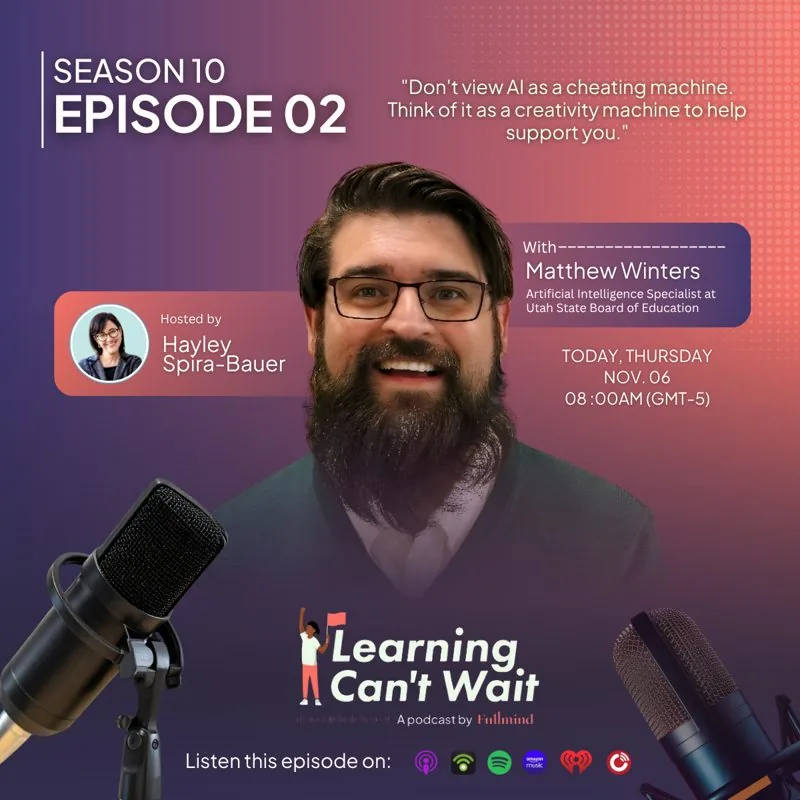
Learning Can’t Wait · Episode 187
AI Education, Pro-human AI Leadership & Utah AI Infrastructure: Matthew Winters
- AI Education
 Hosted by Hayley Spira-Bauer, Chief Academic Officer at Fullmind
Listen now
AI Education, Pro-human AI Leadership & Utah AI Infrastructure: Matthew Winters
Episode summary
Matthew Winters, Artificial Intelligence Education Specialist at the Utah State Board of Education, explains why Utah leads on AI in schools: decades of investment in statewide internet infrastructure, regional collaboration, open sharing of expertise, and the nation's first Office of AI Policy. He describes his three-part role across legislation, district policy, and internal PD, a grant-funded training that reached 6,000 teachers instead of the planned 1,500, a forthcoming repository of 2,000 teacher-written AI lesson plans, and newly published portraits of an AI-infused student and educator. He discusses guardrailed chatbots, consortium pricing with data privacy, companion-chatbot risks, and keeping humans in the loop.
Key takeaways
- Utah's AI lead rests on human capital: long-term infrastructure, regional collaboration, and no gatekeeping
- A teacher AI training planned for 1,500 reached about 6,000; 2,000 lesson plans will be shared globally
- Constitutionalized chatbots and statewide consortium pricing give classrooms tools with privacy floors
- Companion chatbots used at home are a consumer-protection issue, which Utah's Office of AI Policy addresses
- Treat AI as a creativity machine, not a productivity or cheating machine; keep a human in the loop
About this episode
Matt Winters, an AI Education Specialist, shares his unique journey from a radio DJ to a key player in Utah’s AI education landscape. He discusses Utah’s leadership in AI policy and infrastructure, emphasizing collaboration, open expertise, and strategic investment that supports schools statewide. Matt highlights projects like teacher professional development, AI policy advising, and the recent creation of an AI-infused student and educator portrait, underscoring the importance of human-centered AI use and fostering creativity in classrooms.
Full transcript
Transcript generated from the recording; minor errors may remain.
Hayley Spira-Bauer: Welcome back, everybody, to the Learning Can't Wait podcast. I am so excited to have today's guest on for a host of reasons. One, because the work that they are doing with their colleagues in the state of Utah has led it to become the first and foremost in the space of this particular topic. But two, because you'll hear it in a second, but This is a former radio host, so when you hear him speak, you know he knows what he's doing. So, without further ado, I'd love to introduce you to Matthew Winters, the Artificial Intelligence Education Specialist for the Utah State Board of Education. Matt, welcome.
Matthew Winters: Thanks so much. I feel like I should put my, like, radio NPR voice on for you, where… I've talked to other radio DJs, we get… we all wake up with nightmares saying our call letters for the radio station in our sleep, so still, 20 years later, I still do that.
Hayley Spira-Bauer: You know what? Radio teaches you a lot about how to fill space and time, but I don't think you're going to have any difficulty doing that, because the topic we're talking about today is the passion and love you have for emerging technologies and bringing it to Utah, so… Let's jump right in and have you tell everybody, how did you get from radio DJ to here, but also, how did you become the personal and professional version of yourself?
Matthew Winters: Yeah, I… I have a weird story. I was telling a friend about my journey, and she kind of just looked at me like I was an insane person. So I actually almost dropped out from high school. I was unchallenged, and I did not really love what I was doing, and I had a teacher who kind of saved me. She handed me a bunch of books and said, you should read these. Probably books that she shouldn't have handed me, but they were books that I really loved. And after about 6 months of working with this teacher, I went, I think I want to do what she does. And so, I immediately started working towards being a teacher. I took a side route to possibly be a college professor. So my first master's is in, and I love saying this because we're going to talk about AI today, and everyone's always like, oh, Matt, you have such a wonderful background in AI. I'm like, actually, my background, my first master's is in Irish literature, specifically the author James Joyce.
Hayley Spira-Bauer: Wow.
Matthew Winters: So I got that, and then immediately jumped in like a glutton for punishment to a second master's in education, and then started working in statewide ed about 5 years ago, working with our, at our ISTE affiliate conference called UCET. I was the president of that for 2 years, but then also worked in Statewide Ed for Utah Education Network. This role, came open about a year and a half ago, and I applied not thinking I would get it, and just went in there and I found out afterwards that I was the only person that said anything negative about AI, and was really forward-thinking, and so I… I started… they hired me, and I've been working on this project ever since. It's been great.
Hayley Spira-Bauer: What did you say that was negative?
Matthew Winters: Well, I was really… I was in the middle of a book at that point, called, Four Battlegrounds. It's, written by a former military general, and it's discussing the kind of the international political implications of AI between especially, China and the United States, and I was… thinking about, you know, specifically, like, how do we get more people into higher ed, and prepare them to be prepared for using AI and also building AI, and there's a lot of conversation about that, and I brought that up, and said, I don't think we're preparing people right now. I don't think that system's in place, and so apparently that was part of it, was… wow, he has some cautions in place, which is good.
Hayley Spira-Bauer: You know, I'm always very skeptical when I talk to folks that don't have critical opinions of AI. At this point, I feel as if… first of all, you know, this is an emerging technology, but it's… in some sense, it's not really. Like, there has been underground and siloed work happening with machine learning and artificial intelligence for a very long time. But we're seeing it enacted in the public space and in education more recently, within the past few years. So, at this point, we should have a good sense that there are pros, and there are lots of great applications, and ways to make our lives better and easier and more efficient, but also skepticism is healthy.
Matthew Winters: Absolutely. I… I think when we talk about any emerging technology, we have to… this is something I bring up quite frequently, is we have to understand that this was, as a commercially viable technology, generative AI really hit in November of 2022 with ChatGPT. And before that, we have, as one of my favorite, scholars here in the area in Utah says, we had lots of different animals in the zoo of AI, and then here comes generative AI, and all of a sudden it hits everyone equally at once. And 3 years later, just about 3 years later, we're still trying to deal with the ramifications of that. On a lot of different areas, not just in education. And so we have to have some sort of skeptical eye, becauseAll the research isn't in yet.well, you know, we look at preliminary studies, and some people quote those as gospel, and I'm like, well, we need to have a much larger body that presents all aspects of this, and then we can make judgments about it. But I think it's going to be 3 to 5 years before we get there. I think having that kind of skepticism Where, yes, we understand that there's some guiding lights, and there's some positives, and we're especially starting to see that in Utah. But to have a keen eye to what are the problems that could be coming down, and making sure that we're not over-relying on AI in any way, shape, or form.
[05:00] **Hayley Spira-Bauer:** It's healthy. It's very healthy, and I appreciate that approach to it, because ultimately, we should always be willing to have, what is it, strong opinions loosely held, right? And as we learn more information, we can revise our opinions, and we can change our perspectives, and I think that's a healthy way to approach the world. Now, Matt. I just met you in Utah, at NREA's annual conference, and it was fantastic. You are so tall in person, and I'm not, so that was a really fun learning. But I also learned a lot about what's happening in Utah. At that conference. Can you set the stage for folks that aren't familiar with why Utah's name comes at the top of the list when we talk about AI and emerging technologies?
Matthew Winters: Absolutely, I talk a lot about this because I think it's a really interesting situation here in the state, as opposed to other states. There's lots of states doing amazing work, and I'm not trying to denigrate anybody. It's… everyone's working as fast as they can, it's just we have some special circumstances here in Utah. So, it comes down a lot to human capital. Technology's a big, important part of that, but unless you have the ecosystem of people to support the technology, build the technology, and then also maintain it over time, and then proselytize it, you're not going to be able to actually get it in function. And so, I always point to three big things. One is that we have… a long-standing set, like, culture of investing in new technologies and innovation. We have a lot of collaboration across the state, whether it be in our Four Corners region, all the way up to Northeastern, whatever it is. We have regional service centers and statewide groups that really meet together pretty frequently to make sure that we're all developing together. And the third thing is that we have open expertise shared. Like, everyone… I've never… I haven't met very many people that gatekeep here in the state of Utah, particularly around technology, but especially around AI. Everyone's trying to solve this. Let's work together. And so, just kind of illustrate that, Utah, in 1994, invested, through the governor in building the statewide infrastructure for the internet in schools and hospitals. And so, if you go into a publicly funded school in the state of Utah. The internet's free, and it's usually… if you're on the Wasatch Front, it's around 400 gigabits per second right now. If you're going down the backbone, it gets, you know, less capacity as you go down, but there's more and more rural areas. And just last week, we started work on the… second-to-last school in the state of Utah that doesn't have hardwired internet, which is Navajo Mountain. Utah Education Network's doing that work, and it's pretty incredible to see that being laid. The last school is a very, very rural school. It's in the Grand Canyon, essentially, and so they still have internet funded through the state, but hopefully someday soon they'll be able to have hardwire. That kind of investment, we don't see that in other states in kind of the long-term build, and so that has enabled us to have a network that can provide the capacity for AI in our schools. And so, on top of that, being able to do collaborative work around contracting and sharing expertise about what's working, what's not, has just provided so much, growth over such a short span of time here in Utah.
Hayley Spira-Bauer: I was particularly fascinated by learning about the fiber optics being laid across the state in the final two schools that remain. Just so folks can get a sense, can you tell everyone how many students that final school has?
Matthew Winters: Yeah, so this is a school that's in the Four Corners region. It's a school district called San Juan. San Juan is geographically about the size of Massachusetts, Connecticut, and Rhode Island put together. But has just about 1,000 students in the entire district. To get to Navajo Mountain, you have to go about 3 hours down south into Arizona, and then back up, because geographically, there's this thing called the Grand Canyon. And so, there's only a few students there, I think it's less than… I'd have to go back and look at the numbers, but it's not a large amount. The goal is that if they're a student in the state of Utah, they should have internet access to provide them the learning that they need, whether it be in person at the school, or through IVC or distance education courses, and I think because Utah is such a geographically large state with populations that live in these Very, kind of isolated regions. We want to make sure that those students are prepared for the future and able to go to the careers that they want to have. And if we don't provide that internet, if we don't provide that hardwire. And then also the personnel to maintain that, and the teachers to run the courses for them. We're not going to be able to do that into the future. Yeah, absolutely. Whole ecosystem.
[10:00] **Hayley Spira-Bauer:** Yeah, and I also learned from one of your colleagues that, you know, Utah has been at the forefront of Laying the roads and rails, even before the, the, you know. Shiny title of being the country's first state in AI, which, I mean, you don't give yourself, but I think a lot of people are giving Utah that moniker, that title. Let's talk a little bit about what your job actually entails. Now you're there, you got the job, because you were the only one critical, which we said is good. We want that healthy skepticism. What does the job entail, and what are you most proud of right now that you've accomplished thus far in the few years you've been in the position?
Matthew Winters: Yeah, as written, the job is basically three parts. So, one, I'm supposed to work with legislative stakeholders and support any of our legislators or other groups that are working on policy and law. We're lucky in the state of Utah to have the first of its kind office called the Office of AI Policy. You can check out their work at AI.utah.gov. They are super helpful, and I've been working a ton with them to develop code and law around, We spent a lot on mental health chatbots last year. This year, they're focusing on deepfakes and provenance and character chatbots, and we're really trying to lead the way on here, we're seeing the problems as they happen in real time, let's develop those. So that's one third. The second third is that I'm… I'm supposed to support our… or districts and charter schools in how they work on their own policies, and then any support that they need. So, that has basically been a lot of training, which I can talk about here in a second, but also supporting their superintendencies and boards to develop those policies and give them thumbs up, thumbs down, and from an expert perspective. And the third area is internal professional development. For the State Board of Education. So I go out and work with our teams here, give them, support in how to understand AI, and whether or not there's… they're meeting a… hitting a misconception. So, that's the job as written. I've taken it into some really unique places, because we're doing some really unique work here in Utah. One of the most important… there's two big projects I want to speak to. One of the biggest ones is We recognized coming in, we did a series of AI summits, and we asked for feedback from our community, what do you need? And one of the biggest things was ongoing professional development to support teachers, so they can go through this transition and come up with good ideas. And so, thanks to a generous grant from Intermountain Healthcare that my colleague Sarah Young, was able to grab. And bring into the agency, we were able to fund professional development for teachers over the last 6 months. Now, the grant, as written, was hopefully going to get 1,500 teachers to come out and do training with us for an hour across the state of Utah. That was the lofty goal. We are currently hovering around, 6,000 teachers that have gone through the training.
Hayley Spira-Bauer: Wow.
Matthew Winters: And we're… we just opened up the course, because we have some more funding to be asynchronous, so teachers can get it if they just want to take the course, anywhere in the state. We're paying them out at the end of that for a lesson plan that they write in their content area and grade level that either uses AI with students. Or teaches about AI with students, and we're going to be posting those lesson plans, hopefully starting next week, which is the end of October, into the early November, for anyone to read and use across the globe. So the hope is, is that we can't find a repository of stuff like that. Nobody really has that yet. We're gonna have the first 2,000 to share with the globe. So that'll be coming out very soon in batches. The other project, that we're very excited about is we have a big portrait of a graduate state.
Hayley Spira-Bauer: Hmm.
Matthew Winters: And if you're not familiar with Portrait Graduate, it's an aspirational document that are the knowledge, skills, and dispositions that a high school students would have when they leave high school. And so, we've been doing this, I worked on that when I was a classroom educator and loved the process. I got to work with some great experts on that. And when I came into this role, I went, we need to have that for AI. So, just this week, we published A portrait of an AI-infused student, and a portrait of an AI-infused educator. The goal being is to show the knowledge, skills, and dispositions that a student or a teacher should have while using AI. Anything from common skills that we always want, like creativity and critical thinking, to more specialized skills like prompt engineering and data privacy, are all outlined on there. We're very… the work was done in conjunction with a group of higher ed, K-12, special education, agency, governance, students, teachers, the whole nine yards, to really get this into a place where we think we have everything. And so those are all published on schools.utah.gov under Artificial intelligence. And I'm sure we'll put in the show notes, that sort of thing, but it's very exciting to see the work moving this quickly and being able to not only do boots-on-the-ground work. Supporting teachers and leaders and our school… I've done meetings over the last 8 weeks with Superintendents, school boards. School leaders, parents, students, and teachers, training them all up across the state. I mean, it's a big push, but it's, it's been really helpful to see the work going. But then also on the other side, build these documents that can help frame out the work for years to come.
[15:00] **Hayley Spira-Bauer:** You know, I just got back from edtech Week, and one of the big conversations that came up in multiple panels I listened to was around… chatbots and AI girlfriends and boyfriends, and how there was some new research put out that one-fifth of students, either themselves. Use… have an AI girlfriend or boyfriend, or know someone who does. And that number was really alarming to folks that, first of all, didn't even know these existed.
Matthew Winters: And second of all, to other folks who are wondering about, if this is where we are today, what happens in the future? So I'm just wondering, given your purview, if you are having conversations around this new research, and how.
Hayley Spira-Bauer: How that… information, Looks as you work with students to understand, you know, ethical consumption of artificial intelligence.
Matthew Winters: Such a good question. There's two parts to that I think are really important, so I want to focus on the K-12 side, and then there's this very important differentiation. There's the in-school work that we can do and provide that work, but then there's also the consumers, including our students, who are going home, and they have different protocols and safety procedures at home than they do at school. And so, I want to start with K-12, which is… Chatbots are very interesting. But when you add a constitution to them through certain products, you can actually really corral them and add a lot of guardrails to them. I… one of my favorite examples of this is… I work a lot, again, with adult learners, specifically teachers, and I have a chatbot that I've constitutionalized where I can… it only will answer questions about semicolons.
Hayley Spira-Bauer: That's it.
Matthew Winters: I'll often hand it off to teachers, and I'll say, okay, ask it whatever you want, and within minutes, they're, like, super angry, it's not giving me anything. And I'll say, ask it a question about semicolons, and it will spout off all the things that they want to. And so it's a matter of understanding and having the appropriate tools and guardrails in the classroom, and knowing that you can have those guardrails at the micro level in the classroom, but also at the macro level at the district or charter network. And so I think understanding that and getting that information out is a large part of my role, and showing teachers how to do that, but then also enabling Utah educators and districts with the tools that do that kind of work. One of the things that we're very proud of here in the state of Utah iswe were the first state to provide consortium pricing for AI tools, so that districts and charter schools could get tools very cheaply into classrooms, but they had data privacy assured, or at least the floor of data privacy assured. And then on top of that, there was training provided for them. And so, we've had mass adoption across the state because of that, and it's been really interesting to see how quickly teachers are starting to go, oh, I can… corral my students on what they want to do in my classroom with this product. Now, that doesn't account for the other side, though. When our students go home and they're on a non-school laptop or a non-school cell phone, whatever device they're working on. That offers a whole other plethora of challenges that may or may not be in the purview of the district. It's more in the purview of the parent, and possibly law. And so that's where I get really excited about working with the Office of AI Policy here in the state of Utah, because their lens is not K-12, it's consumer rights.
Hayley Spira-Bauer: Right. Protection, and so…
Matthew Winters: That's why I'm so always… whenever I talk about the work here in Utah, I always make sure that people know about that, because they're working on that particular issue that you brought up of these character chatbots, and the dangers of them, and how some students don't know that they're not Just a computer that's going to give them back the… the… the kind of the… the problematic information that they want, and so having some protections around that at the state level from a consumer protection standpoint, is really, really important. And so that's why when we talk about K-12 and we talk about AI, it's a much larger ecosystem than just what we see in the classroom. And we have to have larger conversations, and have larger communities that we work with. And so, just before this recording, I was on a call with higher ed stakeholders and business stakeholders talking through some of our ideas, and sharing what we did with Portrait of an AI-Infused Learner and Teacher. And I think that's a really important standpoint, is look for larger partnerships and share that expertise that you have openly.
[20:00] **Hayley Spira-Bauer:** You know, speaking of sharing that expertise openly, you're about to host the 2025 Utah AI Summit. Coming up in the state, and the title of it is Pro-Human Leadership in the Age of AI. What does Pro-Human Leadership in the Age of AI mean?
Matthew Winters: That's been something that… I'd have to go to the organizers on that. That's the Office of AI Policy for a big one on that, but one of the things that we've all taken as a standpoint here in the state of Utah, whether it be myself at the Utah State Board of Education and, like, the groups that I work with internally. But also University of Utah, UVU, Utah Valley University, Office of AI Policy, is we want to keep humans in the loop.
Hayley Spira-Bauer: Absolutely.
Matthew Winters: Able to have human decision makers, have them being able to speak to what the processes the AI is doing, and making sure that the AI isn't just off Doing the work for us, or…
Hayley Spira-Bauer: Completely invisible to us, which is a possibility with a lot of agentic AI. We want to make sure that that actually.
Matthew Winters: The leadership, the… expertise, and then also the final check goes through a human being. And that's something that we encourage our teachers and our students and our leaders to go through here in the state of Utah, is Don't just publish what you grab on an AI, because it may be inaccurate, it may have problems, but then on top of that, you're the expert in the room, you're the human. Make sure that you keep that human in the loop and you work it through.
Hayley Spira-Bauer: I heard a really interesting conversation at the last conference I was at this week, which was the Begin Early Learning Summit, and it was, there was a panel on AI and how early we should be introducing, literacy, like, AI literacy into our children's lives. And the argument was that it should be early, but it was a really cute conversation that they, like, were quoting, that they could… you could say with your child. So it's like, you talk to Alexa. And then Alexa says something funky that you aren't sure if it's right or wrong. Like, you model for your… even your 2-year-old, your 3-year-old, like, huh, I didn't know if that's true. I wonder where Alexa got that information from. And I was like, oh, I could totally do that. My kids use Alexa to ask! Everything of that computer. Because, you know, I think it's hard for folks to conceptualize at the earliest ages, how are we preparing our kids? I do a lot of, like, prompt engineering with my kids as I talk about their day, so they are getting models for that. But are they getting models for… the, like, the healthy skepticism of looking at sources that are provided, and again, making sure you're top-reviewing content that, you know, a generative tool puts out. But I thought it was a really cute example of how you do that with little kids, but also really powerful of teaching kids to… Question authority, question Alexa, question the computer, you know?
Matthew Winters: Yeah. You're asking a couple really big questions in there. The foremost one is… how young should we do this? And I think there's… what you just point to is really important here, is there's a big difference between handing an AI over to a student and just saying, go.
Hayley Spira-Bauer: Right.
Matthew Winters: Modeling and working with the student to understand us. Going back as far as, you know, the last 20 years and thinking about, like, one-to-one initiatives or whiteboard initiatives and things like that. We really need to think about purposeful use of artificial intelligence and purposeful use of edtech. And so, in the case of, like, younger learners, modeling is a great way to do that.
Hayley Spira-Bauer: Let's talk about, hey, let's ask the AI a question. Right.
Matthew Winters: As a group, and then let's explore it and make sure that the question is accurate. Does that seem wrong? Those sorts of things can be incredibly useful and not in a way… and not pushing us towards every student has their own AI, and they're just out… asking whatever they want with it. I think that's really, really important. Yeah.
Hayley Spira-Bauer: No, it is, and it's funny, because… you could see non-educators in my… I could see non-educators in my life grappling with this question. They know what's coming down the way, but they're not having the conversations, Matt, like you and I are having all the time. They're not sitting in the conference centers like we are sitting in the conference centers. I'm constantly trying to learn about this topic, and non-educators in, you know, other sectors aren't, and so they're grappling with it. I got a text a couple days ago from a friend, hi, Dr. Joe, and she was working with her child on math. And she was struggling, and she said, Hayley, is it okay? I put it into ChatGPT, and I asked it with different numbers to teach me how to solve the question. Did I cheat? Did I teach my kid to cheat? I was like, actually, no, that's brilliant! That's a brilliant use of AI. Like, you were asking for process. Not answer. You didn't ask it to solve your kid's question. You asked it to teach you. Like, you modeled beautifully for your child. So I do think, like, more questions are going to continue to come from the non-education sector about introducing it early with their kids in a productive manner.
[25:00] **Matthew Winters:** And I think that goes to a couple other points, too, that are really important, is that a lot of people went and tried ChatGPT specifically, but also other AI tools.
Hayley Spira-Bauer: In…
Matthew Winters: Early 2023, when they were still incredibly faulty.
Hayley Spira-Bauer: Yes.
Matthew Winters: Big issues, and they held on to that perception of what that tool is, and they haven't come back or tried to use it again. And so we're working with sometimes people who, their perception is two, three years old, and the tools have accelerated so rapidly. Even in just the last, like, 6 weeks, I go and look at, like, updates from different companies, I go. Oh, wow, I really need to up my usage in certain ways. And so, that's one part of this, is that, yes, we're not seeing the expertise, but In the same way, in the same levels, and so making sure that people go out and try these tools and see different ways to use them can be really, really influential. And that's something that I encourage our teachers, especially if they've formed that first opinion, hey, maybe it's time to go back and try that out again. Sure. That works now.
Hayley Spira-Bauer: You know, you kind of got to my last question already, but maybe that's not your most singularly important piece of advice, Matt. I'm wondering, what advice would you give a teacher who hasn't yet tried to integrate AI in their professional life or in their classroom? What advice would you give them?
Matthew Winters: That's a really, really good question, Hayley. There's a couple things that come to mind immediately, and one is, like, don't fight your first perception, like, go and try new things out. But I would also… one of the things that I always think about with AI, especially generative AI, is that it's a fundamental technology. And my friend Emma Moss here in Utah, she works at a district called Canyons School District, she always points to electricity. You don't really value electricity until it's not there. And AI… sorry, electricity only gets really cool when you plug something into it, whether it be a laptop or a light bulb or whatever it might be. When we talk about AI, it only gets really interesting when a human gets put into it, and having a human really ask the questions and build the prompts and things through, and… It's an inherently creative technology, and it's kind of… It's got limits.
Hayley Spira-Bauer: But they're hard to find, and if you hit those limits, that's great, now you know what you can't do.
Matthew Winters: Just like you know what you can't do with paint and things like that. So, having that spark of creativity is really important, and one of the things that… I jokingly do this here in Utah with trainings all the time, but I often go into trainings and I say, I have really deep concerns about the upcoming generation. I don't think enough of them are dying of dysentery on the Oregon Trail. And then I show teachers how to craft an Oregon Trail-style game based on their local history in just a couple of minutes, either through a couple… through a couple different tools. That's a level of creativity that… is very quick now, it's easy to access. And it opens up so many possibilities for teachers, but then also for student projects. And that's just one example of how we can integrate this in new ways. And I think that's where I would encourage teachers, is don't view this as a… a productivity tool only. Yes, it can help you with your emails. But really start to think, what could I not… what have I always wanted to do in my classroom that I've not been able to do because of the limitations on time and effort that I have in my job? And if you're able to go, oh, I really want to create a video game, well, now you can. If you want to create, you know, unique graphics, you can. It's a matter of being that… taking that extra step in creativity, and I encourage all educators, parents, leaders, to really take that extra step andSee how it can be not a cheating machine, but actually a creativity machine to help support you.
Hayley Spira-Bauer: I think you just gave me the title for this episode. Matt, it is such a pleasure talking to you again. I'm really grateful that you took the time to join me here on this podcast. Thank you so much.
Matthew Winters: Yeah, always, and happy to reach out. My email is matt.winters at schools.utah.gov. If anybody listening wants to collaborate, feel free to reach out.
Hayley Spira-Bauer: And thank you to everybody who tuned in today.