
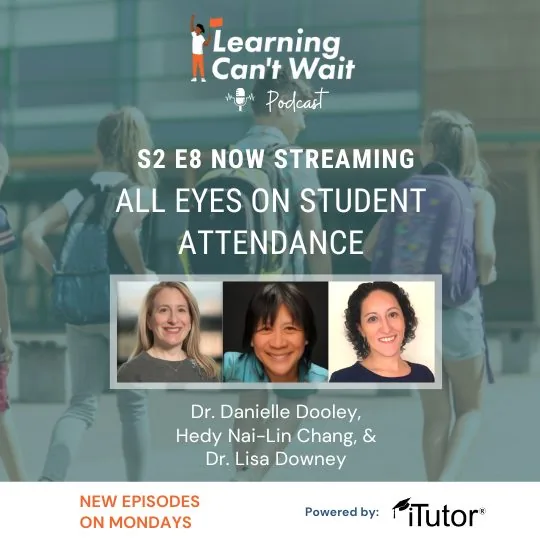
Learning Can’t Wait · Season 2, Episode 8
All Eyes on Student Attendance
 Hosted by Hayley Spira-Bauer, Chief Academic Officer at Fullmind
Listen now
All Eyes on Student Attendance
Episode summary
Attendance Works founder Hedy Chang, pediatrician Dr. Danielle Dooley of Children's National Hospital, and Mineola High School assistant principal Dr. Lisa Downey discuss the doubling of chronic absenteeism to roughly 16 million students by the end of the 2021-22 school year. Hedy explains the 10% early-warning measure, four root-cause buckets, and the need for foundational conditions for learning. Dr. Dooley links attendance to lifelong health and describes a pilot sharing school attendance data with pediatricians. Dr. Downey details advisory groups, a culture committee, and a mentoring program. All three call for an all-hands community approach built on hope, relationships, and student voice.
Key takeaways
- Chronic absence roughly doubled to about 16 million students, nearly one in three, by end of 2021-22
- Use the 10% threshold to intervene after two missed days in month one, not after 17 absences
- Root causes fall into four buckets: barriers, aversion, lack of engagement, and misconceptions
- Health systems can share attendance data with pediatricians and adopt a School-Friendly Health System framework
- Advisory groups that give every student a trusted adult carried Mineola through hybrid learning
About this episode
In the episode of Learning Can't Wait podcast, host Hayley Spira-Bauer interviews Dr. Danielle Dooley, Hedy Nai-Lin Chang, and Lisa Downey. Danielle G. Dooley, MD, MPhil, FAAP is medical director of community affairs and population health in the Child Health Advocacy Institute at Children’s National Hospital in Washington, DC, and a co-author of the 2019 American Academy of Pediatrics Policy Statement, “The Impact of Racism on Child and Adolescent Health.”
Learning Can't Wait is brought to you by iTutor.com.
Full transcript
Transcript generated from the recording; minor errors may remain.
Welcome to the Learning Can't Wait podcast, an iTutor production at iTutor. Our vision is to ensure every child has access to education regardless of circumstance. Each episode, we will be joined by Pathfinders within and around the education space who are bringing about transformational change on behalf of.
Students, I am your host, Hayley Spau. Welcome back everybody. I am so incredibly pleased to be able to introduce the folks that are joining me on today's podcast, as well as the topic we are discussing. Our topic today is All Eyes on Student Attendance, and we have three incredible leaders, both in the space of attendance and in the medical profession and school-based.
Joining us today we have Dr. Danielle Dooley, pediatrician and Medical Director of Community Affairs and Population Health for Children's National Hospital in Washington, dc. Welcome, Dr. Dooley. Thank you so much. It's great to be here. It is great having you, and we also have Dr. Lisa Downey, the assistant principal for Mineola High School.
Hi. Thanks so much for having me. Welcome back to some of our conversations, Dr. Downey, it's great to see you again and certainly. Last but not least, we have Hedy Chang, the founder and executive director of Attendance Works. Welcome, Hedy. Thank you so much. Pleasure to join. It is a pleasure having you here, especially because on the day we are recording this episode, there have been quite a few articles, so I'm going to start with you about attendance in which the work of Attendance Works, the research of Attendance Works, and the, really national attention on attendance has been quoted, really in the past week in a variety of different news outlets.
So why don't you tell us how did you get into the field of studying and creating tools for and supporting schools, on the topic of attendance? Well, this journey started quite a while ago for me. In 2006, I was asked by Ralph Smith, then the VP of the Annie E. Casey Foundation to figure out were their kids missing too much school in kindergarten, first might be a reason they aren't reading by the end of third grade.
And when I started that work, what I found out was it is a big. Missing too much school for any reason, starting when kids are little can have a real impact on their academic performance in third grade, and then later on. But what I realized in those early days was that we actually didn't even know it was an issue because most places were taking attendance paper and pencil.
We didn't have. Electronic databases and we thought about attendance as truancy, which is just looking at unexcused absences or rather, we thought about absenteeism as truancy and so we were actually not at recognizing, we had even at that time, as many as one out of 10 kindergartens, first graders missing so much school, they were academically at risk.
And what happened is over time we ended up launching a national initiative to be able to promote understanding, to promote action. And when this eventually became part of the Every Student Succeeds Act, federally as a required reporting metric, and then 36 states plus Washington DC adopted chronic absences and accountability metric in about 2018 that made this a national metric that is now tracked everywhere.
That is quite the evolution. Paper-based recording of attendance, which I distinctly remember at the beginning of my career to now not only tracking it in a more digital format, but also paying way more attention to its ties to all sorts of factors, including students' medical wellbeing, which I think is a perfect segue to getting Dr.
Dooley's background on this particular topic. You. First medical doctor on the podcast. And so I'd love for you to share Dr. Dooley, if you don't mind, how you became involved with both Attendance Works and as well as other national initiatives, on student attendance. Thanks so much, Hayley, and I'm honored to be the first physician on the podcast.
Hopefully there will be more after me. I became interested in the topic of attendance when I was working as the medical director of school-based health centers in Washington, DC and four different Washington DC public high schools and our medical centers. Our school-based health centers were really comprehensive, offering medical care, mental health care, oral, oral healthcare, sports, physicals, checkups, acute illnesses, family planning.
And what we found though, was on any given day, about half the kids in these high schools weren't at school, and so it really. Just struck me that here we have this incredible resource, we're there to support the students and they're not able to access it at all because they're not able to come to school.
And furthermore, if they're not coming to see us in the school-based health center, they're also not in the classroom and not getting their education. Andit just always struck me as wrong that the entire responsibility for school attendance seemed to be placed on the education sector.When as pediatricians, we spend a lot of time talking with children and families about their child's school progress, how they're doing in school, any school issues that arise.
And so it seemed like at. Needed to be more front and center as part of that conversation, and we've seen that happen in 2019. The American Academy of Pediatrics, which represents over 67,000 pediatricians, released a policy statement on the link between attendance and good health and the role that pediatric providers and health systems could play in supporting school attendance.
I am excited to talk about that particular link in just a moment, but that is an incredible introduction to how different types of, organizations and community and respons, professionals in the community can support schools and students. What I think is a perfect segue to Dr. Downey, as you named, that the entire responsibility adhere to for been in schools and on educators, and so.
Dr. Downey as an educator, yourself, a former school teacher, now a school leader. Talk to us a little bit about your own personal view on attendance and why it's so important for you to be at the table here today. Hi, thanks so much. So I like, as an assistant principal, attendance is a big part of my position.
However, I think with the pandemic it became more in the forefront. So whenever we won, was at home. And you know, we were just most concerned about like our students' wellbeing. And our best way to know about that was if they came to class. So during the pandemic, we really focused on relationships and building those relationships with our, you know, our teachers, building those relationships with our students.
And then that has really trickled down since being home and then being hybrid and now back to a. A full year. So, you know, building those relationships has really been a big focus and how we, how we really get our students to be present and be in the building and be engaged. You know, many schools not in, in, within our country do have that assistant principal role as focused on attendance.
And so your perspective is incredibly valuable here amongst the other experts we have on this topic. And I'm so grateful all three of you were able to make time to have this conversation. So why don't we jump right in. Hedy, I'm gonna start with you. If anybody has read any of the, the major headlines from Hechinger or The 74 or whoever else has published something this week, you probably, they probably know the answer to this question, but I know not everybody's reading as kind of devotedly as I do.
How alarmed should we be with national rates of absenteeism today? So we should be extremely alarmed. What we believe is before the pandemic, there are about 8 million kids who are chronically absent. I believe we've doubled to about 16 million, which is almost close to one out of three kids. Being chronically absent, meaning they've missed 10% or more of the school year for any reason.
Excused, unexcused, suspensions and what we know from research, the whole host of research, is that missing that much school is starting in the earliest of grades. Predicts kids being less likely to read on grade level by the end of third grade, less likely to achieve in middle school, and even more likely to be suspended in middle school.
And then by high school. It's an early predictor of dropout. So if we. Leave this issue unaddressed, unaddressed. You know, you couldn't even look at the NAEP scores they just published about earlier this month. The NAEP scores showing the first time we have a decline in achievement and NAEP is the National Assessment for Educational Progress, and we have.
It, you had always had, it increases for the first time you had declines. And the gap between the kids who are achieving and the kids who are not achieving very well is bigger than ever. We are completely going into a haves and have nots. And at the same time, when you look at those, the results they got, they also, you know, surveyed students and they found the kids who were doing still okay are the ones that had a computer.
That had an internet, had daily access to a adult, had homework help, and that's just at the tip of the iceberg. The thing that is so alarming, there are some kids who did okay in this pandemic, but there are a large number of kids, and they were often the kids who were already teetering because they didn't have the access to health services.
They didn't have the stable housing, they didn't have the transportation, they didn't have the positive school climates that helped them come to school. They were already challenged before the pandemic and the pandemic. Exacerbated all of those issues. And I think we all should be concerned when we sort of have a bottom falling out of this country of kids for whom we don't have the supports to make sure they can have an equal opportunity to learn because ultimately their lack of success will affect our entires country's success.
That is a pretty alarming set of information I think. The first point that really sticks out to me is the doubling of, chronic absenteeism as you named at the start, and then when you put it in perspective of one of every three students in schools is missing 10% or more of the year, that is.
Absolutely a contributing factor to NAEP scores, which let's be, let's be like abundantly clear. NA is not the only indicator that is showing its decline in students' wellbeing and achievement over the past three years, but is certainly one that we've all been paying attention to in the education space for, for a good reason.
Dr. Downey, I'm curious from your perspective, you work at a school district in New York State, your yearly attendance rates are te, are tend to be higher than the national norm. Are you seeing. Increase or doubling that, that he, he is naming or are it, does it look different in your neck of the woods? I was definitely alarmed when I heard those statistics.
I think this year things definitely look different. Students are eager to be back in the building for what is a normal, you know, as normal as we can say year. But when we were hybrid and virtual, It was tough. We really needed to make sure that we were motivating students to come into the building because it was easier for them to stay at home and stay in their bed and log on virtually, and then, Maybe they fell asleep, maybe they missed a class.
So luckily this year we are definitely seeing an improvement in attendance overall. And I think just in general, the students are happy to be back in the building and happy to be back together. So, Luckily, no, we're not seeing that, but I could definitely see how coming out of the pandemic that that's what's happening.
Can I clarify something about timing of data? I was talking about data by the end of last year, not this current school year, and I think there are two different situations. There was the 2021 school year when it was the first, first full year of the pandemic, and at that time it looked. Based on the national data, there was around 10 million kids, chronically absent, but I actually think it was an undercount because we were really bad at knowing whether kids were showing up or not in virtual learning.
The end of last year, especially because you had two covid variants. That hit at the beginnings of semesters, which was is such a critical time for building relationships, for building connections, and for scaffolded learning. So making sure that kids, you know, have what they need. Then you're seeing almost that doubling.
And what I am hearing though is that this year across the country is much better. What's worrisome though is. Kids who are chronically absent in the prior year are at much higher risk in the following year. And while some of those kids might not have had such big issues that they'll, they'll automatically, you know, they'll find ways to get better.
I'm worried, particularly if the kids most struggling may have real challenges because they missed core content. They missed, we didn't, we weren't very good last year about making sure that when kids were quarantined, they could make up. Classes or had access to learning. And, and you're hearing, and I, I, you know, Danielle May be able to speak to this, you know, incredible anxiety and stress on kids.
So while the data's better, I'm worried if we don't take a hard look at it, we're gonna end up with kids, who are struggling and we're not noticing in ways that make sure that then they have what they need to succeed. I really appreciate the distinction on the timing of the data you are speaking about and what we're seeing this fall.
it's amazing how quickly. Our reality around school has changed and how often it has changed the past three years. So thank you for really highlighting for our listeners, which time period we're talking about, what variant we were facing and really what round of each variant, what were we on, because that really impacted how schools looked at what school was, whether it was in person, whether it was hybrid, and of course, we're talking about Dr.
Downey's school, which is in New York State. We're talking about both Dr. Dooley and Hedy. Dr. Dooley speak on the perspective of Children's National, which is located in dc very different reality than different parts of the country. So why don't I, why don't I turn it over you To, to you, Dr. Dooley. And I think the broad question would be like, what is the link that you were referring to earlier between student attendance and student health, and how do health systems play a part?
Or can they play a part in educational systems attendance? So we know that health and attendance are really interwoven or interrelated, and school achievement really depends on school attendance. You know, you have to be in school in order to learn and to progress to the next level academically. And we know that adults who have higher educational attainment, such as a high school diploma or a college degree on average, live longer than adults who did not complete high school.
They also tend to have higher paying jobs, better long-term health outcomes. And in fact, the data shows that on average, an adult who has a college degree lives about nine years longer than an adult who does not. So there is a very real impact of attendance on health. And in order to achieve academically and progress academically, you really do need to be present.
In school so that you can move through the curriculum and the grades. Those are like longitudinal. That's longitudinal data that is really powerful and probably directs a lot of the initiatives that Dr. Downey and other school leaders implement in schools, and then also is a real driver for the work that, you know, Attendance Works is doing to ensure that people understand the reason we have to attend to this information and act on it.
So Hedy in 2018, Attendance Works and everyone, Everyone Graduates Center published a seminal report called Data Matters: Using Chronic Absence to Accelerate Action for Student Success. And in it, you and the other writers offered recommendation recommendations for various stakeholders on how to assess absenteeism, build support, plans, and respond strategically.
How have or should these recommendations. For action change in a, in a wor in the world we live in now, which I'm gonna put quotes around it in the post pandemic world that we're in today. So some things remain the same. We've always advocated, look at your data, use it for early intervention. By the way, you know, we really recommend using this 10%.
As opposed to a day measure, because we want people to notice when kids miss two days in the first month, four days in the second month, not wait till a kid's 17 days and they're like, oh my God, they might miss 18 days. What do we do now? That's just way too late. So the early interventions start, the piece stays the same.
We've always talked about. Taking sort of a more public health model and approach, which invents in prevention and early intervention before you go to the, you know, more significant case, inter and more expensive case management. What I say as during the pandemic, one of the things that we realized was happening is that we needed, if you think about a tiered system of support to add a bottom floor, if you will, a bottom foundation, which we call foundational supports, which we think are the supports that.
Ensure positive conditions for learning. So what do I mean by positive conditions for learning? I mean that when kids come to school, they feel physically and emotionally healthy and safe. When they come to school, they feel a sense of belonging, connection, and support. They feel academic challenge and engagement.
They're surrounded by adults and students who are them, excel themselves, experiencing wellbeing and emotional confidence so that they can. Engage in that relationship building. You know, Dr. Downey talked about relationship building, key being key. It's true in person and virtual and a pandemic makes relationship building more and more essential because relationships are what help people feel.
That sense of belonging, connection, support, they help. Make sure someone trusts that. If the school says, I think it's a safe, it's safe for you to come to school. If you don't have any relationship, no one's gonna believe that's true. And relationships we know are fundamental to creating an engaging curriculum cuz it's also what helps teachers know how to tailor a curriculum to a kid and where they're learning and what their interests are.
But what we saw is, I think before the pandemic, a lot of that in many schools was just sort of happening. It didn't require as much intentionality. When you seek chronic absences doubling, it is a sign that those basic conditions for learning that aren't about attendance necessarily, they're the responsibility of the entire community and school to put in place that they got eroded.
And certainly, you know, people are pretty freaked out. Is school a safe place to be? And there's the physical parts, you know, am I gonna get covid? Am I gonna take Covid back home to my, my, my family and get someone who I love sick, but it's also issues of emotional safety. And we're in a school climate where I'll, I'll say for example, There are places when I hear people talk about they, if kids walk in with a mask, they're worried they'll get bullied.
Kids don't walk in with a mask. There might be, you know, like we are so divisive over what I couldn't have imagined five years ago would've been a divisive issue. And we have to so invest in schools so that they are physically, emotionally, safe places. Everyone feels connected and we have to really invest in the adults who make schools run because if our adults are exhausted, if our adults feel like they don't have any support, they can then not support our kids.
And right now this has been tough both. Not, it's not just the physical, issues, it's the political, emotional strains that as a society we've put on our schools, and we gotta figure out a way out of that. We have to support our schools because our future, our economic future depends on it. And it's incredible.
I mean, I'm just, I'm gonna, there's a lot to unpack there and a lot to discuss there, but I wanna like just emphasize the fact that you're relying on this like kind of conclusion, which is like our economic future depends on it. We live in a capitalistic society. Our society like really thrives and, and kind of holds tight to, we need that to function and continue.
And so there's so much of what we're talking about in schools that really de and the pandemic that occurred during the pandemic that tie back to that. And it's a, it's something that I think. Goes across both lines when you talk about politics, it's something that goes across both lines. So it becomes less of a political issue and more of a health and health of our society issue.
And I just, I can't, I'd be remiss if I didn't mention it because I think it's really resonating with how we can get both sides of whatever political side we, we stand on to, to agree Hedy. So thank you for naming that. I'm gonna go back to Dr. Downey now. So how does this land with you? Like I know that your student rates are, your attendance rates are higher, there's an investment that's happening.
Let's talk on the discreet level for the listeners who are like, okay, great. You know, Attendance Works and Hedy. They're telling me I have to implement things that help build rapport. What are those things? How do I do that? What is Mineola doing? Mineola High School doing that, they're, you're seeing an impact on student attendance and wellbeing and social and social and physical safety in school buildings.
I was taking so many notes while Dr. Chang was talking, cuz I'm definitely seeing and agreeing with so much of what she's saying. I think I completely agree. You know, before the pandemic, those like building relationships pieces kind of happened naturally. And then when everyone's wearing a mask and you're six feet apart, how do you still.
Build those relationships with your students and your staff. So, you know, we started small and I think when we first came back from the pandemic, we didn't know what it was gonna be like. Our school F had a hybrid approach. We're an eight 12 school, so we had students coming every other day and we just told our teachers, don't worry about content for the first few days of school, just get to know your kids.
We have a built in culture committee that's made up. Staff and administrators and counselors, and we use that committee to put together activities that our teachers could use in their classroom. Whether it was a quick check-in of how are you feeling today, you know, with pictures, are you a mountain or a valley?
And just getting students talking. Or you know, whether it was creating their Bitmoji classroom and, you know, sharing things about themselves and their families. And so those little things in the beginning went a long way and kind of took the pressure off of, it's the beginning of school and I need to start teaching math or whatever my content area was.
We really just wanted our teachers to get to know their kids and the, the students to get to know each other and the, and the staff as well. So those pieces prior to. The pandemic. We also had advisory. So the idea with advisory was thatwe wanted every student in the building to have a person.If we asked a student, you know, if something's wrong, is there an adult that you could go to?
We wanted every student to be able to name somebody. So we started out with, again, our building culture committee and we, you know, each teacher's responsible for about 10 to 12 students and they meet once a. And this starts in the eighth grade. Our building's eighth through 12, and then they, they see the same teacher and the same group of kids all through high school.
And at first, of course, with anything, you know, there was pushback. But now that our students are seniors and have been part of this program for five years, they, they have grown to love it and really, you know, support each other. So that was a great piece that we had in the building before the pandemic, but that helped us throughout the pandemic.
And yeah. During Covid we, the advisory was meeting virtually in hybrid and you know, who was home. We tried to alternate days. So when we did meet in advisory, different kids were in the building. But now coming out of the pandemic, it's another support that we have in place. We also have a program called Project Success, which is really a mentorship program.
So we're really catches those students who we see. Chronic absenteeism, but also maybe need academic support. As Dr. Chang was saying, there's always something more. So, you know, once you've built, you've built these relationships and the students are sharing with you, how do we support these students? So we find with them having a mentor, you know, whether it's that they have to, they can't go to extra help because they have to run home to babysit or.
This other teacher in the building is there to support them in whatever they may need, whether it's just getting their iPad fixed or finding batteries for their calculator. Having another person in the building to, to help them has been really beneficial in as improving their attendance as well as giving them academic support.
That is quite the mesh of interventions and proactive strategies to help. Engage students, connect students, help them feel a part of the community. I, I know that I've, I've read some of the, I read the, report from a Attendance Works, said, I've seen a lot of the resources they provide and I think there's a couple boxes checked off.
Quite a few of them checked off, and now you do that. We're getting a thumbs up. For those of you that can't see, Hedy, you're getting a thumbs up from Hedy on that. I think that, you know, Lots of schools are trying, I'm sure different strategies for engagement and a, a lot of these pieces come back to building community.
Now, Dr. Dooley, like with the, with the increasing rates of student mental health issues, how is, how are pediatricians, how are people at Children's National thinking about. This other mountain of, I would say like, you know, tangential effects of the pandemic. We see increasing rates of anxiety, depression, school avoidance, mental health disorders are just on the rise.
So what is the kind of perspective that the pediatrician community is taking and how are, how can the advice from the pediatrician pediatric community advise some of our school-based personnel on how to address these matters? Well, certainly I think we really look to the school side as the experts in a lot of education matters, and that's where the collaboration piece becomes so important.
On the medical side, I think there's a couple things that we're doing both at the individual level and then at the system level. Certainly at the individual level, this is a really important time to reconnect with your pediatrician. We still have families that we haven't seen. For a couple of years because of the pandemic, and so we want all our students and families to know that we are there and we are there to support your student and your family.
We have seen the range of responses to return to school, to anxiety about covid to anxiety about. Reentering social situations. I think if it's out there, your pediatrician has seen it and stands ready to support you and your student. As you navigate that. It's also really important to remember as we still have concerns about returning to school, that immunizations all immunizations, including routine childhood immunizations.
Which we saw quite a decline in during the pandemic, but those routine childhood immunizations, plus the availability of the Covid vaccine and the flu vaccine, those are really important ways to protect your child, to help you and your family feel confident about your child returning to school. And we're in such a different place than we were a couple of years ago, and we didn't have any access to immunizations to address this pandemic.
So I think that's something that also gives me a lot of hope, and we're really trying to talk to families on an individual level about any barriers or challenges they're facing with school attendance. Make sure we're reviewing with families the impact of attendance on both short and long-term health outcomes.
And I would say too, at the system level, we're doing a couple things. The first is we do have a data sharing pilot with our school system in Washington DC where we are piloting the sharing of school attendance data with a child's pediatrician so that then our office can conduct outreach to families and support them with any barriers to attendance.
We've found that's been a really important way to reach families who have maybe become disconnected from the medical system over the past couple of years and actually have medical needs that are keeping them out of school or who have social needs that have really serve as barriers for them attending school, whether it be transportation or childcare.
Or needs of other family members. And those are all things that our office is also equipped to assist with. And the burden shouldn't fall entirely on the school system. And then lastly, I'll just say, our team at Children's National has also developed a framework called a school friendly health system.
And this is really based on other initiatives like baby friendly and age friendly health systems. And it really pushes us to think. So the kids that we're taking care of, how are they doing in school and how can we support their academic achievement? And so a school friendly health system is one in which everyone is working to help children achieve their full academic potential and really also help them attain, you know, their best health as well.
And so we've worked with a group across the country. Of parents and educators and health professionals and other stakeholders to really outline five principles of a school friendly health system and how a health center or a clinic or a hospital can really be deliberate and attentive towards partnering with and supporting the education system.
And you can find more information about that in our principles on our website. Yeah, that's an incredible resource to direct folks too. I know that this idea of a school friendly health system, as you named is paralleled from other types of friendly systems that support families during difficult times, and in this case, really supporting schools.
Because what I think I've taken away from talking to each of you about this topic and doing research and having been a teacher and administrator myself is. An all hands on deck approach is really necessary to attack this problem. So I guess I'll, I'll pose the question and, and whoever wants to jump in and take it to start can do that.
Why is it so important for those of you, for those of our listeners that are maybe not as up to date on the topic we're talking about here today? Why is that all hands on deck approach so incredibly necessary? I can start. Yeah, go for it. First of all, it reflects the fact that in order to get kids to show up to school, you have to address the reasons why they don't show up to school in the first place.
Like that's the first key and, and we've seen that there are kind of four buckets. And I'm gonna say what those buckets are. But the issue is when you look at them, you'll realize not one person, not one entity, can actually address all of them. So one bucket is barriers. Lack of access to healthcare or transportation, you know, unsafe paths to school, unreliable transportation, unstable housing, clearly.
If you've got those kind of barriers occurring, particularly in the community, you need community partners. Schools don't control those issues or influence those issues. It's, you know, it, it's a whole community get there. But then the second issue, and this may be there's a couple that are maybe more in the con purview of school, but it's also true that other people can help schools to address them.
So one is actually the issue of aversion, that what's happening in schools is actually. Pushing kids out. Maybe the discipline policies and process are, you know, in, in incredibly punitive and actually not very effective. Maybe there's bullying going on in schools, and let's take an issue of bullying. I have to say bullying is both a reflection of what the school is or isn't putting in place, but it also reflects what we're telling kids as a society about how they resolve conflicts.
I think kids would be a lot better if we can emphasize the importance of peaceful resolution of conflicts, and there are lots of people who can help kids to learn those skills. My kids actually learned conflict resolution skills in preschool where they were taught at a peace table about how do you talk through with another kid.
And by the time they got into elementary school, they had conflict resolution skills, which their teachers actually noticed, but that wasn't because of what they learned in elementary. It's what they learned in preschool. There's another kind of partner. The third kind of barrier is schools aren't engaging places to be.
The curriculum isn't engaging. , you've had a huge amount of, they don't connect to peers, but then again, let's say for our older kids, you know, if you want an engaging curriculum, what about partnerships with business that help kids see how what they're learning in high school is relevant to what they're gonna learn and work and they have community internships.
That's not just, it does, it does matter what happens in school, but that's also a matter of what happens in our partnerships. And then the last thing I would say is misconceptions. And, and as Dr. Dooley was talking about with, I feel like educator, um, health providers are such important allies in dealing with misconceptions.
People don't know. That absences, even if they're unexcused, unexcused, if they add up to too much time, that can have consequences for kids. I remember early in my work, I found a, a nurse who figured out that she could call the parents of kids who were chronically absent for health related reasons and call them, and she had a whole spiel worked out.
One to find out what was really going on. And they were more willing to tell her because she was a nurse, she wasn't the truancy officer, and she could both help them resolve. It was a health related issue, but she could also help to educate them about the consequences in a way that was different than someone from the school could.
So how we messaged the importance of attendance, how we help families understand how absences add up, that's a community affair. I really appreciate the buckets of understanding what's underneath the attendance, because what we're talking about in part is proactive measures to prevent it. But as with any good study, especially when it relates to children, there's always something underneath the surface.
It's like all the toddler experts, I'm, I have a toddler, so all the toddler experts these days coming out of the woodwork to talk about tantrum. What's really underneath the tantrum, but the same question has to be asked of problems we see with older kids who while they can articulate their needs and how they can, you know, advocate on their own behalf, often there's something behind the curtain.
And that's, I think that's true of anything when you talk about people, there's so much underneath the surface that we have to understand. And Hayley, can I just add one other thing? I think why this might be important. I think we want this pandemic to be over and we don't wanna have to address it, but it's not going to, even if we manage to control all the sy you know, the issues of kids getting covid or not getting covid, we, the consequences, it's gonna take us two to three years to make sure the cohort of kids who've.
Had sporadic schooling, challenges of schooling for the last two to three years actually make up and, and, and get on track, and especially the kids who've been most challenged and it can't all happen in the school day. There are kids who've missed out on so much instruction, they are having gaps. In where they were around reading, they're having gaps in where they are in math.
And in fact, we don't even know always where those gaps are because we don't know when kids missed out on school and which concept they missed out on. Now, I do want schools to look at that, but it's gonna happen. What we do in our communities, what we do in the summer, this is gonna take all of us to make sure kids both get, the support they need to overcome academic gaps, but also they need.
They need people who believe in them, who will help them feel they've got a different future and it's worth sticking out some of the hard, challenging. Asks they're gonna have to undertake in order to make up for what they missed out in the pandemic. And hope comes from relationships. Hope comes from having people believe in you.
And that's about, again, a community. Dr. Downey, I'd love to invite you in. I see you unmuted yourself, so you're beating me to it. But I'd love to hear your reaction to both what Dr. Dooley shared and what Hedy shared, over the past few minutes about schools and engagement and learning. And this is really, I'm sure it's incredibly.
Apropo for your role and what you do. So yeah, I, I couldn't agree more with everything that you're saying, and I think we, we touched on it a little bit, but it's also so important for the staff because all those gaps I think are overwhelming for our teachers to address, and they're also overwhelming for our parents.
Address. So to really be successful, like I agree, we have no choice other than to work as a team and as a community because there's just so much and we can't do it alone. And I think the, the adults need support as much as the, the students do. So we can't forget about that piece either. . And just to pick up on that, you know, I think the adults needing support really speaks to why our health and education systems absolutely have to partner on this and other critical issues affecting children because neither of us have the resources and the capacity to address it or.
Fix it alone. It is going to be a, you know, joint venture and requires us to work together so that we can really align our resources and supports for children and families. Absolutely. And I think that, you know, having had this conversation, having now shared a couple of places for our listeners to look, if they haven't are, aren't already familiar with Attendance Works and also Children's National School Friendly Health System Framework, which can be found on.
Both of the named organizations websites. That's a great next step too as a resource for action. I think a lot of times educators listen to podcasts and they wanna implement things immediately, and in this case, we're actually able to offer some resources that are directly linked to the folks on this podcast here today that can be implemented immediately and can be integrated into planning and implementation for effective school develop.
So I wanna ask as a closing question. I, you know, we spoke a little bit about hope a moment ago, and I think it's a great way to end a conversation on a topic that is so incredibly important as this one. What is your hope? I know we named a moment ago that. This is not an overnight fix. We're not going to be able to address all of the challenges that have really been we've faced over the past three years in just a couple months.
But what is your hope for how school systems evolve on the other side of the pandemic in the next three to five years in, what would be your hope for how a school system really evolves in a, in a me method that address the challenges of education? What would you, what would you ideally see as. A great, kind of outcome of all of the learnings we have from the past couple years and the attendance needs.
Dr. Dooley, I'll start with you. Thanks. I think from my perspective, you know, the pandemic has really raised so many issues and important issues that needed to be brought to the forefront about inequitable distribution of resources. And so my greatest hope would be that over the next three to five years, We really take what we saw in the pandemic, which was, was that under-resourced school districts really faced, you know, many of the biggest challenges, when it came to supporting their kids and families.
And so how do we look at how we are resourcing school districts across the country? And how can we do that in a more equitable way so that we are giving school districts what they need to help their children succeed. And in a broader sense, I think also my hope would be that we are really looking more intentionally at how health and education are intertwined for kids.
And we really can't do something in one sphere without thinking about how it impacts the other, or how the other sphere could support that initiative. Thank you for sharing that. I think that is an, an incredible goal for us to set for ourselves. Dr. Downey, same question for you. Dr. Chang touched on it a little bit, but I think we really need to make learning fun, make our students want to be in school in the pandemic.
And when we were virtual teachers really thought outside the box and engage students in different ways, and they think we can't lose that just because maybe state tests are back, or because we all, you know, can be back in rows in the classroom again. Keep making learning fun for students and prepare them for.
What's after, after high school and what their goals are? I love a message about personalization for learning and getting kids engaged. That's, an awesome one to end with. And how about you? He, what's, what's your hope for the future? So, I'll say in two ways. One is when we think about what gets kids to school,we think kids come to school when they have hope for a different future, and I hope we work together to make sure all kids have a hope and a dream of what that different future is.
They have faith. They have faith that the school in which they're in is gonna reach that different future. They have access to resources. In their school to get them to that different future. That's part of that collaboration with all these different agencies, but they also have voice, and that's the last part of my hope.
What I, I believe is that the way we're going to get us so into a different future is we learn to really recognize student, family, and community voice and co-create solutions, some of which we might not have imagined. It's when we work together and we use all of our understanding of the assets we have.
The challenges we confront and the solutions we might put in place that I think we can put in hope, faith, access, and use that voice to get it to a different future. I know I'm feeling incredibly inspired by both that answer and the answer that Dr. Dooley and Dr. Downey shared. I. Have a lot of renewed excitement on this particular topic, and I feel like I personally am walking away as I hope our listeners are with even more enthusiasm for putting their eyes on student attendance and addressing the, the data that they're collecting in their individual district.
So I wanna say thank you so much to all three of you, Dr. Downey, Dr. Dooley Hedy, for joining us on this conversation today and sharing your expertise, your wisdom, and your experience. It has been an absolute pleasure talking to all three of you. Thank you for having us. Yes. Thank you so much. This was great.
I too feel a little energized after this conversation, so appreciate it. It's a great set of perspectives to have together. Yeah, absolutely. And for all of our listeners, I hope you feel that same enthusiasm and excitement and that you hop on over to the various resources that were shared during today's podcast so you can take some additional resources into your own school buildings if you are school-based or into your communities if you are not.
Thank you again.
Thanks for listening to the Learning Can't Wait podcast. If you liked what you heard, please rate, review, and share this episode. Be the first to know when we have a new episode by subscribing wherever you listen to podcasts. If you'd like to be a guest on the show or have a suggestion for an episode, email us at podcast@itutor.com.
Your campus needs teachers now and we've got you covered With over 1500 state certified educators from across the us Ready to serve both your part-time and full-time requirements. ITutor is perfectly poised to virtually meet all your academic needs with live educators in and around school hours.
Learn how today at itutor.com.