
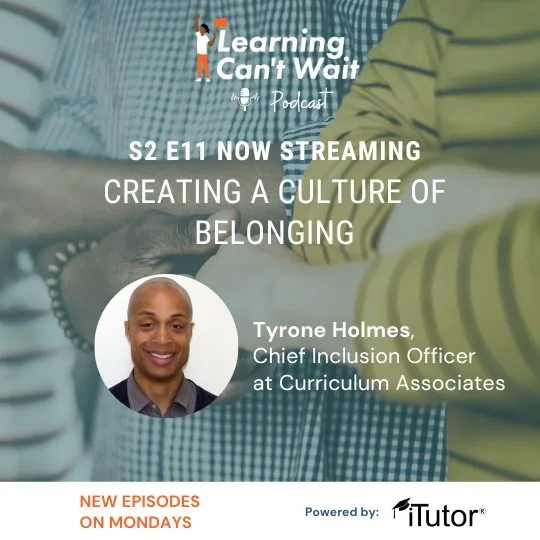
Learning Can’t Wait · Season 2, Episode 11
Creating a Culture of Belonging
 Hosted by Hayley Spira-Bauer, Chief Academic Officer at Fullmind
Listen now
Creating a Culture of Belonging
Episode summary
Ty Holmes, chief inclusion officer at Curriculum Associates, credits University of Maryland professor Dr. Yvonne Gensler with opening the door to educational publishing, where his math background let him explain classroom impact to veteran colleagues. He describes how traveling with CA's national implementation team exposed the racial and economic lines in achievement data and led to his role. Reacting to new NAEP scores, he says communities failed the pandemic quiz if they don't now value teachers. He explains i-Ready's data-to-instruction design, CA's criterion-based belonging goals, and, instead of advising teachers, urges communities to support them.
Key takeaways
- The greatest wealth is relationships; one professor's care redirected an entire career
- If communities don't value teachers after the pandemic, they failed the pandemic quiz
- Assessment should be a learning tool: data tied to actionable, grade-level scaffolding, not a number no one uses
- CA judges belonging by its own criteria, not by Glassdoor-style normative rankings
- Beating-the-odds schools share effective teaching; the work is scaling that wisdom
About this episode
Meet Tyrone Holmes, Chief Inclusion Officer at Curriculum Associates. In this episode, Tyrone shares his thoughts on student assessment, the state of education today, and much more. Tune in!
Learning Can't Wait is brought to you by iTutor.com.
Full transcript
Transcript generated from the recording; minor errors may remain.
Welcome back everybody. I am so excited for you to meet today's guest, Ty Holmes, the Chief Inclusion Officer at Curriculum Associates. Ty, welcome to the podcast. Thank you. Thank you so much, Hayley. Glad to be here. I know that when I name the, the organization that you are a part of, Curriculum Associates, many people's ears will perk up, and I'm sure that during our time together, as you talk about your own education journey and the education journey of Curriculum Associates, there'll be many connections for the folks that are still in classrooms or were in classrooms in the past couple decades.
I imagine, I imagine that'll be the case. Yeah. Very much. One of our guests that has a household name Curriculum Associates, I, or maybe, maybe the term isn't household, maybe it's school hold name. Yeah. Curriculum Associates is a big one that a lot of educators use. And I'm excited for you to share a little bit about your own journey and the journey of the organization today.
Thank you. Thank you. Well, again, thanks for, thanks for having me. I'm, I'm, So, Ty, I know that you didn't begin your career at Curriculum Associates, or CA as the insiders call it. Why don't you share with us a little bit about your own, how you became this professional and personal version of yourself today?
Oh, wow. I would say like, I am really, really fortunate in the sense that likemy greatest wealth has been in relationships, right? Like I've. Just have a great family, amazing parents. I've been really lucky to have cool teachers. I grew up in, White Plains, New York in a a, a town called Greenburgh, which has this like just really sort of rich and interesting history, with diversity of culture and thought and mindset.
And even, even upon going to, college, I went to University of Maryland. Major's, secondary mathematics education, but I, I, I met a professor. I guess my sophomore, maybe my junior year who actually worked in the publishing industry. And what's really interesting for me to think about now is like, even as a student, right?
A lifelong student and you know, books would just appear in classrooms and we would use them. I, I did not actually think about the fact that there was an entire industry of hardworking people who were listening to educator. And trying to make resources to support them. I had, I didn't have, the word, I didn't know, seemed like magic.
Yeah. And like, they disappeared. Like, I, I didn't think about any of the thought that went behind them and I didn't have anyone in my sphere of influence that worked in the industry. So it didn't seem like a possibility to me. And it was just one professor. In a long line of great educators who saw something, provided an opportunity and opened a door.
I love that. First, I love the, the quote that you gave here. You have had the greatest wealth. Your greatest wealth has been in relationships. I've never heard anyone describe their experiences connecting with other people as the greatest wealth. That's such an interesting term. Like you. , it is a wealth to have connections and people that uplift you and enrich you.
So thanks for, for giving that little moniker to the term. Oh, abs. Absolutely. I think that, if anyone, you know, if we, anyone takes a moment just to reflect on their journey, it's people, people like, I don't know anyone who doesn't think like when you ask them, They don't actually work hard like most of the people I know.
Like you work. Yes, of course. I work hard. Yes, I work hard. Like it's always the answer, but most people are in the places and the spaces they are because of some other human. . Yeah. No, and I ask this question in some way quite often, right? And it's, you're right. It's always the people. I've had folks come on this podcast talking specifically about the connections in their lives and how those connections impact themselves and other pe but it, it matters whether it's someone who you look at from afar that inspires you or someone who directly is in your life who challenged you or saw something in you.
No. So often is the story. Absolutely. Absolutely. It's always, it's just always people. So you, I mean, you answered my next question really, which was like, what moment stands out to you. It sounds like this professor had a very profound impact on your trajectory. Oh yeah. I mean her, her name, and she's she's her pastoral, her name is Dr.
Yvonne Gensler. She, Was a professor at the University of Maryland and then she, you know, moved on, from there to a few other universities, but she had a history working in publishing. She worked for, I believe Pearson, she was a consultant for them. And I remember, I mean, like it was yesterday. Her class was the first of my like, professional education classes in my college career.
And it was late, like in the afternoon, like it was after three or four, right? Oh, college, yeah. , right, right. So I remember feeling like that was late and on the first, I think it was like the first night she just asked, you know, she was, it was sort of a getting to know people moment and she asked everyone like, why did they want to become a teacher?
I have no idea what I said. , I can't tell you what I said, but she, she actually asked to see me after class and I was like, huh, okay. That's interesting. And it was like the first night. Never met this person before in my life. And she said to me afterwards, she said, I just want you to know, one of the things I found interesting is that your response was really geared to the impact that educators had had on.
And it was very positive in that, like sort of in that vein. And she said that she was like, I don't know if you noticed, but it was really kind of different. Like most of the class was going in the direction of they wanted to transform this, they wanted to change this, you know, they were here to make this better.
And you literally talked about the impact educators had on you and the, the chance to have that impact. And she just, you know, it was just like a conversation. But the next thing I knew within like a month or two or so, like those conversations continued and she became a real mentor. Mentorship is so important.
I, you know, I, I will say, and, and I'm pulling that out of what you're sharing here, and I wanna go back a little bit more to publishing in a second, but I. I think folks use the term mentor very broadly, but a real mentor can be, as we're saying, transformative and impactful can have a really profound impact on people.
And I, I, you know, I imagine it sounds like Dr. Gensler really had that on you. What about that relationship stands out to you now when you look back at it? Oh, so many things. I mean, first it was. She didn't have to do anything that she did. She didn't have to do any of it. Right? Like, she took the time to explain to me what the publishing industry was about.
She knew that I was, I was graduating. It's, you know, and. Folks who are aspiring educators, you go through this, right? Like you have your coursework, but then you have student teaching. Student teaching is like a semester. And if you don't time out, like your coursework, right? Like it could be the difference between a four year degree and a four and a half year degree.
Right? Right. Like so many, like, you know, aspiring educators go through that. She knew I was graduating in December, that I would be subbing and, you know, those sorts of things. And she said, you know, She sent, one of her former students to a manager who lived in a different part of the country. And that student had a background in ELA and she was like, you have a background in mathematics.
I think you should talk to a few people. Like she did that on her own. Like, I hadn't had a professional, I. Right. I was like, I was like 21 years old. Yeah. . Yeah. And so she, you know, she helped me like even down to like, all right, I, I, I bought this blazer. Should I go with this? Should I, like, it was unbelievable.
The, just the level of detail and care and, yeah, care. That was the word. Care. Yeah. That's care right there. And it, it, it opened, it opened a door that, just led to other, Yeah, I, I love the way you described such small things that you don't forget, right? I, I know that when you think back, you know, this person helped you get all the building blocks in place.
So you could take the next step in your journey and how powerful that was. Ty, that's beautiful. Thank you for sharing that. Yeah, absolutely. Absolutely. So you take her class, you're in, you, you learn about publishing, you realize it's not magic elves that make the books appear . And, and then what happened?
How did we get to your c o role at CA? She's all the acronyms in the world where we are today. Oh wow. That's, that's a much longer story. I, when I started in publishing my, since my background was mathematics, it presented a unique opportunity where I was working for a publisher that was publishing a brand new series.
So they had all of these educators who had tons and tons of experience, but they actually had not been in front of educators with the book. That they were publishing. So while I was, you know, a baby, so to speak, age-wise, I ha had a little bit of experience that all of these, you know, long-term professionals didn't have, which was like, I could really speak to the impact that this book and these resources made.
So I stage sort of in the math realm for a very long time and in publishing, Depend in my past life before Curriculum Associates, companies grew and merged with other companies and, you know, things of that nature. And when I ended up at Curriculum Associates, I was still primarily, I was on a, a team that is, just an amazing team at CA.
They're called, national Directors of Content and Implementation, and I was on that team and my focus was mathematics. And over time we really started to look at our focus really became like equitable access and outcomes for all kids. That team really sort of unbeknownst to them. They really trained me.
They prepared me for this role because they were like, I don't know. They were, they were like poet scholars sort of roaming the countryside , right? Like working with, like spreading the good news and working with educators. But what we noticed, because we're a data tied to instruction company, is we were able to not only look at the data, but look at the data, the data's people.
So we're able to look at what was happening to humans. Demographically, right? Socioeconomically and see those gaps. And then we're traveling to these districts and you know, coming out of New York state and you know, living for a time in the Bronx and so forth. And then traveling around the nation, you start to see like the lines of segregated.
Right, both racially and economically. You start to look at the, actual education data tied to those lines and you start to see where the most need for support is. And I think all of those things, the combination really effectively, led me to this role. I think you bring up this large data set that CA has available to them, given its assessment bank and whatnot, and it is very timely as this morning's headliners are.
All of the recently, which again, it was NAEP data. Let me get to the point. NAEP data. We're waking up this morning, everybody's talking about it. How surprised are you at the results we're seeing this morning? I, I didn't find the results like surprising. Like I wasn't like, wait, I did not expect this ever , you know, that's, that was not the, the case.
I think. Yeah, that, but takeaway wise, I think like, not just like NAEP data, but when I look at the past few years, one of the key takeaways, for me is like, hey. Communities out there, , if you didn't value your teachers before, right, you gotta value them. Now. Now's the time. Now's the time to value them. Now's the time to listen to those teachers who are working in districts, where they're serving the kids who have the highest need, like to listen and to provide them with the resources they need to effectively do their job.
Like now is the. Right. Two. I mean, was it, it was just a year and a half ago where, I mean, there were 8 billion memes of like parents struggling to teach their kids third grade math. Right, right, right. Just desperately wanting schools to open reopen how quickly we forget. Right. Like, and, and realizing just how hard, how challenging the job of a teacher is, right?
Sure. If like,if we're not walking away with that learning, We failed the pandemic quiz.Mm-hmm. . Mm-hmm. , right? Like as a, as a, as a community, as a nation. Like if we're not walking away with that, we failed. We failed the quiz. And it's like listening to educators, providing them with the resources that they need.
The, the training that they need, the lens that they need to look at and implement data effectively and implement instruction effectively, that improves the relationship that kids have with their subject matter. Like that's where it's at. You know, you made a comment earlier about when you traveled the country and you met the people behind the data, and now you're saying it again, you're just saying it a different way.
You're using different words, you are saying. Hey, the data gives us this information. The people behind it are the teachers, and so that's like a real threat I'm hearing from our conversation, and there's no surprise either there, right? We know that in the conversation dialogue around teacher shortage has been an interesting one over the past couple months, but we know that in some places around the country and some demographic regions, we have a teacher shortage.
So not only do our teachers need more help, What to teach. How to teach, which the data does tell us somewhat of a direction, but also how to keep teachers from burning out. Yeah, yeah. That's, I mean, abs absolutely right. We, we definitely need to, it's an extremely important job, and not, we need to make sure that our teachers are taken care of, that they, you know, not just have like, what I would call, Self-care strategies, but that they work in a place where they feel valued, where they feel like their outcomes are, possible, and that they're a member of a team that all has the same initiative, the same goal, right?
Like that's really, really important. And we will, I think as a, like, we have to get better at that. Like our communities have to get better at supporting their teachers so that they. Burnout. Well, and it's interesting because as I was doing digging in preparation for our conversation, I read about CA's mission and one of the, one of the aspects of its mission is actually to make teaching a better profession.
So I'm gonna back us up two steps and we're gonna get there. But Curriculum Associates has been recognized as a phenomenal place to work by a variety of outlets, Glassdoor. Comparably, a whole host of sources say your, your organization is a wonderful place to work. So how do you achieve that? How, what, what does Curriculum Associates, what are you working on with your teams to ensure that your organization is a place of belonging?
So I would say like, to be, to have, a culture of belonging just means that, Effectively, your whole, all of your staff knows that they have an equitable opportunity to thrive, right? That they can be themselves, and that there's not an aspect of their identity that's in some way going to hinder their day-to-day work life and or their opportunity to grow, right?
This is something that we are striving for, and while we. Happy and, you know, over the moon, with the, sort of accolades that are bestowed upon us from other organizations. We set goals for ourselves. We have criteria for ourselves, we have values for ourselves, and we, and we set really, really hard ones, , like really, high goals.
So we are constantly striving to reach the goals we set for ourselves. We never, it's kind of an interesting game where we never quite reach. Sure. No arrival. There's no finish line on it, no finish line. But it keeps us moving and, and what's interesting about that is when it comes to data, and I know we'll get to this later, but when it comes to assessment data, right?
There's like, there's normative data, which is primarily comparative data, and there's criterion reference data, which is really about like what the grade level standards say you need to know or be able to do to perform on grade. So we have internally, like criterion reference data. We're happy for the normed data out there from, you know, Glassdoor and and so forth that look at our company and say, Hey, you're really, we're doing, we are humbled, beyond belief, but it's reaching the criteria we set for ourselves that really matters.
Living and breathing what we expect of our teachers in the classroom. At your own organization, right? It you. I, so much of what I think happens. As teachers who leave the school building, when we work, some of us work at organizations like edtech companies. We suddenly realize that everything is just a microcosm of the classroom, right?
You have to, you have to backward plan everything you want to accomplish. You have to set goals that are big, hairy, and audacious, and companies do the same. It's, it's just, A different format and a different place and space. I love to hear that even though you received all these accolades, you still have goals that you set for yourselves that are hard and ambitious because there is no arrival.
I'm sure that's part of what makes it such a fantastic place to work is that you're continually looking at the future of how you could be better, for the people that are working on this, this journey with you. Absolutely. Absolut. So how does, now going back to the mission and getting back to schools again, how does Curriculum Associates achieve, or how is it going to accomplish some of its secondary part of its mission, which is to make schools better for, for teachers?
So yeah, our, our mission, right? We wanna make classrooms a better place for teachers and for students and the way that we do that, right? There's, there are so many ways to do that and so many organizations that do, you know, things to support, right? Our way of being supportive is to deliver products and services that enable educators to drive, like access and outcomes for all kids.
The shortest way to say it is we tie data to instruction.Data historically has not always been actionable at the level of instruction. Like when I was a kid, I remember, you know, today's the day you go to the gym and you take a test. Okay. I have no idea what that test is or what that test means. You grab your number two pencil, you break open that little sticker piece of tape thing, and then you sit and you take the test.
When you're done, you never see the results. You don't know what it means. You don't know if anyone's u utilizing, what they learned about you on that test. You have no idea. Right? And in many cases, in spaces historically, That's been the case for decades, upon decades. Whereas the way that we look at what we produce is that the, the sole purpose of assessment.
I mean, there are tons, but like at least our heart and our intention is that that assessment's a learning tool and it's meant to tie the assessment data to instruction. The teachers are learning about, right, how they can better reach their students and in one areas the students are getting an opportunity.
To get a sense of what their relationship is with a subject, right? Based on these grade level standards, like where they are in that grade level journey. And then that data needs to be tied to actionable instruction so that a teacher knows. Now I've got a report that says, This fifth grade students on a third grade level with number and operation and a third grade level with algebraic thinking and a fourth grade level with geometry and you know, a third or fourth grade level with measurement.
But what do I actually do with that, right? Like, I have numbers now on a piece of paper, but how do I actually effectively teach the student? And so we answer that. , and that's our way of making right, schools, classrooms a better place for teachers and students because teachers know what the students need and students are getting what they need.
Right? And our tool. Is one way to help. I distinctly remember being early in my career of teaching and getting some data on my students and then seeing like another teacher who was very experienced in the community I was teaching in, had been in the classroom a long time. How they implemented that data and think it was like a light bulb moment for me where I was like, oh, the data itself doesn't really do anything
You actually have to understand the data and action the data. With students and, and you learn it in school. You learn it in your courses, right? But then living and breathing it every day. Because it's every day. It's not for, for folks listening who never taught in the classroom, it's not that you action one piece of data once and suddenly the kid learns the information.
Right? You have to cyclically return back to skill gaps and accelerate student learning so that they can achieve more, or, or, or kind of gain more knowledge and achieve greater success on each of the kind of scaffolded. I didn't know that, even though I learned that until I lived it. Right, right.
That's, and that's what our tool is designed to help. That's what the i-Ready, diagnostic Assessment Suite, is designed to do. It's designed to give teachers actionable data. It lets them know exactly where students are on a K-12 spectrum, like down to the domain level for reading a math, but ties that to actionable.
So if your student is close to grade level or far below grade level and so forth, that data is actionable. And it's also, since we keep getting better at it, it also is actionable, in the sense that it relates nouns becoming cl more closely tied to the grade level scope and sequence that a teacher might be teaching at fifth.
Right, right. Because the, the muscle that, teachers are constantly working to build is, how to effectively scaffold like a boss, you know, hashtag pending , right? Like, it's the, the notion that like there's, every student has unfinished learning. Like every student, nobody masters course, a hundred percent of x.
And then comes in over the summer having all of that, just like now. Okay. Right. Retaining and in their cells, so to speak. Right. So there's always a space or a place where there's something that's not quite fully cooked and while the teacher is going on with their grade level instruction, the data, the reports have to be designed to help them say, oh wait, here's a space where you need to pause.
Right. Teach this in this way. To create an access point for this student or this group of students to the grade level lesson today? Yeah. Not to mention, I think of this, I think it's not a problem if it, if you have the right tools, but this issue that teachers often change grade levels. So they may have become a boss in a master of second grade, and then next year they said eighth and fifth grade, and they have to know a whole new set of content and information.
Which is another thing that I'm not, like, I would love for communities to appreciate about teachers . Oh yeah. You were, you were the pitcher one year. Mm-hmm. , and now you're the shortstop, like mm-hmm. . It's, you know what I mean? Like, you, that's like a, a really tough move. Sure. And teachers, you know, metaphorically have to make that move at the drop of a hat sometimes.
It's like you. August and sure they're told, okay, so you're gonna be, and you're like, wait, what? So, yeah, I had a wait, I had a few Wait, what moments In my school based career? For sure, but it, you know, having the right tools and having the right, data to really know your students because I, at the end of the day, I argue that everything's about the individual, right?
It's never about the curriculum, it's about the children that are in your classroom in front of you each and every day. And so having the right data that tells you about the children so you can adequately support them is what allows for teachers to be successful with every child. So, Ty, I'm curious how you, and how well, how you view the future of teacher teaching and learning.
Like what do you think is the, the next wave. For education. So I don't, I don't really, I don't really think about education in terms of waves or like next waves. You know, I think that there are, there are just good solid teacher moves that are out there that people do and implement, right? And it's just a matter of scaling that wisdom so that more folks can benefit.
There are, I mean, like we did a, what we called, we looked at, sort of like beating the odds data, which were like schools, right? That effectively, you know, beat the odds. They beat, you know, like they defied expectations. They defied, you know, trends from past years. They defied, you know, what their zip code is done like.
And it always comes back to just like really effective teaching . So folks are doing it, I think, so I don't necessarily look at it in terms of here's the, you know, the panacea of the cure, all the silver bullet that's gonna change everything. It's just a matter of like, we have these really amazing bright spots.
It's scaling that wisdom, right? So it's like getting even better at both listening to our educators and then promoting the great things that they're doing. Right, so that other educators across the nation can actually benefit from, it kind of goes back to the starting point of relationships, right?
Bringing, bringing those relationships that you see that are working in schools and classrooms to other people so they can benefit, even if it's not a, a direct connection between the superstar who's making all the right moves as you name, but. Brings us back to that, which is, is a kind of awesome circle to get us at for the end of our conversation.
I, I think that, you know, the last question I, I ask everybody on the, on the podcast is about what advice you would give a teacher starting their career. So I'll ask you the same, Ty, what advice would you give a teacher starting their career? I am, I, I don't, I'm not in really any position to give, advice.
I have often said too to, in, you know, some of our like summits and speaking engagements that like, rather than giving advice to teachers, like listen to them, like I'd rather talk to the community , right? I'd rather talk to the community about like how to value what it is that teachers do. Right.
When you look at any kind of data and so forth that's coming outta your district, the teachers in many cases have already been asking for support in those areas before that data became available, right? So what are we doing as a community to get them the support that they need? Like that's really it.
And, and my hope is, my hope is, As communities do a better job of rallying around teachers, right? That we also consider, the sort of the stress and strain, that teachers are under and start to think about like care. You know, like what are, what are the sort of self-care rituals that teachers have?
Is there a chance for them to share in community with other teachers what they're doing for the benefit, of teachers across the nation? But like what are the things we can do collectively as communities to, to reduce some of the stressors that our teachers are under? I mean, Hayley, during the pandemic, like we were in contact with educators who, even though their schools were closed, they were leaving schools open just so kids could get a hot meal.
Where teachers who literally pivoted on a dime. To learn how to teach via Zoom. And like most people at that point didn't know what Zoom was. Right? Absolutely. Right. Like I know like, like, like they had to find out what Zoom was. And then this notion of creating a lesson and working through Zoom, right. To teach a lesson.
There were teachers who were driving, like we saw this in our community, like that were making house calls. Yep. During the pandemic. Yep. Because this student or that student, like wasn't checking in. Sure. For the virtual classes, like these are the kinds of things that, I don't know if people fully appreciate, but like they definitely should.
Yeah. No teachers, teachers are, are our greatest resource and are some of the most challenged professionally. Any industry that exists. I, I, and I'm obviously a little biased. I'm in, you know, I'm in the game where I, I believe teachers matter more than almost anything in a school building and. What we see is a little bit, uh, quite a bit of erosion.
You mentioned it earlier. We know everybody was uplifting. Teachers at the beginning of the pandemic, like, right, thank you so much for, and now it's somewhat forgotten all of the things you just named. All of the pivoting on a dime, showing up at students' houses, changing every, every ounce of what they know to be true.
Because they physically couldn't be with their students anymore. It, it gets forgotten. Yeah. Yeah. And at the same time, they were going through what we were going through this pandemic. Sure. Right. So like they were doing all of that during the actual pandemic. So, you know, that, I think is, I think it's just, yeah, I would, my, my.
Advice is not a word I use often, but mine would be at least directed towards community and support of educators. Right. And the other thing that we're seeing a lot of now is, like you said, there's this emphasis, this heightened emphasis on acceleration towards grade level. So what are the things that we can do to, you know, Help educators really scaffold for all their kids because increased grade level time is effectively what it's gonna take for kids to actually achieve grade level success.
So the first time ever, no advice to the teacher, but I love why you're giving no advice to the teacher directly. You're giving advice to the communities that surround teachers so teachers can do what they need to do to help children, which. I think is a really important message, and I'm so glad you came on the podcast to share it here today.
Ty, thank you so much for joining me. I've, I've so appreciated your wisdom and what you've shared with everybody listening today. Hey, thank you as well and, I, I really appreciate the, the opportunity.