
Learning Can’t Wait · Episode 207
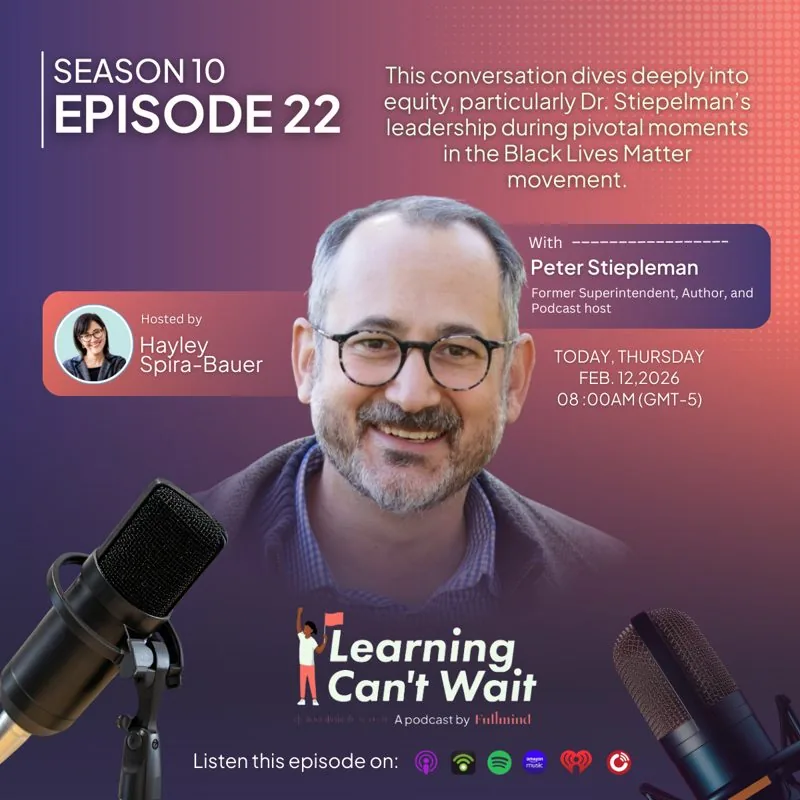
Dr. Peter Stiepelman: Human-Centered Leadership, Equity & Belonging & Imperfect Leadership
- Dr. Peter Stiepelman, Former superintendent, author
 Hosted by Hayley Spira-Bauer, Chief Academic Officer at Fullmind
Listen now
Dr. Peter Stiepelman: Human-Centered Leadership, Equity & Belonging & Imperfect Leadership
Episode summary
Dr. Peter Stiepelman, former superintendent of Columbia Public Schools in Missouri and host of the An Imperfect Leader podcast, traces a path from Long Island to the U.S. Embassy in Madrid, Oakland classrooms, and seven years leading a district spanning urban, suburban, and rural communities. He explains why vulnerability extends leader longevity, how a grow-your-own program gave local students debt-free teaching degrees in exchange for four years of service, and how equity work after Ferguson taught him to decide with the people most affected. He previews his next role leading an elementary school in Cartagena, Colombia.
Key takeaways
- Districts differ in context but share the same systems problems: retention, burnout, belonging, attendance
- Rural communities educate students who then leave; connect schools to local employers and internships
- A grow-your-own pipeline with full college scholarships for four years of service became a Missouri model
- Decide with the people most impacted; a well-meant decision made alone felt like betrayal
- Resist the urge to decide quickly; weigh short-term, long-term, and unintended consequences
About this episode
In this episode of Learning Can’t Wait, host Hayley Spira-Bauer speaks with Dr. Peter Stiepelman—former superintendent, author, and host of An Imperfect Leader—about human-centered leadership, equity, and the courage to lead without pretending to be perfect. Drawing on his journey from Long Island to Oakland, Missouri, and now Colombia, Dr. Stiepelman reflects on what leadership looks like across vastly different contexts and why vulnerability, reflection, and inclusive decision-making are essential. The conversation explores teacher retention, rural education challenges, equity work during the Black Lives Matter movement, and the power of learning from mistakes to build more just, resilient school systems.
Full transcript
Transcript generated from the recording; minor errors may remain.
Hayley Spira-Bauer: Welcome back, everybody, to the Learning Can't Wait podcast. I got to be a guest on this person's podcast, this next guest's podcast. I'm gonna say that again. I got to be a guest on this next guest. Podcast, and now I get to have them on my podcast, and I am so excited for that. Let me please introduce everybody to Dr. Peter Stiepleman, former superintendent, author, and as I mentioned, podcast host. Welcome, Peter, how are you?
Peter Stiepleman: Oh, I'm so happy to be here. Thank you so much for having me.
Hayley Spira-Bauer: You know, the title of this episode is the same as the title of your podcast, which is An Imperfect Leader. I'm going to make sure you tell us why that is such an important concept to you at some point today, but I want you to start off by just telling everybody How did you get here? How did you come to be the personal and professional version of yourself?
Peter Stiepleman: So, that is, you know, I've listened to a number of your episodes, and each person says, like, oh, what a great question, or, oh, I'm really glad that you've asked that. It really helps me reflect, and I thought to myself, I'm not gonna say that. And then, meanwhile, I'm… that's exactly What a great way to sort of start a conversation, to force your guests to really take a step back for a moment and think about their past, how they were socialized, what their background sort of brings them to who they are today. So, well, what a great question. Thanks for asking it.
Hayley Spira-Bauer: Ain't…
Peter Stiepleman: I know, my gosh. So, I grew up on Long Island, so you and I are Long Island folks, and I grew up on the South Shore. And and then I actually went to Madrid, Spain, and worked at the U.S. Embassy there. And really thought that's where I would live, is internationally, leveraging a degree in Spanish and international affairs. And I followed Love to Oakland, California, so it took me away from Spain, which is totally fine, and worked in the Oakland schools as a teacher and as a principal, and then… moved with that same love, and our first child at the time, to Columbia, Missouri. So, right in the middle of the Midwest. And I was a teacher, and I was a principal, and I was the assistant superintendent, and then the last 7 years as the superintendent, and… I would say that that really… all of those experiences make me who I am today. I mean, going from Long Island in a fairly privileged community, in the neighborhood, in the childhood home of my mother's childhood home, so I grew up in the same house that she grew up in. And then, moving out to Oakland and really having a much better understanding of the disparities between rich and poor, black and white. And, and then going to Columbia, where it was… urban, it was suburban, it was rural, it was 300 square miles, 212 buses, it was, like, 75 different languages. It really was quite a, Well, it… when you say, how did it make you the personal and professional journey? That's who I am. It is all of that, and so… it really prompted me when I retired, and then actually moved to the Seattle area, to want to think about those experiences, and so I wrote books, and I started the podcast, and I can tell you all about that.
Hayley Spira-Bauer: You know, that is an incredibly diverse set of districts that you have spent time in. What would you say are your main reflections now that you look back on similarities and differences between, let's say, Oakland and Columbia in Missouri?
Peter Stiepleman: Yeah. I would say, in any school system… I listened to one of your episodes around rural education, which was fantastic, and… And while Columbia itself was considered an urban district by the state definition, it sat very much in a rural area, and so all of my colleagues were in smaller rural communities, and they did everything. And the superintendents in rural districts, the principals in rural districts, they do everything everything. I mean, they drive the bus, they feed children, they are… Responsible for…
Hayley Spira-Bauer: Boss.
Peter Stiepleman: They fixed the bus. They're responsible for the setting the tax rate. They're responsible for teaching and learning, and social work, and every bit of it. And so, the role that I had was certainly a more traditional superintendent role as the civic leader who had done all of these things and also had incredible people who were responsible for teaching and learning and curriculum and all those other pieces. So, I would say. That even though those districts were different, they were very similar in how their systems were set up, it just happened to get bigger, and so… the same challenges that occur in a metropolitan district like Oakland in terms of teacher retention, teacher training, teacher burnout, the sense of belonging or lack of belonging that children might have in school that contributes to their poor attendance, or those schools that are really Absolutely thinking differently about how to teach and learn, and so children don't want to miss a day of school. And so, I would say that school districts across the U.S, are very similar, even if they are dramatically different in terms of their context of who goes there.
[05:00] **Hayley Spira-Bauer:** Yeah, I… the Venn diagram is so interesting to me, now that I've done this deep dive and the study of rural education, and I agree with a lot of what you say. So, can you.
Peter Stiepleman: Where did you disagree?
Hayley Spira-Bauer: Where do I disagree?
Peter Stiepleman: I'm sorry.
Hayley Spira-Bauer: Okay.
Peter Stiepleman: Sorry, sorry, sorry.
Hayley Spira-Bauer: No!
Peter Stiepleman: That's my car.
Hayley Spira-Bauer: It's not that I disagree, I think that… I think that there is a… and I'm sure you would agree with this, you didn't just out… you just outright didn't say it, that there is a really significant Sense of… need to make the most with less in rural America. Like, wherein you have suburbia and urban education settings, there's a lot at people's fingertips. And so, the kind of scarcity mindset and scrappiness that you see in rural America, I do believe, is very, very unique. Yes.
Peter Stiepleman: Well, let me give you an example of some… So, internationally, I do some work in a community in Peru. It's 4 hours south of Iquitos, which is a city that you can only get to either by plane or by boat, and so it is really, really remote in the Amazon rainforest. The community made a real concerted effort that they wanted to educate their children, and particularly their girls. So they didn't have a high school at the time, and an organization called Be The Change Volunteers came together with some others, and they built a high school, and they got their accreditation, and teachers are there now, and they built a really incredible system. And the challenge that they face now is that kids are getting their education and then leaving. As they used to stay, and I mentioned this to some of my colleagues in rural school districts, and they said, that's our story, is that we're doing such a good job of preparing kids for an ever-changing and unpredictable world, and what is predictable is that once they have some of the skills, while they may want to stay. They leave, because that's where the opportunities are, and so then. Small communities are getting even smaller because they don't have the same opportunities. So then, they had to take a step back and see where are there opportunities to not just be an isolated system as a school district. But to actually connect with its community and its county to say, well, who are the big employers here? Where can we find opportunities? Where can there be internships for kids so that when they do go and get their degrees, that they're actually coming back and growing their families and their communities there?
Hayley Spira-Bauer: Yeah, that is so incredibly important. The flight of talent out of… out of rural America is a real, real significant barrier to… having incredible teachers and incredible leaders in many of these schools. Now, speaking of incredible…
Peter Stiepleman: Yes.
Hayley Spira-Bauer: Let's talk about your recognition as Missouri Superintendent of the Year.
Peter Stiepleman: Yes. What an honor. Congratulations, that is enormous, enormous.
Hayley Spira-Bauer: Talk to me a little bit about what the work was like that you think helped you earn that title, and how you subsequently came to be known as the leader of the Imperfect Leader podcast and author of that book.
Peter Stiepleman: Sure.
Hayley Spira-Bauer: To actually.
Peter Stiepleman: Yeah, yeah.
Hayley Spira-Bauer: Hand-in-hand ideas, but I want you to draw the clear picture for.
Peter Stiepleman: Oh, I think that they go hand in hand, because, so I'll start quickly with the podcast and the book, which is, the podcast… sorry, the book is An Imperfect Leader, and, and I thought about the seven years of the superintendency, and what was, like, one big issue that I faced each of those years, and what could I… what did I learn from them? And so I engaged in this very, like, specific after-action review process. And then… I thought to myself, you know, this was really cathartic to some extent, but also, I got really nice feedback from people who were like, wow, I, you know. To sort of pull the veil back and understand what superintendents think about, because not everybody really understands the role. You should do this with other superintendents, and I thought, huh. So I started the podcast of interviewing leaders and leader-adjacent. That's why you were… I mean, you've been a leader, you're doing this important work, and I wanted to support that important work so that, you know, superintendents around the country would have people that they could access for additional support. And so I wanted to ask each of those leaders, tell me about a time that you made a decision, what'd you learn from it? And it's called imperfect because of this sort of… to try to pull away this idea that we should be perfect, and yet we're fed that.We teach the way we were taught, we lead the way we were led, and part of that is this sort of, like. Be really assertive, and make declarations, and don't show them that you're sweating. And meanwhile, I approached it more from.
[10:00] **Hayley Spira-Bauer:** Be vulnerable, and ask people for help, and admit when you make a mistake, and what you'll.
Peter Stiepleman: Is, you'll last much longer in the job, and the national average is 3 years for superintendents before they move on. And it's 2 years if you're a woman or a leader of color, and so… what if we could contribute to, sort of, like, leader longevity by creating this sort of repository of stories that people could go and find? So, if you go to the website, imperfectleader.com, you can actually search, man, I'm thinking about closing a school. What do I need to think about that? And then you can listen to somebody's experience of, like, hey, don't do that alone! Like, engage the people most impacted by that decision. So… and then, when it comes to the Superintendent of the Year, I mean, 518 school districts in the state of Missouri, and so to have been chosen by my peers to be Superintendent of the Year was just unbelievable, and unexpected. Now, I do think one big part of that was, I was looking at an issue with my community that says, man, we kept losing teachers. We would… we… we didn't have a hard time finding teachers. University of Missouri, the flagship school of Missouri, is in Columbia. There are two other local colleges, there are then two more colleges within 30 minutes, and so finding teachers wasn't the issue. It was… After 5 years, teachers not just weren't leaving the profession necessarily, but they were leaving our community to go back home. They're going back to St. Louis, they're going back to Kansas City, they're going back to their rural communities.So, we were like a farm league. We were sort of like AAA. We got you ready for the big leagues, and then you left. Right when you were at your best.And so we thought, well, what if we could really rethink this and grow our own teachers, those who grew up in our community, who want to stay in the community, and then be teachers in our community, and to graduate college debt-free? So, to really help you know, students start building that generational wealth, as opposed to spending most of their lives paying off their debt. And so, because we had 5 or 6 colleges in the area, they agreed to give kids full rides, room and board included, and they had to, you know, they went to college, they became teachers, and they had to give us 4 years. And then, if they wanted to leave, they could. The hope was that they would then come back. And so it's been an incredibly successful program of kids who were, you know, today's students, tomorrow's teachers kind of thing, and I think that became a model for the state, and I think that was a big reason why I was recognized.
Hayley Spira-Bauer: Yeah, that's a huge accomplishment, and I'm sure that anyone who worked in your district or worked alongside of you could probably point out a million reasons why this happened. I would love to call out the… some of the work that you did surrounding, the Black Lives Matter movement. I know that at the time you were still in your superintendency, and you led some professional development trainings on university campuses. I'm sure you did that within the district as well. Talk about, for me, for you, why… or how this moment in… Our, like, our lived history was such an important moment for you and your leadership, and how the after-action review process that you engaged in became routine.
Peter Stiepleman: So, in the book, and I'm really impressed with that you dug a little deeper into the book, and that was a real, a big moment within our community, certainly. You know, Michael Brown in Ferguson, Ferguson's not too far from Columbia, and we were engaged already as a school district and as a community, looking at disparities between rich students, or students who pay for lunch and students who were eligible for free and reduced lunch. I mean, stark differences, two different Columbias. So, you know, here we were as a community, a university town, so children in our community, were among the highest performers in the state, and yet they were also the lowest performers in the state, and so it really had a lot to do with socioeconomics. And if you were, if you, were a student eligible for an IEP, if you were on free and reduced lunch, if you, if you were Black, it was really just, like, so glaring in terms of, achievement disparities. And so, as a community, I thought, like. This district had been founded in the 18… right in the 1860s, so just right after the Civil War, and what… and I always like to look back on where we've come from to know where we're going, right? I said that at the beginning, sort of like. Understanding your past helps you better inform your future. And so I thought to myself, well, who built those systems? Like, more likely than not, there were individuals who thought it was okay to own humans, to enslave humans. And so, those policies and practices continued to follow all the way through, and so it came with, you know, into the 1940s and 50s in terms of redlining, in terms of who could buy homes and where they could build their homes and where they could live. There are still covenants that restricted Jews from living in certain parts, right? So we know that those sort of systems have existed and are now illegal, but yet are still written in documents. So, we decided as a school district, we were going to engage in, like, how have we been socialized, where are the systems of oppression, and what might be some ways that we can sort of dismantle them? What we also discovered was. That I sort of made the decision, so if you talk about after-action review, we had started engaging in sort of conversations around race and where we were seeing disparities, and I shifted the conversation to be around poverty, thinking. Well, we've got this house of inequity, and we're trying to get through this front door, and so this one door about talking about race is kind of sticky, but yet the community's okay talking about it when it comes to, you know, income disparities. Let's go to socioeconomics first, and the team that I was a part of, felt so betrayed, because I hadn't really to them about it, and so it was a… seriously, this sort of, make decisions with the people most impacted. I made a decision without really engaging them. And they were really, like… thoughtful about my heart, and what I was trying to achieve, and wanting to be able to do the work, but it was a mistake in doing that without really talking about the why, and so we changed course, you know, and moved back to why this is super important. Why is it that if African American kids make up only 20% of your school district, that they represent more than 50% of your suspensions? I mean, it doesn't make sense. So when… and so it goes to… our mindsets and our, you know,if you've got a brain, you've got bias, right?So it's about what do you do to sort of rethink our actions and our beliefs so that we can make better decisions. And so, we engaged in, what is called equity training, we had equity teams. And I participated in training all new teachers, because I wanted to make sure that if you're working in our district that you're seeing from the superintendent, like, this is so important. And so we started… and it wasn't just about race, it was race, class, gender, sexual orientation, religion, ability, right? Language, so that we were really engaging in deep, meaningful conversation. And look, it didn't go great always, right? I had somebody who called 911 once.
[17:00] **Hayley Spira-Bauer:** Oh, I have the transcript for that 911 call.
Peter Stiepleman: Isn't that hilarious? Yeah.
Hayley Spira-Bauer: It's wild!
Peter Stiepleman: Yeah. 911, what's your emergency? My wife had to learn about, you know, equity. Like, I'm sorry.
Hayley Spira-Bauer: She's feeling guilty for being white, is what the caller said.
Peter Stiepleman: Yep, yep, yep, yep, yep.
Hayley Spira-Bauer: Called.
Peter Stiepleman: Thank you.
Hayley Spira-Bauer: Yes, we've heard that term before.
Peter Stiepleman: Wild.
Hayley Spira-Bauer: You know, it's just… Today, where we are, as a climate, as a nation, February 6, 2026, There's still this level of pushback, if not more, because.
Peter Stiepleman: Oh, more!
Hayley Spira-Bauer: Because of the federal policies and practices at the moment. Yep.
Peter Stiepleman: I used to say I was born… I was… I was born in Long Island, but I woke up in… in Oakland, and they'd be like… and so I had to stop saying it because it distracted from… all of a sudden, it just was like, oh, woke? Oh, you're woke? Oh, this is all woke? Of course, this is all woke.
Hayley Spira-Bauer: Yeah.
Peter Stiepleman: Like, no.
Hayley Spira-Bauer: I woke up in Philadelphia, is where I woke up, yeah. But it is… So important, and so interesting to me, how… How people find a way to find problems in this conversation, in this Kind of practice of supporting people. Especially the most vulnerable and the ones who've been systemically oppressed for the longest time. But I'm grateful that this work happened at scale, in your community, and… I'm sure that many of those teachers who were sitting in the room on the days that you did the trainings haven't forgotten it, and I hope that it's carried with them through their tenure as educators. Trickly.
Peter Stiepleman: For saying that. I really… One thinks about, in any part of their life, I read this book called From Strength to Strength, and so sort of the first part of your life is about building You know, building your… whoever it is you want to be professionally, and then your second half of your life is really sort of your legacy, and so how do you help and support and… and share what you've learned with others, and what you've just said is my hope, is that, as this sort of second half of life, once you pass 50, is to hope that your legacy is exactly that, is that someone will carry those words and that learning about themselves, and that they shifted their practice, and that they thought about their own relationships with themselves, with their families and with others, you know, the other is always where we struggle, that they're working towards just a more just world. For all, not just some, but for all.
[20:00] **Hayley Spira-Bauer:** Yeah, agreed, agreed. I love the way that you frame that. And now, speaking of the second half of your life.
Peter Stiepleman: Yes.
Hayley Spira-Bauer: Sounds like you're not gonna be retired for very long anymore, huh?
Peter Stiepleman: Yeah, yeah, so…
Hayley Spira-Bauer: What's on the horizon for you?
Peter Stiepleman: Well. I have loved these last… this is… I've done 4 years of the podcast, I've met some amazing people, yourself included, and just get so inspired by the work that they're doing, and I feel so… incredibly grateful to be able to share my thoughts, and I coach superintendents, and I advise some edtech companies, I'm deeply involved in the phone-free movement, and I've been working really closely with researchers around that. But yet, I'm still feeling that I need to do more, and I need to do more of the day-to-day with teachers and with kids, and so I'm starting in July as the head of an elementary school in Cartagena, Colombia. So, talk about, like, radically different, but I'm super excited The folks, the teachers, the counselors, the children, the parents. At, it's called Colegio Jorge Washington, so George Washington. Their mascot is an eagle.
Hayley Spira-Bauer: Oh, wow.
Peter Stiepleman: They are completely focused on empathy and service learning. I mean, this is… when I think of… I mean, I know that you were in the New York City Public Schools, but I think about, like, oh, what is her name? Caroline Pratt, who started the City and Country School. Yeah. And her focus on, if you can do it, then do… like, if… Like, you should do… don't read about swimming, go swimming. Don't read about building a building, go talk to the contractors and the construction workers about the work that they do. When I think about Scott Nearing, who traveled the whole country looking for promising practices, when I think of Ted Dintersmith right now, who's a philanthropist, but he's highlighting the really powerful things that schools are doing, and then creating documentaries or funding them, so the most recent one is called Multiple Choice, really thinking about how to engage kids in real-life learning. This is what that school does. They are engaged in project-based learning, real-life learning, and thinking about their place in Cartagena, their place in Colombia, but then their place in the world. Trying to just really educate future citizens of the world, and as you mentioned, we're in February 6th, there's so much to be depressed about in this world.
Hayley Spira-Bauer: And I really get so energized thinking about, these are kids who are going to become future leaders of this world who really want to make it a more just place. So that's cool. And to be a part of that, I can't wait. It's funny, you're going from Columbia to Colombia. I mean, granted, you spent some time in Seattle, so, like, we'll give you, we'll give you a little bypass there, but when you first told me you were going to Columbia, and then I look… I know the name of your district where you served as soup, I… what irony.
Peter Stiepleman: Isn't that wild? I know. There's a t-shirt I saw on the streets of Cartagena that says, it's Colombia, not Columbia.
Hayley Spira-Bauer: Okay, okay, fair, fair, very bad.
Peter Stiepleman: No, no, no, I…
Hayley Spira-Bauer: That's incredible.
Peter Stiepleman: I was expecting you, I just thought it was funny. Yeah, I'm going from Columbia to Colombia.
Hayley Spira-Bauer: Yeah, exactly, exactly. What are you hoping to bring with you from your time in leadership here in the United States over there to working in a school in a completely different system?
Peter Stiepleman: Right, so, what… well, first of all, what do I hope to bring first is patience. Understanding that, there's so much to learn living in a new place and working with people who have been in that school for 19 years, 15 years, 13 years, so… so I… I… I think when I was a new principal, I entered with sort of a sense, like, almost a degree of arrogance of, like, aren't you lucky, aren't you happy I'm here? Kind of thing. And I want them to know how grateful I am to be there, to learn more. For them. Now, what do I bring? I bring in an ability to build community and to be a part of and deepen relationships, to be in classrooms and learn with and with children and alongside teachers. So, I bring just an energy around understanding that a… A systems… design is what generates its behavior. So how do we make sure that we're creating together this cultural field that says that everyone is valued and honored here? And so, the fact that I get to do that at an elementary school is really where my heart has been for forever. And so, for me, it's… I just can't wait to get back to that.
Hayley Spira-Bauer: You know, one phrase about leadership that I know you embrace is human-centered leadership. What does that mean for you, and how is it different than other philosophies you've encountered?
Peter Stiepleman: Yeah. So human-centered, you know, you've had a number of people who've been on… talking about AI, and they've all been really mindful to talk about, like, AI doesn't care. AI can't care. Right? It is the human that brings compassion and empathy, and then how do we leverage AI for all those other things? So for me, human-centered leadership is about getting to that deeper learning, deeper leading and deeper learning. And I could geek out. I'm mindful of the fact that you don't want me to talk for 2 hours, so I'm mindful of the fact that we're probably coming up to time, but, like, for me, human-centered learning and human-centered leading really… it speaks to three sort of domains. One is collective aspiration. So this is this idea of, like, what do we want to create together? So you ask, what do I bring? I bring this Sort of this universal idea of, like, engaging in appreciative inquiry, looking at what's going well, and then asking, like, what do we want to create together? And then the second domain is this idea of nested patterns. And that really speaks to how do we want to be together? So, creativity and curiosity and empathy and compassion and shared leadership. Where they're… we don't lead by title. So, you know, right before we got on, I said, you might say Dr. Stiepleman, but I just… I don't want to lead by title, because that's not the most important thing to me. The most important thing to me is that people learn with me and see that I… care deeply about the experiences and the expertise that they bring, and so that's the most thing. And then the last is. The leader's learning work, and that's kind of where Brené Brown's work around being vulnerable comes in, it's where resilience comes in, it's where storytelling comes in, because our role as educators is to be great storytellers, to understand that language matters, and then to build like, enduring systems, so that when any of us leave, that somebody isn't walking in and saying, like, so, how do we do these things? Like, it seems like a great place, but nobody wrote anything down.
[25:00] **Hayley Spira-Bauer:** So, like, how do we… I know that you had to have been…
Peter Stiepleman: A part of a system where you've walked in and they're like, yeah, it's all oral history, as opposed to, like, real, like, clear systems. Like, oral history's important in terms of, like, generating a culture. You also want to make sure that it prevails and outlives all of us.
Hayley Spira-Bauer: Yeah, yeah, and iteration, or continuous iteration and improvement is really difficult when it's in your brain, not on paper. Like, all the things that we know to be true. I think that's so exciting, and… In an age of rapidly emerging technologies, it is more important than ever for us to have humans in the loop, and so I think this is a really promising and important concept to bring with you, and ultimately, especially as you kind of put yourself in a new context. And culture and community even more valuable, because computers can't help you understand the people that you're working with, or living beside. It'll tell you, what a great idea that you want to understand this system, right? Stop praising me. What a great idea!
Peter Stiepleman: Yeah, what a great idea. I just go on just to say, like, I think I have an idea. What a great idea that you have an idea.
Hayley Spira-Bauer: Totally, totally. You know, in looking at everything, you just highlighted something when you look back about, the first time you were a principal, and what the mindset you kind of held. What would you say to yourself, if you could? Like, that first piece of… practical insight or personal journey, philosophy? What would you… what advice would you give yourself? If you could speak to that first version of a principle.
Peter Stiepleman: Oh, what a great question, and I really… How about, like, resist the urge to make a quick decision? I think so many of us, we enter leadership and we think that we're supposed to… you know, show that we're great leaders by being able to respond quickly. And I'm a quick thinker, and so I have to remind myself, like, actually, consider the issue fully. Resist that urge to come to a quick conclusion, because… When we resist, we're able to think about the short term, the long-term, and the unintended consequences of that decision. And so instead of having to sort of back up and re-fix what we tried to do as, like, a quick fix. Like, we're actually able to make sure that we're making really inclusive decisions. And so one of the things that I could have done better, particularly when I first started. Was, really understanding the relationship that schools need to have with its parents, and with advocates in its community. Because sometimes we, we say, like, just leave them at the door, we're good, we got it. And truthfully, like, it really is a three-legged stool. It is the school, it is the parent, and it is the kid, right? That we have to honor and value their voice, because sometimes we make decisions we think are in their best interest, and have nothing to do with what they want. So, I would say, resist that impulse to make a quick decision.
Hayley Spira-Bauer: You know, I'm here on his kick now for advice, and I'm amazingly ready to ask you my last question, which is, what advice would you give a teacher starting their career today? Is it the same advice you'd give yourself.
Peter Stiepleman: Yeah.
Hayley Spira-Bauer: It's different because.
Peter Stiepleman: Because I do think that there are leaders at every level, and so when I think about the question, and I answer it as a principle, I'm really sort of translating that word into educator, because we just have different roles. And so, my thought is, the things that you did well as a teacher is why you got promoted to principal. It's why you got promoted to assistant superintendent or superintendent. And so, if, in fact, you walk in. No, you know, confident in what you've learned? And also cognizant of the fact that you don't know it all. In fact, you really need to rely on your team. And be willing to ask people for help. And to do it in a way that doesn't… that you're not waiting too long to ask for help, that you are really vulnerable. It is that sense of vulnerability that actually strengthens that core, not just you as your core, but the school as a core, as a place of… that it become that place of learning.
[30:00] **Hayley Spira-Bauer:** Yeah. Peter, you are such a breath of fresh air. You bring your whole heart and your whole brain to the work that you do. I cannot wait to see how you continue to shape our field in your work in Columbia, but also just so grateful to know you.
Peter Stiepleman: And to know you too, Hayley, I really appreciate the time you give me.
Hayley Spira-Bauer: Oh, and thank you to PBK, who introduced us!
Peter Stiepleman: Oh, that's right! I know!
Hayley Spira-Bauer: No?
Peter Stiepleman: Joke, that's right.
Hayley Spira-Bauer: And thank you to everybody who tuned in today to the Learning Can't Wait podcast.