
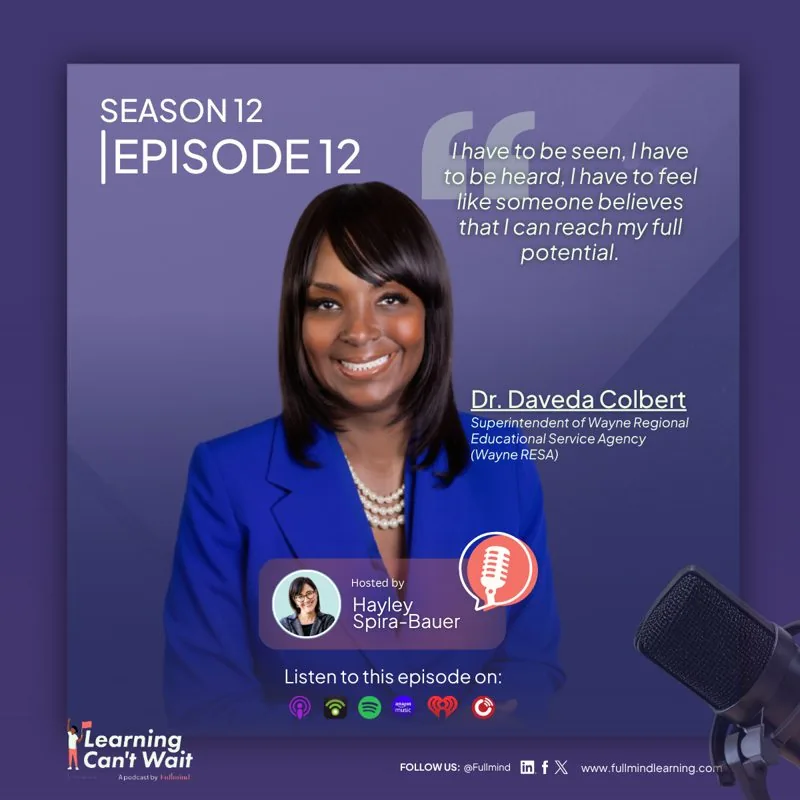
Learning Can’t Wait · Season 12, Episode 12
Dr. Daveda Colbert: Leadership, Belonging & Service
- Dr. Daveda Colbert, Superintendent of Wayne Regional Educational Service Agency (Wayne RESA)
 Hosted by Hayley Spira-Bauer, Chief Academic Officer at Fullmind
Listen now
Dr. Daveda Colbert: Leadership, Belonging & Service
Episode summary
Dr. Daveda Colbert, superintendent of Wayne RESA in Michigan, credits her mother's lessons on character for a career that began when a one-week substitute assignment revealed a class on its fifth sub. She recounts taking over Oak Park Schools in 2010 with an $8 million deficit, an empty central office, and buildings up for sale, and turning it into a district of 5,400 students with a $14 million surplus through belief, visible leadership, marketing, and expanded programs. She closes with advice to lead with heart and character.
Key takeaways
- Oak Park went from an $8M deficit and 3,100 students to a $14M surplus and 5,400 students
- Leading by example matters: she took the same 7% pay cut she asked staff to take
- Turnaround started with asking the board, mayor, police, and businesses for six months and no negative talk
- Every scholar needs a plan: dual enrollment, CTE, arts, athletics, and wellbeing
- Diverse teams that challenge the leader produce better decisions; no one-size-fits-all across 43 communities
About this episode
On the Learning Can’t Wait podcast, host Hayley Spira-Bauer speaks with Dr. Daveda Colbert, Superintendent of Wayne Regional Educational Service Agency (Wayne RESA), about a life grounded in character, belief, service, and care for others. Colbert credits her mother, Jeanette, with teaching her that integrity matters as much as knowledge and describes how a one-week substitute-teaching assignment inspired her to leave a government accounting career for education. She later applied those values to help transform Oak Park Schools from an $8 million deficit and declining enrollment into a financially healthy, growing district by leading through example, rebuilding community trust, and expanding opportunities for students. Now supporting approximately 260,000 students across Wayne County, she emphasizes that every scholar can learn when they feel safe, seen, heard, included, and genuinely believed in.
Full transcript
Transcript generated from the recording; minor errors may remain.
Hayley Spira-Bauer: Welcome back to the Learning Can't Wait podcast, everyone. I am so excited to introduce you to our next guest. We have Dr. Daveda Colbert, the superintendent of Wayne Regional Educational Service Agency, and Jeanette's daughter joining us here today. Welcome, Dr. Colbert. How are you?
Dr. Daveda Colbert: Thank you. I'm so excited. I am fine. I am fine. And how are you?
Hayley Spira-Bauer: I'm doing wonderful. You know, no one ever asks me how I am at the start of the episode. It feels good.
Dr. Daveda Colbert: It matters, it matters how you make people feel matters.
Hayley Spira-Bauer: Well, I have a feeling that's going to be a theme today as we talk about your work and your life and your commitment to education. Perhaps you could start us off by telling everybody how you came to be the personal and professional version of yourself.
Dr. Daveda Colbert: You know what? Thank you for asking. So, first of all, I say I'm Jeanette's daughter, but I'm really Jeanette and John's daughter. So, born, to two amazing parents, but raised by one. So I was raised by Jeanette. My mother and father were only married for one year, and, my mother then took it on to ensure that her life's legacy was really ensuring. That I am who I am today. So my mother always reminded me that everything that she did was for me. And I will say that even to this day, because she lives with me at 83 years young, she'll be 84 next month, I am still living her dream. And so if there was everything that she wanted for me to have come to fruition, I could say that it has. She reminded me each and every day that I only had one name. And that was the name that I was given, and do not ruin it. She's like, ensure that you make the best of every moment. Ensure that everything that you do, it is what you want to do and how you want to be perceived. She was like, you only have one life, live it to the fullest. She always told me that character would outweigh whatever knowledge and skill that I had. She's like, oh, you can be the smartest cookie ever. She said, but if your attitude is not right. She's like, you're not going to come in first. You're not going to get the job that you want. She's like, they're going to overlook you. She said, honestly, you're not going to be picked as the captain of the team. She said, it's going to be the character that will carry you. She said, so yes, I'm telling you, go to school and get all the, you know, skill that you can get, do the best, show up in your best version. She said, but that attitude is going to be what's going to carry you over the top. Top. And so I love that, have always remembered that. I was taught to be reminding of myself to I am somebody and just hold that true for life. And I could say that my mother only has a high school diploma, and I say only, yet her education was beyond that high school diploma. She worked 50 years in her field. And so I, too, carry that commitment of service and of love, and I carry it forward. So that is truly… you say, how did I become who I am? It truly is because of my mother's love. Her faith, her praying over me, watching over me, and pouring into me every step of the way. And I am truly what she wanted me to become. I'm still becoming, but each day I'm living to fulfill that dream.
Hayley Spira-Bauer: That is quite the legacy that you share of your mother, and also how you've accepted her message and really thrived with it. Can you talk a little bit about how that inspiration has impacted your work in education?
Dr. Daveda Colbert: Absolutely. So, what a blessing to have been a product of. So, I had the opportunity to attend a small school. So, of course, I was a pre-K kid. My mother always works. I was always in school. So, I was in school at three. I was in school at four. And then went on to a Catholic and Lutheran education K through eight. And then a proud product of Detroit Public Schools, 9 through 12. So I'm a Detroit Public School graduate. And then I had the opportunity to attend a historically Black college and university for my undergrad, Southern University at New Orleans, and then came back home to Wayne State for my master's degree, my master's and my ed specialist, and then my doctorate degree at Oakland University. So. Had the opportunity to definitely attend school, school, school. I mean, and it was… you keep going until you've earned every level and every layer that you could, because education is key. So, having that understanding that education was the key to unlock doors, and then realizing that, Nelson Mandela, you know, education is the weapon and or tool that can be used to change the world. Is really the reality. I am… I am still a believer that that is. A piece that you must have, and then you also must carry that character along with it, so integrity and honesty and all the things. So having the experiences that I had through my educational journey allowed me to get my bachelor's degree in accounting. So, of course, I believe that I'm going to go and be an amazing accountant, and then attend law school. And so that was really the journey. I was going to law school. I wanted to be you know, the best prosecutor. I want to be a federal judge. Oh, I'm on my way. Yet coming home from college and earning that that bachelor's degree in accounting, I started working for the government at TACOM (Tank-automotive and Armaments Command) and really loved my job. It was amazing. My first real you call it real job. You know, when you graduate from college, it's your real job with a real salary. That's what I'm thinking it was. But the truth, it was really an opportunity for me to examine what I ultimately wanted to do. I grew up being a leader, being the only, my mother's only child. So I grew up in the home by myself. I tell people I was the leader of the dolls. I was the dolls in my room. I was the leader of the dolls. I was the leader of the stuffed animals. I was the leader of myself. But then I was also a leader in church, you know, in the youth department. Then I was a leader in school, you know, whether it was being the, you know, the class this or the class that. If they had terms of president in my class, you know, it was always about being the leader, not just to be the person, you know, that was. Like the top person, but being the person that was actually the decision maker, or the one that was the convener, bringing the people together, or the one that was helping people get through the conflict. So it was always the… I hate to say it, some would call it the busybody, or the know-it-all, but it wasn't that. It really was about just being the one in the middle, kind of making all things come together, and then now we're moving forward. Now we're going in the way that we needed to go. And so having that spirit along the way, it allowed me to really have skills where speech skills, speaking skills, being in front of… honestly, helping people come to a decision. What's the way that we're going to get to the decision? Okay, now we have a decision. Do we… are we going to take a vote on it? You know, or are we going to go with the majority? And so having those skills, it was just, you know, going to TACOM (Tank-automotive and Armaments Command), I even had that. You know, in the accounting role, yet… really was questioning, is this what I'm… is what I'm doing helping me to be fulfilled? And so, during my one-week vacation while I worked at TACOM (Tank-automotive and Armaments Command), one of my sorority sisters said, let's go and provide service to Detroit Public Schools and substitute teach. And she was like, we're not going out of town, so let's go make some money during our vacation. And so we did. So we went and did this one week at a Detroit public school. I, at that time, went to Dixon Elementary School, and I'll never forget the principal saying at the end of the week. He said this is the first week. It was October. He said it was the first week that the students in the class, which I had a 7th and 8th grade split. None of them had been kicked out of the class, they had all remained in the class. The first week that they had done all the work that was assigned to them, they actually performed well in doing the work, so they were showing signs of that they had to listen to the instruction, they followed what I had done, and then they submitted it. He said, honestly, we've had no behavior issues, and they've actually done something that we can see that they've done. He said, you know, I know you have to go back to your job, but if you ever want to come back, he said, our doors are open. He said, and I hope that you would consider teaching, because you truly have a gift. Well, I was like, oh, that's awesome. I'm going back to work next week, but wow, I feel honored. I was so honored. I was really teary-eyed when it was time to leave. The students were wondering why I had to go back. And I finally asked, you know, those tough questions of, well, wait, where is their teacher? You know, I did sub for the week, but where's their teacher? Like, their regular teacher? They didn't have one. So I was their fifth sub. For that school year. And I had only been there one week, but then I was going, and I wasn't coming back, I was going back to work. I went back to work, And all that did was continue to play in my mind of. Why should any child experience that? And about 2 weeks later, I decide that I'm going to write my resignation, give them notice, and I am ultimately going back to that school. And I did just that. So, thank goodness I was given the opportunity at TACOM (Tank-automotive and Armaments Command). They said if I ever wanted to come back, I could. And I was also given a great opportunity to go back to the school where I had been for a week, so I went right back to Dixon Elementary. A blessing, because from that point, I've been committed to education and a life of service. So although I thought I was on my way to law school, planned, prepared for the LSAT, had applied to Wayne State's Law School, all the things My calling was to return to education because of that one-week experience, and from there, I went from substitute teacher to teacher. To athletic director, to assistant principal, to principal, to assistant superintendent, to superintendent. And now. All of those were at a local level, and now I'm at the county level, continuing to serve in a way that really opens doors. Ensures that scholars improve in their outcomes, continue to empower people, and continue to serve in a way where districts, organizations, and systems are strengthened. So today, I believe that I'm continuing to be a part of meaningful change that endures for a lifetime. And that… Is my purpose.
[11:00] **Hayley Spira-Bauer:** I mean, that is the most incredible fortuitous. Star alignment I have ever heard in my life. First of all, do we want to give a shout-out to your sister's name, your sorority sister's name, who set this trajectory in motion? I mean, she sounds like…
Dr. Daveda Colbert: Absolutely. So Felicia, Felicia and I, so Felicia was a student at Dillard University. I was a student at Southern University at New Orleans, but we were both from Detroit. We were in college at the same time, and then we both came back home. Felicia has now retired from Detroit Public Schools and has returned to Detroit Public Schools as a teacher today.
Hayley Spira-Bauer: Oh, my goodness gracious. Thank you, Felicia, for having that recommendation.
Dr. Daveda Colbert: Detroit Sorority Incorporated continues to be a part of who I am and my service. I had the opportunity to attend Roundup this past Saturday for Detroit Alumni Chapter. So all in divine order.
Hayley Spira-Bauer: I love this. You know, you told a little anecdote that is really, really meaningful about how the students were performing at their best when you were a substitute teacher. You know, I know… Because I've worked in schools for many, many years, being a substitute is incredibly challenging. You have to walk into a room full of children who don't know you, and you have to earn their respect in day one. What did subbing students. That time teach you about leadership that you still use in a boardroom today? Because I bet there's a lot of parallels in how you have to win people over in order to lead them.
Dr. Daveda Colbert: Oh, I love it. So we'll start with Hattie's research is very clear that the effect that the teacher has in improving student achievement is significantly high. And so definitely people matter. The way you treat people matter, and the way in which you enter the room. Matters, and I'll say that. So I went in, again, not knowing the backstory of what was going on with these scholars. I didn't know that I was the fifth person in, you know, in front of them since the start of the school. I found that out at the end of the week. I didn't know that they had not really performed at their best prior to me arriving. I didn't know that they hadn't even stayed in the classroom prior to me arriving. I didn't have those. So I went in. Loving on the young people that were placed in front of me, recognizing that, of course, I was a student in school. We know that we would give the substitute teacher all the havoc that we could if that substitute teacher allowed it. But the ones that didn't allow it, we didn't give it to them. So I knew that I had to enter the space with the confidence and the belief that these scholars can learn, will learn. And that they are going to receive whatever message that I have. I didn't go in believing that they wouldn't receive it. I went in believing that they would receive it. So you have to believe it first, and then, you know, give it your best effort. Goes back to my day one story. Give it your best effort. First, believe. I'm one of those that believes, because if you don't believe, then you can't receive, you can't achieve. You know, if you don't believe, then, you know, if you're not speaking your own victory, then. How do you see it to fruition if you don't have a growth mindset? So all of those pieces coming together, and as you said, using those same pieces then that I used today, I walk in that spirit. So I'm going to walk in prepared. I'm going to walk in, acknowledging that there's always room for growth, and then I'm going to walk in acknowledging that we have a goal, we have a target, you know, we have a reason why we are convening, and so we are going to accomplish that, and we have to have some steps in between to get there, and some things that we must do to align, you know, our thinking to arrive at our outcome. Yet, our goal is to get there. You know, there has to be some target that we set that we must achieve. There has to be some reason why we're doing what we're doing to ensure that we're doing it well, but I always start with how you treat the people. You know, so you walk in positivity, and that is the way in which you then get those positive outcomes that you are expecting. You know, but you do the work in between. You know, you assess it, you then, you know, do what you need to do to address it, and or to tweak it, and then you keep going. But, nothing beats a failure but a try. And so you'll say it was the same way in which I walked then that I absolutely still walk today, and has served me well in this leadership. Quest, and I say that I'm still becoming even today, although you could say, well, how long have you been a leader? Since day one, since birth? But that was because that's what my mother said, and that's what she poured into me. So I've been leading for 55 years.
[15:00] **Hayley Spira-Bauer:** You know, as I listen to you, I have a big question that I've been wanting to ask next. But I feel like I already have the answer based on what you told me. So there is a little, not a little, there's a fact about your leadership. When you took over Oak Park schools, there was an $8 million deficit in the district and families were leaving. All the time. So basically, I'm listening to the story that you're saying about how you were raised, the commitment you made as a substitute, how you took that to leadership. And I feel like I could answer the question. How did you do it? Based on what I know about you so far, because you lead so clearly with your values. But still, can you tell us, how did you change the course of that district's trajectory? What… what… What values did you bring to the forefront? And how did you make, you know, this lemon into lemonade?
Dr. Daveda Colbert: So what's so unique about Oak Park is that I actually lived in Oak Park when I served in Oak Park. I had moved to Oak Park prior to even becoming the superintendent of Oak Park. So when I was the high school principal in Clawson, I actually moved to Oak Park, which made my route to Clawson Public Schools, where I served as the first African American employee in Clawson. It made my ride just so smooth. I never had to get on the freeway, I could take Main Street to work, back and forth, so that was how I ended up moving to Oak Park, so I always lived in Detroit, in Wayne County, but then I moved to Oakland County and moved in Oak Park, not knowing that eventually I'd serve as their superintendent. So what a great opportunity to live in the community where I serve. So, here I am, living in Oak Park, and I was tapped to be a part of a community, a community task force that was helping Oak Park with… Their decisions, giving them recommendations, because they were running into a time where they needed to look at buildings, clothing them, selling them, all the things. They had to do some restructuring with the district, and they wanted community input. I happen to be a resident, so they tapped me for this community task force. So I'm a part of that committee. We finished the work. I'm very strong with my recommendations. Then, at that time, I was actually serving in Detroit Public Schools as Assistant Superintendent when I was serving on this community committee for Oak Park Schools. The community committee was about a year plus prior to the posting. And then the posting comes out for Superintendent of Oak Park Schools. So I've served well as a community committee member. I already have some of the information inside, because I live in the community, and also now, because I've been a part of this committee for the school district. And the posting is sent to me for several reasons. One, because I live there. Two, because I was a part of that committee, and so now I'm known in the schools just for that committee work. Three, I'm serving as the assistant superintendent then in Detroit Public Schools. And fourth, they just need a dynamic leader. I'm not sure that they had me marked as the dynamic leader, but I was definitely on the candidate list to be considered in the applicant pool as part of this process. Well, I apply. And I go through the process, which was a very long process. And then I start December 1st, 2010. I can tell you that I shared with them when I When I was granted this job. That I think the posting was false, because the numbers weren't correct when I went inside. They said that they were maybe a million or two in deficit, they were actually 8 million in deficit. They said that they had, maybe 3,200 students, now it's more like 31 and declining. But, I don't believe that they actually falsely posted, I just think that things continue to evolve. As the posting went up. So when I was hired, I was like, woo, I came in, and this is a little different. It's even tighter than what I imagined. Yet. I knew that that was most likely the case. I went in with that same spirit. First, you have to believe that you can do it. If you don't believe, then there's no sense in you going in there. Second, you're going to have to rally the troops, meaning the people inside, and at that time, unfortunately, they were broken, they were hurt, they were still great people, but they were torn. Because the contract wasn't settled. So here we have contract conversations. They're going to have to take a pay cut of 7%. A pay cut. I'll tell you, I went in, I accepted my pay, and then took a 7% pay cut.I had to lead by example. So you don't ask people to go where you won't go.So I had to lead by example. So that was first move, that was like, whoa, she took a pay cut walking in the door. So I took the low salary, and then a pay cut. I also took a job with no one. In the cabinet or central office, meaning the team was very slim. For example, the person who was in HR, his name was on the door, but he hadn't been to work. In a week. He didn't come back to work. He was gone. So he had just exited, and it appeared that… I don't think he gave anyone notice. He just left. He went on one day and just didn't come back. So HR, no one in the office. Curriculum and instruction, sorry, we had to let them go. Oh, we've even cut the day from a 6-hour day to a 5-hour day. So you just say, if there was anything or everything. That you could have thought of that was happening, it was all happening at once. Yet we had to make it, because guess what? We still had 3,100 students and families there. We had to do something about that. And so I told them, if you could just do me a favor and take the two buildings that you have now put on, the list to be sold. They've now been posted as up for sale. Could you please just pull those back? Could you give me the 6 months? To try to figure this out, because one of the buildings was an actual school, and it was in the parking lot of the administration building. So if that building went up for sale, guess what would happen? A public school academy could open right in my back door, sitting right in the parking lot where my office is, which would then also pull additional students. There was already another public school academy that was in need of a charter who was coming to Oak Park at that moment to get their charter authorized that was also located in Oak Park, so I asked them not to approve or authorize that charter, because if they did, here I am having another school open up on me, which already has Oak Park students. We can't keep doing that. Not… Openly. And so the board. They said that they would give me the 6 months to give it a shot. They pulled down the postings of selling the two buildings, which one was the administration building, and the other one was the school that was in the parking lot. And I said, just give me a run. This was December 1st, board meeting was that week, and I asked those things as part of the board meeting of my first week on the job. What I will say is, I just asked them to give me a chance. I went to the then-mayor who had asked for an emergency manager in February of that same year, February 2010, the… that mayor, then-mayor, who became the former mayor shortly after, and now the person who became the mayor in Oak Park is actually still the current mayor today. I asked the then-mayor, could he just give me a chance? Please don't ask for another emergency manager. Could you not call for that? Could you allow me the opportunity? So I started to make all this headway with meetings, with conversations. I went to the city council, talked to two members there. I, like I said, went to the mayor. I met with the police chief at that time. Who didn't have anything favorable to say about the schools either in that moment. I mean, I went to businesses, I kept going. My six-month run was more than a tour of meeting the people. It was not only a meet the people, but it was also an ask. Please work with me, please partner with me, please not the negative banter, please support me, just say that you've met me and that, hey, I think she has a plan. I'm not sure if it's gonna work. But I think she could you just stop saying what you're saying. I also asked my own team inside my own staff. Could you parents, could you not tell the parents that this isn't a good place for their kids to be? Because you saying that doesn't help them leave their children here. And then I started on this marketing campaign of what the school could and should, what the school district could and should look like. And all I will say is, the rest was history. By January, I had partnered with a third party, opened up an alternative school. By January, I had enrolled 150 students by second semester. So that was the first turn in enrollment that they had seen. And by the fall of 2011, we had enrolled 1,000 new students based on marketing. Based on community support and feedback. A few had returned that lived inside the city, and then a few students were coming from all over. They were coming based on a couple things. Some of the students who were enrolled were the children of students that I taught. So that went a long way. Some of them were students who I had worked with because of the connections from the other communities and districts I had worked in. So they were now bringing their children to where I was serving as superintendent. Some who are returns who had been there previously. Others were coming because of the marketing that I did around the school district that we wanted to have. And by the fall, we had enough children, enough scholars, to then make the moves to move the district to what we described. So we enrolled more pre-K, we enrolled more K, we… turned the band around, so now I had a marching band that students wanted to be a part of, our athletic programs, so athletics, arts. Academics, students who needed more. If you thought that we didn't have the academic structure that you needed, then I connected you to dual enrollment classes, to the Center for Advanced Students and Learning. I made sure that you were connected to CTE opportunities, where you were going to the Oakland Technical Center. So we were building out plans for every scholar. So whatever you needed, including well-being, before it was even The word well-being was we were loving on the scholars and the families. And because of that, changing the mindset and the beliefs. All of that, the growth… we brought in Carol Dweck's book, Mindset, for the staff, for the community. We did the work. So, the same things that I described from childhood until even today as a superintendency. Was what made that transition from 2010 to 2019 a story. To be talked about, wherewe went from $8 million in deficit to $14 million to the good. We went from 3,100 students enrolled to more than 5,400 students enrolled at one time.We went from all or many of the schools being on the list of a watch list because of academic performance to coming off the list during that time. No longer had staff vacancies. We laid off no one during that time. We actually had to hire each year. We started each school year with a full complement of staff because people wanted to be there. We went from having schools that possibly needed to close based on declining enrollment to bursting at the seams in classrooms and having to monitor enrollment. A complete turnaround. From start to finish, of everything, but it started with a mindset and a belief that we can do this. And that this is a place where not only you want your children, but where everybody else wants their children to be, because we care for the scholars.
[29:00] **Hayley Spira-Bauer:** Goodness, I'm glad I asked that question. That is incredible. You know, enrollment declines are really common right now across the United States. Schools are struggling as families have different options afforded to them, and maybe their schools have been in crisis for a very long time, and for this from educational justice, and they've made difficult choices. I don't believe that families are… always aware of what's possible with the right supports in place and the right people at the helm, because sometimes they just haven't seen it before, and it makes it really challenging for the community to draw families in. You've given a really clear example of what steps you took, obviously in a very condensed form. To make that visible for families, so that this became a destination, not a community that you wanted to avoid. Can you talk a little bit about how your seat today, as the superintendent of superintendents. Really allows, or, or… Helps other leaders to create that type of environment that attracts families to the district.
[30:00] **Dr. Daveda Colbert:** So I appreciate that. So today I serve as the Wayne County, superintendent, Wayne County being the largest county in the state of Michigan, where I have 33 local education agencies and 95 public school academies encompassing 260,000 students, so just about 60,000 in those public school academies and then the 200,000 in the traditional public schools, so choice. Galore in Wayne County. Wayne County encompasses 43 communities, and what I'll share is that there is a place for everyone. But to be able to work through this, that means that there's no one-size-fits-all. Yet, they're all common… there's so many commonalities. Caring for students is first. Safety matters. Students, scholars, they have to feel safe. They have to feel safe, be able to learn in a safe environment, but also physically feel safe. In the environment. But there also has to be a place for everyone, so inclusive environments, that can't be a buzzword. There must be an inclusivity factor for any and every scholar. That… that just matters. I have to be seen, I have to be heard, I have to feel like someone believes that I can reach my full potential. And when I have that. In most cases, I'm off to the races. I tell people, young people want structure when they say, oh, they don't, they just don't want to follow, they don't put it in front of them. Command their attention with it. Push them forward with the language that you use that allows them to know that they're seen, that they're heard, and that they can do it. Find out what the root cause is for those irregularities or whatever's happening that's not, you know, going well or showing up well. And then work to make those things happen for them as best you can, and then keep pushing them forward. Constant reminders that they are somebody. And that they continue to live in their purpose, and that they will be able to fulfill their greatest dream. Just open up your eyes and start doing the work. I'm… you will see them push through and make it.There's no such thing as a scholar cannot learn.I put on any song, they're singing it. I make some moves, they're trying to dance to it. They show me what they want. They go, look, when my phone, I can't fix it, they can fix it for me. They can show me how to do some of the most creative things, and I was like, I wasn't even trying to do that, but wait, where'd you find that? So, what I say is it's just how they learn, when they learn, and why they learn. It's all about finding the right ways to get them to do. And all they need is that encouragement and that belief to keep going. And so, I know that, that is what we share in our collective being for the ecosystem that I have here in Wayne County. It really is about supporting the leaders. And supporting them in the moves that support, you know, their leaders, and then what supports those teachers, and then what supports those scholars, and then how do we add that additional support for the family piece. So, those are the commonalities. That's everywhere, whether we're in the most affluent districts and or the ones that have the highest number of families who would qualify for some kind of assistance. So, we have socioeconomic, you know, status of all levels across this county. And we have to serve well in each of those. And so my meetings, although I have everyone in the room, so it's diverse, I tell people diversity is positivity. Diversity, is definitely greater strength. And when we come together, it is powerful. So diverse thinking is necessary. I'm not hiring 25 people like me. I don't need 25 clones. We need to make sure that we're meeting the needs of all, which means we need inclusive opportunities, and we need a diverse… a diverse pool. I need someone to challenge even what I'm saying and or doing. It matters, because what that does is takes me to the highest level. There is no stopping me. We have to keep going higher and higher, and so it's the same thing with our district. So I tell… we don't go with deficit thinking, so even the districts that have the higher socio… socio, you know, economic factors that are needed, and the supports that are needed, that just means that we need to make sure that we have them there. That's it! That's just what that means. We need to ensure that all the pieces are there. So again, commonalities are across the board, but there's no one size that fits all. And so we just have to continue to work together. Look, we play together, we work together, we learn together, we grow together. That's just our model. It's one Wayne County, yet unique across the board with the 43 communities. And so having this opportunity to serve in this capacity, again, continues to allow me to ensure that doors are open. It allows me to ensure that scholars improve their outcomes. It allows me to advocate at the highest level. To ensure that my advocacy matters. It allows me to, you know, continue to empower people. Today alone, I have a Wayne County Women in Leadership opportunity this evening from 4 to 7, where the Wayne County Women Leaders come together for conversations. They come together for learning. We're actually using the book today, The Influence Effect, A New Path to Power. For women leaders, and so this is actually the book that we're using in this year's series. So I've been running this series now for 5 years called Wayne County Women Leaders, and we meet three times a year for this convening, so we meet once in September, once in January, and once in May, and it is Wayne County leaders of all levels, from superintendents, deputies, assistants, executive directors, managers, supervisors, principals, so it's building and central office leaders, principals, assistant principals, a leader. Look, if you show up and you don't even have that in your title, I tell people. Titles are within. I've been a leader since day one, so it's not about what goes beyond your name, it's what's in your heart, and that you know that you're leading. So you're leading as a wife, you're leading as a mother, you're leading as a sister, you're leading as a daughter, you're leading as a teacher, a leader, etc. And so, these ways, again, this seat allows me to have these kinds of opportunities. I started this convening. I have an African American leaders convening. You know, that I host and hold. Again, making sure that I'm serving in ways that continue to empower others. It really is about the impact. So I tell my kinfolk that when I leave this earth, you won't have to write my obituary. Hopefully you can say she lived. The life, and she led, which is the legacy. And with that, I hope that, they just do just that, and they don't try to put a bunch of words on paper. That they just say, the dash, she fulfilled it. She continues to walk and ensure meaningful change that endures forever.
[37:00] **Hayley Spira-Bauer:** I, that is, like, the perfect ending to this podcast, but I still want to ask you your advice for a new teacher who's starting their career today. Dr. Colbert, what would you tell them? They're just entering the classroom. What would you give them?
Dr. Daveda Colbert: You know, I would tell them to lead.
Hayley Spira-Bauer: Okay.
Dr. Daveda Colbert: And to lead well. To lead with the heart. And then ensure that they also use their mind. Common sense goes a long way. People will always remember how you treated them. And remember, the same people that you see while you're climbing the ladder, they'll also be there when you come back down the ladder. So make sure that your character is a reflection of what you want it to be each and every single day. And always give your best effort. Where possible, continue to learn and grow each day. And remember, walk into every single classroom, greet every single scholar, and know that there is A child awaiting greatness, and all they need is you. The effect size, the reality, the real research. That person in front of those young people. Changes their lives. They definitely script their trajectory. So remember that every life is precious. Give it your all. You've got this. And don't allow the narrative of education, or the narrative of teaching, or the narrative, even of public education. Don't allow that to hinder you. You are so needed. We've all had a teacher one day, and those teachers make a difference. And just remember that. When there's tough days, go out and walk a mile. When there's tough days, go find a joke, crack up, find a way to smile. Intentional joy is necessary, and I say that in every career, but I definitely say it in those in which we serve the public. Continue to lead well. There's a leader inside of all of us. Teachers are needed. They are heroes with and without capes. And we need them. The field is real.
[40:00] **Hayley Spira-Bauer:** Dr. Colbert, thank you so much for coming on and sharing your story. I am leaving this conversation feeling so hopeful and inspired. It has been truly an honor to interview you.
Dr. Daveda Colbert: Oh, thank you. It has been an honor. I am honored to have had this opportunity. I thank you and you keep doing what you're doing. Please keep doing it because the message is needed and we there's a ministry inside of all of us and this is your ministry and I say that to teachers too. That's a ministry. Go continue to minister to the people. Go continue to make meaningful change.
Hayley Spira-Bauer: I love it. Thank you everybody who tuned in today to the Learning Can't Wait podcast. Dr. Daveda Colbert everyone.
Dr. Daveda Colbert: Thank you.