
Learning Can’t Wait · Episode 70
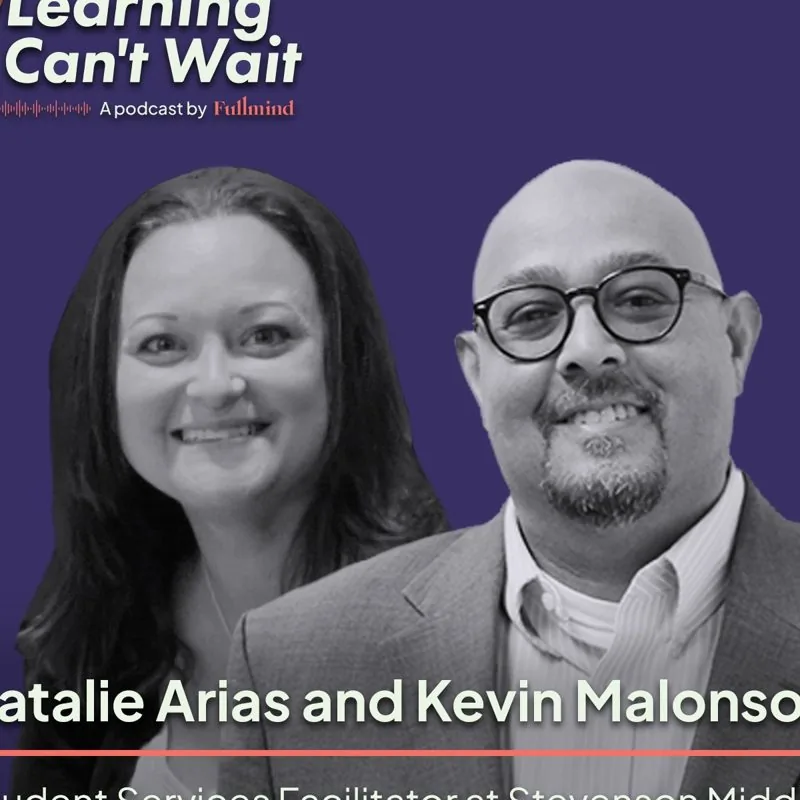
Natalie Arias & Kevin Malonson: Leadership, Advocacy, Policy Fellowship, Effective Educators
- Natalie Arias
- Kevin Malonson, Educators
 Hosted by Hayley Spira-Bauer, Chief Academic Officer at Fullmind
Listen now
Natalie Arias & Kevin Malonson: Leadership, Advocacy, Policy Fellowship, Effective Educators
Episode summary
Kevin Malonson, executive director of Teach Plus Texas, and senior policy fellow Natalie Arias describe how the national nonprofit trains effective teachers in policy and advocacy and puts them proximate to decision makers. Teach Plus fellows helped shape Texas's $6 billion 2019 school finance bill, and Natalie has testified on teacher preparation. They explain the competitive 600-applicant selection process, Wednesday-night cohort meetings, narrowing advocacy focus, and why developing teachers' skills matters more than headline wins. Both argue teachers must be able to lead without leaving the classroom.
Key takeaways
- Teach Plus selects about 50 fellows from 600 applicants, scoring how teachers collaborate more than their policy answers
- Fellows own the policy work; staff facilitate, train, and put teachers in front of legislators and regulators
- Opportunity begets opportunity: policy skills carry back into campuses and open leadership paths without leaving teaching
- Developing teacher skills pays bigger dividends over time than chasing big political wins
- Advice for new teachers: it's a marathon; focus on what you can do, do well, and what makes sense
About this episode
Welcome back to the Learning Can't Wait podcast! In today's episode, host Hayley Spira-Bauer engages in a compelling conversation with educators Natalie Arias and Kevin Malonson. The duo takes us on a journey through their personal narratives, sharing the pivotal moments that led them to the field of education.
Delving into their advocacy work with Teach Plus, Natalie and Kevin shed light on the organization's commitment to addressing crucial issues affecting students, teachers, and equity in education.
Produced by Fullmind
Full transcript
Transcript generated from the recording; minor errors may remain.
Hayley Spira-Bauer: Welcome back everybody to the Learning Can't Wait. Podcast I am so eager for you to meet my 2 guests here today doing the work of helping teachers get into school buildings and a teacher themselves. The very, very heart of the education space we have. Natalie Arias, A student services facilitator from Stevenson Middle School in San Antonio, Texas, Natalie. Welcome! Thank you so much for having me, Hayley. I'm so excited to be here. I'm so honored that amidst your busy day. You've joined us here today. Thank you for being here as well. And we also have Kevin Malonson, the education, the executive director of Teach Plus Texas. Kevin. Welcome.
Kevin Malonson: Thank you, Hayley. Pleasure to be here to talk with you and with Natalie today. Thank you.
Hayley Spira-Bauer: I love that I have this pairing here today, I'm I was introduced to Kevin. And Kevin said, You know, Hayley, I'm not gonna do this podcast. Alone. I think I have someone great for to join me here, and so I'm excited to dig in. Find out how you 2 are connected and really spotlight the work of Teach Plus along our conversation. But before I get ahead of myself I wanna start out by having you both answer my first question, which is, how did you come to be the personal and professional version of yourself. Natalie, will you start us off, please?
Natalie Arias: Absolutely. So I, in my formative years, grew up around a lot of educators. I come from a family full of them cousins, and my mother is a retired public school teacher, and no shade to any of them, but I really thought for a long time I was gonna do something different. And I was in a on the quest to find what that was gonna be. And in the course of that search I found that in every industry that I worked, in every role that I held, II always ended up in some position of teaching or educating whether it was mentoring or training, or. You know, client, customer, patient education so at some point I sort of surrendered to the universe and said, Okay, I guess I'm supposed to be a teacher, and fast forward 10 years. Here I am, with a lot of experience under my belt and different campuses and different roles. And the role that I hold currently, I actually attribute a lot of what took me there to my experience with Teach Plus as a policy fellow, and this year, as a senior policy fellow, that opportunity and experience has just been so expansive for me personally and professionally, in terms of understanding education on a more macro scope. You know, understanding it in terms of how it works as a system, and all the cogs that you know function together. And I'm passionate about the advocacy work that we do with and through Teach Plus so that's what brings me here today, and and how I know Kevin, and I'm so honored to be part of his company in that regard.
Hayley Spira-Bauer: I love the stories of teachers who fought the tide, but still became teachers. Because. You know, there's so many little kids that aspire to be teachers. When they grow up. They have a fantastic experience in in school, and they love their teachers, or one of their teachers makes a profound impact. But there's as many important stories of people's pads meandered, too, and folks who never considered themselves fit for the role of being a classroom teacher, and still found their way so excited to dig into that. Natalie. Thank you for sharing.
Natalie Arias: Of course.
Hayley Spira-Bauer: Kevin, same question for you. How did you come to be the personal and professional version of yourself.
Kevin Malonson: Wow! I mean, I think it was literally the opportunity to be able to help people and meet people like Natalie that brought me into this field, Tommy, literally so. I'm the oldest of 4 children from Houston. My great grandparents were sharecroppers in Louisiana, and early on the message of you have to get an education. To be successful in life was the thing that my family just pushed. And as time went on, I realized. Wow! Not only is this education gonna be a path to hopefully a sustainable life for me, but I'm also gonna be able to learn about this world, learn how to come up with my own opinions and my own perspectives. And then, like I said earlier, to be able to meander like you, you mentioned to be able to meet folks like Natalie and the fantastic teachers that I'm able support in the work that I do at Teach Plus I mean it is. You know you said it. I wouldn't be on this podcast without a teacher. And Natalie just really articulated. You know that why teachers, educators are closest to the children in our schools, and they need to lead on policy and practice issues that advance equity and opportunity for those children. So that kind of ethos literally brings me here to be with you today, and I appreciate the opportunity.
[05:00] **Hayley Spira-Bauer:** I love that story as well. I appreciate when people are are willing to be vulnerable and share just how their journey to education happened. The world needs great teachers, and more of them. So, Kevin, can you paint a picture for us a little bit for folks that are unfamiliar with Teach Plus what is the work that you're currently doing? And how did you and Natalie come to be collaborators in this space. And you know Natalie mentioned a little bit of her policy work. So what does that mean for Teach Plus and and how is that impacting communities today?
Kevin Malonson: Yeah, Teach Plus is a national teacher leadership nonprofit. We work in 12 states. And we we target those states where we can get the lion's share of of really teachers that teach students that need advocacy, and people fighting for them. And so now I got lucky. Literally, I was voted. I was elected, selected as a fellow for Teach Plus in 2018, and about a month later. The executive director then told me, Kevin, we're hiring. We need somebody to run this program. And frankly, at that time I was better suited to run the program than to be a a fellow in the program. And since then I've become the executive, become the executive director of Teach Plus Texas, and what we do is go out and find effective and engaged educators like Natalie. We select those folks that we think are going to be good. We put them in a cohort environment. We focus on a handful of specific education policy topics. Our job, then, is to train those teachers up on policy and advocacy. Put them proximate to decision makers and leaders and let them lead and you know, as a result of that in Texas in 2019 our teachers were the voice of reason when the Legislature passed the largest Education Finance Bill since the eighties and injected about 6 billion dollars into public education. Natalie herself testified on really critical issue in the State of Texas. And if you pay, if anybody paying attention to the State of Texas, we're now on our third special session. And yet we haven't adequately funded public education or teacher raises this year. And so when it's time for folks to give that type of feedback. What I prefer is for me to step back and my team to step back, and for us to facilitate Natalie and the rest of the fellows that work in our policy fellowship. We're trained up on how to communicate. They have really solutions, oriented perspectives, and they always bring recommendations. That's the suites also Teach Plus.
Hayley Spira-Bauer: I love that, Natalie. You have to tell us what that experience was like last year, because that's that's pretty like life changing work.
Natalie Arias: Can you paint a picture for us of what that work was like for you. Absolutely. I mean, you nailed it with that descriptor. It is life changing, and it is completely inspiring in a time where public education and to be a public educator is you know, we shoulder a lot, and so to be involved in something where I feel as an educator, I have been lifted up in such a way. That I'm able to actually impact and affect positive change, not just on my campus, but also statewide, you know, and and again, especially at a time where there are some pretty hot ticket items that are, you know, up for discussion right now surrounding education, and so to to have a voice in that is really huge. II mentioned earlier that my experience as a fellow led me to the point where I have been in pursuit and accepted this specialized role on my campus. That role is affording me a seat at the table in conversations happening locally. I'm also now in a position to help empower my teachers on that campus, and even my admin by educating and informing them on these policy issues. And you know, doing my best to amplify their voice as well through this advocacy work. So it's like taking, you know, your reach and really expanding that that has been the most powerful part. I think of this experience, not to mention coming together with such like minded individuals that are also passionate about this work is such food for the soul. And every experience that I have with my fellow fellows, if you will, and the leadership that we have through Teach Plus is just. I am continually and forever leaving with my cup feeling full, and that you know, I carry that with me into my day to day work as well. So it's just been an in like, I said before, an incredibly expansive opportunity. And it's really important work that we're doing. And to see the fruits of that labor has been incredibly rewarding along the way.
Hayley Spira-Bauer: I love to hear that filling of your cup. You you've named 2 at the top of what your response was. This is incredibly hard work. Being a teacher today is very different than it was even when I was in the classroom some 8 years ago. And it's the landscape has changed, the politics have changed, the demands have changed. The social, emotional needs of our students have changed. The academic needs of our students have changed. We'd be remiss if we didn't name the pandemic as part of that as a large part of that force. You know, Kevin, I am. II meant to ask you this earlier. And it's it's reflecting, because I'm hearing Natalie Sharon. It's so clear to me why Natalie was chosen for this work. I'm just curious from your, from Teach Plus perspective, what goes into identifying an effective and engaged teacher like, how do you measure that? How do you decide that? Because I know a lot of those folks like wha how? How? What's the bar that you all set to to define it?
Kevin Malonson: Well, we have a pretty robust application process, and over the last few years we've had as many as 600 people apply for approximately 50 spots in the fellowship. And so, you know, we have an application that includes, I believe, 4 short answer questions. We then do an initial screen of the applications. We then invite folks to come back for a one on one phone interview and a group interview, and both of those are scored. The group dynamics are really really important. And in in in that group interview we come up with a fake policy scenario. And here's the secret we're really looking for more of how you interact with other educators than what the policy looks like. But you know it is. It is. It's tough. That's one of the hardest parts of our job is to whittle down the the amount of people who actually just want to spend time with us and do this difficult work. You know, Natalie talks about being in community community with all these teachers. But Hayley, that's Wednesday night. After the teachers have worked all day long from 6 30 to 9, and Natalie oftentimes we don't have enough time in that 6, 30 to 9 slot. I bet we could make it 6, and people probably would not complain. We stuff learning time in there. We stuff community time in there. We stuff an awesome guest speaker in that space, and then we give the teachers time to work on their the policy projects. And so it's. It's very difficult, Hayley, to to choose teachers for our policy fellowship, but oftentimes I feel we can't go wrong if somebody is signing up to do this work. Now, granted, we do pay a small stipend, but it doesn't pay for the time that the teachers put into this work. But if you know, if folks are gonna put time into filling out an application and saying, yes, I'll be available at for all those hours that at least we know upfront. We've got folks that are willing to do the work, but then we do also make sure that they can prove to us that they are effective in the classroom. So we ask for evidence of that. And we ask questions about what does your practice look like? Can you really teach children? And that's important.
Hayley Spira-Bauer: I love that that that is such a sounds like a thorough process, and really helps to identify folks that are completely engaged with this work. You know, Natalie, I'm curious. Did you ever see yourself as doing work beyond the classroom in this connected way?
Natalie Arias: I can't say that I saw that early in my career. When I first was introduced to Teach Plus. I want to say, Okay, what year are we in 20, 2, right? 230, my God! 23, almost 24. It's almost over to get ready. So yes, the mind of a teacher. What day is it back in 2,021 is actually, when I first learned of the Teach Plus opportunity, it was sort of an email blast that came through the district as this, hey? Here's an opportunity for anybody that might be interested, and at that time things were still extremely. I hesitate to use the word volatile, though it might be appropriate, but surrounding you know. Equity in education, and I was really compelled to do something about that. I had no real sense of what Teach Plus would entail. I just knew that it was. It was an opportunity for me to explore, and I applied, and went through. You know this vetting process that Kevin described all the way through the Zoom interview the small group sort of quick, rapid fire simulation. And that first year I actually did not get selected. I think that was the year that you you guys had like triple digit applicants because everybody was so energized around this work, and at the time I was a little bit disappointed because I thought, Oh, man, that's that seemed like a really cool opportunity. But I also had this sort of internal like knowing or trust that. Okay, it's alright. It's just not the right time for me to do that work. It's not for me right now. Then, fast forward a year. And I was contacted by our policy program manager at the time and and inviting me to interview again. And you know, I assumed that it was like a I, you know, it was like a mass email that they sent to anybody they had in their system. And I think I said that when I spoke to our policy program manager at the time, and he was like, no, you were on a short list like we kept your name on a list. And and I was so moved that it came back around to me like trusting that the timing wasn't right, but the work was, and so for it to come back to me in that way, it just it felt right. And so I was so excited last year to join as a a first year fellow and you know. Get my feet on the ground, and and it takes a little bit of time initially to understand the full scope of what we're doing. Because again, I had this misperception that you know, somebody else was doing the policy work, and and as a fellow I would be supporting that work either with research or whatever. And you know, as soon as we got started. It was, it was very clear. The messaging from Kevin and our policy program manager was, this is about you guys, you we are going to facilitate. You know, the opportunities for you. But this is your work, and and the training that we receive on how to go about that work is just bar none. I really II can't speak highly enough about about the framework that Teach Plus utilizes to build, to build and develop us into the policy advocates that we are at heart. But you know there's a skill about how you go about that. And that's really where you know I can again. I can't speak highly enough about what we're given, and and one phrase that I will forever associate with Teach Plus. I hope to be involved with Teach Plus for ever. But one phrase that I will never forget, no matter what, and will always associate, is,opportunity begets opportunity.We hear that so frequently from day one. And it is. It's such a driving force for me ever since, because I not only feel equipped to take the opportunities. But I also now have a totally different lens through which to look for those opportunities.
Hayley Spira-Bauer: Think you know every moment in every podcast our cord. There's a moment where I'm like, oh, there's the title of the podcast opportunity begets opportunity so perfectly describes this work that you all are doing and really speaks to my heart. It it thank you for sharing your journey. I think that's so cool that you had the mindset like. Oh, this isn't the right time. But the right time came to you. It speaks volumes about your character and your work. Ethic. II really really appreciate you sharing that, you know, you know, Kevin and Natalie I there are so many topics that I would want to advocate on, or that I do advocate on, but there are so many personally, how do you narrow down your focus like I? Sometimes I feel like I'm too, you know. I always preach like inch wide, mile deep. That's what you gotta do. But with this there's so much I would want to talk about. How do you decide?
Kevin Malonson: I'd love to hear. I'd love to hear Natalie's perspective on that, because it's it's a dance for sure
Natalie Arias: It is. And and one of the things that I struggled with in the in the beginning was like narrowing my focus. Because, you know. And and this is the funny thing. We laugh when we're in our our policy cohort meetings and and in our smaller advocacy group meetings. We just kinda laugh about all of us coming in with all this energy and excitement around varying things. And we can just go on a diatribe about all of them. But part of it is, part of the process is narrowing down the scope of our focus, and what we, what we can actually tangibly try to accomplish in the in the scope of this work. So Teach Plus kind of guides us on some of the major sort of like categories, I would say of of policy issues surrounding education that really impact a lot of different aspects of what we're doing in our classrooms, and how we're able to do it. You know, with the parameters of varying legislation. That sort of, you know, dictates the parameters of that. So in that we are given the opportunity to exercise some choice as fellows as to like what some of those key focus group areas are mine happens to be, for for the last 2 years has been around teacher, preparation and development. But there's a number of things, and they all sort of overlap so part of this dance that that Kevin is talking about is not just focusing on our smaller advocacy group topics in the work that we do together, but also individually recognizing the overlap and taking the opportunities to extend that advocacy through, you know, writing op-eds delivering testimony, varying opportunities. Where? You know. Like, I said, we have a seat at the table, and we can actually lend our voices to the the decision making. That's happening.
Kevin Malonson: Kevin, do you wanna add on to that? I know you deferred to Natalie first, but she gave a great answer, but I still would love to hear your thoughts as well. Yeah, I mean, she she gave a fantastic answer. I think what she's articulating also is a bit of my perspective on this work changing when I started as the Executive Rec. Or actually, when I started as a policy manager, I was much more concerned with us getting big policy and political wins. As time has gone on. I find that oftentimes we still have a lot of the same working groups and generally the same working groups get big wins, because that's where the opportunities are in. Teacher prep and education finance. But the thing that I focus on over the last couple of years, and I would be remiss if I didn't say I have a fantastic team that leads this work. I happen to be the executive director and I get to pick these folks and set the vision. But our policy managers. We've got 3 of them on team. Now. They are the folks that really put this vision into into play. But it's it's it's working directly with those teachers, figuring out what they want to get involved in and then giving them skills like the focus on developing the teachers over the last couple of years for me has paid bigger dividends than it did in the past. We're also able to find folks like Natalie. Figure out, hey? Where do you want to grow? And like you? She said it. I didn't. She wants to stay around, teach us forever. Well, my job is to continue to find opportunities for her to do that, and it is if we focus on the teacher skill development. I think the policy work will come, and you know, the the last thing I want to add is certainly in a place like Texas. We really have to be ready when there's an opportunity for big win. And so I've also prided myself at poising our teachers whether it's at the legislative level or at the regulatory level, or even at the nonprofit partner level when folks are looking for solutions oriented teacher voice that can come with recommendations and is always prepared. They call Teach Plus. And then, like Natalie says she keeps coming. She does a great job. I'm gonna call her again. So this this work is as you can tell. I get jazzed up about it as I as I talk, but it's it's all about advancing these teachers and their voice, and and helping make sure that if they want to stay in the classroom or in the school and the school building they can do that and still be a leader.
Hayley Spira-Bauer: Woof! That last part I like don't even have a reply yet, because that last part's huge. You know. I know a bit about teacher vacancies. So, topic, I am familiar with my day to day. It's something. I talk about all the time on the podcast. And clarifying for the naysayers. There is a surplus of teachers, but there is not proper distribution of teachers across our country, so there is a shortage, but it's regionalized. So the notion that you want to support the teachers who want to stay in buildings is also really powerful.
Kevin Malonson: That's delicious. That's so.
Hayley Spira-Bauer: It's hard to do both. Natalie, have you had trouble balancing the demands of being in a school building and and have your colleagues that you've you've been in your cohort with had trouble? And if so, how have they approached that? Or, if not, how have they approached that?
Natalie Arias: Have we had trouble balancing work of of the policy work with our day to day. Yeah, because you want to sust, we want to sustain it right, Kevin. Name that if if they want to stay in school holdings. We want to support you to sustain that Umhm. I, personally cannot say that I've struggled. II think, because I'm so passionate about it that this is like the the cherry on top for me. There's also so much that is connected in the work, I think. With the experience of working through Teach Plus. I am taking those skills that Kevin's talking about, not just into. You know, a Senate hearing room to give testimony. But I'm also taking those skills into the classroom and onto my campus. And it's through this growth and understanding around educational policy that I am able to take that knowledge into this established. You know, building institution if you will, and attempt to make things better even in just the way that we function day to day on my campus. Fortunately, I have a really supportive administrative team on my campus, and even supportive leadership in our district that are, II think, at the end of the day. Probably every public school wants teachers who are invested in in improving. You know the environment and the the function of our our schools ultimately for student outcomes, right like student achievement. And so for me to have for me and other fellows to have this opportunity to to gain extra skills and knowledge and expertise. And take that into our our campus environment. It's almost the most direct way that we can affect change. Because, like Kevin was saying. You know, there's this energy and excitement around the big policy wins that we can say we had a hand in. But sometimes I think that as I continue to do this work, some of the greatest wins are like the less headline, worthy things that are happening on our campuses with our students. And so for me it has not been a struggle to balance, because it's it's such important work that I'm passionate about, and I think almost all of our fellows would agree with that statement. And in terms of the the time commitment it just it. It doesn't really feel. You know. I was always told by my grandfather growing up. If you, if you do work that you enjoy it doesn't feel like work. It doesn't feel like labor. It's it's something that you're like pouring your heart into. And and that's so true. And I'm so glad to have found that in Teach Plus that that really is like the real life come to fruition lesson for me of what that looks like.
Hayley Spira-Bauer: Funny. You gave that quote from your from your grandfather, because when Kevin, you were sharing about the work you do. I got that energy from you. I got that like, I love this work. I love what I get to do, even when I first met you through the introduction of the esteemed Brett Roer, I was, I like, totally transfixed by the passion and drive and commitment you have to. I like how you said it. Putting teachers proximal to the policy that's really exciting. It's energizing. Again, there's a whole notion this season on on the Learning Can't Wait podcast. That I've been circling around a lot which is sustaining the work because regardless of how you're touching education, we have to sustain it. A burnout is real, and this work is hard, and so, having passion for the work, I think, helps with the folks that are able to sustain it
Kevin Malonson: That passion is huge, and then also like a real recognition of where you fit in the system. And you know not everybody to know. Natalie mentioned this about how there's this, this zeal and enthusiasm in the policy fellowship. Well, you know what? Guess what? Out of 50 folks we're gonna have a few folks every year that this just isn't their thing. They don't think we're moving fast enough. They don't think it's radical enough. It's just doesn't, you know. It doesn't fill their cup the way that it does for Natalie and myself. But you know for me, I always tell anybody who will listen my career. And specifically this work. Now, it's like, it's a. It's been a labor of love, and it's been a selfish endeavor, because it makes me feel good to be able to do the things that I can do both for our society and then specifically for the teachers and our policy fellowship. So like that education. The superintendent in Dallas is one of my favorite people, Dr. Stephanie Elizalde. She always says education is the people business. And I believe that. And she also says teachers are the program. These are 2 things that I'll never forget that she tells me all the time education is the people business. So Kevin, make sure that you build the best authentic relationships that you can with people and show them who you are and continue to do that. And then in the education space. When you realize that teachers are the program. Certainly kids are the beneficiary of what we're doing in schools from 8 to 5 every single day. Butif there is no teachers, there's no program.So like, I can't think of a higher calling for somebody who spent their life working in education than to be of service for these teachers working on behalf of their students. You know that's somebody. Come and pinch me and take this away. Ii will have been a dream. It is definitely a pleasure to do this work. And and I think you've got to bring some of that you got to bring some of that with you to be successful over the long run.
Hayley Spira-Bauer: Oh, there's so many other things I think we could touch on this conversation. II have to tell, you know. Funny! I don't know that I mentioned this to you, Kevin, but probably 6 times since the middle of August. People have sent me that. What Barbie teaches us about school leadership article written by Shayla Ewing, the assistant principal at at Pekin Community High School in Illinois who's a Teach Plus Senior Writing Fellow, and I know that you know you talked a little bit, Natalie, about the writing that that folks are doing the blogging. But you know you, you're very much out there, and this work is I I've before I even knew or put the pieces together about Teach Plus. I had read about Teach Plus and other places and spaces, that article being just one example, I think, that really captured an important sentiment about equity in school teaching and leadership. You know II talk about all this, but I do want to be respectful of the time that we have with each other today. And II think it's important. This question that I always ask folks at the very end of our conversation, I think, is so critically important to you. And that question is. What advice would you give a teacher starting their career today? Who wants to go first?
Kevin Malonson: I'll go first to give Natalie some time to think about it. So I would. I would venture to guess I was probably the worst teacher out of the 3 of us in this room. My teaching career was very short lived, although I was in the classroom on 9/11, and that left a profound mark on me, and I think of those children you know. To this day. But for somebody that is coming in to be a teacher who expects to be a teacher for the the lifetime for their lifetime. I would say. This is definitely a Marathon, not a sprint. It's gonna be better tomorrow. Keep at it, keep at it, keep at it, and recognize what your why is super practical information, super practical advice from the old guy in the room?
Natalie Arias: No, that was wonderful advice. I think I have to kind of 2 answers to your question, Hayley, so forgive me for bending the rules there. But one. The first thing that came to mind is is a statement that I heard a a long term teacher make at a professional development my first year in my current district.: I worked in the fine Arts department, and they do a thing every year at the beginning of the year, where they bring all of us together from the whole district, and they line everybody up and turn in from, you know, the least experienced to the most experience, and the person with the most experience, our fine Arts director would say, what would your advice be to that very first year, teacher, down on the total opposite end of the line. And he said. Don't take anything too serious, and don't take anything too personal. And in the classroom that was like a light bulb for me, and I was like, Oh, this is brilliant, because when you kinda remove those things, you can really focus on on what you're trying to do and what what you know, what's right in front of you, instead of getting caught up in the things that you can't really control. Now that I have progressed and grown and developed in in my career, I think, while that's solid advice. I also now in thinking about that thing. Wow! But it is personal in terms of the advocacy work that we do. So I would struggle to give that advice in. In the my, you know current context, I think my advice would be what is focus on what you can do.Well. And what makes sense?: Because one of the things that I've I've gleaned from my time in the fellowship is, you know, we can talk about and around all of the different things that we would like to see happen in education, in educational policy, in the classroom on our campuses. And a lot of times that conversation turns into sort of a gripe session, even. You know, at varying levels throughout education. I think. In the work room on campus, you know, amongst your teacher, friends, and happy hour even. You know, even probably around the table at some of the the higher up meetings, you know, there's a lot to be concerned about.But the solutions that we're after really come from this place where we're focused on what we can do, what we can do well and what makes sense.And I think that's just really a good way to kind of ground ourselves in in what we're doing, whether it's policy work, or, you know, delivering a lesson to the 30 students that are in front of us.
Hayley Spira-Bauer: Woo a word. I love that and Natalie and Kevin. You know. I sometimes I feel so selfish for hosting this podcast because I leave uplifted and inspired and driven after listening to brilliant folks like you, who are doing the work, share about the work that you're doing. So. Thanks for letting me be a little selfish today, because I'm definitely leaving here with response and excitement. I'm so grateful. You both join me on the podcast
Natalie Arias: Thank you. So much for the invitation and for having a voice in this conversation. It's been wonderful
Kevin Malonson: Ditto, ditto, and thank you for being willing to let me bring a fantastic teacher along. Natalie is great. And we've got tens of the teachers like her all over the State that are committed to their work, committed to their students, committed to advocacy and committed to just making Texas education a better place, and so she is certainly a proxy for our policy, fellowship, cohort, and they are all over doing great things.
Hayley Spira-Bauer: I appreciate that call out, and I'm so grateful to have both been introduced and met both of you. And again, thank you for coming on the Learning Can't Wait podcast and to everybody who joined us listening in today.
Natalie Arias: Thanks. Hayley.