
Learning Can’t Wait · Episode 188
Emily Hartnett: Women Leadership, Education Equity & Leadership Sustainability
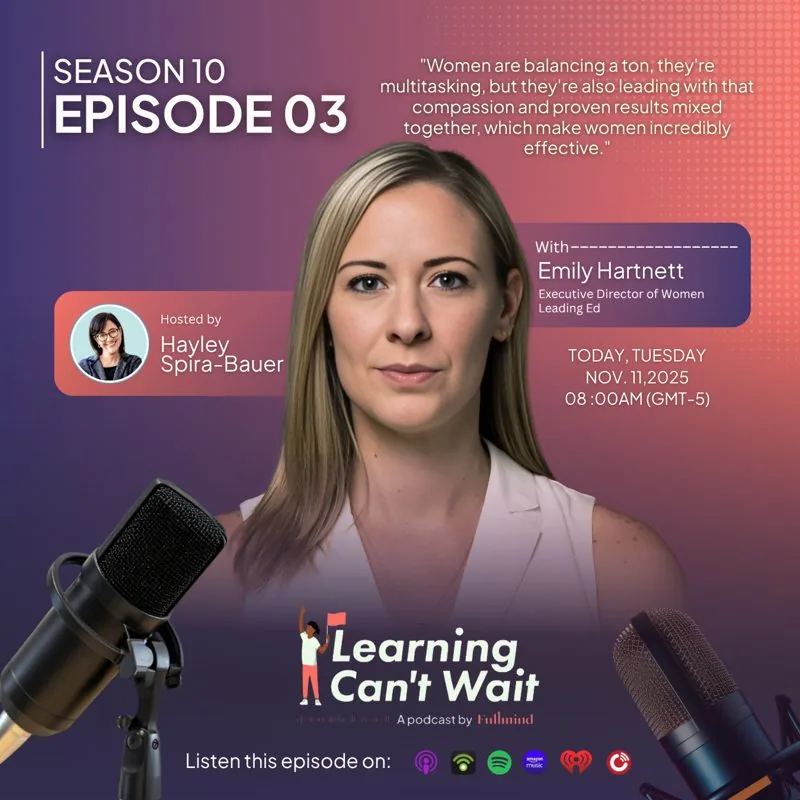
- Emily Hartnett, Executive Director of Women Leading Ed
 Hosted by Hayley Spira-Bauer, Chief Academic Officer at Fullmind
Listen now
Emily Hartnett: Women Leadership, Education Equity & Leadership Sustainability
Episode summary
Emily Hartnett, executive director of Women Leading Ed, describes moving from first-generation college student to a post-Katrina New Orleans classroom, district strategy, and national work before leading a nonprofit network of over 500 women education leaders in all 50 states. She shares survey findings that more than 80% of women leaders feel held to different standards and have never been trained in negotiation, explains why women get steered away from finance and operations roles, and describes a nonpartisan network built on collective action rather than competition. She previews the SEEN cohort on sustainability, informed by an Olympian in residence, and advises new superintendents to lean on their network.
Key takeaways
- Over 80% of women education leaders report different expectations for how they speak, dress, and behave
- Most women leaders have never been trained to negotiate; the network now teaches it
- Women are steered into academic pathways and need finance and operations experience to reach the top seat
- Women Leading Ed is nonpartisan; students needing the best education is the unifying factor
- Superintendent tenure averages about three years and is shorter for women, so sustainability is the next focus
About this episode
Emily Hartnett, Executive Director of Women Leading Ed, shares her journey from being a first-generation college student and teacher in post-Katrina New Orleans to leading a national nonprofit supporting women leaders in education. She discusses the unique challenges women face in education leadership, including higher standards of behavior and expectations, lack of training in negotiation and financial management, and the pressure to balance professional and personal responsibilities. Emily emphasizes the power of collective networks among women leaders for sharing opportunities, learning from mistakes, and pushing forward education equity and excellence. She also highlights current challenges such as AI in education, literacy, and fiscal uncertainty, while advocating for sustainability and resilience among women superintendents.
Full transcript
Transcript generated from the recording; minor errors may remain.
Hayley Spira-Bauer: Welcome back, everybody, to the Learning Can't Wait podcast. I'm so excited to introduce our next guest. We are long overdue to record this episode, but it's very much perfect timing, because we're probably just about entering 2026 right now, and some big events are coming up in 2026 for this guest. We have Emily Hartnett, the Executive Director of Women Leading Ed. Welcome, Emily!
Emily Hartnett: Thank you so much, I'm thrilled to be here with you today.
Hayley Spira-Bauer: I'm thrilled to have you here, because, you know, when we talk about topics that I'm personally passionate about, we have women, we have education, and we have leadership, and I think you know a little bit about all three of those.
Emily Hartnett: My favorite topics, this is perfect.
Hayley Spira-Bauer: I knew we were meant to meet. So, Emily, thank you for your grace. For those that are listening, you probably have no idea what I'm talking about, but it was the beginning of the school year when Emily and I were supposed to record, and this won't be a topic we spend much time on, but of course, one of my kiddos was sick. And so we had to reschedule, but I think it speaks to how graceful you were about that reschedule. I think it speaks to… the compassion and empathy that women have in leadership, and so I am excited to delve into some of those qualities, what makes them… what makes women better leaders because of them, or often great leaders because of them. We don't have to be better, but, you know, some might say we are. And what… why you do the work that you do. So, without further ado, why don't you jump in and tell us. How did you come to be the personal and professional version of yourself?
Emily Hartnett: Thanks so much, what a kind introduction. So, interestingly, I… I would start with… I was… I'm a first-generation college student, and during… when I was in college, I started very randomly working at a school. I live in New Orleans, and I started working in a school post-Katrina, immediately post-Katrina. And I absolutely fell in love. I was gonna go to law school, and I had all these big dreams, and… I realized that I wanted to teach, so I stayed, I taught, and… I went back to school, I got my master's in leadership, for education, and… I've been doing it since. So, I took a very traditional career path to a lot of the women that I'm now lucky to support, of… I was a teacher, I was an instructional coach, I was a director of curriculum, and then I became chief of strategy for a network of schools that focused on whole school transformations and turnarounds, really seeing the impact that education has. Directly on students who were in schools that weren't serving them in really high-needs areas. However, I also realized that New Orleans is an interesting microcosm of education, one might say, and I really wanted to see that at a different level. At this time, I started, working nationally, helping states, districts, governors on their big education bets. And I absolutely loved it. And during that time, I also got to spend about half my time supporting this affinity group that was… is now known as Women Leading Ed. It was an informal network of women education leaders who really came together to support one another. I was lucky to spend a bit of my time volunteering for them, and then 2 years ago, we officially became a non-profit, and now I'm lucky to actually lead that nonprofit. I realized during this time, sort of throughout this, thatin my 15 years of working in education, directly in schools and systems, I only worked for male CEOs and superintendents.And it never crossed my mind. It was just the norm. Wow. Who I worked with in schools were women, who are the principals that I worked for, and my and my staff, who I was working with in district office, were majority women, but that wasn't true at that highest level. And I'm not at all meaning to say that some of the men, CEOs and superintendents I worked for were not incredible, and they were sponsors of me, and really supported me personally and my leadership, but there just weren't women at the top. And now, in sort of that pivot, I get to support incredible women leaders, both in that top seat, but also those who are thinking about it and really having an impact. And that's incredibly special.
Hayley Spira-Bauer: What are some main differences you see in working with women leaders? I sort of alluded to this in the introduction, but there's a lot of research around this topic, so this isn't just Emily sharing her feelings, or Hayley sharing her feelings.
Emily Hartnett: And being biased as amazing women leaders. But let's, like, dive into what we know to be true from a research and context perspective. Yeah, so one of the interesting things that we do every year is we do an insight survey. And in it, we survey women leaders from our 500-plus network of women leaders across the country. And really get their feelings and insights into what they experience as women leaders. We've all heard the individual stories, which are really powerful. And we found that, like, people often are like, oh, that was just something that happened to you, so we wanted to make sure to have this collective understanding of what women experience in education as leaders in education. Not in any one state, not in any one district, but really collectively across the country. And we found, first of all, that, like, women feel a different pressure than their male counterparts, and they say that. Four-fifths, so, like, over 80%, feel that they… are asked to speak differently, are asked to dress differently, behave differently, all of those things. There's just a higher standard for women. And women rise to it. I think that this is sort of that difference of… we all hear, like, if a male counterpart is, like, going to the ballet class or the performance for their child, they're like, oh, that's so great, they're, like, such a good dad. And if women do the same. Then it's like, well, why aren't you more committed to your job? So I think the expectation, and, like, women continue to do that. We, no matter what our family responsibilities are, are, like, running our households, plus running our departments, districts, states. And really thinking about all of the aspects, personally and professionally, that go into being a woman and into a woman leader. We're balancing a ton, we're multitasking, but we're also leading with that compassion and proven results mixed together, which make women incredibly effective. And… Is why we… we were really focused on investing more in women to lead systems, because they have that experience holistically.
[05:00] **Hayley Spira-Bauer:** So you've named a lot of the challenges and also some of the strengths that women have. How are you approaching building the areas of growth for women. And I will name, for example, one of my favorite supervisors, that was a woman, it was my first woman leader in my professional career. Taught me how to negotiate my salary with her. Like, I was negotiating with her. And it was eye-opening to me, because I never would have asked for more. I would have just accepted what I was being offered. And so I imagine that plays a part, but let's talk more holistically beyond just maybe negotiation. What other… what other areas of… What growth are you looking to ensure your women leaders are equipped with?
Emily Hartnett: I mean, I have to start, and I love that you just said negotiation. This is a huge one. Women are not trained in negotiation. We, again, have data on that. 80% of women said that they've never been trained on negotiation. That both impacts them personally, but also impacts, like, their professional roles. Women are negotiating. Curriculum contracts? Employee contracts, those who are COs are thinking about, operational ones, like, all of these deeply matter, and matter as we think about actually supporting ourselves. So we, now actually have negotiation training. We've done this, we also, have, and we've had this at our past summits, which are in-person events, we actually dig into this. We're thinking about this for our upcoming summit as well. There are ways that we can do this that are applicable to real life. So we've had speakers come and talk on this. We have Annie Duke, who is… yeah!
Hayley Spira-Bauer: Oh, I know Annie.
Emily Hartnett: I was like, someone brought me?
Hayley Spira-Bauer: Oh my goodness, someone brought me to a, like, fireside chat with Annie Duke, and it changed my life, Emily.
Emily Hartnett: She did one of our quarterly all-network calls, which is our virtual programming that we have for women across our network. She's also coming, we just announced her as a speaker for our upcoming conference in April. Which is our in-person, and she's phenomenal. She is a cognitive behavioral scientist who thinks deeply about decision making. And there's ways that we are bringing in experts from outside of education, who are women who have done this, to really think about what are those aspects that women education leaders can apply in their personal and professional lives to become more effective. And to still hold strong and hold true. We all know that, like, women are viewed sometimes in different ways of really coming in as a strong leader. We, like, sort of rebuke that. Women are strong, they are proven, they're dedicated, and coming in with strong decisions and really holding true to them is important, and knowing how to negotiate that is critical. So we have negotiation, I think that's one of the pieces. We're also really leaning in now to thinking about that majority of women, and we've seen this in Pathways, is that go in from teaching, and then they're pushed into elementary, principalships. Again, I was an elementary teacher, but they're sort of in a different pathway, and we see this as that stair step. They then, shift into, if they're going into district or state offices, more of an academic and school pathway. Less, and they're given less opportunity for financial and operational background or experiences, we want to change that also, knowing that even if you Are the COO running the most important aspect of a system, of the academics? Finance and ops is a huge part of that. Making sure that they have the financial grounding and really those supports to best make decisions, again, to best think about where their resources should be allocated so that student achievement can continue to rise is really important. So we're thinking about a lot of those aspects. That really go into, like, supporting the foundation so that what women are incredible at just, like, is notched up just a little bit.
[10:00] **Hayley Spira-Bauer:** There's a ton of research around women lacking P&L ownership in their career, which typically inhibits them from reaching the C-suite. So, the statistics are there, and it also is that there's no explicit rooms and places, often, that women have that opportunity to be able to learn the skills of owning P&L, operations, finance. So they can advance in their career. So, the two that you named are two that I am super familiar with, the two topics you named, and are incredibly important, especially when we talk about a superintendency and school and district leadership, like, I don't think people outside of education realize that it's a business.
Emily Hartnett: Yeah.
Hayley Spira-Bauer: Running a school is a business. Millions and millions and millions of dollars on the line.
Emily Hartnett: Yeah. No, this… I mean, the stats and the impact, like, are… are incredible. For some of our leaders, they… they're running the most important aspect of the economy of their community.
Hayley Spira-Bauer: Community, right. Right.
Emily Hartnett: Far-reaching, how it connects to business, how it connects to nonprofits, all of it. I totally agree. People don't realize the vast impact and really breadth of what education leaders are responsible for. They absolutely are CEOs of districts and states. And, like, given… given the respect of leading those complex, critical systems, I think it's often overlooked because they're educational systems.
Hayley Spira-Bauer: Yeah, absolutely. I just came back from two conferences, and three conferences, actually, in the past two weeks, and all I could talk about with folks is how undervalued this pathway is and this career and ecosystem is, despite being the linchpin for our society to continue to thrive. Like, educating our children is the most important job. If we are a capitalistic society that depends on people gaining knowledge in order to continue to make the United States more prominent and profitable and all the things. And yet, we pay our teachers less than almost any other profession, and we pay our early childhood teachers less than anything. You can make more working at, you know, a big brand name store with better conditions very often. So… these are really important topics.
Emily Hartnett: Yeah, absolutely. I mean, I think that is also, like, the respect that is given as individuals are entering the workforce, and thinking about really shifting that mindset of and for teachers. To encourage more going in. We've all seen, like, the recent NAEP scores, and how we really collectively need to think about the future of education of our country. Also, in knowing that, like. Those graduating from high school right now who are… who are not proficient, perhaps, as NAEP is showing us in math and in other subjects, like, those… That is the population that will then become our workforce, whether they're moving into teaching or other aspects. And… and the impact that that's gonna have on us as a country.
Hayley Spira-Bauer: Yeah, absolutely. I'm glad you brought up the collective impact here. I know that that's a huge part of Women Leading Ed's belief system, is that the strength of collective action really matters. So how does that come to look over the course of engagement with Women Leading Ed? Because I deeply believe that us working together is the answer. So, I'm curious how that manifests in the work that you're doing today.
Emily Hartnett: Yeah, so Women Leading is intentionally nonpartisan. We have members from all 50 states and DC, from every sort of end of the political spectrum, and every district and state type, from very small districts of 500 students total to The largest ones across the country of over a million, and of course, state agencies. And the unifying factor in all of this is that every woman who's a part of Women Leading Ed is here to move education forward for students. Our ways of getting there and our approaches may look a little bit different, but that's really the unifying factor, and that is the critical part of knowing that there is great work happening in different areas in different states, and being able to connect the leaders who are really propelling it forward, so that we can learn from one another. We all know that leadership can be isolating, it can be challenging. And we need strong networks who can support us and really push things forward. We also just need to know who they are. It's really easy as you're, like, so dedicated to your students and so dedicated to your community or your state and your district to get laser-focused into the work that you're doing there. And we want to make sure we have that bridge that for whatever that big initiative is, that we know the other women across the country who are working on that same thing. Collectively, in thinking about how we can, Make sure that women know who else is doing that. To introduce them, to think about what are those points at which there may be synergy, there may be work together, there may be learning from one another. To better catapult it than to move it, and also just learning from each other's mistakes. Like, we've all tried the big initiative, and there's been… there's some things we wouldn't do the same, or we would do differently, and making sure that women know that, and having a space where it's really honest, where you can come with challenges, you can come with successes, but it's really sharing. I've…I think one of the critical parts of this is the lack of competition that exists within Women Leading Ed, because it's not women competing against one another for seats, or for status, or for power, it is women Pushing forward for education for students. And able to move all of the things outside of it. To really come through to that is, like, no one can argue that students deserve the best, and even if you philosophically may disagree with someone about Some policy stance or anything like that. Like, what doesn't change is students, and students needing and deserving the best education.
[15:00] **Hayley Spira-Bauer:** Yeah, you've raised a lot of great points here about you know. Sharing ideas so we can grow, but also learning from mistakes, and… Right now, I'm sure there are a lot of challenges that are beyond just being women leaders, but rather from some of the tumultuous education news that are going on in our country, and I'm curious, what sort of challenges are rising to the top of your community right now, and how are they approaching them?
Emily Hartnett: Yeah, I think one is, we're really… our women are really excited by AI, and it's ever-changing. We know that. We know, and I guess by data that we have, by research, by many, many others, that students are using AI, teachers are using AI, but we need to really think about how to do so safely, and putting in the systems that will protect both data, but really thinking about, like, how… How to continue student achievement while taking the best pieces of it, and really, utilizing it in a smart and intentional way, and there are some groups doing this, and really bringing together working groups, but I think that's a really big piece. Like, no… women across our network are not, like, ignoring it. I think, obviously. Sort of public perception and public excitement on it has shifted quite a bit over the last, like, 2-3 years. And now it's the sort of thing of, like, years ago, we would have been like, ugh, like, when people would be like, stop googling things, like, go look at the, like, we can't ignore it, it's here to stay.
Hayley Spira-Bauer: Sure.
Emily Hartnett: How do we use it well, and how do we train and support staff in using it in a way that enhances education? And how do we think about student usage of it in a way that We'll keep them safe. But also, we'll think about, like, how it really can support their learning. So that's… AI is one big thing that… that our leaders are considering. Another is reading. I mean, we've heard a ton about science of reading, and it's really the foundation. So I know that so many of the women across our network are really focusing on it, and are having incredible results for students. There are some huge shining stars really coming from it. And deepening in that, and thinking about how, hopefully, in the future, we see, really, the impact and the output of their very integrated. And very student-centered approach that they're having to reading. And really researched back we'll have, sort of shifting forward. I think all the others are, like, cell phone policies and all the things that just, like, life, brings to us, like, which is sort of related to the AI one. Like, all of these are real, in addition to, sort of structures and changes of funding and things like that.
Hayley Spira-Bauer: Yeah, I have the good fortune of being able to interview a lot of leaders on the podcast, but also just meet them when I'm out in the world and talk to our current partners and all that. And you're naming all the hot button issues. I think… I think the other one that I hear a lot right now is… just fiscal uncertainty. You know, which funding streams are lessening? We know ESSER is gone now. How, if we invested a significant portion of our funds from ESSER into long-term initiatives, and now we can't sustain them, how do we ensure we are continuing to serve our kids to the best of our ability? I think those are a lot of… that's, like, maybe the third topic I also hear a lot of right now.
[20:00] **Emily Hartnett:** Yeah, yeah, absolutely. And I think that goes back to… That women, regardless if you're in that top seat, or you're thinking about leading your department, etc. Need to be strong financial leaders, that even if your background is academics, like, thinking about that and thinking about these long terms and really making strong budgetary and fiscal decisions is critically important, particularly as we enter a time where It's a bit new, and we, I think, all are learning day to day what shifts may be happening, but then being able to plan for and anticipate out where we should be… where they should be budgeting, and where they really should be reallocating, allocating, pulling in other resources, the funding streams, like, that depth of knowledge is critically important, and I think is just increasing as important as we… as we continue to move forward.
Hayley Spira-Bauer: Absolutely, absolutely. You know, at the end of the day. Superintendents have a very difficult role, and… There is no question they do the work because it is important to further our education systems, but it can often be a thankless job, and it can often be a job that Because of politics, internal systems, a whole variety of factors. The superintendent doesn't stay in one role very long. I believe I heard the statistic this week that the average superintendency is 3 years in each position.
Emily Hartnett: Yeah.
Hayley Spira-Bauer: Is that aligned to what you are also quoting when you share research?
Emily Hartnett: Yeah, we're seeing about that, and we have data that shows that it's actually a little bit less for women, because of everything that we talked about. Sure. Women are expected to do so much. We often say that, like,being a superintendent is the best job in the world, and it's the hardest job in the world.And our women would often, like, they… They're incredible leaders, and they give so much, and really thinking about that sustainability and resiliency is something we're starting to focus on. We actually, right now, have a new cohort that is launching, that's a really small, intentional group of women. Who… we're calling it the Sustained Education Executives Network, or SEEN, and it's… Laser-focused on thinking about sustainability and resiliency for women education leaders, knowing that women often give their entire, like, selves into their job. And that at some point, that's unsustainable. So thinking about how we can help sustain leaders to be in their seats in the long term, because that's better for students, communities, staff. We have an Olympian in residence on our team, Lauren Dahlmann-Weiss, a two-time Olympian, soon to be three, and thinking about leadership from the same lens that Olympians train with. Everything is intentional. How they sleep, how they eat, their goal-setting process, how they're taking care of the obvious themselves physically, but the entirety of how they train is brilliant, and we are bringing that to leadership. Leaders are just… the expectations for leaders are just as high. And we need to make sure that we are supporting them in all aspects of their being. Nutrition matters. You can't keep showing up to the job if you are not okay physically. And therefore, like, we're really pushing on it. And we're able to now, as we think about this cohort over a period of time, think about how to sustain and support women in this. And we're really excited about it, and then thinking about, like. In all of the work that we do, the impact, positively, that we'll have on the communities, on the districts and states that our women lead in. So, we're just, like, absolutely thrilled about it, and it's because of a challenge, like, for anyone, superintendency and leadership are hard, inside and outside of education, but really thinking about, what we can do to not just accept that, but begin to really move the needle on it.
Hayley Spira-Bauer: Yeah, absolutely. And, you know, you've kind of touched on this throughout the conversation, and by virtue of the work that you do, but I'm curious if you could summarize in your wrap-up here, you would give one piece of advice to a superintendent starting their journey today, what advice would you give them?
Emily Hartnett: Yeah, I would say lean, lean on your network. You are not in this alone at any time, and really think about who you can turn to in addition to your family, who I'm like, you know, they always get the phone call on the way home, but really in your network and who has been in that seat. Who understands deeply what you're going through, and also the celebrations and successes you've had. Like, those small things that, as we're talking to our friend outside of education. They're like, okay, you, like, passed the bond, like, that's great. The woman who has done that, who has spent the years and all the aspects of getting there, like, recognizes that celebration, and making sure you have them in your corner. They will be… and your network is so important, and of course, like, your network of women is always what I'm going to say. But that network of who you can turn to for successes, for challenges, just to talk through things with. Is going to be a really big part of how you're able to continue leading and doing that work. And particularly as you are a first-time superintendent. Having that network of Supes who've been literally in the seat, who have experienced what you have, particularly in starting that, are important because they will and they want to help guide you to success that they know you will get to, but, like, be by your side and pushing you the entire way.
[25:00] **Hayley Spira-Bauer:** Emily, that is such valuable advice, and I'm just grateful to know the work that you do, and be… A huge admirer of women supporting women, so thank you so much for coming on the podcast and sharing this work with our audience, and really just being a light in the space of, this work in education.
Emily Hartnett: Absolutely, thank you so much. This was just absolute joy. So thrilled.
Hayley Spira-Bauer: Yeah, thank you, and thank you to everybody who tuned in today.