
Learning Can’t Wait · Episode 135
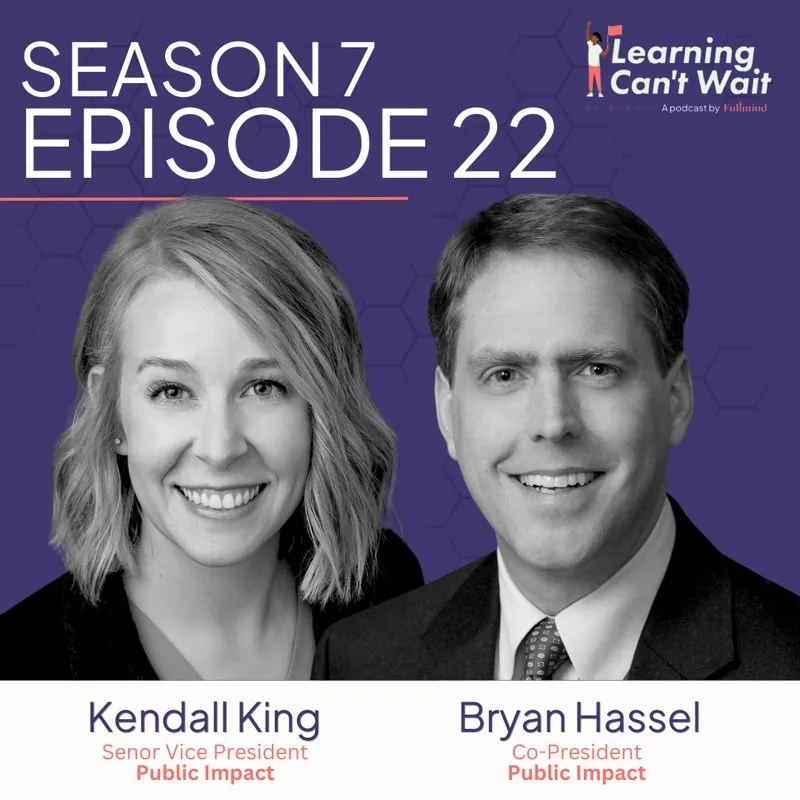
Bryan Hassel + Kendall King: Public Impact, Opportunity Culture, Multi-classroom Leadership
- Bryan Hassel
- Kendall King, of Public Impact
 Hosted by Hayley Spira-Bauer, Chief Academic Officer at Fullmind
Listen now
Bryan Hassel + Kendall King: Public Impact, Opportunity Culture, Multi-classroom Leadership
Episode summary
Bryan Hassel and Kendall King of Public Impact describe the Opportunity Culture initiative, which replaces one-teacher-one-classroom with small teams led by proven multi-classroom leaders paid through recurring budgets. Launched in Charlotte-Mecklenburg in 2013, it now reaches about 200,000 students, and two third-party studies show roughly an extra half year of growth in math and reading. They explain district and school design processes, how states can scale through an online portal, advice for foundations on sustainability, and digital learning that enables small-group instruction and remote multi-classroom leaders.
Key takeaways
- Opportunity Culture teams are led by teacher leaders with proven results who are accountable for the whole team
- Roles are funded from recurring budgets, not grants, so they survive after funders leave
- Design processes at district and school level build ownership, which is why teachers embrace the model
- Third-party research shows students on MCL teams gain about an extra half year in math and reading
- Digital learning keeps students progressing during small-group tutoring and lets leaders coach across districts
About this episode
In this episode of Learning Can’t Wait, host Hayley Spira-Bauer sits down with Bryan Hassel and Kendall King of Public Impact to explore how innovative staffing models—like the Opportunity Culture initiative—are transforming schools across the country. They dive into the power of multi-classroom leadership, sustainable funding strategies for foundations and policymakers, and how digital learning can expand the reach of excellent teachers. With compelling research results and a bold vision for scale, Bryan and Kendall share how Public Impact is working to ensure every student has access to high-quality teaching—every year, in every classroom. Whether you're a teacher, policymaker, funder, or advocate, this episode will leave you inspired by what’s possible when we reimagine how schools are staffed and supported.
Full transcript
Transcript generated from the recording; minor errors may remain.
Hayley Spira-Bauer: Welcome to the Learning Can't Wait podcast of Fullmind. At Fullmind, our vision is to ensure every child has access to an exceptional education. Each episode, we will be joined by Pathfinders within and around the education space who are bringing about transformational change. On behalf of deserving students, I'm your host, Hayley Auer. Welcome everybody back to The Learning Can't Wait podcast. I am so excited for today's panel. We haven't had one of those in a while, and those always make for great discussion. We have Bryan Hassel, the co-president of Public Impact and Kendall King, the Senior Vice President of Public Impact with us today. Welcome both of you.
Bryan Hassel: Hi, thanks for having you.
Hayley Spira-Bauer: I'm so excited you're here. As you both know, we had a little snafu in our original recording date, but we made it work. We found our way to this conversation and I've been really eager to talk with you both about the work you're doing at Public Impact and how that is quite frankly impacting the education space. So let's jump right in. I'll start with you Kendall. How did you come to be the personal and professional version of yourself?
Kendall King: Honestly, education has been part of my life since before I can remember. I'm ironically the product of a Houston ISD love story. My mom was a teacher in her school, my dad was the school counselor in his school, and I've been kind of around education since I can remember. I was that kid who was playing teacher in her bedroom on my pretend chalkboard for years. So no one in my personal life would be surprised at all that I became a teacher. I think professionally things changed for me when I became a teacher leader and then later in instructional coach, it was the first time that I was able to see the same group of students in one classroom with then go into another classroom with a different teacher. And so for me, I was seeing firsthand these are the exact same students, but they're getting different results academically, behaviorally, you name it. And it showed me the power of a teacher in front of that group of students. And I think at the same time, through coaching and that instructional support, I was seeing the power of adults as well as humans to grow and develop over time. And I think that's kind of become one of my big core values that brought me to Public Impact the human capacity to grow and develop over time, especially when you're getting support. So I would say that's probably one of the biggest things that drives my work now.
Hayley Spira-Bauer: What an incredible both love story and education story. I resonate with a lot of what you shared about your journey as a teacher to teacher leader and how you notice threads between the important work of great teachers and the impact that that has on students. Thanks for your vulnerability in sharing that. Bryan, same question for you. How did you come to be the personal and professional version of yourself?
Bryan Hassel: Yeah, so I'm also the child of two educators, but probably for the best for the kids that I didn't end up becoming a teacher myself, instead went into the research and policy world. And really my shaping has come from this quest that I've been on along with Emily Ayscue Hassel, the other co-president of Public Impact. We're searching a lot of different education issues, consulting with a lot of different education organizations for decades on a quest for what's really going to make a dramatic difference for students and what can be scaled, not just what can work for a few kids or a few schools, but what can really reach the whole country. And it really wasn't until the late two thousands that Emily started to zero in on the ideas that have become the Opportunity Culture initiative that I hope we're going to get the chance to talk about. So the quest and the quest continues.
Hayley Spira-Bauer: I would be silly if we did not talk about the Opportunity Culture initiative y'all are running on. I'm personally fascinated by it. But Bryan, I also love to have non-educators on this podcast because I do think there is, especially on a panel, a great balance of insights that can be shared when we bring diverse voices to the table and have these important conversations. So I'm so glad you both are here. Let's talk about Public Impact. Bryan, what inspired Public Impacts beginnings and how has your mission evolved over time?
Bryan Hassel: Public Impact started back in 1996, so it's been around for quite a while, and we really set out to, as I said, try to find a way to make a dramatic difference in education. We had studied other policy issues, but really what's going to make the difference for kids? What's going to make the difference for communities? What's going to make the difference for the economy? Ultimately, it comes down to education. And so with all of the challenges facing the world, how can we make a difference in that arena? That's what we set out to do. Emily often jokes that she thought we would solve education in a few years and then we could move on to some other topic. That's why we called ourselves Public Impact rather than say education impact. But here we are. It's a challenging topic. We're still working on it to this day, but we've evolved a lot over the years, Hayley, and we can get into that more. ([05:35](https://www.google.com/url?sa=E&q=https%3A%2F%2Fwww.rev.com%2Ftranscript-editor%2Fshared%2FcXrVmsMyDd_mR7GLyk8jmTVAgYGE1KaJTNR9vj-PpxE-A58uenIsAA2XOm4DJrHXFasY9gBdM3dXSP0GNmzuxm-a8UU%3FloadFrom%3DDocumentDeeplink%26ts%3D335.77)): But as I mentioned, research policy consulting was our initial frame. We helped write reports, study topics, put together recommendations about different ways education could be better over time. We've really zeroed in on the idea that we need to help districts and schools really change the way teaching works so that all kids can have excellent teaching every year, and all educators can have great careers. And that's now all we're doing all the time, focusing on that, going from that diverse portfolio of topics down to something that we really think can make that difference at a big scale.
[05:00] **Hayley Spira-Bauer:** As an educator, I hear that evolution, and I know in my heart that this work will be forever. As much as I would love to see the impact you're having in education spread to other sectors as you named as your original mission, we are in a really important time in our society when education matters more than ever. Just last week, a results were released and students are fearing worse than they were before the pandemic. So we have a really big challenge before us to do what Kendall said and have great teachers in front of every student. Kendall, can you talk a little bit about why you came to Public Impact and what really struck you about this mission and what your focus is at the organization?
Kendall King: Yeah, my biggest thing that brought me here was the support and collaboration that I saw teachers grow from having development, job embedded development, collaboration with their teams, that type of work. I was lucky in my school I didn't have to work in a silo, but when I became an instructional coach, I saw other schools where the teachers were completely alone on one side of the building completely by themselves left to their own whatever, to figure it out for themselves. And so it's no wonder that teachers are leaving the classroom. So I came to Public Impact specifically for the Opportunity Culture Initiative. I love that it's a strategic staffing initiative. I love that we're trying to change the status quo of education. We are truly trying to change the way we do education.No more one teacher, one classroom, and instead have a beautiful team-based approachwhere you have teams, small teams across an entire building that are led by a teacher leader who has a proven track record, who is accountable for getting results across the team, and who creates this culture of teamwork and collaboration and just this attitude of, I'm going to do whatever it takes because we're in it together. ([08:19](https://www.google.com/url?sa=E&q=https%3A%2F%2Fwww.rev.com%2Ftranscript-editor%2Fshared%2FUCutcORzKIZH_tDSZHhiyalgF_yT8kl2JRhjKIinP7GGcmsP24xc--pXhHSmrBLCDstNbXMDKiTNv96_EdPCLVOPyuU%3FloadFrom%3DDocumentDeeplink%26ts%3D499.04)): And that to me, that's the heart of where we need to move in education. And what drew me here and kept me here, it's been here a long time,
Hayley Spira-Bauer: And Kendall did it, Bryan, she jumped right into Opportunity Culture. It's what brought her here. I am familiar with Opportunity Culture because some of your districts are really well-known districts, and I've seen them speak on this model and this initiative, but I'd love for you to share, I know Kendall just kind of dove in on this strategic staffing model. So how long ago was this initiative begun and what impact have you seen holistically from embedding this Opportunity Culture initiative in hundreds of schools across the US? Bryan?
Bryan Hassel: Yeah, so the ideas of this were formulated in the late two thousands, and it wasn't really until 2012, we started working with the first school district that was Charlotte-Mecklenburg Schools here in North Carolina with just four schools that then implemented in 2013. So we're in the 10 plus year range of implementing with schools now, as you said, hundreds of them around the country. We're reaching about 200,000 students this year across many states around the country. So it's gone from four schools to many. There are a lot more schools though, Hayley. So we have a ways to go and Learning Can't Wait, as some people say. So we're feeling some urgency about going beyond where we are now, but it's been a great learning process to work with so many schools in those pioneering districts because Charlotte was the first. That's a big district, but we've also worked with rural districts around the state and the nation that have one or two schools, very different context, but rural, urban, big, small, high schools, middle schools, elementary schools. But what they all have in common is they all have great teachers who want to do more and have the opportunity to reach more kids with these models by being teacher leaders.
[10:00] **Hayley Spira-Bauer:** I am enamored with the fact that you just dropped the title of this podcast in your answer, but I'm going to just leave that aside for a second because nobody's ever done that before. Bryan, I'm going to leave that aside for a second, because what Public Impact is doing with this Opportunity Culture Initiative is putting what we have done for centuries on its head. And I always say, I didn't make this up, but I often repeat that when we continue to repeat the same actions and expect different results, it's mind boggling to me and education has stalled, if not declined as per the evidence I just shared a moment ago. And the fact that this effort to redesign how school days function in order to one, minimize the impact of teacher shortages, a topic that Fullmind knows a lot about, but two also really elevate the teachers that are most impactful for the benefit of kids. Gives me so much hope. I'm curious what reticence, if any you all see to adopt this model One, how does it work? Can anybody get in and try to start being part of this? Is there an application process? Is there reticence? I have all the questions.
Kendall King: That's a great question. So essentially what before schools can redesign, you need the district to redesign or whatever the system is because you need to be thinking about what are the roles we can offer in our school? How are we going to fund these roles sustainably? One of our core principles is funding through recurring budgets instead of being reliant on a grant fund that might end and roles disappear. So that's all work at the district level. What are parameters the schools need to do? What are things that need to be true in their schedule to continue in initiative? What positions can they flexibly rethink and innovate on? So those are all really important district level decisions that we do a design process at that system level and then do a long design process at the school level in order to bring a lot of voices in as a design team. But we also offer other modalities for that that can be slower or faster depending on the capacity and changemaking skills at both levels. What would you add, Bryan?
Bryan Hassel: Yeah, that process is so important. You asked about reticence. We find teachers love working in this model. We can talk more about that, the surveys that we do, but they don't necessarily know they're going to love it before they start. So a big part of what schools go through is getting a team of teachers together with school administrators and spending time thinking about this model. It's got a set of principles associated with it, but how can we make this our own? How can we make it work in our context? What are our teams going to look like? What is our schedule going to look like? How are we going to reallocate the funds that are in our budget to pay for this work in a way that's going to be the most effective for our kids and our teachers? And so that's really important for customization, but also for addressing reticence because by the time a group of teachers have gone through that process, it's really their work, and that's probably one of the reasons that they love it so much once it's rolling.
Hayley Spira-Bauer: How long does this cycle take that you're discussing here?
Kendall King: It varies on the modality. So in that one cycle, whereas far more intensive model it could be sometimes it's a year long design process, six months, four months to a year in order to scale. That works really well for districts that have a lot of silos or a lot of different departments and things that they need to rethink and manage change. But other things, other districts could work more effectively, more quickly in different, we have asynchronous options, things like that, that could speed along the process.
Hayley Spira-Bauer: I'm pretty fascinated with this for a lot of reasons. You think about how schools often get things handed to them, and what I really like about the way you're implementing is it really takes into account the ownership piece of implementation science and how that lubricates and facilitates ultimately achieving implementation goals. Can you tell me a little bit about how do you expect, I'm going to change gears for a second here, because we're in a climate right now where there's a lot of uncertainty in our federal education landscape. I'm thinking about the transition in federal government that we're undergoing right now and the anticipated changes we see happening in the Department of Education. Does Public Impact feel that they'll be impacted themselves by these changes? And if so, how are you ensuring that your reform practices still have the impact you intend?
[15:00] **Bryan Hassel:** Yeah, there's no doubt anytime a new administration comes in, it's going to lead to changes. We've been through many of these, and this may be a bigger one than others in some ways, but we're all waiting to see exactly how it's going to play out. We can't fully know yet because it's early days, but we know there'll be some changes. But we also know that at the end of the day, schools, teachers, classrooms, they go on, they meet, they teach, and we've been able to work with schools in a variety of different political contexts. Ultimately, if we're focused on the kids, focused on the teachers, we think we can move forward and have great education for all the students. If you look at North Carolina for example, there've been Republican governors, Democratic governors, Republican legislators, Democratic legislators, the school board, the state board of education has changed political hands over time. And yet this work has continued to grow and spread within North Carolina. And it's because ultimately whatever side of the aisle you're on, education is vital. It's vital for the kids, it's vital for economic growth. And so we're hopeful about moving forward under different administrations as well as we can. In
Hayley Spira-Bauer: Your work, you sit very close to policy makers. You do advise policymakers as part of your work, you convene policymakers. Can you talk a little bit about what common misconceptions you see policymakers often have about education reform?
Bryan Hassel: Policymakers, they're in a unique position. They're often coming from all different walks of life. They have to be an expert in 47 different topics. So yeah, they've all been in school themselves. They might've had kids in school, so they have some knowledge, but what are they really bringing to their policymaking? It is a lot for them to take in. And so it's really incumbent on us and others to show them not just what needs to be done in schools, and we can talk about that, but what can they do? What can their role be? Because they're not the ones with their hands on the levers of school curriculum directly and what goes on day-to-day in classrooms, but they can still play a critical role. And we've been thinking a lot about this because as we've seen this work roll out, there's a district here, a district there and a state implementing these models, and that's a great way to and get started. ([17:50](https://www.google.com/url?sa=E&q=https%3A%2F%2Fwww.rev.com%2Ftranscript-editor%2Fshared%2FU2HNPnFzbtjfl4UpMiuyP_tblf4m_auY32Rf86K4zVmW2u9qAj_nr3pKtP_XpthDy8MIc2dv1y0VpJtQNsmd2CqhEtU%3FloadFrom%3DDocumentDeeplink%26ts%3D1070.04)): But these challenges are statewide everywhere across the state. You see in the NAEP results, we have big learning challenges everywhere across the state. We have teacher retention challenges. And so if you're a state policy maker, you've got to think, what can I do to really make a difference on this? And so we've been thinking a lot about that and thinking about ways state policy makers could bring this kind of different staffing model to everybody, not just a district here and a district there. And one way they can do that is by, we've created an online portal that they could provide to every single district in the state for a much lower cost than it would cost to provide consulting to every single district in the state. And that same portal can give them data that they can use to see what's happening in schools, what's working, what's not, and then they can shape their investments over time in ways that they haven't been able to do. So it's now more possible than ever for states to think how can we reach across an entire state with different models versus just supporting a pilot here And there
Hayley Spira-Bauer: Very knowledge is power storytelling, but at a grander scale. And you talked a lot about that scaling, which I'll get to in a second. But interestingly, Public Impact serves at the kind of center of so many different stakeholders. I'm going to ask you about a different one, a different stakeholder now, which is foundations, the folks that are often giving money to nonprofits to help them scale up their initiatives. I'm curious about when you are helping foundations identify impactful areas for investment, what you advise them to look for and seek out.
Bryan Hassel: Kendall, you probably had your share of foundation experience here. I could start out on that one. I think one of the main things that we are trying to help people see is how to create something that's sustainable. A lot of times you see foundations make grants, and this goes for federal and state policy makers too, make grants that temporarily make things better, but then once the grant is gone, the thing, whatever it may be, is also gone. And it's tempting to think, well, if we can make a grant and something really great happens, it will be sustained just on the merits of its value. But we see over and over again that that's not always the way it goes. And so one of our big pieces of advice to foundations isfind a way that you can invest in a change that is temporarily funded by you, but then is built from the beginning to be sustainable.And Kendall mentioned from the Opportunity Culture perspective, what that looks like is making sure that these extra pay that goes to these multi classroom leaders and any extra roles that are added to the schools to help with tutoring and other kinds of support they're paid for out of regular budgets so that if a foundation makes a grant to help you create that model, you can keep doing it over time, even after the foundation is done.
[20:00] **Hayley Spira-Bauer:** Really good advice that a lot of schools could have used with the ESSER funds that they saw dry up this past calendar year and really impact their ability to offer supplemental services like tutoring. Kendall, did you have more to add to that?
Kendall King: More of the advising side, but I don't really have much more to add to that actually.
Hayley Spira-Bauer: That's okay. That's okay. No, I mean it was a great answer, but Bryan was like passing. Nailed it. Yeah, no, nailed it. Kendall, I have a question for you about scale because you're approaching your 30 year anniversary over at Public Impact, and as you approach that anniversary, I'm sure you're looking at the future of how you continue to grow. Can you talk a little bit about how specifically the Opportunity Culture initiative hopes to continue to grow and scale in the next 30 years?
Kendall King: Yeah, absolutely. Think about growth in two ways. We're trying to grow within schools so that eventually every single school implementing our model is implementing in every grade, every content. So all students are receiving that support in all contents as well as growing across schools, districts, so that every student you start in K, you're not just having a huge gap in your middle school years and then hopping back in. We hope it's a trajectory over time as well as getting new districts. So that's kind of the three layers of growth that we're continuously thinking about growing within schools within a district, and then two more districts.
Hayley Spira-Bauer: As you all said earlier, you are in many schools, but you are not in all the schools, and there is a pretty much limitless opportunity. I mean, somewhere over 16,000 you get limit, but that's a wide scale that you can continue to impact. Bryan, as you think about the future of Public Impact and you think about the work that you've done so far, what's something that you are the most proud of from your time in founding the organization?
Bryan Hassel: Yeah, I think one thing I'm really proud of, and Kendall is an example of this, but also leads another whole group of people that fall into this category. But we've given a lot of great teachers the chance to have a big impact on a lot of other teachers because Kendall, the team, Kendall Leads, is made up mostly of former teachers, teacher, former teacher leaders who have been able to come in and use their experience and use these models to then reach many, many schools around the country. So we're trying to create career paths for teachers within school. So those that want to stay and continue teaching can do that because now your only way to advance in your career and earn more as a teacher often is to become an administrator or to work for Public Impact or maybe be a podcast host. But if you want to, we want to make that possible for teachers to stay, continue to teach, be with kids, be with other teachers every day if that's their path. ([23:56](https://www.google.com/url?sa=E&q=https%3A%2F%2Fwww.rev.com%2Ftranscript-editor%2Fshared%2F0eAvc5lbHv47CZAq8B5XTGK3o-prCi-ao2HRa7YLMvJ_RvYi__KnQvSQSSOmQAAmbiMPkP_1ngRvHvrG6Oeb3bbBl8E%3FloadFrom%3DDocumentDeeplink%26ts%3D1436.54)): But then we've also created a way for teachers to have an impact in a different way by helping other schools around the country do this work. So I'm really proud of that. But I think what I'm most proud of is the fact that through these models, students across the country, not as many as we would like, but those that are reached are able to have excellent teaching every year. And we know teaching is the single most important factor within schools that drive student learning. If we look at those NAEP results, we know the most important thing we can do is to make sure every year kids have great teaching. And that's what we're able to do with this model.
Kendall King: And Bryan, we're the results speak for themselves too, right. I think the thing I'm most proud about is the results we're getting through the initiative. We've had two third party research studies that are showing thatwhen teachers are on an MCL team, their students are getting an average of extra half year of learning growth and math and reading.That's huge. And that's something really exciting that I think we're trying to just continue to spread and bring more students in and collect data over time.
[25:00] **Hayley Spira-Bauer:** Thank you so much for highlighting that, Kendall, because at the end of the day, one of the things that I was in my prior research reading a lot about with Public Impact is the importance of centering research. It's something I feel professionally has to be at the core of anything we put in front of a student or a school or a teacher. There are too many distractions in this world. And the truth of the matter is that if we don't see results in the efforts, the resources we're allocating, we should not be allocating those resources. I have one more topic for you that we didn't touch on at all today, which I would be remiss if I ignored that. At Public Impact, there is a big emphasis on the vision for using digital learning to help advance and expand the capacity of both great teachers and great learning opportunities. It's very central to the work I do day to day when I'm not hosting a podcast. And I have read a couple of the reports that you all have published from your website on this very topic. This is obviously somewhat of a transformation that was in some ways accelerated in some ways stagnant by most schools after the pandemic. But I am curious about your emphasis and attention to high quality digital learning and excellent teaching and how those two things go hand in hand.
Bryan Hassel: Yeah, there's so many possibilities here for the future as well. There's so many intersections. One intersection is that when teachers are working these models, one of the things we're really encouraging them to do based on enormous research about this, is to move much more of their time into small group learning. So having kids work together with adults in small group tutoring sessions, boost student learning enormously. But then it creates the question of what are other students doing during that time? And there's lots of things that kids can do during that other time, but if there's really high quality digital learning available for them to tap into and advance at their own pace through different kinds of learning experiences, that can be a very powerful way to engage students while others are in the small group instructions. That's one big intersection that we have. The other one, I think another one has to do with teachers using digital technology to reach more students themselves. So one thing we're doing this year in North Carolina is experimenting with a new model of multi classroom leadership where a teacher lives in one district but leads teachers in another district because sometimes it's difficult to find enough multi classroom leaders to reach all the grades and subjects you want. And so this remotely located multi classroom leader can do that, and that's only made possible by the digital technologies that we have available now.
Hayley Spira-Bauer: It is work that I know well and work that I am proud to be a part of. At Fullmind, I am excited to hear about how continuously excited to hear about how technology transforms education. Not because we just had more apps to teachers for kids to use, but we think about how great teachers can impact more lives. I'm so impressed with the scope of work that Public Impact tackles. I mean, you could hear it in this interview candidly, I feel like a little all over the place because I'm asking you about, because various stakeholders you touch in schools and research, but the reality is the breadth of your work is wide in a way that I do believe fosters even greater results because you are tackling a problem from many different angles and the history of your organization, as Kendall said, and the results that you've garnered speak for themselves. So I feel really excited by being able to share your story and amplify this work, which many people already know, but will hopefully learn more about through this podcast episode. I have though the final question, which is what advice would you give a teacher starting their career? I'll start with you, Kendall.
Kendall King: Well, you're going to guess mine. My advice would be to work in an Opportunity Culture school on an MCL team where you have someone, a teacher leader who's able to model lessons and co-teach and pull small groups and analyze data for the entire team so that we can be strategic and get growth together. And I'm not stuck alone. So that would be my recommendation. What about you, Bryan?
Bryan Hassel: Well, of course I'd have the same advice, and I would just add, if you then go on, as some teachers will do to do something else in your life, aside from teaching, find ways to keep making a difference for students, whether that's as influencing policy, whether that's as a parent, whether that's as a member of your community, a business person. There are so many needs out there, and if you're starting out as a teacher, it means that you care about students. You want to advance their interests. How can you do that in a way, whatever you do with your life.
[30:00] **Hayley Spira-Bauer:** Kendall and Bryan, thank you so much for coming on the podcast and sharing a corner of your work at Public Impact. It has been so I've had such an honor interviewing you both.
Kendall King: Thank you.
Hayley Spira-Bauer: This was fun.
Bryan Hassel: Thanks for having us, and thanks for all the stories you tell.
Hayley Spira-Bauer: Thank you so much. And thank you to everybody who tuned into this one. Thanks for listening to the Learning Can't Wait podcast. If you like what you heard, please rate, review and share this episode. Be the first to know when we have a new episode by subscribing wherever you listen to podcasts. If you'd like to be a guest on the show or have a suggestion for an episode, email us at podcast Fullmind Learning.