
Learning Can’t Wait · Episode 83
Doug McCurry: Leadership Lessons, Educational Challenges, Summer Learning Programs, High-Quality Curriculum
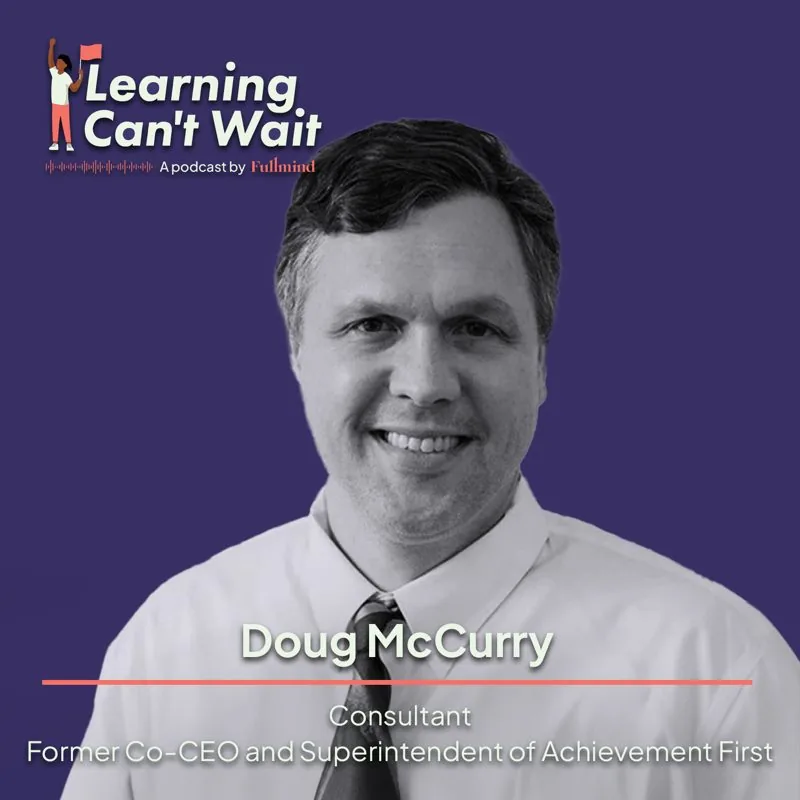
- Doug McCurry, Former Co-CEO and Superintendent of Achievement First, now working
 Hosted by Hayley Spira-Bauer, Chief Academic Officer at Fullmind
Listen now
Doug McCurry: Leadership Lessons, Educational Challenges, Summer Learning Programs, High-Quality Curriculum
Episode summary
Doug McCurry, co-founder and former co-CEO of Achievement First, credits his father's optimism, co-founder Dacia Toll's can-do drive, and his son's resilience for shaping his leadership. He names cell phones, pandemic learning loss, and a tight labor market as the biggest shifts, and finds bright spots in high-quality curriculum, SEL, and the science of reading. He urges simplicity, strong classroom management, an arc-of-the-year coaching focus, summer as teacher development, and retaining talent by celebrating, listening, removing nonsense, and coaching hard.
Key takeaways
- Smartphone ubiquity tracks closely with declining student mental health; schools must make learning sacred
- Pick curricula for standards rigor, simplicity, and a proven track record with similar students
- Classroom focus is the top in-class determinant of achievement; management is not sexy but essential
- Summer should pair a focused next-grade curriculum with weekly grade-subject teacher training
- Retain teachers by noticing and celebrating, listening monthly, removing busywork, and coaching intensively
About this episode
Welcome back to Season 5 of the Learning Can’t Wait podcast! Today, Hayley Spira-Bauer hosts a conversation with Doug McCurry, Former Co-CEO and Superintendent of Achievement First, now working as a consultant.
Doug shares insights on the resilience learned from his father and son, the impact of smartphones on school and mental health, and why summer is a great time for both students and teacher development. Doug also discusses his ideas around curriculum and standards, and shares how school leaders can support their teams through celebration and recognition.
Produced by Fullmind
Full transcript
Transcript generated from the recording; minor errors may remain.
Hayley Spira-Bauer: Welcome back everybody to the Learning Can't Wait. Podcast I have an incredible guest today whom I have looked up to for longer than I think I acknowledged, the first time we met. It is the former Co. CEO, and superintendent of Achievement First, who is now a consultant Doug McCurry welcome Doug.
Doug McCurry: Oh, it's great to be here.
Hayley Spira-Bauer: It's so great to have you on as I kind of fangirled. The first time we talked I grew up in the charter movement of New York City, and so to meet you, the founder, co-founder of Achievement First is a true honor, and I'm so grateful to have you on the podcast to share some of your experiences in education.
Doug McCurry: Oh, great! To be here.
Hayley Spira-Bauer: So, Doug. I am very curious as as are our listeners. How did you come to be the personal and professional version of yourself?
Doug McCurry: What a great question! I I really think about different people that I've copied, emulated, etc, over the years. I often say to folks that like I'm not as great at coming up of ideas of my own, but I'm really good at like watching people and learning from them and trying to take the best of that. And so a lot of me actually starts with my dad, who who actually just passed away last year, but was a giant in my life. And I I really learned optimism, humor, and generosity for my dad. And those are qualities I I try to keep in leadership, you know he he was a a guy who actually grew up in a orphanage from age 4 to 13. But kind of you would have thought would come out with. You know. I don't know bitterness, resentment, whatever, but always just came out. He always would talk about people and things in the most positive way we'd go to an Applebee's. And my dad would say that was the greatest restaurant we've ever been to. I love that meal. I'd be like Dad. It was an Applebee's and he always was super generous with this time with his resources to others, and he ran a medical distributorship different industry. But I watched him and kind of learn. This is how you can kind of treat people well, this is how even in the face of really big challenges. You can maintain joy and optimism and generosity, and that's always been kind of a really important kind of piece. For me. I was also lucky enough to to cofound team at first with Dacia Toll, who's kind of a powerhouse leader, and she is just the most can do optimistic. Let's go add it. Okay, there's a problem. Let's go. I I always laugh. I love meeting with Dacia because she does this thing where she like snaps with her fingers. And I just knew she's snap, and we're going and so I I I just appreciated that and kind of just kept building in me this idea that doing anything big, especially what we tried to do at Achievement First, you know, run great charter schools at scale. You're gonna have problems. You're gonna get conflict. You're you're gonna have obstacles right? And just that unfailing belief that like we we can. And we will do it. I think you know those folks, and then kind of like. Recently. Over the last decade or so, my life's been a lot shaped by by son [student], who has autism. Pretty profound autism. And he's super smart, can communicate by typing, but can't really speak in in conversational ways and just watching him and his journey, and the resilience that he's had, and you know what my wife and I are doing and what he's doing. That's also just kind of double clicked for me on, on resilience as resilience. And again, optimism as as key. So I'm I'm talking in broad leadership strokes, right? Because I do think at the end of the day it's those things that have mattered and propelled me, even though I'm I've done different types of roles.
Hayley Spira-Bauer: Well, first of all, thank you for sharing some stories and anecdotes about people in your life who have been really influential in the course of how you've become who you are. Your father. I'm sorry about his loss. He sounds like a really incredible human, and as does your son.
Doug McCurry: Thank you for your.
Hayley Spira-Bauer: Oh, CEO Dacia! These are all people in various ways who have shape as a person. Mush the way educators shape the students that they teach can you talk a little bit about? I I am curious. This is personal interest, for sure about how Achievement First came to be.
Doug McCurry: Yeah, that's a a great question. So it it first started. Dacia was in law school in New Haven with a group of folks and noticed. You know, we're just kept seeing the the challenges of of New Haven public schools. And she actually did some student teaching while she was in law school. And had the idea and and kind of brought a community group together and wrote the charter. I was then at graduate school. A teachers, college, Columbia and I knew Dacia and undergrad. We both went to University of North Carolina together, and so we kind of hooked up to then kind of co do this thing, you know, even from the very first school we started. You know, I was kind of more of the academic leader. She did the the fundraising and external, and all of that, and more or less. That's what we did along the way. I always say that, like, you know, I was probably 80 20 academics, 20% external. She was, also kind of flipped. And we we did a little bit in each other's lane. But yeah, and that that it started with in New Haven as a small charter school with with 84 kids, you know. I I did everything from teaching fifth grade to serving tater tots, at lunch, and everything you do and grew that that from, you know, 84 kids to, you know, over, I think 16,000 kids now has in in that those very first, those very first years. We we were able to get success relatively early. Our, our, our, the first group of kids. They used to only do the State test every 2 years, bizarrely in Connecticut back then. But so we waited a year. And when our kids, when our kids took the took the state test, they they did like extraordinarily well, I did I the little thing we I remember one time we did a field trip to New York, and we were taking the bus from our kids in New Haven, and we passed Greenwich. And I remember sending the kids, those poor kids in Greenwich. They didn't do as well as you guys in math. There's such an achievement gap. I feel so bad for those kids in Greenwich. Let's maybe stop by on the way back and tutor them in math, and the kids just thought it was hilarious. In my dad kind of joke. Kind of way. Yeah.
Hayley Spira-Bauer: There's that humor from your father.
Doug McCurry: Yeah.
Hayley Spira-Bauer: And now, obviously Achievement First is a very large network. Shout out to my former roommate and regional superintendent, Kevin Lowell, who did not bring us together, but would be happy to know that we are.
Doug McCurry: Yeah, Kevin, one of my favorite all time. AFers.
Hayley Spira-Bauer: You know, E, education is a really challenging environment. And you look at people like Kevin, and you wonder and you have such. I I have, I wonder, and I such. Aw, for how he has sustained this work school based work for so many years. In your leadership you obviously have seen a lot of change. What do you think? What do you think? As you reflect? Maybe from a 30,000 phone.
Doug McCurry: Mmm.
Hayley Spira-Bauer: Are some of the biggest changes to education today that you've witnessed.
Doug McCurry: Wow! That's a that's a huge question. I mean, what? There, a few things jump to mind. That that may be obvious. I really think the advent of cell phones has changed kids dramatically. I mean, there's such compelling research. You see, the almost a straight line correlation to where ubiquitous ubiquity of smartphones. As it went up, student mental health went down and so that that was already on the stage. And then the pandemic. Had both mental health issues and lost learning issues.so that those have been. Those have been 2, you know, like huge huge times. The other thing is, you know, paradoxically, when the job market as a whole is good for the, for the broader economy. It's bad for education in this. It's like it, you know. Paradoxically, when we have recessions, more talented people go into teaching and and it is so that it's this coupled. We've had a huge mental health issues that we're not facing in the past, coupled with harder time finding talented folks to go into education, and those 2 things often can go together because it's more challenging. And and then I'm seeing schools just kind of in death spirals of they. They're not where they wanna be so. Their people aren't happy. So their people are leaving and they just can't. They can't, you know, escape that in a way that that was much more challenging than it was even a decade ago.
Hayley Spira-Bauer: Cannot imagine. I was actually in a school 2 days ago in New York City, a high school. And the kids had cell phones, and they were actively on them in classes. And I was thinking back to when I saw middle school, and really out of touch with how challenging that must be to be a classroom teacher today competing with cell phones, both understanding what you named here. The impact on a students while being in mental health. Those are connected to the mental health crisis we see in kids today. You know, the APA, I think recommended. Or maybe it was the physicians or psychologists not giving kids cell phones to like 16 to the significant impact it has on their health. I I can't even fathom what it must be like a leader or a teacher today competing with cell phones.
Doug McCurry: And and and I say this with all love and respect for school leaders out there. But it's a failure, school leadership to to go into a school, and kids are all on their cell phones like at some level. I think we're often asking teachers to be individual enforcers of these types of things right, and that would drive me crazy if I were a teacher. And my principal said, Well, it's kind of up to you. And I was like, we need to create, like the conditions where across the school that learning is sacred, I mean, I sometimes see it. You know, I work with different groups. And my my wife is also a consultant and expert in multilingual learners, and we work with different groups, and we even see that sometimes with adults, you know. And I'm really big at selling setting a hey? This is a tech free, you know, zone. And some groups are awesome like they're completely focused with us and jamming. And there are groups of grownups who can't be in a professional development for 30 min without checking their phone constantly. And and I can't imagine them leading classrooms that are anything different than that. And that's just not good for kids.
[11:00] **Hayley Spira-Bauer:** Let's talk about some bright spots. Right? I think of her apple. No, but for if.
Doug McCurry: Think I'm not.
Hayley Spira-Bauer: I'm where you are like. There's so many things that we look at with schools. And we're like, Well, that's really hard. And I have.
Doug McCurry: Yeah.
Hayley Spira-Bauer: The deepest, most profound for educators who endured the past 4 years of trauma on trauma.
Doug McCurry: Yeah.
Hayley Spira-Bauer: Pandemic. But what are some things that you? You know you're looking at schools today. And you're like, this, evolution is so pro social, so pro academic like, what could we be excited about? That's happening.
Doug McCurry: Yeah, there's there's a couple of things that these are a little, you know. They're little geeky, but I'm super excited about curriculum. I feel like, you know. Whereas if if I'm worried about if I'm worried about cell phones or student mental health. I over the last 5 to 10 years. I think we've realized that while there are some superhuman teachers who can create amazing curriculum that exactly meets the needs of their kids, the vast majority of schools and teachers need and welcome the support of a really high quality curriculum. And so that has been something I'm seeing kind of schools adopting that. And and that makes a huge difference. That kids having access to grade level. High quality curriculum makes a makes a really big difference. And then I likewise. I'm seeing both on the academic side, but also kind of SEL providers. There's more quality stuff out there and more buzz. And I I think schools are saying, Hey, we need to put aside some time. And we need to have rich advisory programs, etc. To to think about kind of the the mental health and SEL providers. And then that needs to be integrated clearly through the day. But then, also, you know, kids in every single class, we should guarantee that they have access to like quality curriculum. And that was just not the case 5 to 10 years ago. And then, you know, I think, with with science of reading also being you know, kind of a positive, a really positive, you know, aligned to curriculum thing. I mean. This was something 2 decades ago, at AF. We were doing structured phonics, and I think that was one of the reasons like we always said we always said to to families, say, your kindergartner is, gonna learn to read. And you know, I remember showing data to people where you know, like 92% of our second graders were at or above grade level and reading. And they were saying that data's false. It's not true. It's whatever it's like. No, it is. It's because, like we, we are doing what Research says.
Hayley Spira-Bauer: While for everybody else to catch up.
Doug McCurry: Yeah, exactly.
Hayley Spira-Bauer: For sure. That's a bright spot, and I hate to do this, but I have to ask you, so where do we find good high quality curriculum, because I just read an article not even 2 weeks ago, that EdReports, is pivoting, which was really a lot of people's touchstone to rate curriculum. So how does Doug McCurry qualify content for schools.
Doug McCurry: Yeah, this is this is, this is tricky. Right? I look for a few. I look for a few things. I mean, it it. One is deep standards, alignment and standards can get trickier, because you know, the Common Core is slowly decimated right? But you know. Does. Does the curriculum align to the level of rigor? That the standards articulate for kids in that grade? I actually look a lot more for simplicity than other people do. I'm not a fan of curricula that has 5 different components on each day, or 4 different lesson types. It's so. It's like that means there's 20 different things that teachers have to figure out. Like, I'm I'm more of a fan of days, you know. There's a few core types of lessons and days are relatively similar. So as a teacher and a kid, I can really hit the ground running and jam, I look for curriculum that have a proven track record of success like that's essentially where we often, you know, started, was. You know, do or does this curriculum have have a track record of of dramatic results serving stu similar student population that I'm serving. And you know, when you start to triangulate those you can. You can. More and more you can more and more kind of get down to you know what what may work.
[15:00] **Hayley Spira-Bauer:** You name that you're really big on simplicity. And right now, we're in a, we're in a bit of a boom and innovation boom around technology and change in schools. How do you feel about this innovation? Boom? What gets you really excited about it? But what also makes you concerned about it?
Doug McCurry: Yeah. Look, innovation overall, you know, is a good thing, you know. I'm pro innovation. But innovation for innovation's sake. Is where I sometimes like, like innovation in of itself. That's what we're going after. I feel like we can sometimes lose a sight ofat the heart of schools is teaching and learningright like that is the heartbeat of schools, and whatever we're doing should be supporting great teaching and learning, and that should be our focus. And yes, there's some other things around the side that's but if what we're doing is not directly going at that. And so yeah, like, I I think you know, in in the zeal to do a lot of other things, we can sometimes lose sight of just fundamentals. I mean, there's speaking of research, there's a lot of research out there that shows, like the number one determinant in a classroom to achievement is the level of student focus. In the classroom, and like people don't want to hear like classroom management is not as sexy is the new thing, but the reality is. If we don't have our kids feeling like they belong, and, you know, motivating them to do focused work. Then it doesn't matter what what other thing that we have around it. You know. And so the the the work that I'm doing a lot of work with schools is really helping them. First, just make sure just some of the basic structure. And so that's on the instructional side. But also just some of the basic structures and systems like, does every teacher know what their goals are? Does every leader do? Do people have clear roles and responsibilities like? Does every teacher have a coach that meets with them? And they know. At 1 12 on Wednesdays, in the conference room I meet with my coach. Right? Is there regular professional development happening? And does that follow a sequence and not just drive by PD, right? Like those things really matter. And then, you know, we also try to help help schools with what we call the arc of the year, because a year follows a natural flow. You start the year, and you want to make sure you have a strong classroom environment. Then you want to make sure that like teachers are really intellectually preparing for classes. So they have the level of rigor. And then you want to make sure that, like kids are getting great feedback on their work right? And then you wanna deepen thinking in the classrooms. And then you wanna crescendo to the end of year assessment. And like, that's a natural flow which has its its own coaching focus. And if you can help teachers and leaders like kind of embrace that that simplicity like you know what in this 6 weeks, the beginning of the year, we're gonna make sure that every single classroom in this school has focused learning where kids feel loved and respected. Great. Now we're gonna make sure that every single teacher in this building is doing high quality, intellectual prep on their curriculum over the next 6 weeks like that's powerful. But it's like simple and focused. And it's not a hundred things that are going on. It's that and I feel like we've gotten away a little bit. From that as schools. And we've gotten away honestly, a little bit from achievement, I think. You know, we, while the pendulum is probably too much like, you know, test scores were everything. It was kind of like it became like, well, there's a thousand things that matter. It's like, no like, it really does matter if kids learn reading and math and science like that, that really does matter and and we need to. We need to put that a little bit more in the driver seat than we are right now.
Hayley Spira-Bauer: One would say. Maybe a good school name would be achievement.
Doug McCurry: January first. Exactly exactly.
Hayley Spira-Bauer: You know, Doug, I hear you sharing a lot about professional development and sentiments. Educators, sentiments about PD. On a national scale are pretty low teachers, don't I? I don't remember the exact statistic, but I will share it when I share this this, podcast so that I don't look like a complete fraud. But I remember reading that, you know, generally speaking, educators had trouble with the offered PD. At their school. So what I hear you saying in the podcast, right now is that it should be focused. It can be small, it should be consistent. It should be predictable. What do you do with schools? I'm gonna transition us a little bit about summer learning. Cause I love summer learning both for kids and for teachers. What do you recommend schools do in the summer with their teachers. We're we're like around the corner from those beautiful, beautiful, glorious summer days.
Doug McCurry: Yeah. Well, in summer I work really closely with an organization called the National Summer School Initiative, is one of the co-founders and still do some work with them. And I, I think what what we've done it in NSSI is is really smart because it it solves 2 of the problems we just were talking about during the school year. One is, there's an exceptional simple, easy to use curriculum in reading and math that is aligned to the power standards for for that next grade and and subject level. And so if you're a kid like, that's what we're gonna focus on and then the second is, we see summer as a great teacher. Development. Opportunity. That instead of instead of like putting some worksheets and putting kids on a computer and calling it summer school. We're like, we're going to make summer the best 6 weeks of the year, like we're gonna do a 2 day to 4 day intensive training of your teachers before the summer. And then we're gonna meet weekly in subject teams, grade subject teams. So you're gonna be meeting with, you know, third grade math teachers from across the country. And so that's like, basically have a super high quality summer specific curriculum, and then have really excellent grade and subject level training. We do that in NSSI. A district hypothetically could do that themselves, but I just find that oftentimes districts and charter networks like summer, is like fifteenth down the list, and so finding a really trusted partner can be a smart way to do that.
Hayley Spira-Bauer: I love that, and I know that. You know I was just talking to a girlfriend last week whose kid was put in summer school. She's like, what do you think I should do? I was like you should take it.
Doug McCurry: Right, right.
Hayley Spira-Bauer: So hard because.
Doug McCurry: Yeah.
Hayley Spira-Bauer: You know, we think back to our childhood, and very often summer meant being out in the sun, being by water, if we could like not having a care in the world in many cases. Hopefully, hopefully, not having a care in the world during summer. So it's hard to imagine what a great summer program could look like. I I really want summer to be an opportunity for kids to explore interest, too.
Doug McCurry: That's right.
Hayley Spira-Bauer: Like getting their hands and science and really doing Si a focus science study over the course of a couple of weeks. Not, you know a one off lab, but the opportunity to really study a subject and study it deeply. I think that so often our school days are packed with our schedules are packed right teachers and school leaders. They have one activity, they've one lesson and the next lesson. Then they have this activity. And so it's hard to fit in like learning and making learning fun. So I love the focus of NSSI and how there's so much of that incorporated. Yeah.
Doug McCurry: I mean, Rip riffing off something you said, yeah, I'm a huge believer. Hopefully. Most summer schools also are just like what I told my core. Academic is like a a morning and then afternoon. There's, you know, all sorts of enrichment. Just for the you know, parents or or others out there. Something I really highly recommend is a group called Rock by Rock. Is Jeff Imrich, who was a former AFer started. And it's it's basically project based units and science. For elementary age kids that can be done at the home or in school. And and they're getting. They're just really, they're really cool units around great questions. And so it's a great way over over the summer to different time to, as you said, like kind of go deeper in something rather than just doing a one-off lab.
Hayley Spira-Bauer: I have never. I had never heard of that organization. So that's a new to me one, and I'm so excited to explore it. And probably adapt adapt some of what I can find for my own kiddos at home.
Doug McCurry: Love it.
Hayley Spira-Bauer: Let's take a good idea. Bring it home for them. You know, Doug, I imagine that in the role you serve today, working with all types of schools. You really have a a team view on what are sorry. I'm I'm going back to an earlier topic, which is what we talked about with retaining teachers and teacher talent, and the challenge that schools have today in ensuring their teachers are connected and happy, and all of that. What are some like? What do you think schools do? Right? Schools that are successful even when they're in challenging circumstances to retain talent.
Doug McCurry: That is a great question. So I'm I'm working with all these these schools. One great thing is talent. Retention is actually on the rise at at overall at all of them, which I'm very ha happy about, but in particular is one school. That just had has had off the charts talent, and I was been coaching this principle. Trans. She's transformed the school in one year. And so excited working with her name's Tequila. And and I asked her, and I was like, you know, I just really wanna better. Let's unpack like what you're doing. Because one day I was there, and she's like, I'm so sorry we had someone call out today. It's like we've only had 4 call outs all year, and I was like 4 call outs all year. She's like, yeah, it's a small school they have like 15 teachers, but like their staff, just like most schools I'm talking about have 4 callouts a day or more, and like it's just, it's just hard. So I you know, I talked to her, and and I think what she said, resonates with what I think works, which is one. She celebrates a lot, and so, you know, pretty much every day we'll go around putting little notes on teachers just saying, Hey, amazing thing I saw today, even like in the hallway, just like awesome job. So and so like, notice and celebrate like people just wanna be seen. And they wanna know this is like a really hard job. And I'm the leader. And I see you. I see you busting your your chops there first year, teacher, with those fourth graders who are hard. I see you veteran Ap. History, teacher, like running that amazing discourse. I'm with you. I see you right like just acknowledging that is huge. The second is. Listen so you know she. Even though she doesn't coach every single person she makes it a habit of like on a monthly basis, just going around and just asking people, hey, how's it going? Is there anything brief survey after each PD. That has a has a block that we've helped people do, just, you know, help, rank, rank, how happy you are, and anything. Is there anything getting in your way, and this try to knock that down? Sometimes it's as simple as like. I don't have any chart paper in my class to do the visual anchors, and it's driving me crazy right? And like you solve that for for people. That kinda goes to take away the nonsense like a lot of the stuff that we like. Ask, you know. Submit your lesson plans every week by x time that you don't look at, you know. Do you know these, you know, duties that were over staffed for right like try to keep people's job to like intellectual prepping, looking at student work and teaching. The more you can do that. I think the final thing and this is counterintuitive to people cause this is what they're not doing iscoach the ham sandwich out of peopleright? And so she is coaching more like we have regular weekend weekly coaching. She does two hours a day of real time coaching. If a teacher struggling, she's grabbing them after school and having them work more. And we're people are in this death loop right where people are struggling, and they're worried about them struggling. So they're not giving them any feedback. And then they're struggling more and then they're more unhappy. And then they call out sick, and then the other people call out sick, because there's too many people out, and it's stressful like that's the loop we're in versus I've made. I see you. I'm celebrating you. I'm Li listening to you. I'm taking away all the nonsense, and I'm gonna help you get great. And if you're struggling today in the fourth grade, I'm gonna make sure by tomorrow you're struggling a little bit less, and you have momentum. And so when people feel like they're growing and supported that they they can do their jobs, and the the person has their back that they see them. They appreciate them and celebrate you. They actually in this school. This is a Milwaukee school. That's 98% low income Stuart. With all the challenges like they are jamming achievement is up. Attendance is up all that stuff in in a lot of it's because of this talent cycle. But that's what people aren't doing. And they're they're they're scared to give feedback because their people are tired. But that's just making them more tired.
Hayley Spira-Bauer: Okay, so this is really concrete, tangible advice for school years, which leads me to my last question, which is the perfect setup? Thanks for doing that didn't expect it, but. That was like amazing, amazing, tangible advice. I both love to talk theoretically and about reality, because people are listening and hopefully enacting some of these ideas in their daily practice. But what advice, Doug, would you give a educator starting their career today? And we could say, teacher here specifically.
Doug McCurry: Yeah. Have a few things. First,find the best teacher in the building right, and sit in the back of their classrooms during your prep periodsright? And then ha! Have them. Be your informal coach right? And just talk to them. Listen to them. Figure it out. The second is. Really work on your classroom management, like, if you can manage a classroom, it's just so much easier like everything else flows, flows from that, and so get feedback. Don't be defensive practice, you know, like, just say and be willing to say, Hey, I'm really struggling right. These 2 boys aren't listening to me at all. I'm trying this, and it's not working which kind of leads me win over your toughest kids. Outside of class. So it's hard to win them over inside of class. But you can win them over outside of class. You can go to lunch, and if they're into something. Talk to them about it. Like. Let them.
Hayley Spira-Bauer: They're deeply into their eyes as they tell you about Minecraft.
Doug McCurry: Exactly, exactly.
Hayley Spira-Bauer: Outbreak, eye, contact.
Doug McCurry: Don't break eye cut. Tell them you may not understand, but you're like, yes, and if they talk about Minecraft, you go home and you download Minecraft, and you learn it, and you come back the next day, and you ask them a question about Minecraft right? And so that I would say, those are like kind of 3 big things that I think really help a lot. And then just the other would be over prepared. When you walk into classrooms prepared both like technically prepared. I have all my copies and all that, but intellectually prepared, like I know the content. I know the great answer I'm looking at. I know what I'm gonna say. If the student says this. You just feel so much more confident.
Hayley Spira-Bauer: That is some amazing, amazing advice. I would love to say, thank you for you coming and joining the podcast today and also thank you to the universe, for.
Doug McCurry: In, the.
Hayley Spira-Bauer: Because I'm so excited to hear from you. Both your like ethos and your practical beliefs. And so it's been an honor having you on here today. Doug.
Doug McCurry: Oh, it was a joy, Hayley, thank you.
Hayley Spira-Bauer: And thank you to everybody who joined us.