
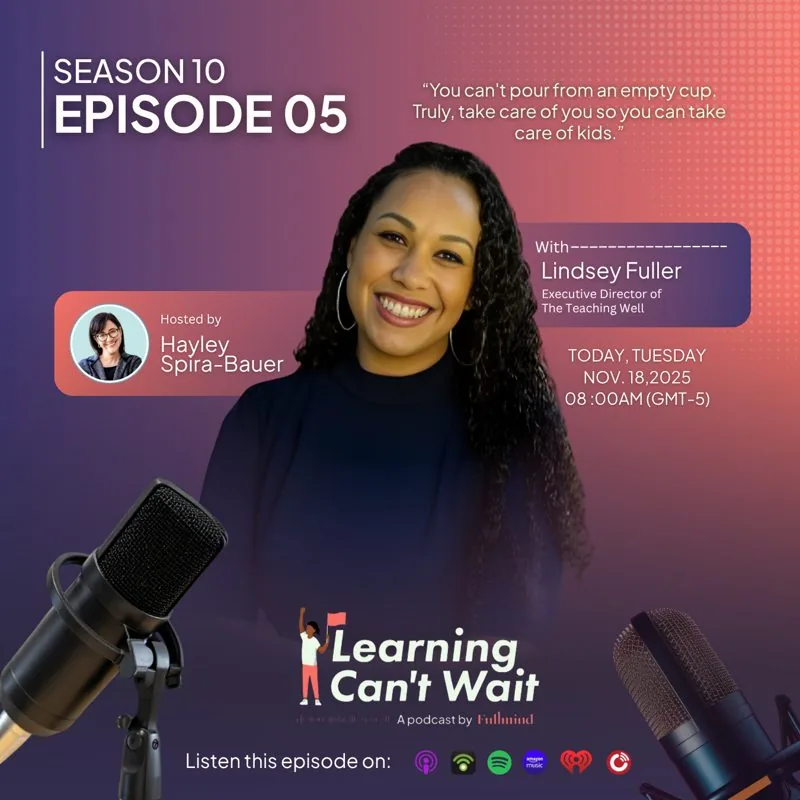
Learning Can’t Wait · Episode 190
Lindsay Fuller: Educator Burnout, Workplace Well-being & Mental Health Crisis
- Lindsay Fuller, Executive Director of The Teaching Well and a legacy educator
 Hosted by Hayley Spira-Bauer, Chief Academic Officer at Fullmind
Listen now
Lindsay Fuller: Educator Burnout, Workplace Well-being & Mental Health Crisis
Episode summary
Lindsay Fuller, executive director of The Teaching Well, describes a team of former educators building the organization they needed to stay in the profession. A legacy educator who burned out as an administrator in Deep East Oakland, she teaches educators to study their own fatigue cues through self-study and somatic practices, rejects the wellness industry's promise of eliminating stress, and distinguishes eustress from distress. She reframes the teacher shortage as a staffing crisis of intolerable conditions, describes a people-management crisis from rapid promotions, and shares trends from The Teaching Well's new clinical wing, including stress-induced reproductive loss and unhoused educators. Her advice: get therapy, choose mentors wisely, ask for support.
Key takeaways
- Stress can't be eliminated; study your fatigue cues and intervene before burnout
- Eustress gets us up in the morning; the work is noticing the shift into distress
- One in eight teaching positions is vacant or filled by someone not fully certified; it's a conditions crisis, not a shortage
- Rapid promotion of new leaders without coaching is creating a people-management crisis
- Microdose wellness in 5-30 minute practices; we can't bypass the educator to reach the kid
About this episode
Lindsay Fuller, Executive Director of The Teaching Well and a legacy educator, shares her deep commitment to addressing educator burnout and mental health crises in education. Drawing from her experience as a teacher, administrator, and nonprofit leader, she highlights the systemic challenges educators face including understaffing, under-resourcing, and the lack of adequate mental health support. Fuller advocates for proactive self-care, workplace well-being, and structural reforms to retain and support educators, emphasizing the importance of managing stress rather than trying to eliminate it and reclaiming joy and sustainability in teaching.
Full transcript
Transcript generated from the recording; minor errors may remain.
Hayley Spira-Bauer: Welcome back, everybody, to the Learning Can't Wait podcast. I am really excited to introduce someone who I think is really going to transform how we approach and think about what's going on in education today. We have Lindsey Fuller, the Executive Director of The Teaching Well, here with us. Welcome, Lindsey!
Lindsey Fuller: Hey, thank you so much for having me, excited to be here.
Hayley Spira-Bauer: So, you know, I'm so excited to have you, because when we met, someone introduced us, someone lovely introduced us, and when we met, I left our conversation and just said. I took a deep breath, and I wondered, where was this work and this line of thinking when I was still in schools?
Lindsey Fuller: It's that.
Hayley Spira-Bauer: Yeah, where was it? It wasn't here!
Lindsey Fuller: Yeah, 100%, and I'd say that that's the general sentiment of The Teaching Well's team, which is just, we're building the organization we needed to have stayed in the classroom or in administrative positions, right? We're 100% former educators, all have a burnout story, and are trying to solve that, crisis in our field today.
Hayley Spira-Bauer: Yeah, well, I'm excited for you to really dig in and talk about what you're doing, why you're doing it, what you're noticing, and where you think we need to go next, but why don't we start us off by telling everybody, how did you come to be the personal and professional version of yourself?
Lindsey Fuller: Yeah, yeah, through much, much, intensive healing work, I'll tell you that. I… a couple of things. I stand on the shoulder of ancestors who were deeply committed to this work. I'm a legacy educator, my mom taught for 42 years, my dad worked in schools as a teacher and an administrator for 20, and so this was the social justice movement of our lifetime as I was raised. I also got to hold multiple roles inside of schools, so I get it. I get the unique struggles at every level. I was a teacher, a turnaround school administrator, a district leader with 11 schools, and now a nonprofit leader trying to figure out How do we solve the staffing crisis together? Personally, I'm just trying to heal out loud. I… it is hard to adult, it is hard to human these days, the world feels… uncertain, and callous, and shaky, and I am… Really eager to have a joy-filled… study. Nimble Life. One where I can be my homie, and model in front of my daughters what it means to be just a good human trying to do good in the world. That's it. Just those small things, right?
Hayley Spira-Bauer: Yeah, no, and again, like, I know I have chills right now, and I know people listening have chills, too. I also know that you just named the title of this episode, which is Healing Out Loud, so we're gonna do a bit of Healing Out Loud today. If you don't mind, can you tell us a little bit about your burnout story?
Lindsey Fuller: Well, I've had multiple stints with burnout. This is something that I've been studying and teaching on really regularly right now. What I'll say is that there are seasons of burnout. One of the instructional pieces we bring forward to educators is that you must invest in studying your fatigue cues. Because intervening at fatigue before you are in ill health or burnout is essential.We cannot escape stress.So, any partner that you have, any consultant, any professional development leader, anybody trying to sell you anything about reducing or eliminating stress, that's a lie. That's the scam of the wellness industry. We are interested in learning how to manage stress, and to… be able to really reduce the severity, intensity, and length of burnout seasons. My first burnout was… when I was an administrator. I actually didn't burn out as a teacher. I was reckless and unwell in certain ways, but for the most part felt really sustained, which is an uncommon story. My first burnout was as an administrator in Deep East Oakland. We had a very, very high needs population, and we're a very under-resourced school. Now they have a behavioral health program, right? 3 hours of supports for Tier 3 and Tier 4 presenting behaviors. We had none of that. So I was chasing kids down streets and climbing fences, engaging in physical restraints, supporting mental health before we even had a clinician. It was rough. And the first way I actually knew I was in a burnout was that I was touched out. I didn't have the language at the time, now I know it's a whole concept of needing sensory rest, overstimulation, nervous system dysregulation, but it manifested as what we call being touched out. So I didn't want my one-year-old to crawl on me. I didn't want to hug my husband when I got home. I didn't have the capacity to respond to phone calls and text messages. Water fell hard in the shower, like, literally my body was… on fire. And yet, at the same time, I was pretty numb and feeling disassociated. And so, that was the first burnout that I really… had to stop and say, what is the relationship I want with work?
[05:00] **Hayley Spira-Bauer:** Mmm…
Lindsey Fuller: Yeah.
Hayley Spira-Bauer: I hear that, I'm like, oh, wow, those… some of those sound very familiar. And just, like, from my own experience, or even my experience, you know, grinding every day in the education space, it's… so real. You know, you talk a little bit about identifying the symptoms, and you named a few of them here. Talk me through what your… how you help folks identify the unique symptoms for them, because your symptoms are not going to be everyone's symptoms.
Lindsey Fuller: That's exactly right, and that's one of the other misconceptions, right? Folks are looking for burnout because of what pop culture or social media is telling them are the most prevalent symptoms, and so they miss it in themselves. There's a concept in our curriculum called a self-study, right? We talk about SSTs in schools, student support team meetings. You need a self-SST. How do you engage in self-study? So, some of the work that we do with our clients is First, to teach them about somatic work. Somatic practices are anything that heals you mind, body, spirit. Mindfulness is all sexy in our field. It is one way to heal. It is not the only way to heal. And so we work with our clients to really understand what's happening for you mentally, physically, and emotionally slash spiritually, right? If you have a spiritual phase. But, I think we also then work across the body, behavior, and communication planes. And so, in self-study, you're kind of looking… it's… we don't have, like, a rubric or a table, because maybe your brain started to do that, but there are multiple planes where your nervous system, your, inner wisdom, your mental health, are talking to you. Your body is communicating with you, and we aren't particularly adept at listening. Because we're socialized in the education field to numb, right? We don't drink water, because then we'd have to go to the bathroom.
Hayley Spira-Bauer: I'm holding in.
Lindsey Fuller: Yeah, gotta hold it in, teacher bladder activated. We don't eat on a regular cadence because, maybe we've given our lunch to our students, maybe we don't have time to go warm it up, maybe we didn't meal prep and have home practice routines and habits that sustain us. Our sleep hygiene is really impacted as educators, so we're typically not operating with a full battery, right? There's so many, so many common threads, but… We really want to help people start thinking about, what is your body telling you? How are you behaving outwardly and inwardly, right? How are you training yourself Are you consenting to your inner voice, which is communication, outward, again, inward. Some of the ugliest ways teachers are talked to is by themselves. Negative self-talk is very prevalent. So, really, it's just about studying, and we also have them study how they're doing when they're really well. Which is not something we actually ask educators to figure out, and not well during summer break.
Hayley Spira-Bauer: Right.
Lindsey Fuller: Well, during the work year.
Hayley Spira-Bauer: Lindsey, I used to have a term, I called it Vacation Hayley. Like, Vacation Hayley was so energetic, and, like, loving, and just a good vibe to be around, and hearing you say this, I'm like, oh, Vacation Hayley just, like, was, like. Not Teacher Hayley, or educator, Administrator Hayley. It was just a different version of me.
Lindsey Fuller: That's right. And then, so we… we want to bring curiosity to that and say, what are the conditions required for me to actually experience workplace well-being?
Hayley Spira-Bauer: Mmm.
Lindsey Fuller: And that's what I love to do, and I find teachers and administrators alike lighting up and being like, you know what, actually, yeah, when I'm with the instructional lead team, I am completely fueled. Like, I don't know how I get the extra resource on that Wednesday evening. But I'm like, see, that's actually… I would call it spirit, but for others, that's your purpose. It's your joy. It's where you feel cognitively engaged and stimulated. It's where you're with the right team of collaborators, and you feel nourished and inspired and.
Hayley Spira-Bauer: Prompted to extend yourself, professionally and personally. And so, where are the pockets where we want to do more of that?
Lindsey Fuller: And where are the places that tell us it's time to go, right? So, retention work is critical for us, and sometimes folks aren't in the right position, and we need to be having honest dialogue with that, and that's what our coaching can help folks kind of land on.
Hayley Spira-Bauer: I think this is a different approach, and you named it that it was a different approach than we hear often in the wellness industry. I think you and I spoke the first time, and I told you that anecdote about how early in my teaching career, someone said, if you feel like, you know, breaking your leg on purpose so you don't have to go to work, that's a problem. And that really… yeah, your reaction was the same. Your eyes got wide, for those of you that can't see Lindsey. Her eyes got wide. You know, to be anonymous. And it was… I mean, that was the training I got in 2006-ish. So, let's talk a little bit more now about… you've identified some signs. How are we living with that? I really appreciate that you just have to learn how to manage and live with it, versus just escape it and, like, find a different path, because that's not always possible.
[10:00] **Lindsey Fuller:** Sometimes we can even leverage stress.
Hayley Spira-Bauer: Mmm.
Lindsey Fuller: In our curriculum, we also talk about positive, motivational, inspirational stress. It's called eustress, EU stress. We've all been socialized to believe that stress is inherently negative, and it's something you should run from. I think it's one of the greatest myths in the education field, is that we're all on this hamster wheel trying to figure out if we can escape stress. That's not… that's not a thing. We talk about stress, much more neutrally as the desire to act or perform.
Hayley Spira-Bauer: Yeah.
Lindsey Fuller: And eustress is actually what gets us up in the morning. Eustress is what has us show up for our students and colleagues every day, right? Eustress is good. It's when we shift into distress. And how do we know the difference? And who are the people, and the places and the practices that tug us in either direction? We actually have agency. It's… a big part of our model that's different, to your point, is we're tired of wellness as woo-woo, Lululemon on the beach doing yoga. You get well when you're not at work. I spend too much, and I will spend too much of my life working to dread it. I don't consent. To the Sunday Scaries. Which are very common for teachers. I'm dreading work. But then we override that, and we push through it. What exactly is summoning that dread internally? Right? Like, what is happening for us, and is it solvable? You have agents.
Hayley Spira-Bauer: And quite frankly, we need it to be solvable, Lindsey, because there's… across the United States, there's declining enrollment in the profession of teaching. We have school districts that have, for decades, experienced vacancies. This is the topic I talk about often on the podcast, because it's one I live all through my day at Fullmind. And so, if we just accept that… you know, the burnout is just part of the job, and you're gonna have fewer and fewer teachers entering the profession. You said yourself, you're the product of public school teachers. You yourself have been an educator. Do you want your kids to be teachers in the environment of distress? Probably not, right?
Lindsey Fuller: Definitely not, but I'm hopeful that of three daughters, I got at least one educator coming through. Yeah, it's…
Hayley Spira-Bauer: Eyes are in your favor.
Lindsey Fuller: Well, and it's something that actually keeps me up at night, because for a long time, my two eldest were both talking about being educators. One is already jumping to, I'm gonna be a vice principal mama. I'm like, okay, man, know your ministry, but I think that for… both of them, it's shifted, and my eldest is like, I don't know, mama, I think I'll be an architect or an engineer, because look how they treat teachers, is what she said to me 2 years ago, when she was 9, and I was like. That's deeply distressing, that elementary school children understand the workforce crisis that we're in, and how we really urgently need to re-dignify the profession in order to invite the next generation towards this career. But I agree with you, we just dropped our annual report, today, actually, from our work last year. I know I'm so excited, but one of the things I cite is that Currently in the US, 1 in 8 teaching positions Are either vacant or filled by someone not fully certified. Correct. Right? And, like. I'm concerned that the media isn't talking about this. I'm shouting from the mountaintops along with my team, but others aren't discussing this. We… we also, if we do hear about it in the media, are referring to it as a staffing shortage, which I rebuke. We have ample educators who are credentialed, currently, and not quite at the place of retirement.We have a staffing crisis. The difference is that we've made the conditions so unbearable, so intolerable for educators.We have, continued to under-resource them. The amount of our clients that have a second or third job.
Hayley Spira-Bauer: Yep.
Lindsey Fuller: To make ends meet in this country. Right? That is all contributing to an exodus. That is preventable, that is solvable, right? The amount of educators that are, like, becoming consultants. Love it, but how many ed consultants do we need trying to turn around and coach and work inside their own districts from the outside? Like, we… And, you know, it's linked to the other thing I love to get on a soapbox around, which is the people management crisis in the education field. We are… Because of the exodus, rapidly promoting very green, very new people into administrative, managerial, and supervisory roles without adequate onboarding, training, coaching, and support, and so the interpersonal ruptures that we're observing in The Teaching Well are growing faster than anything else. We do a lot…
[15:00] **Hayley Spira-Bauer:** Smell.
Lindsey Fuller: A lot of mediation.
Hayley Spira-Bauer: You just said two topics that are so near and dear to my heart. Not in a positive way, even, though, because they're both super negative, but I do think it relates to a topic you and I spoke about, right before the call started, which was we're also, like, dancing around the mental health crisis, right? Burnout is not exactly depression, anxiety. It is a separate function that can contribute. To mental health issues. So let's talk a little bit about how that's manifesting in education today, what you're seeing, and what we do with it.
Lindsey Fuller: Yeah, absolutely. We are seeing a… huge mental health crisis in the education field. And there's a couple of contributing factors first, I'll say. One is we are partnering with districts across the country who, unfortunately, with state, federal, and local budget threats, are reducing benefits. So, one of our partner districts, for example, shifted EAP, which is how you get mental health through your benefits in schooling systems, shifted Therapy sessions from 12 down to 3 sessions.
Hayley Spira-Bauer: Hmm.
Lindsey Fuller: I don't know if anybody… if you're listening and you've done therapy, okay, it takes me 3 just to provide the context of.
Hayley Spira-Bauer: I was just gonna say, to unpack my past.
Lindsey Fuller: Exactly, right? So there's that. We have, speaking of that, actually, we've done a lot of listening to educators who say one of the largest challenges is that Clinical professionals don't understand what it is to work in the education field, so they spend so much time trying to share the context that they don't get to the root issues. We're also hearing, that they're being priced out. So if.
Hayley Spira-Bauer: Hmm.
Lindsey Fuller: If educators want to engage in therapy and have to come out of pocket, the COVID-19 pandemic, bless the mental health clinicians everywhere, they have raised their prices. In the Bay Area, for example, we're averaging $250 to $375 for a therapy session, if you're paying out of pocket, and so teachers can't afford it. So that's why we've launched a clinical wing, and are using largely grant funding. We've started in the state of California to provide low- and no-cost therapy. Some of the trends we're seeing are high rates of anxiety. High rates of burnout. We… two recent phenomena that we're seeing a lot of, unfortunately, educators come to us for therapy. One is reproductive loss, stress-induced reproductive loss. This is a female-dominated field.
Hayley Spira-Bauer: Yeah.
Lindsey Fuller: We have not caught up to ensure that bereavement policies in school districts account for reproductive loss, so teachers are being told that if they miscarry, they should use PTO days, which is a sick, sick message.
Hayley Spira-Bauer: Yeah.
Lindsey Fuller: To tell a woman who's caring for our community's youth. And the other recent trend is educators who are unhoused. So we, you know, at my daughter's own school, lost an educator the beginning of this year who had to resign because she was living in her car all summer. It's unacceptable to me that our social kind of framework in this country is allowing educators to struggle this intensely, and that we're not investing everything In making sure that the future generations are well cared for by well people.
Hayley Spira-Bauer: These are some really powerful messages that… I think a lot of educators and forever educators, I don't call them former educators, understand But often. It's struggle… it's a struggle to help policy makers and the folks who hold the purse to understand these messages.
Lindsey Fuller: And so I, I do appreciate…
Hayley Spira-Bauer: A few different folks that are doing the advocacy work to help others understand this, but it feels so uphill, and I don't mean to be negative, but it really feels so uphill, because unless you've been an educator, you think that summers are time off for just chillin', and like, teachers are so lucky, but you cannot do this job 12 months a year.
Lindsey Fuller: Cannot. Cannot. I mean, that's… that's called parenting.
Hayley Spira-Bauer: I really…
Lindsey Fuller: Many educator parents that know what's up, right?
Hayley Spira-Bauer: Yeah.
Lindsey Fuller: It's intense. It's intense to raise tiny humans, and what I'm hearing from a lot of millennial parents is this very real notion of it takes a village to raise a child has really largely dissipated. Like, many of us are looking around, being like, yo, where's the village?
Hayley Spira-Bauer: Right.
Lindsey Fuller: Right? Like, schools are doing the best they can, they're an essential part of our village, but many parents are also experiencing a burnout. And so, I think fundamentally what we're constantly asking, again, is how do we microdose wellness, which is one of the concepts we teach on? How do we embed workplace well-being strategies? How do we figure out how to decouple healing from capitalism? Because it…
[20:00] **Hayley Spira-Bauer:** Does require money once you're burnt out. I tell people the cost of burnout is that it takes…
Lindsey Fuller: More labor, more support, more resources, yes, financial investments to climb out. It's more of a macro intervention. And so again, how do we learn how to microdose wellness? Practices we can do in 5 to 30 minutes, embedded in our workday and around it, to say, I choose to Shift my nervous system, my mental health, my emotional well-being, my physical practices. In ways that keep me in the game. Because this is a marathon.
Hayley Spira-Bauer: It is. It is… I always say it's a marathon and a sprint, because you're doing this for a really long time, but you're also running as fast as you can as you do it.
Lindsey Fuller: It's that.
Hayley Spira-Bauer: Because our kids deserve that! And not to, like, say that we have to self-sacrifice, because that's exactly the opposite of what you're saying and you're telling and teaching me right now, but it is really vital that our kids are growing and benefiting from all of the wisdom and all of the expertise that great teachers have to offer.
Lindsey Fuller: 100%, and yes, I am sayingwe can no longer bypass the educator to get to the kid.
Hayley Spira-Bauer: Yes.
Lindsey Fuller: It's the sacrificial narratives, the martyrdom inside of our field, the disposability of educators, right? A highly trained educator. It's why we're partnering and very proud to partner with the California Black Educator Institute that is a part of the national board certification effort. They're trying to certify 900 Black educators across California. We know that national boards mean that kids are going to achieve more because you have the highest caliber of educators. Right? And it's also a retention strategy, because they get greater compensation, more professional development, more support. So there are structural and systemic investments that districts and schools can participate in. To really show they value their educators while enhancing the quality of education for young people. But it's both. I'm tired of the kind of binary of, like, we either serve the kids or the adults.
Hayley Spira-Bauer: Yeah.
Lindsey Fuller: No, when both are thriving, both stay, and continuity of care is a part of the solution long-term.
Hayley Spira-Bauer: You know, you've given us a bright spot just there, and I was going to ask you, what gives you hope? Like, what keeps you feeling afloat amidst some of these really trying and even regulatory changes at the federal level? What gives you optimism and inspiration right now?
Lindsey Fuller: Yeah, I would say the National Board's work gives me hope. I would also say our fastest growing program is called Retention at the Roots. It's partnering with pre-service credentialing and intern residencies. To kind of build in workplace well-being before educators get into the field, before they get their own classroom, before they learn burnout habits, and pattern those as normal. Right? And so, that's giving me a ton of hope. On Wednesday, I spent the whole day at Stanford, who is one of our largest… their credentialing program is one of our largest Retention at the Roots clients, doing everything from working and coaching the internal staff. To working with the student teachers, right? And, providing trainings with their mentor teachers and their supervisors, all in the same room. And we actually explored the concept of a self-care default, so whether you're a spontaneous or a scheduler. And the four S's, how do you differentiate and vary your self-care practices? Money not included. And it… It's just so inspiring. If you talk to an educator who's being credentialed right now, I know we're struggling to bring teachers into the field, but the ones that are coming in are so incredible.
Hayley Spira-Bauer: Hmm.
Lindsey Fuller: They have a deep, deep conviction and passion for youth. And they're unwilling to engage with work in the way that previous generations have. So it's fascinating, I think we're at this, like, really critical juncture. And I'll say, talking to several credentialing students across the country, they're on EBT, They, are deeply unwell. They're barely making rent.
Hayley Spira-Bauer: Right.
Lindsey Fuller: They're all working multiple jobs, by the way, they're teaching all day long, and going to class at night. So, you know, it's… I think there's a lot of duality. I have hope and inspiration, and also I'm disgusted by the fact that a single-year teaching credential puts people in debt. Burnout. And financial challenges, right? Health challenges, just to become a teacher.
[25:00] **Hayley Spira-Bauer:** Bye.
Lindsey Fuller: We've got work to do.
Hayley Spira-Bauer: We do have work to do, and I appreciate that you're doing the work to make sure that despite some of these conditions which are outside of your specific control. We can help teachers find joy and place and value in themselves and the work that they do. So I guess as a final question, I will ask you, what advice did you give a teacher who's starting their career today, Lindsey?
Lindsey Fuller: Woof! Yeah, I mean, there's a couple of things. One, I would say… Get in therapy. If you're in California, hit us up. Got you. But actually, truly, working with young people, the vicarious secondary direct trauma that you will experience if you don't have coping strategies and mechanisms for metabolizing that level of chronic stress. It's gonna be really essential for you to reinforce yourself to stay in the field long-term. I would say, choose your mentors. And your, professional friends wisely. You… there is a difference between gossip, venting, and productive processing. We have curriculum on it. You want people around you that are productively processing. Be cautious of people that are constantly gossiping and venting. It will suck your energy. And I would say the last part is, don't be afraid to ask for support. Of admin, reach back to your credentialing programs, hit us up at The Teaching Well, ask for mentoring and support. You're not crazy, it's hella hard, you've got this, and… Figuring out how to sustain and reinforce yourself. Is going to be the most… liberatory part. Of committing to this field long-term. Yeah, we can't pour from an empty cup. All the cliche, insert all the cliche comments I could make, but truly, there's wisdom in what our elders have taught us, and so take care of you so you can take care of kids.
Hayley Spira-Bauer: Lindsey, I know, I am unbelievably certain that educators listening to this will have gained a ton from 30 minutes of your wisdom and your… what you've shared here. I am so grateful you came on the podcast, and I feel as moved today as I did the first time we met. Thank you for just being you and doing this work. I'm… I'm, I am at a loss for words, which is so rare for me, because of… as I listen to you. Thank you so much.
Lindsey Fuller: Yeah, thank you for having me. I hope folks check us out on theteachingwell.org, and also check out our podcast, Gather at the Well, that gives you free somatic practices and workplace well-being tips while you're driving to or from your job. So, shout out to the educators in the world. We see you, we love you, and we'll get through this together.
Hayley Spira-Bauer: Thank you for those educators that listened in, but also everyone else for joining us here on the Learning Can't Wait podcast.