
Learning Can’t Wait · Season 1, Episode 12
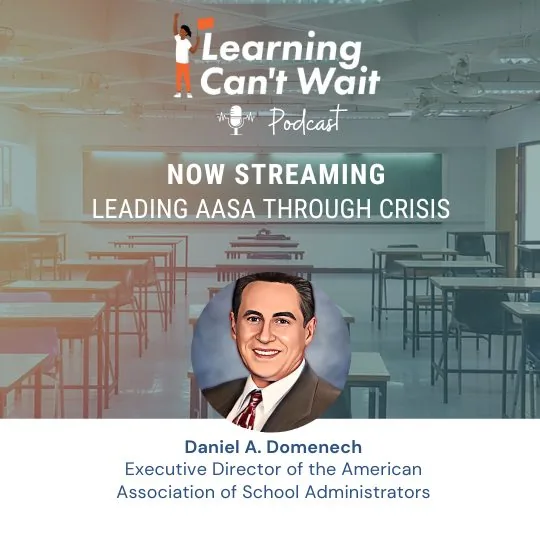
Leading AASA through Crisis
 Hosted by Hayley Spira-Bauer, Chief Academic Officer at Fullmind
Listen now
Leading AASA through Crisis
Episode summary
Dr. Dan Domenech, executive director of AASA, recounts arriving from Cuba at nine, teaching newcomers at 15, becoming a superintendent at 32 after applying only to keep his job, and leading Fairfax County before AASA. He calls superintendent turnover a crisis: 37% in the top 500 districts, with leaders threatened over masks, vaccines, and critical race theory. AASA responds with wellness programs, media advocacy, and community-engagement training. He warns the teacher shortage is worse, points to Arizona State's team-teaching model, year-round and remote learning for time on task, and AASA's Learning 2025 network of 120 model districts.
Key takeaways
- Superintendent turnover hit 37% in the top 500 districts, with families threatened and leaders fired over DEI
- The teacher shortage is really a shortage of certified people willing to work in classrooms; bring them back
- Team-based staffing models can personalize learning for more students with fewer teachers
- Remote learning, extended time, and year-round calendars are needed to recover three years of disruption
- 76% of parents love their own school; start common ground there and build toward equity
About this episode
The well-being of teachers and students is at the forefront of today's headlines. Dan Domenech's eyes are on another key stakeholder in the education space: superintendents. As the Executive Director of the American Association of School Administrators, Dan has weathered many challenges, but none so forceful as the crisis that is COVID19 and all its subsequent repercussions.
Learning Can't Wait is brought to you by iTutor.com.
Full transcript
Transcript generated from the recording; minor errors may remain.
Welcome to the Learning Can't Wait podcast an iTutor production at iTutor. Our vision is to ensure every child has access to education regardless of circumstance each. We will be joined by Pathfinders within and around the education space who are bringing about transformational change. On behalf of deserving students, I am your host, Hayley Spau.
Welcome back everybody. I'm so excited to have today with me, Dr. Dan Domenech, the lead, the head, the, the king of all superintendents at AASA, the School Superintendent Association. Is that a good title for you, Dr. Dan Domenech? Well, I would remove King. I don't know that superintendent necessarily feel that the King is appropriate, but I am the Executive Director of AASA, the executive director of AASA.
And how long have you been the executive director? I have been there 14 years actually. I'm, I'm normal. I will complete 15 years in June. Congratulations. That's quite an accomplishment to have led the organization for 15 years. I'm sure you've seen a lot while sitting in the executive director's seat, and I'm excited to dive into that today.
Sure. Absolutely. So for folks who are unfamiliar with your tenure and your background in education, give us a little bit, catch us up to speed. What led you to education and how did you wind up in the seat you're in right now? Well, it's a long history. I have been around for quite a while, but, you know, I am an immigrant.
My family migrated to the United States when I was nine years. From Cuba and I remember when I was 15, I was hired by a summer camp and, my job was basically to, work with, newly arrived, children from, Spanish speaking countries. And, and work with them to try to get them ready for school in September.
So I was very excited by that. And, I remember that I would put on a white shirt and a tie and, and walk and, and deal with the students as I'm the teacher, you know, and it was such a, a fulfilling job for me working with these youngsters, teaching them some keywords in English and getting them ready for a school in September.
But that's when I first got a taste of, wanting to be a. And I, I did, that's exactly what I did. I went to Hunter College, in New York, which is then, and even today, I recognized as a leading educator training organization. So I got my degree from Hunter, and then I started teaching in New York City. I was basically a, a New York City bilingual teacher again, using my, a dual language at the skills, and I taught in New York City until I had the opportunity.
To apply for a position on Long Island. And that was, an interesting opportunity for me because I, I went to work for BOCES, the Board, what's known as BOCES, the Board of Cooperative Educational Services in New York, which is basically an intermediate school system, an education, service agency. And the six years that I spent with at BOCES were just a great education.
For me. My job became being the innovator to travel around the country and find out where innovative ideas were being practiced. And to bring those practices to, Nassau County on Long Island. Things like bilingual education, things like, historic programs, early childhood education, personalized learning, the open classroom, all of these were great ideas.
So I did that for six years in the process, getting my doctorate from Hofstra University on Long Island. So when I did get my doctorate, I decided to apply for an assistant superintendent position, and I did that in a district called Deer Park on Long Island. And the inter interesting thing that, four years into, not four years, four months into the position, the superintendent that hired me was let go and the board began a, a search, a worldwide search.
For, a replacement. I decided that, security for myself in a job that I had just gotten four months ago required that I applied for the position just so that I can come before the board and let them know who I was. And I, I want to continue to do what I'm doing here, and this is who I am. One of the things I brought back from, Nashville as a cold, I hate to say, Dr.
Dan, you're Dr. Dan Domenech, you're referring to as, AASA yearly conference in Nashville, Tennessee that just closed, which was an incredible event. I know my own colleagues attended, and, and hopefully that cold exits faster than the conference lasted , I hope so. So anyway, four months into the job, we applied for this position just to let the board know who I was.
Ironically, and I was only 32 years old at the time. Ironically, even though there had been five candidates, experienced superintendents that were finalists and were being interviewed, I basically told them what I would do given all of these innovative programs. You had such a good bird's eye view of what was great happening across the country.
That's a absolutely, that's invaluable experience. And so they hired me to much Your surprise, , much your surprise. I was shocked. I said, are you kidding me? That's not what I, you know, I came here to do . That wasn't your intent at all, but I just wanted to keep my. Yeah. And they made me the superintendent and, it was a great experience.
I actually got implement, as a superintendent, all these ideas, full day kindergarten, which back in those days was revolutionary early childhood centers. Right. All of these ideas, came into play. I was, I was in their part for about three years when a, a neighborhood, district offered me the same opportunity.
They recruited me to be their superintendent. That was South Huntington Long Island. And they wanted me to do the same things. So I brought to, south Huntington, kindergarten childcare. Even childcare I introduced in South Huntington. So it was a great experience there. And then I got the, job as the BOCES superintendent.
So 20 years on Long Island before, Fairfax County, Virginia Tenth's largest school district in the country. Offered me the opportunity to be their superintendent. So altogether, 27 years as a superintendent, I retired from the superintendency, did a stint with McGraw-Hill Publishing for about three years, four years.
And then AASA recruited me for the position that I have now, which I thought I was gonna do maybe for three or four years. And I've been going, now we're going on 15, going on, going on 15. Cause I love it. I love what I do. I love representing our superintendents. I, I love to support them, particularly now in these times.
And you're referencing, you know, in these times. And I think we'll jump right into to kind of the meat of why I was so excited to talk with you. You know, the, the national landscape and education is such that. , there is a lot of concern about teachers leaving the profession, but you have been quoted in talking about the same crisis that we are facing with superintendents.
So, you know, there, there was a Newsweek article published in the, in mid-December, late December, about the concern for the great exodus. Of superintendents, why are we facing this crisis? Help help us kind of understand the landscape a little bit. And where, where, what are you thinking about? The largest thing or the biggest things we could be paying attention to, to prevent this from becoming an actual crisis and more of just a kind of prediction of what might happen next.
Well, It's a crisis already. What's happened is that the pandemic we, we saw from the pandemic early on the struggles, that superintendents were having. And basically it damned if I do and damn if I don't situation, if they open schools. Parents, were angry because they didn't wanna send their kids to school cause they didn't think it was safe.
If they closed schools. Parents were angry because they needed to go to work and they needed a child to be in school. When masking was seen as a mitigating factor, parents wanted their kids to wear a mask. Other parents didn't want their kids to wear a mask. So here again, it's a knowing situation, quite polarizing.
And then with the vaccines, When superintendents began to offer vaccination clinics in their schools or made it easier for kids to get vaccinated again, parents objected because they didn't want their children vaccinated. They were upset that the, uh, superintendents would, push that. And then most recently you have critical race theory, where after, school systems adopted, the move towards diversity, equity, and inclusion, critical race theory became a significant backlash against.
And now we saw superintendents being fired if they were implementing diversity, equity, and inclusion in their communities and, and their board didn't want them to. So the stress on superintendents has been significant. Superintendents are being threatened, their families are being threatened. Some of them have been physically assaulted, and so it, it's an environment.
When you need police protection and your family needs police protection, it's not something that they signed up for.Stress has always been part of the job, but not your family being brought into those threats, that kind of a situation. So what we're seeing is a lot of our most capable. Experienced leaders leaving the profession, a lot of them are being fired by their boards for again, doing whatever it is that was against what the board wanted.
And so we're seeing a huge turnover. The most recent survey of the top 500 school districts in the country shows the turnover rate of 37%. Which is incredibly high. That's very high. It, it most, states that I speak to, it, it ranges. In some cases it's still low, around 10%, which is more the, the typical.
But there are places where the turnover is as high as 40%. Alaska, for example, as a huge turnover. Maryland has a huge turnover. So there are a number of states that are having huge turnover. This is a crisis because at a time when, school systems need that kind of experience and leadership, they're being replaced by individuals that are moving into the position that don't have that experience.
And that is, that can be a significant factor in, in a school system at a time like this when making decisions that are critical in some cases, determining the, the lives of staff or students, that they're not being replaced by individuals that, that don't have that kind of experience. So, I'm, I'm hearing the landscape a little bit described by you.
Seems like I said before, very polarizing and one that has caused significant concern amongst the folks holding these roles and that are exiting from these roles. What. Is the answer, right? Like when we, when we face these challenges as a society that are polarizing and, and our society is, is pretty dichotomous right now, more than it has ever been.
How do, how does AASA, support its superintendents to navigate these challenges in a way that helps them remain in their roles so that schools have the strong leadership that, that they need, it needs. The one thing we can do that does have a direct immediate impact. Is to provide our, our superintendents with the opportunity to engage in, stress reducing workshops that we do.
For example, at our conference in Nashville in the exhibit area, we actually had a wellness center. And in that wellness center there were puppies. You could go in there and play with a puppy. And by the way, that was the most, popular. I understand why I'm really upset. I wasn't there for that. And you could, you could actually make yourself a smoothie by pedalling, a bicycle, an exercise bicycle, or you could get a massage or you could sit down with a therapist.
So we're doing a lot of that for our members. We find that when we put them in groups where they're just superintendents and they feel safe, and it's a safe. That the, they can let their hair down, they can talk about these issues, they can talk about the pressure that they feel, the stress, that they feel, they share what they're doing to help reduce that trust.
And that's been very helpful and we're getting a lot of positive feedback for, for doing these things. The second thing is, you know what I do? It's now being a perfect example, to spend a lot of time doing interviews, with the media, television, print, media, internet to explain, the situation and, and, and why these superintendents are so stressed out, because they're caught in the middle of what, in essence and no win situation.
And then the last one is, you know, how do we fix this long range? And that's gonna require, strategies that are very different, from the ones that we've done before. How do you. With a divided community, how do you get people to sit down and be reasonable and understand what, what the issues are? And that's a, that's a longer strategy that requires more training, but it, it, it, it basically calls for engaging the community and bringing the community members who, who have.
Strong feelings together and and try to clarify if the mitigating factors to help us deal significantly with this. Pandemic is first and foremost to get vaccinated, and then next you're getting vaccinated to be able to wear masks and next the masks, you know, to keep a certain distance and to, and to look at the metrics in terms of infection rates in the community, hospitalization rates in the community.
As a determining factor of which one of these things is I. If everybody did that, we'd be able to get this pandemic under control. Students would be able to be in school as they are now. But, you know, we've seen this in the past. Okay. We've already gone through this. Towards the end of last year and the beginning of the school year, things were looking great.
Then all of a sudden we had, the first variant that came along. And that changed everything. Then again, by Thanksgiving things were going great again, and then the holidays came along and Omicron. And back it is, you know that there's gonna be another variant and it's gonna come and it's gonna have an effect again.
And we're gonna be going through the same process. So to the extent that we can explain to people why it's so important that these things are done, that it's being done in the best interest of students and staff, and a supportive community would make things go a lot smoother for everybody, it'll make a difference because this isn't gonna go.
This is gonna keep happening over and over again until we get to the point where the vaccinated, you know, that's how we did polio and chickenpox and measles and all of these other illnesses that we had nobody objected to, to having those vaccines. You couldn't go to school without having those vaccines.
And this pandemic is more serious than any of those that we've had. And yet there's still this reluctance on the part of people to wear masks, to get vaccinated, to do the things that we. From the scientists we know from experience. I mean, all you have to do is check the chart, the charts and see where the areas are, where you have the greatest amount of hospitalizations, rates, and, and, and, infection rates.
And, and they match with low vaccination rates or wearing masks. It's, it's, it's not, rocket science. It's just playing science. You know what, Dr. Dan Domenech, as I'm listening to you, I'm wondering, there's a theme for me that that is kind of evolving, which is how parallel some of the challenges teachers are facing to those of the superintendents, right?
The, everybody at the, at the center of the circle, this co centric circle, we have students, everybody is in this for the students. Nobody's in teaching for the. We're, we become educators because we wanna make a difference in the lives of children. Like you said, you found, you put on your white shirt, you put on your tie, and you loved being with kids every day.
And today it feels like we've moved away from people being able to enjoy that center, that center of being able to change the lives of children. And you mentioned this opportunity to, to think about education differently. So in a world where students are at the center and we're making sure we move the needle for children, what does the long-term opportunity to redesign education look like?
Let me start off by saying thatas critical as the superintendent exits happens to be, even more critical is the shortage of teachers.Because without teachers, and we're seeing that happen, that schools are, are in many cases, not closing. Not because of the pandemic, but because they don't have sufficient staff.
That's a real problem. When we don't have enough teachers in a classroom to be able to support the number of students that are going to school, that's a serious matter. That's a serious concern. And teachers are under the same stress, situation, and teachers are leaving in droves because the stress that they're under because the private sector recognized that, Hey, look at this.
We're having all kinds of worker shortage. And we have all these wonderful people out there that are college educated, articulate, smart, let's hire them. Let's offer them more money that they're making in the classroom without the stress factor. So we're losing teachers left and right. We see surveys that are being done by, the AFT and the NEA indicating that most teachers are considering leaving by the end of the school year over 50.
That is huge and that would be a very real problem. It would be catastrophic for our system functioning in the way that it needs to function. Totally. And so what is the solution there? Well, the solution there obviously is that we need to retain our teachers. And we need to bring them back. By the way, the, there isn't a teacher shortage.
There is a, a shortage of teachers wanting to work in the classroom because we've seen over the years, even before the pandemic that the average teacher taught for five years and then left. So there are a lot of people out there that are certified to teach, so we need to bring them back into the profession.
And then we also are gonna have to look, and this is where the, the, the pandemic is, is necess. You know, it's an opportunity to change and we may very well have to change the traditional model of seeing a teacher in a classroom all day with the average of 25 students that may not be, possible anymore.
If we don't have enough teachers for that Arizona State University, their School of Education, which is, one of the, it, it is the largest school of education in the country. We've been working with them because they've come across with a really great model. It's called Community Team Teaching, and the idea here is that you create a team of individuals.
Starting with, the, the classroom aid, the teacher aid student teachers in local universities that are interested in going into teaching, beginning teachers, experienced teachers, and then other school personnels like counselors and librarians and other people that are not necessarily assigned to a classroom but can be assigned to a team.
And now you change the dynamics. You change the ratio, and now you can provide with fewer teachers because they're not there. You can't provide instruction personalized learning to more children in the school. So those kinds of, of radical changes to education are gonna have to be made as much as we badmouth, remote learning, it's here to stay.
we, we talk about learning loss. Well, kids are not going to gain, you know, three years now of a pandemic simply by getting back to school at the same rate as, as they were. They need more time on task. And the only way to do that is by providing them, with virtual learning out of the classroom, weekends, after school holidays, summers, that's how remote learning can become an asset, and a support mechanism, for allowing students to catch back up.
So there's a lot of changes. You know, the, the, the school calendar, right? The, summer o off calendar for, for students. We may have to abandon that. We may have to go to year round instruction, which is something that we should have done for a long time. So this is an opportunity to, to make some of these radical changes that should have been made to education long ago.
But now the situation necessitates that these changes are made. And if not now, All right. Like I, I firmly agree with you on the fact that this is an opportunity. We've, we've been through a traumatic experience as a society. We've seen where cracks are widening. We've seen where students are struggling.
We've seen where school leaders and superintendents and teachers are really just troubled and, and challenged. And so if not now, when we have this opportunity to rethink. And I think back to how you traveled the country and you saw where people were doing innovative things, why not take some of the innovative implementations and approaches that people applied during the pandemic and bring them forward?
One of the, exactly. One of the ideas I heard lately, and you just echoed it yourself, that I really like, is we are really stuck in 18th century pedagogy in having these structured days where kids have first period math, second period English. Why does it have to be like that? Why can't we create more flexible schedules that allow for exploration, independent exploration, building of curiosity, leverage the teachers where you need them the most.
Exactly. And, and those changes would be welcome changes. One of them being that we have to give students more of a voice in deciding what they wanna learn, how they wanna learn it, and when they wanna learn. There's nothing wrong with that. If, if, if students are motivated to learn, the teacher doesn't have to force.
Information down their throat, which they're either gonna ignore or forget. So if we allow students to be more engaged in how they learn, what they learn when they're learning, that's gonna make a difference if we allow teachers, to become more engineers of learning than necessarily the S on the stage.
They don't have to be in front of the class lecturing every minute. They can be the directors of learning that bring about the technology, that bring about other people that could be part of this, this team to deal with issues, and that's gonna be a more effective process than what we have in place today.
How often do you get to travel in your current role as executive director and see the schools that, that and the leaders that you support? Yeah. I would love to know, just given your experience in seeing innovation around the country, what it, what it feels like for you today and what you're seeing today that really inspires you.
I know you mentioned a U'S community team teaching model that seems very different and very inspiring. What else? Scene out there that really is just a breath of fresh air and a change from status. Prior to the pandemic, I was probably on the road on a weekly basis and that was great. Yeah. Since the pandemic, that has, dropped considerably, it's now just beginning to pick up as schools are, are back in session.
But, you know, we, we have, at AASA, a program that we just launched this school year. It's for learning 2025 and it really, I is designed to bring about the kind of changes in education that we've been talking. And we have already identified about 120 school systems around the country that are engaged in many of these ideas and many of these changes.
And we're looking to use them as models for people to be able to travel to these school districts and see these things being done, to see early childhood being practiced in a very different way other than just childcare. To see personalized learning where, where students in combination with, with a teacher and the technology have the opportunity to proceed at their own pace.
Imagine that allowing students to proceed at their own pace. The students that can go and move forward and don't feel that they're restrained can do so. Students that need more time to learn the subject matter so that we don't pass 'em by and leave them behind, have that time. That's a great concept.
And yet, it's something that we, we have not done and can be done today. It can be done and it is being done. So that's our approach. We want to create, these models. I, I kind of subscribe to the, disruptive technology approach. We've seen how that works, right? I do too, considering I work for an online education company for the past five years, I would say I'm fully in that camp as well,
So, you know, when we, I think the formula is that when you get 20 to 30% of the consumer using that, It flips, right? That's how we got to the iPhone. That's how we've gotten to all of these technologies that we couldn't live without nowadays. Well, if we can get 20 to 30% of our school districts implementing these approaches successfully, it won't be long because before the rest of them come along, that will allow us then to, to finally move into the 21st century, which education still hasn't.
I'm really holding onto this notion of being able to see model schools, a and I, and again, like you said, you did that in your career when you were working at Nassau in, at BOCES and now you're doing it again by creating this learning in 2025 opportunity. I remember the best professional development I had as a teacher and a school leader was the ability to visit schools.
I was work, I worked my whole career in New York City, in Harlem and the Bronx, visit schools in the communities I worked in, outside the communities I worked in, in different. And get the chance to see different models in action. It, it showed me what was possible, because often when you. Read about an implementation, you, you immediately put up barriers.
You think, well, the students are different than my students. Or the school has different resources, or you just put up all these barriers as to why it might not work in your own community. And so having the ability to really view it and explore it and see it in action for me made a huge difference in my career.
In in, in opening up what would be possible for the kids that I. And that's, Hayley is exactly the model that, we're implementing it that is actionable. It's visible, it's demonstrable. You can see these things being done. It's not just theory, but it's practice. And, and get other superintendents that see it and say, whoa.
I wanna bring that into my school districts and do that. So that's, that's what our Learning 2025 Initiative is about. And this is a great time. That's why we launched it. We figured to your point, if, if not now, when Absolutely. Well, I'm looking forward to exploring that a little bit because again, that's how I learn.
And I, you know, As someone who's not in a school anymore or not in a classroom anymore, it's important for me to know what is happening in schools across America. Just out of pure curiosity. I like to know what's happening. I have my own kids in schools now, right in the neighboring districts from where you worked on Long Island.
Mm-hmm. . And it's fascinating too, as a parent, your perspective changes pretty dramatically. When you have your own kids in. So I'm really looking forward to diving into learning 2025 because I think that it'll help really give me some more perspective and just get a view, view, vantage point of these 120 schools that are really leading on the the innovative edge.
For sure. Can I get, can I get admittance just seeing what's going on there? Oh, we go get, arrange that for sure. . So Dr. Dan Domenech, I, you know, I wanna just think about for you, what would be a perfect scenario. We've talked a little bit about the future. We've talked a little bit about some of the challenges superintendents are facing today.
What would be an ideal scenario? Is it around communication? Is it around being able to break down the barriers and the kind of opposing viewpoints between different stakeholders and schools? Like if you could remedy everything that is troubling and challenging for your school leaders right now, what, what would it be?
What would it, how would you do that? What would it be that would solve the, with the magic wand, solve? Well, the biggest problem that I think we face right now, it's, it, it it's the, the diversity that exists, the animosity, the, the caustic board meetings that we see all the time. The arguments that, that, that take place, you know, the pushback against this whole issue of, of equity, that even social emotional learnings become a dirty word that's troubling.
And that's something that we need to, to correct. And I've seen surveys that are being done recently that basically demonstrate that if you ask the majority of people a question regarding, are you against? Making sure that each child gets what each child needs. Everybody will say no. So that's equity, right?
But people will say, well, no, not, you know, I mean, they're all for this. Nobody wants to see a child marginalized. No one wants to see a child hungry or a child sick. We're all in this together. So what is it that that has create this divisiveness? Is it because it's, it's being politicized and I think to some extent it is.
So how do we bring people so that we have a, a, a common language and a common discourse to say, Hey, what are we all for? And if we are all for this, then let's focus on what we are all for. And let's put aside our, our, our differences for the time being and pursue. Because gradually what we'll find is the reality that we're all for the same thing, more so than we are against.
So that's why I, I had mentioned earlier, you know, you, you look at the most recent survey of how parents feel about their school, their child attends. 76% of parents love their neighborhood school, love their teacher, love the school that their child. . But then when you ask them how do they feel about government education at the national level, it drops down to the thirties.
So the point is thatto know your school is to love your school.And if we can start there with parents in their neighborhood, in their local community, being advocates for the kind of education that their children are getting, and then bring in to those discussions, people who are outside and don't really underst.
Why are you so happy with your school? Because my child is learning. My child is being taken care of. This is great. I love it. I think that's the key, the discourse that we need to have to bring us all together, think so often. Confusion is at the center of. You know, diametrically opposite viewpoints because not everybody always understands the perspective of others.
And I love the notion that bringing people together about what unifies them, which is every student getting what they need, is a really powerful one. It is. And I think that there, there is common ground there, so that's, that's a critical area to pursue. So Dr. Dan Domenech, one final question for you. What advice would you give an educator starting their career today?
Well, first of all, I would hug them, kiss 'em, and say, thank you so much for doing what you're doing, . We need you , we, we need you. And and, you know, and, and make them realize, as teachers do. I mean, nobody went into education to make money. Nobody went into education just to have a job. People are, have gone into education do so because they love children and they love the ability to make a difference in the lives of children.
And today, Today more than ever, children need teachers that care about them and can make a difference in their lives. They need that connection. They need that lifesaver to, for, for a teacher to engage them and, and put an arm around them and say, how can we help you? You know, what, what's going on at home?
How are you dealing with this whole situation? And deal with their social and emotional needs. Before you jump into instruction, because the teacher that does that, the teacher that engaged, that the student, the teacher that makes that student feel that they're loved, cared for, that student will perform.
And that student will be successful because of that teacher. I could not agree more . I actually, I posted today on my, on my Twitter account, education week, posted an article or wrote an article about how teachers help students during times when current events are troubling. And this morning, you know, war broke.
Between Russia, Russia invaded Ukraine. So a lot of children are coming to school today with fear and heaviness and concern and worry, and who's at the center of that. But educators, yes, they're the front lines, yet again, they're the, as we said, frontline workers, included healthcare workers, but they also included teachers throughout this pandemic.
And now with another challenge before them. We rely on teachers to be the social kind of, You know, safety net for students to make sure they feel heard and their feelings validated. And so I could not agree with you more, Dr. Dan Domenech as, as usual, we have educators at the very, very center of our society making sure that our youth are protected, safe and well in loco parentis.
That's what we refer to. The teacher is there when the parent is not, and that's very, I. Yeah, absolutely. Well, I have to say thank you so much for joining us today, Dr. Dan Domenech. It has been an absolute pleasure to talk to you and learn about the work you're doing and, and share with the audience the importance of so many aspects of being a superintendent, as well as how as a society we can move forward in the current climate we're in.
And I've really enjoyed talking with you. Hayley, it's been my pleasure. I apologize not being able to be as, clear in voice as I might be otherwise. But, I think your message was well received by the audience and well understood. So not a problem at all. Well, thank you. Thank you for everybody who joined us today.
We'll look forward to talking to you again soon.
Thanks for listening to the Learning Can't Wait podcast if you liked what you heard. Please rate, review and share this episode. Be the first to know when we have a new episode by subscribing wherever you listen to podcasts. If you'd like to be a guest on the show or have a suggestion for an episode, email us at podcast@itutor.com.