
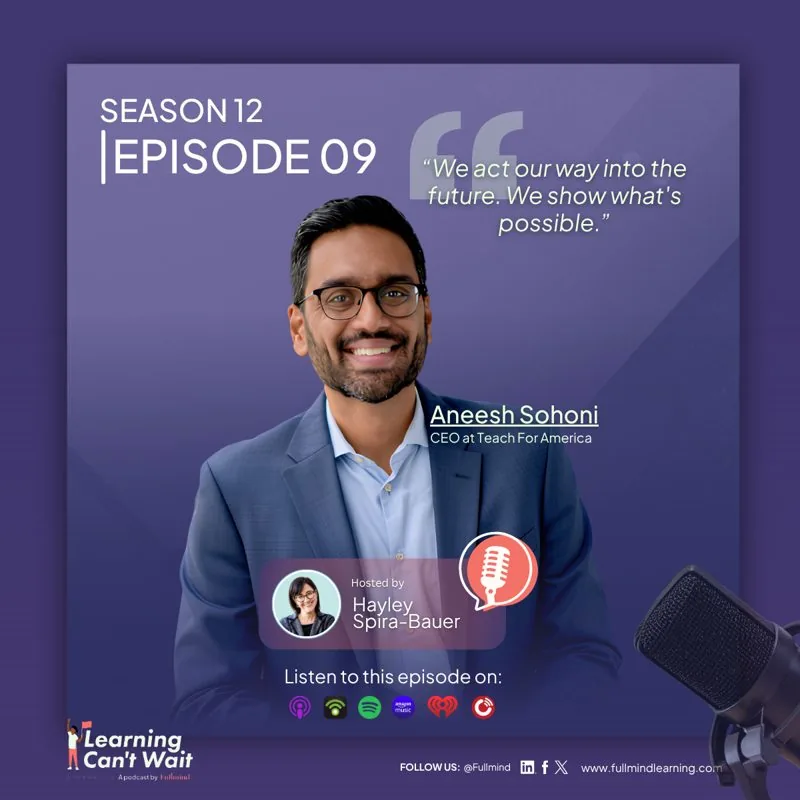
Learning Can’t Wait · Season 12, Episode 9
Aneesh Sohoni: Leadership, Opportunity and Community
- Aneesh Sohoni, Teach For America CEO
 Hosted by Hayley Spira-Bauer, Chief Academic Officer at Fullmind
Listen now
Aneesh Sohoni: Leadership, Opportunity and Community
Episode summary
Aneesh Sohoni, CEO of Teach For America, shares how his immigrant parents and a sidewalk chalk sign at the University of Minnesota led him to the corps, and why he initially turned down the CEO role. He explains TFA's theory of change, its network of over 72,000 alumni, and why the teacher shortage is fundamentally a leadership challenge. He describes the Ignite high-dosage tutoring fellowship in rural Edgecombe County, North Carolina, previews the 35th anniversary summit, and argues teaching is the best first job in today's economy.
Key takeaways
- TFA's theory of change is two years in the classroom followed by decades of leadership across sectors
- 60% of 72,000 alumni still work in education; 75% work in education or a related field
- The teacher shortage is a leadership challenge; great leaders build schools where teachers stay
- The Ignite fellowship grew from 100 tutors to a projected 5,500-plus placements in five years
- Bright-spot systems share decades of sustained focus on education, not a single strategy
About this episode
On this Learning Can’t Wait podcast episode, host Hayley Spira-Bauer speaks with Teach For America CEO Aneesh Sohoni about how his parents’ immigrant journey shaped his belief in educational opportunity and how teaching revealed both his students’ potential and the systemic barriers they faced. Aneesh explains that Teach For America’s impact extends far beyond two years in the classroom, creating a 72,000-member, multigenerational leadership network working throughout education and related fields. As schools confront teacher shortages, artificial intelligence, economic uncertainty, and declining student well-being, he argues that the central challenge is leadership—and calls on new and experienced leaders to transform purpose into collective action so every student can learn, lead, thrive, and see a place for themselves in the future.
Full transcript
Transcript generated from the recording; minor errors may remain.
Hayley Spira-Bauer: Welcome back, everybody, to the Learning Can't Wait podcast. Today is a really exciting moment. I have a guest joining us today, I haven't even told him this yet, that I almost asked to be a guest last year when I saw him in person, but I chickened out. And here he is. We have Aneesh Sohoni, the CEO of Teach For America, and a well-known dad to two kids. Welcome, Aneesh, thank you so much for joining us.
Aneesh Sohoni: Thanks, Hayley, and you know, better late than never. Excited to do this.
Hayley Spira-Bauer: I know, it felt easier to message you through LinkedIn than it did in the moment to ask you while you were at a conference a couple months back, but now you're here, and we're gonna have a great conversation about you, this work, the future, and all things Teach For America.
Aneesh Sohoni: I'm looking forward to it.
Hayley Spira-Bauer: So you're gonna tell everybody, please, how you came to be the personal and professional version of yourself.
Aneesh Sohoni: Great question. I'll start with the personal, and the answer there is my parents. So my parents grew up in Mumbai, but they came over to the U.S. In pursuit of better opportunities. My dad came over to pursue higher educational opportunities, and he came here with a one-way plane ticket on the condition he get into a college here and get that college paid for, and he was the only one of his five siblings to this day that made it to the U.S. A few years later, he went back to India, and he and my mom had an arranged marriage. And so my mom came over, took this big risk, right? Within a month of meeting this strange guy, getting married to him, and then moving to this new, strange place in the U.S. And she was able to continue in her educational journey and make a great career in the IT sector. And every choice my parents made, was rooted in a question of how they could make sure that my sister and I had access to an excellent education, including where they thought about buying their first home. Because they knew and they learned after they moved here that oftentimes zip code determined access to opportunities. And so, they enlisted in me this, like, work ethic and this ethos of never take for granted the opportunities you do have access to, because not everyone does. So, that's my personal… Professionally, the answer, and maybe this is a little cliche, given my role, is Teach For America. I didn't think I would be working in education, right? Clearly, given my… parents' journey and my own upbringing, education was deeply rooted in my purpose, but I also was fascinated, by, politics. I was a political science major. I thought I'd go to law school one day, and so my plan and my journey was to go to law school. Until I saw a sidewalk chalk sign at the University of Minnesota, right outside Kauffman Student Union. This was, of course, before digital marketing was a thing. And, it was an invitation to an informational session at the Student Union. And so later that night, I went, I listened to Katya Colon Homer's talk to me about why Teach For America would be an incredible opportunity to both live into that purpose that my family instilled in me, and also for me to have a great opportunity to really get to know students and families, make a real impact on them, and then also develop the leadership skills I needed, that no matter what I wanted to go to next. I would forever be able to carry this forward, and that… that came true. I said yes to joining the corps. I met my students, and what kept me doing this work are my students, right? I saw their brilliance, I saw their potential. I also saw how oftentimes, systems can get in the way of making sure our students have access to opportunities, and so I said I couldn't look the other way, and I needed to commit the rest of my life to this work.
Hayley Spira-Bauer: That you've now held almost every single role in the TFA ecosystem. You know, you've been a corps member, an executive director, an award recipient, and now you're the CEO. When the board called you for this role, what was your immediate gut reaction?
Aneesh Sohoni: I mean, two things. One, very humbling, but two, I said no. And I said no because I was leading another organization, One Million Degrees, and I felt like I was just getting started there, and I was really enjoying the opportunity to think about growth and impact there. But then I thought about it, right? And as good boards and search firms do, they're persistent. And the more I thought about it. And the more I thought about my own journey, right, after the corps, I had an opportunity to go work in Tennessee, at the Tennessee State Department of Education, where I got to work for an alum commissioner of education. It was Kevin Huffman at the time. I got to work with dozens of other TFA alums together to help make Tennessee the fastest improving state in the nation. I then took a role at TNTP, where I supported two school systems, one in Camden, New Jersey, and Boston, Massachusetts, both of whom at the time had Teach For America alumnus superintendents. And then, as you mentioned, I served as the executive director of TFA in Chicago, and so I feel like I really understood and knew the organization within the context of that community. It was a no-brainer for me to actually throw my hat in the ring, because I realized that I look back across the last 35 years, there has been no other organization that has been as impactful in terms of supporting and driving student outcomes as Teach For America, because our leadership network of over 72,000 incredible leaders, has been doing, incredible things focused on excellence for students, and trying to figure out, where we don't have the answers, how we find our pathway there. And so, knowing that I'd have an opportunity to contribute to that is what led me to say, okay, I'll give this a shot.
[05:00] **Hayley Spira-Bauer:** You know, you mentioned something that happens so often when I walk into a new workspace or a new community, where it comes out suddenly that I'm an alum, someone else is an alum, and there is this, like, magnetic energy that transfers between you and this other person, this moment of recollection that happens in a workspace when you connect with other alums. Both because you know, oh, that person is like-minded. They share the same type of ideology and goals and belief system that all students can achieve. And also, because wow, have we been in the trenches together. This is not an easy path.
Aneesh Sohoni: That's exactly right. I mean, you're getting to the heart of it, right, which is we have a set of shared values.
Hayley Spira-Bauer: Hmm.
Aneesh Sohoni: We have a set of shared beliefs about what is possible for all students, and something I appreciate is actually when I go into conversations, and we don't agree on how to get there. Because I'm a deep believer that the best way to find the solutions that we need for our students, right, we've made incredible progress, but we haven't arrived yet, is to engage in rigorous conversation and dialogue around where we disagree, because it's through that disagreement, the ability to find third-way solutions, that I think we're going to actually create a better world for our students.
Hayley Spira-Bauer: I mean, Teach For America is a third-way solution, right? Like, I'm steeped in the work at FullMind in a third-way solution. You can't get to the end goal doing what you've always done if it doesn't work. So let's talk now about, you know, the 35 years of Teach For America. It started as one type of mission with one particular goal, but now we're 35 years later, 300 communities involved. Scale and mission can drift. How do you make sure that at 35 years, Teach For America is as sharp and focused as Teach For America in year one?
Aneesh Sohoni: So I think a lot of people have theories on, like, what was the original mission.
Hayley Spira-Bauer: Oh, great.
Aneesh Sohoni: Let's do that.
Hayley Spira-Bauer: Of course, yeah.
Aneesh Sohoni: And so, like, no, no, I think it's just a good ground in that, right? Because then we can ask the question of, like, where are we today relative to that?
Hayley Spira-Bauer: Sure.
Aneesh Sohoni: Now, if you talk to Wendy, right, who had this great vision in her senior thesis at Princeton, she would say that it was always true that her belief was, as she saw her peers at Princeton and elsewhere going into consulting or finance, while they had a deep desire and a belief that they could actually create a better world, they were seeking those opportunities. That the idea of joining the corps and being a classroom teacher for at least 2 years was just the first part of that theory of change, right? Which is to say, when you go into… Classrooms and communities, you have a profound impact on students. And you see how the system works and operates, like I got to see when I joined the corps, it forever changes you as well, and that our alums would go on to lead at every level of the system and across sectors. And as I look back on the last 35 years, that's what's happened, right? And I think Wendy would even say she could have never imagined at the scale and at the level of impact, right, that we've been able to have, but the theory of change has borne out. I think about the work that we've done to support core members to come in and spend, again, at least 2 years, our investment there is actually an investment in 40 years of leadership that each individual provides, and then as a collective, right, working together now across 4 generations, I think that's the power of what we've done, and that's the power of what we want to continue to do moving forward.
Hayley Spira-Bauer: Aneesh, I have to share an anecdote with you. So, I did 06 New York. I have a very… deeply entrenched love of the folks that I met then. Many of them are our colleagues today and have been in the past, but I have a core group of friends that's about 15 people strong. All of us, either our professional jobs or our pro bono, like, work outside of our professional jobs for one person, is still in education, either in schools or immediately surrounding schools. We are basically all intermarried. I'm one of the outliers who's not intermarried. And we saw… we saw Wendy at dinner once on the Upper West Side, and pulled her aside, and… and, like, told her, we are the secondary part of your mission. Like, we all have committed our lives to this path. Our commitment to one another. We just celebrated our 40th birthdays together one year late last year, last summer, over in Massachusetts, but yeah, that… we've seen that born true in our own anecdotal experience as alumni, and it is powerful.
[10:00] **Aneesh Sohoni:** Yeah. My wife did the corps one year before you in New York, so I wonder if you all crossed paths.
Hayley Spira-Bauer: Right by, too, yeah.
Aneesh Sohoni: But we see this play out, you know, at scale. So I mentioned we have over 72,000 alums now, 60% of whom continue working in education, and 75% of whom either work in education or a related field or sector, impacting students. And even if you're part of the other 25%, you are forever changed, right? And how you show up to whatever you're doing today to your community, looks fundamentally different. And so, yeah, I think the power of the continued force of leadership over time, and the compounding impact of that, and that leadership working together is the real story.
Hayley Spira-Bauer: Absolutely. Okay, so we talked about the origin, we talked about the initial mission, let's talk about drift, scale, change, where are we today, and even where are we going?
Aneesh Sohoni: Yeah, so I mean, the original idea that Paul brought us in of one day all children will have an opportunity to attain an excellent education continues to be our focus. But I think about what's happening in society right now. The world is rapidly changing, right? We have technology and AI, we have economic change, we have a lot of political evolution as well. And so, within that context. You do see a lot of young people asking themselves, where do I fit in to this future vision of a thriving country? And I think we have a deep opportunity, actually, to help more young people see themselves in that future. Right now, I worry too many people are worried that they won't be able to get a good first job or have a career because of what's happening in the labor market. You have a lot of people worried about whether they can afford to buy a home, right? Establish a home and a family for themselves. It's a crisis of hope in many ways, and yet, every time we have seen this crisis of hope. We've seen an opportunity of leadership. And that's why I so deeply believe that where we're headed at Teach For America is to double down on what we are uniquely positioned to do. To find the next generation of leaders who want to commit and say yes to this, right? This is work, this is purpose work, it's impact work, it's work in a community that this generation is craving. And it's a real leadership opportunity. You get to work with students, as you know, you have to work with them to set goals and motivate them, and at this moment in time, it's an opportunity to shape the future of teaching and learning. Because we have a group of digital natives entering classrooms and schools where technology is ever-disruptive to what's happening, and AI is ever-disruptive in classrooms. The story is yet to be written, right, on what happens in classrooms with this new emerging technology. But I'm willing to bet it's our leaders and our digital natives who are coming in who are going to shape it. And so, the corps part of what we're up to is to continue to bring in more and more leaders and grow the force of new leaders coming in. At the same time, we have this incredible alumni force, right? And so, continuing to work with them to think about how we support them in taking on high-impact roles in the system, because with their experience comes wisdom, and with that wisdom comes the ability to work across generations to see how we can move work forward, either evidence-based practices or, where we haven't figured out solutions. To dream in different ways. And then lastly, we know this is not an individual effort, right? This work happens community by community. We need people working together toward a shared vision that communities create for themselves about what's possible, and so we're going to stay focused on supporting our alums to take on these roles and come together to create incredible opportunities for all students.
Hayley Spira-Bauer: As you talk about the secondary, kind of. Goal or purpose here, I am deeply, deeply understanding. Of this idea that our economy is shifting pretty dramatically, and professions are unknown. Our own children, who are almost the same age, it turns out, are going to enter a workforce that is inconsistent with the one that exists today. And yet, today, there is a teacher shortage that is Not due to the total quantity of teachers, but the distribution of teachers in the United States that I know acutely well from my work at FullMind and Teach For America knows and has been working on for the past 35 years. Teach For America kind of sits at the center of trying to solve for this challenge, right? Like, the great teachers being in the communities that are furthest from educational justice and are often facing teacher shortages. What's TFA's responsibility in solving that crisis, even though it hasn't created it? How do you feel the organization should and can change the system's approach to handling this challenge.
[15:00] **Aneesh Sohoni:** Yeah, to me, what's underneath the teacher shortage or other challenges we face is actually a challenge of leadership.And so, I actually think it's, like, the best time right now to consider joining Teach For America, joining a service corps. You think about this generation, right, and the purpose-driven impact that they want to have. They want to know that they're actually doing something in the world, tangibly speaking, and there's no better way to know that than by working with your students to help them grow in their learning. We know this generation craves community as well. They're weary of technology, they're rejecting, you know, you're seeing all these third spaces come up. There's no better way to reject technology than by joining a teaching core where you have to build human skills and relationships with your fellow teachers, with your students. And at the same time, we know our next generation is worried about their futures. They're worried about their financial futures, they're worried about what their career pathways can look like in a disruptive labor market, and so we do need to pay teachers more, right, for the work that they do, and I think it's important to say that. And we have to show teachers how the leadership opportunities that they're going to get in the classroom today can help them no matter what they want to go do. There are very few people in college today that will tell you, I know what I want to do for the rest of my life, right? The idea that there's a clear, linear career ladder no longer exists. And so, getting somebody to get proximate and get that experience with students, to have an impact on them, to then also shape who they want to become. We found that's actually the best way to think about how do we create a system and a structure in education and in society that can allow all students to thrive. So, I think it's a question of leadership, right? Because great leaders then create great school environments where teachers want to stay. Great leaders go lead school systems and school districts and state education departments where people want to continue to work, and I think that's actually what it's going to take moving forward.
Hayley Spira-Bauer: Aneesh, you're probably in classrooms more than most people are in a… in a really… really unique way. You get to see schools all over the United States, people at all levels of the system. Can you paint a picture for what has stuck out to you? A story, an anecdote of a time when you were recently in a classroom, and you said, oh, this This is what is possible when we bring the right forces, the right pieces together, and have a shared mission about student achievement.
Aneesh Sohoni: Yeah, I mean, there's so many stories, but maybe the one I'll tell is I recently had a chance to go to rural eastern North Carolina in Edgecombe County. And I got to see our Ignite High-Dosage Tutoring Fellowship in action. So for your listeners who aren't familiar, we've been working on this, this initiative and this program. It started with 100, tutors, we call them Ignite Fellows at Teach For America, who have an opportunity to make an impact in supporting students with reading or with math. That has now grown, by the way, to a projected over the next school year, over 5,500 to 5,800 Ignite tutoring placements, which is incredible, right? Rapid growth in 5 years. It supports students with their learning. It also creates exposure and opportunity for the next generation to think about what it would look like to try on teaching, and then consider joining the corps themselves. I got to see that work in action, and I got to hear from students, not just what they were learning, right, that absolutely matters. They felt, you know, they could track how much they've grown in math, in that case, but what I really heard was a sense of pride a sense of belonging and a sense of accomplishment from these students. The kind of thing you'd want to hear from a student, where you start to realize they actually see themselves as part of this thriving country for the future, because they believe they have the ability to make incredible progress. And so. Whenever I go to schools all across the country, that's what I'm looking for. I'm looking for, like, do our students really feel like they have the ability to learn, to lead, and to thrive? So that they can continue to shape where our country goes, and they feel like they belong within it. And that was an experience where I heard a student say, I'm so excited by what I've been able to accomplish. Right? It's sort of the level of self-satisfaction and assurance that we need more of in society.
Hayley Spira-Bauer: So often, they are labeled as soft skills, like those types of mindsets that children can hold about themselves, their potential, their ability. And yet, it's inextricably linked to student success, right? That what they believe is what they can actually achieve. Those moments give me the tingles, and hearing you share that also gives me the tingles. I imagine at the upcoming 35th Anniversary Summit, we're going to hear a lot of these stories. Just, first of all, paint just a picture. I know a lot of my network is headed to this… to Las Vegas in October for the 35th Annual Summit. What can we expect from the convening that's happening this fall?
[20:00] **Aneesh Sohoni:** We wanted to host this convening, and we've done these in the past, it's the first time in a decade, but we wanted to host this convening because we really believe it's an opportunity to bring our network together, to be into relationship with one another again, to be exposed to various ideas and what's happening in society, and to commit to what could happen in the future. I deeply believe that some of the ideas you're going to be having on your podcast in 5, 10 years from now will be seeded at the 35th Anniversary Summit, just by the nature of the relationships that people will have, the conversations and dialogue we'll have there as well. So, it's not too late if you want to come. It's the first weekend of October in Las Vegas. You can still register. If you're an alum, you can register. If you're a partner of ours, you're also welcome to come and you can register. And we're excited to do this. I mean, the idea, you know, we're going to have Lin-Manuel Miranda talking about leadership, right? We're gonna have Common performing with students. We have other incredible speakers, many of whom are alums who have done incredible things. So I'm really excited for it, but the idea of this also is it's not just a one-weekend summit, right? In the run-up to it, the enthusiasm and energy we've seen from our network is incredible. We actually created an opportunity this year for people to update their data, and we would send them their application letter from when they applied to the corps. We got nearly 14,000 alums. To request the letters, and to see on LinkedIn and other forms of social media, people reflecting on their original… remembering their why has been powerful. We've seen people reacting and reflecting on just their own core experience, right, and reminding others. So, to get alums back in the fold, to get them thinking about where we go, and then on the back end of the summit, to really think about what we're going to collectively do together, community by community, is our… our communities and our students need all of us to really go all in on this work.
Hayley Spira-Bauer: Yeah, I really appreciate the tagline for the summit, action beats intention, results beat rhetoric, doing beats streaming. It's like, it's a direct challenge to the community. Who would you say you're calling out, and who are you calling in?
Aneesh Sohoni: We're just calling people in, right? I think… we've been at this work for a while. It can be easy at times to feel… tired, this work is hard, right? Those of us in the work, in the system, there's a lot of fatigue. But what our network of Teach For America corps members and alumni have proven time and time again iswe act our way into the future. We show what's possible.And so this is really just meant to be a calling in to say 35 years in, whether you're a first-year Corps member, or you were in the original Corps and are still in this work, what is it we're going to do together across nearly four generations of people now? To ensure we create more opportunity for students, because again, as I mentioned earlier, we haven't arrived, right? I want to celebrate the progress we've made, and there is still so much more to do. And so it's just a calling in of people to reflect on what role they want to play in this work moving forward.
Hayley Spira-Bauer: Yeah, I appreciate you naming there that we're not where we need to go. I don't know that there's ever an arrival when it comes to students and their well-being, both, you know, academically and social-emotionally, but it goes without saying that if you're reading the news right now, you're super aware that our students are performing academically, and socially emotionally, their well-being is worse than it was before the pandemic, and in many cases is lower than it has been in decades, if not longer. I… this is more important than ever for people to recommit. I appreciate that the summit gives an opportunity for that, and I look for other places and spaces to do that as well, because our children deserve that, and this work is so incredibly important as you need.
Aneesh Sohoni: Yeah, I mean, I think you are right. Like, on average, too many students in too many communities are not where our students would say they want to be in terms of their learning and their well-being. At the same time, I think it's important to also acknowledge that there are incredible bright spots all across the country. Recently, a bunch of researchers from Dartmouth, Stanford, Harvard came together to release the education scorecard, and within it, they identified systems that actually were bright spots in what is possible. And these bright spots extended from places like Louisiana to Washington, D.C, from Mississippi to Compton, right, across rural, urban, blue, and red systems. There's a lot that each of these systems took on, in terms of their strategies. I'm not going to go there right now, because it would be a longer conversation, but the one thing that was consistent across all of these systems Is they had… sustained focus over multiple decades and leadership that was continuing to stay focused on this question of how do we deliver for students and families, and they didn't take education off the agenda. They didn't take an excellent education for all children off the agenda, specifically, and they built off of the previous generation before them, and so we all need to stay at this, right? I think the persistence that comes from multiple decades of what's work and what's possible, it compounds, and we can do better. We have… we know how to do better, and there's things we don't know that we're still trying to figure out, right? There is no playbook for it, but there's really potential and opportunity when you ground in what we also know is working.
[25:00] **Hayley Spira-Bauer:** Yeah, absolutely. So… I want you to picture a new corps member who has not yet started their first day. They're probably in New York, if that's the case, because we're, like, the last school system anywhere in the country to start school, so all our kids are still on summer vacation. Not that I'm tired or anything. But I want you to picture that Corps member who's getting ready to start, and who's listening to this right now. Someone who wants to do something that matters, and is getting ready for the year. What advice would you give them?
Aneesh Sohoni: Yeah, my kids, by the way, start school next week, and we can't wait.
Hayley Spira-Bauer: Before it.
Aneesh Sohoni: That as well. Look, if you are a young person right now in college or early in your career, and you're asking yourself, like, what can I do to make this country a place that is for all? I would say consider joining a service corps, join Teach For America. The impact you get to have. Every single day with students is profound. Many first jobs put you working in your parents' basement or in a skyscraper. Right? That is all fine and good, but the opportunity to have a deep and profound impact with students every single day, it'll impact them, it'll also shape you. The opportunity to be part of a community and this core experience, right? You won't be doing it alone. I remember joining the corps myself back in 2009, and feeling so grateful that I was doing this with so many others. And being able to lean on them, right? They were my roommates, they were… people who I could call when I felt like I couldn't be the teacher that I wanted to be for my students. I think that is just so powerful. And I know it's going to take a leap of faith, but if you do this work, the leadership skills that you develop by working with a group of students, setting goals with them, motivating them to achieve, are incredible. And so, society and the world is going to tell you, hey, you have to go down this route or this route. My encouragement would be to just try this on. Try doing our Ignite High-Dosage Tutoring Fellowship, meet with a recruiter at Teach For America, talk to others who've gone through this experience, because it will profoundly change who you are. You'll be able to profoundly change the communities where you get to go work, and you will have a lifetime of leadership opportunity available to you.I think it's the best first job in today's economy.
Hayley Spira-Bauer: Aneesh, this has been such a pleasure. I feel… so inspired by the conversation, but also the future of Teach For America, an organization that shaped my life just the way you named it, shaped yours, and every single twist and turn of the pathway. Thank you for joining us on the Learning Can't Wait podcast.
Aneesh Sohoni: Yeah, thank you for the opportunity. Look, we are all, you know, we're all stewards of an organization at any given moment in time. I feel grateful and fortunate to be stewarding this chapter of Teach For America, and more importantly, I feel grateful for the opportunities I get every single day and every single week to go all across the country and see incredible leaders doing incredible things. It's what keeps me going, and I'm looking forward to doing more of this over time. So thanks for having me.
Hayley Spira-Bauer: And thank you to everybody for tuning in. See you in Las Vegas!